Sunday, July 19, 2026


Hindu group sues Chicago suburb to build temple, citing 1967 legal barrier
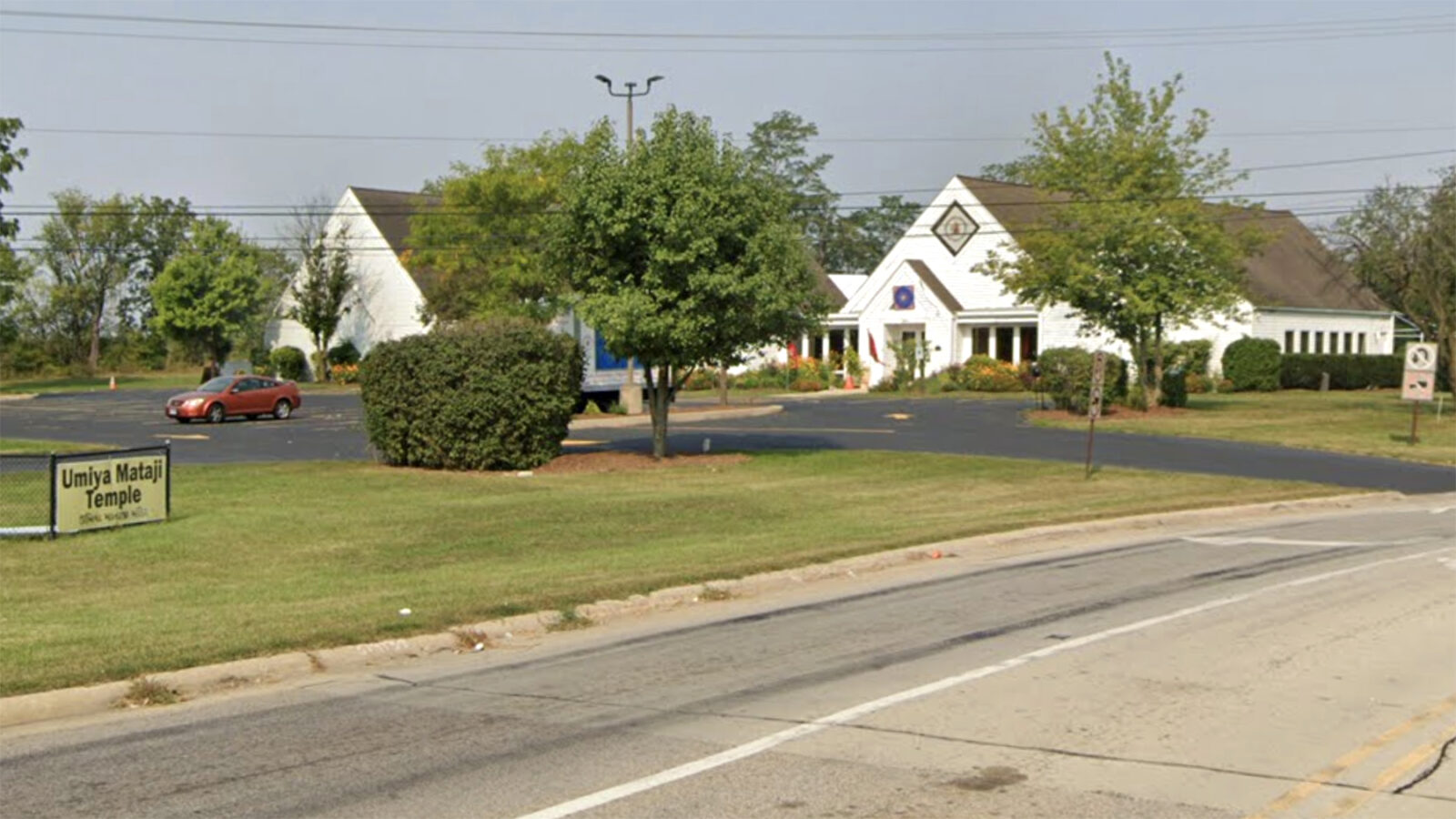
(RNS) — Umiya Mataji Sanstha, a Hindu community in Chicago's western suburbs, hopes to build a temple and homes for community members. But a 1960s-era consent decree stands in their way. Will a religious freedom law help their case?
Umiya Mataji Sanstha Chicago Midwest temple at the current site in West Chicago. (Image courtesy of Google Maps)

(RNS) — A Hindu group that wants to build a temple and residential project is suing a Chicago suburb to overturn a nearly 60-year-old legal agreement that blocks their plans.

The lawsuit, filed on Tuesday (July 14) by Umiya Mataji Sanstha Chicago Midwest, a Hindu religious community, said that a 1967 consent decree meant to create a buffer between a railroad line and residential homes governs a 34-acre property in Elgin, Illinois, which the Hindu community owns. 

Earlier this year, Elgin officials approved plans for a temple and houses to be built on the site, but that approval cannot be made final while the consent decree remains in place. The Hindu group, which serves the Kadva Patidar community, argues in the lawsuit that the consent decree could be used to religiously discriminate against them.

The plaintiffs have also asked for a preliminary injunction to bar the city from withholding final approval and permits and to bar neighbors from trying to enforce the 1967 consent decree.


 The decree, which does not mention race or religion, allows offices or other limited business development on the site but does not allow for homes to be built. A house of worship is not specifically barred or permitted on the site.

The city has no plans to oppose the lawsuit, but a group of about 300 nearby property owners still have the right to object under the consent decree. More than 20 local residents spoke at a zoning hearing earlier this year, voicing their opposition, citing traffic and environmental concerns. 

 “This opposition has absolutely nothing to do with religion,” said Jessica Astrug, a nearby resident who was among those voicing opposition to the project during a zoning meeting, according to the Daily Herald newspaper. 

Religious zoning cases are often complicated, involving logistical concerns like traffic and taxes along with issues of religious liberty and sometimes religious discrimination. Faith groups are subject to the same zoning laws as businesses, schools and other entities but governments also have to treat faith groups fairly. 

The lawsuit cites the 2000 federal law, the Religious Land Use and Institutionalized Persons Act (RLUIPA), which was designed to keep governments from using zoning to discriminate against religious groups. Whether the law applies here, and whether a decree with no mention of religion could still block a temple, is up for dispute. 

“It’s not a RLUIPA case,” said Alan Weinstein, professor emeritus at Cleveland State University and an expert in religious land use, adding RLUIPA is usually cited when a city or other government entity opposes a house of worship being built. That is not the case with this temple.

He also said that the Umiya Mataji Sanstha was likely aware of the restrictions on the property when they bought it. “That is a classic self-created hardship,” he said.

Weinstein also said that neighbors have likely grown used to having undeveloped land near them, and that will make them harder to convince. He did wonder if some kind of mediation between neighbors and the Hindu group would be a better approach than a suit.

John Mauck, attorney for the Hindu group, said his clients currently meet in West Chicago, another suburb, and have been looking for a place to build a temple for years. They finally settled on the current site. He said that the consent decree is outdated — and that the city no longer supports it. And he said the decree also gives nearby residents almost unlimited veto power over what happens on the site.

That could lead to unintended consequences, such as allowing a neighbor who dislikes Hindu and Indian Americans to block the temple.

“The fact that they have arbitrary exclusion rights, we’re saying, makes the 1967 court order illegal as applied to this situation,” he told RNS in an interview.

Mauck told RNS that the consent decree predates RLUIPA and has not been tested in court. The complaint asks the court to evaluate whether the decree is enforceable now that religious land use laws have changed.

“A decree that made sense under the conditions of its original creation is not entitled to perpetual protection,” he wrote in the complaint.

 Opinion

A faithful call to abolish ICE

(RNS) — As people of faith, we must call for the end of this ICE army, which has grown beyond legal accountability or moral control.
Protesters gather near a U.S. Immigration and Customs Enforcement facility in Scarborough, Maine, one day after the shooting of Johan Sebastián Durán Guerrero, Tuesday, July 14, 2026. (AP Photo/Robert F. Bukaty)


(RNS) — In less than a week, Immigration and Customs Enforcement has mercilessly taken two more lives.

Neither man appeared to have been the “intended target” of the operations that took their lives, according to news reports. But I would argue they were. Both were brown men. Both were immigrants. And the Trump administration’s mass deportation policies have intended to target immigrants of color all along.

Last week, after the killing of Lorenzo Salgado Araujo in Houston, the Department of Homeland Security said the victim was targeted because he “resembled” the person they were seeking. And for an operation that uses shameless racial profiling, of course he did, because he was brown. These tragic killings confirm that in the United States, all immigrants of color, regardless of legal status, are in imminent danger.

Araujo, 52, was from Mexico, but had been calling the U.S. home for 35 years, and his family told The New York Times he was likely months away from receiving a work permit. He worked as a homebuilder, supported his family, and on July 7, he was driving members of his construction crew to work when he was racially profiled and killed by ICE. His eldest son, Ronaldo Salgado, spoke through tears about the father taken from him and his siblings, and the husband his mother will not see again.

ICE officials claim Araujo “weaponized” his van and tried to ram an ICE vehicle, the same justification they tried to use for Renée Good’s killing. Of course, this time there is less evidence, as no civilians were present on the street and none of the officers had the body cameras they were supposed to wear, according to U.S. Rep. Sylvia Garcia

Days later, on Monday (July 13), ICE agents shot and killed 25-year-old Joan Sebastian Guerrero in Biddeford, Maine. Guerrero was a Colombian immigrant with work authorization and a Social Security number who regularly complied with immigration authorities as he sought asylum. He was working two jobs to support his family, including a 3-year-old daughter who is now left without her father. 

Guerrero’s dad described a son with “a lot of dreams to achieve,” and asked the question all these grieving families are left with: “He loved his family so much. I don’t know why they did this to him.”

In similar efforts to justify ICE agents’ reckless actions, DHS said Guerrero tried to flee during a traffic stop, and “fearing for public safety, an officer discharged his weapon.”

Although police officers are trained to preserve life whenever possible, this shouldn’t be shocking since training for ICE officers was reportedly diminished last year (ICE argues the training programming was instead “accelerated”). This is now a multibillion-dollar army that seems to have few legal bounds, is basically untrained and is armed to kill. They are nothing but bounty hunters who relish the unaccountable force they are able to use.


Since the start of President Donald Trump’s deportation crackdown, at least 23 people have been fired at and six people have been killed by federal agents. Nearly all of these fatal incidents involved agents firing at people in vehicles.

Meanwhile, ICE detained roughly 10,000 people over five days at the end of June — an average of about 2,000 arrests every day. After the recent fatal car shootings, DHS ordered ICE to halt most vehicle stops. But one day later, Trump rescinded the order and took to Truth Social to say, “The Radical Left Democrats would like to see this done, but it won’t happen on my watch.”

The Trump administration continues to argue that its mass deportation campaign targets violent criminals, but only about 3% of the individuals detained had violent felony convictions. The stories of ICE subjecting our innocent neighbors to violence and injury are beyond counting now, as the number of immigrants kidnapped off the streets and taken to detention centers without lawful process, by masked and armed agents with no uniforms or badges, also grows. Hundreds of thousands of families are left to wonder if their loved ones are alive, dead, or deported.

How is it that ICE can do this to Ruben Ray Martinez in South Padre Island, Texas, and Silverio Villegas-Gonzalez near Chicago, to Good and Pretti in Minneapolis as they tried to protect their neighbors, and now to Araujo in Houston and Guerrero and Biddeford, without repercussions or pause? Even after the killings, Stephen Miller, Trump’s White House deputy chief of staff, continues to enthusiastically push mass deportation with huge numerical goals.

Every one of these victims was our neighbor. Many of the future targets of these mass deportation efforts are also our neighbors. Many serve our communities or were part of our congregations. They were people who had friends, families and dreams in this country.

The Bible and Jesus call us to love and protect our neighbors, especially “the stranger” among us. Today, more than ever, that calling should also become a public policy demand from the faith community.

As people of faith, we must call for the abolition of this ICE army, which has grown beyond legal accountability or moral control. ICE is now rotten to the core and cannot be reformed or saved.

Every nation has the responsibility to maintain and enforce immigration laws and procedures. But it should be abundantly clear that those laws cannot be entrusted to an army that is corrupt and violent beyond redemption. The massive human failure of Trump’s immigration policy should be a wake-up call to millions of Americans that our nation needs a new set of immigration laws that are safe, fair, humane, compassionate and just. 


As people of faith, we will engage in deep and neighborly solidarity with our immigrant neighbors, many of whom are members of our faith communities. We will accompany our neighbors through this time of great trial and much suffering, offering the support and protection that they need. We will publicly protest ICE and warn our neighbors about attacks against them. We will offer our non-violent resistance to an unlawful and violent army.

Now, ICE could seek to intimidate by appearing at polling places or targeting communities exercising their constitutional rights. We will stand with those being threatened and defend the integrity of our democracy. We will not be silent in the face of fear. And we will pray and act for the abolition of ICE, a national disgrace that violates the God-given dignity of every person and our religious conscience.

(The Rev. Jim Wallis is Archbishop Desmond Tutu Chair and director of Georgetown University’s Center on Faith and Justice and is the author, most recently, of “The False White Gospel: Rejecting Christian Nationalism, Reclaiming True Faith, and Refounding Democracy.” A version of this commentary appeared on the Substack God’s Politics with Jim Wallis. The views expressed here do not necessarily reflect those of RNS.)

Shocking Revelations Out of West Antarctica


 July 17, 2026

Image by Cassie Matias.

It’s mid-winter but a large area of West Antarctica that should be frozen solid is not frozen. What’s up?

Antarctica is the coldest spot on the planet where the average winter temperature is -34.4°C (-30°F), but it does vary by region. For example, inland locations like the South Pole average around -60°C (-76°F), while coastal areas such as the Antarctic Peninsula range between -12°C and -20°C (10°F to -4°F).

The area recently experienced a winter heatwave, but that has passed. Winter heatwaves happen on occasion, but the ice always, always, always refreezes for as long as anybody can remember. But satellite photos d/d July 12, 2026, by the University of Colorado Boulder’s Snow and Ice Data Center show a large portion of West Antarctica 150,000 square miles that’s typically frozen this time of year shockingly ice free! Something is wrong.

Scientists Identify Thin Vulnerability of West Antarctica

Of even more concern than failure of refreezing in the dead of winter, the following headline appears in Space Daily d/d June 20, 2026 and serves as a shocking backdrop to the recent news: Scientists say the West Antarctic Ice Sheet Could Collapse With Very Little Additional Warming and the Four Metres of Sea Level Rise that Would Follow Cannot be Stopped Once it Begins.

“A modelling study published in Communications Earth & Environment in June 2025 found that West Antarctic Ice Sheet could begin an irreversible collapse at ocean temperatures between zero and 0.25°C above current levels — meaning the threshold may have already been reached,” Ibid.

Still, nobody really knows for sure how soon or how far sea levels will rise, but the direction is known. It’s up!

That was then. Today, parts of the West Antarctic ice sheet don’t refreeze. Hmm.

Civilization is currently living through break-neck climate change. It’s reflected in erratic climate system behavior. The entire global system has gone bonkers, unpredictable, ecosystems threatened everywhere. As it happens, science has isolated the main culprit as too much heat; it’s excessive greenhouse gas emissions CO2 from burning fossil fuels.

CO2 has been on a rampage as oil and gas companies crank up production.

Based Upon AI Analyses, July 2026: “Carbon dioxide is the main driver of climate change. It traps heat, so the more of it in the air, the warmer the planet runs, which is why its concentration is the most closely watched number in climate science. Almost everyone has seen the chart of that number climbing since the 1950s.But the line is not just going up, it is getting steeper. The air took on more CO2 in the last decade than in any 10-year stretch since record-keeping began in 1959, and this past May the monthly average at Mauna Loa hit 432 parts per million, the highest ever measured.”

It’s hard for scientists to accept global warming so pervasive, so unexpected that it halts Antarctic refreezing in the dead of winter. No scientific models predicted this.

As a prelude, the past couple of years science did provide clues. An article in Inside Ecology d/d May 11, 2026 describes the background: Antarctic Sea Ice Defied Global Warming for Decades – Now Hidden Ocean Heat is Breaking Through, to wit: “For decades, Antarctica seemed to defy global warming. Since satellites began monitoring the poles in the late 1970s, the seasonal growth and retreat of Antarctic sea ice – frozen seawater that expands around the continent each winter – appeared remarkably resilient. It was often described as the ‘heartbeat of the planet.”

The “one-in-3.5 million” Happenstance

“Since 2015 Antarctic sea ice has declined sharply. In 2023, winter sea ice extent fell to record lows — so far below the long-term average that scientists considered it an event with roughly a one-in-3.5 million probability of occurring by chance,” Ibid.

A “one-in-3.5 million” proposition demands attention. Those odds demand analysis, a wake-up call, an omen of change, and sure enough, three years later the strangest thing happens, refreeze fails in a region of brutally cold West Antarctica.

There are other omens, e.g., Hektoria Glacier (Antarctica) retreated 8 kilometers (5 miles) in only two months; one-half of the structure collapsing in record time. This is the fastest glacier collapse ever, and the message to the world is very clear: Global Warming looks like it’s ahead of schedule. (Antarctica Just Saw the Fastest Glacier Collapse Ever Recorded, ScienceDaily d/d February 26, 2026)

Another early warning signal: “Researchers have discovered dozens of new methane seeps littering the ocean floor in the Ross Sea coastal region of Antarctica, raising concerns of an unknown positive climate feedback loop that could accelerate global warming,” a decidedly negative configuration. (Methane Leaks Multiplying Beneath Antarctic Ocean Spark Fears of Climate Doom Loop, LiveScience d/d Oct. 15, 2025)

And more forewarnings: Polar scientists have been warning, with more fervor than ever before, of a rapidly deteriorating Antarctica, especially since 2024. Their warnings via press releases address the public at large; as politicians, especially Americans, care less. Major warnings by scientists since 2024: (1) August 2024 the 11th Scientific Committee on Antarctic Research attended by 1,500 scientists: Gino Casassa, glaciologist head of Chilean Antarctic Institute claimed: “Based upon current trends, sea levels will be up 13’ by 21oo.” This is the first time a high-level scientist has made such an alarming forecast. (2) November 2024, 450 polar scientists called an emergency meeting in Australia to make a public announcement: “If we don’t act, and quickly, the melting of Antarctica ice could cause catastrophic sea level rise around the globe within our lifetimes.” This is the first time polar scientists have predicted ‘catastrophic sea level rise with our lifetimes.’ (3) A February 2025 study in Nature: Worldwide Glacier Meltdown Underway, a 20-year study by 35 international teams identified terrestrial glacier losses that are larger than Greenland and Antarctica but not found in scientific models of sea level rise, yet described “staggering loses” of terrestrial glacier systems.

The West Antarctic downturn over the past decade was not predicted by climate models. This means the decline is especially concerning and suggest things may be unfolding faster than scientific models can capture.

Accordingly, that matters a lot because sea ice reflects sunlight back into space, one of the planet’s major albedo (reflective) sources that helps keep the climate system stable and it helps drive ocean currents that lock away heat and carbon deep underwater. This sudden change will bring serious far-reaching consequences for the climate system and for Antarctica’s ecosystems, already starting to show the impact.

Why should anybody care if Antarctic sea ice does not refreeze? Most people will surely shake it off as one more issue not to worry about today. And that is understandable. But when the dashboard of their cars blink red, they freak out, gotta find a service station immediately or the engine might freeze-up, who knows what’s going on?

In similar fashion, Antarctica is the planet’s dashboard flashing red, nonstop.

The failure of the nations of the world to cut CO2 emissions, as agreed by 195 countries at Paris 2015, cannot be talked about enough. Only a couple of countries, out of 195 signatories, are tracking Paris 2015 commitments to cut CO2 emissions by 2030. They agreed to cut CO2 emissions by 2030 via Nationally Determined Contributions (NDCs), the core climate action plans submitted by countries under the 2015 Paris Agreement. They collectively (to a person, 195 delegates) recognized excessive fossil fuel emissions as an existential risk to society in 2015. That remains but it’s much worse now with global heat thriving like never before on record-setting CO2 emissions.

Where are they?

Robert Hunziker lives in Los Angeles and can be reached at rlhunziker@gmail.com.