Sunday, July 19, 2026


National Baptists launch social justice center near US Capitol
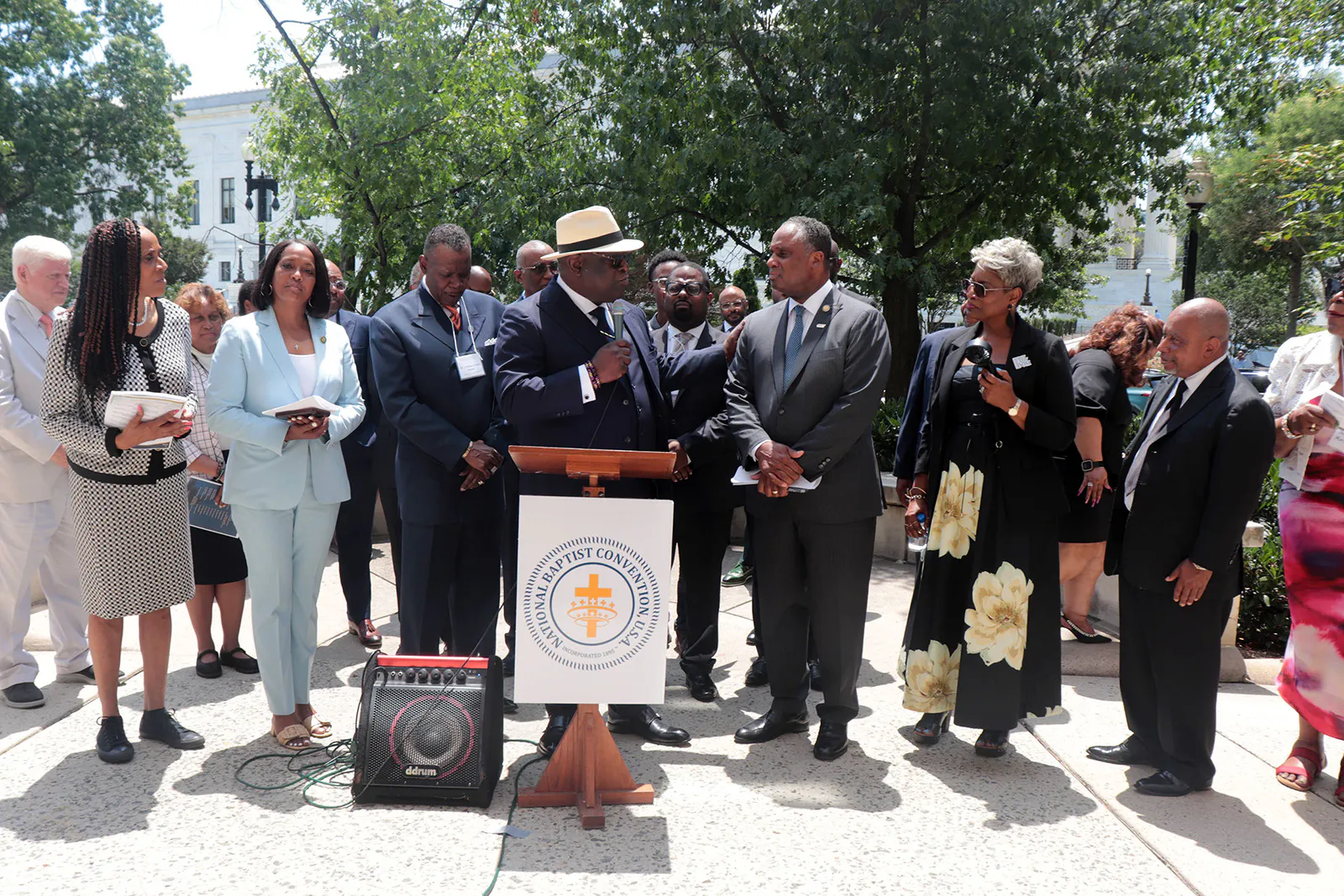
WASHINGTON (RNS) — ‘Voting rights are being eroded,’ said President Boise Kimber of the National Baptist Convention U.S.A. Inc. ‘Black political leaders are being decimated by redistricting.’
National Baptist Convention U.S.A. Inc. President Boise Kimber, center, speaks during an introduction ceremony for the Center for Social Justice outside the United Methodist Building, Tuesday, July 14, 2026, in Washington, D.C. (RNS photo/Adelle M. Banks)


WASHINGTON (RNS) — Months ahead of the midterm elections, leaders of the National Baptist Convention U.S.A. Inc., a historically Black denomination, have launched a Center for Social Justice steps away from the U.S. Capitol and across the street from the Supreme Court.

At an introduction ceremony on Tuesday (July 14), NBCUSA President Boise Kimber cited numerous challenges facing African Americans that he said need to be addressed: “Voting rights are being eroded. Black political leaders are being decimated by redistricting. Black history is being whitewashed and erased. Economic equality is also moving farther out of reach.”

The announcement of the center was made in the chapel of the United Methodist Building where leaders said the NBCUSA will be sharing space with the National Religious Partnership for the Environment.

Cassandra Carmichael, the partnership’s executive director, told RNS in a statement that her organization offered some of its space to the denomination.

“We are currently working through the final details but definitely looking forward to working alongside them as they advocate for social and environmental justice issues,” she said.
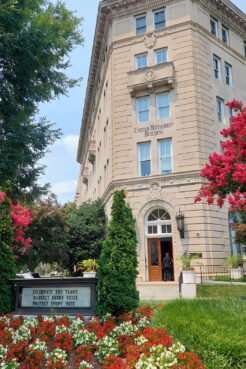
The United Methodist Building, Tuesday, July 14, 2026, in Washington, D.C. (RNS photo/Adelle M. Banks)

In his remarks, Kimber emphasized the need to mobilize voters — including in states like Tennessee, Alabama and Louisiana — where redistricting has occurred in the wake of the recent Supreme Court decision that gutted a section of the Voting Rights Act.


RELATED: Black clergy strategize, preach and urge election turnout after Voting Rights Act gutting


“For many years, we believed we were moving close to a more perfect union,” he said. “We even elected a Black president. And yet the past two years have shown how quickly hard-won progress can be undone. We became too comfortable, underestimating how quickly those gains could be taken away.”

Members of Congress and of other faith organizations appeared at the launch event, which included several speakers who stood outside the building in the shadow of the Supreme Court after the chapel ceremony concluded.

Congressional Black Caucus Chair Yvette Clarke said the launch of the center was timely and a reflection of the history of the Black church’s work on equality and justice.

“From the Civil Rights Movement to the present day, faith leaders have challenged our nation to live up to its highest ideals and to fulfill the promises of our Constitution for every American,” said Clarke, D-N.Y. “As a national hub for policy engagement, research, education and advocacy, this center will carry that legacy forward.”

Dozens of faith and political leaders attended the launch event, including other members of Congress and officials of other denominations, ecumenical groups and the National Newspaper Publishers Association, a Black consortium that is working with the NBCUSA on voter registration efforts.
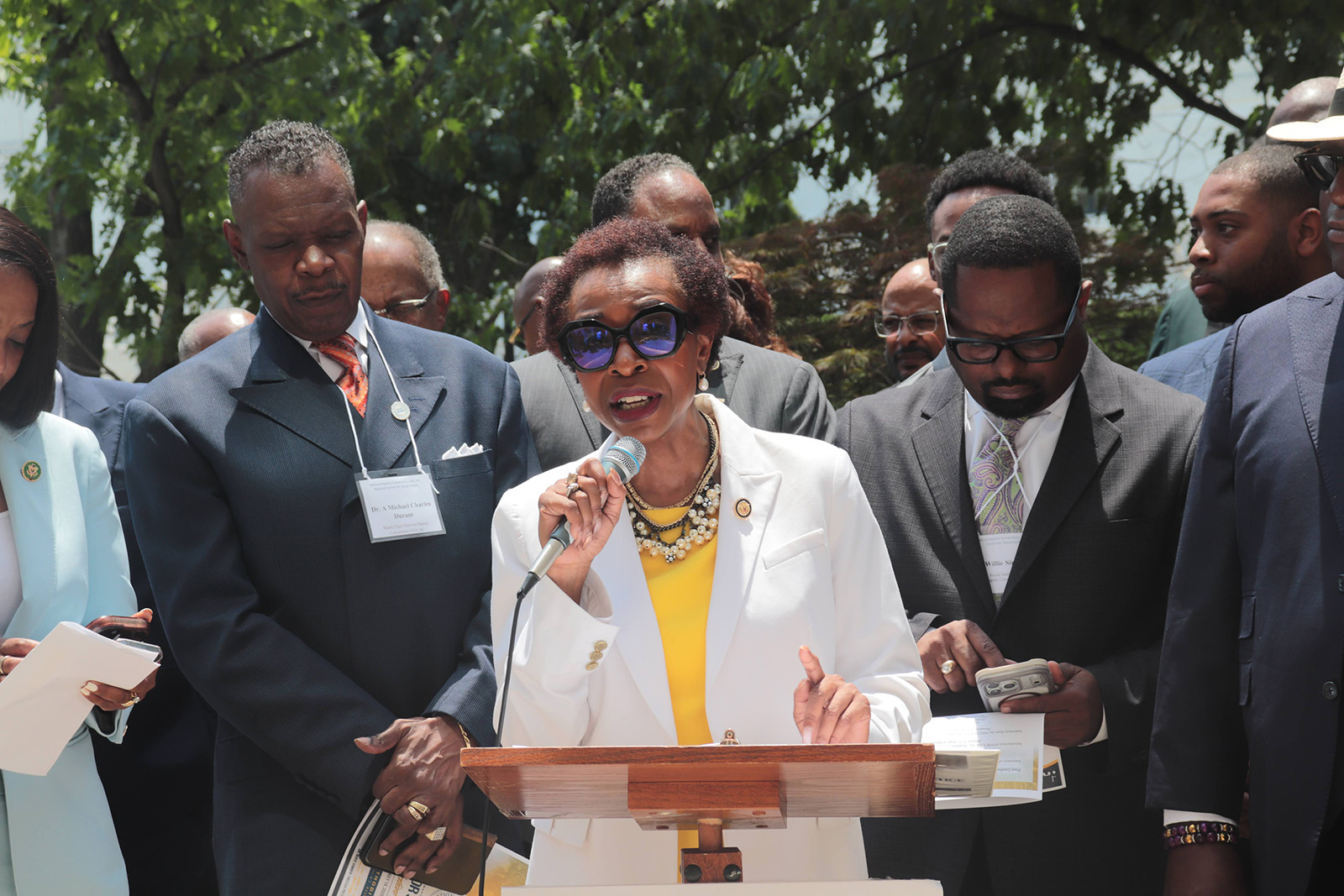
Congressional Black Caucus Chair Yvette Clarke speaks outside the United Methodist Building, Tuesday, July 14, 2026, in Washington, D.C. (RNS photo/Adelle M. Banks)

On Wednesday, the Black Opposition Coalition, a national research initiative about Black voters that includes the NAACP and nine other organizations, said new data shows that about two-thirds of Black voters “say that recent attacks on voting rights and gerrymandering in the South make them more likely to vote in the upcoming midterm election.”

The center is to be housed in the century-old building that leases offices to religious and interfaith groups, including the National Council of Churches, the Islamic Society of North America and Interfaith Alliance, as well as programs of higher education institutions. It has been the backdrop of major protests and the home of apartment dwellers that included members of Congress.

“The National Baptist Convention coming to Washington, D.C. to engage in ministries of justice is good news,” said Bishop Julius C. Trimble, general secretary of the United Methodist Church’s General Board of Church and Society, which is the owner of the building.

“The National Baptist Convention currently does not have leased space at the United Methodist Building, but we are glad to welcome them to D.C. for the holy work of justice as demonstrated by love of God and neighbor,” he added.

 Opinion

If the church doesn’t rise up for the disabled, who will? 

(RNS) — Moving forward does not require first answering every question. The gospel calls us to simply take the next right step.
(Photo by Chona Kasinger/Disabled and Here/CC BY 4.0)


(RNS) — We are watching systems designed to care for our nation’s most vulnerable begin to shrink.

On June 18, 2026, the U.S. Department of Justice’s (DOJ) Office of Legal Counsel issued a memorandum threatening the Olmstead v. L.C. decision, the 1999 ruling protecting the right of people with disabilities to live in their communities. The slip opinion is “inconsistent with long-standing interpretations of federal disability rights law embraced by courts and administrations of both parties.” The U.S. Department of Education also announced recently that the U.S. Department of Health and Human Services will oversee special education and rehabilitative services, while DOJ will handle civil rights activities. Federal officials insist these changes reduce bureaucracy and ensure stronger service coordination.

Perspectives on these recent federal actions vary widely within the disability community. Some disability advocates interpret the memorandum as federal officials seeking to strengthen access to care for adults with serious mental illness, while others believe the DOJ’s slip opinion signals a move toward broader institutionalization across the disability community as a whole. On the issue of education, consensus exists among advocates: shifting administrative responsibilities to DOJ and HHS will cause confusion, delay claims and weaken enforcement of education and civil rights laws. 

These changes follow April 2025 comments by a senior HHS official who said nonverbal individuals with autism “will never pay taxes, they’ll never hold a job,” and “autism destroys families.” Such deficit-focused language against any segment of the disability community — and the latest announcements — pave the way for significant, troubling changes to the nation’s social safety net.


As we face these reminders of the inhumanity of government systems, an important question arises: Who will care for those no longer held by the safety net? I believe Scripture calls the church to step up.

The biblical mandate: Gut-wrenching justice and mercy

In Micah 6:8, the prophet distills God’s expectations regarding the marginalized: “To act justly and to love mercy and to walk humbly with your God.”

The original Hebrew word for justice, “mishpat,” means more than simply punishing wrongdoers. It refers to dismantling oppressive systems and proactively ensuring people — particularly society’s most vulnerable — receive their rights. Paired with this is “hesed,” translated as mercy or steadfast love, which describes a stubborn, unbreakable commitment to another person’s well-being.

Jesus perfectly embodied “mishpat” and “hesed.” The Greek word “splanchnizomai” describes his reaction to those suffering or excluded from society. This visceral, gut-level empathy demanded immediate action. Jesus didn’t simply feel compassion, mercy and grace toward people. He took action. He healed. He touched. And he restored people to the center of the community.

Throughout history, believers like William Wilberforce, the Rev. Martin Luther King Jr. and the Rev. Billy Graham understood that this biblical mandate often required a countercultural response to the defining injustices of their day, such as the slave trade or segregation. The modern church has sometimes struggled to mirror this same gut-level, systemic justice.

The data tells a concerning story

Frankly, the church would benefit from a comprehensive examination of the disability community’s experiences within the American church. Although only sparse, somewhat dated data exists, a heartbreaking story emerges:

  • 32.3% of special-needs families have left a church.
  • 46.6% of special-needs parents avoid religious activities because their child was unwelcome or excluded.
  • 45% of adults with disabilities attend church monthly, compared with 57% of adults without disabilities.

My late friend and colleague, Bobby Silverstein — disability rights champion and behind-the-scenes architect of the Americans with Disabilities Act — often said, “What gets measured gets done.” I couldn’t agree more. Changing church culture in this area begins with allocating resources to measure it.

This data gap provides a unique opportunity to closely examine our past and current systemic shortcomings. It is understandable that some may be reluctant to engage in such an undertaking, concerned about the potential findings. But better understanding the experiences of individuals, families and caregivers within our congregations can inform future efforts. Given that faith-based organizations with 15 or more employees must follow the ADA’s employment requirements, it’s imperative to understand these numbers as well.

Until we measure these realities, we cannot effectively address the cracks.


The next right step

Moving forward does not require first answering every question. The gospel calls us to simply take the next right step.

Formal training or a title isn’t necessary to pursue what I refer to as covenantal health. Covenantal health moves beyond piecemeal, individual accommodations to establish systematic accessibility. It pushes us to view disability as an ordinary aspect of church life rather than a hurdle to overcome or a project to manage. It recognizes that leveraging the gifts and anticipating the needs of the entire body of believers — including those impacted by disability — is essential for the church’s health, survival and growth.

If you’re a church leader, remind your community why this matters and ground it in the gospel. Share stories. Church members also have a responsibility to help leadership see the positive, life-changing impact of full, meaningful inclusion. Embrace progress over perfection. Don’t let the fear of doing it imperfectly stop you from doing it at all. Start with one family. Begin with one conversation.

We are called to a long obedience combined with holy impatience. The path forward undoubtedly requires flexibility. But we serve a God who draws the forgotten into the center of the fold.

It is time for the church to rise and look like the kingdom.

(Nadia Ibrahim Mossburg, born with cerebral palsy, uses her experience as a senior adviser in disability policy to improve policy at the national, state and local levels. The views expressed in this commentary do not necessarily reflect those of Religion News Service.)


American Jews face a Democratic Party rethinking unconditional Israel support

(RNS) — A growing number of Democrats, and a growing number of American Jews, no longer want the U.S. to issue Israel a blank check.
Palestinians inspect damage to their tents following an Israeli airstrike in Khan Younis, Gaza Strip, Tuesday, June 30, 2026. (AP Photo/Abdel Kareem Hana)


(RNS) — American Jews woke up to a stark new reality Wednesday: Decades of unequivocal support for Israel is no longer a key plank of the Democratic Party.

That reality was plain when almost half of Democrats in the House of Representatives (103 out of 212) voted Wednesday (July 15) to cut all $3.3 billion in military and humanitarian aid to Israel from a foreign affairs spending bill. The measure failed and only one Republican supported it — Republican Rep. Thomas Massie of Kentucky, who sponsored the amendment to the bill.

But it underscored an emerging reality, that unconditional support for Israel’s actions in Gaza, the West Bank and Lebanon are no longer deemed acceptable by as many as half of elected Democrats.

Ian Lustick, professor emeritus of political science at the University of Pennsylvania and a consultant to past administrations on Israel, likened the result of the vote to a balloon popping.

“There’s a principle in physics and politics of constrained volatility,” Lustick said. “If there’s a tremendous amount of discontent that’s constrained over time because people are afraid or prevented from expressing it, it comes out explosively and fast, and that’s what happened.”

A growing number of Americans, including a growing number of American Jews, have soured on the Israeli government in the wake of the war in Gaza, with some calling it a genocide. Israel’s military assaults on Gaza, launched after Hamas’ October 7, 2023, attack on Israel that killed 1200 Israelis, have left more than 73,000 dead, according to the United Nations.

House Minority Leader Hakeem Jeffries, D-N.Y., speaks to reporters Thursday, July 16, 2026, at the Capitol in Washington. (AP Photo/J. Scott Applewhite)

Hakeem Jeffries, the top Democratic leader in the House, hinted as much. In a letter to his colleagues, Jeffries said he was voting against the amendment but would not pressure his colleagues to vote with him.

“For the good of Israel and the Palestinian people, American policy in the Middle East must change,” he wrote.

His predecessor, Rep. Nancy Pelosi, the former House speaker, went further and voted in favor of cutting aid to Israel.

“The American people are rightfully demanding an end to a perpetual cycle of war, and the Netanyahu government cannot maintain its current course,” Pelosi said in a statement. “Therefore, while this amendment is ill-conceived, I vote yes for the message that it sends.”

Ahead of the 2026 midterms, Democrats are facing increased pressure. Mainstream Democrats in Colorado, Illinois, New Jersey and New York have lost high-profile primary races to progressives who campaigned on ending U.S. military support for Israel.

Most notably, in a New York House district race, Brad Lander, who is Jewish and repeatedly described Israel’s military campaign in Gaza as a genocide, soundly beat Rep. Dan Goldman, the incumbent who, while criticizing some Israeli government actions, received funding from the American Israel Public Affairs Committee, one of the top-spending political groups in U.S. elections supporting pro-Israel candidates. (Goldman, during the campaign, said he felt AIPAC had been singled out.  “I do think there is an undercurrent of antisemitism in the degree to which AIPAC seems to be vilified,” he said.) 


RELATED: New polls show plummeting support among faith groups for Israeli government, Netanyahu


To some Israel supporters, such as Rep. Josh Gottheimer, a Democrat from New Jersey,  the vote was devastating. “I think people are bowing to political pressure instead of actually looking at the facts on this,” he told Politico.

Establishment Jewish institutions remain staunch supporters of Israel and oppose cuts in U.S. aid. The American Jewish Committee said in a statement it was “deeply disappointed” that so many lawmakers voted in favor of cutting all aid to Israel. The Jewish Democratic Council of America  called the vote a “cynical ploy by Republicans to divide Democrats.”

But more American Jewish institutions are also acknowledging criticism of Israel.

The Religious Action Center of Reform Judaism, the lobbying and advocacy arm of the country’s largest Jewish denomination, sent a letter to U.S. House members imploring them to vote against the measure to strip Israel of aid even as it acknowledged “genuine concerns about Israel’s conduct.”

“The behavior of the Israeli government is embarrassing,” Rabbi Jonah Dov Pesner, the center’s director, told RNS. “I can see why people are frustrated. But that doesn’t mean you just kind of summarily cut off aid. You have a rational conversation among allies, and you figure out what (are) the right policies (that) make sense to keep everybody safe.”

J Street, a progressive group long supportive of a two-state solution, said it opposed the House measure but that members could in good conscience vote “yes,” “no,” or “present,” because it was “one of the few opportunities to cast a recorded vote expressing opposition to the way American military assistance and American-supplied weapons have been used by the Israeli government.”

Dov Waxman, professor of Israel Studies at UCLA, said a divided Democratic Party is exactly where American Jews are, too.

“The Democrats’ position is not out of step with the views of many, if maybe not most, Jewish Americans,” Waxman said. “The idea that we’re going to send $3.3 billion dollars of military aid to Israel, without regard for what Israel is doing in the West Bank or in the Gaza Strip, that is something that most Americans, and at least a plurality of American Jews, oppose as well.”

Waxman said the House vote doesn’t signal an end of all support for Israel but an end of the blank check policy of unconditional support. 

A poll of American Jews earlier this year found that 70% of American Jews oppose unconditional military and financial assistance to Israel. (That 70% was broken into two categories: 26% said the U.S. should stop providing aid to Israel, and 44% said the U.S. should condition military and financial assistance to Israel by requiring Israel to comply with U.S. law.)

Among U.S. Jews under 35 years old, 51% favored stopping all aid to Israel, the poll commissioned by J Street found.

American Jews, about 70% of whom vote Democratic, also hold negative views of President Donald Trump. Asked if they might abandon the Democratic Party in light of its wavering support for Israel, Lustick said he doubted it.

“The visceral hatred of Trump is so deep that they will not vote Republican,” said Lustick. “There might be less enthusiasm for some Democrats, but we’ll learn a lot from the upcoming election.”


Some World Cup fans are blaming Brazil’s loss on evangelicals

(RNS) — ‘If we pray like a gringo, then we play like a gringo,’ fans claim in the debate over whether Catholic or Protestant faith favors football champions.
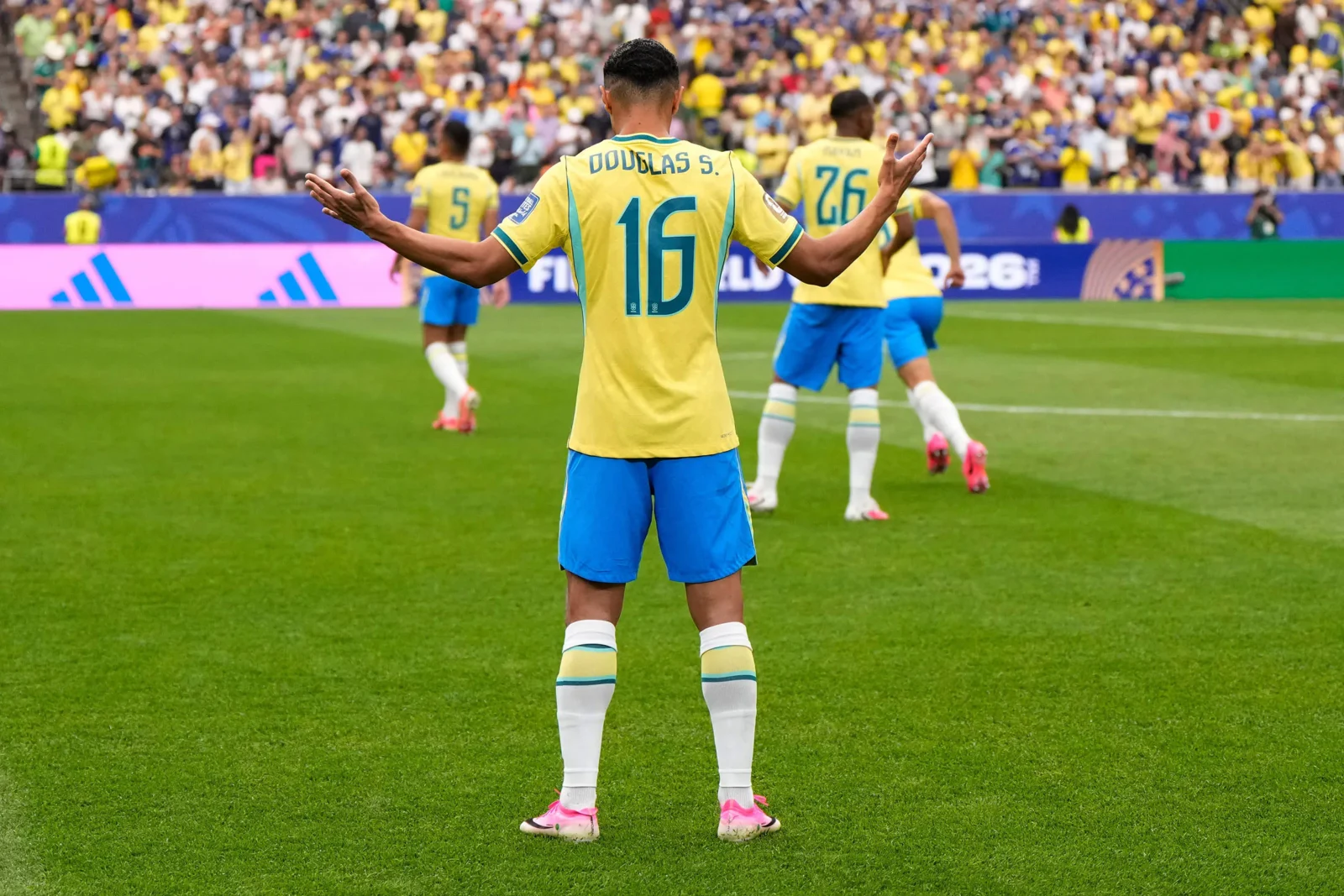
Brazil's Douglas Santos (16) prays before the World Cup round of 32 soccer match between Brazil and Japan in Houston on Monday, June 29, 2026. (AP Photo/Ashley Landis)


(RNS) — Brazil’s loss to Norway on July 5 eliminated the team that has won more FIFA World Cups than any other nation — five — and is the only one to have played in every edition of the tournament. But they haven’t tasted victory in more than 20 years.

The glorious days of Pelé earned him the admiration of fans far beyond Brazil. He led the team to FIFA World Cup victory three times between 1958 and 1970 and helped give the national team — the Seleção — a passionate global following that reached well past Latin America.

The players Ronaldo, Ronaldinho and Rivaldo, who lifted the trophy in 2002, charmed fans of the world’s most popular sport with their dribbling and “jogo bonito” (beautiful game).

The newer generations of the national team have spent years being measured against those memories. But after this early exit in the round of 16, fans and commentators online have circulated a theory. The team’s change in playing style, they argue, mirrors the religious transformation that’s been under way in Brazil for decades: The more evangelical the country has become, the worse their national team has performed.

Or, as one widely shared post put it, Brazil is suffering a “historic loss of aura.” Another popular line in the debate simply says: “If we pray like a gringo, then we play like a gringo.”

These fans link Catholicism, once the country’s overwhelming majority faith, to improvisation, the samba and the dribbling of past generations. Popular Catholicism in Brazil is often understood as more communal and festive, making fewer severe demands of religious commitment on its adherents, while evangelicalism in Brazil is more often associated with prohibitions and austerity. The fans supporting the theory associate evangelical growth in the country — and in the faith most current players themselves profess — to a more structured, austere, rigid way of playing.

The census numbers behind the internet theory are real. Brazil’s transition away from a Catholic majority has been one of the defining religious stories of Latin America over the past 40 years. Evangelical Christians, who made up roughly 9% of Brazilians in 1991, reached 27% by 2022, while Catholics fell from 83% to 57% over the same period.

Of the eight nations that have won the World Cup, six (Brazil, Italy, Argentina, Uruguay, Spain and France) are majority Catholic. The other victors, England and Germany, also have a fair share of Catholics.

More than three-fourths of Brazil’s current team are evangelical Christians. 

“But transposing that onto the players’ behavior and performance is a stretch,” said Pedro Feitoza, a historian of religion in Latin America and assistant professor at the University of Edinburgh. He attributes the theory mostly to nostalgia for the past, when Brazilian Catholics made up a strong majority.


The reasons for the shift are many, Feitoza told RNS, including the legal ease of opening a new church in Brazil. In many evangelical denominations, leaders rarely go through seminary training. And the movement’s responsiveness to pressures faced by lower-income Brazilians offers a sense of belonging and community along with the promise of upward mobility. There is also a tradition of individual evangelism, in which congregants are encouraged to convert friends, neighbors and relatives.

Still, close observers agree that Brazil’s national team has changed the way it plays.

“The traditional Brazilian style was boldness, dribbling, individual plays, less concern with tactics, offensive play,” Júlio Nascimento, a Brazilian sports journalist, told RNS. But he attributed the change to the way Brazilian players now leave for Europe very young and develop within a European style of play. They become pragmatic and tactically obedient, he said, with individual talent subsumed by the system.

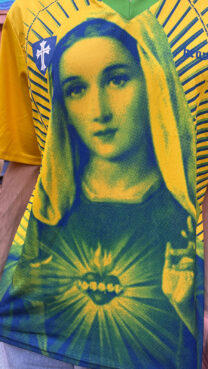
An image of the Virgin Mary on a Brazil jersey during a Brazil-Scotland watch party in a public square on June 24, 2026, in New Haven, Connecticut. ( Helen Teixeira/RNS Photo)

Pedro Alamino, a Brazilian sports content creator who covers soccer, largely agreed. Soccer as a whole has changed, he said: Where dribbling and individual genius used to carry more weight, physical conditioning now counts for more. The national team’s identity is now shaped by Europe, the biggest market in this sport. For him, the game has lost some of the greater emphasis on a “winning spirit” and fighting mentality that it had in the past.

If there’s one change that reshaped players’ conduct off the field more than any other factor, both commentators agreed, it’s the rise of social media, and with it, players exposing far more of their personal lives than earlier generations did. But when asked whether this shift in off-field conduct could be attributed to religion, both were skeptical.

Evangelical players have long been part of Brazil’s winning teams. Seven players on Brazil’s 1994 World Cup-winning squad — including goalkeeper Cláudio Taffarel and defender Jorginho — were evangelical Christians, and several of them famously formed a prayer circle at midfield after the deciding penalty kick against Italy in the final. FIFA has since restricted political, religious or personal statements on national team uniforms, but such expressions of faith persist online, including among current players. Kaká, who won the Ballon d’Or (award for best player in the world) in 2007, was one of the most visible evangelical stars in Brazilian soccer.

And while the number of evangelicals on the team did rise around the same time Brazil’s results dropped off, Nascimento called that a coincidence. “To try to explain why the national team isn’t winning, people look for explanations,” he said.

The pace of evangelical growth has slowed in recent years. “As generations pass, believers develop different ways of relating to Brazilian culture,” Feitoza said, noting that evangelical symbols — worship music, for instance — are now part of mainstream Brazilian pop culture, and the friction between evangelicals and the Catholic majority has softened over time. “Being evangelical today, in 2026, is certainly different from what it was to be evangelical in 2000, or in the late 1990s,” he said.

Feitoza also cautioned against treating the two traditions as more distinct than they are in practice. Many symbols and practices attributed to evangelicalism are also absorbed and practiced within Brazilian Catholicism. Even the contrast between the festive spirit of popular Catholicism and the austerity and rigidity of evangelicalism has grown less visible in practice. “In Brazil’s complex religious reality,” he said, “in the end, both are drinking from a shared religious culture.”

Soccer, and especially the World Cup, has always done double duty, carrying national identity and cultural narratives along with the game. In a country where the national team’s reputation functions as a form of soft power and a pillar of national identity in ways few other countries share, 24 years without a title, with no clear turnaround in sight, is a hard “jejum” (fast) to sit through.

Even if the theory fails as an explanation for what happened on the field, its popularity may say something true about a deeper need many Brazilians feel to explain a loss that goes beyond soccer itself — the loss of such a strong Catholic majority in Brazil. The new Brazil is still working out what to make of its own faith, let alone its soccer.