Sunday, July 19, 2026

The Invisible Weapon: Sanctions, Overcompliance, and the Human Cost


 July 17, 2026


The fear of Unilateral Coercive Measures (UCMs), or sanctions, is not unfounded. For example: since 2018, the Office of Foreign Assets Control (OFAC) has imposed sanctions against Iran’s use of cryptocurrencies; the decentralized nature of the blockchain no longer offers any immunity. Any exchange or virtual asset service provider with any connection to the United States—whether by being incorporated there, having U.S. customers, or processing transactions in dollars—is required to block transactions, verify IP addresses, and report frozen assets, under threat of multimillion-dollar fines and exclusion from the dollar-based financial system; the same happened with the Petro in the Venezuelan case. The result is a self-perpetuating regime: Washington does not need to directly sanction an actor for that actor to become isolated. It is enough for third parties, out of caution, to decide not to take any risks—this is known as overcompliance.

What the Numbers Say: The Human Cost

For years, the argument that sanctions are ‘surgical’ or ‘targeted’—striking governments without harming populations—has been difficult to refute with hard data. That changed with a study by the Center for Economic Policy Research (CEPR) in Washington: a comparative panel analysis of sanctions and mortality by age group, using data from 170 countries between 1971 and 2021, which presents compelling findings: sanctions raise mortality rates across all age groups, not just among specific vulnerable populations; mortality among children under one year of age increases by 21 percent as a result of the collapse of health care, nutrition, and access to medicines; the longer the blockade lasts, the higher the mortality rate, which debunks the idea that the impact is a ‘temporary shock’ that societies eventually absorb; specific vulnerabilities in maternal health and the burden of care expose them disproportionately to the effects of the blockade.

Finally: the unilateral measures imposed by Washington prove deadlier than those decided by the UN Security Council or other blocs.

When Sanctions Become a Political Weapon

The U.S. government has expanded the political use of UNSCR-based sanctions, directing them not only against governments and institutions but, in recent years, against specific individuals whose actions upset Washington or its allies.

In December 2025, the United States sanctioned two judges of the International Criminal Court—Gocha Lordkipanidze of Georgia and Erdenebalsuren Damdin of Mongolia—for their involvement in investigations and arrest warrants targeting Israeli officials, including Prime Minister Benjamin Netanyahu himself. Secretary of State Marco Rubio justified the measure by describing the Court’s actions as ‘politicized’ and warning that Washington would not tolerate what it considered a violation of U.S. and Israeli sovereignty, noting that neither country is a party to the Rome Statute.

The practical consequences of this type of sanction are severe: the judges affected have their funds frozen in U.S. banks and their credit cards blocked—regardless of the issuing country, given the global reach of the dollar-based financial system—and they lose the ability to make international transfers, book hotels, or use everyday services such as online shopping, etc. It is, in effect, a form of financial death.

The case of Francesca Albanese, the UN Special Rapporteur on the Occupied Palestinian Territories, further illustrates how erratic and politicized this mechanism can become. Originally sanctioned in July 2025 following her criticism over Gaza and her recommendations to the ICC, a federal judge suspended those sanctions in May 2026, ruling that they unduly infringed on freedom of expression. Days later, an appeals court halted that suspension through injunctive relief, and the Trump administration reinstated the sanctions. Albanese’s own husband, World Bank economist Massimiliano Cali, faced financial restrictions at his job and pressure to be fired—driven by the NGO UN Watch—as a result of the sanctions against his wife.

These two episodes—the ICC judges and Albanese—show that the sanctions apparatus does not distinguish between states and individuals: it is deployed equally against a government as against an individual judge or a human rights rapporteur, and its collateral effects even reach family members with no direct responsibility for the matter that prompted the sanction.

Venezuela: When the Blockade Also Blocks Humanitarian Aid

The Venezuelan case connects both levels—the structural and the human—in a particularly stark way. Following the earthquakes that struck the country on 24 June 2026, more than one hundred economists and academics signed a letter addressed to the U.S. government and the International Monetary Fund calling for the lifting of economic sanctions against Venezuela and for facilitating the country’s access to international financial mechanisms to address the emergency.

The letter specifically requested the removal of restrictions affecting the Central Bank of Venezuela, PDVSA, and other institutions, so that the country could access international resources earmarked for the humanitarian response and reconstruction. Grassroots organizations and sectors of civil society reported at that time enormous difficulties in receiving and distributing aid, noting that the sanctions prevent access to international funds and make it difficult for supplies to reach those affected directly.

This is a clear example of how the ‘over-compliance’ described at the beginning of this article—banks and entities that refrain from doing business with Venezuela out of fear of sanctions, beyond what the law requires—ends up hindering even the response to natural disasters, in which no political considerations should play a role.

A Common Pattern

The episodes gathered here—the extraterritorial design of the OFAC regime, the statistical evidence on mortality, the selective sanctioning of judges and rapporteurs, and the humanitarian blockade in Venezuela, which have also been applied with the same force against Cuba—are manifestations of a single pattern: a sanctions system that operates less as a targeted legal tool and more as an instrument of power with global reach, whose cost is measured in child mortality and in humanitarian aid that does not arrive in time during crises that the sanctions themselves provoke—resulting in a perfect storm and serving as a weapon for the regime-change model already tested in more than 20 countries around the world.

The question these cases leave open is not whether sanctions ‘work’ in terms of the policy they seek to change, but rather who ends up paying the price when the system is over-enforced: almost always, not only the governments they target, but to a greater extent the populations—infants, women, and individuals caught within their scope—while the U.S. government employs these illegal measures with total impunity.

This article was produced by Globetrotter.

Robin Hood in Reverse: How the Pentagon

Makes Us Poorer


July 17, 2026

Photograph by Nathaniel St. Clair

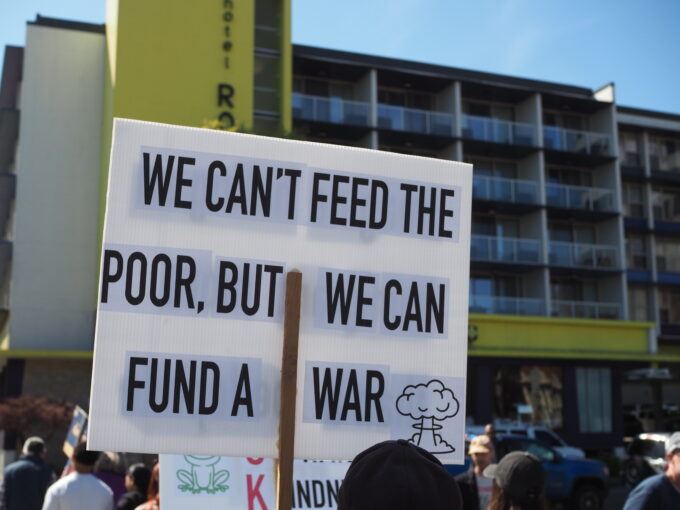
In an era of high prices for fuel, food, and housing, an extra $4,000 could make a life-saving difference for many families. But instead, that’s what the average household had to shell out for the Pentagon last year.

That’s right: The average U.S. taxpayer in 2025 had over $4,000 taken out of their paychecks to fund the Pentagon, according to the National Priorities Project at the Institute for Policy Studies. In the coming years, that amount is set to rise as Congress considers a $1.5 trillion war budget for 2027.

For the growing number of working poor in the United States, that money can mean the difference between making rent or falling behind, or between being able to afford an emergency trip to the doctor or going without care.

Money directed to the Pentagon represents nothing but betrayal for many Americans. A large majority oppose our wars, especially the latest conflict in Iran. And roughly half of the Pentagon’s budget flows to for-profit contractors, fueling the billionaire (and now even trillionaire) class.

Take SpaceX, one of many companies built on government contracts funded by taxpayer dollars. Elon Musk’s company would not exist without U.S. taxpayers. As early Tesla investor Ross Gerber put it, “There would not be (Tesla and SpaceX) if it weren’t for the government.”

Early investments and contracts from the U.S. government helped propel SpaceX to success, while continued awards from the Pentagon provided the stable revenue that made the government one of Musk’s largest customers. The company is now valued at more than $1 trillion. Private investors alone did not make Musk a trillionaire — taxpayers across the United States did.

But Musk isn’t the only person who made himself rich off the backs of American workers.

Lockheed Martin receives over 70 percent of its revenue from U.S. government contracts. The numbers for Raytheon and General Dynamics are similar. These military contractors simply would not exist without the taxpayers — and a new $1.5 trillion budget would send hundreds of billions of dollars more to people who already have more than most Americans could even conceptualize.

At the same time, while taxpayers are subsidizing the military-industrial complex, the jobs those industries are allegedly providing are in decline, with the war industry creating over 2 million fewer jobs than it did forty years ago.

Worse still, under the so-called “Big Beautiful Bill” Republicans passed a year ago, the money for these ever-rising Pentagon budgets comes directly from SNAP, Medicaid, and other programs that help Americans make ends meet.

Under those cuts, millions of Americans — including children — have lost SNAP benefits already. And that’s impacting not just families but the farmers who helped feed them.

SNAP benefits were “guaranteed money in the pockets of farmers,” said Reese Amxy, a policy organizer at the Illinois Stewardship Alliance. But 150,000 people in the state have already lost eligibility.

It’s not just Illinois. Arizona has seen the steepest decline, with 50 percent of recipients — nearly half a million — already losing benefits. Louisiana (21 percent), Florida (20 percent), Oklahoma (16 percent), Virginia (16 percent), Texas (14 percent), Wyoming (13 percent), and Arkansas (12 percent) round out the rest of the hardest hit states so far.

Yet the person who lost SNAP and the farmer who lost their income alike will be asked to foot the bill for the $1.5 trillion war budget. This is Robin Hood in reverse. Worse still, the weapons those taxes buy are often to use to kill children like ours in Gaza and Iran.

The weapons and tech CEOs that would benefit from the massive war budget, and the politicians bought off by them, seek to keep this cycle going next year at an even grander scale. Americans need to demand their lawmakers say no more Pentagon spending — and invest in the things that actually keep our communities safe instead.

 SECULAR, HUMANIST, INTERNATIONALIST

Bipartisan Bill Would Place Thomas Paine Memorial Among America's Most Honored Founders in Washington, D.C.

Thomas Paine Memorial Association


By Margaret Downey

More than two centuries after Thomas Paine helped ignite the movement for American independence, Congress has taken an important step toward giving him the national recognition many historians believe he has long deserved.

The Thomas Paine Memorial Association (TPMA) welcomes the introduction of the Common Sense 250 Act of 2026 (H.R. 9600), bipartisan legislation sponsored by Congressman Jamie Raskin (D-MD-08) and Congresswoman Victoria Spartz (R-IN-05). Once enacted, the bill would authorize a memorial honoring Thomas Paine in Area I of Washington, D.C.’s monumental core—an honor reserved for individuals whose contributions to the United States are of “preeminent and lasting historical significance.”

The legislation arrives at a particularly meaningful moment as the nation commemorates the 250th anniversary of its founding. It also marks the 250th anniversary of the publication of Common Sense, the extraordinary pamphlet that transformed colonial debate into a movement for independence.

Although Thomas Paine’s words helped inspire the birth of the United States, he remains one of the few major Founding figures without a memorial in the nation’s capital.

Born in England, Paine arrived in America in 1774 with little more than a letter of introduction from Benjamin Franklin. Within months, he had become one of the Revolution’s most influential voices.

Published in January 1776, Common Sense became the bestselling political work of the eighteenth century. Written in language ordinary citizens could understand, it persuaded thousands of colonists that complete independence—not reconciliation with Great Britain—was both necessary and achievable. He sold half a million copies of Common Sense when the nation was still only an idea. Paine never sought to profit from his revolutionary writing. He declined royalties from Common Sense, surrendered his copyright so it could be freely reprinted, and donated his earnings to support the Continental Army.

Thomas Paine gave this country its argument for independence, then took up a musket in the Continental Army to help win it. His service extended beyond the printed page. During the Revolutionary War, Paine served alongside General George Washington’s army and wrote the thirteen essays collectively known as The American Crisis. His words inspired soldiers during some of the war’s darkest days.

Paine’s legacy extends well beyond American independence. He condemned slavery decades before abolition became a national movement. He advocated universal education for boys and girls, defended religious liberty, promoted democratic government, argued for social welfare programs, and envisioned international cooperation among free nations. He also popularized the phrase “United States of America,” helping define the identity of the new nation.

His writings later influenced leaders including Abraham Lincoln and Frederick Douglass, demonstrating that his ideas continued to shape American democracy long after the Revolution.

For many supporters, the absence of a memorial to Paine on the National Mall has become one of the nation’s most significant historical omissions.

Congressman Jamie Raskin emphasized the historic significance of the legislation, saying, “On the 250th anniversary of the publication of Common Sense, our legislation finally brings the great Tom Paine from the attics and libraries of history to a place of shining prominence on our National Mall, establishing the dazzling national memorial he deserves.”

Congresswoman Victoria Spartz connected the proposal to the nation’s anniversary celebration, stating, “As we celebrate America’s 250th anniversary, we remember Thomas Paine’s timeless words, ‘These are the times that try men’s souls,’ important words that helped rally General Washington’s army. Their sacrifices should remind us of the price so many Americans paid to secure our freedom—a precious gift we have a solemn duty to preserve for future generations.”

Leaders of the Thomas Paine Memorial Association described the bill as the culmination of decades of effort by supporters throughout the United States and abroad.

TPMA Vice President Robyn Blumner noted that Paine’s influence continues to resonate around the world. “Thomas Paine’s writings transformed scattered resistance into a movement for independence,” she said. “His ideas helped create the United States, and his influence continues to shape democratic societies around the world. A memorial worthy of his legacy belongs in our nation’s most distinguished commemorative landscape.”

Secretary of TPMA Annie Laurie Gaylor underscored the memorial’s symbolic importance during the nation’s semiquincentennial. “Without Thomas Paine, the United States would not be celebrating its 250th anniversary,” she said. “No tribute to this milestone would be more fitting than ensuring that Paine’s long-overdue memorial stands prominently near the Capitol and National Mall, where his life, words, and vision can inspire millions of visitors.”

TPMA Treasurer Diane Straka reflected on the many years of dedication that have brought the project to this point. “For decades, supporters across the United States and around the world have shared a vision of honoring Thomas Paine in the place where his ideas helped shape the nation he inspired,” Straka said. “This legislation brings that vision significantly closer to reality. We remain steadfast in our commitment to honoring Thomas Paine and to ensuring that every contribution entrusted to us advances our mission with transparency, accountability, and responsible stewardship.”

If Congress approves the legislation, supporters will have up to seven years to complete fundraising, finalize the memorial’s design, secure approvals from federal commissions, and construct the monument on an approved Area I site.

The Thomas Paine Memorial Association has already enlisted internationally acclaimed sculptor Zenos Frudakis, whose clay statue of Thomas Paine is currently housed at his studio in Glenside, Pennsylvania.

Upon learning that the legislation had been introduced, Frudakis reflected on the significance of the project. “As a sculptor, there are few honors greater than being entrusted with preserving the memory of someone who helped change the course of history. My goal is to create a Thomas Paine who speaks not only to his own time, but to every generation that believes in freedom, reason, and the power of ideas.”

For supporters of the memorial, the legislation represents more than authorization for another monument. It is an opportunity to restore one of America’s most influential founders to his rightful place among the nation’s honored architects of liberty. For 250 years, the capital he helped bring into being has had no memorial to him. TPMA seeks to correct that, and Area I is the prestigious location where he belongs.

As the United States reflects on its first 250 years, many believe there could be no more appropriate time to recognize the writer whose words helped make American independence possible.

Thomas Paine Memorial Association

Email: Margaret@ThomasPaineMemorial.org

Website: https://ThomasPaineMemorial.org

Facebook: https://www.facebook.com/ThomasPaineMA/

Meetup: https://www.meetup.com/thomas-paine-memorial-association-meetup-group/

###

Disclaimer: The views and opinions expressed in this article are those of the authors and do not necessarily reflect the official policy or position of RNS or Religion News Foundation.