Sunday, July 19, 2026

The Retreat from Global Warming and Environmental Protection

Source: Originally published by Z. Feel free to share widely.

Walking It Back

We once took for granted that everyone concerned with global warming outside the Trump administration’s orbit accepted the scientists’ conclusion that 1.5 degrees Celsius of warming was the critical threshold. Following on its pullout from the Paris Accords, the administration has ignored climate scientists’ overwhelming findings on the human causes of global warming and stifled publication of their research. 

It has fired numerous government scientists for being environmental “activists,” sought to dismantle federally funded research centers, and eliminated the Environmental Protection Agency’s longstanding “endangerment finding” on threats to health posed by climate change—all in order to promote the interests of the fossil fuel industry.

Yet we thought we could rely on influential outsiders not tied to oil, gas, and coal to stand firm on combating climate change. But as Leah Aronowsky writes for Foreign Policy magazine: 

“climate elites have walked back their previously hawkish positions. Bill Gates, for whom climate change has long been a signature issue, published a memo last October in the lead-up to the U.N. Climate Change Conference in Brazil, or COP30, criticizing the ‘doomsday outlook’ of the climate community. Canadian Prime Minister Mark Carney, who as governor of the Bank of England described climate change as a ‘defining issue for financial stability,’ is… aggressively fast-tracking permits for liquefied natural gas export terminals. The same banks that once promised to no longer provide financing for new coal projects or drilling in the Arctic in the name of supporting net-zero goals have recently begun issuing forecasts about the business opportunities that 3 degrees of warming could bring. Even the European Union—long the world’s self-styled leader on climate—has recently retreated from its most ambitious policies, abandoning a planned ban on new internal combustion engine vehicles and watering down its emissions reductions targets in the name of maintaining economic competitiveness.’ 

Taking advantage of these retreats, China has become the “clean energy superpower.”

The West and the US Leap Backwards, China Leaps Forward

What that shift means is that the Western model for mitigating climate change, built around the 1987 ozone treaty (the Montreal Protocol), has failed—a model, Aronowsky writes, that said “establish a scientific consensus about the nature of the threat, cultivate international political concern, and then negotiate a treaty organized around binding targets and timetables that included carve-outs for the developing world.” 

The universally approved ozone treaty has never been followed by any other. Instead of pledges by governments and international conferences, China has presented a model that emphasizes green technology—batteries, EVs, solar panels, wind farms—available for purchase or as foreign aid. Aronowsky concludes: “It turns out . . . that the West was merely inventing a market for the products China now sells to the world.”

Meanwhile, the US continues to leap backwards on the environment. Just last week, the Trump administration discarded a longstanding rule that protected the habitats of endangered animals. 

It is now legal for farmers, fossil fuel companies, and land developers to destroy these species’ nests. This new ruling comes on the heels of another, in March, that exempted oil and gas drilling in the Gulf of Mexico from measures to protect endangered species such as whales.

A second administration step last week was the appointment of yet another climate denier to a key post. Matthew M. Wielicki, a former professor without any background in climate science but plenty of podcasts that question it, will lead the US Global Change Research Program, which compiles the National Climate Assessment. 

Hundreds of experts who had worked on this report were fired last spring. Expect that the next NCA will have little if anything to say about drought, wildfires, or other critical events impacted by climate change.

And how about investigating microplastics in seas? The EPA had planned last year to require fish farms in federal waters to monitor microplastics, which can harm public health in numerous ways. But officials recently decided otherwise—and fired one of their own who had dared question the reversal. 

After all, if a fish farm company were required to investigate microplastics, other industries might be required too. Ridiculous. The fired employee is appealing the firing, arguing that removing the monitoring of microplastics was “unscientific, politically motivated, unethical, and an abuse of authority.”

Finally, speaking of retreats, how about the turnabout in the auto industry on battery-powered SUVs and trucks? The New York Times reported July 15 on the sudden move away from those EVs by virtually every auto maker, thanks in no small part to the Trump administration’s elimination of the tax credit on EVs and gutting of emission standards. The Times writes that “the combined cost of this industry about-face remains nothing short of staggering.” But that doesn’t compare with the long-term impact. “We pulled a U-turn while the rest of the world was pushing forward,” an auto journalist says. By “the rest of the world,” he mainly means China, which accounts for about three-quarters of all EVs sold worldwide.

A Few Victories

At the federal level, the environmental protection community has occasionally fought back successfully against the Trumpian anti-science, pro-industry agenda. For example, the administration’s attempted dismantling of the National Center for Atmospheric Research in Boulder, Colorado, an indispensable source of weather research, was blocked by a federal judge in June in a lawsuit brought by the University Corporation for Atmospheric Research, the nonprofit organization that oversees the center. The judge issued a temporary injunction. 

In another win, former employees of the National Oceanic and Atmospheric Administration recreated a website that Trump had closed down to quash its climate data. The administration had fired hundreds of NOAA employees, several of them resurrected climate.gov as climate.us.

But let’s face it: a government whose leader decides that climate change is a “hoax,” whose political fortunes are tied to the fossil fuel industry, and who holds sway in both Congress and the Supreme Court, has enormous power to turn scientific findings on their head. As the few victories against this tidal wave make clear, it is up to courageous scientists and judges to resist—just as is true for doctors, forest rangers, and whistleblowers who cannot sit idly by while this administration acts against the public interest on vaccines, national forests, and official corruption. 

Fortunately, their efforts are fortified by countless state and local organizations that are protecting watersheds, air, animals, land, and the rights of nature itself.Email

Mel Gurtov is Professor Emeritus of Political Science at Portland State University.

INSIDER TRADING

Truth Social Is Selling Instant Access to Trump’s Posts to Banks and Traders

Source: Truthout

President Donald Trump’s media company is launching a new product that will allow banks and financial traders to access Truth Social’s data at the “fastest” speed for a fee, giving them exclusive real-time access to posts that may affect the markets, as Trump’s posts frequently do.

The product is known as “Truth API,” and Trump Media & Technology Group, which runs Truth Social plans to leverage it into a “meaningful source of revenue for the company,” said interim CEO Kevin McGurn.

“Markets already move on Truth Social posts,” McGurn said. He also added that the company hopes to “create a lot of friction” for firms that have already been scraping Truth Social data, which the company says is against its terms of service.

The new product comes as the Trump administration faces scrutiny over potential insider trading, spurring the White House to send a warning to staff discouraging them from making bets related to the U.S. and Israel’s war on Iran on prediction markets. This followed reports of unusual activity surrounding bets before the start of the war, which came unannounced, during which traders placed over $500 million in bets on the war starting as well as $950 million in bets on oil prices.

Trump himself is also under scrutiny for questionable trading activity. In an analysis published Thursday, CNN documented over 20 times in which Trump promoted companies just days after buying stock in them. Breaking from prior presidencies, Trump’s assets aren’t in a blind trust, which means that he can see stock trades being made in his portfolio — and could, consequently, be manipulating markets for personal gain. Last year alone, managers of Trump’s assets made over 20,000 stock trades.

“This is why we’ve long said government officials should not be able to trade stock while they’re in office,” said Dylan Hedtler-Gaudette, interim vice president of policy and government affairs for the Project on Government Oversight, to CNN. “That definitely applies to the president and the disproportionate power of that office.”

The CNN report raises further questions of Trump using his office for personal financial gain; prior reporting has revealed that Trump has made $2.2 billion during his first year back in office, including $1.4 billion from his cryptocurrency dealings, like his $TRUMP coin.

Trump’s teleprompter operator is also reportedly under investigation for winning over $100,000 while placing bets on the content of the president’s speeches on prediction market Kalshi.

Gabriel Perez has been operating Trump’s teleprompter since 2016, and is discussing a settlement with federal regulators on the allegations that he used his knowledge of the speeches for his winnings, ABC reported. He allegedly placed bets on more than a dozen trades.

Kalshi has a “Mentions” platform that allows users to place bets on words or phrases that will be used on things like sports broadcasts, earnings calls, and political remarks. This includes bets on the contents of Trump’s speeches; for instance, in a market on Trump’s upcoming speech to the nation on Thursday night, users can place bets on whether or not Trump will say the words “election” or “SAVE America Act,” among others.

Perez reportedly placed bets on over a dozen speeches ranging back to Trump’s December 2025 primetime address. He also allegedly bet on the president’s speech at the World Economic Forum in January; State of the Union address in February; and remarks during a Medal of Honor ceremony.

Kalshi’s top lawyer says that the company “promptly” alerted the Commodity Futures Trading Commission (CFTC) of the trades. White House Press Secretary Karoline Leavitt told reporters that Trump believes news of the report is “a disgrace” and that Perez has been placed on paid administrative leave. A different person will operate Trump’s teleprompter for Thursday night’s speech, Leavitt said.

“The White House has extremely strict ethical guidelines with respect to issues like this, and as I just told you, this individual will no longer be here,” she told reporters at a news conference. “That was a decision by the president, so I think that speaks for itself.”

For Whom The Strait Tolls

Source: Informed Comment

US President Donald Trump startled shipping companies and foreign governments earlier this week by announcing that the US would be charging a 20% toll for passage through the Strait of Hormuz. Trump publicly embraced the idea of a tolled future for the Strait, a proposal he had sought China’s help in preventing during at a bilateral summit in Beijing just two months earlier, when it was Iran pushing it.

However, the president ultimately withdrew the toll proposal after emergency talks with Gulf states, instead announcing unspecified trade and investment deals that would finance new jobs, factories and equipment for the benefit of ordinary Americans. The brief saga has added to global confusion about what the status of the waterway will be once the war between the US and Iran eventually ends.

Gulf States Raced to Nix Toll Idea

Governments in the Gulf States of Saudi Arabia, the United Arab Emirates, Bahrain, and Qatar responded rapidly to lobby the White House against the idea of a US toll, which would weigh heavily upon countries which are heavily import-dependent. Gulf Cooperation Council (GCC) states import 85% of their food, for example. Moreover, a toll — whether US or Iranian — would also significantly raise the cost of exporting the oil and gas cargoes upon which regional government revenues still often depend.

Since the start of the war in the Strait, Saudi Arabia and other energy exporters have shifted some hydrocarbon exports to Red Sea ports. However, expanding pipelines and other infrastructure needed to bypass Hormuz entirely would take years and cost billions. Only prolonged conflict and legal uncertainty in the Strait would make doing so worth it.

Yemeni Instability

That appears unlikely, as the Red Sea route is as potentially unstable for commercial shipping to risk navigating, as the Strait of Hormuz currently is. Saudi Arabia and the Houthis, the armed group that controls a significant percentage of neighbouring Yemen, have been in an uneasy truce since 2022, despite the latter’s ties to Iran. However, planes from Yemen’s internationally recognised government, backed by Saudi Arabia, bombed the Houthi-controlled Sana’a airport to prevent an Iranian plane landing there earlier this week. The Houthis fired missiles at Saudi Arabia in response.

On Monday (Jul 13), a Houthi military spokesman said: “In response to this criminal Saudi aggression, the Yemeni Armed Forces carried out a military operation targeting Abha International Airport, using a number of ballistic missiles and unmanned aerial vehicles.” The group also warned airlines to avoid traveling over Saudi airspace until Saana airport was allowed to reopen.

The clashes have died down for now, but tensions remain, with sources telling Reuters this week that Iran has asked the Houthis to attack Red Sea targets if the US attacks Iran’s power infrastructure.

Strait’s Status Remains Contested

Rather than risk the Red Sea repeating their Strait of Hormuz experience, GCC states want the latter to return to its pre-war status as an international maritime trade route. Their rush to persuade Trump to announce new-if-opaque investment deals instead has held off a US guardianship over the Strait for now. They are also vehemently against an Iranian toll regime.

Tolls are an idea that President Trump has floated before, however, including in April. He initially floated the idea of the US charging a toll for controlling the Strait as a “winner” and then considered a joint toll operation with Iran. Confusion over the Strait’s ultimate status is therefore likely to continue in the second half of 2026, especially given the current lack of a clear US military objective.

Conclusion: A Divided Strait?

Though the White House appears to have abandoned its earlier plans to topple the Iranian regime, the US and Iran returned to conflict over control of the Strait. Iran is keen to turn its leverage over commercial traffic there into funding to rebuild itself. The Trump administration appears willing to be allow its Gulf partners to talk it out of imposing its own toll regime. But it is unwilling to allow Iran to take its place as guardian of the waterway. This has created a new impasse separate from the first round of the war. Iran’s parliament have introduced a bill to manage the Strait, the Strategic Action for the Security and Sustainable Progress of the Strait of Hormuz and the Persian Gulf, which shows a return to the passageway’s pre-war status quo is unlikely.

Littoral states at other global chokepoints, like the Strait of Malacca or the Bosphorus and Dardanelles, offer alternatives to the current instability. But Iran and the US likely lack the trust required to construct such an elaborate policy framework at present. The result is likely to be a frozen maritime conflict similar to the one between North and South Korea in the Yellow Sea, with periodic skirmishes along a boundary that divides the Strait; with an Iranian zone in the north and a one in Omani waters in the south that the US tolerates or even endorses to spite Iran. What there is unlikely to be is a US role as controller of the Strait, charging commercial shipping a fee to enter and exit.


This article was originally published by Informed Comment; please consider supporting the original publication, and read the original version at the link above.

Media Cheering a Deal That Puts Lebanon on the Chopping Block for Israel

Source: FAIR

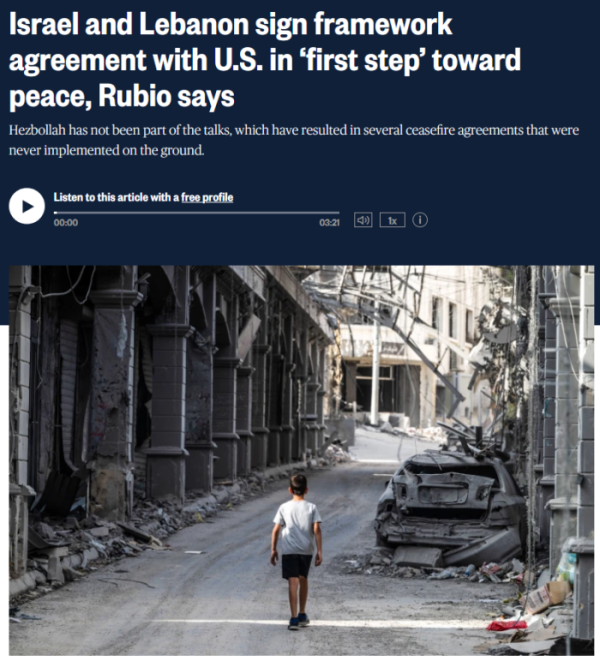
US Secretary of State Marco Rubio on June 26 triumphantly announced the “signing of the Trilateral Framework between Lebanon, Israel and the United States.” The document allegedly “builds a realistic path out of endless conflict” between Israel and Lebanon—“the inheritors of ancient civilizations that date back to the time of the Bible.”

According to Rubio:

This agreement establishes a clear and structured process to restore Lebanon’s sovereignty, disarm Hezbollah and dismantle its terrorist infrastructure, and enable Israel to return to its borders once that threat to its citizens is removed.

The framework also creates a cool-sounding “Military Coordination Group for Lebanon (MCG4L), facilitated by the United States.”

As should be immediately clear to anyone who has paid minimal attention to politics over the past 80 years, any US-brokered agreement between the two inheritors of ancient civilizations will automatically be designed to screw over Lebanon in favor of Israel—which has harbored designs on Lebanese territory from the get-go.

As Amnesty International noted, the agreement “betrays victims of war crimes in Lebanon” by essentially blocking their right to seek justice in international forums. It also signs off, Amnesty said, on the “prolonged and indefinite forced displacement of tens of thousands of residents of vast swathes of southern Lebanon occupied by Israeli forces.”

The ‘legitimacy’ of occupation

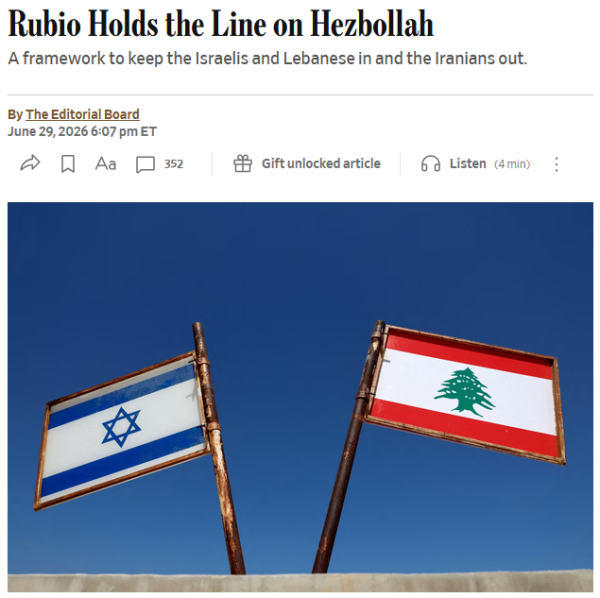
The Wall Street Journal (6/29/26) hopes an agreement will keep Israelis “in” Lebanon, and “the Iranians”—by which it means Lebanese Shia—”out.”

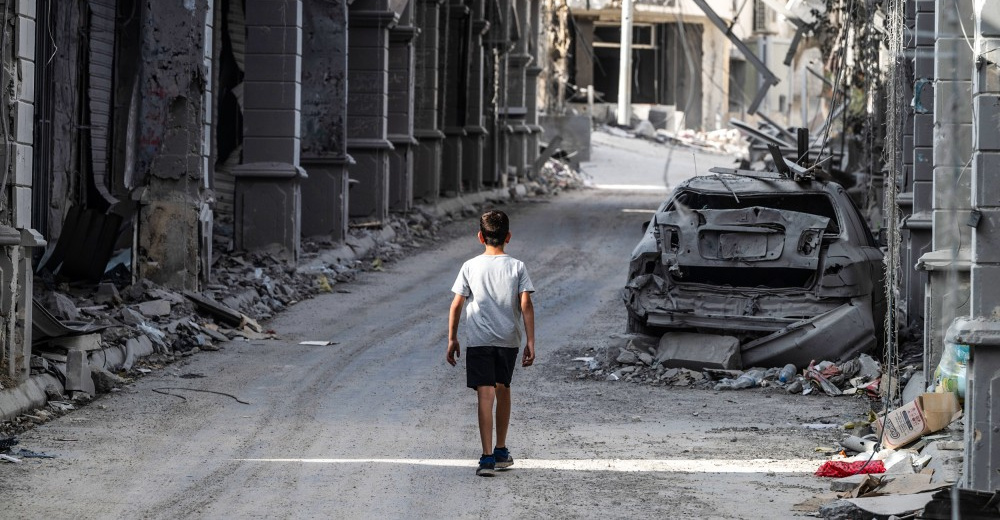
Since March, Israel has killed at least 4,321 people in Lebanon—despite a series of so-called “ceasefires”—and has issued “evacuation orders” (read: “ethnic cleansing directives”—FAIR.org, 6/11/26) covering no less than one-fifth of the country. One would thus be forgiven for feeling slightly less optimistic than Marco Rubio regarding the potential for a “realistic path out of endless conflict.”

US corporate media, however, have done their best to put a positive spin on things. The Wall Street Journal editorial board took the cake for demented delusion in its June 29 intervention, “Rubio Holds the Line on Hezbollah,” in which it argued that

the US/Israel/Lebanon Trilateral Framework signed Friday focuses on the only real way for Beirut to regain its sovereignty: disarming Hezbollah, Tehran’s Lebanese Shiite proxy.

It bears recalling that Hezbollah’s very existence is the result of Israel’s violent trampling of Lebanese sovereignty. The resistance group formed in the aftermath of the 1982 Israeli invasion of Lebanon, which killed tens of thousands of Lebanese and Palestinians and unequivocally placed the Israeli army in the “terrorist” category that Israel prefers to deploy against its victims.

But, as is par for the corporate media course, the Journal provided zero relevant historical context—and took things a step further by arguing that the agreement can somehow put a stamp of validation on Israel’s illegal occupation of Lebanese territory: “The framework also recognizes the legitimacy of the [Israeli] presence in southern Lebanon until Hezbollah is disarmed.”

A veneer of law and order

“The latest conflict began when Hezbollah fired rockets into Israel,” writes AP (via NBC, 6/26/26), “days after Israel and the US launched their war on Iran on February 28,” whereupon “Israel invaded Lebanon.” Israel has actually been occupying part of Lebanon since 1967, and grabbed another chunk of territory in 2024.

As for the eventual Israeli withdrawal from Lebanon that is proposed in the Trilateral Framework, this hinges on the concept of “pilot zones”—a new vocabulary word that has been lapped up by the media and that, like “buffer zone” and “yellow line,” ends up whitewashing Israeli atrocities, endowing mass killing and forced displacement with a veneer of law and order.

The Associated Press (via NBC, 6/26/26) explained that pilot zones are “where the Lebanese army is supposed to take exclusive control of the territory as Israeli troops will withdraw.” But these pilot zones will consist of only “two small areas,” as another AP piece (via Washington Post, 6/27/26) specified, and the framework agreement does “not say where they will be.” AP continued: “The countries will agree to future pilot zones for Israel’s withdrawal in the future, the agreement says.”

What this means—and what the media don’t care to dwell on—is that Israel will continue blowing up people and places in Lebanon while everyone waits to see if the Lebanese army is deemed worthy of handling two itsy-bitsy unidentified areas.

‘To defang Hezbollah’

The New York Times (6/26/26) makes the priorities clear: “The long-term goal… is a peace agreement with Israel in which Lebanon’s government fully disarms Hezbollah…. In return, Israel would end its attacks against Hezbollah targets in Lebanon…and ultimately withdraw entirely from the country.”

The corporate media outlets that do manage to hint at the fact that the occupation will proceed apace do so in as roundabout a fashion as possible—and without ever suggesting that a foreign occupying army is perhaps more of an infringement of “sovereignty” than a domestic resistance movement.

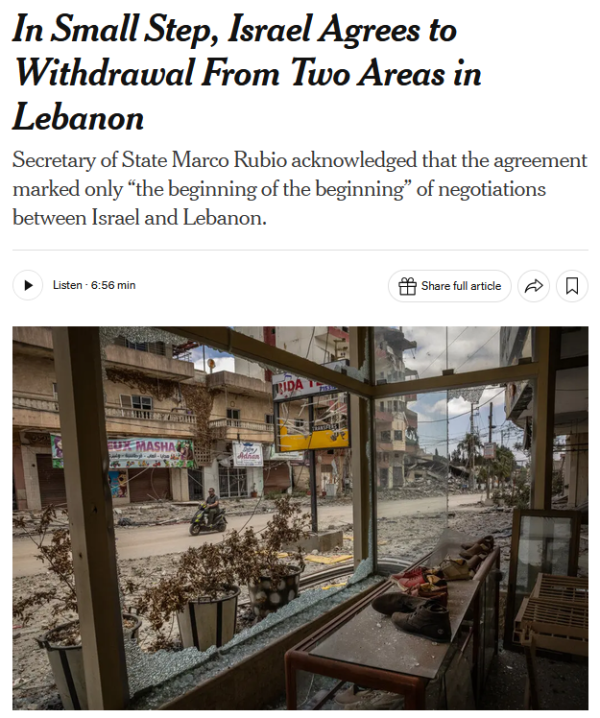
In its June 26 report on the framework agreement, for example, the New York Times went as far as to note that “the limits of the agreement were reflected by a statement” from Israeli Prime Minister Benjamin Netanyahu, who “emphasized not the modest territory Israel says it will give up, but instead the much larger swath of Lebanon that it will continue to occupy.” The Times also mentioned Netanyahu’s refusal to “offer a timeline for the withdrawal, saying only that Israel would allow the Lebanese army to ‘begin organizing’ to take control of the areas.”

And yet, because Israel’s viewpoint is conveyed in an all-important light, the reader is left with the feeling that the real problem is not that a “large swath” of Lebanon remains under the control of a genocidal army that has been literally obliterating entire south Lebanese villages from the face of the earth.

Rather, the problem is that south Lebanon is “home to the Iran-backed proxy group Hezbollah”—and it turns out that Israel alone has the right to decide what should be done about that:

Israeli officials remain deeply skeptical about the prospect of expanding the pilot zones, arguing that the Lebanese army lacks the training, equipment and political will to defang Hezbollah.

The Times presented it as completely appropriate for Israel to be calling the shots—allowing “skeptical” Israeli officials to determine the conditions under which their own illegal occupation of another country might cease. But Israel’s blood-soaked regional track record should make it obvious that Israel itself is the one that needs to be defanged.

In its own writeup of the “pilot program,” headlined “Israel to Withdraw From Two Areas in Lebanon Under Newly Signed Agreement,” CNN (6/27/26) observed that Netanyahu had “described the agreement as a major win for Israel, allowing the Israeli military to remain in much of the territory it occupied in southern Lebanon.” Ongoing occupation notwithstanding, the article framed the deal in a resoundingly positive light—minus one complaint in the very final sentence from Hezbollah Secretary-General Naim Qassem, who criticized the “squandering of Lebanon’s sovereignty.”

‘The ultimate test’

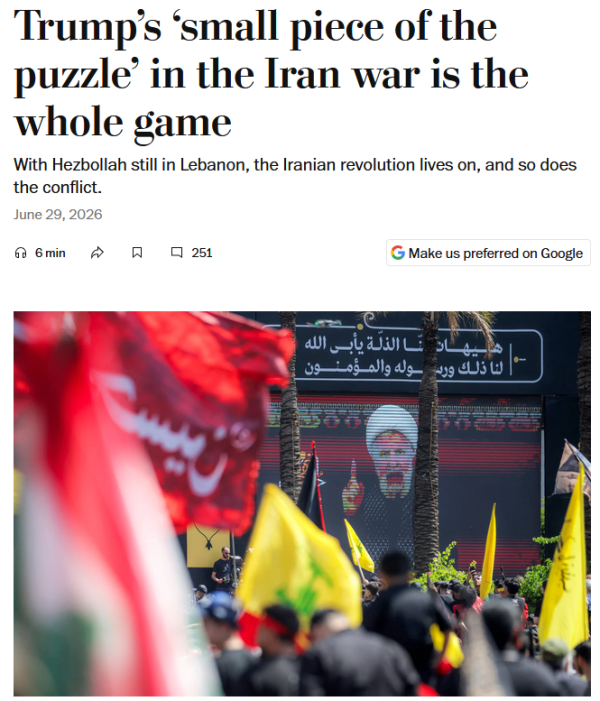
Carine Hajjar (Washington Post, 6/29/26) insists that the point of the Iran War is to stop the “radical Shiite revolution” in Lebanon. She gives no hint that Shia Muslims are about a third of the population of Lebanon—making them the largest faith community there.

For its abominable part, the Wall Street Journal editorial board (6/29/26) proclaimed that “the pilot zones are Lebanon’s best chance to make progress,” by giving the Lebanese army the opportunity to try its hand at “dismantling terror infrastructure” belonging to a “terrorist group” that answers “only to Iran.”

To be sure, one effect of the relentless media portrayal of Hezbollah as a proxy of the ever-vilified Islamic Republic is that it reduces a whole chunk of Lebanon and its inhabitants to a dehumanized terrorist blob, thereby fueling Israeli impunity.

And, as in Palestine, it is always up to the Arabs to prove that they do not deserve to be slaughtered and occupied by Israel, and never up to Israel to simply refrain from slaughtering Arabs and occupying their land. Over at the Washington Post, opinion journalist Carine Hajjar (6/29/26) insisted that “the Lebanese must do more to demonstrate that they are credible partners.” The pilot zones, she maintained, are “the ultimate test: Can the [Lebanese army] keep Hezbollah from operating? Is the Lebanese state ready to prove it can defend its own sovereignty?”

At the end of the day, the “ultimate test” is an infantilizing Orientalist experiment in which a psychopathic occupying army agrees in theory to unoccupy a smidgen of Lebanese land in order to judge whether the Lebanese state is willing to oversee it in a manner compatible with Zionist objectives. And in the meantime, the occupation becomes an irreversible fact on the ground—aided and abetted by corporate media apologetics.

In a media lexicon where self-defense is “terrorism” and occupation is “sovereignty,” a US-backed pilot program in Lebanon fits in perfectly as “progress.” Here’s hoping that one of these days there’ll be a pilot program where the media can try telling the truth.


This article was originally published by FAIR; please consider supporting the original publication, and read the original version at the link above.Email
avatar

Belén Fernández is the author of The Imperial Messenger: Thomas Friedman at Work and Martyrs Never Die: Travels through South Lebanon.