Sunday, July 19, 2026

No Country on Earth Fully Respects Workers’ Rights, and it’s Getting Worse


IWW.ORG


 July 17, 2026


Class warfare continues to be waged incessantly. And that war’s offensives continue to be more intense. In just the past year, the world’s working people have seen more attacks on the rights of free speech and assembly, more attacks on civil liberties, more arrests and imprisonments, more refusals to engage in collective bargaining with unions and more technology used to monitor, discipline and silence workers.

None of this is new, but it is getting worse. The International Trade Union Confederation (ITUC) has issued its 2026 Global Rights Index report, and as has been the case in past years, the annual report makes for grim reading. Once again, no country on Earth fully protects workers’ rights.

In past years, there were only nine countries that met the qualifications for the best category, “sporadic violations of rights,” defined as where “Violations against workers are not absent but do not occur on a regular basis.” That was the case for the 2023 and 2022 reports. This year? Only eight countries were found to be merely “sporadic violations of rights.” Those countries are Austria, Denmark, Germany, Iceland, Ireland, Norway, Sweden and Uruguay, with Uruguay newly promoted to this level from a year ago.

Before we dip into the details, the larger picture is alarming. And the advanced capitalist countries, you won’t be surprised to know, are no exceptions. “In Europe and the Americas, workers’ rights are suffering an alarming decline. Both regions registered their worst average country rating since the Index began in 2014, and the increasing influence of the far right is putting workers and unions at risk in countries such as Argentina and France – two out of four countries to be downgraded in 2026,” the ITUC said in its report. Nor are the reasons behind these developments a mystery. “This year’s results reinforce the ITUC’s view that we are witnessing a global erosion of democratic principles – a ‘billionaire coup against democracy’ – funded by the rich and delivered by far-right and authoritarian leaders,” the report said. “As a snapshot of the violations of workers’ rights, the 2026 Index exposes a pattern that the powerful would rather keep hidden: the systematic weakening of democracy through attacks on workers, unions and collective bargaining. From repression of strikes to the erosion of legal protections and the criminalisation of unions, these are not isolated incidents but part of a broader strategy to silence dissent and entrench inequality.”

Fully half of the world’s national governments launched attacks on the rights to free speech and assembly, and half also arrested or detained workers, the highest total yet. Workers in three-quarters of the world’s countries had their right to union organizing impeded, also a record high, and 80 percent of countries restricted the right to collectively bargain. Worse still, 87 percent of countries violated the right to strike.

For the past decade, the number of countries that exclude workers from the right to establish or join a union, that violate the right to collective bargaining, that violate the right to strike, that arbitrarily arrest and detain trade union members, and that deny or constrain freedom of speech and assembly have all risen.

The global rise of hard right governments has gone hand-in-hand with the deterioration of workers’ rights. Argentina, where President Javier Milei has carried out his promise to impose the harshest variety of austerity that he can get away with, achieved the unprecedented “accomplishment” of falling in the ratings for two consecutive years. Argentina is now classified in the ITUC survey as a 5 rating, the worst category, representing the worst offenders where workers “have effectively no access to rights.” The ITUC lists Argentina as one of the world’s ten worst. “Milei has led a staunchly anti-union agenda since coming to power in 2023, undermining basic workers’ rights, civil liberties and union activity,” the Confederation reports. “Workers and unionists face systematic abuse and the shrinking of civic space. … Union offices, including the headquarters of the glassworkers’ union, were infiltrated and vandalised.” High union officials have fled the country after a police roundup. “Employers in Argentina engage in union busting and exploitative practices with impunity,” the report concludes.

In France, which also saw its rating decline, there is a “sustained deterioration of workers’ rights, an increasingly hostile political atmosphere, and incrementally regressive government policy since nationwide protests against pension reform deeply shook the political landscape in 2023.” Furthermore, in an atmosphere of the government attempting to impose regressive labor policies, “more than 1,000 Confédération Générale du Travail (CGT) activists have fallen foul of state and employer crackdowns and a spate of violent attacks by far-right groups.”

And what of the two countries that love to claim their defense of democracy is unwavering and endlessly point fingers at other countries? The United Kingdom was rated as a “regular violator of rights,” a ranking of 3, the middle of the five categories. That was actually an improvement from a year earlier, with the ITUC crediting the outgoing Starmer administration for “repeal[ing] excessive restrictions to industrial action introduced in the previous Conservative government’s 2016 Trade Union Act.” And the United States? Once again given a rating of 4, the category for countries that have “systematic violations of rights,” the second worst ranking.

“In 2025, Trump stripped collective bargaining rights from more than a million federal workers across more than 30 agencies — perhaps the biggest act of union busting in the nation’s history,” the report said. “The move, reserved in the past for emergencies, was portrayed by the Republican administration as being in the interest of national security. It means entire departments, such as the Departments of State and Justice, and even the Food and Drug Administration, are excluded from this basic right.” The ITUC also cited Trump leaving the federal labor arbitration body, the National Labor Relations Board, without a quorum so that no cases brought by unions can be heard, as well as imposing an intimidating environment for immigrant workers, the excessive force used by Immigration and Customs Enforcement (ICE) and arbitrary arrests of union leaders. “The harm caused by these militarised enforcement practices extends well beyond these high-profile cases, as hundreds of other workers and trade unionists have been arrested and deported or detained in life-threatening conditions without charges or due process,” the report said.

The Global Rights Index ranks the world’s countries from 1 to 5, with 1 the best category, denoting “sporadic violations of rights,” defined as where “Violations against workers are not absent but do not occur on a regular basis.” Those are the aforementioned eight countries.

Rating 2 countries are those with “repeated violations of rights,” defined as where “Certain rights have come under repeated attacks by governments and/or companies and have undermined the struggle for better working conditions.” Countries with this rating include Australia, Italy, Japan, the Netherlands, New Zealand, Portugal and Spain.

Rating 3 countries are those with “regular violations of rights,” defined as where “Governments and/or companies are regularly interfering in collective labour rights or are failing to fully guarantee important aspects of these rights” due to legal deficiencies “which make frequent violations possible.” Countries with this rating include Belgium, Canada, Chile, France, Mexico, South Africa and Switzerland.

Rating 4 countries are those with “systematic violations of rights,” defined as where “The government and/or companies are engaged in serious efforts to crush the collective voice of workers, putting fundamental rights under threat.” Countries with this rating include Brazil, Greece, Israel, Peru, the United States and Vietnam.

Rating 5 countries are those with “no guarantees of rights,” defined as where “workers have effectively no access to these rights [spelled out in legislation] and are therefore exposed to autocratic regimes and unfair labour practices.” Countries with this rating include Argentina, China, Colombia, Ecuador, India, the Philippines, Russia, South Korea and Turkey. In addition, there are countries with a 5+ rating, those with “No guarantee of rights due to the breakdown of the rule of law.” The dozen countries listed here include Afghanistan, Myanmar, Syria and Yemen.

The ITUC determines its ratings by checking adherence to a list of 97 standards derived from International Labour Organization conventions. Those 97 standards pertain to civil liberties, the right to establish or join unions, trade union activities, the right to collective bargaining and the right to strike. As a self-described confederation of national trade union centers, it says it represents 191 million workers in 169 countries and has 340 national affiliates.

Outside the scope of the International Trade Union Confederation’s report is the ability of workers to even have a job. Unemployment statistics notoriously greatly understate the number of people out of work and ignore altogether those with part-time work who need a full-time job. Even those lesser known statistics, such as the U-6 in the United States and R8 in Canada, that reveal higher numbers because of a more expansive definition of counting unemployment than the standard measures, undercount. One estimate of the true rate of un- and under-employment is 24.3 percent, calculated by the Ludwig Institute for Shared Economic Prosperity. The International Labour Organization estimates that 2.1 billion workers are employed informally, far fewer than those with regular work. The ILO notes that “Informality is typically associated with lower job quality due to limited access to social protection, rights at work, workplace safety and job security.” And all this at a time when the gigantic sums of money shoveled into the pockets of billionaires and other capitalists is so high that there is not enough outlet for investment or other productive use, and instead the money is shoveled into financial speculation — the volume of trading in currency (foreign exchange), stocks, bonds and their derivatives exceeds the size of the global economy in 10 business days.

As we yet again have cause to note, class warfare is intensifying and remains decisively one-sided. For how long?


Pete Dolack has been an activist with several groups, most recently Trade Justice New York Metro. He writes the Systemic Disorder blog and is the author of the books What Do We Need Bosses For?: Toward Economic Democracy and It’s Not Over: Learning From the Socialist Experiment.

Why House Members Came Together to Pass the Bipartisan Workers’ Bill

Source: Originally published by Z. Feel free to share widely.

Terry Stickles supported the successful union drive at JSW Steel in Mingo Junction, Ohio, in 2025, then went to the bargaining table eager to hammer out his first contract with the company and set a course for the future.

His coworkers, also new members of the United Steelworkers (USW), felt the same urgency. But JSW chose to play around instead, offering few meeting dates to union negotiators, taking hours to review even basic contract proposals, and cutting bargaining sessions short for no good reason.

“It’s almost like kids’ games,” Terry, an Army veteran and millwright, explained of a bargaining process that continues to drag on because of the company’s stonewalling.

This kind of dithering is how spoiled-brat executives retaliate against hardworking people for exercising their labor rights. It’s why it takes workers, on average, almost 500 days to negotiate their first contract after joining a union.

Negotiations over health care coverage, workplace safety, and related issues are no place for juvenile antics—and that’s exactly why Democrats and Republicans in the U.S. House joined forces recently to pass the Faster Labor Contracts Act.

The legislation, now before the Senate, promises to fix a broken system that allows employers to flout labor law and run roughshod over workers’ rights.

It would require companies to begin negotiations within 10 days of workers’ vote to form a union and require mediation if the two sides prove unable to reach a contract within three months. If mediation also fails to bring consensus, a panel of arbitrators would step in and set the terms of the first contract.

The legislation forces a company’s negotiators to roll up their sleeves and get down to business. That makes perfect sense to working people. It’s what we do every day.

“Show up,” Terry said, referring to JSW’s negotiators. “Let’s do our job. Let’s get this over with.”

Sadly, many executives view empowered workers as a threat.

It bruises their inflated egos to think that the people who actually produce the company’s wealth want a seat at the table, and so they pull every trick imaginable to thwart workers from banding together in the first place. Like many others, the USW members at JSW faced a nasty anti-union campaign in the run-up to voting for the union.

When workers unionize in spite of all the threats and harassment, their bosses double down on obstructionism and slow-walk the bargaining process. They’d rather pay their labor lawyers to twiddle their thumbs—and let their HR consultants run up huge tabs doing nothing—than come to the table in good faith and wrap up a fair contract with the workers who deliver day after day.

This isn’t an occasional occurrence. It’s become the corporate business model, with research showing that the average fight for a first contract is actually taking longer as the years go by.

The stalling takes various forms.

For example, the company sometimes rebuffs union efforts to schedule negotiating sessions. Or it agrees to meetings and then cancels them, often at the last minute. Or the company negotiators arrive late and leave early, deliberately leaving little time to get anything done.

On other days, the company representatives throw a tantrum and walk out. Or they say they can’t discuss a certain issue because they failed to bring the right person with them. Or they take a union proposal and disappear into a caucus for hours at a stretch, just to waste time, as often happens at JSW.

You get the picture.

It’s all calculated to demoralize workers and punish them for unionizing. Corporations also hope that frustrated workers will turn on each other, undermining the solidarity that’s the heart of collective power.

This is more than petty. It’s harmful, holding up progress on issues truly important to workers and employers alike.

“We want safety,” Terry said of his coworkers, who make steel for wind turbines. “We want a voice on safety.”

Terry and the rest of the negotiating team provide regular updates to their colleagues, keeping everyone up to date and focused on the fight.

They’ll prevail. But passing the Faster Labor Contracts Act will put teeth in our labor laws, force employers to respect the bargaining process, and spare millions of other workers the chicanery that Terry and his coworkers face.

This article was produced by the Independent Media Institute.Email

Roxanne D. Brown is the international president of the United Steelworkers Union (USW).

US Union Density is the Cause of and Solution to Our Problems


Union density. Union density. Union density!

What is the reason for our problems? Union density. What is the answer to our problems? Union density. What explains our plagues? Union density. What must our goal be? Union density.

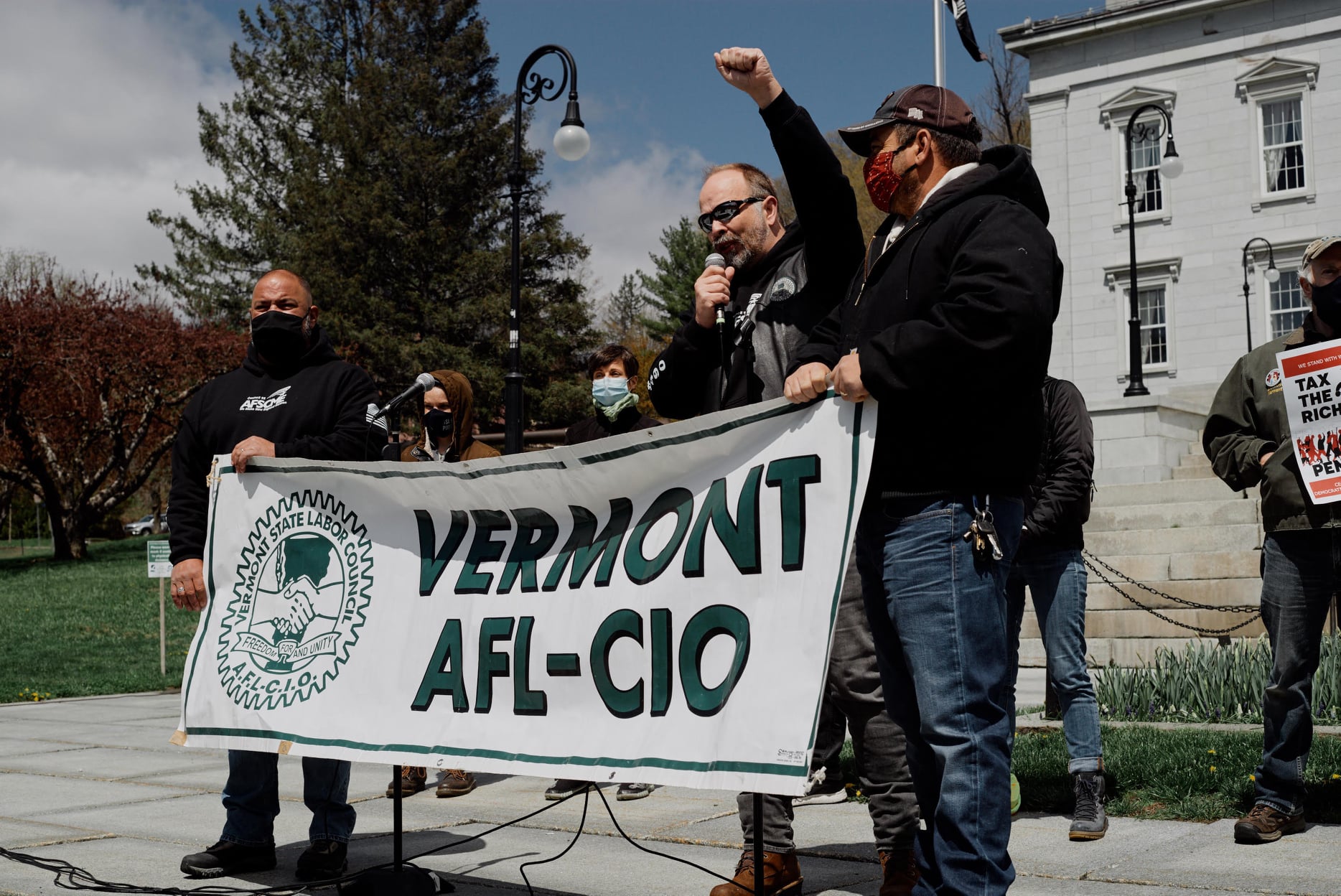
Everybody should be talking about union density. Always. Union density—the percentage of the work force that is represented by unions—has been declining since the middle of the 20th century, almost without pause. In the 1950s, one in three American workers was a union member. Today, it’s only one in ten. This decline goes a long way to explaining our half century-long rise in economic inequality, the slow collapse of our civic society, the enormous fortunes in the hands of a small number of billionaires, the capture of our electoral politics by money, and more. Union density has been crushed so the power of working people has been crushed and unions have less economic and political power and as a result corporations and the rich have more power. And here we are.

For the same reasons, increasing union density is a key to reversing all of those deleterious trends. Many regular people can see the ways that our society is socioeconomically broken, but they are not exactly sure what to do about it. The simplest and most elegant answer is: increase union density. This will increase the power of working people and decrease the relative power of corporations and the rich, put more wealth in the pockets of the working class, and create political power that can be used to do things like “give everyone health care” and “tax the rich”—policies that would themselves help to fight inequality, but which have proven to be politically impossible when the working class has less political power than the rich.

I wrote a book about this if you’re interested in a longer discussion.

Despite its importance, union density doesn’t get a lot of attention in mainstream political discourse. I’m always keeping an eye out for new UNION DENSITY FACTS. And this week we got some: a new report from the Economic Policy Institute that quantifies what would happen if we could triple union density—if we could once again make 30% of the work force union members, as they were in the mid-20th century.

Among the findings of the report (bolding added):

  • “If we tripled union density from 10% to 30%, the real median wage for all workers (including both union and nonunion workers) would rise from $25.67 in 2025 to $29.39 per hour—a 14.5% increase. A full-time, full-year worker earning that wage would see annual pay rise by more than $7,700.”
  • “Assuming the 14.5% wage boost we estimate from a tripling of union density applies to the bottom 80% of the U.S. workforce, this would raise these workers’ combined pay each year by $1.2 trillion.”
  • Unions also bring benefits to health care coverage. “If union density tripled and all states were high-density states, the national nonelderly uninsured rate would fall by about a quarter, from 9.8% to 7.3%.”
  • Unions help ensure that workers get their unemployment benefits when they’re eligible. “In recent years, the average UI recipiency rate in high-union-density states was 36%, double the 18% rate in low-union-density states.
  • Economic research has established that increasing union density raises wages even for non-union workers, because all companies in the market have to compete with unionized companies for labor. Because the economy-wide benefits of union density don’t really kick in until it hits 15%, EPI says, they are probably underestimating the economic benefits: “Below 15% union density, a one percentage point increase in density is associated with just a 0.2% increase in the median wage; above 15%, the median wage increases by 0.9%—a wage response more than four times as large.”

Note that the huge economic benefits from this increase in union density would happen without any new taxes on the rich or other direct redistributive government action. They would happen because workers would have more power, and they would use that power to collectively bargain for a fairer share of the wealth they produce. Unions, as a solution to our political and economic problems, do not require some omniscient policy expert to determine the right solution for every working person in every place. They simply give working people the power to advocate for themselves in a way that actually works for their particular situation. Mass unionization produces infinitely more nuanced and workable solutions than any other path to reform.

But How?

The incredible benefits of increasing union density are clear. Okay. Great. How do we do it? This is where we see more clearly the problems inside of the labor movement itself. EPI’s report lays out a purely legislative path to increasing union density: Pass the PRO Act to reform America’s anti-worker labor laws, and enact another federal law to give collective bargaining rights to all public sector workers nationally. They also advocate laws guaranteeing annual cost-of-living raises for all union workers, and automatic collective bargaining in any company where the CEO-to-worker pay ration exceeds 100-1.

Neat. Good ideas. Please wake me up when we can pass any of these laws.


I am not trying to sound combative here. I support all of these laws! Unions should continue their efforts to get them passed! The thing is, we need a serious plan to increase union density in the meantime. That, unfortunately, does not exist. Liz Shuler, the head of the AFL-CIO, was on the press call for the EPI report. I asked her what the path is to raising union density absent these legislative changes. She said that we need “multiple strategies,” including targeting individual states and using them as laboratories for reform. “We are fighting on all fronts. But we need the air cover of policy change and legislation. It’s not the end all be all, but we know how broken labor law is in this country.”

EPI’s Heidi Shierholz pointed out that public approval of union is at 60-year highs, far higher than it was under Obama, when the last major Democratic push for labor law reform fell short. So there are rational reasons to say that we are in a new moment that is more promising for legislative reform. Still, the fact remains that while we certainly do need labor law reform, history tells us that we shouldn’t expect to get it, even though we will continue to fight for it. The labor movement cannot subordinate itself to Congress. We need a concrete strategy, controlled by us, that we can pursue until the “holy grail” of legislative reform happens.

In short, what the labor movement has the power to do now is to massively increase funding for new union organizing. The real meaningful conversation, for those who take the idea of increasing union density seriously, is “where are we going to get the money to do the organizing we need to right now?” Much of the money is already sitting in the coffers of major unions, who just have to decide to spend it on organizing. More of it can come from the private sector, which has not been adequately tapped for this purpose. And more of it can come from the government, which can commit to funding union organizing alongside other legislative priorities.

The public should know that union density is vital, an answer to our most pressing problems, something to be focused on and talked about and pursued. Politicians should know that labor law reform must be a top, top priority for Democrats when we retake the White House, and that we are going to have to eliminate the filibuster to get it, and politicians unwilling to do that should suffer our wrath.

But the labor movement itself needs to be talking about: Where are we getting our first billion dollars for the big organizing push? If we are not talking about this, we are not taking seriously our obligation to give all workers access to a union. Not really. Therefore, we are failing. We cannot blame the evil bastards of corporate America for our decline if we are not actually trying to do the things that might turn it around.


This article was originally published by How Things Work; please consider supporting the original publication, and read the original version at the link above.Email
avatar

Hamilton Nolan is a labor writer for In These Times. He has spent the past decade writing about labor and politics for Gawker, Splinter, The Guardian, and elsewhere. More of his work is on Substack.