Monday, July 20, 2026

Montana on the Verge of Massive Blunders with Data Centers, NorthWestern merger

 July 20, 2026

Photograph Source: NASA – Public Domain

Montana, the fourth-largest and one of the least populated states in the Union, has been savagely ill-treated in the past and left with injuries that continue to plague us long after those who made the decisions aren’t in office or alive to be held accountable.

Elected officials, at the local, state, and national level have and continue to make enormous mistakes, largely in service to corporations not “We, the people.”

Need examples?

How about the Berkley Pit, one of the largest bodies of toxic water in the world the Copper Kings left behind when they took the riches Butte’s workmen had pried from rocks and fled for the East Coast.

Or how about the stump fields that now characterize much of Montana’s once-forested lands?  Plum Creek, a scion of Burlington-Northern Railroad, decided to “liquidate” its “timber assets” — also known as forests — and did just that, leaving massive knapweed-filled clearcuts behind.  Those vast swathes of lands were granted to BN’s predecessors by the federal government to facilitate “settling the West.”  Having plundered the timber resources, Plum Creek then became a Real Estate Investment Trust to sell off the lands.

Then there’s perhaps the greatest debacle in the state’s recent history — the late ’90s decision by the legislature and then Gov. Marc Racicot to deregulate Montana’s utility industry at the behest of the former Montana Power Company.  Theoretically, citizens would benefit as competition lowered prices. But that didn’t happen.

Instead, the dams, transmission lines and generation facilities that were paid for by Montana consumers were sold to an out-of-state corporation and the proceeds dumped into a telecommunications business that failed.  Montanans then went from the cheapest power in the region to the most expensive. In desperation, the legislature re-regulated the new owner, NorthWestern Energy, and now we’re paying for the dams and infrastructure once again while our energy prices go up, and up, and up.

Meanwhile, Montana is facing an onslaught of enormous data centers whose consumption would suck down more energy than all of NorthWestern’s current customer base — and NorthWestern Energy is seeking approval from the Montana Public Service Commission for a $15.4 billion merger with Black Hills Corp., to form a multi-state mega-utility.

Make no mistake, corporations are in business for one thing — to make money.  The Public Service Commission, however, is supposed to protect Montana’s consumers while the energy corporations seek their profits.

But the Public Service Commission is in crisis as this critical decision looms. Brad Molnar is the longest-serving member of the Commission and, recalling the deregulation debacle, has been asking hard questions about what happens if the data centers fail and Montana consumers are left to pick up the costs of the infrastructure installed to serve them.

In an unprecedented action, Gov. Greg Gianforte, who strongly supports data centers, suspended Molnar for a year for workplace infractions. He intends to appoint a replacement who, one might guess, will support the merger and the data centers.

If that sounds a lot like what’s going on with President Donald Trump’s “fire and replace with friendlies” actions, it’s not a coincidence. Moreover, in early July Gianforte signed Trump’s “ratepayer protection pledge” that’s supposed to “protect American consumers from price hikes due to data center energy and infrastructure requirements, and lower electricity costs for consumers in the long term.”

We’ve heard that consumer protection and “lower electricity costs” line before — and Trump’s endless years of broken promises continues unabated. Montanans got fooled and burned by politicians and utility corporations before — this time around, we must ensure we don’t get fooled again.

George Ochenski is a columnist for the Daily Montanan, where this essay originally appeared.

Op-Ed: Australia vs AI copyright theft and data centres blow by blow

Paul Wallis
July 15, 2026
DIGITAL JOURNAL
Australia’s prime ministers says new laws will ensure AI data centres don’t raise people’s water and power prices – Copyright AFP DAVID GRAY

Sydney: Prime Minister Anthony Albanese outlined the government’s response to local copyright issues and data centres in a speech at the University of Sydney yesterday. The Australian government is trying to draw a firm defensible line against AI encroachments on physical and intellectual property.

This is new territory for Australian legislation, and it’s in the face of massive AI uptake and investment in Australia. This is also the first definite indicator of the government’s position. It comes after strong lobbying for the protection of the arts and the rise of many local issues raised by data centre developments.

The other big, unavoidable issue is copyright. Australian copyright law is an average international standard and just as vulnerable to data theft and AI scraping. It was never designed to manage AI phenomena. There’s been scathing criticism of the lack of action on AI regulation.

There is even supposed lobbying to “legalise copyright violation” and blurring of IP rights. The government will inevitably have to codify and rule on these issues. Without statutory law, courts can only do so much, and they can’t do much.
Australia is a test case

The rest of the world has the same problems, but Australia is unique as a test case for managing AI. There’s a big market overlap with international IP. Australian made products are marketed outside Australia under license, and copyright materials are published and distributed overseas.

These very high value intellectual properties must therefore be protected. AI effectively undercuts the creative process, devaluing the IP. The AI products in turn also compete in the same markets.

Australia’s big advantage is to be able to start from scratch managing these issues. There’s no existing specific AI legislation or regulation. An entire regulatory system can be constructed and tested for effective application.
AI regulation vs existing laws

Existing copyright laws do help to a point, but not enough:

Copyright materials are properties, and their ownership is not negotiable. Ownership is attributed to a legal entity by default. Ownership rules don’t need to be “fixed” but enforced.

AI is not a legal entity in the same sense as a natural person or corporation. It can’t own or hold property.

Any use whatsoever of copyrighted materials is covered by existing laws. If you want to use it, you buy the right to use it, whether it’s a textbook or a comic book.

AI can’t claim to have created IP. By definition, it sources what it makes from copyrighted materials. That’s the exact opposite of ownership. It’s direct proof of non-ownership.

The major problems come with “scraping” in the course of training AI. This involves training LLMs on vast amounts of data, much of it commercial copyright. This is usually done without the consent of copyright owners or any compensation.

The content derived from scraping feeds back into the same markets from which training materials are sourced. AI is “diluting” these markets directly. It’s generating a lot of largely useless AI slop at the expense of the producers of the copyrighted materials.
Markets vs laws

The biggest problem with AI scraping is the lack of movement on the part of AI developers. They have resisted any sort of acknowledgement of basic copyright laws.

This entire situation could be completely avoided with definitive laws. In theory, all current copyright laws cover scraping simply due to the direct use of IP in scraping. In practice, none of these laws work at all, nor are they being made to work. Test cases against AI scraping are many, but there are so far no clear decisions. These endless disputes are simply dragging the chain. It’d be simpler and far cheaper to just hammer out a workable deal for copyright owners.

This is where Australia can get ahead of the disasters and deliver straightforward statutory solutions. The alternative is a legal mess with incredibly slow turnaround times for decisions.
An important AI reality that’s being overlooked

AI LLM training is a major, expensive process, but it pays back in many ways. The values derived from this training extend well beyond writing a book, doing someone’s homework, and compromising the whole future of higher education.

The real value of AI training has very little, if anything at all, to do with stealing creative content anyway. This training, particularly at the language level, delivers major efficiencies. It delivers the linguistic fluencies, and dynamic skill sets AI needs. The training is critical to AI performance and future development.

By comparison, the value of creative content is simply training the AI to learn those skills. A price can easily be set and standardized for general use.

Should a textbook have a price? It does, so what’s the problem? Do you, or can you, own the content of the textbook? Only if you buy the rights. Do you need to own that content? No. You’re just paying for the use of the content.
The world needs to get on board with AI regulation

Australia is trying to take a step forward in cleaning up this legalistic mess and making it manageable. Copyrights are gigantic assets worldwide. International laws need to be on the same page to work.

AI vs copyright disputes are achieving nothing and are far too slow in this environment. Most copyright laws can simply be adjusted to define copyright ownership rights in relation to AI. It’s time for AI to learn to respect property rights.


Xi calls for global AI cooperation as US restrictions squeeze China's tech access

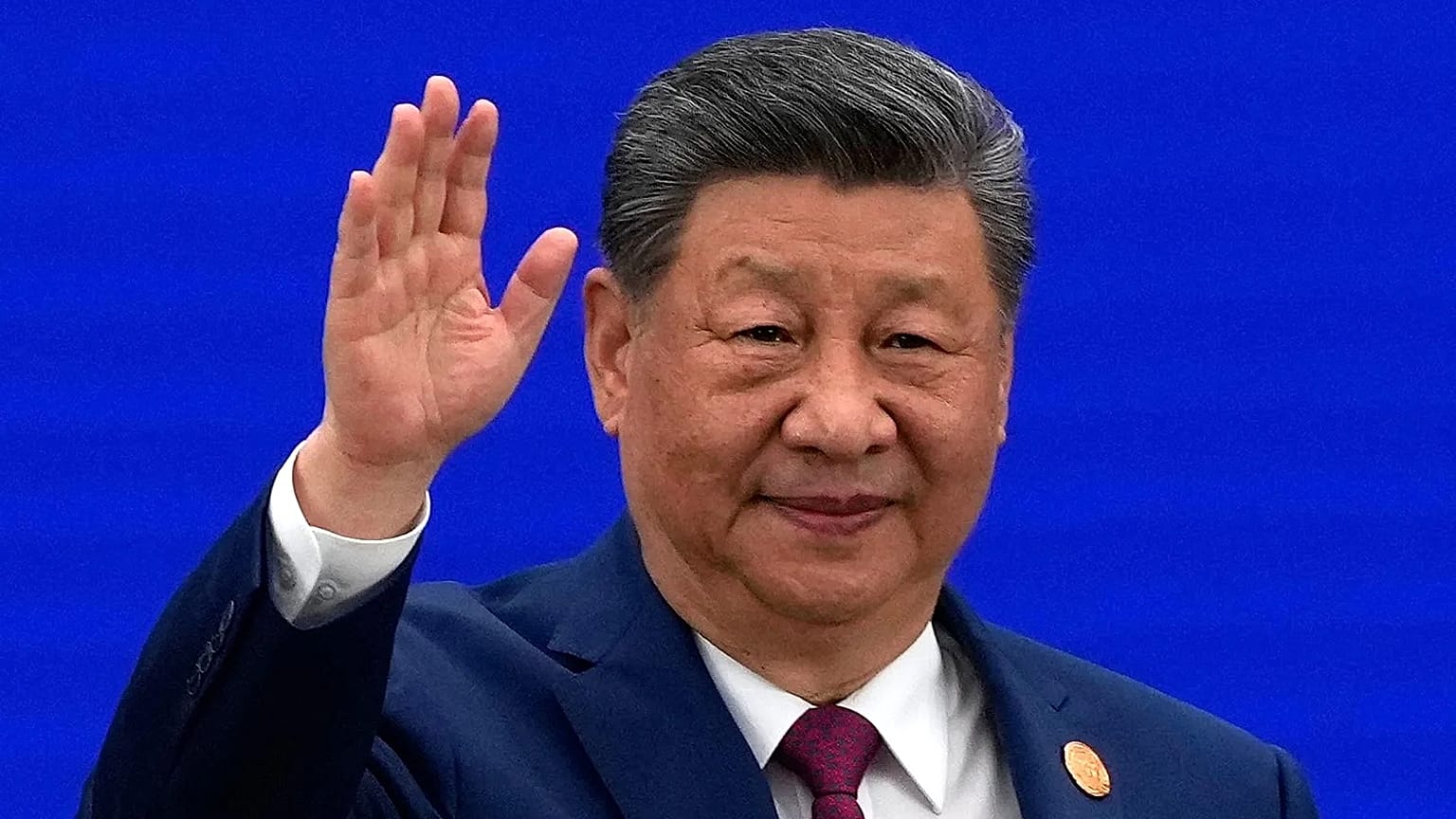
Chinese President Xi Jinping waves as he arrives at the opening ceremony for the World AI Conference in Shanghai, Friday, July 17, 2026. (AP Photo/Ng Han Guan, Pool)
Copyright Ng Han Guan/Copyright 2026 The AP. All rights reserved.


By Una Hajdari
Published on

As US restrictions continue to limit China's access to advanced technology, Xi Jinping used a major summit to rally developing nations around Beijing's vision for AI.

China's President Xi Jinping used a major AI summit on Friday to push back against US technology restrictions, calling for artificial intelligence to be developed and governed as a global effort rather than dominated by any single country.

Speaking in Shanghai, Xi warned against what he called the "overstretching" of national security concerns — a pointed reference to American-led curbs that have cut China off from some of the world's most advanced chips and AI technology.

"The development of artificial intelligence should not be a solo performance by any single country but rather a symphony of global cooperation," he said.

The remarks came at China's annual World Artificial Intelligence Conference, attended by the leaders of Kazakhstan, Cambodia and Thailand, as well as UN Secretary-General António Guterres.

Xi announced that China would offer 5,000 AI training opportunities to developing nations over the next five years and give 30 countries access to a Chinese-built meteorological AI system with early-warning capabilities.

The day before, 29 countries, including Russia, Pakistan and Kazakhstan, signed an agreement with China to set up a new intergovernmental body, the World Artificial Intelligence Cooperation Organisation, to be based in Shanghai.

Tech giant Huawei is also at the conference, showing off its Atlas 950 SuperPoD AI computing system.

The flurry of announcements reflects how seriously Beijing is competing for AI influence, particularly in the developing world where China believes it has a competitive advantage over Western companies.

Chinese open-source models such as DeepSeek have already gained ground globally as cheaper alternatives to US offerings.

China’s Is Bigger: Don’t Tell Trump


 July 20, 2026

Image Source: Alex Microbe – Public Domain

Don’t worry folks, we’re keeping our PG rating here. I’m talking about GDP. I had some people question my line in yesterday’s post that China’s economy is one-third larger than the US economy and growing twice as fast.

This is true. The data come from the World Bank. According to the data, China’s GDP last year was $41.2 trillion, compared to $30.8 trillion for the United States.

These numbers are GDP measures by purchasing power parity. This measure applies a common set of prices to all goods and services, regardless of whether they are produced in the United States or China. This means a car, a washing machine, a hospital visit, and a haircut are assumed to carry the same price, regardless of which country it is produced in.

There is an effort to adjust for quality differences, but this is undoubtedly imperfect. Nonetheless, it should get us in the ballpark, and for purposes of comparing living standards and economic power in the world, it will generally be far more useful than the more commonly cited currency conversion measures.

That measure takes domestic GDP measured in China’s currency and then converts it into dollars at the current exchange rate. It is not clear what this measure gets us, especially since it’s not unusual to see a currency rise or fall by 10 percent or more in a year, which would imply an implausible rise or fall in GDP.

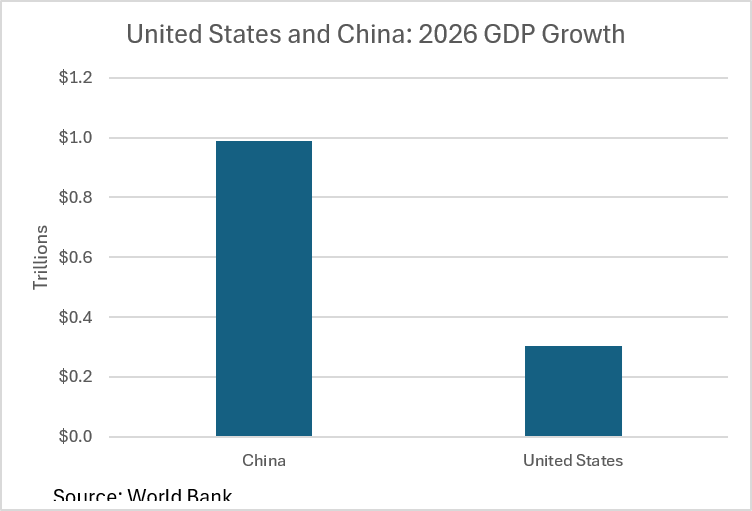
As I noted in yesterday’s piece, not only is China’s GDP one-third larger than the US economy, it is growing twice as fast. This means that the addition to GDP each year is far larger in China than in the United States. Here’s what the picture looks like for the first half of 2026.

China’s economy grew by just under $1 trillion in the first six months of 2026. The US economy is on track to grow by just over $300 billion. Unless growth in China slows radically, or the growth rate of the US economy accelerates in a way that no one other than Donald Trump is predicting, this gap will continue to grow.

This first appeared on Dean Baker’s Beat the Press blog.

Dean Baker is the senior economist at the Center for Economic and Policy Research in Washington, DC. 

China’s Kimi K3 rattles US AI industry

AFP
July 17, 2026

A model released by Chinese startup Moonshot AI has fuelled buzz around the country’s tech prowess – Copyright CN-STR/AFP –

Kimi K3, a new artificial intelligence program from a Chinese startup called Moonshot AI, stunned the US tech industry on Friday, setting off fresh discussion over the China-US rivalry to dominate AI.

The program was released Thursday and within hours hit the top spot on a widely watched ranking of AI coding tools called Arena, marking the first time a Chinese model had claimed the number one position on the list.

Investors in Silicon Valley and on Wall Street, as well as White House officials, worry that if China can build AI as good as America can, then US companies like OpenAI and Anthropic may struggle to keep charging high prices for their products.

Kimi K3’s release follows that of other much-hyped Chinese AI models. Like most of China’s offerings, it costs less and uses source code that programmers can customize.

Some experts compared the moment to early 2025, when another Chinese company called DeepSeek shocked markets by releasing a powerful AI model at a fraction of the usual cost.

That episode briefly wiped hundreds of billions of dollars off the value of US tech companies.


– ‘Reckoning’ –


Anastasios Angelopoulos, who runs the Arena ranking site, told the TITV podcast that Kimi K3 could force investors to rethink the whole AI industry, since businesses may prefer free Chinese programs they can customize on their own computers over paid American ones that require sharing data with outside companies.

He said the release will likely “cause a reckoning in the capital markets” since it “brings into question what the dominance will be” of US-based, closed-source models like those from OpenAI and Anthropic.

David Sacks, a venture capitalist who advises the White House on AI and is a vocal opponent of tech regulation, said on X that Kimi’s success showed US dominance was under threat and that the technology should be allowed to develop unimpeded.

He argued that American politicians are slowing their country down by blocking new data centers, adding state-level rules and pushing for a federal agency to approve powerful AI models before they can be released.

“This is how you lose the AI race,” Sacks wrote.

Dean Ball, who recently worked as an AI adviser in the White House and now works at OpenAI, said Kimi K3 was clearly a strong program and not just a copy of American models, a frequent criticism of Chinese AI products.

He predicted President Donald Trump’s administration will eventually try to more explicitly discourage US companies from using Chinese AI — not by outright banning it, but by warning that it contains hidden risks and that companies should not use them.

“You just create enough regulatory risk that every regulated enterprise backs off,” he wrote on X.

For Gavin Baker, a prominent Silicon Valley investor, Kimi K3 is “potentially negative for Anthropic and OpenAI while being net positive for essentially every other company in the world.”

China’s Moonshot AI chases ‘DeepSeek moment’ with much-hyped model

AFP
July 17, 2026

Moonshot AI called Kimi K3 the world’s first open-source model of its size – Copyright AFP/File GREG BAKER

A model released Friday by Chinese startup Moonshot AI has fuelled buzz around the country’s tech prowess, as experts said it could rival some of the more advanced offerings from US labs.

Large language models underpin chatbots and other artificial intelligence tools with their ability to crunch huge amounts of digital data.

Moonshot AI’s “Kimi K3” is one of several from China growing in global popularity thanks to their lower costs and source code that programmers can customise.

Soon after its launch, Kimi K3 had topped a leaderboard for AI coding run by a platform called Arena created by UC Berkeley researchers.

That drew excitement from industry insiders, with some evoking a 2025 release from China’s DeepSeek that shook assumptions of US dominance in AI.

“Kimi K3 seems really good, closest to the frontier yet,” Ethan Mollick, a University of Pennsylvania professor and a leading voice on AI, said on X.

But it “cannot write a good murder mystery (though neither can any other model). That remains the jaggedest of frontiers” of AI development, he said.

“Sensing a violent market reaction to KimiK3… similar to DeepSeek moment,” tech writer and investor Kevin Xu wrote.

Beijng-based Moonshot AI said Kimi K3 was the world’s first open-source model of its size.

The more internal variables, or parameters, a model has, the better it can handle complex requests, and Kimi K3 has around 2.8 trillion.

Leading US players Anthropic and OpenAI do not release details of how many parameters their top models have.


– ‘Frontier-level’ –


“Kimi K3 demonstrated frontier-level performance across our evaluation suite, consistently outperforming other tested models,” Moonshot AI said.

However, overall performance “still trails the most powerful proprietary models” from Anthropic and OpenAI, the company said.

Hussein Abbass, a computing professor at UNSW Canberra, said Kimi K3 appears to be good at coding, “but it is still unknown how competitive it is across the whole range of tasks expected from foundation models”.

Should US rivals be concerned? “I wouldn’t say they need to be worried. But they shouldn’t be still,” to maintain their edge, Abbass told AFP.

He added that AI performance is “not just about the model” but also the hardware that runs it, along with data centres and supply chains.

Arena ranked Kimi K3 ninth worldwide for text queries. When AFP tried Kimi K3, it generated ideas for tech reporting that compared favourably with responses from other chatbots.

Kimi K3’s release follows that of other much-hyped Chinese AI models such as Zhipu AI’s GLM-5.2.

It came during a major tech conference in Shanghai where President Xi Jinping on Friday urged international cooperation on AI governance.

The United States, which restricts the export to its rival of powerful microchips that can train and run AI, said earlier this year it was around eight months ahead of China in the strategic field.

But the Trump administration recently caused delays to the public release of top-end models from Anthropic and OpenAI, over concerns they could help hackers break into online systems.

“Post-Kimi K3 and open weights models getting closer to the frontier again, I wonder if Anthropic and OpenAI will be allowed to increase their release cadence by the government,” Mollick wrote.


Chinese AI model Kimi K3 halts new signups amid skyrocketing demand

FILE - Visitors at the booth for Moonshot's Kimi K3 during World AI Conference in Shanghai, Friday, July 17, 2026.
Copyright (AP Photo/Ng Han Guan)


By Una Hajdari
Published on


Moonshot AI paused new subscriptions to its Kimi K3 model just days after launch, as surging demand strained its computing capacity amid heightened competition between Chinese and US AI developers.

Chinese AI model Kimi K3 got too popular for its own good.

Just days after launch, Moonshot AI has had to pull the plug on new signups because so many people piled in to try it that the company ran out of computing power to cope.

The Beijing-based firm broke the news on X late on Sunday, admitting demand had "pushed close to the limits" of its systems in just 48 hours. The good news, if you already have an account: nothing changes for you.

The bad news for everyone else: new signups are paused until Moonshot can add more capacity, which it says will happen gradually, "in batches".

It is becoming a familiar pattern. Chinese AI labs keep building models good enough to grab headlines worldwide, then discover they do not have the servers to handle the stampede that follows. And that scramble to keep up says a lot about just how heated the AI rivalry between China and the US has become.

A crowded field of Chinese challengers

Kimi K3 is part of a wave of low-cost, openly available Chinese models that have gained traction internationally in recent months, following DeepSeek's V4 release and the market shock caused by DeepSeek's original model in early 2025, which prompted many to view China as a serious AI rival to the US.

Chinese frontier models tend to be open weight, meaning developers can examine and adapt the underlying system rather than access it only through a paid interface.

Moonshot launched Kimi K3 last week as a 2.8 trillion-parameter model, making it the largest open-weight system released to date.

According to the South China Morning Post, it has outperformed rivals including GPT-5.6 Sol and Claude Fable 5 on some benchmarks, including Arena's ranking for front-end coding capability, where it topped the leaderboard following its public release.

Analysts point to under-forecasting

Lian Jye Su, chief analyst at technology research firm Omdia, said new model releases typically generate a spike in interest that can strain existing infrastructure.

"This does show Moonshot AI does not have sufficient compute chips to serve the current surge in demand," he said.

Su added that the more likely explanation was that Moonshot underestimated how popular K3 would become, noting the model is unusually demanding in terms of compute, which makes allocating capacity both difficult and costly.

Pressure on US tech stocks

The release has weighed on shares of major US technology firms, amid concern that cheaper Chinese alternatives could squeeze the pricing power of American AI companies.

This comes despite US-led export restrictions that have already limited China's access to some of the most advanced chips on the market.

Kimi K3 is the latest in a string of Chinese releases to draw international attention.

Over the weekend, Alibaba previewed its Qwen3.8 Max model, which it said has 2.4 trillion parameters and ranks "second only to" Anthropic's Fable 5 among frontier systems — a claim made by Alibaba itself, with no independent benchmarks yet published to support it.

Last month, Chinese startup Zhipu, also known as Z.ai, released its GLM-5.2 model, which has seen swift uptake internationally.


Your next AI prompt comes with an energy bill: The growing environmental cost of chatbot use

Dr. Tim Sandle
July 16, 2026
DIGITAL JOURNAL

Accessing digital services at work. Image by Tim Sandle

As much of the Northern Hemisphere experiences increasingly intense summer temperatures and policymakers continue to examine the environmental impact of emerging technologies, attention is turning to an unexpected contributor to energy consumption: artificial intelligence. A new analysis from cybersecurity company Surfshark highlights the cumulative energy demands of generative AI systems such as ChatGPT. While an individual query consumes relatively little power, the sheer scale of global usage means that billions of daily prompts collectively require substantial energy resources.

The findings raise an important question: can society enjoy the productivity benefits of AI while also managing its environmental footprint?

Most users think of AI interactions as intangible. Typing a question into ChatGPT feels no different from performing a web search or sending an email. Behind the scenes, however, every prompt requires computing resources housed in large-scale data centres.

According to Surfshark’s analysis, a typical ChatGPT query consumes approximately 2 watt-hours of energy. That equates to running a 40-watt mini cooling fan for around three minutes or charging a smartphone with a 5-watt charger for roughly 24 minutes. In isolation, these numbers seem trivial. The challenge arises when those queries are multiplied by billions.

OpenAI has reported that ChatGPT handles around 2.5 billion queries each day. Surfshark estimates that, at this scale, the energy consumption associated with those queries could power approximately 200,000 air-conditioning units continuously for 24 hours. According to the researchers, that would be sufficient to cool entire cities such as Miami, Lyon or Canberra for a day. The comparison provides a striking illustration of how seemingly insignificant individual actions can accumulate into substantial infrastructure demands.
The carbon footprint of a conversation

Energy consumption is only part of the story. Because many electricity grids remain partly dependent on fossil fuels, AI use also creates associated carbon emissions. Surfshark estimates that a single ChatGPT prompt generates approximately 4.32 grams of carbon dioxide equivalent.

Again, the figure appears small on a per-query basis. However, multiplied across billions of interactions, the environmental impact becomes more significant. The researchers estimate that if every person in a large industrialised country submitted a single ChatGPT request on the same day, the resulting emissions could reach thousands of tonnes of carbon dioxide.

There is also the issue of water consumption. Data centres require extensive cooling systems to maintain stable operating temperatures, and AI-driven workloads can increase pressure on cooling infrastructure. Surfshark’s analysts note that the training and operation of large AI models require huge numbers of servers running continuously, with cooling systems consuming substantial volumes of water.
Why AI consumes so much energy

The environmental challenge associated with AI is not limited to answering everyday user prompts. Experts often point out that model training represents the largest portion of AI’s energy footprint. Creating large language models requires extensive computational resources operating for prolonged periods. Once deployed, the models must then serve millions of users simultaneously. Complicating matters further, estimates of AI energy consumption vary considerably across studies.

Surfshark notes that estimates for a ChatGPT query range from around 0.3 watt-hours to nearly 3 watt-hours depending on methodology, hardware efficiency and model type. More advanced reasoning models may require significantly greater computational effort than simpler AI systems.

The uncertainty reflects a broader transparency problem. Technology companies rarely disclose detailed energy consumption data for their AI infrastructure, leaving researchers to estimate environmental impacts using available technical information.

The issue becomes even more significant when viewed against projected growth in AI adoption. Surfshark estimates that the number of AI users worldwide reached approximately one billion in the first half of 2026, representing a dramatic increase from the previous year.

Researchers at IEEE Spectrum have similarly highlighted the scale challenge facing the industry. Based on reported usage figures, billions of daily interactions already require vast amounts of electricity, and future AI agents operating autonomously may multiply those demands even further. The result is growing pressure on technology companies to improve efficiency while maintaining model performance.

Despite the environmental concerns, experts caution against viewing AI as inherently unsustainable. Tomas Ivanaitis, Head of Data & AI at Surfshark, argues that responsible AI use is more about efficiency than avoidance. His recommendations focus on reducing unnecessary computational workloads while continuing to benefit from the technology.

Among the suggestions are formulating prompts carefully rather than repeatedly asking variations of the same question. In addition, using AI when it genuinely adds value rather than for tasks that can be completed more efficiently without assistance.

Another model involves deploying smaller, specialised AI models for routine business applications rather than using the largest available models for every task. This recommendation may prove particularly important for organisations. Just as businesses would not use a high-performance industrial machine for a simple household task, not every AI challenge requires the most powerful model available.
Have You Even Heard of RASCOM? A Command for America’s Robot Army

Lawmakers are pushing for a new combatant command they say will speed up the military’s uptake of robotic and autonomous systems. Experts warn they are ignoring serious flaws with this approach.


A long row of humanoid robots in a futuristic warehouse, showcasing the advanced state of artificial general intelligence technology.

Stavroula Pabst
Jul 19, 2026
Responsible Statecraft

Even as the Pentagon mulls culling its combatant commands to reduce its bureaucratic bloat, lawmakers are itching to prop up another one — based on robots and AI.

Combatant commands like CENTCOM (Central Command) and AFRICOM (Africa Command) — sprawling military headquarters which oversee operations and activities across their assigned region or function — are notorious for their high operational costs and continued pushes for more responsibilities, including entanglements abroad.

The Department of Defense has weighed paring the commands back in response, floating restructuring plans last December that would reduce their number from 11 to 8. But lawmakers are going in the opposite direction, pushing for a new combatant command they say will speed up the military’s uptake of robotic and autonomous systems.

As experts tell RS, the new command is poised to create more redundancy, waste, and inefficiency — and the mission creep that comes with it — while stifling efforts to deploy such technologies in practice.
Embracing the future of warfare?

Tucked into the Senate Armed Services Committee’s (SASC) version of the National Defense Authorization Act (NDAA) for FY 2027, a provision called section 917 would allow for the creation of a Robotic and Autonomous Systems Command (RASCOM).

By centralizing oversight over autonomous systems, lawmakers hope RASCOM will help the military adopt them as quickly as possible. In particular, they aim to overcome difficulties that have plagued previous procurement efforts.

In a press release, SASC chairman Sen. Roger Wicker (R-Miss.) hailed the prospective combatant command as a means to help the military “embrace 21st century warfare.”

RASCOM “would standardize the way the entire armed services use unmanned systems in combat,” Wicker wrote, The armed service branches would be able to set up offices within RASCOM, “ensuring that [they all] adopt the latest systems.”
Runaway bureaucratic bloat

But another combatant command would be at odds with the Pentagon’s stated goal of reducing its sprawling bureaucratic overhead.

DoD Secretary Pete Hegseth “has righteously complained about bloat in the GOFO [General and Flag Officers] corps, saying he wants to cut the number of [four-star generals] by 20%,” Justin Logan, director of defense and foreign policy studies at the Cato Institute, told RS. “Another place to park a four-star and his buddies flies in the face of that.”

A new combatant command would also take up work the Pentagon is already doing through its deployment of uncrewed systems across its operation. And, as Jennifer Kavanagh, Defense Priorities’ director of military analysis, tells RS, the administrative structure needed for a new combatant command will “duplicate functions provided elsewhere, including at the leadership level.”

What’s more, combatant commands rarely remain limited to their original missions. Instead, they often push for greater budgets, more responsibilities, and more sway over the direction of U.S. military policy.

“If RASCOM is created, it will face the same institutional incentives to expand its mission,” Gary Sampson, a national security strategist and retired U.S. Marine Corps intelligence and international affairs officer, told RS.

“Just like the Navy pushes for Naval spending and CENTCOM pushes for wars in the Middle East, RASCOM would act as a sales team for robotics and autonomous systems,” Logan predicted, referencing CENTCOM officials’ persistent support for continued U.S. military engagement in the Middle East. “That is the job of companies who manufacture autonomous systems, not the U.S. government.”

Standing up and maintaining another command would also be costly. “This is the last thing the Pentagon needs given its already massive budget,” Kavanagh said.

And, once established, RASCOM may prove difficult to get rid of. As Dan Grazier, who directs the Stimson Center’s National Security reform program, tells RS, “there would be entrenched interests that... have a stake in seeing it continue.”

“Even if the [command’s] headquarters is stood down later, many functions, personnel, and institutional interests tend to persist and migrate elsewhere,” Sampson said.
Throwing a wrench at military preparedness

Beyond concerns over bureaucratic bloat and mission creep, experts observe that RASCOM’s proposed organizational structure could create other operational problems.

For example, most existing combatant commands are organized around geographic missions, or by function. In contrast, RASCOM would be structured around a class of tools.

Brandon Carr, a senior studies associate at the Quincy Institute, tells RS this “logic is well-intentioned” but “likely to be counterproductive.”

“So many future robotic and autonomous systems will become part of an individual service member’s personal equipment,” Carr said. The “technology does not lend itself to a unified command with centralized control.”

To best promote innovation, he said, “robotic and autonomous systems should be integrated and deployed down to the lowest levels of each service.”

Others contend RASCOM’s centralized approach could hinder autonomous systems’ use on the battlefield.

David Deptula, the dean of the Mitchell Institute for Aerospace Studies, wrote last month that a combatant command “would risk centralizing control in a way that makes [autonomous] capabilities less responsive to the commanders who need them most.”

That could create a “seam in command and control” that adversaries would exploit in combat, Deptula wrote. (The Mitchell Institute is financially supported by weapons contractors.)

More broadly, Grazier cautioned against an over-reliance on autonomous systems, warning that adversaries will inevitably look for and leverage their weaknesses.

“We’re spending a crazy amount of money building this robot army. When it’s disrupted [by enemy combatants], our skills to operate without it will have atrophied,” Grazier warned. “We’re actually building in the means of our own defeat.”


© 2023 Responsible Statecraft


Stavroula Pabst
Stavroula Pabst is a writer, comedian, and media PhD student at the National and Kapodistrian University of Athens in Athens, Greece. Her writing has appeared in publications including the Grayzone, Reductress, and the Harvard Business Review.
Full Bio >