Monday, July 20, 2026

‘Working-Class Organizing Wins’: Troy Jackson Pulls Ahead in Race to Replace Platner in Maine

“We’re well on our way to getting the government that we deserve,” said Jackson.


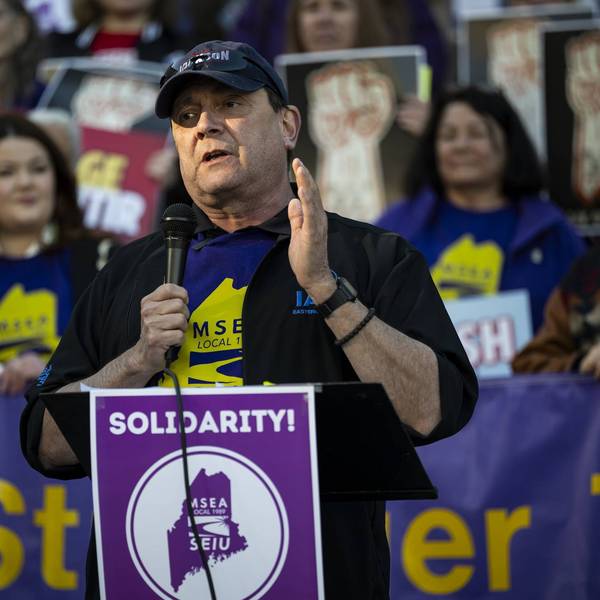
Troy Jackson, Democratic candidate for US Senate, speaks to a woman during a demonstration after a man was fatally shot by US Immigration and Customs Enforcement (ICE) agents on July 14, 2026 in Scarborough, Maine.
(Photo by Ryan Murphy/Getty Images)


Julia Conley
Jul 19, 2026
COMMON DREAMS


As Democratic US Senate candidate Troy Jackson pulled far ahead of his opponents in the race to replace Graham Platner as the party’s nominee on Saturday, one commentator credited the former state Senate president’s campaign with an “extremely impressive organizational feat”—one that was focused on nominating a working-class champion.

Eight of Maine’s 16 counties held in-person and virtual delegate nominating meetings on Saturday, deciding on the first 319 of 500 total delegates who will vote for the Democratic nominee at next weekend’s convention, which was rapidly organized after Platner dropped out of the race last week following rape allegations that he denied.


‘I’ll Be a Vote for Medicare for All’: Troy Jackson Makes His Case After Platner Exit

At least 290 of the delegates who were chosen in the first eight counties backed Jackson, the Bangor Daily News reported. The former logger, who previously ran for governor, has deep union ties, and has been endorsed by Sen. Bernie Sanders (I-Vt.), won at least 148 of the 149 delegates in Cumberland County, all 44 delegates in Penobscot, and 22 of 23 in Hancock, dominating in several other counties as well.

The rest of the state’s counties will vote on delegates at similar meetings on Sunday, but as one election watcher said, “Troy Jackson will almost certainly be the next Democratic nominee for Maine’s 2026 US Senate election.”


Jackson appeared confident enough in Saturday’s results to announce a celebratory tailgate planned for Sunday in York County as voters there would be selecting delegates. The Maine State Nurses Association also announced its endorsement of the candidate on Sunday morning.

After Saturday’s county meetings, Jackson addressed some of his supporters virtually, giving his volunteer network credit for quickly organizing on his behalf after many had previously expected to be campaigning for Platner, who spent nearly a year mobilizing Mainers from across the political spectrum with a platform focused on taxing billionaires, ending US “forever wars” and military aid for Israel, and passing Medicare for All.

“I can’t tell you how much I appreciate all the hard, hard work. I’ve been getting text messages all day about what a great job I did. I didn’t do a goddamn thing, all of you just smoked it,” said Jackson in a video posted on social media. “It’s really, really incredible, so thank you so much. We’re well on our way to getting the government that we fucking deserve, and that’s what I’m excited about.”


Organized volunteers attended some of the county conventions, some wearing “Jackson for Maine” t-shirts leftover from the candidate’s gubernatorial run and passing out flyers with the names of the pro-Jackson delegate slate—supporters whom volunteers had spent the past week calling to secure their commitment to the progressive candidate.

The eight remaining counties will select 181 more delegates on Sunday. Another 101 Democratic state committee members have already been chosen to attend the statewide convention on July 25. Together they make up the 601 delegates who will vote for the party’s nominee.

The party’s nominee will face five-term Republican Sen. Susan Collins, whom Jackson has condemned in recent days for voting to fund US Immigration and Customs Enforcement, which he has called to abolish. An ICE agent fatally shot 25-year-old Johan Sebastián Guerrero in Biddeford, Maine last week.

A poll by Wedgewood earlier this month found Jackson leading Collins in a hypothetical matchup, 48-43, with 9% of voters undecided.

Ahead of Saturday’s meetings, Jackson addressed a crowd of about 100 supporters in Portland.

“I’m running for the logger in Allagash who does not think that anyone in Washington knows about them,” said Jackson. “I’m running for the nurse that’s working another double shift because their hospital is understaffed, and all the while billionaires and massive corporations are making record profits, buying influence in Washington, and telling the rest of us that there is just nothing that we can do.”

“I’m asking for your vote, but I’m also asking for more than that,” he added. “I’m asking you to organize... I’m asking you to talk to your neighbors. I’m asking you to show up at your county meetings, make the calls, send the texts, and bring even more people into this movement.”

Writer Cole Sandick suggested that despite the excitement that Platner’s campaign had generated, many of his supporters appeared to have quickly pivoted toward Jackson, also a Medicare for All supporter and opponent of military aid for Israel, in an effort to ensure progressive priorities are represented in the Senate.


“Working-class organizing wins,” said one Maine-based writer.
Rallying in Michigan, Sanders Says Primary Race Is Between Abdul El-Sayed ‘and the Billionaire Class’

“When the stakes are so high,” said Rep. Alexandria Ocasio-Cortez, “is the answer to our problems to turn to the same playbook over and over again?”


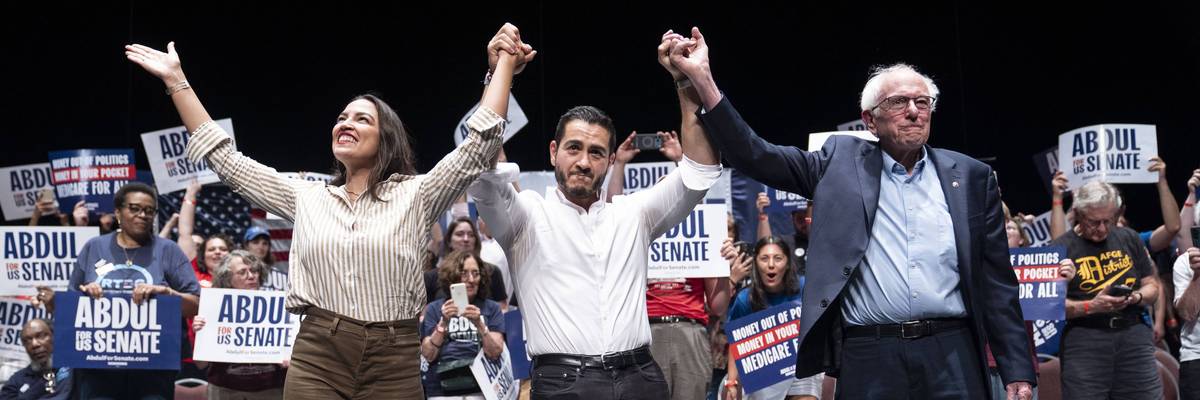
US Rep. Alexandria Ocasio-Cortez (D-NY), Michigan Democratic candidate for Senate Abdul El-Sayed, and Sen. Bernie Sanders (I-Vt.) greet the crowd after El-Sayed spoke at The People v. The Powerful rally at the Detroit Opera House on July 18, 2026 in Detroit, Michigan.
(Photo by Sarah Rice/Getty Images)


Julia Conley
Jul 19, 2026
COMMON DREAM


Ahead of early voting in Michigan’s Democratic US Senate primary, candidate and Medicare for All advocate Abdul El-Sayed was joined in Detroit Saturday evening by progressive leaders, including Sen. Bernie Sanders and Reps. Alexandria Ocasio-Cortez and Rashida Tlaib, for a rally titled: “The People vs. The Powerful.”

The senator declared to 1,600 attendees that the choice in the primary is not simply between El-Sayed and his opponent, Rep. Haley Stevens.

“In all due respect to Congresswoman Stevens, everyone knows that this is not an election between her and Abdul El-Sayed,” said the Vermont Independent senator. “This is an election between Abdul and the billionaire class.”


The final weeks of the primary, in which Michigan voters will go to the polls on August 4, have been marked by reports of massive outside spending in favor of Stevens and against El-Sayed, who has made the refrain, “Money out of politics, money in your pocket, and Medicare for All” the central message of his campaign.

As Common Dreams reported last week, El-Sayed led the way in fundraising in the second quarter of 2026, bringing in $4.6 million while Stevens raised $2.2 million.

But Federal Election Commission (FEC) campaign finance filings showed that outside spending by people and groups supporting Stevens has soared to an estimated $50 million, according to an analysis by Punchbowl News.

“More than half of the total ($28.4 million) is coming from United Democracy Project (UDP),” said congressional reporter Ally Mutnick, referring to the super political action committee (PAC) affiliated with the American Israel Public Affairs Committee (AIPAC), which has also backed the vehemently pro-Israel Stevens in the past.

UDP acknowledged last week that it had spent nearly $15 million on the Michigan Senate primary race so far, including $9.3 million in support of Stevens and $5.7 million against El-Sayed.

El-Sayed is a strong supporter of Palestinian rights and—like a growing majority of Democratic voters after more than two years of Israel’s assault on Gaza—has called for the US to end military aid to Israel.

In recent weeks he has responded to reporters’ frequent questions on his views about whether Israel has a “right to exist,” by asking whether Palestine has a right to exist and, in a Sunday interview with CNN’s Jake Tapper, saying that a more pertinent question for American voters is whether Israel has “a right to our tax dollars.”


At the rally on Saturday night, Sanders said that AIPAC’s focus on funding Stevens’ campaign “has everything to do with the fact that they understand that Abdul and I, and the vast majority of the American people, want a foreign policy that is based on morality and decency.”

“This is an election that will show the nation whether AIPAC and other billionaire-funded super PACs can spend tens and tens and tens of millions of dollars to buy a US Senate seat, or whether, within a corrupt campaign finance system, the voices of ordinary Americans—the people of Michigan—can prevail,” said Sanders. “That is what this campaign is all about. It is about democracy versus oligarchy, and we are on the side of democracy.”


Ocasio-Cortez noted that the contest between El-Sayed and Stevens comes as Americans are struggling to afford groceries, gas, and other essentials while President Donald Trump continues his war against Iran, dismisses working families’ financial struggles, and insists the federal government cannot afford to provide universal public services.

“When the stakes are so high, when more people than ever are living so close to the bone, eventually we have to ask ourselves: Is the answer to our problems to turn to the same playbook over and over again?” said Ocasio-Cortez. “A playbook that says, in order to win, Democrats must rely on the same dark money—$50 million and counting—from the same people who backed 35 election deniers to Congress who voted to overturn the 2020 election?”

“I believe Michiganders—Democrats, Republicans, and independents—believe that good leadership swings for the fences,” said the congresswoman, who has been named as a potential presidential or US Senate candidate in 2028. “Good leadership gets big money out of our system. It takes on the corruption that blocks commonsense solutions that lift working people. And, by the way, it helps not to take their money in the first place.”


“We can choose to reward the $50 million in dark money by voting their way—which, by the way Michigan—do you think that $50 million is for free?” continued Ocasio-Cortez. “Do you think it’s an act of charity? We know how this works. There’s $50 million in this race because they’re expecting a return. It’s an investment... So we can choose that or we can choose Dr. Abdul El-Sayed for the United States Senate.”

On Sunday, as El-Sayed and his high-profile supporters in Congress prepared to rally more voters in Grand Rapids and Lansing, CNN reported that House Minority Leader Hakeem Jeffries (D-NY) and Rep. Gregory Meeks (D-NY) had confronted Sanders in a phone call, complaining about his “meddling” in primary elections.

“The candidates we are supporting are candidates who are representing working people, and I think it’s a long time overdue for the Democratic Party to stop worrying about their wealthy campaign funders and start worrying about the needs of working people,” Sanders told CNN.

CNN correspondent Seung Min Kim suggested that Stevens is seen by Democratic leaders as a safer bet to win the general election in Michigan in a crucial election year. But recent polls have shown her views on Israel and her support from AIPAC, as well as her donations from the for-profit health insurance industry and her opposition to Medicare for All, could harm, not help, Stevens.

Along with big spending from the pro-Israel lobby, the primary race has been characterized in recent weeks by El-Sayed’s call for social media users to refrain from mocking and making personal attacks against Stevens and to focus instead on the issues at the center of the campaign, as well as recent Islamophobic vitriol against El-Sayed, including from Sen. John Fetterman (D-Penn.).

Fetterman told Fox News Saturday that El-Sayed is “essentially, a pro-Hamas candidate that’s been anti-American and deeply anti-Israel,” adding that “44% of Muslims, you know, they have positive views of Hamas.”

Journalist Prem Thakker of Zeteo News called on Stevens to “condemn this racist and Islamophobic rhetoric coming from your allies,” as El-Sayed had earlier called for civility from his own supporters.

El-Sayed pointed to the recent attacks at the rally, saying his opponents “have taken to calling me ‘dangerous.’”

“If you’re a worker who wants our economy to work for you, I’m not dangerous,” said El-Sayed. “If you’re someone sitting in medical debt, wondering what your financial future is because you deigned to see a doctor in the richest, most powerful country in the world, if you’re that person, I’m not dangerous.”


“But if you’re Blue Cross Blue Shield shareholders, yep, I’m dangerous!” he added. “If you’re AIPAC and want to send our money abroad, you damn well better believe I’m dangerous. If you’re Chuck Schumer and want to keep doling out corporate money to elect people who are going to do your bidding, I am so damn dangerous!”

“If you’re somebody who wants government to work for you,” El-Sayed said, “I aim to be the best friend you ever had.”

MONOPOLY CAPITALI$M

Uber to gobble up Delivery Hero in latest food delivery deal


AFP
July 16, 2026

Food delivery giant Delivery Hero operates in dozens of markets worldwide – Copyright AFP Toby Shepheard


US ride-hailing giant Uber has struck a 12.7-billion-euro ($14.6-billion) deal to take over German food delivery behemoth Delivery Hero, the latest consolidation in the industry, the companies said Thursday.

The German firm operates in over 60 markets worldwide and has expanded beyond its traditional food business to “quick commerce”, delivering household items and groceries to customers.

The deal, widely expected after Uber built up a stake in the Berlin-headquartered group, brings together two companies operating in 99 markets which delivered goods and services worth $236 billion in 2025.

“Uber’s global mobility and delivery platform and our shared commitment to innovation make this the right partnership to build on Delivery Hero’s strengths in local food delivery and quick commerce,” said Niklas Oestberg, CEO and co-founder of Delivery Hero.

It is the latest consolidation in the fast-growing global food delivery industry, after US group DoorDash took over Britain’s Deliveroo and Prosus acquired Dutch outfit Just Eat Takeaway.

But the huge deal is likely to attract scrutiny of regulators worldwide due to its potential to reduce competition.

In a bid to placate concerns, Uber will not take over Delivery Hero’s operations in 14 mainly European markets where they already compete, with these businesses instead being sold to a US investment firm.

“There is always a risk with acquisitions that the resulting increase in a company’s market power will be used to push through higher prices,” Kai Hudetz, managing director of the IFH Koeln retail research institute, told AFP.

But he also stressed it was a “major challenge for anti-trust authorities to properly assess acquisitions in the digital sphere”.


– ‘More opportunities’ –


Uber is offering 41.50 euros per share for Delivery Hero — above their price on Thursday of nearly 39 euros — valuing the transaction at 12.7 billion euros.

Shares in Delivery Hero, which was founded in 2011, were volatile in Frankfurt following the announcement, initially dropping over two percent before bouncing back to trade one percent higher.

Uber is acquiring Delivery Hero’s businesses in 50 markets worldwide.

It operates under different brand names around the world: in much of Asia, it is called foodpanda; in parts of Europe and Africa, Glovo; in Latin America, PedidosYa and in the Middle East, talabat.

A US investment firm, SSW Partners, is paying 1.4 billion euros to acquire the German group’s operations in the 14 markets where the firms compete.

Delivery Hero said its management recommended that shareholders accept the offer, and it is expected to be finalised in the second half of 2027.

For the deal to pass, it needs to be accepted by parties holding 50 percent of Delivery Hero stock, plus one share.

The deal had been widely expected after Uber, which also operates food delivery services in many countries on the Uber Eats platform, built up a stake of over 30 percent in Delivery Hero.

Uber CEO Dara Khosrowshahi said a merger would “extend affordable, reliable delivery to many millions more people in some of the world’s most dynamic economies, while creating more opportunities for merchants and couriers”.


EU slaps €550 million fine on AliExpress over illegal and counterfeit goods

AliExpress is an online retail service owned by the Alibaba Group
Copyright Euronews

By Vincenzo Genovese
Published on

The EU’s crackdown on Chinese online marketplaces is accelerating, with aggressive compliance checks and increased charges for imports into the bloc from fast-fashion sites like Temu and Shein.

The European Commission on Monday fined AliExpress €550 million for failing to adequately assess and mitigate risks linked to the sale of illegal, unsafe and counterfeit products on its e-commerce platform.

The decision comes just days after the EU introduced a €3 flat duty on parcels worth less than €150, which had previously entered the bloc duty-free – a move expected to significantly affect the business models of Chinese online retail giants AliExpress, Shein and Temu.

The fine is the latest development in formal proceedings launched in 2024 over a potential breach of the EU’s Digital Services Act. The Commission found that AliExpress failed to establish an effective system to detect and remove illegal products, while underestimating the gap between the number of human moderators available and the scale of their workload.

The platform’s product compliance checks were also found to be vulnerable to abuse, with malicious traders allegedly misclassifying products to exploit less stringent requirements.

According to the Commission’s investigation, large volumes of illegal products – including unsafe toys and dangerous cosmetics – continued to circulate on AliExpress despite moderation efforts, in some cases remaining online for weeks after being flagged.

The Commission also found that AliExpress failed to properly enforce its penalty policy, allowing stores selling illegal products to remain active on the platform even after receiving sanctions.

The company’s brand authorisation system, designed to prevent the sale of counterfeit goods, was deemed ineffective and insufficiently robust to stop abuse, with sellers able to bypass safeguards and list fake products.

AliExpress now has until 20 October 2026 to submit an action plan outlining how it will address the Commission’s concerns. The EU executive will then decide within two months of receiving the plan whether further action is required.

Asked for comment by Euronews, AliExpress replied it has invested substantial resources in risk assessment and mitigation, product safety and consumer protection.

"We disagree with today’s decision and the disproportionate fine, which does not adequately reflect our established framework and the significant, proactive enhancements we have made," the company said in a statement. "We are carefully reviewing the decision and considering all available options."

USA-China-EU: Between Cooperation And Fragmentation In Global Trade – Analysis


July 20, 2026 

By Paweł Gałecki
IFIMES


Key Takeaways:

US-China-EU trade relations in 2026 were marked by escalating tariffs and geopolitical tensions, with Trump’s administration imposing high tariffs on both China and the EU, leading to a 16.6% drop in US-China trade while China strengthened ties with ASEAN and the EU.

Chinese firms in the US demonstrated resilience despite tariff impacts: 79% reported negative effects, but 73% maintained investments, 81% remained profitable, and reinvestment willingness hit record levels (79%), showing long-term commitment.

The article warns of increasing fragmentation (technological decoupling, parallel ecosystems, regulatory barriers like the EU’s CSA2 and IAA), which raises costs and slows innovation, urging a shift toward pragmatic cooperation on global challenges like climate, AI, and supply chains rather than protectionism.


The contemporary international trade system has reached a critical juncture where economic logic yields to geopolitical imperatives. Relations among the USA, China, and the EU shape not only the flow of goods but the foundations of global stability. The year 2026 brought an intensification of tensions, revealing deep contradictions between declared cooperation and the reality of protectionism.

The year 2025 will be remembered as a period of unprecedented escalation of tariff barriers. The second Trump administration introduced tariffs that reached levels threatening bilateral trade. In May, the parties established a 90-day ceasefire, and in November at Davos, tariff reductions were extended through November 2026. Analysts emphasize that stable economic ties among China, the USA, and the EU are fundamental for protecting global supply chains. However, data from the first quarter of 2026 shows clear shifts: USA-China trade declined 16.6% to $128.68 billion, while China’s trade with ASEAN grew 18.4%, and with the EU 17.6%. Despite these turbulences, the fundamental complementarity of the economies remains unchanged. Carlos Gutierrez, former US Secretary of Commerce, stated that if both sides established a framework for coexistence, it could serve as a model for the global system.

Resilience and Fragmentation: Chinese Enterprises Navigating Tariffs, Geopolitics, and Long-Term Commitment in the US Market

According to the 2026 China General Chamber of Commerce – USA report, 79% of Chinese firms in the USA reported negative tariff impacts on their operations. The most common consequences were rising import costs (39%), margin compression (27%), and supply chain disruptions (24%). Tariff uncertainty affected investment decisions; 12% of firms delayed or minimized expansion plans. Most striking was the trend of “position maintenance”: 73% of firms reported no changes in investments, compared to 53% the previous year. Practical examples, however, demonstrate the durability of cooperation. Fujian Zhongjing Petrochemical imported 308,000 metric tons of propane from the US in the first four months of 2026 (34.8% of total imports). JAC Auto Parts reported 30% year-over-year export growth to the USA, reaching 40 million yuan. Yang Weiguo from JAC stated that automotive markets in China and the USA remain complementary, and stable relations are essential for development.


Fifty-five percent of firms assessed that conditions deteriorated in 2025, including 21% significantly. Chinese enterprises demonstrated adaptive capacity: 33% achieved revenue growth, 81% remained profitable. Positive business environment assessments fell to 9% the lowest level since 2018-2020. Particularly striking was the growth in high-margin firms. Enterprises with EBIT margins above 15% increased from 7% in 2024 to 21% in 2025 the highest level in survey history. This signals operational resilience among firms leveraging competitive advantages. Simultaneously, 27% experienced revenue decline, indicating polarization. Despite difficulties, willingness to reinvest reached a record 79%. Half of firms planned to reinvest all profits in the USA, another 29% the majority. This underscores long-term commitment despite emerging barriers. Business objectives reflect a defensive orientation: “rebuilding and developing existing business” ranks first (61%), replacing “improving profitability.” Six percent chose “exit from the US market,” compared to no such declarations in 2025.

According to the 2026 CGCC Report: 82% of firms cited geopolitical uncertainty as the main obstacle to brand building, far exceeding other barriers. Brand recognition has a “pyramidal” character; 70% of firms acknowledged not reaching mainstream American brand levels, 69% reported recognition mainly within Chinese business circles. Fewer than 30% entered the competitive landscape of local brands. Firms indicate that customers value price-to-quality ratio (76%) and product quality and safety (59%). In brand narratives, product quality dominates (68%), followed by collaboration with local partners (43%) and contributions to employment (38%). Emotional elements (23%) and local innovation (25%) are less developed. Firms indicate that most effective for building trust are: partnerships with American companies (62%), product excellence (62%), and emphasizing local employment (59%). Looking ahead, the greatest impact will come from: geopolitical de-risking (54%), AI-driven marketing (49%), and brand value (38%). In practice, firms plan to increase digital marketing investments (41%) and expand decision-making authority for US units (33%). US macroeconomic uncertainty (70%), bilateral tensions (64%), and trade friction (56%) remain primary challenges. “Inflation and instability” ranks first, particularly in the context of the Middle East conflict, which drove oil prices up by one-third.

Escalating Trade Wars and Regulatory Fragmentation: The EU–US–China Triangle at a Crossroads of Industrial Policy and Technological Decoupling

On May 2, 2026, President Trump announced his intention to raise tariffs on EU automobiles from 10% to 25%, accusing the bloc of non-compliance with the July 2025 Turnberry agreement. Trump stated that the new tariff would force the EU to accelerate production relocation to the USA, revealing the true intention – forced reindustrialization. Currently, most EU exports to the USA are subject to a 10% tariff, introduced after the Supreme Court struck down the 15% tariff, ruling the President lacked authority. The Turnberry agreement itself was controversial: it provided for zero tariffs on US exports to the EU and 15% on EU exports to the USA, with production relocation requirements. On May 7, the European Parliament and Cypriot Presidency attempted to finalize an agreement, but without breakthrough. Member states remain divided. Parliament demands safeguards conditioning tariff reductions on US compliance and a sunset clause in March 2028. France supports safeguards, while the German-led bloc prefers the agreement as established.

Bernd Lange, Chair of the EP Trade Committee, stated that higher tariffs are “unacceptable” and that the USA “constantly violates commitments.” Kyriakos Pierrakakis said Europe is ready to respond, though dialogue remains the priority. Potential escalation could affect trade worth $2 trillion annually. Potential 25% tariffs would particularly hit German premium manufacturers: VW, BMW, Mercedes, and Porsche. The situation places European industry before a dramatic choice – relocation entails enormous costs and efficiency losses, while maintaining production with 25% tariffs may render vehicles uncompetitive.

While the EU defends itself against American tariffs, it prepares its own measures against China. The proposed Cybersecurity Act amendment (CSA2) introduces the concept of “non-technical threats,” enabling arbitrary exclusion of suppliers from 18 key sectors. A May 7, 2026 CCCEU and KPMG report warns that regulations could cost the European economy €367.8 billion over five years – equivalent to nearly two years of the EU budget. The greatest burden would fall on Germany (€170.8 billion), France (€46.3 billion), and Italy (€36.5 billion). Liu Jiandong, CCCEU Chairman, characterized the criteria as contradicting principles of equality and non-discrimination. The report indicates that exclusions may violate bilateral investment agreements and WTO principles, threatening claims and disputes. Forced supplier replacement will not benefit cybersecurity but will redirect innovation budgets to infrastructure replacement costs, increase fiscal burdens, and raise consumer prices. In energy, it will delay transformation; in transport, slow decarbonization; in telecommunications, raise 5G costs. China’s Ministry of Commerce warned that the decision will weaken trust, harm cooperation, and undermine supply chain stability.


The Industrial Accelerator Act (IAA) containing “Made in EU” origin requirements and introducing specific vehicle requirements (must be assembled in the EU, at least 70% of component value must originate from the EU, and battery cells must be produced in the EU) significantly points to “In Europe for Europe” solutions. China’s Ministry of Commerce (MOFCOM) formally submitted comments to the European Commission on April 23, 2026, expressing serious concerns about the IAA. China characterized the regulation as containing discriminatory origin requirements, foreign investment restrictions with disproportionate impact on Chinese enterprises. The Ministry warned that EU decisions will compel it to take necessary measures to protect legitimate rights and interests of its firms. EU import market monitoring results showed for Q1 2026 increased imports of goods from China, particularly in textiles, chemicals, and metals sectors. The EU Council decided in 2025 that from July 1, 2026, all small shipments from third countries will be subject to a fixed tariff rate of €3. New regulations apply to parcels valued below €150 and will cover approximately 93% of all e-commerce flows to the EU. The charge is temporary and will remain in effect until implementation of the target EU customs system, likely from 2028.

Stakeholders focusing energy on tariff skirmishes should emphasize cooperation in AI and pioneering technologies. Common interests in open-source AI, big data, quantum computing, 6G, robotics, green transformation, and biotechnology are important for global development. In the context of challenges such as climate change, energy security, and pandemics, technological cooperation becomes a necessity. However, reality shows fragmentation. Export controls on semiconductors, AI restrictions, and firm exclusions create parallel technological ecosystems that may be less efficient and more expensive. Duplication of R&D efforts, standards fragmentation, and restricted talent flows may slow global progress. An example is 5G and 6G development. Chinese firms like Huawei and ZTE have achieved advances and offer competitive prices but are being excluded from Western markets. This forces countries toward more expensive alternatives, delaying deployment. Simultaneously, China develops its own standards, leading toward a world with two incompatible systems. In AI, export restrictions on advanced GPU chips aim to slow development of Chinese capabilities. History shows that restrictions stimulate domestic innovation and lead to greater technological independence. China has increased investments in domestic semiconductor production and alternative computing architectures. Paradoxically, while governments introduce barriers, enterprises continue seeking cooperation. This divergence between government policy and business interests will shape the future of the global technological landscape.
Between Cooperation and Fragmentation: The Strategic Future of the USA–China–EU Economic Triangle

Analysis of the USA-China-EU triangle reveals a fundamental contradiction: economic logic and mutual interdependence mandate cooperation, political imperatives lead to fragmentation. The intensity of this contradiction has reached a level threatening global stability and requires rethinking assumptions about international trade. Key findings indicate several trends. Despite escalation, fundamental complementarity remains unchanged. China is essential as a manufacturing and innovation hub for Western firms; access to Western markets remains crucial for China. Despite a 16.6% decline, USA-China trade reaches $128.68 billion quarterly, testifying to deep integration. Enterprises demonstrate resilience and adaptation. Record reinvestment levels despite deteriorating conditions show long-term commitment. Protectionism under the guise of national security is becoming the dominant tool in both the USA and EU, threatening the multilateral system. The CSA2 amendment (€367.8 billion in costs) and vehicle tariff threats (25%) show that fragmentation extends to transatlantic relations, creating a spiral.


Lack of verifiable evidence of technical threats suggests that politics prevails over economic rationality. Tariff escalation serves as a tool of pressure and forced relocation, not a response to specific violations. Fragmentation costs are asymmetric. Protectionism is not a zero-sum game—everyone loses, though some more than others. Smaller EU economies may be more susceptible to pressure, weakening bloc cohesion. Simultaneous pressure from the USA and EU places Chinese firms before an unprecedented challenge of navigating multiple regulatory environments. This requires not only resources but fundamental rethinking of global strategies and resource allocation. Prospects remain uncertain. On one hand, signals from Davos and partial ceasefire offer hope for stabilization. Visits by American and European business leaders, declarations preferring cooperation indicate that business communities are pressuring policymakers toward pragmatism. On the other hand, structural geopolitical tensions, technological rivalry, and uncertainty about global order complicate long-term planning. For enterprises, adopting strategies balancing political risk with business objectives becomes crucial. Increased localization, supply chain diversification, building local partnerships are foundations of future resilience. Firms effectively navigating this environment will have competitive advantage. Particularly important is developing rapid adaptation capabilities. Enterprises should invest in early warning systems enabling anticipation of regulatory changes. Building relationships with local stakeholders – authorities, communities, partners—can provide protective buffers. Geographic diversification can reduce dependence on single regions and increase shock resilience.

For policymakers in Washington, Beijing, and Brussels, understanding that long-term stability cannot be built on mutual exclusion is crucial. Rational dialogue, transparent technical standards, mutual verification, and dispute resolution mechanisms should replace arbitrary political criteria. History shows that protectionism rarely achieves intended goals and leads to unintended consequences harming all parties. New cooperation frameworks are needed that acknowledge security concerns but prevent their abuse for protectionist purposes. Cooperation in areas of global challenges is particularly urgent. Climate change, health security, cybersecurity, and food security recognize no borders and require coordinated responses. Technological fragmentation hinders cooperation and may slow progress. Green transformation will be more expensive and slower if implemented in isolated national or regional ecosystems. The question is: will leaders have the vision and courage to prioritize long-term stability over short-term political gains? Will business communities effectively articulate interests and influence trade policy? Will multilateral mechanisms regain significance in regulating global trade? The answers will determine the future not only of trade but of global cooperation in facing common 21st-century challenges. The year 2026 showed that the world stands at a crossroads between fragmentation and renewed commitment to rules-based cooperation. Choices made in coming years will have consequences for decades, determining whether the global economy develops toward greater integration and efficiency or increasing fragmentation and inefficiency. In an era of political polarization and geopolitical tensions, the ability to build bridges through quality, transparency, and local engagement may prove the most important strategic resource for globally operating enterprises.


The article presents the stance of the author and does not necessarily reflect the stance of IFIMES.

About IFIMES
IFIMES – International Institute for Middle-East and Balkan studies, based in Ljubljana, Slovenia, has special consultative status with the Economic and Social Council ECOSOC/UN since 2018. IFIMES is also the publisher of the biannual international scientific journal European Perspectives. IFIMES gathers and selects various information and sources on key conflict areas in the world. The Institute analyses mutual relations among parties with an aim to promote the importance of reconciliation, early prevention/preventive diplomacy and disarmament/ confidence building measures in the regional or global conflict resolution of the existing conflicts and the role of preventive actions against new global disputes.

Restoring Our Nation’s Soul From Mass Delusions

The present leadership in Washington has moved aggressively and efficiently—and with venality and myopia—to lay waste to our noble aspirations and our natural endowments. 

What can we do about it?


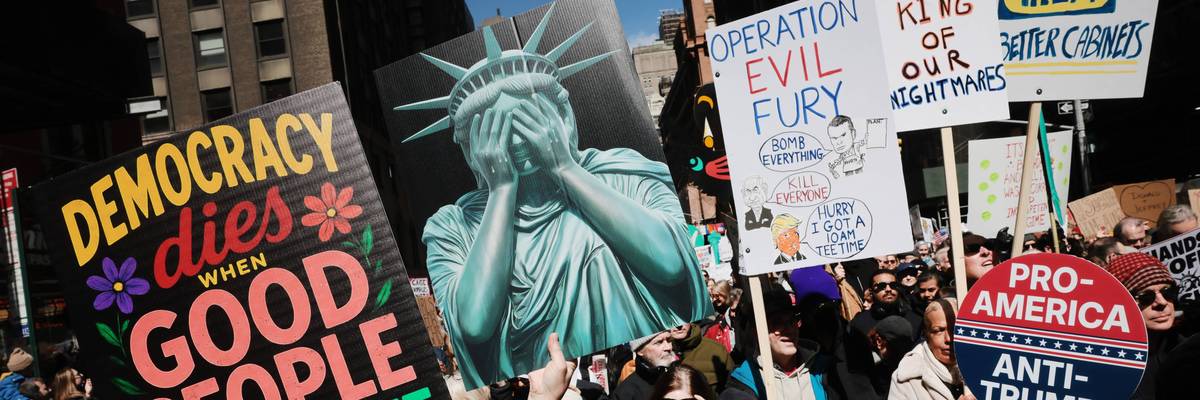
Protesters hold signs as they participate in a “No Kings” protest in Manhattan on March 28, 2026 in New York City.
(Photo by Spencer Platt/Getty Images)

Steve Kaagan
Jul 19, 2026
Common Dreams


Has mass delusion overtaken America’s collective consciousness and eaten into its soul? Rather than “America the Beautiful,” are we becoming “America the Delusional”? The question sprang from speculating that many of my fellow citizens might agree with statements that expertise and evidence have clearly undercut. Would a majority think there was truth in them?

After reading these statements, ask yourself if my concern is warranted.
Technology will protect us from the ill effects of climate disruption.
Next generation Americans will be able to maintain the standard of living they have now.
The Earth will provide sufficient food and shelter for a population exceeding 8.3 billion.
Vigorous enforcement of national borders and deportation of illegal migrants will stem mass migration in the US and across the globe.
Fatal shootings in America will decrease as guns become more widely available.
The US dollar will remain the world’s dominant currency.
Black people and other minorities are narrowing the economic gap with white people.
The US President is the world’s most powerful government leader.
American universities and research centers will continue to be regarded as the best in the world.
The American diet is comparatively as healthy as that of other developed nations.

Having enumerated them, I pondered the toxic effect of such delusions on the soul of our nation. That Washington has mounted a ceaseless campaign of disinformation, on everything from the Iran War to voting integrity to the Reflecting Pool, only adds potency to the poison.

A nation’s soul, writes Gary Kowalski, is its “capacity for valor and visionary change.” Valor springs from confronting fear or pain with firmness and a realistic sense of one’s challenges. Visioning similarly involves the courage and wisdom to chart one’s future course with both creativity and a realistic take on present circumstances.

Nourishing the soul of this nation for 250 years has been its idealistic aspirations and its remarkable natural endowment. Mount Rushmore is a fit representation. All four leaders depicted there exhibited valor and vision on behalf of America’s unique assets, both prior to and during their presidency.

In contrast, the present leadership in Washington has moved aggressively and efficiently—and with venality and myopia—to lay waste to our noble aspirations and our natural endowments.

Our soul is on “life support.” Democratic self-governance and equality of economic opportunity, two pillars of national aspiration, are evaporating month by month. Calculated governmental action—and inaction—are accelerating the arrival of climate-related disasters and diminishing our natural capital.

Despite a grim present, future restoration of the nation’s soul is possible. It begins with each of us accepting in large part the unreality of the contentions listed above and helping leaders and their constituents chart a course within that frame. Whatever form our civic engagement takes, seeing ourselves as unabashed truth seekers is essential. Valorous action and visionary change derive from a firm grasp on what is real, not what is fanciful.

Motivated and supported by allies, we can make a difference. All it would require is each of us focusing on a delusion or two, and through writing, advocacy, or group action, promoting clear-eyed resilience over wishful thinking. Project Soul Restoration begins individually, takes root locally, then spreads regionally and nationally.

Break the mold. Take on the mantle of “influencer” on behalf of the nation’s soul!


Our work is licensed under Creative Commons (CC BY-NC-ND 3.0). Feel free to republish and share widely.


Steve Kaagan
Steve Kaagan is an octogenarian, writer, wooden whale craftsman, teacher, and consultant. He writes at Stevekaagan.substack.com.
Full Bio >

Trump’s War and the Decay of the American Soul


by | Jul 20, 2026

One thing that is always thrown by the wayside in times of war is the maintenance of the national soul. When faced with the inherent brutality of war, the emotions of the moment can overshadow the values we seek to uphold. When the job of maintaining this national soul is left to the state, – a group Murray Rothbard labeled a “centralized, regularized organization of theft” – more enticing projects tend to arise. Often those projects directly harm the citizens of the nation, as by the state’s very nature, they tend to involve aggression, theft, murder or coercion.

Despite the lack of care given by the government to our nation’s soul, it is nonetheless a core pillar of a cohesive country. It defines the virtues our country intends to project to the world.

The “national soul”

This concept is not new. Ronald Reagan famously referred to America as a “shining city upon a hill” in his 1988 farewell address to the nation. He explained that it was our country’s prioritization of freedom for our citizens which made us an example for the world to emulate.

Many have also outlined the danger of losing sight of our national soul. As the war in Iran escalates, and Donald Trump’s rhetoric and actions become increasingly concerning, I am reminded of John Quincy Adams’ famous Independence Day speech from 1821. In the address, he masterfully explains the danger of getting our nation trapped in a web of conflicts across the world and forgetting to focus on the liberty of our domestic population:

“Wherever the standard of freedom and Independence, has been or shall be unfurled, there will her heart, her benedictions and her prayers be. But she goes not abroad, in search of monsters to destroy. She is the well-wisher to the freedom and independence of all. She is the champion and vindicator only of her own. She will recommend the general cause by the countenance of her voice, and the benignant sympathy of her example. She well knows that by once enlisting under other banners than her own, were they even the banners of foreign Independence, she would involve herself beyond the power of extrication, in all the wars of interest and intrigue, of individual avarice, envy, and ambition, which assume the colors and usurp the standard of freedom. The fundamental maxims of her policy would insensibly change from liberty to force. The frontlet upon her brow would no longer beam with the ineffable splendor of Freedom and Independence; but in its stead would soon be substituted an Imperial Diadem, flashing in false and tarnished lustre the murky radiance of dominion and power. She might become the dictatress of the world. She would be no longer the ruler of her own spirit.”

Adams is precise and accurate in his warning. If our nation chooses to export force and war rather than the virtues of liberty, our spirit will be harmed in the process. We will lose track of what it is that makes America unique in the history of the globe, the way we showcase the success that can come when a nation is born out of a longing for liberty.

This warning has unfortunately not been heeded, at least not by those in positions of state power. Rather than focus on domestic liberty, the U.S. federal government has decided its best means to influence the globe is through military force.

Embracing aggression

The U.S. federal government has engaged in non-stop military conflicts for decades, despite the threat to the American homeland being relatively small. Not only have these conflicts been counterproductive in forwarding the cause of freedom, but we are so far down the path of the collapse of the republic that the pretext has been essentially dropped. Now, rather than give us speeches about how Americans must support the cause of freeing a foreign population from their evil dictator, we instead get monstrous social media posts such as this from our president on Easter morning:

“Tuesday will be Power Plant Day, and Bridge Day, all wrapped up in one, in Iran. There will be nothing like it!!! Open the F*ckin’ Strait, you crazy bastards, or you’ll be living in Hell – JUST WATCH! Praise be to Allah. President DONALD J. TRUMP”

While Trump didn’t follow through on this genocidal threat, it shows a lack of basic humanity. Careless as ever, the president showed no regard for the fact that he is speaking to the world as a representative of hundreds of millions of people, including millions of children, who do not wish to become entangled in a religious war that they have nothing to do with.

The whole war with Iran reeks of this same disregard for human life and basic morality. Not only has the rhetoric been shocking but so has the conduct. On February 28, 2026, the first day of the U.S.-Israeli joint military campaign against Iran, the United States struck an elementary school in Minab, killing over 100 schoolgirls. While questions regarding who was responsible for the strike were asked for days, it soon became apparent that the U.S. military was in fact the culprit. However, the U.S. government is still yet to admit this.

In fact, the official “investigation,” – which was the crutch Pete Hegseth used whenever he was asked about the strike – is supposedly still ongoing all these months later. In fact, CNN reported on July 16, 2026, that the U.S. military is still yet to conduct a standard review of the intelligence related to this airstrike.

I would like to believe (and I still do) that this was a tragic mistake. However, we cannot truly come to a conclusion on this saga until the U.S. government explains what happened here. Was this an accident? If so, everybody with the slightest sense of humanity must demand an apology. It is beyond reckless to claim to represent a population and simultaneously commit atrocities like this in their name, without showing an ounce of remorse.

The “Truth” Social Graft

Imperialism has led to the decay of America’s moral standing in the world. This has been seen for the last 25 years, as the U.S. federal government’s adventurism abroad has led to the death of millions and the destruction of nations. This decay has also manifested strategically. As we’ve seen throughout this war with Iran, the U.S. has struggled to get any tangible military wins. America is dangerously low on defensive weapons systems, this war has not achieved any of the goals the Trump administration originally set, and the U.S. has been unable to reopen the Strait of Hormuz, resulting in 20% of the world’s energy supply being unable to reach the global market.

At home, Americans have felt the energy crunch. Gas prices rose for a period of time due to the reduction in the global oil supply, and the U.S. Strategic Petroleum Reserve is dangerously low.

This was all totally predictable. If we simply observed the results of the other wars of the 21st century, we could see clearly that the money printed to fund them causes inflation, which leads to rising prices, and affects Americans in a direct financial manner. Our dollars simply don’t go as far. Simultaneously, there are intangible effects. Social media has been flooded with the murderous social media posts of the president, videos of entire neighborhoods being bombed, and skies in Iran raining oil from the attacks on Iranian energy infrastructure.

The presidents’ posts on Truth Social also represent a different kind of degradation in the soul of America. Trump’s posts serve as de-facto official White House press releases and have the capability to drastically swing financial markets back and forth at a moment’s notice.

With ethics having gone completely out the window, it is somewhat unsurprising to hear about the alleged insider trading activities surrounding this war. Over the course of the conflict, there have been many instances of massive trades being made on oil futures and in the stock market just minutes before major announcements were made by Trump regarding the starting and stopping of attacks on Iran.

To take it one step further, Truth Social, owned by Trump Media, is now offering users the chance to pay for early access to the president’s posts.

The program, known as “Truth API,” would give its users advanced information on the market-shifting announcements of President Trump, allowing them to make financial trades before the rest of the public knows about it. The Trump family are major stakeholders in Trump Media, and Donald Trump himself owns 41% of the company.

This quite literally means that Wall Street asset managers will be paying Donald Trump and his family in exchange for early access to his market-altering public statements.

We are talking about levels of corruption and greed that are unprecedented in modern history. It’s disgusting, and it’s beyond me how even the biggest Trump loyalist could defend this.

A decaying soul

This is the crumbing-empire style of governance. As the system degrades, everyone is trying to take as much as they can for themselves. In the end, they may be comfortable and wealthy as the country crumbles around them. Similarly, those who lack morals likely won’t notice the darkness that arises as a result of their behavior. We on the other hand will be left to fend for ourselves with a diluted currency and a weakened sense of national spirit.

Why should we allow the nation of our ancestors to be irreversibly damaged by these sinister actors? The virtues of liberty have not died, and anger towards pointless wars has only grown in prominence within the American public discourse. There needs to be a reckoning in this country over the damage these wars have done to our national soul.

If America is to once again serve as a shining city for the world to emulate, we must finally have leaders who understand that you can be a constitutional republic or you can be the world empire, but you cannot be both.