One US author called the staggering surge a “reproductive genocide that Western feminists can’t be allowed to ignore.”
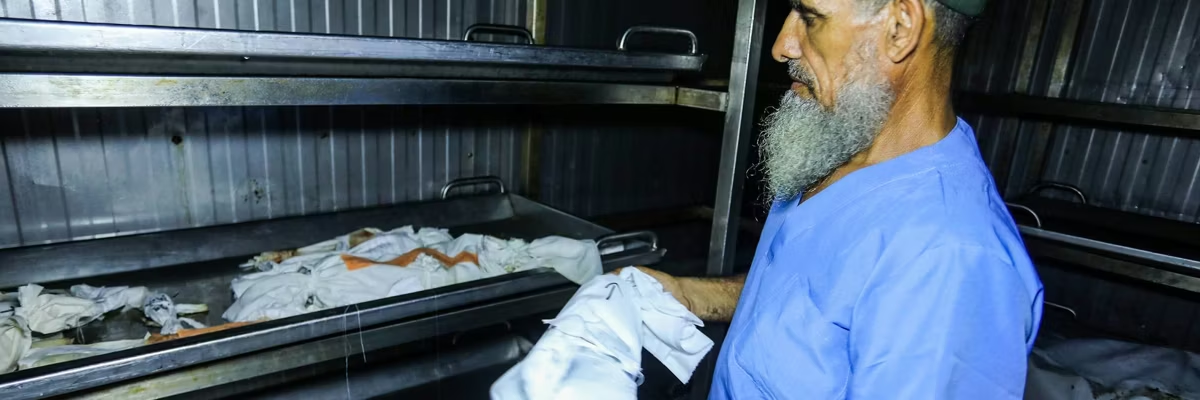
A worker at Nasser Hospital’s morgue adds the wrapped body of a dead newborn baby to a tray containing 19 other miscarriage victims, on July 13, 2026 in Khan Younis, Gaza, Palestine.
(Photo by Abed Rahim Khatib/Anadolu via Getty Images)
Brett Wilkins
Jul 21, 2026
COMMON DREAMS
A senior medical official in the Gaza Strip sounded the alarm on Tuesday over a dramatic rise in miscarriages in the Palestinian exclave, with nearly 4,000 cases reported during the first half of 2026 amid Israel’s ongoing genocide.
Gaza Medical Relief Director Bassam Zaqout said that 3,958 miscarriages were recorded in Gaza during the first half of this year—an increase the doctor called “unprecedented,” and a serious risk to the health of pregnant women and their unborn fetuses.
Zaqout cited the soaring miscarriage rate to factors in Israel’s genocidal assault on Gaza, including the destruction of the strip’s infrastructure, unsanitary living conditions in camps for forcibly displaced Palestinians—where numerous babies have died of hypothermia—lack of hot water and hygiene supplies, and relentless terror caused by Israel Defense Forces bombing.
The Gaza Health Ministry documented 921 miscarriages and 2,004 live births in April. This staggering ratio—460 miscarriages for every 1,000 live births—is more than double that in neighboring nations Israel and Egypt.
Live births have also dropped dramatically in Gaza this year, from 5,210 in January, to 3,433 in February, 3,233 in March, 2,004 in April, and just 1,701 in May 2026, according to the ministry.
Last month, the Gaza Center for Human Rights said that the alarming rise in miscarriages is due to the systematic destruction of Gaza’s healthcare system, repeated attacks on hospitals, and widespread deprivation of food, medicine, and essential medical services amid 33 months of what United Nations experts and others have described as a genocide.
The Gaza Center for Human Rights said the following factors are the most significant drivers of the miscarriage crisis:The widespread destruction of hospitals, primary healthcare centers, maternity wards, and fertility clinics;
Repeated attacks on medical personnel, including the killing, detention, and targeting of healthcare workers;
Mass malnutrition caused by Israel’s siege;
The collapse of maternal and child healthcare services; and
Restrictions on the entry of essential medicines and medical supplies needed by pregnant women and newborns.
The center also noted that Article II of the Genocide Convention—the legal basis for the South Africa-led genocide case against Israel currently before the International Court of Justice—includes “imposing measures intended to prevent births within the group” in its definition of the crime.
United Nations officials and other experts have accused Israel of “systematically” using reproductive, sexual, and other forms of gender-based violence against Palestinians in Gaza and committing “genocidal acts” by deliberately destroying reproductive and healthcare facilities in the strip.
There has also been a documented surge in birth defects among Gaza newborns. According to the Gaza Health Ministry, congenital anomalies doubled in 2025 compared with 2022.
Experts attribute the increase to many of the same factors driving miscarriages, pointing to contaminated water and widespread malnutrition, including the former famine that killed at least hundreds of Palestinians in Gaza, many of them children and infants.
Zaqout warned that Gaza’s health crisis is worsening as severe shortages of medicines, equipment, diagnostic tools, and laboratory supplies persist amid the strip’s heavily damaged healthcare infrastructure and ongoing siege. He also noted the epidemics of diseases such as chickenpox, waterborne illnesses, and respiratory infections.
Numerous Palestinian women have lost their pregnancies due to direct acute trauma inflicted by Israeli bombs and bullets, which have often also killed would-be mothers. Israeli invaders have also ordered the evacuation of Gaza’s hospitals, forcing staff to leave prematurely born babies to die and decompose in incubators.
A United Nations commission of inquiry reported last month that approximately 30% of the more than 73,000 Palestinians killed during Israel’s 33-month war on Gaza were children—many of whom were deliberately targeted. Israeli forces have killed more than 21,500 Gazan children, including 1,022 babies, since the October 7, 2023 Hamas-led attack, according to the Gaza Government Media Office.
The United Nations Children’s Fund has called Gaza “the most dangerous place in the world to be a child.”
Jul 21, 2026
COMMON DREAMS
A senior medical official in the Gaza Strip sounded the alarm on Tuesday over a dramatic rise in miscarriages in the Palestinian exclave, with nearly 4,000 cases reported during the first half of 2026 amid Israel’s ongoing genocide.
Gaza Medical Relief Director Bassam Zaqout said that 3,958 miscarriages were recorded in Gaza during the first half of this year—an increase the doctor called “unprecedented,” and a serious risk to the health of pregnant women and their unborn fetuses.
Zaqout cited the soaring miscarriage rate to factors in Israel’s genocidal assault on Gaza, including the destruction of the strip’s infrastructure, unsanitary living conditions in camps for forcibly displaced Palestinians—where numerous babies have died of hypothermia—lack of hot water and hygiene supplies, and relentless terror caused by Israel Defense Forces bombing.
The Gaza Health Ministry documented 921 miscarriages and 2,004 live births in April. This staggering ratio—460 miscarriages for every 1,000 live births—is more than double that in neighboring nations Israel and Egypt.
Live births have also dropped dramatically in Gaza this year, from 5,210 in January, to 3,433 in February, 3,233 in March, 2,004 in April, and just 1,701 in May 2026, according to the ministry.
Last month, the Gaza Center for Human Rights said that the alarming rise in miscarriages is due to the systematic destruction of Gaza’s healthcare system, repeated attacks on hospitals, and widespread deprivation of food, medicine, and essential medical services amid 33 months of what United Nations experts and others have described as a genocide.
The Gaza Center for Human Rights said the following factors are the most significant drivers of the miscarriage crisis:The widespread destruction of hospitals, primary healthcare centers, maternity wards, and fertility clinics;
Repeated attacks on medical personnel, including the killing, detention, and targeting of healthcare workers;
Mass malnutrition caused by Israel’s siege;
The collapse of maternal and child healthcare services; and
Restrictions on the entry of essential medicines and medical supplies needed by pregnant women and newborns.
The center also noted that Article II of the Genocide Convention—the legal basis for the South Africa-led genocide case against Israel currently before the International Court of Justice—includes “imposing measures intended to prevent births within the group” in its definition of the crime.
United Nations officials and other experts have accused Israel of “systematically” using reproductive, sexual, and other forms of gender-based violence against Palestinians in Gaza and committing “genocidal acts” by deliberately destroying reproductive and healthcare facilities in the strip.
There has also been a documented surge in birth defects among Gaza newborns. According to the Gaza Health Ministry, congenital anomalies doubled in 2025 compared with 2022.
Experts attribute the increase to many of the same factors driving miscarriages, pointing to contaminated water and widespread malnutrition, including the former famine that killed at least hundreds of Palestinians in Gaza, many of them children and infants.
Zaqout warned that Gaza’s health crisis is worsening as severe shortages of medicines, equipment, diagnostic tools, and laboratory supplies persist amid the strip’s heavily damaged healthcare infrastructure and ongoing siege. He also noted the epidemics of diseases such as chickenpox, waterborne illnesses, and respiratory infections.
Numerous Palestinian women have lost their pregnancies due to direct acute trauma inflicted by Israeli bombs and bullets, which have often also killed would-be mothers. Israeli invaders have also ordered the evacuation of Gaza’s hospitals, forcing staff to leave prematurely born babies to die and decompose in incubators.
A United Nations commission of inquiry reported last month that approximately 30% of the more than 73,000 Palestinians killed during Israel’s 33-month war on Gaza were children—many of whom were deliberately targeted. Israeli forces have killed more than 21,500 Gazan children, including 1,022 babies, since the October 7, 2023 Hamas-led attack, according to the Gaza Government Media Office.
The United Nations Children’s Fund has called Gaza “the most dangerous place in the world to be a child.”
‘Nowhere Is Safe’: Israel Kills Gaza Families and Bombs Hospital Despite Ceasefire
“I don’t feel like there is a ceasefire at all,” said a man who witnessed an Israeli missile attack on a hospital.
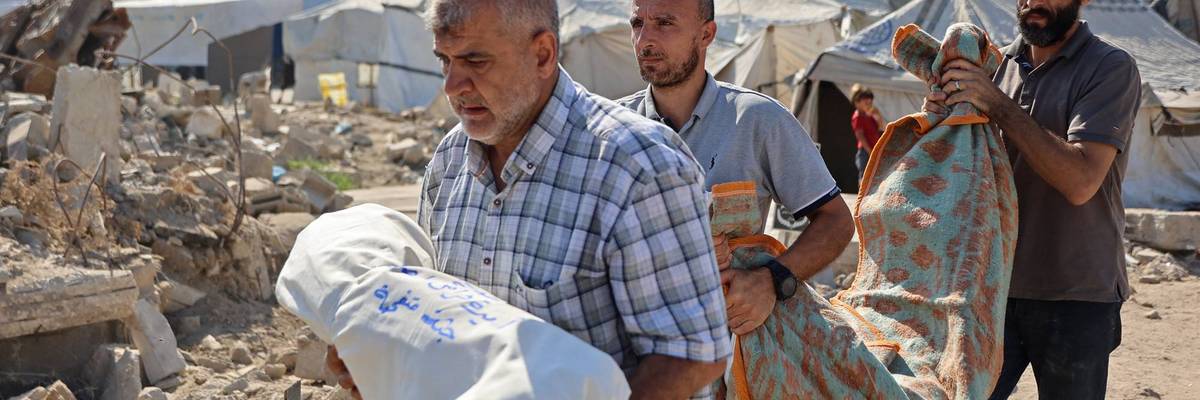
Family members carry the bodies of the Palestinians killed in a July 21, 2026 Israeli airstrike on an apartment in the Sabra neighborhood of Gaza City, Palestine.
(Photo by Omar al-Qatta/AFP via Getty Images)
Brett Wilkins
Jul 21, 2026
COMMON DREAMS
Palestinian officials said an Israel Defense Forces drone strike burned a family of six alive in their Gaza City home on Tuesday, a bombing that followed the massacre of another Palestinian family over the weekend and other attacks—including one on a hospital—as the Israeli genocide continues amid a nominal ceasefire.
The Palestinian Red Crescent Society said that rescue workers initially recovered the charred bodies of a mother, later identified as Salsabeel el-Masri, and her four children from their home in the Sabra neighborhood of Gaza City. Husband and father Firas el-Masri was later confirmed killed in the same strike.
The couple’s three daughters and son—Faryal, Salma, Amira, and Naeem—ranged in age from 6 to 13.
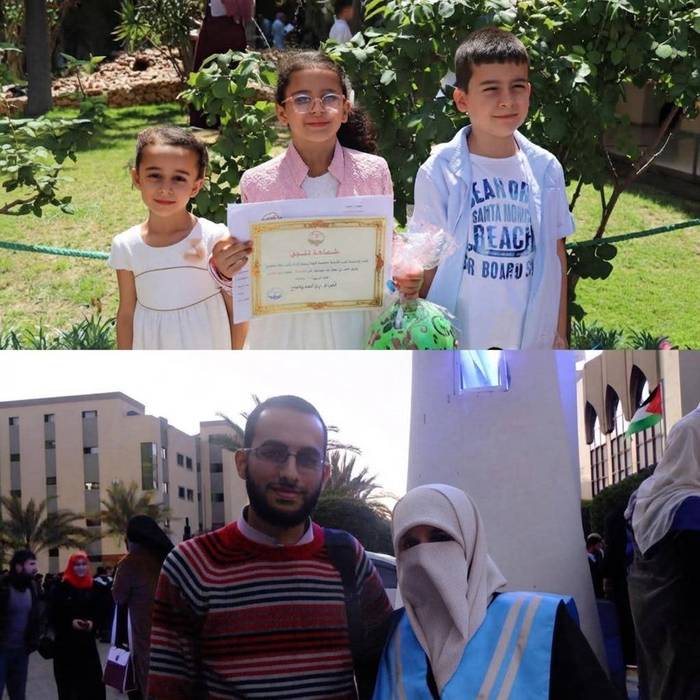
The el-Masri family is one of approximately 2,700 erased from the registry since Israel launched its war on Gaza in retaliation for the Hamas-led attack of October 7, 2023, according to an Al Jazeera analysis published in January.
The Israel Defense Forces confirmed the bombing, claiming the strike was targeting a Hamas member. The IDF dramatically loosened its rules of engagement following the October 7 attack, effectively allowing an unlimited number of civilians to be killed when targeting a single Hamas member, no matter how low-ranking.
Reuters reported at least six more Palestinians were killed by Israeli strikes later on Tuesday, including one targeting a vehicle in the central Gaza Strip.
On Monday, an IDF missile attack on the al-Yemen al-Saeed Hospital in northern Gaza’s Jabalia refugee camp killed at least two people and wounded 16 others, including women and children.
“The children were having fun and playing football, and suddenly they started screaming,” eyewitness Youssef Akasha told Drop Site News contributor Mohamed Ahmed. “We found many children lying on the ground, women screaming, and young men running to rescue the wounded.”
Graphic video footage shows children, including infants, being treated for shrapnel embedded in their bodies.
Israel’s attack on the el-Masri family followed a Saturday IDF airstrike on the home of the Nasman family in the al-Nasser neighborhood of Gaza City that killed five people. The Israeli newspaper Haaretz reported that Adham Nasman, 42; his wife, Marwa, 40; and three of their children—Arwa, 8, Ibrahim, 16, and Yahya, 18—were killed, and that Adham was apparently the intended target.
The couple’s 13-year-old son, also named Adham, was not home at the time of the strike. Video footage published by photojournalist Nahed Hajjaj shows the grieving boy beside the bodies of his slain family.
In another massacre on Saturday, an Israeli drone bombed a funeral in the Nuseirat refugee camp for a man who was allegedly a member of Palestinian Islamic Jihad, who had been killed earlier the same day in another IDF strike. Eight people were killed and 20 others wounded in the second attack, according to Palestinian, Israeli, and international media reports.
Israel’s US-backed assault on Gaza has left more than 250,000 Palestinians dead, maimed, or missing since October 2023 and around 2 million people forcibly displaced, starved, or sickened. Over 21,500 children—1,022 of them babies—are among the more than 73,000 Palestinians killed by Israeli forces during the war that scholars, jurists, human rights groups, a panel of United Nations experts, and others say is a genocide.
Israel is facing a genocide case filed by South Africa at the International Court of Justice and supported by nearly 20 nations, while Israeli Prime Minister Benjamin Netanyahu and Yoav Gallant—his former defense minister who ordered the “complete siege” on Gaza that fueled famine and disease—are wanted by the International Criminal Court for alleged crimes against humanity and war crimes, including murder and forced starvation.
The IDF’s continued attacks come despite a US-backed ceasefire that went into effect last October. Since then, more than 1,160 Palestinians—most of them civilians—have been killed and over 3,750 others wounded by Israeli forces, according to the Gaza Health Ministry.
“Nine months after the announcement of a ceasefire, still nowhere is safe for Palestinians in Gaza,” UN human rights spokesperson Thameen Al-Kheetan told reporters in Geneva on Tuesday. “The killing of civilians in these attacks raises concerns of continuing violations of international humanitarian law, war crimes and other possible atrocity crimes in Gaza. Under international law, deliberately attacking civilians is a war crime.”
Akasha, who witnessed the Jabalia hospital bombing, told Drop Site News, “I don’t feel like there is a ceasefire at all.”
“I don’t feel like there is a ceasefire at all,” said a man who witnessed an Israeli missile attack on a hospital.
Family members carry the bodies of the Palestinians killed in a July 21, 2026 Israeli airstrike on an apartment in the Sabra neighborhood of Gaza City, Palestine.
(Photo by Omar al-Qatta/AFP via Getty Images)
Brett Wilkins
Jul 21, 2026
COMMON DREAMS
Palestinian officials said an Israel Defense Forces drone strike burned a family of six alive in their Gaza City home on Tuesday, a bombing that followed the massacre of another Palestinian family over the weekend and other attacks—including one on a hospital—as the Israeli genocide continues amid a nominal ceasefire.
The Palestinian Red Crescent Society said that rescue workers initially recovered the charred bodies of a mother, later identified as Salsabeel el-Masri, and her four children from their home in the Sabra neighborhood of Gaza City. Husband and father Firas el-Masri was later confirmed killed in the same strike.
The couple’s three daughters and son—Faryal, Salma, Amira, and Naeem—ranged in age from 6 to 13.
(Photo by el-Masri family/X)
At least some members of the family—who were sleeping when their home was bombed—were apparently not killed by the blast.
“They were all burned so much that our crews couldn’t reach them,” said Palestinian Civil Defense spokesperson Mahmoud Basal. “They were screaming and begging us to get them before they were martyred, but all attempts failed.”
Video recordings of the airstrike’s aftermath show first responders desperately trying to extinguish the blaze caused by the attack and retrieving the burnt victims’ bodies.
Ahmed el-Masri told the Emirati newspaper The National that his brother’s “entire family was wiped out from the civil registry.”
At least some members of the family—who were sleeping when their home was bombed—were apparently not killed by the blast.
“They were all burned so much that our crews couldn’t reach them,” said Palestinian Civil Defense spokesperson Mahmoud Basal. “They were screaming and begging us to get them before they were martyred, but all attempts failed.”
Video recordings of the airstrike’s aftermath show first responders desperately trying to extinguish the blaze caused by the attack and retrieving the burnt victims’ bodies.
Ahmed el-Masri told the Emirati newspaper The National that his brother’s “entire family was wiped out from the civil registry.”
The el-Masri family is one of approximately 2,700 erased from the registry since Israel launched its war on Gaza in retaliation for the Hamas-led attack of October 7, 2023, according to an Al Jazeera analysis published in January.
The Israel Defense Forces confirmed the bombing, claiming the strike was targeting a Hamas member. The IDF dramatically loosened its rules of engagement following the October 7 attack, effectively allowing an unlimited number of civilians to be killed when targeting a single Hamas member, no matter how low-ranking.
Reuters reported at least six more Palestinians were killed by Israeli strikes later on Tuesday, including one targeting a vehicle in the central Gaza Strip.
On Monday, an IDF missile attack on the al-Yemen al-Saeed Hospital in northern Gaza’s Jabalia refugee camp killed at least two people and wounded 16 others, including women and children.
“The children were having fun and playing football, and suddenly they started screaming,” eyewitness Youssef Akasha told Drop Site News contributor Mohamed Ahmed. “We found many children lying on the ground, women screaming, and young men running to rescue the wounded.”
Graphic video footage shows children, including infants, being treated for shrapnel embedded in their bodies.
Israel’s attack on the el-Masri family followed a Saturday IDF airstrike on the home of the Nasman family in the al-Nasser neighborhood of Gaza City that killed five people. The Israeli newspaper Haaretz reported that Adham Nasman, 42; his wife, Marwa, 40; and three of their children—Arwa, 8, Ibrahim, 16, and Yahya, 18—were killed, and that Adham was apparently the intended target.
The couple’s 13-year-old son, also named Adham, was not home at the time of the strike. Video footage published by photojournalist Nahed Hajjaj shows the grieving boy beside the bodies of his slain family.
In another massacre on Saturday, an Israeli drone bombed a funeral in the Nuseirat refugee camp for a man who was allegedly a member of Palestinian Islamic Jihad, who had been killed earlier the same day in another IDF strike. Eight people were killed and 20 others wounded in the second attack, according to Palestinian, Israeli, and international media reports.
Israel’s US-backed assault on Gaza has left more than 250,000 Palestinians dead, maimed, or missing since October 2023 and around 2 million people forcibly displaced, starved, or sickened. Over 21,500 children—1,022 of them babies—are among the more than 73,000 Palestinians killed by Israeli forces during the war that scholars, jurists, human rights groups, a panel of United Nations experts, and others say is a genocide.
Israel is facing a genocide case filed by South Africa at the International Court of Justice and supported by nearly 20 nations, while Israeli Prime Minister Benjamin Netanyahu and Yoav Gallant—his former defense minister who ordered the “complete siege” on Gaza that fueled famine and disease—are wanted by the International Criminal Court for alleged crimes against humanity and war crimes, including murder and forced starvation.
The IDF’s continued attacks come despite a US-backed ceasefire that went into effect last October. Since then, more than 1,160 Palestinians—most of them civilians—have been killed and over 3,750 others wounded by Israeli forces, according to the Gaza Health Ministry.
“Nine months after the announcement of a ceasefire, still nowhere is safe for Palestinians in Gaza,” UN human rights spokesperson Thameen Al-Kheetan told reporters in Geneva on Tuesday. “The killing of civilians in these attacks raises concerns of continuing violations of international humanitarian law, war crimes and other possible atrocity crimes in Gaza. Under international law, deliberately attacking civilians is a war crime.”
Akasha, who witnessed the Jabalia hospital bombing, told Drop Site News, “I don’t feel like there is a ceasefire at all.”
Gaza Is in a Water Crisis as Israel’s Blockade Makes Reconstruction Impossible
Water should never be a luxury. Yet, in Gaza, it has become one.
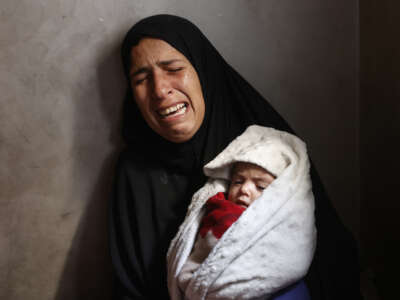
Babies in Gaza Die Preventable Deaths Due to Medical Shortages Imposed by Israel
Mothers in Gaza are losing their newborns as hospitals struggle to function without adequate supplies and resources. By Shahad Ali & Sojoud Alkhour , Truthout July 16, 2026
Before the genocide, Gaza relied on three main water resources: three seawater desalination plants, providing around 7 percent of the Strip’s drinking water; three pipelines operated by the Israeli water company Mekorot, accounting for nearly 13 percent of Gaza’s drinking water; and a network of around 300 municipal wells tapping the Coastal Aquifer for desalination. Alongside them, three wastewater treatment plants recycled treated wastewater, primarily for agricultural use.
The director of the desalination plant in the Central Governorate of the Coastal Municipalities Water Utility, Dr. Muhammad Al-Abwini, told Truthout that, before October 7, 2023, the average share of water per person reached around 80 liters per day, including both domestic and drinking water.
“Although it was still far below the World Health Organization’s recommended [optimal] liters per person per day, it was a milestone for us. It was a breakthrough, given Gaza’s longstanding status quo,” he said.
Despite these achievements, a UN report released in 2018 warned that the water produced in Gaza was unfit for human consumption and that, unless urgent action was taken, the crisis would have disastrous consequences, rendering Gaza uninhabitable by 2020.
Al-Abwini explained that Gaza’s water insecurity largely stems from its geographical location along the coast. Seawater continuously leaks into the Coastal Aquifer, increasing the concentration of total dissolved salts and rendering much of the groundwater unfit for drinking.
“Before the genocide, people received 80 liters of water in their homes, with dignity. Today, 20 liters is the best we can offer, and even that reaches people through an exhausting and undignified process.”
“From there, several master plans were proposed to improve both the quality and quantity of water,” Al-Abwini said.
Yet since the first days of genocide, Israel has weaponized water, turning it into a tool of mass suffering. The Israeli Defense Minister Yoav Gallant ordered the cutoff of water supplies to Gaza just days after October 7.
Then the systematic destruction of water and sanitation infrastructure followed. According to a report by Médecins Sans Frontières released in April 2026, about 90 percent of water, sanitation, and hygiene infrastructure has been damaged or destroyed. Wastewater treatment plants have been put out of service, leaving sewage overflowing across displacement camps, while Gaza’s largest functioning desalination plants have been decimated.
Speaking in a weary voice, Al-Abwini told Truthout, “The Water, Sanitation, and Hygiene (WASH) system has been reduced to ashes. Before the genocide, it was designed with remarkable precision, taking into account both Gaza’s geography and its population density. Yet now, people are crammed into the so-called safe zones and al-Mawasi, which was originally designated for agricultural purposes rather than human settlement. That has further deepened the crisis.”
The ordeal extended far beyond the destruction of infrastructure and the deliberate killing of municipal staff. Engineers and water utility staff struggled to keep the plants functioning, but the complete blackout across Gaza hampered any attempt to revive its Water, Sanitation, and Hygiene system.
Al-Abwini elaborated, “Generators in Gaza were originally intended to operate for only a few hours a day. Today, however, the water sector relies on them almost entirely.”
Yet severe fuel shortages have forced many facilities to shut down. Israel’s restrictions on essential equipment, along with its ban on spare parts under the pretext of “dual use,” have further hindered efforts to restore the water system.
“The desalination plant has been plagued by technical failures … forcing us to run the plant manually,” Al-Abwini said. Damage to critical components reduced “production capacity from 2,500 cubic meters to just 1,200. We spent six months pleading with international organizations to facilitate its entry before it was finally allowed in.”
“I have to buy gallons of water for between two and four shekels each, nearly one dollar per gallon.”
Even beyond the severe restrictions on fuel, tight restrictions remain on both the power capacity and the type of generators allowed into Gaza.
Al-Abwini condemned the policy, saying, “The generator required to operate our desalination plant has a capacity of 1,600 kilowatts. Yet the only generators allowed to enter Gaza — if they are allowed at all — have a capacity of 30 kilowatts or less.”
Lubricating oil, an essential component for operating and maintaining machinery, has also been barred from entering Gaza.
“If we have a generator, we don’t have the oil to run it. And even when we do, the generator is now operating nearly four times beyond its intended workload, yet the lubricating oil is never changed.”
He put it plainly: “This is not a heroic act. This is a slow death for the generators and the gradual dismantling of the entire system. It’s a closed, hollow circle of suffering.”
All these factors combined have paved the way for a humanitarian crisis. According to a May 2026 report from Oxfam, “By early 2026, the United Nations estimated that drinking water availability in Gaza City had fallen below six litres per person per day, well below even emergency humanitarian standards.”
Dr. Al-Abwini proudly said, “Despite the unprecedented challenges, we managed to improve the quantity, reaching 20 liters per person per day for both drinking and domestic use. We considered it as us having had smashed the target, yet it is still far too little compared with the immense need on the ground. Before the genocide, people received 80 liters of water in their homes, with dignity. Today, 20 liters is the best we can offer, and even that reaches people through an exhausting and undignified process.”
Many families have resorted to compensating for the shortages by retrieving water from small private wells or relying on turning brackish water into potable water.
For Abo Ahmed Abo Ghatrous, a 52-year-old unemployed father of seven, domestic water has not reached him for almost a month and a half.
“My suffering to get domestic water far exceeds my struggle to find drinking water,” he told Truthout. “I have been displaced from Rafah for the third year in a row and now live in a tent pitched on agricultural land. I have to buy gallons of water for between two and four shekels each, nearly one dollar per gallon. We need more than seven gallons every day for bathing and cleaning. That means spending more than $200 every month just to meet our basic water needs. And that’s on top of the skyrocketing prices of the containers.”
Speaking in a broken voice, he said, “I can’t take it anymore. What should we do? Where should we go? Life has become unbearable, and the situation grows worse day by day.”
The water crisis has also profoundly affected Gaza’s social fabric.
“It’s a battle for survival,” Abo Ghatrous added. “Any aggressive reaction is understandable. We need water to live.”
Yet he also recalled how he and his neighbors continue to share what little water they have with one another.
Abo Ghatrous, who once cared for olive, lemon, pomegranate, and guava trees, is now bidding them a final farewell.
On the other hand, Al-Shararha stressed that disputes over water can quickly turn violent. “People have been shot over a single gallon of water,” he said.
Back in 2024, an analytical study released by Euro-Med Monitor found that 66 percent of the sample reported severe diarrhea, intestinal diseases, skin rashes, scabies, and vomiting. Each passing additional day of water insecurity and pollution jeopardizes the health of an already immunocompromised population in Gaza.
That is a predictable consequence, given the deteriorating hygiene conditions and the collapse of the desalination and wastewater treatment systems. As a result, waterborne pathogens spiral out of control, threatening many lives.
Abo Ghatrous remarked, “My daughters have developed gastroenteritis multiple times. I also underwent a chondrectomy shortly before the genocide, but my recovery was compromised because I had to haul heavy containers of water.”
The crops on the remaining agricultural land that survived the Israeli bombardment may not survive the water shortages.
Abo Ghatrous, who once cared for olive, lemon, pomegranate, and guava trees, is now bidding them a final farewell, accepting their fate.
“We are barely finding water to drink, let alone enough to water the trees. All of them have withered,” he said in distress.
Not surprised, Al-Abwini remarked, “This genocide has ruthlessly killed life itself — the marginalized people, the environment, humans, plants, and dignity. This genocide has pulverized 50 years of tireless work and investment in the environment. To restore the kind of water situation we had before the genocide, we will need at least decades.”
Looking for a sustainable solution as the scorching summer heat continues to rise, Hatem Abo Tahoun, a Water, Sanitation, and Hygiene system engineer with extensive experience working with international NGOs during emergencies, said the lack of materials continues to hinder any meaningful recovery plan.
“We are working in reverse,” he explained. “We first assess what is still usable, then build our plans around it.”
Water trucks continue to fall far short of people’s immense needs and are no longer an effective solution, Abo Tahoun said:
For now, portable reverse osmosis desalination plants distributed across overcrowded and densely populated areas are the ideal solution. To avoid overcrowding around the plants themselves, they should be supported by distribution networks that make water accessible to as many people as possible. Displacement has forced people to replace proper water storage containers with thin, makeshift ones that no longer meet their needs. Many humanitarian organizations are now working to provide families with durable jerrycans and equip desalination plants with water storage tanks. It is a complementary process. Each part depends on the other. The goal is to mitigate these harsh conditions and help people reach the bare minimum needed for survival.
Regarding domestic water, Abo Tahoun explained, “One practical solution is to reactivate old, unused wells to provide water for household and sanitation purposes, then connect them to distribution networks. This, in turn, would reduce the demand for drinking water supplied by the desalination plants.”
“Everything we are doing is an emergency measure. We cannot address the root cause. All we can do is take a humanitarian approach to keep people from falling into the abyss.”
As fuel continues to stand as a major roadblock, Abo Tahoun suggested, “If solar panels were allowed to enter at scale, they would completely change the humanitarian situation. Instead of facing a cascade of shortages and operating costs, we could rely on a natural resource — the sun.”
Abo Tahoun added, “Earlier in the genocide, we assessed the needs of the plants and, according to the available budget, distributed fuel to private wells so they could operate and provide water free of charge to marginalized families in the surrounding areas.”
Almost all families are now forced to ration their water use by recycling greywater.
“It’s not an effective solution, but we use it for flushing. My own family does the same,” Abo Tahoun said. “We’re running out of solutions. They are simple solutions that should be easy to implement, but without fuel, materials, and the equipment needed to restore the system, they remain out of reach.”
Given that the so-called reconstruction plan remains little more than ink on paper, Abo Tahoun warned: “We are still in emergency mode. We are simply trying to enhance our people’s resilience and preserve their dignity. Gaza’s future remains uncertain. Everything we are doing is an emergency measure. We cannot address the root cause. All we can do is take a humanitarian approach to keep people from falling into the abyss.”
For Al-Shararha, Abo Ghatrous, Al-Abwini, Abo Tahoun and all Gazan families, the unalienable right to water should never be undermined or weaponized. No one should have to chase the sirens of water trucks, queue for hours, or go to sleep thirsty. Water should never be a luxury. Yet, in Gaza, it has become one
This article is licensed under Creative Commons (CC BY-NC-ND 4.0), and you are free to share and republish under the terms of the license.

Hend Salama Abo Helow
Hend Salama Abo Helow is a researcher, writer and medical student at Al-Azhar University in Gaza. She is also a writer with We Are Not Numbers and has published in the Washington Report on Middle East Affairs, Institute for Palestinian Studies, Mondoweiss and Al Jazeera. She believes in writing as a form of resistance, a silent witness to atrocities committed against Palestinians, and a way to achieve liberation.
Water should never be a luxury. Yet, in Gaza, it has become one.
July 20, 2026
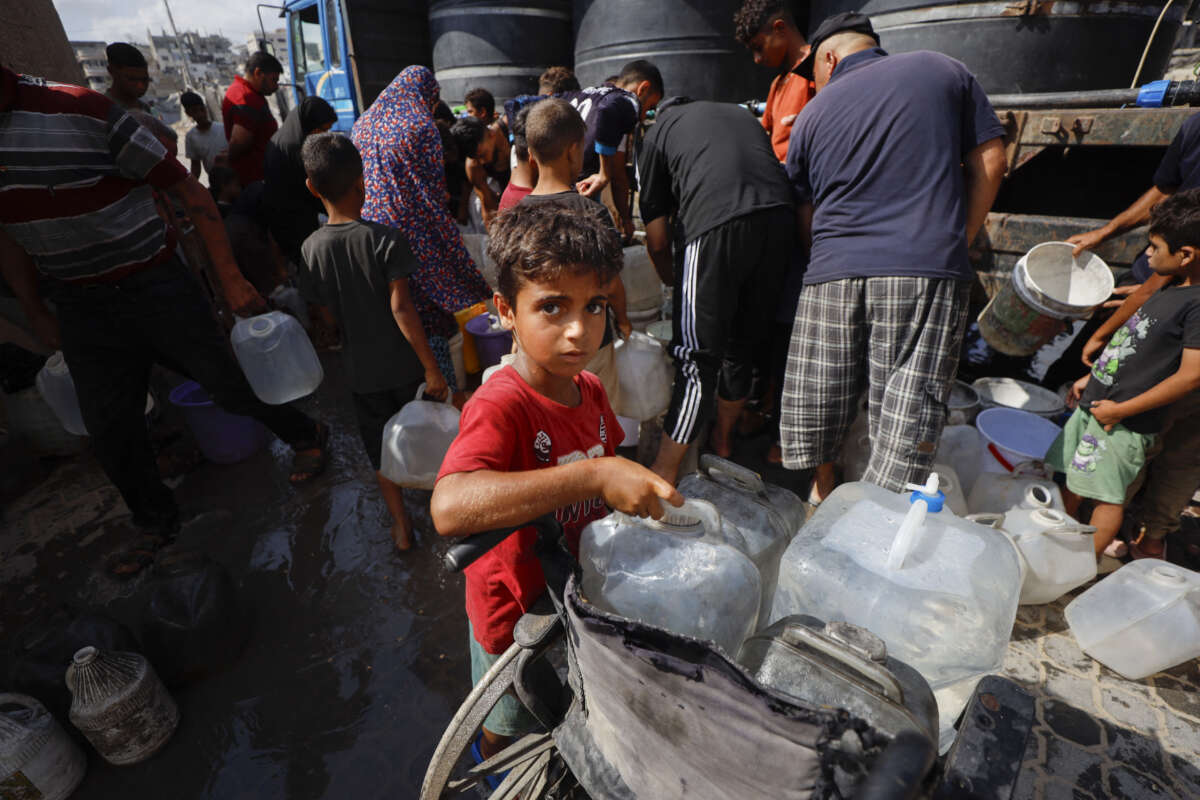
A Palestinian child stands next to a wheelchair loaded with water containers near a water distribution truck in Al-Shati refugee camp, west of Gaza City, Gaza Strip, on July 4, 2026.Ahmed Al Arini / Middle East Images / AFP via Getty Images
Each Tuesday, at exactly 8 a.m., Abo Watan Al-Shararha’s mornings are marked by the distant sirens of humanitarian water trucks. The 39-year-old, who struggles to provide for his family of five, must carry empty jerrycans and venture through the rubble of his neighborhood in al-Zawaida, hoping he will make it to the trucks before the drinking water runs out.
For Al-Shararha, whose name references the Arabic word for “homeland,” home is where he can live with dignity and safety, without battling for life’s most basic necessities. Displaced six times during the genocide, he has reached what he hopes will be his latest refuge.
“But getting water is a matter of luck,” he told Truthout. “Sometimes I manage to fill my containers. Many other times the water runs out before my turn, leaving desperate people who have queued for hours parched and empty-handed. Other times I see the endless line and give up. And sometimes fights erupt over the remaining water, so I am forced to avoid the battle.”
When that happens, Al-Shararha has no choice but to buy water, despite its soaring prices.
“I used to work as a freelancer before the genocide,” Al-Shararha lamented. “We lived a humble life in a residential tower where tap water was available around the clock.”
Each Tuesday, at exactly 8 a.m., Abo Watan Al-Shararha’s mornings are marked by the distant sirens of humanitarian water trucks. The 39-year-old, who struggles to provide for his family of five, must carry empty jerrycans and venture through the rubble of his neighborhood in al-Zawaida, hoping he will make it to the trucks before the drinking water runs out.
For Al-Shararha, whose name references the Arabic word for “homeland,” home is where he can live with dignity and safety, without battling for life’s most basic necessities. Displaced six times during the genocide, he has reached what he hopes will be his latest refuge.
“But getting water is a matter of luck,” he told Truthout. “Sometimes I manage to fill my containers. Many other times the water runs out before my turn, leaving desperate people who have queued for hours parched and empty-handed. Other times I see the endless line and give up. And sometimes fights erupt over the remaining water, so I am forced to avoid the battle.”
When that happens, Al-Shararha has no choice but to buy water, despite its soaring prices.
“I used to work as a freelancer before the genocide,” Al-Shararha lamented. “We lived a humble life in a residential tower where tap water was available around the clock.”
Babies in Gaza Die Preventable Deaths Due to Medical Shortages Imposed by Israel
Mothers in Gaza are losing their newborns as hospitals struggle to function without adequate supplies and resources. By Shahad Ali & Sojoud Alkhour , Truthout July 16, 2026
Before the genocide, Gaza relied on three main water resources: three seawater desalination plants, providing around 7 percent of the Strip’s drinking water; three pipelines operated by the Israeli water company Mekorot, accounting for nearly 13 percent of Gaza’s drinking water; and a network of around 300 municipal wells tapping the Coastal Aquifer for desalination. Alongside them, three wastewater treatment plants recycled treated wastewater, primarily for agricultural use.
The director of the desalination plant in the Central Governorate of the Coastal Municipalities Water Utility, Dr. Muhammad Al-Abwini, told Truthout that, before October 7, 2023, the average share of water per person reached around 80 liters per day, including both domestic and drinking water.
“Although it was still far below the World Health Organization’s recommended [optimal] liters per person per day, it was a milestone for us. It was a breakthrough, given Gaza’s longstanding status quo,” he said.
Despite these achievements, a UN report released in 2018 warned that the water produced in Gaza was unfit for human consumption and that, unless urgent action was taken, the crisis would have disastrous consequences, rendering Gaza uninhabitable by 2020.
Al-Abwini explained that Gaza’s water insecurity largely stems from its geographical location along the coast. Seawater continuously leaks into the Coastal Aquifer, increasing the concentration of total dissolved salts and rendering much of the groundwater unfit for drinking.
“Before the genocide, people received 80 liters of water in their homes, with dignity. Today, 20 liters is the best we can offer, and even that reaches people through an exhausting and undignified process.”
“From there, several master plans were proposed to improve both the quality and quantity of water,” Al-Abwini said.
Yet since the first days of genocide, Israel has weaponized water, turning it into a tool of mass suffering. The Israeli Defense Minister Yoav Gallant ordered the cutoff of water supplies to Gaza just days after October 7.
Then the systematic destruction of water and sanitation infrastructure followed. According to a report by Médecins Sans Frontières released in April 2026, about 90 percent of water, sanitation, and hygiene infrastructure has been damaged or destroyed. Wastewater treatment plants have been put out of service, leaving sewage overflowing across displacement camps, while Gaza’s largest functioning desalination plants have been decimated.
Speaking in a weary voice, Al-Abwini told Truthout, “The Water, Sanitation, and Hygiene (WASH) system has been reduced to ashes. Before the genocide, it was designed with remarkable precision, taking into account both Gaza’s geography and its population density. Yet now, people are crammed into the so-called safe zones and al-Mawasi, which was originally designated for agricultural purposes rather than human settlement. That has further deepened the crisis.”
The ordeal extended far beyond the destruction of infrastructure and the deliberate killing of municipal staff. Engineers and water utility staff struggled to keep the plants functioning, but the complete blackout across Gaza hampered any attempt to revive its Water, Sanitation, and Hygiene system.
Al-Abwini elaborated, “Generators in Gaza were originally intended to operate for only a few hours a day. Today, however, the water sector relies on them almost entirely.”
Yet severe fuel shortages have forced many facilities to shut down. Israel’s restrictions on essential equipment, along with its ban on spare parts under the pretext of “dual use,” have further hindered efforts to restore the water system.
“The desalination plant has been plagued by technical failures … forcing us to run the plant manually,” Al-Abwini said. Damage to critical components reduced “production capacity from 2,500 cubic meters to just 1,200. We spent six months pleading with international organizations to facilitate its entry before it was finally allowed in.”
“I have to buy gallons of water for between two and four shekels each, nearly one dollar per gallon.”
Even beyond the severe restrictions on fuel, tight restrictions remain on both the power capacity and the type of generators allowed into Gaza.
Al-Abwini condemned the policy, saying, “The generator required to operate our desalination plant has a capacity of 1,600 kilowatts. Yet the only generators allowed to enter Gaza — if they are allowed at all — have a capacity of 30 kilowatts or less.”
Lubricating oil, an essential component for operating and maintaining machinery, has also been barred from entering Gaza.
“If we have a generator, we don’t have the oil to run it. And even when we do, the generator is now operating nearly four times beyond its intended workload, yet the lubricating oil is never changed.”
He put it plainly: “This is not a heroic act. This is a slow death for the generators and the gradual dismantling of the entire system. It’s a closed, hollow circle of suffering.”
All these factors combined have paved the way for a humanitarian crisis. According to a May 2026 report from Oxfam, “By early 2026, the United Nations estimated that drinking water availability in Gaza City had fallen below six litres per person per day, well below even emergency humanitarian standards.”
Dr. Al-Abwini proudly said, “Despite the unprecedented challenges, we managed to improve the quantity, reaching 20 liters per person per day for both drinking and domestic use. We considered it as us having had smashed the target, yet it is still far too little compared with the immense need on the ground. Before the genocide, people received 80 liters of water in their homes, with dignity. Today, 20 liters is the best we can offer, and even that reaches people through an exhausting and undignified process.”
Many families have resorted to compensating for the shortages by retrieving water from small private wells or relying on turning brackish water into potable water.
For Abo Ahmed Abo Ghatrous, a 52-year-old unemployed father of seven, domestic water has not reached him for almost a month and a half.
“My suffering to get domestic water far exceeds my struggle to find drinking water,” he told Truthout. “I have been displaced from Rafah for the third year in a row and now live in a tent pitched on agricultural land. I have to buy gallons of water for between two and four shekels each, nearly one dollar per gallon. We need more than seven gallons every day for bathing and cleaning. That means spending more than $200 every month just to meet our basic water needs. And that’s on top of the skyrocketing prices of the containers.”
Speaking in a broken voice, he said, “I can’t take it anymore. What should we do? Where should we go? Life has become unbearable, and the situation grows worse day by day.”
The water crisis has also profoundly affected Gaza’s social fabric.
“It’s a battle for survival,” Abo Ghatrous added. “Any aggressive reaction is understandable. We need water to live.”
Yet he also recalled how he and his neighbors continue to share what little water they have with one another.
Abo Ghatrous, who once cared for olive, lemon, pomegranate, and guava trees, is now bidding them a final farewell.
On the other hand, Al-Shararha stressed that disputes over water can quickly turn violent. “People have been shot over a single gallon of water,” he said.
Back in 2024, an analytical study released by Euro-Med Monitor found that 66 percent of the sample reported severe diarrhea, intestinal diseases, skin rashes, scabies, and vomiting. Each passing additional day of water insecurity and pollution jeopardizes the health of an already immunocompromised population in Gaza.
That is a predictable consequence, given the deteriorating hygiene conditions and the collapse of the desalination and wastewater treatment systems. As a result, waterborne pathogens spiral out of control, threatening many lives.
Abo Ghatrous remarked, “My daughters have developed gastroenteritis multiple times. I also underwent a chondrectomy shortly before the genocide, but my recovery was compromised because I had to haul heavy containers of water.”
The crops on the remaining agricultural land that survived the Israeli bombardment may not survive the water shortages.
Abo Ghatrous, who once cared for olive, lemon, pomegranate, and guava trees, is now bidding them a final farewell, accepting their fate.
“We are barely finding water to drink, let alone enough to water the trees. All of them have withered,” he said in distress.
Not surprised, Al-Abwini remarked, “This genocide has ruthlessly killed life itself — the marginalized people, the environment, humans, plants, and dignity. This genocide has pulverized 50 years of tireless work and investment in the environment. To restore the kind of water situation we had before the genocide, we will need at least decades.”
Looking for a sustainable solution as the scorching summer heat continues to rise, Hatem Abo Tahoun, a Water, Sanitation, and Hygiene system engineer with extensive experience working with international NGOs during emergencies, said the lack of materials continues to hinder any meaningful recovery plan.
“We are working in reverse,” he explained. “We first assess what is still usable, then build our plans around it.”
Water trucks continue to fall far short of people’s immense needs and are no longer an effective solution, Abo Tahoun said:
For now, portable reverse osmosis desalination plants distributed across overcrowded and densely populated areas are the ideal solution. To avoid overcrowding around the plants themselves, they should be supported by distribution networks that make water accessible to as many people as possible. Displacement has forced people to replace proper water storage containers with thin, makeshift ones that no longer meet their needs. Many humanitarian organizations are now working to provide families with durable jerrycans and equip desalination plants with water storage tanks. It is a complementary process. Each part depends on the other. The goal is to mitigate these harsh conditions and help people reach the bare minimum needed for survival.
Regarding domestic water, Abo Tahoun explained, “One practical solution is to reactivate old, unused wells to provide water for household and sanitation purposes, then connect them to distribution networks. This, in turn, would reduce the demand for drinking water supplied by the desalination plants.”
“Everything we are doing is an emergency measure. We cannot address the root cause. All we can do is take a humanitarian approach to keep people from falling into the abyss.”
As fuel continues to stand as a major roadblock, Abo Tahoun suggested, “If solar panels were allowed to enter at scale, they would completely change the humanitarian situation. Instead of facing a cascade of shortages and operating costs, we could rely on a natural resource — the sun.”
Abo Tahoun added, “Earlier in the genocide, we assessed the needs of the plants and, according to the available budget, distributed fuel to private wells so they could operate and provide water free of charge to marginalized families in the surrounding areas.”
Almost all families are now forced to ration their water use by recycling greywater.
“It’s not an effective solution, but we use it for flushing. My own family does the same,” Abo Tahoun said. “We’re running out of solutions. They are simple solutions that should be easy to implement, but without fuel, materials, and the equipment needed to restore the system, they remain out of reach.”
Given that the so-called reconstruction plan remains little more than ink on paper, Abo Tahoun warned: “We are still in emergency mode. We are simply trying to enhance our people’s resilience and preserve their dignity. Gaza’s future remains uncertain. Everything we are doing is an emergency measure. We cannot address the root cause. All we can do is take a humanitarian approach to keep people from falling into the abyss.”
For Al-Shararha, Abo Ghatrous, Al-Abwini, Abo Tahoun and all Gazan families, the unalienable right to water should never be undermined or weaponized. No one should have to chase the sirens of water trucks, queue for hours, or go to sleep thirsty. Water should never be a luxury. Yet, in Gaza, it has become one
This article is licensed under Creative Commons (CC BY-NC-ND 4.0), and you are free to share and republish under the terms of the license.
Hend Salama Abo Helow
Hend Salama Abo Helow is a researcher, writer and medical student at Al-Azhar University in Gaza. She is also a writer with We Are Not Numbers and has published in the Washington Report on Middle East Affairs, Institute for Palestinian Studies, Mondoweiss and Al Jazeera. She believes in writing as a form of resistance, a silent witness to atrocities committed against Palestinians, and a way to achieve liberation.