Iran’s All-or-Nothing Game in the Strait of Hormuz
Brent crude is set to close above $100 for the first time since 2022 as tensions around the Strait of Hormuz intensify.

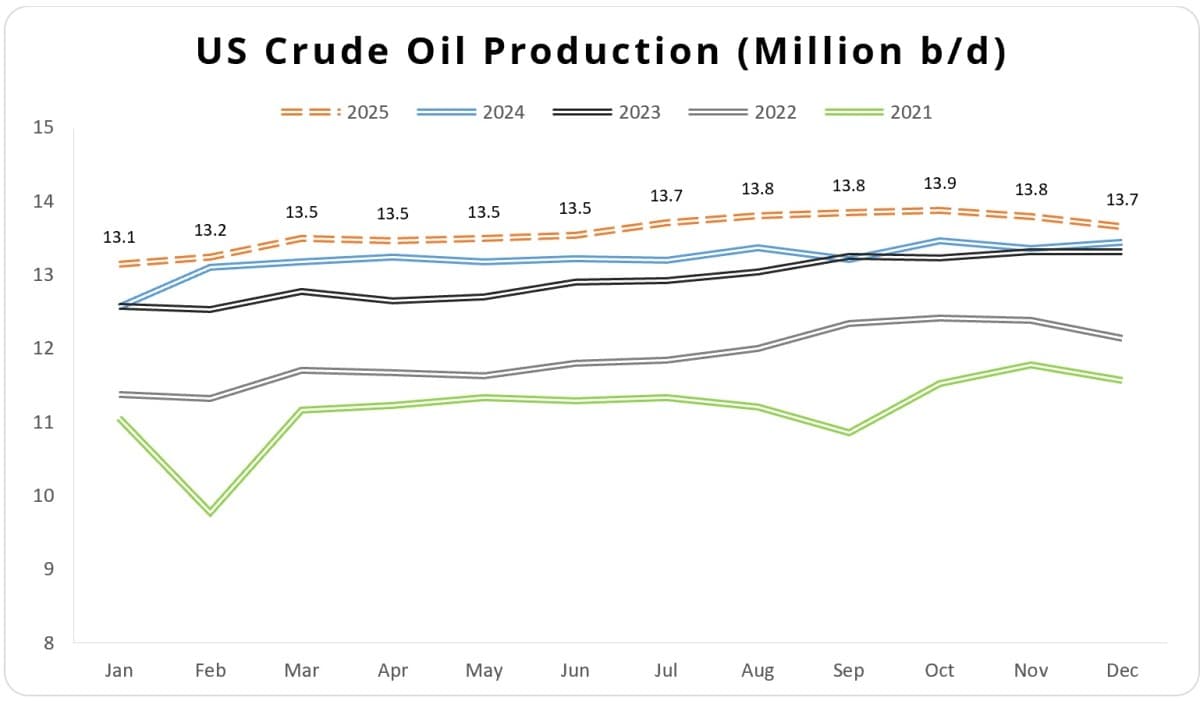
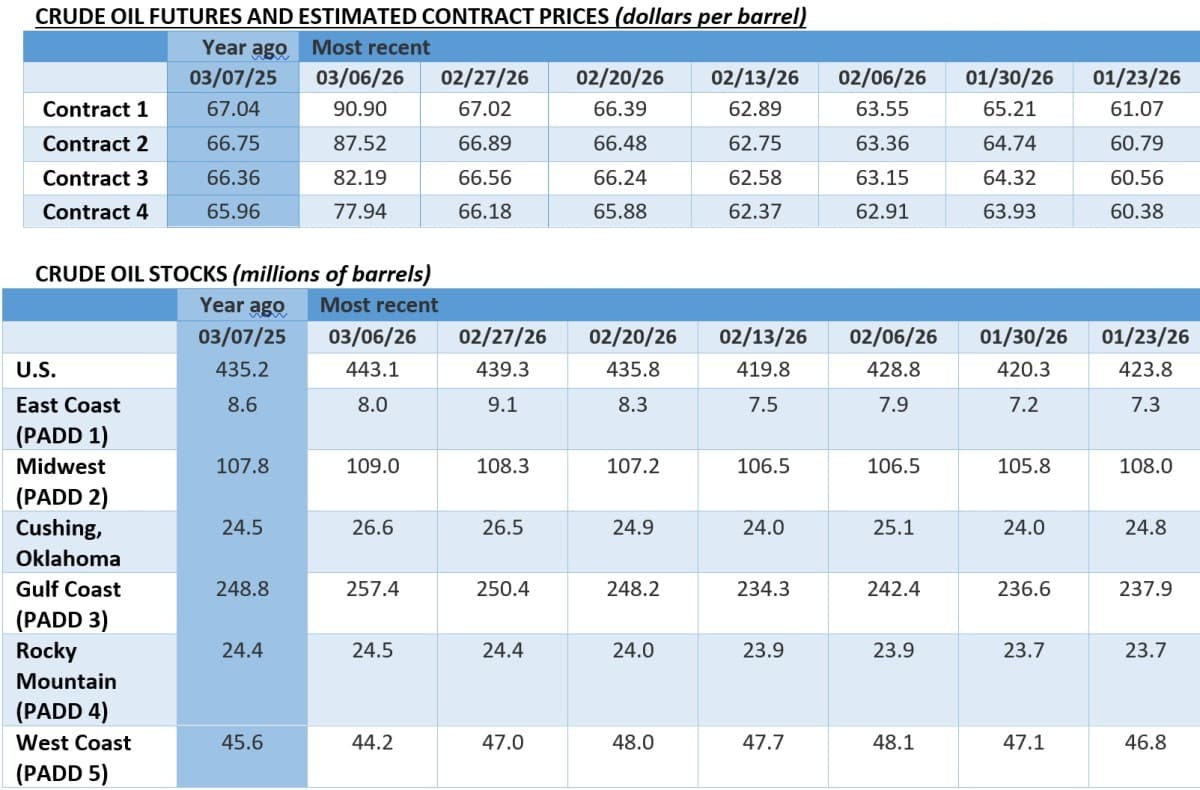
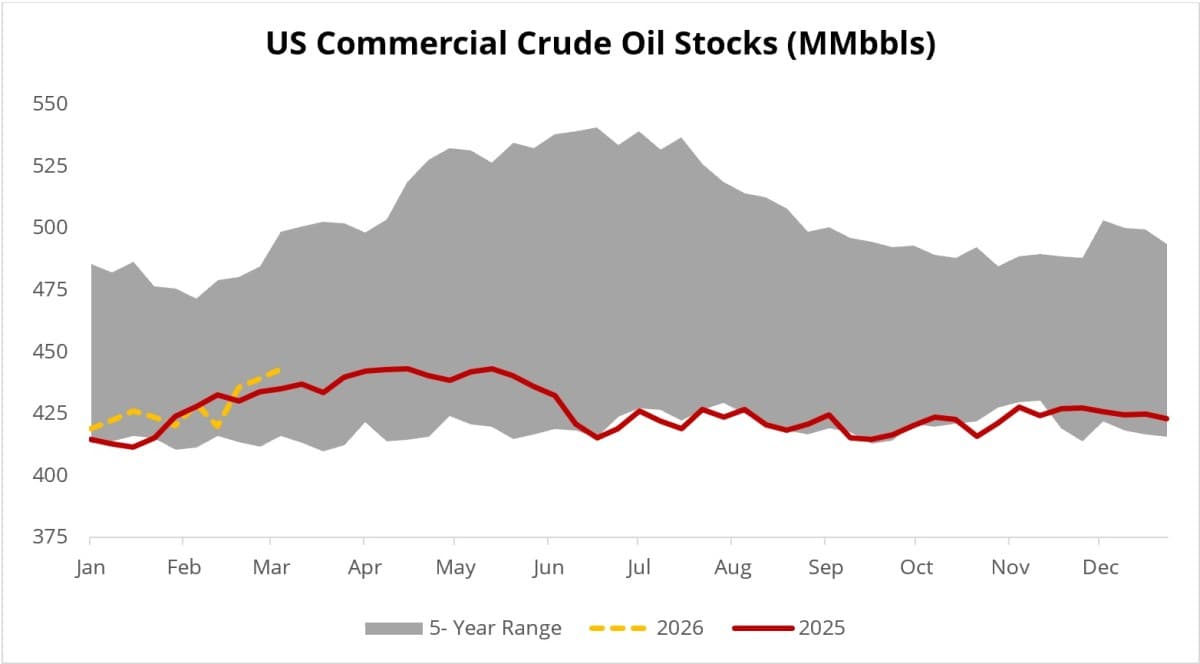


ICE Brent is set to settle above $100 per barrel for the first time since August 2022, undeterred by the US’ easing of sanctions on Russia and the IEA’s mulled release of strategic petroleum stocks. The closure of the Strait of Hormuz sits front and centre to any oil price outlook, with Iran already striking at least 18 vessels since the US-Iran conflict started two weeks ago.
Iran’s New Supreme Leader Goes All In on Hormuz. Iran’s new Supreme Leader, Mojtaba Khamenei, the son of the previous ayatollah, has pledged to continue blocking the Strait of Hormuz, calling it a lever that must be used after unmanned Iranian drones struck two tankers anchored in Iraqi waters.
The World Is Ablaze; EU Sees No Problem. The European Union stated that it does not see any ‘immediate concern’ regarding the security of its oil supplies, even though its leading members, Germany, France, and Italy, have all announced SPR release in line with the IEA’s guidance.
US Grudgingly Admits Escort Difficulties. US Energy Secretary Chris Wright said that Navy escorts of oil tankers through the Strait of Hormuz are not possible currently, at the same time dismissing Tehran’s claims that oil will soon be traded at $200 per barrel, saying the world is well supplied with oil right now.
Russia Oil Sanctions Off for a Month. The US government issued a 30-day waiver for all countries to buy Russian oil and petroleum products currently at sea, provided they loaded before March 12, the latest move by the Trump administration to tame rising crude oil prices amidst blocked Hormuz Strait flows.
Glencore Didn’t Give Up on Rio Tinto Merger. The chief executive of global mining giant Glencore (LON:GLEN) Gary Nagle said that a recent surge in coal prices could bring back Australian peer Rio Tinto (NYSE:RIO) to the negotiation table, aiming to create the world’s largest mining firm worth $240 billion.
Brazil Brings Back the Oil Export Tax. Brazil’s government has scrapped federal taxes on diesel, seeking to mitigate the impending rally of the middle distillate, all the while imposing a 12% export tax on crude oil outflows, notably higher than the 9.2% export tax implemented in early 2023.
Trump Mulls Waiving the 1920 Jones Act. Seeking to tame soaring transportation fuels prices and ease product movements between US states, the Trump administration is considering waiving the century-old Jones Act, banning foreign ships from carrying out intra-US deliveries, for a period of 30 days.
Norway Forbids Its Ships to Enter the Gulf. Norway’s maritime authority has forbidden Norwegian-flagged ships, currently totalling almost 1,500 vessels or 1% of the global tonnage, to enter the Strait of Hormuz until further notice, fearing reputational damage from its tankers being targeted by drones.
Exchanges Turn Against Treasury Intervention. A number of global exchanges, including CME Group and Toronto Stock Exchange parent TMX Group, have voiced their opposition to the idea of the US Treasury intervening in oil futures markets amid rising energy prices on the back of the Iran conflict.
US’ Largest Midwest Refinery All Set for Strike. The USW trade union representing workers at BP’s (NYSE:BP) 450,000 b/d Whiting refinery in Indiana have overwhelmingly (98%) rejected the UK major’s ‘last, best, and final’ collective contract proposal, setting the stage for high-level industrial action.
Colombia Joins the IEA. Colombia has joined the International Energy Agency, becoming its 33rd member country this week, however as a net oil exporter with production levels above 750,000 b/d the Latin American country would not be subject to the IEA’s strategic petroleum storage requirements.
China Doubles Down on BHP Pressure. China’s state-controlled iron ore buyer CMRG has prohibited domestic steel mills and traders to purchase Newman fines, an iron ore grade produced by Australia’s giant BHP (NYSE:BHP), even though negotiations on a potential 2026 term supply deal are still ongoing.
Tengiz Just Cannot Get Any Rest. Kazakhstan’s largest oilfield, the 950,000 b/d Tengiz project, has suffered another fire incident, less than two months after a power plant blaze debilitated production for several weeks. Operator TCO indicated that the current output of 875,000 b/d will not be impacted.
Australia Taps into SPRs as Inventories Shrink. Australia has become one of the first movers amongst IEA countries to tap into its strategic product stocks, pledging to release 5 million barrels of gasoline and diesel into the domestic market as China’s product export ban jeopardizes the country’s supply.
Iraq Pins Its Hopes on Truck Transfers. Iraqi oil producers slashed oil output by 3 million b/d as the closure of the Strait of Hormuz led to a tank-top situation across the country’s upstream and storage sites, with Baghdad hoping to move 200,000 b/d of crude in trucks to neighbouring Turkey and Jordan.
By Tom Kool for Oilprice.com
Iran Doesn’t Need a Navy to Threaten Global Oil Supply
- U.S. and Israeli strikes have severely damaged Iran’s conventional naval fleet, sinking dozens of vessels and destroying several major warships.
- Iran’s IRGC Navy continues to threaten shipping through asymmetric tactics, including drones, mines, and fast-attack boats.
- The persistent risk to tankers has effectively halted commercial traffic through the Strait of Hormuz, a route that carries roughly 20% of global oil supply.
The United States and Israel have largely destroyed Iran's conventional naval fleet in a massive bombing campaign since February 28.
But Tehran's threat to the Strait of Hormuz, one of the world's most important shipping routes, has not diminished. Iran has effectively closed the narrow waterway, through which 20 percent of the world's oil supplies flow, by using asymmetric warfare tactics.
Besides Iran's conventional navy, the powerful Islamic Revolutionary Guards Corps (IRGC), the elite branch of the country's armed forces, has its own naval units that continue to hound and attack shipping in the Persian Gulf.
"While I think the Iranian Navy is largely combat ineffective at this point, the IRGC Navy remains able to harass shipping," said Sascha Bruchmann, a military and security affairs analyst at the London-based International Institute for Strategic Studies.
"That maintains a specter of danger that most civilian shipping lines and insurers will find unacceptable," Bruchmann added.
Decimated Navy
The United States has decimated Iran's conventional navy since February 28.
The US military said on March 11 that it had sunk 60 Iranian vessels. Satellite imagery and publicly disclosed military footage suggest most of Iran's naval fleet has been damaged or destroyed.
Iran's two Mowj-class warships, its Alvand-class frigate Sabalan, and the forward-basing ship Makran -- which gave Tehran a limited long-range power projection capability -- are gone. So, too, are hundreds of the fast-attack boats that formed the backbone of the IRGC's naval asymmetric strategy in the Persian Gulf.
On March 4, a US submarine torpedoed Iran's IRIS Dena warship in the Indian Ocean near Sri Lanka as the frigate returned from multinational exercises, with roughly 180 personnel onboard.
It was the first confirmed wartime submarine sinking of a surface warship since Britain sank the Argentine cruiser General Belgrano in 1982 during the Falklands War, highlighting the reach and intent of the American campaign.
But those losses have not reduced Iran's threat to shipping in the Persian Gulf, experts say.
Iranian projectiles struck the Mayuree Naree, a Thai-flagged civilian tanker, on March 11 while it attempted to transit the strait. Photographs from the crew's evacuation showed damage just above the waterline near the stern, a typical signature of explosive-laden surface drones that strike at waterline level.
Iran's Naval Doctrine
Iran changed its naval doctrine after the US Navy sank around half of Iran's conventional fleet in a single day in April 1988. The attack was in retaliation for the mining of a US warship days earlier.
Experts say the incident showed Tehran that symmetrical naval warfare against a superpower was a losing proposition.
What followed was a decades-long pivot toward asymmetric tools such as fast-attack boats, shore-based anti-ship missiles, naval mines, midget submarines, and, more recently, unmanned surface vessels (USVs) configured as floating bombs.
Iran institutionalized this split into two separate navies, symmetrical and asymmetrical forces.
The Iranian Navy, as part of the regular military, maintained a conventional fleet for prestige and occasional long-range deployments, including a transatlantic voyage as recently as 2021.
But the real warfighting instrument was the IRGC's navy units, which were purpose-built for harassment and denial operations in the Persian Gulf's shallow, island-cluttered waters, where geography compresses distances and partly neutralizes the advantages of a superior conventional force.
Over the years, the IRGC's naval force has released footage of underground storage facilities housing fast-attack boats, some likely configured as unmanned surface vessels or suicide boats.
It is a tactic used by Ukraine against Russia's Black Sea Fleet, although experts say the Iranian variants are less technically sophisticated.
"I doubt they could inflict the same kind of damage on US warships that Ukraine could on Russian ships," Bruchmann said, adding the more plausible target is civilian shipping that supplies global oil markets.
US Central Command said on March 10 that it had sunk 16 Iranian mine-laying ships.
But Mohammad Farsi, a former Iranian naval officer, told RFE/RL's Radio Farda that the focus on mines misses the point.
"Any vessel can do it, even the IRGC speedboats currently in the Persian Gulf," he said.
"In my opinion as a naval officer, there is no need for Iran to plant mines in the mouth of the Persian Gulf right now. The reason ships aren't passing through is that companies know the probability of being hit is extremely high."
He pointed to Iranian drone capabilities near the islands of Qeshm, Hengam, and Larak -- positioned close to the main shipping lanes -- as the more immediate threat.
By RFE/RL
Iran's Nuclear Option Isn't a Bomb
- Nearly one-fifth of the world’s oil supply passes through the Strait of Hormuz, making it the most critical chokepoint in global energy markets.
- Iran does not need to physically close the strait; mines, missiles, drones, and harassment tactics could make the route too dangerous for commercial shipping.
- Even a temporary disruption could trigger major oil price spikes and force military intervention to restore global energy flows.
For decades, global attention has focused on the potential “red line” of Iran’s nuclear program. Intelligence agencies track centrifuge installations, debate enrichment levels, and speculate about the possibility of a nuclear breakout.
But while the world has been watching Iran’s nuclear program, it has a far more immediate strategic lever.
Iran’s most powerful weapon is not a bomb. It is the geography it controls.
The Strait of Hormuz is a narrow shipping corridor between Iran and Oman. If that passage is effectively closed or significantly restricted for any sustained period, the economic consequences could rival those of a major military escalation.
Markets are already reacting to the possibility. West Texas Intermediate crude oil has soared past $110 per barrel as traders price in rising geopolitical risk. But that move may only represent the early stages of a potential energy shock if tensions escalate further.
The real issue is not simply higher fuel prices. It is the vulnerability of a global energy system that depends heavily on a handful of critical transit routes.
The World’s Most Dangerous Energy Chokepoint
The Strait of Hormuz is the most important chokepoint in the global oil system—and it may also be Iran’s most powerful strategic weapon. Nearly 20% of the world’s oil supply flows through the narrow waterway, making any disruption there a potential shock to the global economy.
For decades, analysts and policymakers have warned about the possibility that Iran could close the strait in the event of a military confrontation. Each time tensions escalate, the question resurfaces: Could Iran actually do it?
The answer is not as complicated as many people think. It comes down to geography and mathematics.
The Mathematics of a Chokepoint
The Strait of Hormuz sits between Iran to the north and Oman to the south. On a map, it appears wide enough that closing it might require a large-scale naval battle.
But global shipping doesn’t work that way.
Commercial vessels follow strict maritime traffic lanes designed to prevent collisions and maintain orderly transit. In the case of Hormuz, those lanes compress the movement of the world’s oil supply into a remarkably narrow corridor.
And that creates a powerful chokepoint.
At its narrowest point, the Strait of Hormuz is about 21 miles wide. That may sound spacious, but tanker traffic does not spread across the entire waterway.
Instead, ships follow a traffic separation scheme consisting of two shipping lanes roughly two miles wide each, separated by a two-mile buffer zone. In practical terms, the arteries of the global oil system are compressed into just a few miles of navigable water.
Even more significant is the geography. The northern shipping lane runs relatively close to Iran’s coastline. From shore-based positions, Iranian forces can easily cover the entire transit corridor with anti-ship missiles, drones, artillery, and radar systems.
The ships themselves are hardly difficult targets. Modern supertankers can carry two million barrels of crude and move slowly through the confined channel. Their size and predictable routes make them highly visible and vulnerable.
But missiles are only one part of the equation.
Naval mines are among the most effective tools ever developed for shutting down narrow waterways. Iran has spent decades building that capability, and even a relatively small number of mines can halt commercial shipping.
You don’t need to sink dozens of ships. Once a single tanker hits a mine—or insurers believe the threat is credible—traffic can stop almost immediately.
Military planners call this anti-access / area-denial strategy. The goal is not to defeat the U.S. Navy in open battle. The goal is to create conditions so dangerous that commercial shipping simply refuses to enter.
And that is the critical point.
Iran doesn’t need to physically block the Strait of Hormuz with ships or barriers. They just need to make it too risky to use.
Why Markets Pay Attention
Because so much oil flows through Hormuz, even the perception of disruption can move markets.
Saudi Arabia, the UAE, and other Gulf producers have built pipelines that bypass the strait, but those routes only cover a fraction of the region’s export capacity. The majority of Gulf oil still depends on tanker transit through Hormuz.
If that flow is interrupted—even temporarily—the global energy system would feel the shock almost immediately.
Oil inventories could cushion the blow for a short period, but sustained disruption would tighten supply and send prices sharply higher. The ripple effects would reach far beyond energy markets, affecting transportation costs, inflation, and economic growth worldwide.
This is why every flare-up in the Persian Gulf sends traders watching tanker traffic and satellite imagery. The Strait of Hormuz isn’t just another shipping route.
The Real Strategic Question
Despite the constant rhetoric, a prolonged closure of the strait would carry enormous risks for Iran as well. Its own oil exports move through the same waterway, and a direct confrontation with U.S. and allied naval forces could escalate rapidly.
But the strategic leverage remains.
Iran does not need to permanently seal the Strait to disrupt global markets. If Iran were to mine the strait, deploy anti-ship missiles, or harass tankers with drones and fast boats, commercial traffic could halt almost immediately. Even clearing mines and restoring safe passage could take weeks or months while the U.S. Navy hunts down launch sites, missile batteries, and mine-laying vessels along Iran’s coastline.
That creates a dangerous escalation dynamic. Once global oil markets begin to seize up and pressure mounts from allies and energy-dependent economies, Washington would face enormous incentives to forcibly reopen the strait. What begins as a naval and air campaign to secure shipping lanes could easily expand into a broader effort to neutralize Iranian military infrastructure along the Gulf coast. That is where the risk of a deeper conflict, potentially involving ground forces, begins to grow.
Iran may never detonate a nuclear weapon. But by threatening the world’s most important oil chokepoint, it already possesses a strategic lever capable of shaking the global economy and pulling major powers deeper into the conflict.

No comments:
Post a Comment