Russia’s nuclear exports a flourishing geopolitical asset, after four years of Ukraine war

Four years after the invasion of Ukraine triggered sweeping Western sanctions, Russia has managed to preserve one of its most important channels of global influence: civil nuclear exports.
Russia’s nuclear exports are booming. Since the Chernobyl disaster in the 1980s, Russia has closed down all the RMBK-type reactors and replaced them with its state-of-the-art VVER reactors that are considered to be some of the safest in the world.
Today, Moscow’s state nuclear corporation, Rosatom, “remains the world’s leading exporter of nuclear reactors” and continues to secure long-term energy partnerships across emerging markets, according to a report by the Washington-based Center for Strategic and International Studies (CSIS). With more than two dozen projects overseas and multiple countries entirely dependent on Russian nuclear fuel supplies, the West has reframed from imposing sanctions on Rosatom or uranium exports.
Uranium is the new gas. The Kremlin has used energy relations to build up a client base that is dependent on Russia for a large part of its energy generation. Rosatom’s business model is nuclear technology deals that usually come with long-term financing, maintenance and 60-year fuel supply obligations that bind clients to Moscow for the long-term.
The geopolitical implications are significant. CSIS argues that civil nuclear agreements “bind partner countries into long-term technological and fuel dependencies”, giving Moscow durable influence over critical infrastructure and energy policy.
Rosatom’s pitch is particularly attractive package for poor countries in the Global South, seeking to expand nuclear power but lacking domestic expertise or capital. By providing state-backed financing of up to 90% of the cost of a project on easy terms, alongside construction and operational support, Rosatom has secured projects in regions including the Middle East, Asia and Africa.
At the same time, the war in Ukraine has prompted renewed efforts in the US and Europe to weaken Russia’s dominance in the nuclear fuel market. Russia controls a substantial share of global uranium enrichment capacity and fuel fabrication, creating a strategic vulnerability for many Western reactor operators. The US has formally banned the import of Russian uranium, but as it has little domestic production of enriched uranium of its own, it has simultaneously issued all US importers of Russian uranium a waiver until 2028 when the US’ own production is supposed to come online.
Russia has also used its uranium exports as a geopolitical weapon. It threatened to ban uranium exports to the US in September 2024, after the US gave Ukraine limited permission to use Nato-made on targets inside Russian territory. However, Deputy Foreign Minister Sergei Ryabkov said the decision would “not be taken lightly,” and was never implemented.
IAEA and Russia discuss Zaporizhzhia nuclear plant situation

Grossi said the topics covered included the "current safety, security, and safeguards situation" at Zaporizhzhia Nuclear Power Plant, "including the IAEA-brokered ceasefires that enabled repairs to restore the plant's back-up power line".
He added that the presence of agency experts at the plant - which has been under Russian military control since March 2022 and is close to the frontline of Russian and Ukrainian forces - "remains essential to prevent a nuclear accident".
Rosatom said Grossi "was briefed on the ongoing work, jointly with Rostekhnadzor, (Russia's nuclear regulator) to prepare for the launch of the plant's power units, including obtaining the relevant licences from the Russian regulatory agency".
Since December Rostekhnadzor has issued 10-year operating licences for units 1 and 2 of the Zaporizhzhia plant - although Rosatom has said the units will not be restarted while the military conflict continues.
According to the official Russian Tass news agency citing comments made after the talks: Likhachev said that equipment needed to address the plant's water supply issues had already been manufactured; Grossi said he believed electricity generation at the plant can only resume after hostilities end, because there must be no threat to the nuclear facility; and said the IAEA would continue to establish local ceasefires for safety work/restoration of power at the plant.
According to Interfax, Likhachev also said that, regarding restarting Zaporizhzia units, "in terms of electricity sales and electricity use, we are prepared to consider an international and even multilateral format for this activity", although "of course, the state corporation Rosatom will operate and guarantee the safe operation of the station".
Ukraine's long-standing position has been that the best way to ensure safety and security at the six-unit plant is for it to be returned to its control, and put back under its regulatory control.
Infrastructure work under way for Namaru uranium deposit
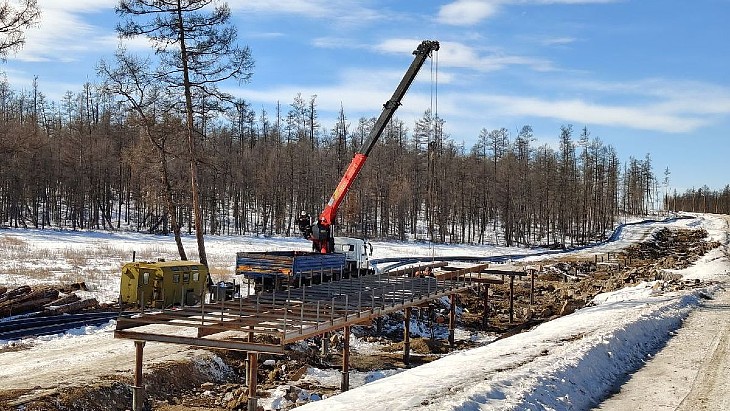
JSC Khiagda, part of Rosatom's mining division, is Russia's leading uranium producer with operations at five deposits "in the challenging permafrost conditions of the Bauntovsky Evenki District", in a region which is north of Mongolia and near Lake Baikal.
For the deposit's development, pipelines are to be laid from the company's main building to the deposit, which will "deliver specialised solutions to process wells for in-situ leaching", also known as in-situ recovery, Rosatom said.
Service roads being built alongside the pipelines will "ensure year-round, unimpeded access for production equipment to process units, wells, and drilling sites, equipment installation, and operational maintenance" and mobile phone and internet services are being installed.
Anatoly Mikhailov, CEO of JSC Khiagda, said: "The development of the Namaruskoye deposit is an important stage in the long-term development programme of JSC Khiagda. The implementation of this project will allow us to develop new reserves, gradually increasing uranium production volumes and ensuring uninterrupted supplies of strategic raw materials for the Russian nuclear industry."
Rosatom said that the plan is to complete the infrastructure construction and commissioning of the field by the end of 2026.
UK implementing nuclear regulatory review recommendations
_41397.jpg)
The Nuclear Regulatory Taskforce was announced by Prime Minister Keir Starmer in February 2025. Led by John Fingleton, former CEO of the Office of Fair Trading, the taskforce's objective was to speed up the approval of new reactor designs and streamline how developers engage with regulators. In its final report, published in November, the taskforce said a "radical reset" was needed and outlined 47 recommendations for the government to speed up building new nuclear projects at a lower cost and on time.
"The government is implementing the review's recommendations, with all reforms expected to be completed by the end of 2027," the Department for Energy Security and Net Zero said. "These reforms could help speed up other types of infrastructure, such as looking at whether reforms to judicial reviews could apply to other major planning regimes."
The government said it plans "a move towards smarter regulation: proportionate, focused on real risk, rooted in evidence, and designed to effectively protect nature and biodiversity. This plan will support safe, cost-effective, and rapid delivery across the entire civil and defence nuclear enterprise. The plan is expected to reduce the cost and timeframe of delivering new civil and defence nuclear projects, without compromising safety and environmental protections." The plan includes immediately putting in place one lead regulator for nuclear projects.
To further unlock innovation in the UK's nuclear industry, more than 500 doctoral students will be trained at universities across the country over four annual intakes, quadrupling the current intake of nuclear PhDs. The government is backing seven research programmes with GBP65.6 million (USD87.1 million) new funding, delivered by UK Research and Innovation, at various universities including Bangor University in North Wales, Glasgow University in Scotland and Imperial College in London, "investing in the next generation of scientists and engineers to support the clean energy mission and the nuclear deterrent". The funding, which will be matched by industry partners, will support cutting-edge research such as on advanced nuclear reactor components, nuclear waste disposal, innovative nuclear fuels and materials, and research of critical importance to national security and keeping the UK safe.
Energy Secretary Ed Miliband said. "As the current Middle East conflict shows, we need to go further and faster to build the clean energy we need to get off volatile fossil fuel markets and deliver energy security for our country. A crucial part of this is ensuring that we speed up the building of infrastructure in a way that reduces costs as well as delivering better outcomes for nature."
Chancellor of the Exchequer, Rachel Reeves, added: "To build national resilience, drive energy security and deliver economic growth, we need nuclear. That's why we're overhauling the system, getting rid of duplicative or overly complex guidance, rules and regulations that have been holding back our nuclear ambitions."
Reeves has written an open letter to industry and regulatory leaders, setting out the need for substantial change at all levels within the sector. The Chancellor has asked industry and regulators to assess the way their organisation approaches risk management and to challenge themselves on whether those responsible for risk management are properly equipped and empowered to make proportionate judgements on acceptable risk. Recipients are asked to respond to the letter within six months setting out their plans to implement the required changes.
"We must all put serious effort into stripping away duplicative or gold-plated processes, overly complex guidance, rules, and regulations, both in our own organisations and in supply chains," the letter says. "We should focus resources on the most safety-critical issues. We should evolve from a culture that resists new technology and practice to one that actively enables their safe implementation."
It continues: "Timeliness and predictability of decision-making are essential to successful delivery. Alongside the commitments the government has made to implement the recommendations of the review, I am asking you to rigorously review your internal processes, incentives and performance management approach to identify where complexity, delay, or uncertainty can be reduced, and to ensure that responsibility for decision-making is understood and supported by clear timelines and effective oversight."
Support for regulatory reform
Mike Finnerty, Chief Nuclear Inspector and CEO of the Office for Nuclear Regulation (ONR), said: "We welcome the government's acceptance of the Nuclear Regulatory Taskforce's recommendations and its plan to implement them. As an enabling regulator, we look forward to working in close partnership with the government, industry and all stakeholders to drive forward the cultural and practical changes needed to safely deliver nuclear projects more efficiently and effectively in support of the country's clean energy goals. We embrace this new era with ambition and purpose while maintaining our cornerstone principles of upholding the safety and security of workers and the public, which is at the heart of everything we do."
The ONR sad it has been working closely with the government and other regulators since November to take significant steps in establishing the lead regulator model, with ONR designated as the default interim lead for the nuclear sector. "This is the first step towards establishing the new Commission for Nuclear Regulation," it said.
Simon Roddy, CEO of Great British Energy – Nuclear, said: "A more streamlined and predictable regulatory system is essential to delivering new nuclear at pace, and we are ready to support the government in turning these reforms into real-world delivery, including accelerating progress at GBE-N's Wylfa site on Anglesey - home of the UK's first SMR project."
David Peattie, CEO of Nuclear Decommissioning Authority Group, added: "We welcome the clear direction provided by the government's response to the report, which sets out a vision for a regulatory environment which applies a proportionate, risk-based approach to managing hazards, and can support timely, cost-effective decommissioning while maintaining the highest standards of safety and security. We also wholeheartedly support the investment in nuclear PhDs. It's vital we maintain critical skills across the sector and explore emerging technologies and innovations which are transformative for decommissioning."
Tom Greatrex, Chief Executive of the Nuclear Industry Association, said: "This ambitious programme of nuclear regulatory reform is the most important thing we can do to cut deployment times and costs, and rebuild the backbone of our energy security. We need more proportionate regulation that recognises the vital contribution nuclear makes to the nation's core interests, and driving through these recommendations offers our best chance in a generation of achieving that. We look forward to working with the government throughout the implementation process."
Regulatory justification for Rolls‑Royce SMR
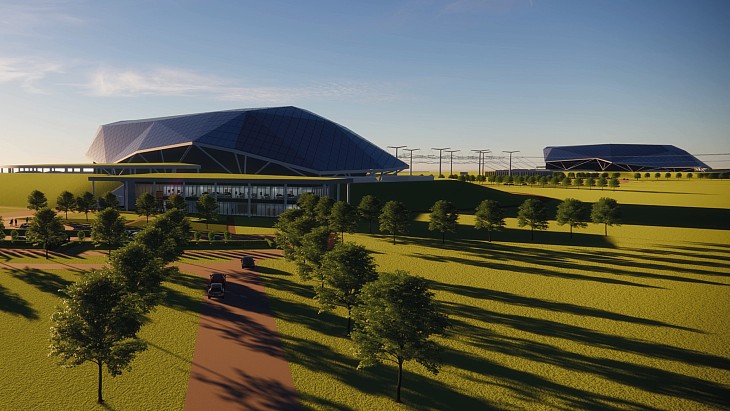
Justification is an early regulatory step required for the operation of a new nuclear technology in the country. It determines whether or not a new reactor design is justified under The Justification of Practices Involving Ionising Radiation Regulations 2004.
The Nuclear Industry Association (NIA) applied in July 2024 to the Department for Environment, Food and Rural Affairs (DEFRA) for a justification decision for the Rolls-Royce SMR, marking the first ever application for justification of a UK reactor design. In October last year, the deparment, DEFRA, opened a public consultation on the NIA's application, which closed on 1 December. It said it was seeking views on: whether the proposed practice belongs to a new, or to an existing class or type of practice; whether the proposed practice was a suitably defined class or type of practice for a justification decision; and whether the information in the application and supplementary information is suitable for DEFRA to make an appropriate assessment of the balance of benefits and detriments of the proposed practice.
The Secretary of State for Environment, Food and Rural Affairs has now decided that the Rolls-Royce SMR is justified.
"The decision takes into account responses to the Consultation on the Application for the Rolls-Royce SMR designed by Rolls-Royce SMR Limited, open from 6 October to 1 December 2025, and the views of statutory consultees," DEFRA said. "Secondary legislation giving effect to the justification decision will need to be approved by a resolution of each House of Parliament."
Helena Perry, Safety and Regulatory Affairs Director for Rolls-Royce SMR, said: "We welcome the decision by the Secretary of State for Environment, Food and Rural Affairs, providing regulatory justification for our power station - a key step in our regulatory journey to deploying the UK's first small modular reactors and in our mission to provide clean, affordable energy for all."
The NIA, as the representative body of the UK civil nuclear industry, often makes justification applications, because justification is a generic decision that can be relied upon by anyone and are not personal to individual reactor vendors or project developers. The NIA has previously applied for justifications for Hitachi's Advanced Boiling Water Reactor, Westinghouse's AP1000 and Framatome's EPR.
The Rolls-Royce SMR is a 470 MWe design based on a small pressurised water reactor. It will provide consistent baseload generation for at least 60 years. Ninety percent of the SMR - measuring about 16 metres by 4 metres - will be built in factory conditions, limiting activity on-site primarily to assembly of pre-fabricated, pre-tested, modules which significantly reduces project risk and has the potential to drastically shorten build schedules.
In June last year, Rolls-Royce SMR was selected as the UK government's preferred technology for the country's first SMR project. A final investment decision is expected to be taken in 2029.
In November, the government announced that Wylfa on the island of Anglesey, North Wales, will host three Rolls-Royce small modular reactors. It said the site - where a Magnox plant is being decommissioned - could potentially host up to eight SMRs.
Arup to support delivery of the UK's first SMR
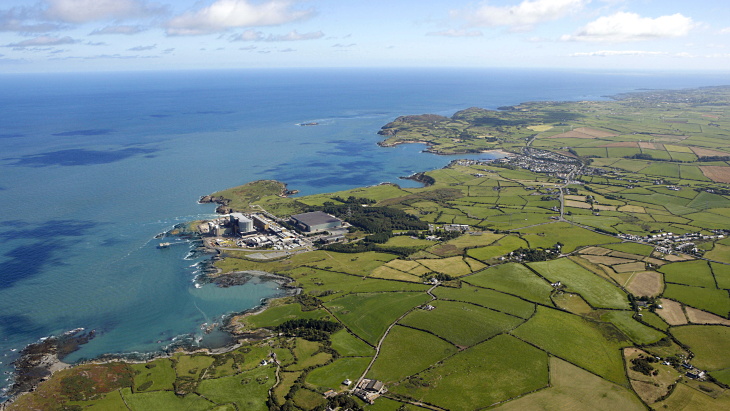
Arup - together with project partners LDA Design, TÜV SÜD Nuclear Technologies, Mace Consult and Gleeds - will deliver early phase foundation engineering to assist Great British Energy - Nuclear (GBE-N) in delivering optioneering, feasibility and a subsequently integrated site-specific concept design.
Arup said its partners will be key to the successful delivery of the work. It said TÜV SÜD Nuclear Technologies brings deep expertise in nuclear safety, licensing and regulatory compliance, providing critical input to early design decisions and ensuring that safety considerations are embedded from the outset. LDA Design is a placemaking consultancy specialising in design, planning, and the environment. It will lead the master planning process and has a wealth of experience on major infrastructure and other UK nuclear projects, including Sizewell C. Mace Consult will leverage its major programme delivery capabilities to support programme implementation, integration and optimisation. Gleeds will contribute its expertise in cost engineering to the early phases of the site and infrastructure development.
"The project represents the first of the UK's anticipated fleet of small modular reactors and aligns with the UK's energy policy, supporting the need for all available technologies to address carbon reduction and energy security challenges, with nuclear as a vital part of the energy mix," said Jeremy Stain, Nuclear Business Leader at Arup. "We are delighted to contribute Arup's multidisciplinary engineering skills and local knowledge to this landmark nuclear project."
GBE-N CEO Simon Roddy added: "Delivering a safe, high-quality, and integrated site-specific design for the UK's first SMR requires strong collaboration, innovation and precise technical decision making with our Technology and Foundation Engineering Partners. I welcome Arup and their project partners to this landmark nuclear project alongside GBE-N and our preferred technology partner bidder Rolls-Royce SMR."
The UK government launched GBE-N in 2023 as an arms-length body that will be responsible for driving the delivery of new nuclear projects, with the aim of increasing the share of nuclear in the UK's electricity mix from the current 15% to 25% by 2050.
In November last year, the government announced that Wylfa will host three Rolls-Royce small modular reactors. It said the site - where a Magnox plant is being decommissioned - could potentially host up to eight SMRs.
The Rolls-Royce SMR is a 470 MWe design based on a small pressurised water reactor. It will provide consistent baseload generation for at least 60 years. Ninety percent of the SMR - measuring about 16 metres by 4 metres - will be built in factory conditions, limiting activity on-site primarily to assembly of pre-fabricated, pre-tested, modules which significantly reduces project risk and has the potential to drastically shorten build schedules.
GBE-N said it will start activity on the site this year with the aim for Wylfa's SMRs to be supplying power to the grid from the mid-2030s.
Earlier this month, UK land and property consultancy Fisher German secured a contract to provide GBE-N with expert advice during the planning and delivery of its SMR project. Under the contract, Fisher German will provide a broad range of services from across the firm to help the project move forward, including its property management, advisory, and infrastructure divisions. The team will provide estate management services in the pre-construction phase, including activities associated with agency and lease arrangements; consents and easements; and estate and asset management.
US aims for 5 GW more from existing nuclear
_26024_32614.jpg)
The Department of Energy (DOE) initiative, known as UPRISE, aims to target "the most cost-effective and immediate methods" to increase nuclear capacity - targeting 2.5 GW more by the end of next year, and a similar amount again within three years.
The DOE said that the initial phase "will be centred on a three-pronged approach focused on establishing the business case by examining supply chain readiness, assessing plant equipment for increased power output or upgrades, and validating economic models to support project investment decisions. The effort will also support research to streamline regulatory processes, advancements in nuclear fuels, and workforce initiatives as a foundation for future nuclear deployments".
It said that through UPRISE, the Office of Nuclear Energy and the Office of Energy Dominance Financing will seek to "facilitate collaborative agreements between plant owners and end users", with the Office of Energy Dominance Financing having "more than USD289 billion in available loan authority". It will be able "to provide up to 80 percent financing for eligible project costs associated with nuclear uprates at attractive interest rates".
DOE loan programme support is currently being used to support unit restarts at Palisades (805 MW capacity, targeted for this year) and the Crane Clean Energy Center (835 MW capacity, targeted for 2027).
US President Donald Trump announced last year the goal of expanding the country's nuclear energy capacity from 100 GW to 400 GW by 2050.
The DOE said: "By focusing on solutions available today and immediate opportunities for nuclear energy capacity expansion, UPRISE aims to deliver immediate results that align with national energy priorities."
First San'ao unit connected to the grid
_19417.jpg)
"At 17:28 on 12 March, the first Hualong One nuclear power unit in the Yangtze River Delta region - unit 1 of the CGN Zhejiang San'ao Nuclear Power Project - successfully connected to the grid for the first time and generated its first kilowatt-hour of electricity," China General Nuclear said. "This marks a crucial step towards the unit's goal of officially putting it into operation."
It added: "Following grid connection and on-site confirmation, the unit is operating well, and all technical indicators meet design expectations. Next, the unit will enter the load trial operation phase, conducting planned power increase and performance tests, and is expected to officially commence power generation in the first half of 2026."
_191f165e.jpg)
(Image: CGN)
In September 2020, the executive meeting of China's State Council approved the construction of units 1 and 2 as the first phase of the San'ao plant. The National Nuclear Safety Administration issued a construction permit for the two units on 30 December that year and first concrete for unit 1 was poured the following day. The first concrete for San'ao 2 was poured on 30 December 2021. Unit 1 achieved first criticality last month, San'ao 1 and 2 are scheduled to begin supplying electricity in 2026 and 2027, respectively.
The San'ao plant is the first nuclear power project in China's Yangtze River Delta region to adopt the Hualong One reactor design. A total of six Hualong One units are planned for the San'ao site.
_a81ca075.jpg)
The San'ao site (Image: CGN)
The construction of two Hualong Ones as units 3 and 4 of the San'ao plant was among plans for 11 reactors approved by China's State Council in August 2024. The first concrete was poured for the nuclear island of unit 3 on 19 December last year.
Upon completion, the project will provide more than 54 TWh of electricity annually to Zhejiang Province and the Yangtze River Delta region, reducing standard coal consumption by over 16 million tonnes and carbon dioxide emissions by over 51 million tonnes annually, CGN noted.
The San'ao project marks the first Chinese nuclear power project involving private capital, with Geely Technology Group taking a 2% stake in the plant. CGN holds 46% of the shares of the project company Cangnan Nuclear Power, with other state-owned enterprises holding the remainder.

No comments:
Post a Comment