
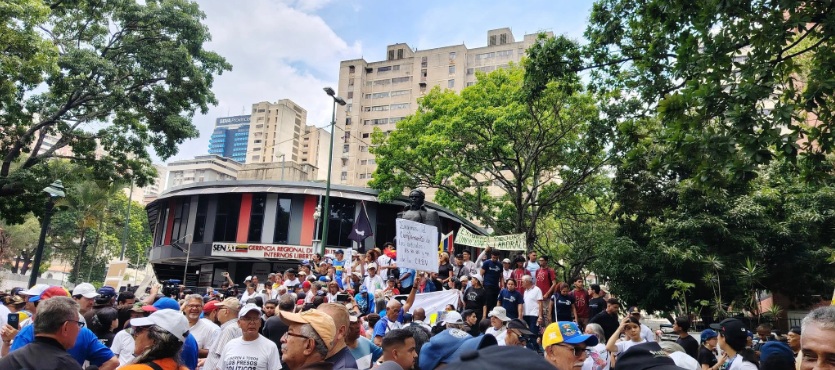
More than 1,000 workers, union members and retirees marching toward downtown Caracas were blocked by riot police during a May Day demonstration. Chanting, “A bonus is not a salary,” they took to the streets in Caracas to protest the only-modest increase in the so-called comprehensive minimum wage, from the equivalent of $190 per month to $240. A short distance away, a small group of workers — convened by the Bolivarian Socialist Workers Federation of Venezuela — celebrated the raise. For the first time in over 20 years, the government had not organized a large rally. Instead, it provided a concert — a Festival for Peace — featuring dozens of international performers.
“People are really happy. They are dancing in the streets because there is a lot of money coming in through the big oil companies,” U.S. President Donald Trump said a few days later. His administration is still managing a political transition process following U.S. military attacks and the abduction of Venezuelan President Nicolás Maduro earlier this year.
But even ultraright-wing polling firms such as Meganálisis suggest Trump is wrong about the mood in Venezuela. According to the firm, the proportion of Venezuelans who are “grateful” to the U.S. for its intervention has dropped from 92% in January to just 47% in April. Trump’s attempt to cast himself as the savior of Venezuela’s economy isn’t working — especially as Venezuelans say they haven’t seen any improvements since January, nor since the U.S. imposed economically devastating sanctions in 2015.
Wages are too low
Rafael Venegas, Jacques Derose and Yrma Rivero have different work situations. Venegas works in the public sector, Derose is in the private sector and Rivero is self-employed. But all three have something in common: Their income is not enough to live on.
Venegas is 70 years old and has spent 14 years teaching undergraduate and graduate courses at the Central University of Venezuela, the country’s oldest and largest higher education institution. However, his latest proof-of-employment document, seen by Truthdig, shows his salary is the equivalent of $1.37 a month. Any benefits like severance pay, end-of-year bonus and holiday pay are calculated based on that amount.
At the same time, Venegas, who survived a stroke and who is looking after his 93-year-old mother, receives — as all public sector workers do — a monthly food bonus of $40, and what is called an “economic war bonus” worth $150. The explanation is as simple as it is complex: Venezuela’s legal minimum wage has been frozen at 130 bolivars (about 27 cents) a month for four years. To bring actual take-home income closer to a living wage, workers get monthly bonuses paid in bolivars at the official exchange rate. Together, these amounts are known as the “comprehensive wage” and are only for formal workers.
Thirty kilometers away, Derose, a 27-year-old who dropped out of the university to work at a hardware store in La Guaira, receives a comprehensive wage of $200 a month, which may sometimes go up to $230 or $260 if he takes on extra work loading or moving merchandise.
Derose, who does not have children, tells Truthdig that his income goes to food, transit and paying rent for a single room. The room costs $120, while an apartment in Caracas costs at least $250 a month.
“That’s why my other two brothers, though they’re older, are still living with our parents,” he says.
Meanwhile, Rivero travels around the city cleaning apartments to support herself, as well as her son’s university studies.
“He got into a public university, but we spend a lot on transportation and food, not to mention medical expenses. Right now, my son has severe sinusitis, and an MRI of his sinuses costs $300,” she says.
She charges $30 to $40 for each deep clean, depending on the size of the property. She tries to have at least four clients a week in order to earn around $400 a month. As the highest earner of the three, Rivero’s situation illustrates why many young people are choosing not to study but to work informally or in trades instead.
All three workers tell Truthdig they use the same strategy to get by: working multiple jobs. Venegas earns intermittent extra income by proofreading books or giving workshops, Derose works as a bricklayer some weekends and Rivero sometimes irons or cooks. They all say that no one can get by on less than $400 a month, and a family of five requires at least $1,500.
According to the Caracas-based, union-run research center Center for Documentation and Social Analysis, the basic food basket for a family of five, which includes 61 essential products, reached $703.11 in March, a 7.2% increase from February. Venezuelans must also pay for transportation or gasoline, utilities, rent or condominium fees, medicine, clothing and much more.
Thousands of workers, especially in sectors like education, healthcare and public services, share this sentiment and have been protesting in the streets of Caracas for weeks, demanding a living wage. But how would that be achieved?
“It would be difficult to have a salary — not bonuses, but a legal minimum wage — that covers basic needs. But there are no ethical or economic reasons to keep it at 27 cents,” Hermes Pérez, economist and former head of the Exchange Desk at the Central Bank of Venezuela, tells Truthdig.
He says the legal minimum wage should be at least $300, but that’s not feasible for either the public or private sector. “The resources simply aren’t there, and since wages are practically zero, raising them to that level would be very expensive. But at least $70 or $100 would be possible. Furthermore, it’s estimated that Venezuelan revenues will grow significantly in 2026 compared to last year. We received $18 billion in oil revenues alone in 2025, and that amount could rise to $33 billion,” Pérez says. Despite attempts at diversification, oil remains Venezuela’s primary source of foreign currency, and the country is dependent on oil revenue to finance public spending.
Pérez stresses that a key indicator must be addressed regardless of how much salaries increase: inflation. “According to the Central Bank, Venezuela ended 2025 with an annual inflation rate of 465%, and by March 2026 it was already at 650%. That’s enormous. In Colombia, for example, inflation is around 5%, and in Latin America, in general, it’s in the single digits,” he says.
“It’s not just the isolated [price] increase of one or two things; it’s the generalized increase across the board. Given this context, it’s very difficult for the average worker to actually perceive any economic improvement.”
Economist Asdrúbal Oliveros agrees. He believes the country will enter a phase of recovery in purchasing power this year, but a “notably slow” one, as Venezuela must first increase incomes, sustainably reduce inflation and stabilize the exchange rate.
Venezuelan government response
On April 8, acting President Delcy Rodríguez took a stance for the first time on low wages and precarious working conditions in the country. She acknowledged some of the problems and noted that there are more pensioners (5.7 million) than formally employed workers (5.3 million), a figure that reveals the extremely high rate of informality that now prevails in Venezuela.
On May 1, Rodríguez then announced a 26% income increase through the country’s bonus system. This raised the comprehensive minimum wage — which includes the official minimum wage and bonuses — from $190 to $240 per month by increasing the economic war bonus by $50. For pensioners, the war bonus increased from $58 to $70. She also announced a one-off “professional recognition” bonus for the education, health and security sectors of around $195, with the exact amount varying by job.
Organizations such as the Professors Association of the Central University of Venezuela rejected “the policy of replacing salaries with bonuses,” which they argued do not affect workers’ social security contributions and “ignore merit, experience and seniority.” The workers also demanded respect for salary scales and collective bargaining agreements.
The acting president acknowledged that the $240 increase is “insufficient” but said it is “a responsible increase” to improve purchasing power “without generating an excessive inflationary impact.” According to the Central Bank, annual inflation in Venezuela reached 130,000% in 2018, the peak of a four-year hyperinflationary period that ended in 2021. It was then that the government decided to freeze wages and implement a bonus policy to avoid a relapse.
However, some economists also attribute the high inflation rates to the uncontrolled issuance of money by the Central Bank to finance the fiscal deficit. Unions argue that the economy will not collapse from paying off labor liabilities like wages and benefits.
“For the past four years, salaries have been frozen and increases through bonuses have been meager. So, clearly, workers’ salaries or benefits haven’t contributed to causing the current inflation rates,” Venegas says. “There are millions of us in the public sector, but benefits are only received by those who retire, resign or are dismissed — a small amount per year.”
Venegas believes the government and business leaders are currently colluding to try to reform the Organic Law of Labor and Workers (LOTTT) in order to eliminate the country’s social benefits system.
The LOTTT, passed by then-President Hugo Chávez in 2012, is considered a bastion of workers’ rights. Among its provisions, it prohibits unjustified dismissal and subcontracting, provides 26 weeks of maternity leave, guarantees the right to work for women and people with disabilities and extends retirement pensions to all workers, including full-time mothers and the self-employed.
Now, businesspeople have argued at the Council of the International Labour Organization for reform of the LOTTT, especially Article 104, which defines what constitutes a salary, and Article 122, which establishes the basis for calculating social benefits and severance pay. They say the current model of accumulating social benefits would be structurally unsustainable if the legal minimum wage is increased.
The U.S. decides
Amid these debates, the acting Venezuelan president has said that the economic situation of workers will improve “progressively” thanks to restored relations with the U.S. and the recovery of oil production, which — after some relaxing of sanctions — has exceeded 1.2 million barrels per day.
“In 2025, Venezuela produced a similar average number of barrels, but they were sold at a 30% to 35% discount to get around the sanctions,” sociologist and political analyst Franco Vielma said on X. These discounts acted as a key economic incentive for private buyers and intermediaries to assume the high legal and financial risk of violating the sanctions imposed by the U.S. Furthermore, the price per barrel exceeded $126 at the end of April 2026, reaching its highest level in four years due to the conflict between the United States and Iran.
Rodríguez has said the latest salary increase is backed by oil and fuel oil income. But Venezuelans still do not know how much oil revenue they are receiving, where it is deposited, what percentage the U.S. is getting or what the new agreements mean.
In January, Trump stated that the U.S. would control Venezuelan oil sales, saying Venezuela would submit monthly budgets to the White House, which would then be reviewed by auditors. Rodríguez said at the time that citizens could track every oil dollar through a new website. However, this website has not materialized.
The United States, after attacking Venezuela four months ago and, according to the Venezuelan Anti-Blockade Observatory, having imposed 1,081 sanctions on the country since 2015, has argued that increased oil income will benefit Venezuelans. Trump asserted in January that Venezuela would experience “an unprecedented economic upswing … It will earn more money in six months than in the last 20 years.”
In this regard, the U.S. Office of Foreign Assets Control issued 14 licenses in April that allow for the development of the Venezuelan oil sector and the possibility of conducting banking transactions with Venezuela, although each transaction requires OFAC approval. Payments in gold or cryptocurrencies are prohibited; Venezuela cannot trade with China, Russia, Iran, North Korea or Cuba; and the country’s frozen assets will not be released. Crucially, all revenues from oil and mineral exports must be deposited into accounts controlled by the U.S. Treasury Department, which then decides when and how much to return to Venezuela from its own resources.
Although the international media has framed this as a “lifting of sanctions,” the licenses granted by the U.S. are only conditional and temporary permits that allow some oil and banking operations in Venezuela. Executive orders blocking state assets and controlling and supervising the operations of the state oil company PDVSA remain in place, limiting the legal certainty that is necessary for long-term investments.
Many Venezuelans did believe the economic situation would improve after Jan. 3. In fact, some pollsters claimed that 70% to 80% of the population then had “hope for the future.” Now, in April, according to an AtlasIntel poll, 77% of Venezuelans rate the current economic situation as “bad,” and 76% hold a negative opinion about the state of the labor market.
According to Datanálisis, economic despair also prevails, with 55% of those surveyed identifying inflation and low wages as their main problems. These worries are followed by devaluation and failures in the electrical system.
Datanálisis also found in April that 65% of the population agrees that Venezuela’s priority should be resolving the economic crisis above any political transformation or electoral process. However, Trump hinted on May 12 that beyond the current intervention, he’s also “seriously considering” making Venezuela the 51st U.S. state, posting a map of the country with a U.S. flag. Joke, threat or a reflection of how Trump already sees Venezuela, Venezuelans have much to worry about.

No comments:
Post a Comment