Showing posts sorted by relevance for query OUN. Sort by date Show all posts

Thursday, January 23, 2020

UKRAINIAN NATIONALIST ARMY OUN–UPA AND THE NAZI GENOCIDE

THEORY AND PRACTICE

Historical representation of the wartime accounts of the activities of the OUN–UPA (Organization of Ukrainian Nationalists—Ukrainian Insurgent Army)

Per Anders Rudling parudling@ualberta.ca 

Introduction

When it comes to assessing the history of the violent 20th century, historical analysis hasoften been restricted by ideological blindness and selective interpretation. This is not anissue limited to one side of the ideological spectrum, or to any particular ethnic community.
This article focuses on the nationalist historiography of the post-war or “third wave” of Ukrainian immigrants to North America and the largely positive representation of the OUNand UPA by some high-profile Ukrainian historians. In this paper, I attempt to highlight thediscrepancy between theory and practice, and I suggest that the change in the ideology of the OUN was not followed by changes in practice. 

Rather, the political course of the OUN–UPA remained one of uncompromising ideological and ethnic extremism. This translated into a continuation of a policy the implementation of which completed the mass murder initiated in the summer of 1943. I also focus on the unwillingness of a number of Central Ukrainian and diaspora historians to confront this bloody past. This article will consider Ukraine in a European context, adjudged by the same tools of analysis as other European states, which is particularly apposite given contemporary circumstances. Confronting the past means challenging myths, something that is painful for a country still in the process of nation-building and actively constructing national myths. There are attempts at casting the OUN in a heroic light in the official Ukrainian historical narrative.At the same time, the Orange Revolution has shown that many Ukrainians identify with Europe and desire European integration. To a large extent, European integration requires realignment with liberal democratic or “European” values. Much like post-war Germany was forced to confront its history, post-Orange-Revolution Ukraine faces a similar challenge of Vergangenheitsbewältigung . If Ukraine is serious in its attempts to orient itself towards the European Union, the anti-democratic trends of the past need to be confronted rather than allowed to enter the new national mythology as doctored recollections.


The Carl Beck Papers in Russian and East European Studies 2107 (Pittsburgh: University Center for Russian and East European Studies, 2011).

Per Anders Rudling

During the past decade, particularly under the presidency of the third Ukrainian president Viktor Yushchenko (2005–2010) there have been repeated attempts to turn the leading figures of the Organization of Ukrainian Nationalists (OUN) and its armed wing, the Ukrainian Insurgent Army (UPA) into national heroes. As these fascist organizations collaborated with the Nazi Germany, carried out ethnic cleansing and mass murder on a massive scale, they are problematic symbols for an aspiring democracy with the stated ambition to join the European Union. Under Yushchenko, several institutes of memory management and myth making were organized, a key function of which was to deny or downplay OUN-UPA atrocities. Unlike many other former Soviet republics, the Ukrainian government did not need to develop new national myths from scratch, but imported ready concepts developed in the Ukrainian diaspora. Yushchenko’s legitimizing historians presented the OUN and UPA as pluralistic and inclusive organizations, which not only rescued Jews during the Holocaust, but invited them into their ranks to fight shoulder to shoulder against Hitler and Stalin. This mythical narrative relied partly on the OUN’s own post-war forgeries, aimed at cover up the organization’s problematic past. As employees of the Ukrainian security services, working out of the offices of the old KGB, the legitimizing historians ironically dismissed scholarly criticism as Soviet myths. The present study deals with the myth-making around the OUN, the UPA, and the Holocaust, tracing their diaspora roots and following their migration back and forth across the Atlantic.


"Memories of 'Holodomor' and National Socialism in Ukrainian Political Culture"
in Yves Bizeul (ed.) Rekonstruktion des Nationalmythos?: Frankreich, Deutschland und die Ukraine im Vergleich (Göttingen: Vandenhoeck & Ruprecht Unipress, 2013), 227-258.

Per Anders Rudling

Subsequently, World War II brought nearly incomprehensible suffering and population losses.
A 2004 study lists the total Ukrainian war deaths at 6,850,000 people, or 16.3 % of the population. Of these, a full 5,200,000 were civilians,whereas military victims “only” constituted 1,650,000. Of these civilian deaths,at least 1.4 million, but perhaps as many as 2.1 million Jews were murdered in Ukraine.
The German occupation of Ukraine was extraordinarily harsh. Ukraine was divided between German, Romanian, and Hungarian occupants, the largest part organized as the so-called
 Reichskommisariat  Ukraine. The western most part way incorporated into the Greater German Reich, as the Distrikt Galizien.
 Here the occupation was considerably milder, and the Ukrainian population played off against the Poles.Whereas Ukrainian national sentiments were suppressed in the rest of Ukraine they were partially supported in Galicia. Talented Ukrainians were offered scholarships to study in the Reich,and in 1943 even a GalicianWaffen-SS Division was formed.
The occupying authorities strictly guarded the sealed border to the Reichskommissariat, where the situation was quite different.
The brutal Reichskommissar Erich Koch banned education above the third grade, and mused that “if I find a Ukrainian who is worthy of sitting at the same table with me, I must have him shot.”
Ukraine saw considerable resistance to the Nazi occupation. 4.5 million Ukrainians fought in the Red Army to which The estimates differ greatly, and have been manipulated by various political interest groups.
Gregorovich, Andrew: Ukraine’s Population Losses in World War II: 7.5 million

Terrorists or national heroes? Politics and perceptions of the OUN and the UPA in Ukraine

Ivan Katchanovski

Tudy analyzes controversies and public attitudes concerning the Bandera faction of the Organization of Ukrainian Nationalists (OUN-B), the Ukrainian Insurgent Army (UPA)
and Stepan Bandera in Ukraine. The research question is: Which factors affect attitudes toward the OUN-B, the UPA and Bandera in contemporary Ukraine? This article employs comparative and regression analyses of surveys commissioned by the author and conducted by the Kyiv International Institute of Sociology (KIIS) in 2009 and 2013 to determine the effects of regional and other factors on attitudes toward these organizations and the OUN-B leader. The study shows that regional factors and perceptions of these organizations' involvement in mass murder were the strongest predictors of the views concerning the OUN-B, the UPA and Bandera. Their public support is strongest in Galicia and weakest in the East and the South, in particular, in Donbas and Crimea, two major conflict areas since the “Euromaidan.”
Journal Name: Communist and Post-Communist Studies, 48 (2-3), 217-228
Publication Date: Oct 15, 2015

The OUN, the UPA, and the Nazi Genocide in Ukraine
Mittäterschaft in Osteuropa im Zweiten Weltkrieg und im Holocaust / Collaboration in Eastern Europe during World War II and the Holocaust, 2019Ivan Katchanovski
Ivan Katchanovski
The issue of the political rehabilitation and glorification of the Organization of Ukrainian Nationalists (OUN) and the Ukrainian Insurgent Army (UPA) became one of the central political issues in Ukraine after the Orange Revolution and the Euromaidan. It provoked major political and historical controversies and debates in Ukraine and other countries. Presidents Yushchenko and Poroshenko, their parties, far right organizations, and many Ukrainian historians attempted to recast the OUN-B and the UPA as parts of a popular national liberation movement that fought against Nazi Germany and the Soviet Union and to present the OUN-B and UPA leaders as national heroes. They denied, minimized or justified the involvement of the OUN-B and the UPA leaders and members in the mass murder of Jews, Poles, Russians, and Ukrainians.The analyses of biographic publications, historical studies, and archival documents show that the majority of the OUN-B and UPA leaders and very large proportions of their members collaborated with Nazi Germany, mainly in the beginning of the Second World War. early half of the top and middle-ranked leaders of these organizations andat least until the end of 1943 the majority of UPA members served in various police formations. They assisted the German occupation authorities in implementing genocidal policies towards the Jews, Ukrainians, Russians, and Poles by helping to carry out mass shootings and create conditions intended for the physical annihilation of the entire Jewish population and large numbers of Ukrainians, Russians, and Poles, specifically in Volhynia. The fact that many police commanders and large numbers of policemen in various locations and formations followed orders from the OUN-B by deserting en masse from their service, in particular in Volhynia in the spring of 1943, and forming the basis of the UPA shows that these commanders and police members were de facto controlled by the OUN-B.
More Info: In Black , Peter; Rásky, Béla; Windsperger, Marianne (Eds)
Page Numbers: 67-93
Publication Date: 2019
Publication Name: Mittäterschaft in Osteuropa im Zweiten Weltkrieg und im Holocaust / Collaboration in Eastern Europe during World War II and the Holocaust

Ethnic Cleansing, Genocide or Ukrainian-Polish Conflict? The Mass Murder of Poles by the OUN and the UPA in Volhynia
Ivan Katchanovski
This paper analyzes the mass-murder of Poles in Volhynia in Western Ukraine during World War II. The mass murder of Poles by the Ukrainian Insurgent Army (UPA) and the Stepan Bandera faction of the Organization of Ukrainian Nationalists (OUN-B) during the Nazi occupation of Volhynia in 1943 became an important political issue in Poland and Ukraine after the collapse of communism. Previous studies by Polish, Ukrainian, and Western researchers offered different and often divergent theories of this historical event. It is often presented in Ukraine as a mutual Ukrainian-Polish conflict. In contrast, in Poland, the mass murder of Poles in Volhynia is often characterized as genocide. A research question is whether this was a Ukrainian-Polish conflict, ethnic cleansing or genocide. This study analyzes a variety of archival documents, historical studies, and eyewitness accounts. It offers an estimate of Polish casualties derived from analysis of OUN-UPA, Polish, and Soviet, and sources and demographic data. This study concludes that the mass murder of the Polish minority in Volhynia by the OUN-B, the UPA, and their security service (SB) represented not a mutual Ukrainian-Polish conflict or genocide of Poles but that it was a part of ethnic cleansing.
More Info: Paper presented at the 19th Annual World Convention of the Association for the Study of Nationalities, Columbia University, New York, US, April 24-26, 2014


Peasants into Perpetrators: The OUN-UPA and the Ethnic Cleansing of Volhynia, 1943-1944
Jared  McBride

The Ukrainian nationalist-led ethnic cleansing campaign against Poles in Volhynia during 1943–44 has long been the subject of international tension and contentious public and scholarly debate. This article analyzes the topic through a microhistorical lens that looks at one ethnic cleansing operation in the Liuboml’ area of Volhynia that killed hundreds of Poles. Using newly declassified materials from Ukrainian secret police archives, alongside more traditional testimonial sources, I demonstrate that not all participants were prepared nationalist ideologues eager to kill. Rather, there was a range of actors involved in the massacres and the Ukrainian nationalist leadership was able to recruit average peasants to participate in ethnic cleansing through diverse mechanisms. This disaggregation of the killers and their motives not only contributes to growing social science research on mobilization for violence, but also challenges assumptions inherent in the double or triple occupation thesis frequently used to explain violence in Volhynia from 1939 to 1945.

Debating, obfuscating and disciplining the Holocaust: post-Soviet historical discourses on the OUN–UPA and other nationalist movements

Grzegorz  Rossoliński-Liebe

After the dissolution of the Soviet Union the archives of the former republics and satellite states of this multiethnic empire were opened. This allowed historians to investigate the history of nationalist and radical right organisations and armies that, during the Second World War, had been involved in the Holocaust and other atrocities. Among them was the Organisation of Ukrainian Nationalists. For a long time the history of these movements was unknown or distorted by Soviet propaganda and propagandist publications written during the Cold War by veterans of these movements living in the West and cooperating with Western intelligence services. The dissolution of the Soviet Union was simultaneously accompanied by the “rebirth” of nationalism that was not free from antisemitism and racism, and which triggered different types of nationalist distortions of history and obfuscations of the Holocaust. Post-Soviet historical discourses were shaped not only by journalists or political activists, but also by radical right historians. These discourses impacted as well on historians who in general were critical of the post-Soviet rehabilitation of nationalism, war criminality or East Central European fascism. Concentrating on Ukrainian and Polish history, this article explores how the radical right historical discourses appeared in the post-Soviet space, what types of historians were involved in them and what kinds of distortions and obfuscations have predominated.
More Info: East European Jewish Affairs Vol. 42, No. 3, December 2012, 199–241.

“Introduction: The Organization of Ukrainian Nationalists (OUN) in Post-Soviet Ukrainian Memory Politics, Public Debates, and Foreign Affairs,”

Andreas Umland and Yuliya Yurchuk,

 Journal of Soviet and Post-Soviet Politics and Society 3, no. 2 (2017): 115
This second introduction, like the one to the first special section within this series, does not list many of the previous scholarly studies on this section’s topic in as far asmost of the relevant articles and books are listed in the two special sections’papers’ footnotes. We are very grateful to Julie Fedor for her extremely careful and patient final editing of the contributions to these two special sections (including this introduction). Responsibility for any remaining impressions and misinterpretations here and below lies, however, solely with the respective texts’ authors.

Reclaiming the Past, Confronting the Past: OUN-UPA Memory Politics and Nation-Building in Ukraine (1991-2016), 
in: War and Memory in Russia, Ukraine, and Belarus, ed. Julie Fedor, Markku Kangaspuro, Jussi Lassila, and Tatiana Zhurzhenko, Palgrave Macmillan Memory Studies, 2017.


Yuliya Yurchuk

AND THE UKRAINIAN INSURGENT ARMY:UNWELCOME ELEMENTS OF AN IDENTITY PROJECT
 Ab Imperio, 4/2010
John-Paul HIMKA
 Introduction
What follows below are four polemical texts that aim to repudiate thelegacy of the Organization of Ukrainian Nationalists (OUN) and of itsarmed force, the Ukrainian Insurgent Army (UPA). They were motivated by the, unfortunately largely successful, campaign of former presidentViktor Yushchenko in Ukraine and the Ukrainian Canadian Congress(UCC) in the North American diaspora to put the glorication of these radical right nationalists at the very center of the Ukrainian national identity project.
On the most recent Remembrance Day in Canada (November 11, 2010), the UCC issueda statement containing this passage: “As Ukrainian Canadians we also remember and paytribute to the millions of men and women who perished ghting for the freedom of their ancestral Ukrainian homeland. The men and women of the Ukrainian Sich Riemen, the1st Ukrainian Division of the Ukrainian National Army, the Ukrainian Insurgent Armyand the Organization of Ukrainian Nationalists.” The Ukrainian Sich Riemen foughtfor an independent Ukraine after World War I, and the 1st Ukrainian Division was aWaffen-SS unit in World War II

Monday, August 07, 2023

Reconciliation but No Resolution to Poland’s and Ukraine’s Memory War

By Alex Perez-Reyes on August 7, 2023

KENNAN INSTITUTE

CONFLICT RESOLUTION AND PEACEBUILDINGHISTORICAL 

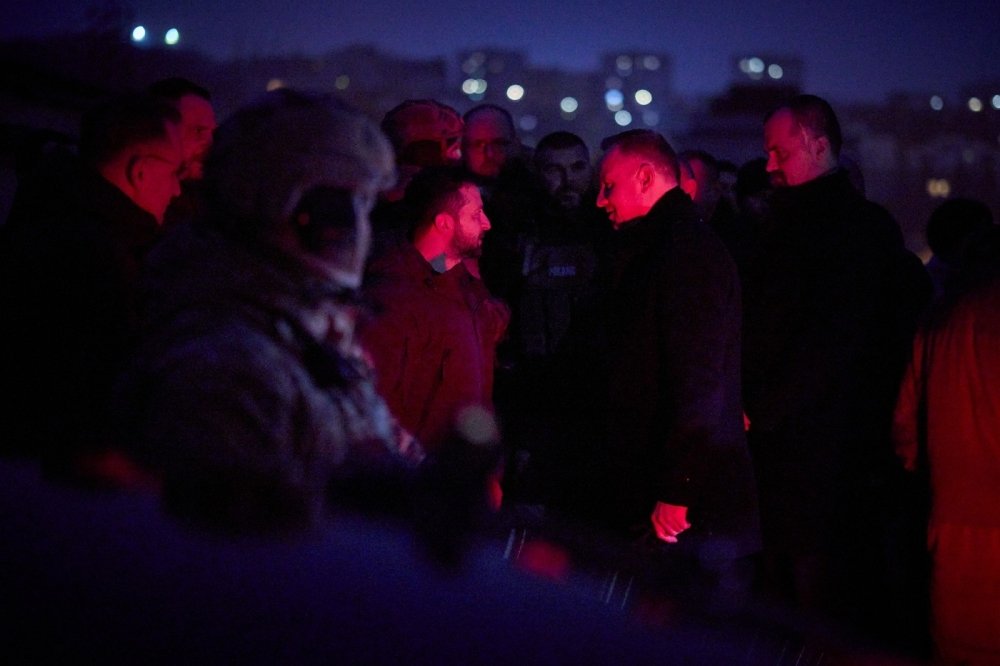
Lviv, Ukraine—January 11, 2023: Ukrainian President Vladimir Zelensky and Polish President Andrzej Duda visit Lychakiv Cemetery during their visit to Lviv.

On the eve of last month’s NATO summit in Vilnius, the presidents of Poland and Ukraine came together to try to resolve a long-simmering dispute: how to countenance and characterize the Volhynia massacres of 1943 to 1945, which Poland regards as genocide and Ukraine regards as the unfortunate actions of partisan groups against the Poles, with subsequent retaliatory killings of Ukrainian citizens. When Presidents Andrzej Duda and Volodymyr Zelensky placed commemorative candles in a Catholic cathedral during an ecumenical service in the western Ukrainian city of Lutsk, they continued a pattern of presidential interventions that, while highly symbolic, has failed to bring resolution to this memory war.

A Brief History of the Volhynia Massacres and Their Commemoration

While the present-day meaning of the Volhynia massacres remains hotly contested, historians generally concur on the details of the events themselves. Between 1943 and 1945, the Organization of Ukrainian Nationalists—Bandera faction (OUN-B) and the Ukrainian Partisan Army (UPA) organized the massacre of approximately 50,000–60,000 Poles in the Volhynia and Eastern Galicia regions, parts of the interwar Polish territories seized by the Soviet Union according to the terms of the Molotov-Ribbentrop Pact. The OUN and UPA aimed to make these ethnically heterogenous regions definitively Ukrainian and to “cleanse the entire revolutionary territory of the Polish population.” In response to this ethnic cleansing campaign, Poles retaliated against Ukrainian civilians, killing approximately 2,000 people.

SEE

UKRAINIAN NATIONALIST ARMY OUN–UPA AND THE NAZI GENOCIDE


Historical representation of the wartime accounts of the activities of the OUN–UPA (Organization of Ukrainian Nationalists—Ukrainian Insurgent Army)


Presidents Duda and Zelensky are not the first leaders of their countries to try to reconcile strongly different national views over the violent incidents of this period. Twenty years ago, Presidents Kwaśniewski and Kuchma attended the unveiling of a commemorative monument in the Volhynia region and called for remembrance and reconciliation. In 2016, Ukrainian president Petro Poroshenko laid flowers and lit a candle at Warsaw’s monument to the victims of the Volhynia massacre[MP1], becoming the first Ukrainian official to visit the site. Unfortunately, this latest presidential attempt at reconciliation seems destined to meet the same fate as its predecessors owing to several crucial gaps in its proposed memory narrative.

Honor Victims Generally, Name No Perpetrators

The seeds for the downfall of this latest attempt at reconciliation lie in the very language the presidents used to describe the event. In parallel Twitter statements, they proclaimed: “Together we pay tribute to all the innocent victims of Volhynia! Memory unites us! Together we are stronger.” While the statement seems to project unity and agreement on this tragic past, it obscures the past more than resolves it. Similarly to how Soviet war memorials decentered the Jewishness of Holocaust victims through subsuming phrases such as “peaceful Soviet citizens,” the statement aims to strip the dead of their nationality and commemorate them as nationless victims. This is particularly problematic because Poles died in greater numbers than Ukrainians during the massacres and were killed as part of a deliberately organized ethnic cleansing campaign. Such attempts to achieve reconciliation by commemorating victims in a denationalized way cannot do justice to their memory.

It is worth noting the absent third party to this historical conflict: the Jewish victims of the OUN and UPA. Volhynia, for instance, had a Jewish minority amounting to 10 percent of the population prior to the war. Many of the UPA recruits in 1943 came from the ranks of the auxiliary policeman who just the year before had collaborated in the execution of over 150,000 Volhynian Jews. The exclusion of these victims from the narrative of the Volhynia massacres is a grave injustice to their memory.

Also unnamed in this statement are the perpetrators of the crimes themselves. Nowhere in the statement are the OUN or UPA named and directly condemned for their violent actions. Like the joint statements that came before it, which refer only to “those who were tragically killed” by unspecified perpetrators, the Duda-Zelensky statement eschews the question of culpability and thereby allows Ukraine to continue to cultivate the memory of the OUN and UPA as national heroes. Unnamed and unblamed for the Volhynia massacres, the OUN and UPA remain key parts of Ukraine’s nationalist pantheon for their armed resistance to the Soviets.

The Russian Dimension

The battle to define the meaning of the Volhynia massacres has gained a new sense of urgency with the outbreak of Russia’s war against Ukraine. As Zelensky’s chief of staff Andriy Yermak implied, Russia is the “common enemy who dreamed of dividing us (Ukraine and Poland)” by escalating tensions over the past. This argument, however, is fundamentally untenable. While deferring conflict in the name of projecting unity in the face of Russian aggression might work to preserve the status quo in Polish-Ukrainian relations, it fails to create a real consensus on the past. For evidence of this divide, one needs merely to consider how this past is being interpreted in each country’s capital. In Warsaw on July 11, Polish prime minister Morawiecki marked the National Day of Remembrance of the Victims of the Genocide of the Citizens of the Polish Republic Committed by Ukrainian Nationalists. Meanwhile in Kyiv, the reputation of OUN leader Stepan Bandera as a national hero and symbol of resistance to Russia is inscribed in the very streets of the city. As part of the country’s decommunization process, Kyiv’s Moscow Avenue became Stepan Bandera Avenue.

Presidents Duda and Zelensky can try to project unity and assert that their countries have reconciled with this difficult history, but until both Poland and Ukraine stop using Russia’s aggression to avoid an honest reckoning with these events, the past will continue to haunt Polish-Ukrainian relations.

The opinions expressed in this article are those solely of the author and do not reflect the views of the Kennan Institute.

Monday, May 23, 2022

Stepan Bandera: Ukrainian hero or Nazi collaborator?

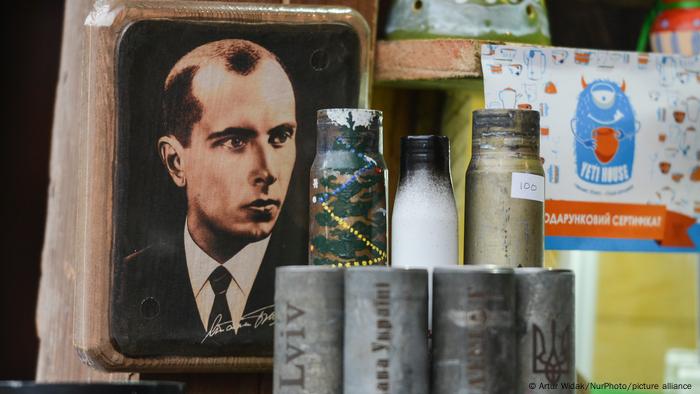
The Mariupol fighters revere him, Russian soldiers hunt his supporters. The myth surrounding Ukrainian nationalist Stepan Bandera is at the heart of Russia's assault on Ukraine. Who was he?

ANTI-SEMITE, WHITE NATIONALIST LIKE 
SIMON PETLURA BEFORE HIM


Stepan Bandera remains a divisive figure for many Ukrainians

"Bandera is our father, Ukraine is the mother. We will fight for Ukraine!" sings a young woman in camouflage uniform, carrying a machine gun, in a video that Ukrainian defenders in Mariupol shared on social networks in early May.

The video seems to have been recorded in a bunker at the Azovstal Steelworks, the city's last stand for Ukrainian resistance to Russian troops. "Azov" fighters were on site, too, a regiment founded by radical nationalists that was later put under Ukraine's Interior Ministry.

Stepan Bandera, killed by Soviet intelligence agents in West Germany more than 60 years ago, is probably the best-known Ukrainian nationalist. His name became a symbol long before the war that Russia has been waging against Ukraine since February 24.

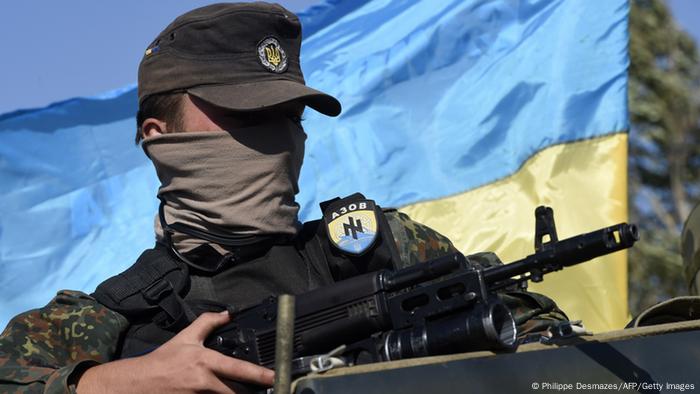
Russia's top prosecutor has asked the Supreme Court to designate the Azov Regiment, seen here in 2014, as a terrorist group

For parts of Ukraine society, Bandera is a hero and role model. Russian propaganda portrays him as an enemy against whose supporters they have been fighting for decades. Russia's military regards the use of his name as a kind of clue to literally hunt down Ukrainians in the occupied territories. Ukrainian media are full of eyewitness accounts of how the Russians chased down Bandera supporters among Ukrainian prisoners of war and civilians alike.

Whoever is deemed to be a supporter faces torture or death. When Russian President Vladimir Putin justified the war against Ukraine in his May 9 speech in Moscow, he spoke of an inevitable confrontation with "neo-Nazis, Banderites."
Life and death of a radical fighter

Bandera's life is closely linked to western Ukraine, which was then part of Poland and the Austro-Hungarian Empire. The son of a priest was born in 1909 in the village of Staryi Uhryniv, now in the province of Ivano-Frankivsk. Bandera studied in Lviv and joined the Organization of Ukrainian Nationalists, which fought underground for independence.

In the 1930s, Bandera was convicted of being a co-organizer of politically-motivated murders in Poland and was released only after the start of World War II. The OUN split into two groups, and Bandera became leader of the more radical wing, OUN-B. While Nazi Germany was preparing for the attack on the Soviet Union, Bandera's comrades-in-arms joined the German leadership with two Ukrainian battalions named Nightingale and Roland.

Bandera was in occupied Poland when on June 30, 1941, his comrades proclaimed an independent Ukrainian state in Nazi-occupied Lviv — and the Germans banned him from traveling to Ukraine. Adolf Hitler rejected the idea of Ukrainian independence, and Bandera was arrested and imprisoned in Sachsenhausen concentration camp until 1944.

The OUN-B continued to fight for independence in Ukraine with the help of its military arm, the Ukrainian Insurgent Army. The Nazis and the Soviets persecuted and killed OUN-B fighters. After the war, Bandera lived in Munich until he was killed in 1959 by a KGB agent using cyanide.

Bandera cult in present-day Ukraine
(AND FOR THE POST WWII DIASPORA IN NORTH AMERICA AND EUROPE)

Ukrainian emigrants in the West revered Bandera. In western Ukraine, a veritable cult emerged after the collapse of the Soviet Union; there are museums, monuments and streets named in his honor.

Elsewhere in Ukraine, in particular in the east, many people believed in Soviet historiography. They did not take a favorable view of Bandera, and saw him exclusively as a Nazi collaborator. Under pro-Western politician Ukrainian Viktor Yushchenko, who became president in 2005, Bandera was awarded the title "Hero of Ukraine." His successor, pro-Russia President Viktor Yanukovych, had the title revoked.


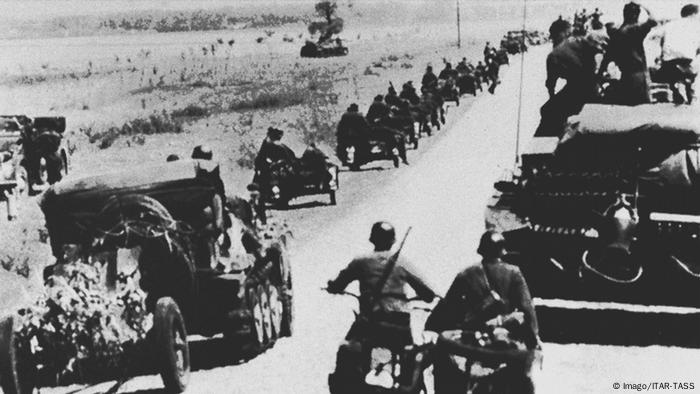
German troops were on the offensive in June 1941

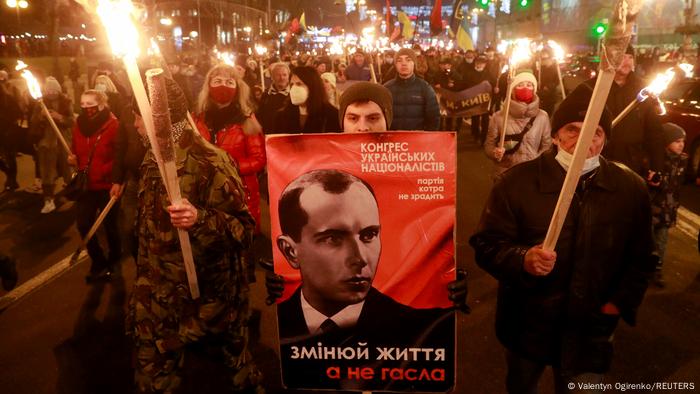
Bandera's supporters parade through the capital, Kyiv, every year on his birthday with a torchlight procession. In 2016, Kyiv renamed the avenue called Moscow Prospect after the nationalist, calling it Bandera Prospect. While the view of Bandera has becom more positive over the years, Ukraine remains divided over the issue. A survey by the Democratic Initiative Foundation in April 2021 found that one out of three Ukrainians, 32%, considered Bandera's acts as positive, and just as many took the opposite view.
Ukraine that Bandera wanted

The Bandera cult is an "expression of selective memory and politics of history," said Andreas Umland, an expert at the Stockholm Center for Eastern European Studies. It is about remembering that Bandera was a radical fighter for independence who served time in a Polish prison and a German concentration camp and was murdered by the KGB, he told DW.

"What people do not remember is that both at the beginning and at the end of World War II, the movement that Bandera led, the OUN, cooperated with the Third Reich for various reasons," Umland said.

Many Ukrainians are supportive of Bandera's actions

Experts have two explanations, said Umland. One group believes the cooperation was forced, while others argue there was an ideological closeness. Both are true, said Grzegorz Rossolinski-Liebe, a Bandera biographer and historian at the Free University of Berlin.


"Of course Bandera wanted a Ukrainian state, but he wanted a fascist state, an authoritarian state, one where he would have been the leader," said Rossolinski-Liebe.

Both Umland and Rossolinski-Liebe point out another dark side in the history of the Bandera movement, the involvement of OUN fighters in the murders of civilians, Jews and Poles, in the regions of Galicia and Volhynia. However, they said Bandera personally had no part in the murders.


"The OUN joined the Ukrainian police, in 1941, and helped the Germans murder Jews in western Ukraine," said Rossolinski-Liebe, adding he had found no evidence that Bandera supported or condemned "ethnic cleansing" or killing Jews and other minorities. It was, however, important that people from OUN and UPA "identified with him," he said.

Hugely popular, despite 
controversial image

Bandera was not a "Nazi," but a "Ukrainian ultranationalist," Umland argued, saying Ukrainian nationalism at the time was "not a copy of Nazism." Rossolinski-Liebe takes a different view, saying Bandera can be called "a radical nationalist, a fascist."


The German-Polish historian disagrees with Ukrainian colleagues who say Bandera's supporters fought Nazis just as much as they fought Soviets. "The USSR was the OUN's most important enemy," said Rossolinski-Liebe. He pointed out that the Soviet People's Commissariat for Internal Affairs waged a brutal battle against Ukrainian nationalists — about 150,000 people were killed and more than 200,000 deported.


A recent poll found that a majority of Ukrainians still view Bandera favorably

Selective memory is not something that's unique for Ukraine — it happens in other countries too, Umland said. He pointed to a prominent example from Germany, where churches and streets are named after Martin Luther — although it's known that he hated Jews.

Honoring Bandera damages Ukraine's image because it strains the relationship with Poland and Israel, said Umland, adding that Israel's reticence concerning Russia's current war against Ukraine is one of the consequences. Among Ukrainians, the war seems to have brought about a radical change with regard to Bandera. In April, researchers from the Rating group, a Ukrainian research organization, found that 74% of Ukrainians now view the historical figure favorably.

This article has been translated from German

Monday, January 06, 2025

How Ukraine’s Far Right Pushed Its Myths About World War II

An interview with Marta Havryshko

Throughout the Russo-Ukrainian war, each side has cast its enemy as heirs to the Nazis of World War II. In Ukraine, this has fueled comfortable myths about the nationalists of the 1940s, whose role in the Holocaust is routinely ignored.


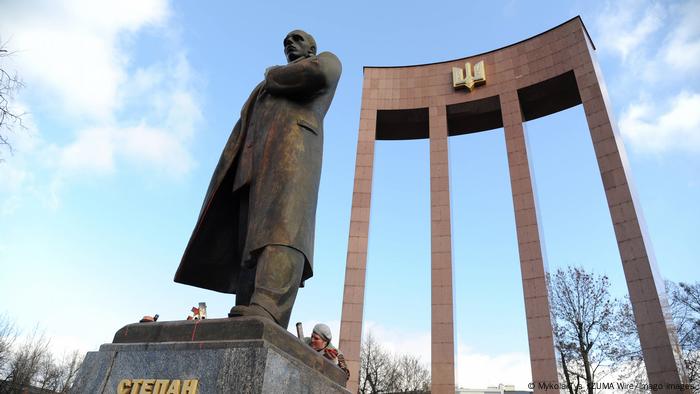
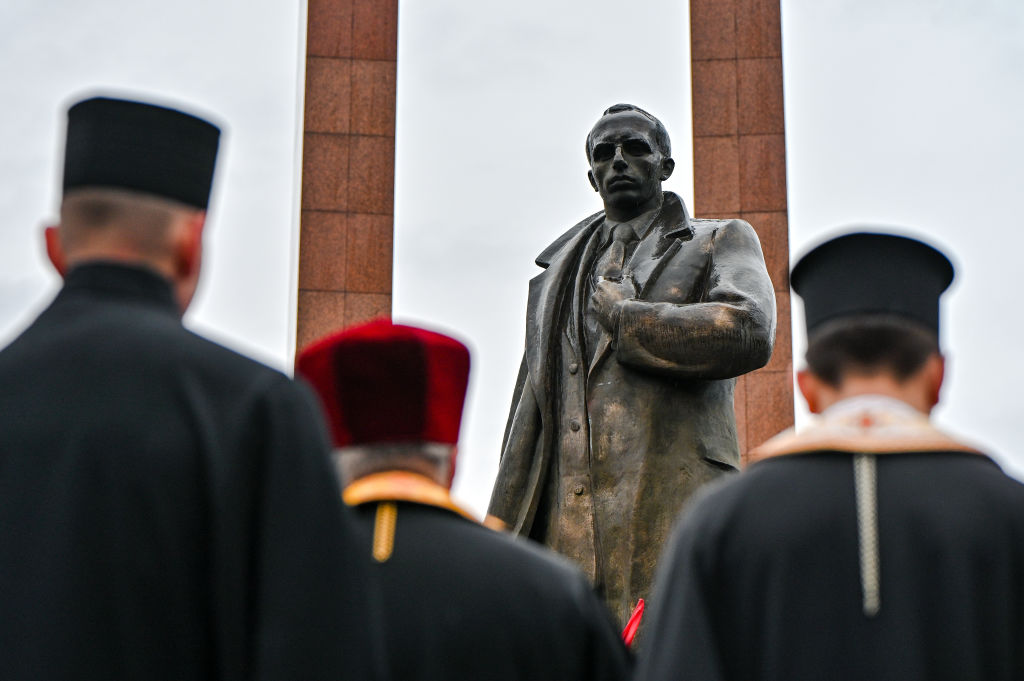
The monument to Stepan Bandera, the leader of the Organization of Ukrainian Nationalists, in Lviv, Ukraine, on January 1, 2024. 
(Ukrinform / NurPhoto via Getty Images)


12.31.2024
Interview by Ondřej Bělíček
JACOBIN

During World War II, Ukraine became the epicenter of the most brutal fighting, and also the most extreme murder of Jewish and Slavic populations. Many Ukrainian nationalists sympathized with the Nazis, hoping that they would help them achieve an independent Ukrainian state. But this was far from Nazi Germany’s goal. From the start of its invasion, it tried to keep the main Ukrainian nationalists at bay — or to exploit their desperate situation to keep the genocidal war going.

Many Ukrainian nationalist forces joined in anti-partisan actions and the murder of Jews for various reasons. After World War II, all these circumstances were used by Soviet propaganda to vilify the Ukrainian nationalists, led by Stepan Bandera, whose real importance the Soviets greatly exaggerated. After the fall of the USSR, memory politics went to the opposite extreme — and pro-Nazi nationalists began to be celebrated by parts of Ukrainian society, especially those in exile.

But how far has the memory politics of World War II in Ukraine been dominated by the far right after the Maidan revolt of 2014? And how has this whole situation escalated since Russia’s invasion of Ukraine? Marta Havryshko, a Ukrainian historian and expert on the Holocaust in Ukraine, currently based at Clark University, answered these questions in an interview with Ondřej Bělíček.
Ondřej Bělíček

During World War II, Ukraine was a center of the fiercest fighting and the genocide of Jewish and Slavic inhabitants. Can you describe the situation in Ukraine during the Nazi-German invasion? How far did Ukraine’s inhabitants collaborate with the Nazis in exterminating the Jewish population?
Marta Havryshko

It’s important to talk about World War II, because amid the current Russo-Ukraine war, the history and memory of this conflict and the Holocaust is used and abused by both sides. What did Vladimir Putin say in his speech when he decided to invade Ukraine? He mentioned “denazification” as a goal of his “special military operation.” Russian foreign minister Sergey Lavrov made a statement about the Jewish background of Volodymyr Zelensky and said that Zelensky is a “Kapo” — meaning a Jewish prisoner forced to collaborate with the Nazis. The main idea behind such claims is that Zelensky betrayed his Jewish origin and allied with so-called “Nazi forces “in Ukraine.

In contrast, the Ukrainian leadership is trying to invoke the memory and the history of World War II and the Holocaust to mobilize people in Ukraine to support the government and participate in resistance to Russian aggression. For example, after the liberation of Bucha and Irpin, and after discovering the mass atrocity committed by Russians, some people started to speculate that Bucha is Ukraine’s Babi Yar. These analogies and parallels are also a manifestation of an abuse of history. You can’t relate these events to Babi Yar, because this was the tragedy when during two days almost 34,000 Jewish people — mostly women, elderly people, and children — were killed.

In March 2022, Zelensky addressed the Israeli Knesset and said that Ukrainians made their choice during the Holocaust — and that it was about saving Jews. He erased the important part of Ukrainian history when Ukrainians collaborated with Nazis in killing the Jews. Why did he do that? He wanted to attract the Knesset’s sympathy, because he believed that Israeli support to the Ukrainian cause is not enough.
Ondřej Bělíček

You have researched this topic extensively. Can you tell us what kind of motivations Ukrainian people had to collaborate with Nazis during World War II?
Marta Havryshko

One of the main motivations for political collaboration was the idea that Adolf Hitler could reinstate Ukraine as an independent state. That’s why the Organization of Ukrainian Nationalists [OUN] that was established in 1929 heavily relied on this idea. Ukrainian nationalists had communication and relations with the Wehrmacht and the Nazi Party. They received training and informational support. They believed that if they showed loyalty to Nazi Germany, the independent Ukraine state would be established.

One of the battalions that was formed early on, Nachtigall, entered Nazi-occupied Lviv on June 30, 1941. Local people greeted them and expressed their satisfaction. Right after entering Lviv, the Ukrainian independent state was proclaimed. But the Germans didn’t want to establish such a state. That’s why many leaders, including Bandera, were imprisoned. They spent most of the war in different concentration camps. Still, many Ukrainian nationalists continued collaborating with Nazis. Why? Because they wanted to have access to power, weapons, and military training. That’s why they were members of local administrations, auxiliary police, and the German military itself.

They participated in the Holocaust by guarding the Jews, convoying them to the killing sites, by directly participating in killings, and by hunting out the people in hiding and handing them to Germans.

Antisemitism also played an important role in political collaboration. The concept of Judeo-Bolshevism was popular among Ukrainian nationalists. They associated Jews with Soviet power and blamed Jews collectively for Soviet crimes in Ukraine, including the Holodomor, the Great Famine of 1932 to 1933. The German occupation forces that shared the same sentiment were portrayed as an ally who could help the Ukrainian people to get rid of Jews and their alleged power.Ukrainian nationalists participated in the Holocaust by guarding the Jews, convoying them to the killing sites, by directly participating in killings, and by hunting out the people in hiding and handing them to Germans.

Another motivation for collaboration with Nazis and their allies was a pragmatic opportunism, typical also in other European countries during the war. Many wanted to survive, to improve their economic condition, to gain power, to make a career, to protect their family members from forced labor and repression. Even many concentration camp guards were former Communist Party members, or Red Army soldiers and officers, because prisoners of war died en masse in Nazi captivity. Millions died from hunger, disease, and poor medical treatment. Many would rather collaborate than to die.
Ondřej Bělíček

You already mentioned Bandera in your answer. Can you tell us his story during World War II?
Marta Havryshko

From early in life, Bandera was obsessed with establishing a Ukrainian state. He was born in western Ukraine, which during the interwar period belonged to the second Polish republic. So, formally, he was a Polish citizen who hated all occupiers — Poles, Russians, Hungarians — and other “hostile “groups, including Jews. He dreamt of an independent Ukrainian ethnic state with a fascist political regime.

He became a member and then a leader of the Organization of Ukrainian Nationalists to make this dream come true. He believed that Nazi Germany would support Ukrainian aspirations, but instead, it put him behind bars, where he spent almost the entire German-Soviet War. So, he didn’t participate in the war crimes of OUN and its military wing (Ukrainian Insurgent Army, UPA), but he never explicitly condemned them.

In addition, he bears responsibility for these crimes as a leader of OUN. Some members of OUN and UPA criticized his radicalism, fanaticism, and obsession with power. He started to lose popularity after World War II but regained it after his assassination by a Soviet agent in 1959. His violent death made him a martyr and key figure in the Ukrainian heroic pantheon. Soviet propaganda greatly contributed to this Bandera myth, even more than his own political activities.Stepan Bandera’s violent death made him a martyr and key figure in the Ukrainian heroic pantheon. Soviet propaganda greatly contributed to this Bandera myth, even more than his own political activities.
Ondřej Bělíček

Was Bandera popular among Ukrainians during or after the war?
Marta Havryshko

In the Soviet Union, Bandera was demonized. His name became a byword (banderivtsi, Banderites) for those who were deemed Ukrainian nationalists and dissidents despite their actual attitude toward Bandera and his legacy. After the collapse of the Soviet Union, Bandera became extremely popular in Western Ukraine, where OUN and UPA mainly operated. Numerous memorial sites commemorated him. But most people in eastern and southern Ukraine had skeptical and negative views of him.

This changed a little after the so-called Maidan Revolution in 2014 when the newly established Ukrainian Institute of National Memory (UINM) started to whitewash him and the entire Ukrainian nationalist underground movement. These efforts became stronger after the full-scale Russian invasion in 2022. Numerous streets in Poltava, Odesa, and Kharkiv oblast were named after him. UINM’s official video depicted Bandera in a Christian iconographic style. Both state and non-state memory actors in Ukraine portray him as a symbol of current Ukrainian resistance to Russian aggression.
Ondřej Bělíček

Apart from Bandera, who else was involved in the nationalist movement during the war?

Marta Havryshko

Ukrainian nationalists were divided during World War II. One faction of Ukrainian nationalists obeyed Bandera, while another obeyed Andriy Melnyk. This latter was even more loyal to Nazi Germany than Bandera’s supporters: for example, these people were in favor of the creation of the Waffen SS Division Galicia, officially established in April 1943. Bandera was against this. Why? Because he believed that Ukrainian youth should join the UPA.

Tens of thousands of young Ukrainian men did join Waffen SS Division Galicia. Bandera couldn’t stop this process, so he decided to infiltrate the SS Division. When the Galicia Division was defeated in the Battle of Brody with the Red Army in July 1944, some of its members deserted to UPA. They became part of the Ukraine liberation movement under Bandera and Roman Shukhevych.Many leaders, including Stepan Bandera, were imprisoned. They spent most of the war in different concentration camps. Still, many Ukrainian nationalists continued collaborating with Nazis.
Ondřej Bělíček

Who was Shukhevych?
Marta Havryshko

Roman Shukhevych, like Bandera, was an active member of OUN in the interwar period. When the Third Reich attacked the Soviet Union in June 1941, he entered Lviv as a commander of the Nazi-formed Nachtigall Battalion under the command of the German Abwehr. In 1942, this battalion took part in punitive operations against partisans in Belarus, in which numerous Jews and other civilians were killed. Later on, he became a commander of the UPA, which carried out the ethnic cleansing of Poles and hunted Jews in forests. Thousands of Nazi collaborators from the Ukrainian Auxiliary Police joined UPA and served under his command. Those people were already socialized in anti-Jewish violence, so they brought their experience to UPA.
Ondřej Bělíček

Can we find some democratic forces among the Ukraine nationalists?
Marta Havryshko

Yes, there was a socialist faction in OUN led by Ivan Mitrynha, but even he was a proponent of a Ukrainian ethno-state: in his vision of the country’s future, only ethnic Ukrainians could enjoy full citizenship. He demonstrated a special hostility toward Jews, blaming them for “cosmopolitism” and supporting Moscow’s imperialism. In 1941, Mitrynha split up with OUN under Bandera and established his own party — the Ukrainian People’s Democratic Party. “Democratization” of the entire Ukrainian nationalistic movement was a necessity after the military failures of Nazi Germany when its defeat seemed inevitable. OUN understood it was better to seek an alliance with the Western powers, so their political program became less hostile to ethnic minorities.
Ondřej Bělíček

How was World War II remembered during the Soviet times? You already mentioned Bandera, but what about the role of Ukrainians in the genocide of Jewish people? Was this taboo?
Marta Havryshko

During the Soviet period the myth of the “Great Patriotic War” was created. Part of this myth was a complete denial of the Molotov-Ribbentrop Pact, which divided Poland, the Baltic states, and Finland between Nazi Germany and the USSR. Another key pillar was the creation of the concept of “peaceful Soviet citizens” as collective victims of Nazi Germany, which overshadowed the Holocaust as the specific victimization of Jews. The Ukrainian nationalist movement was demonized and dehumanized. Members of the OUN and UPA were portrayed as cold-blooded murderers, rapists, and Nazi collaborators.

Why did they do this? Because OUN and UPA was the biggest anti-Soviet resistance after World War II, that took a lot of resources to deal with. Tens of thousands of its members were killed or jailed in the Gulag, with even family members sent to Siberia. Through the demonization of OUN and UPA, the Soviet regime wanted to protect its power and prevent new armed resistance.The result of the Soviet distortion of Ukraine’s history was that after the collapse of the USSR, there was a great pushback.

Part of this demonization was the creation of different historical myths. One is about Nachtigall’s alleged participation in the Lviv pogrom in July 1941. We can’t exclude the possibility of some members being involved — but not the battalion as such. Still, it is also known that Nachtigall was involved in anti-Jewish violence in the Vinnytsia region in 1941 on its own initiative, not because of German orders.

The result of this distortion of Ukraine’s history was that after the collapse of the Soviet Union, there was a great pushback. Many memory actors started to “rehabilitate” the wartime history of the Ukrainian nationalist movement. But the distortion went to the opposite extreme and new myths started to circulate. The ethnic cleansing of Poles, for example, started to be justified, and so, too, the collaboration with the Nazis. Participation in anti-Jewish violence was portrayed as obeying German orders, when Ukrainians had no agency.

But we know that Ukrainian nationalists participated in pogroms against Jews even before the Nazis’ arrival, when the Red Army retreated, and the vacuum of legal power created new opportunities for extremists and opportunists. In many localities, Ukrainians, including members of OUN, attacked Jewish homes, robbed them, raped women and girls, publicly humiliated Jews, and killed many, sometimes in the form of ethnic cleansing.
Ondřej Bělíček

When you refer to this change of narrative, are you talking about the period after the collapse of the Soviet Union, or already during perestroika under Mikhail Gorbachev?
Marta Havryshko

The alternative history of the Ukrainian nationalist movement existed in the West during the Soviet times and was developed by members of the OUN and UPA who ended up there. It was weaponized by the Western political powers as a part of the Cold War. That’s why the Ukrainian diaspora was the main actor in memory politics. It whitewashed the history of the Ukrainian nationalist movement and wanted to construct a very different narrative that opposed the official Soviet one. After the collapse of the Soviet Union, this narrative was exported to Ukraine and favored by some far-right political parties like Svoboda.

In 2010, President Viktor Yushchenko awarded Bandera the title of Hero of Ukraine, which sparked heated debates inside Ukraine and abroad. Many people whose grandpas and grandmas fought the Nazis in the ranks of the Red Army felt deeply offended by this decision. They were not comfortable with celebration of Nazi collaborators, when they had their own, true heroes who sacrificed their lives.

These two main memory regimes — the Soviet and the Ukrainian-nationalist — coexisted in Ukraine for a long time. Their influence and dynamic depended heavily on which political forces were in power. Thus, during the presidency of pro-Russian Viktor Yanukovych, the OUN and UPA were not glorified on the national level, but its cult remained in the local level, in Western Ukraine.
Ondřej Bělíček

Obviously the turning point in Ukraine’s most recent history was 2014 — the annexation of Crimea and the start of the war with Russia. How did this change the narrative?
Marta Havryshko

It was the turning point. Many ultranationalists occupied key positions of power and started to build memory politics heroizing the OUN and UPA. The key actor became the Ukrainian Institute of National Memory established in 2014 under the supervision of nationalist historian Volodymyr Vyatrovich. He became a proponent of the “decomunization law,” which honored the OUN and UPA as “fighters for the Independence of Ukraine in the 20th century.” Many experts were skeptical and disappointed by this controversial law because it undermined critical studies about the history and legacy of these groups.Many Ukrainians whose grandpas and grandmas fought the Nazis in the ranks of the Red Army felt deeply offended by the official veneration of Bandera.
Ondřej Bělíček

Do you think that the far-right groups took the opportunity during the Maidan events and imposed their ideology on Ukraine society?
Marta Havryshko

Yes, I’m convinced that the Maidan Revolution enabled ultranationalists to hijack memory politics in Ukraine. They started to impose an ultranationalist narrative. And from the beginning many people were actually not in favor of this. Many people opposed this narrative. They did not want Bandera and Shukhevych monuments and streets in their cities. Some were against the so-called “Leninopad” that started with the damaging of the [Vladimir] Lenin monument in Kyiv on December 1, 2013.

After the Maidan Revolution, more than a thousand monuments of Lenin were demolished and taken down across Ukraine, and likewise other monuments to Communist leaders, Red Army soldiers, and Soviet partisans. Tens of thousands of streets were renamed, as well as towns and villages. It happened without proper discussion with local people and historians. Many of those policies were just imposed by force and locals just had to accept the changes. Those who opposed this were labeled as loyal to Russians or as “traitors to the Ukrainian people.”

Those huge divisions over the Soviet legacy became even deeper after the start of so called “decolonization” in 2023. It basically means that all the Russian heritage that is present in Ukraine is meant to be removed. [Alexander] Pushkin, [Mikhail] Bulgakov, [Anna] Akhmatova, [Isaac] Babel — all these monuments are to be removed. It is absurd, because many important events and cities in Ukraine were established and flourished under the Russian Empire. Many ethnic Ukrainians took part in the building of this empire. They were active agents of its political, economic, and cultural processes, not just objects of imperial powers. By destroying this memory, Ukraine canceled an important part of its own history, making it less diverse and inclusive and more ethno-nationalistic and mythical.

One of the by-products of this “decolonization” is bullying of the people who use the Russian language. Even Olena Zelenska, the First Lady, claimed that you shouldn’t speak Russian because it is the “enemy language.” When you call a language used by at least half of the Ukrainian population an “enemy language,” you will create huge tensions within Ukrainian society. To my knowledge, in Lviv one school has already established “language patrols.” The idea is that Ukrainian-speaking students will police Russian-speaking students. The problem is that Russian-speaking students are mostly internally displaced persons from war-torn eastern and southern parts of Ukraine. So, those who suffered the most in this war are surveilled and bullied by less affected children.‘Decolonization’ basically means that all the Russian heritage that is present in Ukraine is meant to be removed.

Another initiative on the state level is a legislative ban on using the Russian language during school breaks in all schools in Ukraine. This law has not been adopted yet, but it has sparked heated discussions in society. Can you imagine if Ukrainian refugees in the Czech Republic were forced to use only the Czech language during school breaks — and punished, with their parents fined, if they did use the Ukrainian language? Those children are traumatized. They fled their homes and left their lives behind.

This “decolonization” hysteria has caused a growing number of violent incidents in public spaces when people in cafés, buses, and trams were humiliated and beaten for speaking Russian among themselves. These incidents are more common in mostly Ukrainian-speaking western regions, where local authorities, politicians, journalists, and activists discussed publicly what to do with “non-patriotic” compatriots who don’t give up the Russian language in their private lives. The mayor of Ivano-Frankivsk even established a “language patrol” in the city.
Ondřej Bělíček

I understand that many things dramatically changed after the Russian invasion in 2022. Would you say that the far-right narrative about World War II is now dominant in the Ukraine society?
Marta Havryshko

The Russian full-scale invasion radicalized Ukrainian society dramatically. Many started to be interested in the roots of Russian imperialism and resistance to it. That’s why the history of OUN and UPA became the core of nationalist memory as an example of an uncompromising fight and self-sacrifice for Ukrainian independence.

This memory is full of myths and silence about inconvenient matters that don’t fit a heroic narrative. In addition, this whitewashes the collaboration with Nazis as the “lesser evil.” That’s why it celebrates not only members of the Ukrainian national underground, but members of military units that Nazis created, gave oaths to Hitler, and fought for the interests of Nazi Germany. By that I mean the Waffen SS Division Galicia, involved in anti-partisan punitive actions in Slovakia and Slovenia in 1944.

For a long time, glorifying Waffen SS Division Galicia was a local phenomenon because its members were born in Galicia. That changed after 2022. Many units in the Ukrainian Armed Forces based on far-right groups — the Right Sector, Karpatska Sich, Azov, and Svoboda — started openly celebrating it as a unit that “fought Bolshevism for Ukrainian independence” and wore patches with its logo — a Ruthenian lion.Ukrainian-nationalist memory is full of myths and silence about inconvenient matters that don’t fit a heroic narrative.

The 3rd Assault Brigade, which is a part of the Azov movement, even made an exhibition in the Museum of Kyiv where two photos of Division members were displayed. This exhibition was opened a couple of days after the notorious appearance of Yaroslav Hunka — a ninety-eight-year-old veteran of Waffen SS Division Galicia — in the Canadian Parliament, where he was given a standing ovation in the presence of Zelensky. This caused a huge scandal and political crisis in Canada.

In Ukraine, however, some politicians, intellectuals, and military personnel started to defend Hunka as a “Ukrainian hero.” The Ukrainian Institute of National Memory kept silent and never challenged this problematic discourse. The Center for Countering Disinformation, a working body of the National Security and Defense Council of Ukraine, started to whitewash Waffen SS Division Galicia and claimed that all information about its alleged crimes is “Russian propaganda.”

When I criticized all those troubling developments regarding the celebration of Nazi collaborators, I was harassed, bullied, denounced, and received death threats. Such criticism is a privilege in wartime, which belongs primarily to intellectuals outside of Ukraine. Most Ukrainians can’t afford this due to the self-censorship and fear of being blamed for fueling “Russian propaganda,” meaning “collaboration with the enemy,” which might involve the justice system and imprisonment. Freedom of speech has become a luxury in war-torn Ukraine, in which ethno-nationalist historical myths have become the core of war propaganda.

Contributors

Marta Havryshko is a visiting assistant professor at Clark University’s Strassler Center for Holocaust and Genocide Studies.

Ondřej Bělíček is editor of Czech online daily A2larm.cz.


Wednesday, November 09, 2022

 PERSPECTIVE

Who is Chrystia Freeland, Washington’s “prime candidate” for NATO Secretary-General?

The New York Times recently reported that Washington is promoting Canada’s Deputy Prime Minister, Chrystia Freeland, as its “prime candidate” to succeed Jens Stoltenberg as NATO secretary-general when the Norwegian’s term expires in September 2023.

Freeland is being backed by US imperialism to head the aggressive military alliance because she is a war hawk with extensive personal and political ties with Ukrainian fascism, which has emerged as a key proxy for the Western powers’ predatory war against Russia.

The selection of the next head of the US-led alliance is seen as a crucial issue in Washington and European capitals. The next secretary-general will oversee some 300,000 NATO “high readiness forces” in Europe and will therefore be instrumental in the prosecution of the imperialist powers’ war aimed at subjugating Russia to the status of a semi-colony and seizing control of its natural resources.

In a manner typical of a newspaper that has deceitfully propagandized for every US war of aggression over the past three decades, the Times shamelessly covered up Freeland’s personal and political ties to far-right and outright fascist forces in its November 4 report.

After noting Freeland’s presence in Kiev in 2014 to “celebrate” the fascist-led coup that overthrew elected pro-Russian President Viktor Yanukovich, the Times observes, “(H)er Ukrainian grandfather, a grateful immigrant to Canada, was as a younger man involved with a Ukrainian nationalist movement that saw the Nazis as useful foils to counter the Soviets.”

Contrary to this anodyne portrayal of Freeland’s grandfather as a young man led astray, the fact of the matter is that Mykhailo Chomiak was a high-level Nazi collaborator. From the beginning of 1940 to the early months of 1945, he served as managing editor of the only Ukrainian-language newspaper permitted to publish in Nazi-occupied Poland.

Krakivski Visti (Krakow News), which was produced on a printing press stolen from a Jew who perished in a Nazi death camp, published a steady stream of anti-Semitic and anti-Polish racist filth, regularly lauded Adolf Hitler as a leader of a new Europe and an ally of Ukraine, and actively campaigned for recruits to the 14th Division of the Waffen SS, the so-called Galicia Division. The Galicia Division participated in horrific massacres of Jews and Poles during 1943 and 1944.

Chomiak was a member of the Organization of Ukrainian Nationalists (OUN), which collaborated closely with the Nazis, joined in the war of extermination against the Soviet Union, and was implicated in hundreds of thousands of deaths of Poles and Jews in the Holocaust. The OUN was an explicitly fascist organization that set as its goal the creation of an ethnically pure Ukrainian state.

The faction to which Chomiak belonged, the OUN Melnyk (M), directly served the Nazi occupiers by integrating itself into the administrative and security apparatus in the General Government (Nazi-occupied Poland). The other faction led by Stepan Bandera, the OUN (B), focused on embedding its forces into the military and claimed to act more “independently” of the Nazis. The activities of both factions and their push for an “independent” Ukrainian state were in reality entirely dependent upon the patronage of Nazi German imperialism.

After the downfall of the Third Reich, Chomiak found refuge together with thousands of Nazi collaborators in Canada and the United States. Former members of the fascist OUN were among the first recruits of the newly established CIA, which was above all concerned with recruiting “anti-communist” forces amid the Cold War.

Canada emerged as a key player in enabling Hitler’s accomplices to whitewash their history and write a new narrative of Ukrainian nationalism as having fought for “liberation” against Nazi Germany and the Soviet Union at the same time. In addition to allowing tens of thousands of former SS members and other Nazi collaborators to settle in Canada, Ottawa provided financial support for an ideological campaign to legitimize far-right Ukrainian nationalism, including through its sponsorship of the Ukrainian Canadian Congress and creation of the Canadian Institute of Ukrainian Studies at the University of Alberta in Edmonton.

The state intervened to help far-right forces associated with the OUN gain control of property and other assets owned by groups representing the Ukrainian diaspora that had been strongholds of socialism and left-wing politics prior to the Second World War. 

(This history is presented in detail in the WSWS series Canadian imperialism’s fascist friends)

Freeland emerged out of this milieu. After working as a student on the so-called “Encyclopedia of Ukraine,” a project aimed at concealing the Ukrainian nationalists’ active support for Hitler and the Nazis led by Krakivski Visti’s publisher, Volodymyr Kubiyovych, Freeland traveled to Soviet Ukraine in the late 1980s to stoke the far-right Ukrainian nationalism in which she had been schooled.

The Canadian state facilitated the return to Ukraine of large numbers of exiles and their descendants with ties to far-right nationalist groups over subsequent years, many of whom emerged as important figures in the establishment of an independent capitalist Ukraine following the Stalinists’ dissolution of the Soviet Union. Halyna Chomiak, Freeland’s mother, returned to Ukraine to establish the Ukrainian Legal Foundation, which was involved in drafting the country’s constitution.

The most significant import these forces brought back to Ukraine was a virulent strain of far-right nationalism. As Freeland observed in a 2015 essay entitled “My Ukraine, Putin’s big lie”: “Ukraine’s national consciousness was weak.” The Canadian state, supported by the politically influential Ukrainian Canadian Congress, made a significant contribution over the following years to revive the cult of Stepan Bandera, with the result that dozens of statues and other memorials to the fascist leader sprang up across western Ukraine.

This history goes a long way to explaining why Freeland has secured such a prominent position in Canadian imperialism’s preparation for and waging of the US-led war against Russia. After the fascist-led Maidan coup brought to power a pro-Western regime in Kiev in 2014, prompting Russia to annex Crimea in response, Washington and Ottawa took the lead in reorganizing Ukraine’s armed forces.

They oversaw the integration of fascist militias like the notorious Azov Battalion into its ranks. Canadian troops involved in a military training mission in Ukraine provided instruction to members of Azov and Centuria, an elite group of fascist army officers. Canada simultaneously joined in NATO’s massive build-up of military forces on Russia’s western border by leading one of the alliance’s forward battalions in Latvia. The deployment of similar battalions to Estonia, Lithuania and Poland continued the eastward march of the aggressive military alliance aimed at encircling Russia that began in the aftermath of the restoration of capitalism by the Stalinists in Russia and Eastern Europe.

Freeland served as Foreign Minister throughout much of this period, before being promoted by Prime Minister Justin Trudeau to the position of deputy prime minister and finance minister following the 2019 federal election. When the US and its NATO allies succeeded in goading Putin into his reactionary invasion of Ukraine in February, Freeland emerged as one of the leading voices for ruthless economic sanctions, including the removal of Russia from the SWIFT global payments network. She has also served as a key interlocutor between the Ukrainian government and its imperialist masters, boasting earlier this year that she has daily conversations with Ukraine’s prime minister and finance minister.

The fact that Freeland is now being mooted for the top job of NATO underscores the predatory character of the imperialist war waged by the US and NATO against Russia. Far from the Western powers intervening to defend Ukraine’s “sovereignty” and “democracy,” as publications like the Times incessantly claim, the conflict is about plundering Russia’s rich natural resources and seizing control of the geostrategically crucial Eurasian landmass.

These goals demand the deployment of ruthless military force abroad, threatening the world with a nuclear conflagration, and no less brutal methods of state repression at home to crush popular opposition to the subordination of society’s resources to imperialist war and conquest. This is why the imperialists have cultivated intimate ties with fascist forces.

The political utility of Freeland for the Times and its predominantly middle-class readership, which makes up a key constituency of support for imperialist war, is that she unites her close ties to Ukrainian fascism with the requisite dose of identity politics.

For these social layers, it is of far greater significance that Freeland could become “NATO’s first female Secretary-General” than that she is an avowed war hawk and far-right Ukrainian nationalist who describes an important Nazi collaborator as one of her heroes. Confronted with her grandfather’s Nazi collaborationist record in 2017, Freeland dismissed it as “Russian disinformation.” She has repeatedly paid tribute to Chomiak for teaching her about Ukrainian culture and nationalism.

During her time as Canada’s foreign minister, Freeland proclaimed Ottawa was pursuing a “feminist foreign policy” as it deployed troops to Latvia, trained neo-Nazis in Ukraine and participated in “freedom of navigation” exercises in the South China Sea. In 2017, Freeland announced a military spending hike of over 70 percent within a decade, and delivered a keynote address on Canada’s new defence strategy that cited both Russia and China as “threats” to national security.

Freeland also maintains close ties to the trade union bureaucracy, which Canada’s Liberal government views as a key partner in enforcing austerity to pay for war and suppressing the class struggle. Since the war broke out, Freeland has been invited to address several union conventions, including the 2022 Teamsters convention in June.

Freeland’s appointment to NATO’s top job is by no means guaranteed. Since its formation in 1949, the alliance has traditionally been headed by a European, while a US general typically holds the position of Supreme Allied Commander in Europe.

The prospect of a Canadian and an American occupying NATO’s two top positions would undoubtedly raise eyebrows among the European imperialists, especially under conditions in which Germany has seized on the war to revive its global great-power ambitions. These geopolitical tensions aside, the war-mongers in Washington, Ottawa, Berlin and Brussels could hardly find a more politically appropriate figure to head their military alliance of death and destruction than Chrystia Freeland.

Friday, May 29, 2026

EMBRACING UKRAINIAN FASCISM

RAGOZIN: Melnyk reburial signals ideological shift in Ukraine

RAGOZIN: Melnyk reburial signals ideological shift in Ukraine
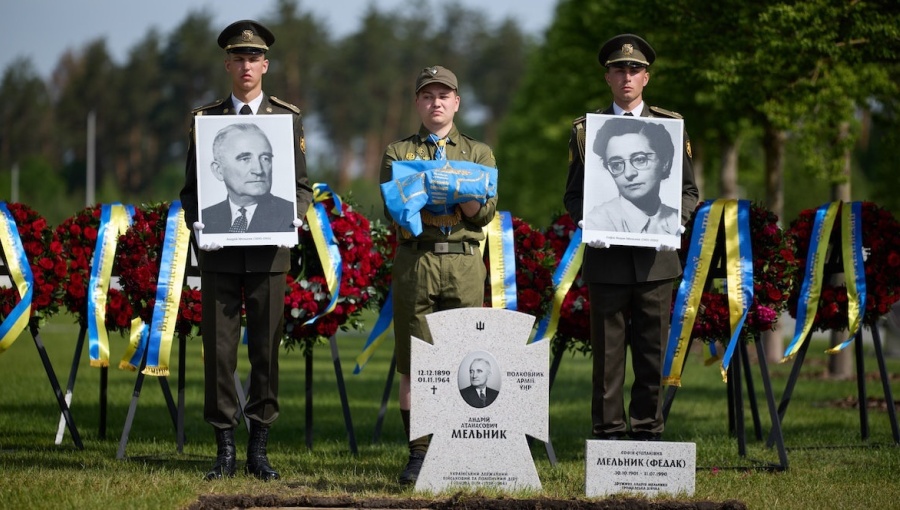
Ukrainian President Volodymyr Zelenskiy attended the reburial of Andriy Melnyk, one of the leaders of the Organisation of Ukrainian Nationalists (OUN). / Volodymyr Zelenskiy via XFacebook
By Leonid Ragozin in Riga May 29, 2026

Last week, Ukrainian President Volodymyr Zelenskiy went to the National Military Memorial Cemetery to take part in the reburial of Andriy Melnyk, Adolf Hitler’s ally in World War II and one of the leaders of the Organisation of Ukrainian Nationalists (OUN). Next to Zelenskiy, stood his chief of staff Kyrylo Budanov, who has been overseeing a visible ideological shift in Ukraine since assuming office early this year. 

In a tweet published on the occasion, Budanov wrote that the reburial heralds the creation of the “Pantheon of Prominent Ukrainians”. The choice of Melnyk’s ashes as an object of national veneration sends a clear signal about the direction of that shift.

Over seven years in the presidential seat, Zelenskiy has undergone a remarkable transformation from a dove seeking rapprochement with Russia to a defiant wartime leader and the Kremlin’s sworn enemy. His attitude to Ukraine’s history has changed just as radically.

Soon after he was elected in 2019 on the promise of peace, Zelensky made a point about celebrating May 9, the Soviet Victory Day, by visiting the grave of his grandfather who fought in the Red Army.

This populist gesture was designed to appeal an overwhelming majority of Ukrainians, in both the east and west of the country, whose ancestors fought on the Soviet side in WWII and who gave their votes to the new president. A memo published by Ukraine’s ministry of foreign affairs in October 2014 cites the figure of 7mn residents of Ukraine who fought in the Soviet army during WWII versus only 240-250 thousand who collaborated with the Nazis.

As his 57th Guard Division was pushing the Germans out of Mairupol, Sloviansk and Kramatorsk, lieutenant Semyon Zelenskiy was avenging the deaths of his father (President Zelenskiy’s great-grandfather) and three brothers, all of whom perished in the Holocaust.

Meanwhile, Melnyk was attempting to set up a fascist Ukrainian puppet state in Ukraine with a constitution, authored by his friend Mykola Stsiborsky, which described future Ukraine as “authoritarian and totalitarian state”. In a letter to Hitler in 1941, Melnyk pleaded that anti-Soviet Ukrainians be “allowed to march shoulder to shoulder with the legions of Europe and with our liberator, the German Wermacht”. Meanwhile, his subordinates in Ukraine took part in Jewish pogroms in Bukovyna and assisted the Germans in killing the Jews elsewhere around the country.

Melnyk’s pleas fell on deaf ears in Berlin since Hitler saw Slavs as an inferior race subject to enslavement and extermination. He was interned by the Nazis in a camp for foreign VIPs, who were treated humanely and respectfully, and released in 1944 when Hitler felt Ukrainian fascists could help him stall the Red Army’s onslaught in western Ukraine. Failing to receive guarantees of a pro-Nazi Ukrainian state, Melnyk ended up offering his services to Western allies in the US-occupied zone.

The World Holocaust Remembrance Centre, Yad Vashem, stated that it was deeply troubled by Melnyk’s reburial in Kyiv. “Honouring the leader of a movement [OUN] that supported and collaborated with Nazi Germany during the persecution and murder of millions of Jews undermines the moral integrity essential to Holocaust remembrance,” its press release said.

OUN’s dream Ukraine

Melnyk died in 1964 and was buried in Luxembourg where his remains were lying peacefully until Zelenskiy’s administration decided to repatriate them in May this year. “Colonel Andriy Melnyk returned to a different Ukraine – not the one he had been forced to leave, but the one he had dreamed of,” Zelenskiy said at the reburial ceremony.

Today’s Ukraine is indeed much closer to Melnyk’s ideals than those Zelenskiy’s grandfather was fighting for.

Built in 1974 and topped with the 102m-tall Motherland statue, Kyiv’s WWII History Museum was designed to commemorate Soviet war heroes like Semyon Zelenskiy. In the WWII cult developed under the Ukraine-born Soviet leader Leonid Brezhnev, this was one of the three most sacred sites in the entire Soviet country.

In 2026 however, it housed an exhibition dedicated to the Russian Volunteer Corps (RVC), a military unit formed by fugitive Russian neo-Nazis who believe that today’s Ukraine is much closer to their ideals than Russian President Vladimir Putin’s authoritarian regime. They see Putin’s Russia as a continuation of the Bolshevik internationalist project, citing Putin’s tolerance to mass immigration from Central Asian countries as proof.

In its propaganda and symbols, RVC draws inspiration from Gen. Andrey Vlasov’s Russian Liberation Army which fought on Hitler’s side in WWII. Featuring prominently in the exhibition, RVC’s symbol is called Spayka, best translated as fascia. It was designed in the 1930s by the Russian emigre organisation White Cause which later joined the Russian Fascist Party. 

The exhibition was officially curated by RVC’s khorunzhy (ideological officer), Aleksey Lyovkin. Having served a sentence for racially motivated attacks on migrants in his native Tver in Russia, Lyovkin founded a band called M8L8TH (which translates as Hitler’s Hammer and contains the numerical symbol 88 that stands for Heil Hitler in skinhead jargon) before moving to Ukraine in 2015.

Although it existed in Russian imperial forces, khorunzhy is not an official rank in the Ukrainian army. It originally meant flag-bearer in the Cossack troops, but it resurfaced in the Russo-Ukrainian war as an equivalent of the Soviet politruk, a political officer. 

Officially non-existent in the Ukrainian army, khorunzhy is used as a rank in politically autonomous units that form what its members call the “Azov family” or “movement”. Born out of the original Azov battalion, this far right mega-group currently controls Ukraine’s 3rd Army Corps commanded by Andriy Biletsky, its founder and political leader. 

The 3rd Corps runs its own school of political officers which is named after Yevhen Konovalets, Melnyk’s predecessor as the OUN leader. Its political bible is Natiocracy, an ethnonationalist teaching of OUN ideologist and Melnyk’s ally, Mykola Stsiborsky.

The Azov battalion in its original forms had a significant presence of Russian neo-Nazis, like Lyovkin or the most prominent living Russian neo-Nazi leader Sergey “Malyuta” Korotkikh, who was in charge of the battalion’s intelligence. 

These Russians (though not Korotkikh) eventually formed the core of RVC, which ideologically is a part of the Azov family but operates under the auspices of Ukraine’s military intelligence, the HUR. The latter was headed by Zelenskiy’s chief of staff Budanov from 2020 to 2026.

An ideology for New Europe

Melnyk’s reburial would be hard to imagine under Zelenskiy’s previous chief of staff, Andriy Yermak, who graduated from secondary school in the Soviet times and whose father served at the USSR’s embassy in Kabul during the Soviet occupation of Afghanistan. His Russian-born mother grew up in Leningrad. Hardly famous for political restraint, he still displayed some ethical red lines when it comes to history and politics.

But Yermak took upon himself the role of chief scapegoat in a massive anti-corruption investigation that targets Zelenskiy’s immediate entourage. He has been formally charged in a multilayered corruption case which involves four mansions, one of which belongs to him and another one likely to Zelenskiy himself. 

Budanov is another story. Born in 1986, he is largely a product of post-independence Ukraine with all of its geopolitical ambivalences and mafia state realities. An ideological orphan, he was provided with a social lift when he joined unit A2245 of the HUR whose members were trained by the CIA. 

A Washington Post investigation, published in 2023, revealed that the military intelligence agency Budanov would become the head of was created under the CIA’s supervision from scratch and hermetically sealed from other Ukrainian spy agencies to avoid Russian interference. The HUR is “our baby”, the newspaper’s CIA source boasted. Since the end of WWII, the CIA’s Ukrainian operation has been defined by the influx of OUN cadres who previously worked for the Germans. 

Ideology is a swear word with the liberal-democratic paradigm which Ukraine is still ostensibly pursuing, but Zelenskiy’s chief of staff is not shy about using the word. 

“Ukraine today embodies true Europe — both geographically and, above all, ideologically,” he wrote on May 9, the day of the Soviet victory over the Nazis, also marked as Europe Day in the EU. “We are defending the security and values of the entire continent: freedom, respect and the right to one’s identity,” he continued, adding the word “identity” where centrist politicians would normally mention human rights or social justice. 

His ideology reveals itself in commemorative events like Melnyk’s reburial, which he organised. Zelenskiy named Budanov first when listing officials who helped to make it happen. It also spills into his sometimes surprising statements, like when he mused on the meaning of Rus, the Kyiv-centred medieval state which gave its name to Russia. “Rus is Ukraine. But Rus is more, much more and Ukraine is the motherland of everything, even of those who we are fighting against,” he told the audience at the Kyiv Stratcom Forum this month. “You see where is the issue: We have handed over much of our history to them, we did it voluntarily. They privatised it, although they are nobody. We are the Rus, we should rule them.”

These imperial sentiments hark back to the ideas first expressed by Azov Movement ideologists back in 2014-16. They boil down to recreating the Russian Empire, only with the capital in Kyiv rather than Moscow.

Budanov’s effort to build the pantheon of Ukrainian heroes is expected to bring more results in the coming months and years. Negotiations are underway with the US and European countries about the repatriation of prominent Ukrainians who died in exile, prominently featuring OUN leader Stepan Bandera and Simon Petlyura who led Ukrainian nationalists in the Russian civil war. 

But Zelenskiy mentioned only one figure who is going to be reburied for sure. It is Yevhen Konovalets, who headed the OUN before Bander and Melnyk and after whose name the Azov Movement’s ideological school bears.

Leonid Ragozin is a freelance journalist based in Riga. He covered Russia, Ukraine and other countries for leading global media, including the BBC, Bloomberg and Al Jazeera. Leonid co-authored “En eiropeisk tragedie”, a book about the roots of Russo-Ukranian conflict published in Norway.