India's opposition leader calls for Modi to step down as youth-led 'Cockroach' protests press on
Rahul Gandhi, India's opposition leader, called for Prime Minister Narendra Modi to resign on Tuesday "for destroying the future" of the country's youth. The youth-led Cockroach movement continued their protests in New Delhi, refusing to leave their sit-in site a day after police used tear has and batons to disperse demonstrators marching towards parliament.
Issued on: 21/07/2026
Rahul Gandhi, India's opposition leader, called for Prime Minister Narendra Modi to resign on Tuesday "for destroying the future" of the country's youth. The youth-led Cockroach movement continued their protests in New Delhi, refusing to leave their sit-in site a day after police used tear has and batons to disperse demonstrators marching towards parliament.
Issued on: 21/07/2026
By: FRANCE 24

'Shameful day'
"We won't stop. Pradhan has to be sacked," CJP spokesman Ashutosh Ranka said on social media.
There were far fewer protesters at Jantar Mantar than on Monday, when the CJP mobilised huge crowds to march on India's parliament.
CJP founder Abhijeet Dipke urged protesters on Tuesday not to lose hope.
"They want to break our spirit," he said, perched on top of a lorry. "Do not let them silence you."
Protest organisers condemned the "high-handedness" of the authorities and said hundreds of protesters had been injured.
"It's a shameful day in the history of Indian democracy that people, honest students, who had come for a genuine issue were brutally beaten by the Delhi police," Ranka told AFP.
Ranka, who met senior minister JP Nadda on Monday, said the government had yet to respond to their demands.
Protesters said they would not relent.
"We have become even more fearless now," said 25-year-old law student Chandra Pratap Sishwi.
"When I saw people being beaten up by the police like that, my blood boiled."
Parliament was adjourned on Tuesday after the opposition benches demanded a discussion on the alleged "brutality unleashed on students".
Despite rapid economic growth, millions of people in the world's most populous nation still struggle to find stable and well-paying jobs, fuelling discontent.
The protests follow a series of examination scandals that have shaken confidence in India's testing system.
Some 2.2 million aspiring medical students sat for a re-examination under tight security last month after the previous test was scrapped following the leak of a question paper.
That came on top of another scandal related to the online marking of tests taken by nearly two million high school students.
Parliamentary Affairs Minister Kiren Rijiju defended the government on Tuesday, saying it had acted swiftly after the exam paper leaks by arresting several people.
He said Modi had called for a "foolproof system" to prevent irregularities in the future at a closed-door meeting with his allies on Tuesday.
Modi has yet to comment directly on the protests.
(FRANCE 24 with AFP and AP)
“It’s just shocking to see that the people we elected have turned a blind eye to youth dying,” said one protester.
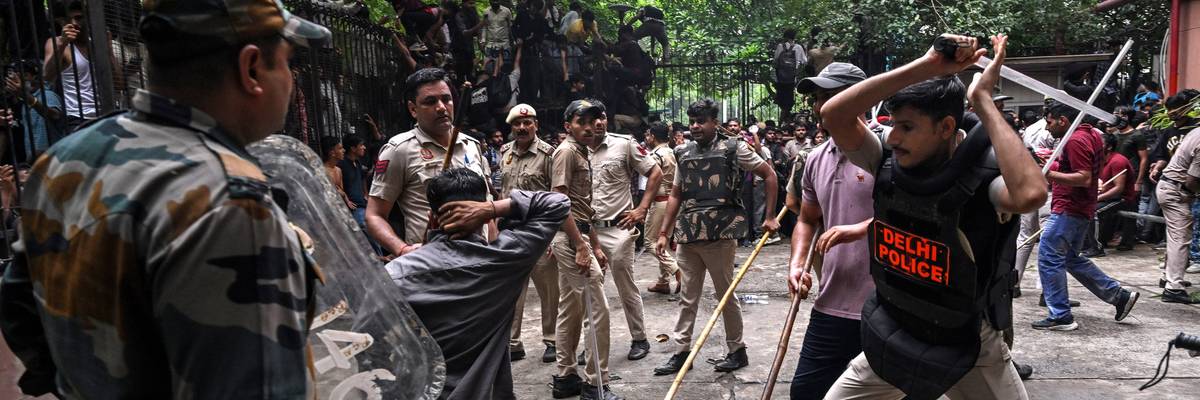
Delhi police officers beat Cockroach Janta Party protesters during a July 20, 2026 protest in New Delhi demanding the resignation of India’s education minister.
(Photo by Arun Sankar/AFP via Getty Images)
Brett Wilkins
Jul 20, 2026
C0MM0N DREAMS
Indian protesters rallying Monday in New Delhi under the banner of the youth-led Cockroach Janta Party were brutally attacked by police as they marched toward the country’s Parliament demanding the resignation of the country’s education minister and denouncing the right-wing government of Prime Minister Narendra Modi.
Tens of thousands of protesters took to the streets of the Indian capital despite police bans, barricades, internet shutdowns, and a heavy security presence. Police, some of them in plain clothes, attacked the overwhelmingly peaceful demonstrators with baton charges and tear gas. Delhi police are controlled by the Bharatiya Janata Party (BJP)-ruled central government.
The Wire reported that thousands of people were injured—some seriously—by police. Despite video footage and photos showing officer brutality, Delhi Police denied “sporadic use of violence” against protesters.
The protesters are seeking the resignation of Education Minister Dharmendra Pradhan following repeated leaks of National Eligibility Entrance Test papers that have upended the lives of millions of students by forcing them to retake the grueling exams and delaying university admissions. Protest organizers say more than 20 students have killed themselves over the matter.
Late last month, Pradhan dismissed the protesters as “the B-team of terrorists.”
“Already more than 20 students have died by suicide, but this government is not done yet,” Cockroach Janta Party (CJP) founder Abhijeet Dipke said on social media. “This government has resorted to hooliganism now.”
Protester Rhythm Katoch told The Guardian on Monday: “They are calling this protest illegal, they are calling us anti-national. But I am 22 years old, and I am standing here to fight for our education system, for the rights of the young people, and for our democracy. Is it too much to ask for the government to listen to us?”
The CJP and other student groups have been leading hunger strikes at the Jantar Mantar, an 18th-century astronomical observatory designated as the protest site. Three students from the leftist All India Students’ Association ended their fast on Monday, while environmentalist Sonam Wangchuk, who has been on a hunger strike since June 28, was taken by authorities on Saturday to Safdarjung Hospital, where he continues his fast.
“I am touched and moved by how the youth have held on to peace despite provocation,” Wangchuk said Monday.
The movement began in May after Chief Justice of India Surya Kant reportedly compared unemployed young people to “cockroaches.” The protesters satirically reclaimed the slur as the symbol of a movement that has grown into a broader challenge to Modi’s increasingly authoritarian Hindu nationalist rule, which has seen mounting repression of protest and dissent, including restrictions on journalists and activists, and the use of legal measures to target critics.
On Monday, protesters chanted “Go, Pradhan, Go, Saat Mein Modi Ko Bhi Lo! (Take Modi along with you too!),” banging plastic bottles on the ground to keep the beat.
“It’s just shocking to see that the people we elected have turned a blind eye to youth dying… because of their incompetency,” Sajal, a 22-year-old law student, told The Straits Times.
Another protester, yoga instructor Jyoti Rajput, told The Associated Press that she joined the demonstration because “this rotten system refuses to take action.”
“It cannot see the pain of students, and that’s why so many people have joined this movement,” she added.
Amid Monday’s demonstration, CJP leaders met Union Minister JP Nadda at his Delhi home.
“The minister assured us he will discuss this at the appropriate level,” CJP spokesperson Saurav Das said on social media. “However, no commitments have been made so far.”
Responding to the brutal crackdown, Amnesty International India board chair Aakar Patel said in a statement that “the images and reports emerging from the protest at Jantar Mantar show how peaceful dissent is being suppressed in India.”
“The role of the authorities is to protect and facilitate peaceful protests, not to suppress them,” he continued. “The right to freedom of peaceful assembly is recognized under international human rights law and the Indian Constitution.”
“The Delhi Police’s actions raise serious questions about whether their response met the requirements of legality, necessity, and proportionality under international human rights standards,” Patel added. “We call on the Delhi Police to exercise restraint and immediately cease the use of unlawful force against peaceful protesters. Authorities must ensure that all allegations of unlawful conduct, including the reported excessive use of batons, tear gas, and stone-throwing by police personnel, are promptly, independently, and impartially investigated.”
Video by: Delano D'SOUZA
Cover image: India's opposition leader Rahul Gandhi stands with hands tied as he participates in a sit-in protest outside Modi's residence in New Delhi on July 21, 2026. © Shekhar Yadav, AP
01:47
India's main opposition leader, Rahul Gandhi, demanded on Tuesday that Prime Minister Narendra Modi step down over the police crackdown against student protests demanding reforms in the education system.
Modi must resign "for destroying the future of India's youth", the Congress Party leader said in a post on social media as he led a march with other MPs towards the prime minister's residence in New Delhi.
"The government doesn't want to take any accountability, nor does it want to have a debate on it in parliament," said Gandhi.
Along with dozens of his Congress party lawmakers, Gandhi staged a sit-in protest outside Modi's residence. Several were seen fastening zip ties around their wrists.
Gandhi's comments came after police said 60 protesters were injured in clashes with security forces in the heart of New Delhi on Monday, marking the biggest street rally in the capital for about five years.
Thousands of protesters had gathered to demand the resignation of Education Minister Dharmendra Pradhan, following an appeal by the Cockroach Janta Party (CJP) online movement.
Police fired tear gas and charged with batons at protesters, who responded by pelting stones. At least 118 police personnel were also injured, Delhi Police said.
The CJP vowed to press on with its demands for Pradhan's removal as hundreds of protesters remained camped at Delhi's Jantar Mantar protest site on Tuesday, many of them calling for changes to the wider education system.
The CJP has won millions of followers on social media since its launch in May, fuelling one of the biggest challenges to Hindu-nationalist leader Modi since he won his third term in office in 2024.
01:47
India's main opposition leader, Rahul Gandhi, demanded on Tuesday that Prime Minister Narendra Modi step down over the police crackdown against student protests demanding reforms in the education system.
Modi must resign "for destroying the future of India's youth", the Congress Party leader said in a post on social media as he led a march with other MPs towards the prime minister's residence in New Delhi.
"The government doesn't want to take any accountability, nor does it want to have a debate on it in parliament," said Gandhi.
Along with dozens of his Congress party lawmakers, Gandhi staged a sit-in protest outside Modi's residence. Several were seen fastening zip ties around their wrists.
Gandhi's comments came after police said 60 protesters were injured in clashes with security forces in the heart of New Delhi on Monday, marking the biggest street rally in the capital for about five years.
Thousands of protesters had gathered to demand the resignation of Education Minister Dharmendra Pradhan, following an appeal by the Cockroach Janta Party (CJP) online movement.
Police fired tear gas and charged with batons at protesters, who responded by pelting stones. At least 118 police personnel were also injured, Delhi Police said.
The CJP vowed to press on with its demands for Pradhan's removal as hundreds of protesters remained camped at Delhi's Jantar Mantar protest site on Tuesday, many of them calling for changes to the wider education system.
The CJP has won millions of followers on social media since its launch in May, fuelling one of the biggest challenges to Hindu-nationalist leader Modi since he won his third term in office in 2024.
'Shameful day'
"We won't stop. Pradhan has to be sacked," CJP spokesman Ashutosh Ranka said on social media.
There were far fewer protesters at Jantar Mantar than on Monday, when the CJP mobilised huge crowds to march on India's parliament.
CJP founder Abhijeet Dipke urged protesters on Tuesday not to lose hope.
"They want to break our spirit," he said, perched on top of a lorry. "Do not let them silence you."
Protest organisers condemned the "high-handedness" of the authorities and said hundreds of protesters had been injured.
"It's a shameful day in the history of Indian democracy that people, honest students, who had come for a genuine issue were brutally beaten by the Delhi police," Ranka told AFP.
Ranka, who met senior minister JP Nadda on Monday, said the government had yet to respond to their demands.
Protesters said they would not relent.
"We have become even more fearless now," said 25-year-old law student Chandra Pratap Sishwi.
"When I saw people being beaten up by the police like that, my blood boiled."
Parliament was adjourned on Tuesday after the opposition benches demanded a discussion on the alleged "brutality unleashed on students".
Despite rapid economic growth, millions of people in the world's most populous nation still struggle to find stable and well-paying jobs, fuelling discontent.
The protests follow a series of examination scandals that have shaken confidence in India's testing system.
Some 2.2 million aspiring medical students sat for a re-examination under tight security last month after the previous test was scrapped following the leak of a question paper.
That came on top of another scandal related to the online marking of tests taken by nearly two million high school students.
Parliamentary Affairs Minister Kiren Rijiju defended the government on Tuesday, saying it had acted swiftly after the exam paper leaks by arresting several people.
He said Modi had called for a "foolproof system" to prevent irregularities in the future at a closed-door meeting with his allies on Tuesday.
Modi has yet to comment directly on the protests.
(FRANCE 24 with AFP and AP)
‘Black Day for Democracy’: Indian Police Bash and Gas Youth-Led ‘Cockroach’ Protesters
“It’s just shocking to see that the people we elected have turned a blind eye to youth dying,” said one protester.
Delhi police officers beat Cockroach Janta Party protesters during a July 20, 2026 protest in New Delhi demanding the resignation of India’s education minister.
(Photo by Arun Sankar/AFP via Getty Images)
Brett Wilkins
Jul 20, 2026
C0MM0N DREAMS
Indian protesters rallying Monday in New Delhi under the banner of the youth-led Cockroach Janta Party were brutally attacked by police as they marched toward the country’s Parliament demanding the resignation of the country’s education minister and denouncing the right-wing government of Prime Minister Narendra Modi.
Tens of thousands of protesters took to the streets of the Indian capital despite police bans, barricades, internet shutdowns, and a heavy security presence. Police, some of them in plain clothes, attacked the overwhelmingly peaceful demonstrators with baton charges and tear gas. Delhi police are controlled by the Bharatiya Janata Party (BJP)-ruled central government.
The Wire reported that thousands of people were injured—some seriously—by police. Despite video footage and photos showing officer brutality, Delhi Police denied “sporadic use of violence” against protesters.
The protesters are seeking the resignation of Education Minister Dharmendra Pradhan following repeated leaks of National Eligibility Entrance Test papers that have upended the lives of millions of students by forcing them to retake the grueling exams and delaying university admissions. Protest organizers say more than 20 students have killed themselves over the matter.
Late last month, Pradhan dismissed the protesters as “the B-team of terrorists.”
“Already more than 20 students have died by suicide, but this government is not done yet,” Cockroach Janta Party (CJP) founder Abhijeet Dipke said on social media. “This government has resorted to hooliganism now.”
Protester Rhythm Katoch told The Guardian on Monday: “They are calling this protest illegal, they are calling us anti-national. But I am 22 years old, and I am standing here to fight for our education system, for the rights of the young people, and for our democracy. Is it too much to ask for the government to listen to us?”
The CJP and other student groups have been leading hunger strikes at the Jantar Mantar, an 18th-century astronomical observatory designated as the protest site. Three students from the leftist All India Students’ Association ended their fast on Monday, while environmentalist Sonam Wangchuk, who has been on a hunger strike since June 28, was taken by authorities on Saturday to Safdarjung Hospital, where he continues his fast.
“I am touched and moved by how the youth have held on to peace despite provocation,” Wangchuk said Monday.
The movement began in May after Chief Justice of India Surya Kant reportedly compared unemployed young people to “cockroaches.” The protesters satirically reclaimed the slur as the symbol of a movement that has grown into a broader challenge to Modi’s increasingly authoritarian Hindu nationalist rule, which has seen mounting repression of protest and dissent, including restrictions on journalists and activists, and the use of legal measures to target critics.
On Monday, protesters chanted “Go, Pradhan, Go, Saat Mein Modi Ko Bhi Lo! (Take Modi along with you too!),” banging plastic bottles on the ground to keep the beat.
“It’s just shocking to see that the people we elected have turned a blind eye to youth dying… because of their incompetency,” Sajal, a 22-year-old law student, told The Straits Times.
Another protester, yoga instructor Jyoti Rajput, told The Associated Press that she joined the demonstration because “this rotten system refuses to take action.”
“It cannot see the pain of students, and that’s why so many people have joined this movement,” she added.
Amid Monday’s demonstration, CJP leaders met Union Minister JP Nadda at his Delhi home.
“The minister assured us he will discuss this at the appropriate level,” CJP spokesperson Saurav Das said on social media. “However, no commitments have been made so far.”
Responding to the brutal crackdown, Amnesty International India board chair Aakar Patel said in a statement that “the images and reports emerging from the protest at Jantar Mantar show how peaceful dissent is being suppressed in India.”
“The role of the authorities is to protect and facilitate peaceful protests, not to suppress them,” he continued. “The right to freedom of peaceful assembly is recognized under international human rights law and the Indian Constitution.”
“The Delhi Police’s actions raise serious questions about whether their response met the requirements of legality, necessity, and proportionality under international human rights standards,” Patel added. “We call on the Delhi Police to exercise restraint and immediately cease the use of unlawful force against peaceful protesters. Authorities must ensure that all allegations of unlawful conduct, including the reported excessive use of batons, tear gas, and stone-throwing by police personnel, are promptly, independently, and impartially investigated.”
India's Cockroach party leads thousands of youth in protest to parliament
Issued on: 21/07/2026 - FRANCE24
Issued on: 21/07/2026 - FRANCE24
Demonstrators in the Indian capital have marched to parliament as they demand the sacking of the country's education minister. The youth-led Cockroach movement, started as a satirical youth platform, but has morphed into something larger. Protesters are more galvanised after a hunger-striking social activist was forcibly moved to hospital, against his will.
Video by: Delano D'SOUZA
India's Cockroach protests vow to continue despite police crackdown
Issued on: 21/07/2026 - FRANCE24
The leaders of India's youth-led Cockroach movement are vowing to continue protesting a day after police cracked down on demonstrators. They have been demanding the country's education minister, Dharmendra Pradhan, resign amid repeated leaks for entrance tests to medical schools. While two of the movement's members met with a government minister on July 20th, India's prime minister, Narendra Modi, is failing to address the issue for now. Delano D'Souza reports.
Video by: Delano D'SOUZA
Issued on: 21/07/2026 - FRANCE24
The leaders of India's youth-led Cockroach movement are vowing to continue protesting a day after police cracked down on demonstrators. They have been demanding the country's education minister, Dharmendra Pradhan, resign amid repeated leaks for entrance tests to medical schools. While two of the movement's members met with a government minister on July 20th, India's prime minister, Narendra Modi, is failing to address the issue for now. Delano D'Souza reports.
Video by: Delano D'SOUZA

Indian police on Saturday forcibly moved environmentalist Sonam Wangchuk to hospital after his health deteriorated during a weeks-long hunger strike in New Delhi. Wangchuk, a prominent activist tied to the viral, opposition Cockroach Janata Party, is seeking education reforms. His family has denounced the “lack of transparency" and trust in Indian authorities.
Issued on: 18/07/2026 -
By: FRANCE 24
Video by: Navodita KUMARI

Cover image: Abhijeet Dipke, founder of the Cockroach Janta Party, center, talks to activist Sonam Wangchuk, on an indefinite hunger strike in New Delhi, July 10, 2026. © Manish Swarup, AP
04:20
Police forcibly transferred a prominent activist to a hospital in New Delhi on Saturday after his health deteriorated during a 20-day hunger strike tied to India’s viral Cockroach Janta Party movement for education reform.
Authorities tightened security around New Delhi’s Jantar Mantar, a designated public protest ground enclosed by police barricades, where activist Sonam Wangchuk has been camped along with students and Cockroach Party activists who demand the resignation of India's Education Minister Dharmendra Pradhan, after allegations that exam papers were leaked in advance.
The movement also seeks sweeping reforms to the examination system and compensation for families of students who died by suicide over the leaks or exam results.
The 59-year-old engineer and education reformer’s strike has become a rallying point for the party, which began in May after Supreme Court Chief Justice Surya Kant compared some unemployed young people to “cockroaches” during a hearing on another issue. Supporters embraced the insult as a badge of resilience, turning it into a satirical political campaign that amassed more than 21 million Instagram followers in a few days.
04:20
Police forcibly transferred a prominent activist to a hospital in New Delhi on Saturday after his health deteriorated during a 20-day hunger strike tied to India’s viral Cockroach Janta Party movement for education reform.
Authorities tightened security around New Delhi’s Jantar Mantar, a designated public protest ground enclosed by police barricades, where activist Sonam Wangchuk has been camped along with students and Cockroach Party activists who demand the resignation of India's Education Minister Dharmendra Pradhan, after allegations that exam papers were leaked in advance.
The movement also seeks sweeping reforms to the examination system and compensation for families of students who died by suicide over the leaks or exam results.
The 59-year-old engineer and education reformer’s strike has become a rallying point for the party, which began in May after Supreme Court Chief Justice Surya Kant compared some unemployed young people to “cockroaches” during a hearing on another issue. Supporters embraced the insult as a badge of resilience, turning it into a satirical political campaign that amassed more than 21 million Instagram followers in a few days.
WATCH MORE What next for India's Cockroach Party?
Delhi Police said Wangchuk was taken to hospital after his health worsened during the hunger strike, and that a brief commotion occurred when some protesters tried to block the move.
Sachin Sharma, a deputy commissioner of police, said Wangchuk’s hospitalisation was carried out following medical advice and a court directive.
“Mr. Sonam Wangchuk has been taken from here to an appropriate government hospital, a much-needed medical intervention, under medical supervision,” Sharma said.
The Cockroach Party said in a social media post that the government “forcefully abducted” Wangchuk “without his or his family’s consent” two days before their planned march to India’s Parliament.
Saurav Das, chief spokesperson of the Cockroach Party, disputed the police account, saying the court had not ordered Wangchuk’s forcible removal. He questioned the medical grounds for the move, noting that no doctor had examined him shortly before he was taken away, and alleged that authorities were trying to curb a protest movement that had been gaining momentum.
Shortly after the incident, Abhijeet Dipke, a Boston University student and founder of the Cockroach Party, announced he would begin a hunger strike and called for nationwide protests.
Dipke told The Associated Press at the protest ground that police used force while removing Wangchuk and alleged that he was “kidnapped by the police like criminals and goons” after “covering him in sheets".
The party founder reaffirmed the movement’s plan to march to India’s Parliament, scheduled for Monday, when its session begins.
“The resolve and the movement will only get stronger from here,” Dipke said.
Meanwhile, Wangchuk’s wife, Gitanjali J. Angmo, in a letter to Delhi’s Safdarjung Hospital, said “lack of transparency has shaken their trust” and sought her husband be shifted to a medical centre of their choice. She said nothing should be given to Wangchuk orally or intravenously without her consent.
Authorities deployed additional police and paramilitary soldiers and erected barricades around Jantar Mantar. Police said the heightened security measures were precautionary and urged protesters to cooperate with authorities.
(FRANCE 24 with AP)
How India's youth-led 'Cockroach' movement challenges Modi
Murali Krishnan in New Delhi
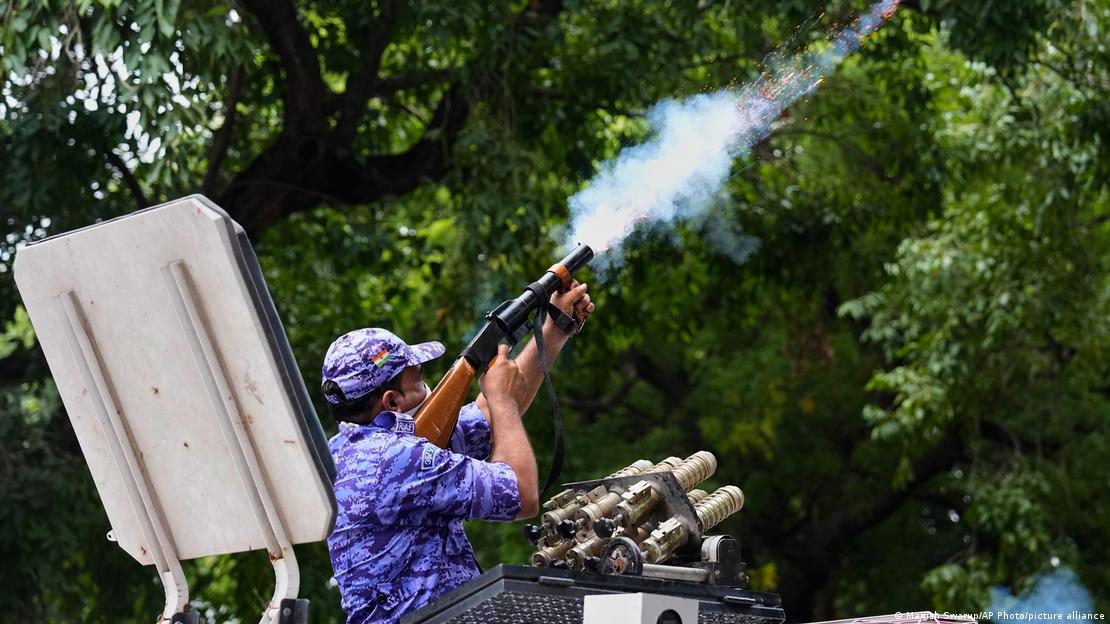
Riot police fired tear gas and used batons in New Delhi as tens of thousands of supporters of the satirical Cockroach Janta Party (CJP) marched towards India's Parliament on Monday (July 20).
Police in the Indian capital said 60 protesters and 118 police officers were injured in the clashes between demonstrators and security forces. Mobile internet was suspended in parts of the city, including around the Jantar Mantar protest site, during the violence.
Protesters are demanding the resignation of Education Minister Dharmendra Pradhan. Earlier this year, authorities canceled the high-stakes NEET medical entrance exam over a leaked question paper, affecting millions of students and sparking outrage across India.
What is India's Cockroach Janta Party?
The CJP began as an online campaign in May and rapidly evolved into a Gen Z street movement, giving a voice to a generation frustrated by unemployment, shrinking opportunities and a failing education system.
Lessons from earlier protests in India
The CJP movement gained fresh momentum over the weekend after veteran reform activist Sonam Wangchuk, whose three-week hunger strike has become a symbol of the protests, was forcibly taken to a hospital by police.
It is not the first time India has experienced major protest movements. Hunger strikes, famously used by Mahatma Gandhi, remain a common and peaceful form of protest in India.
India Against Corruption (IAC) led by veteran activist Anna Hazare, managed to mobilize millions in 2011 and reshape the country's political landscape. A decade later, yearlong farmers' protests forced Modi to repeal controversial farm laws. However, a 2023 Olympic wrestlers' protest over allegations of sexual harassment achieved few of their goals, despite widespread sympathy.
Analysts say the CJP lacks a nationwide organizational network, which the farmers had at their disposal. Yet like the IAC movement, it has tapped into a broader public mood.
"This protest is different because it reflects a much broader cross-section of Indian society," said Yamini Aiyar, an analyst and senior visiting fellow at Brown University. "They are expressing their frustration with a country whose long-atrophied education system has left them with very little hope of a better future."
"Like the IAC movement, it has drawn the middle class onto the streets," Aiyar told DW. "But this is a far more coercive political environment. From the anti-citizenship protests to the farmers' movement, citizens have increasingly looked beyond political parties to hold governments to account."
Police response sparks backlash among Indian protesters
This week's clashes have done little to quell the anger among India's Gen Z.
"Like many young people across India, I am angry about a lack of jobs and an education system that crushes my aspirations. Even though my family supports the BJP, I managed to get away," Rukmini Singh, a student from Meerut, told DW.
"This was an attack against our children. I saw many young boys and girls hurt and bleeding. They will never forget it but the courage these people displayed gives me hope," Vasundara Singh, a teacher from Bihar, told DW.
As during the farmers' protests, leftist parties and student organizations have become visible on the ground, helping mobilize supporters and giving the movement organizational backing.
"After 50 years, youth have occupied the road to parliament," political activist Yogendra Yadav told DW. "This energy by the students shows that the path to parliament goes through the streets. It is remarkable."
Can CJP mobilize India's villages as easily as its cities?
The surge in protest numbers forced the government to engage with the movement after weeks of dismissing it.
Alongside the police action, senior ministers opened talks with CJP leaders. Home Minister Amit Shah met cabinet colleagues while Health Minister J P Nadda held discussions with representatives of the movement.
"We will decide on how best to address the students' demands," a senior Bharatiya Janata Party (BJP) MP, told DW on condition of anonymity.
Most CJP support appears to come from students and India's urban middle class. The BJP's strongest electoral base remains in rural India and smaller towns, where the CJP has yet to prove that its message resonates with young voters.
However, some experts believe that the CJP will do just fine beyond India's urban centers.
"This movement is likely to resonate beyond India's cities because the aspirations of young people in small towns and villages are no different," political analyst Radhika Ramaseshan told DW.
"For a generation that saw education as the route to a better life, the failure of the education system has become a deeply political issue," she said.
"Young people in rural India no longer see farming or traditional occupations as their only future. Whether the CJP itself survives is another matter, but the anger and frustration it has tapped into have the potential to reshape politics."
'The anger is now directed at the government'
A movement focused on India's cities may generate headlines without altering the BJP's political fortunes. But if the CJP spreads to rural youth, it could become a much broader political challenge.
"I don't think this will remain an urban movement," said commentator Apoorvanand.
"People constantly move between villages and cities, and those who witnessed the police action will carry those experiences home," Apoorvanand told DW.
"The anger is now directed at the government. Whether it becomes a broader political movement depends on the CJP's ability to widen its appeal."
For now, the CJP has already achieved something unusual. It has transformed satire into sustained street mobilization, forced the government into talks, and ensured that the concerns of India's young people remain firmly in the national spotlight.
"This is a long fight. We will have to engage in a very long struggle for this. Because you have to change an entire system, the nexus of that system is very deep-rooted," said Saurav Das, CJP's chief spokesperson.

Murali Krishnan Journalist based in New Delhi, focusing on Indian politics, society and business@mkrish11
Murali Krishnan in New Delhi
DW
21/07/2026
What started as a satirical protest against exam leaks in India has grown into a wider movement voicing young Indians' anger over jobs and education.
.JPG)
What started as a satirical protest against exam leaks in India has grown into a wider movement voicing young Indians' anger over jobs and education.
.JPG)
The Cockroach Janta Party accused police of a brutal crackdown following the New Delhi protest
Image: Manish Swarup/AP Photo/picture allianc
Riot police fired tear gas and used batons in New Delhi as tens of thousands of supporters of the satirical Cockroach Janta Party (CJP) marched towards India's Parliament on Monday (July 20).
Police in the Indian capital said 60 protesters and 118 police officers were injured in the clashes between demonstrators and security forces. Mobile internet was suspended in parts of the city, including around the Jantar Mantar protest site, during the violence.
Protesters are demanding the resignation of Education Minister Dharmendra Pradhan. Earlier this year, authorities canceled the high-stakes NEET medical entrance exam over a leaked question paper, affecting millions of students and sparking outrage across India.
What is India's Cockroach Janta Party?
The CJP began as an online campaign in May and rapidly evolved into a Gen Z street movement, giving a voice to a generation frustrated by unemployment, shrinking opportunities and a failing education system.
The protesters attempted to march toward India's ParliamentImage: Manish Swarup/AP Photo/picture alliance
The youth-led "Cockroach" party is now posing an unexpected challenge for Prime Minister Narendra Modi's government, prompting a response that combines political outreach with police action.
Modi's rivals have also tried to step in and take advantage of the youth's frustrations.
"Is this how a government behaves? Using tear gas and baton charges against students? This is a worthless government," Renuka Chowdhury, an MP from India's opposition Congress party, told DW.
The youth-led "Cockroach" party is now posing an unexpected challenge for Prime Minister Narendra Modi's government, prompting a response that combines political outreach with police action.
Modi's rivals have also tried to step in and take advantage of the youth's frustrations.
"Is this how a government behaves? Using tear gas and baton charges against students? This is a worthless government," Renuka Chowdhury, an MP from India's opposition Congress party, told DW.
Lessons from earlier protests in India
The CJP movement gained fresh momentum over the weekend after veteran reform activist Sonam Wangchuk, whose three-week hunger strike has become a symbol of the protests, was forcibly taken to a hospital by police.
It is not the first time India has experienced major protest movements. Hunger strikes, famously used by Mahatma Gandhi, remain a common and peaceful form of protest in India.
India Against Corruption (IAC) led by veteran activist Anna Hazare, managed to mobilize millions in 2011 and reshape the country's political landscape. A decade later, yearlong farmers' protests forced Modi to repeal controversial farm laws. However, a 2023 Olympic wrestlers' protest over allegations of sexual harassment achieved few of their goals, despite widespread sympathy.
Analysts say the CJP lacks a nationwide organizational network, which the farmers had at their disposal. Yet like the IAC movement, it has tapped into a broader public mood.
"This protest is different because it reflects a much broader cross-section of Indian society," said Yamini Aiyar, an analyst and senior visiting fellow at Brown University. "They are expressing their frustration with a country whose long-atrophied education system has left them with very little hope of a better future."
"Like the IAC movement, it has drawn the middle class onto the streets," Aiyar told DW. "But this is a far more coercive political environment. From the anti-citizenship protests to the farmers' movement, citizens have increasingly looked beyond political parties to hold governments to account."
Police response sparks backlash among Indian protesters
This week's clashes have done little to quell the anger among India's Gen Z.
"Like many young people across India, I am angry about a lack of jobs and an education system that crushes my aspirations. Even though my family supports the BJP, I managed to get away," Rukmini Singh, a student from Meerut, told DW.
"This was an attack against our children. I saw many young boys and girls hurt and bleeding. They will never forget it but the courage these people displayed gives me hope," Vasundara Singh, a teacher from Bihar, told DW.
As during the farmers' protests, leftist parties and student organizations have become visible on the ground, helping mobilize supporters and giving the movement organizational backing.
"After 50 years, youth have occupied the road to parliament," political activist Yogendra Yadav told DW. "This energy by the students shows that the path to parliament goes through the streets. It is remarkable."
Can CJP mobilize India's villages as easily as its cities?
The surge in protest numbers forced the government to engage with the movement after weeks of dismissing it.
Alongside the police action, senior ministers opened talks with CJP leaders. Home Minister Amit Shah met cabinet colleagues while Health Minister J P Nadda held discussions with representatives of the movement.
"We will decide on how best to address the students' demands," a senior Bharatiya Janata Party (BJP) MP, told DW on condition of anonymity.
Most CJP support appears to come from students and India's urban middle class. The BJP's strongest electoral base remains in rural India and smaller towns, where the CJP has yet to prove that its message resonates with young voters.
However, some experts believe that the CJP will do just fine beyond India's urban centers.
"This movement is likely to resonate beyond India's cities because the aspirations of young people in small towns and villages are no different," political analyst Radhika Ramaseshan told DW.
India's 'cockroach' protests meet with batons and tear gas 02:24
"For a generation that saw education as the route to a better life, the failure of the education system has become a deeply political issue," she said.
"Young people in rural India no longer see farming or traditional occupations as their only future. Whether the CJP itself survives is another matter, but the anger and frustration it has tapped into have the potential to reshape politics."
'The anger is now directed at the government'
A movement focused on India's cities may generate headlines without altering the BJP's political fortunes. But if the CJP spreads to rural youth, it could become a much broader political challenge.
"I don't think this will remain an urban movement," said commentator Apoorvanand.
"People constantly move between villages and cities, and those who witnessed the police action will carry those experiences home," Apoorvanand told DW.
"The anger is now directed at the government. Whether it becomes a broader political movement depends on the CJP's ability to widen its appeal."
For now, the CJP has already achieved something unusual. It has transformed satire into sustained street mobilization, forced the government into talks, and ensured that the concerns of India's young people remain firmly in the national spotlight.
"This is a long fight. We will have to engage in a very long struggle for this. Because you have to change an entire system, the nexus of that system is very deep-rooted," said Saurav Das, CJP's chief spokesperson.
Edited by: Keith Walker
Murali Krishnan Journalist based in New Delhi, focusing on Indian politics, society and business@mkrish11

No comments:
Post a Comment