Thursday, July 15, 2021

DEMOCRATIC Maine governor vetoes consumer-owned electric utility

By DAVID SHARP July 13, 2021
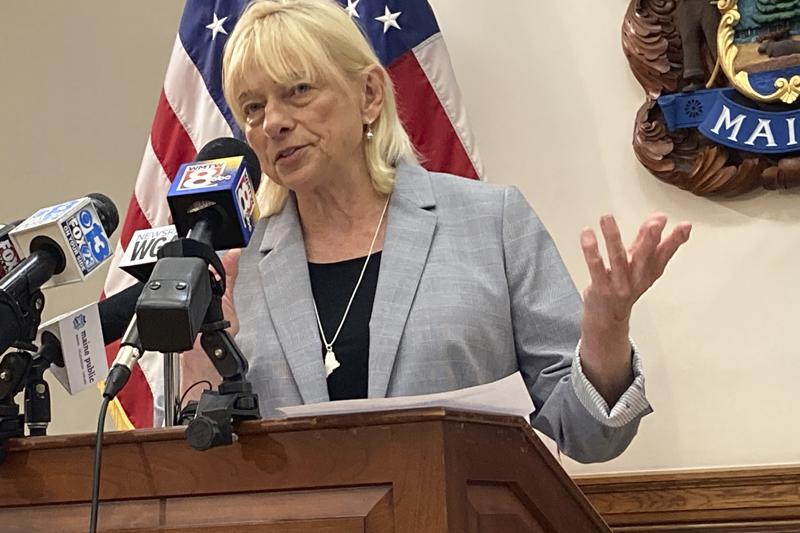
Maine Gov. Janet Mills speaks to reporters in her cabinet room, Tuesday, July 13, 2021, in Augusta, Maine, after announcing she has vetoed a bill to replace the state's privately owned electric utilities with a consumer-owned utility. (AP Photo/David Sharp)

AUGUSTA, Maine (AP) — A bill that that aimed to eliminate Maine’s privately owned electric utilities by buying them out and replacing them with a consumer-owned utility was vetoed Tuesday by Democratic Gov. Janet Mills, likely spelling the end of the proposal this legislative session.

Mills acknowledged that performance of Central Maine Power and Versant Power has been “abysmal” but said the proposal to send them packing — with voters getting the final say — was “deeply flawed” and “hastily drafted and hastily amended.”

“I certainly agree that change is necessary. No question about that. And I remain open to considering alternative proposals,” she said.

The bill’s chief sponsor, Rep. Seth Berry, D-Bowdoinham, disputed the governor’s characterization of the proposal, arguing that it was thoroughly vetted over the past three years.

And it isn’t going away. A coalition will be launching a referendum drive to put the proposal before voters anyway next year, instead of this fall.

Supporters said it’s time to replace Central Maine Power and Versant Power, which are owned by corporations in Spain and Canada, with an entity that works in the interest of Mainers instead of shareholders.


The new entity, Pine Tree Power, would keep rates low, respond faster to outages and support clean energy projects, they said.

Critics accused the bill’s supporters of underestimating the cost of buying the utility companies and said ratepayers would be saddled with billions of dollars of debt from the purchase and litigation.

The bill came at a time of frustration with CMP, the state’s largest electric utility, over a botched rollout of a billing system, slow response to storm damage and power outages, and a controversial utility corridor that would serve as a conduit for Canadian hydropower.

The bill won bipartisan support in the Maine Legislature, but Berry acknowledged there’s little hope of reaching a two-thirds majority necessary to override the governor’s veto.

The veto came a day after an independent audit conducted for the Maine Public Utilities Commission found that CMP is making improvements and isn’t “irredeemably flawed.”

But the report also said “it remains prudent to question the sustainability of the positive changes that have occurred.”

Berry said “modest improvements” cited in the report were in response to the bill that aimed to replace the utilities, and that those improvements will “go away as soon as this bill goes away.”

The veto was not a surprise. Mills previously called the proposal “a rosy solution to a very complicated series of problems.”

On Tuesday, she reiterated her concerns about the bill, calling it “a patchwork of political promises rather than a methodical reformation of Maine’s complicated electrical transmission and distribution system.”

She said she had a number of concerns including who’d operate the grid, the potential loss of property taxes for several communities, and the bill’s language that could affect the tax-exempt status of bonds.

She said she wasn’t closing the door on a takeover of the utilities but said she wants more time and effort to go into the vetting.

In the meantime, she said the state should step up its regulatory efforts through the Public Utilities Commission, look at performance-based incentives like those used in Hawaii and consider beefing up the state’s divestiture law.

William Dunn from Our Power, which will lead the referendum drive to put the proposal before voters next year, dismissed the idea that regulators can solve the utilities’ problems.

“Maine regulators cannot fix this problem any more than a mouse can tame a cat,” Dunn said.
Lawsuit says Alabama blocking solar power with unfair fees
By KIM CHANDLER

In this Thursday, Nov. 14, 2019 file photo, Teresa Thorne walks out of her solar power-equipped home near Springville, Ala. The fees imposed by the Alabama Power company on customers who generate their own electricity with rooftop or on-site solar panels are now the subject of a federal lawsuit against the state's regulators. Environmental groups argue that punishing fees are purposely discouraging the adoption of solar power in the sun-rich state. (AP Photo/Jay Reeves, File)

MONTGOMERY, Ala. (AP) — The fees imposed by the Alabama Power company on customers who generate their own electricity with rooftop or on-site solar panels are now the subject of a federal lawsuit against the state’s regulators.

Environmental groups argue that punishing fees are purposely discouraging the adoption of solar power in the sun-rich state.

Alabama Power maintains that the fees are needed to maintain the infrastructure that provides backup power to customers when their solar panels don’t provide enough energy.

The Southern Environmental Law Center and Ragsdale LLC filed the lawsuit on Monday against the Alabama Public Service Commission on behalf of four Alabama Power customers who installed solar panels on their properties and the Greater-Birmingham Alliance to Stop Pollution, or GASP.

“We’re asking the court to require the Commission to follow the law so that Alabama Power will stop unfairly taxing private solar investments,” said Keith Johnston, director of SELC’s Alabama office.

“Alabama is being left behind by other Southern states when it comes to solar generation, and the jobs, bill savings and other benefits that come with it,” SELC’s statement said. “These charges are a significant roadblock to our state’s success.”

A spokesperson for the Public Service Commission wrote in an email that, “it would not be appropriate for the Alabama Public Service Commission to comment on pending litigation.”

Alabama Power charges a $5.41-per-kilowatt fee, based on the capacity of the home system, on people who use solar panels or other means to generate part of their own electricity. That amounts to a $27 monthly fee on a typical 5-kilowatt system. The average solar panel setup for a home costs about $10,000, according to the law center, and the fees add another $9,000 or so over a system’s 30-year lifespan, dramatically increasing costs and reducing any financial benefit for the homeowner.

Alabama Power maintains that the fees are needed to maintain the infrastructure that provides backup power. A spokesperson for Alabama Power said, “we believe Alabama law and sound ratemaking principles were followed in reaching a fair determination of the cost for this service.”

“It is important to us that all of our 1.5 million customers are treated fairly. There is nothing about the lawsuit that changes our position – we believe the lawsuit is without merit. Customers who want to rely on the company to back up their own generation should pay their share of associated costs,” Alabama Power spokesperson Alyson Tucker wrote in an email.

The Federal Energy Regulatory Commission rejected the environmental groups’ request to take enforcement action last month against the Public Service Commission.

However, two members of the five-member panel issued a separate statement expressing concern that Alabama regulators may be violating federal policies designed to encourage the development of cogeneration and small power production facilities and to reduce the demand for fossil fuels.

While the lawsuit deals with home and business solar energy systems, Alabama Power on Tuesday won approval for its own large solar project.

The Alabama Public Service Commission approved Alabama Power’s proposal for an 80-megawatt HEP Greenville solar project to be located in Butler County. Annual output generated from the HEP Greenville solar project is equivalent to the amount of energy used in nearly 15,000 homes, the company said.
Haiti: Retired soldier claims 26 Colombians accused in assassination were actually hired to protect the President


After 26 Colombians were accused of assassinating Haitian President Jovenel Moise, a retired special forces soldier in Colombia has told CNN that they were actually hired to provide the leader security, and that he himself was approached for the job by a US-based company
.
© Joseph Odelyn/AP The police chief described the men presented at a news conference as attackers who were apprehended in the assassination of Haiti's President, in Port-au-Prince, on July 8.

By Stefano Pozzebon, CNN 5 hrs ago

Matias Gutierrez, 45, told CNN he was contacted in early June by a fellow veteran named Mendivelso Gersain, who put him in touch with another man -- retired Sgt. Duberney Capador -- recruiting a group of private security guards to travel to Haiti.

Capador told the men he was working for a US-based company and created a WhatsApp group to coordinate the recruitment effort, Gutierrez alleged. The logo of Florida-based firm CTU Security was added as the icon of the WhatsApp group, which, Gutierrez said, at some point had more than 250 people in it.

"They only mentioned a company based in the US, and a job as private security in Haiti. Security for the President of Haiti, who was believed to be under death threat," Gutierrez told CNN.

Colombian police had already named CTU Security as the recruiter for the Haiti operation, but their Haitian counterparts believe a Haitian-born American, Christian Emmanuel Sanon, had hired CTU to recruit the 26 Colombians, characterizing them as mercenaries, as well as two Haitian-Americans.

When asked about the 26 Colombians and two other Haitian-Americans who are suspects in the investigation, Sanon emphasized that "he doesn't know anything at all," according to a source close to the investigation, who cannot be named because they are not authorized to discuss the affair. "He doesn't know. He doesn't know. This is what he said since the day authorities interviewed him," the source said.

CTU Security is headquartered in the Miami area and run by a Venezuelan man, Antonio "Tony" Intriago.

CNN has tried repeatedly to contact CTU Security since Saturday and has been unable to identify contact information for Intriago. Colombian police say they are working with Interpol to provide information on Intriago.

On Monday, Colombian police also claimed that the airfares for 19 the Colombian men were paid with a credit card linked to a company based in Miami.

About a month after the first recruitment approach was made, according to Gutierrez, Moise was killed in his private residence in the early hours of July 7. Capador was gunned down in an operation by Haiti police shortly afterward, on the same day, and Gersain remains detained as one of 20 Colombians captured after the assassination.

Gutierrez told CNN he had been in contact with the recruited Colombian guards several times while they were in Haiti. They told him the job was to supplement the Haitian presidential guard.

"They were not working in the inner circle," Gutierrez said. "A country would never put the safety of a president in the hands of a stranger. The inner circle is always a group of presidential guards or secret service in civil clothes. Our group was uniformed and working in support of the inner circle."

According to the Colombian police, Capador travelled to Port-au-Prince on May 10 with another Colombian man, retired Capt. German Rivera. A group of 11 retired Colombian soldiers followed them on June 4. It's unclear when Gersain arrived in Haiti.

At the end of May, Dimitri Herard, the Haitian chief of the General Security Unit at the presidential palace, also traveled to Ecuador through Bogota, according to the Colombian National Police. The force said July 12 that it is investigating whether Herard, while in Colombia, met with any of the Colombian nationals allegedly involved in the assassination.

Herard is currently under disciplinary measures in Haiti and was due to appear in court Wednesday, but he missed his appearance, citing "a precautionary measure ordered by the General Inspector of the Haitian Police," according to a letter from Herard that CNN has seen.

Gutierrez questions Colombians' involvement


Gutierrez, who works as a security guard for an oil company in Bogota, says he was attracted to the job by the good pay and the possibility to travel: "In Colombia, any job would pay you some three hundred USD, while this offer was for $2,700 per month, with food and accommodation included. I know people who are working right now in Dubai, Abu Dhabi, people in Kabul or Yemen, or even Syria. It was a similar job offer to those ones."

Gutierrez told CNN he is part of a wide network of retired special forces and commandos who work as private security at home and abroad. Colombian veterans are highly sought by private security companies because of their combat experience garnered from sustained warfare among the Colombian state, left-wing guerrillas and paramilitary groups.

Capador's sister told CNN her brother was also looking for a better salary abroad, saying he was struggling to get by on the state pension he received after 20 years of service in the Colombian army.

Gutierrez, as well as several relatives of other Colombians who traveled to Haiti, told CNN the accusations against the men do not add up.

"It was all a plot. How can you have this type of assassination and not have a single dead but the President himself? If my fellows had done the job, they would have had to enter the residence and kill the guards before killing the President. You would have seen a combat scene," Gutierrez said.

Capador's sister also told CNN she spoke with her brother in the morning on the day of the President's assassination, and that he told her they had arrived too late and could not save the target they had been hired to protect.

She said she last heard from her brother on the afternoon of July 7, when he told her he was negotiating the Colombians' surrender to the Haitian police, Capador told CNN, a claim CNN has not been able to independently verify.

After the news broke from Haiti, everything turned quiet on the WhatsApp group created to coordinate the recruitment effort, Gutierrez claims.

"Our group was called 'First Flight.' They created other groups because there were more than 250 people in that group, and they could not add more. Then everyone left. There's less than 50 people in it now."

Gutierrez said he felt the fact that there were so many people on the WhatsApp group suggested that the operation was nothing untoward.

"You don't do that if you need to kill somebody," he said.

"I've done those operations when I was in the military, and they would send a commando to kill a guerrilla leader or something similar. You're never more than eight people. Eight is the maximum, because otherwise too many people make the operation harder. This time they were adding more and more people."

His thoughts, he says, are for the families of the detained guards: "They didn't even receive their first salary, they had just got there. Now this happened, and probably the Colombians are going to be charged. Who knows when they'll see them again."
Miami security firm faces questions in Haiti assassination

By GISELA SALOMON and ANDREW SELSKY
today

1 of 11


MIAMI (AP) — For the owner of a small private security company with a history of avoiding paying debts and declaring bankruptcy, it looked like a good opportunity: Find people with military experience for a job in Haiti.

Antonio “Tony” Intriago, owner of Miami-based CTU Security, seems to have jumped at the chance, hiring more than 20 former soldiers from Colombia for the mission. Now the Colombians have been killed or captured in the aftermath of the July 7 assassination of Haitian President Jovenel Moïse, and Intriago’s business faces questions about its role in the killing.

On Wednesday evening, Léon Charles, head of the Haiti’s National Police, accused Intriago of traveling to Haiti numerous times as part of the assassination plot and of signing a contract while there, but provided no other details and offered no evidence.

“The investigation is very advanced,” Charles said.

A Miami security professional believes Intriago was too eager to take the job and did not push to learn details, leaving his contractors in the lurch. Some of their family members back in Colombia have said the men understood the mission was to provide protection for VIPs.

Three Colombians were killed and 18 are behind bars in Haiti, Colombia’s national police chief, Gen. Jorge Luis Vargas, told reporters in Bogota. Colombian diplomats in Haiti have not had access to them.

Vargas has said that CTU Security used its company credit card to buy 19 plane tickets from Bogota to Santo Domingo for the Colombian suspects allegedly involved in the killing. One of the Colombians who was killed, Duberney Capador, photographed himself wearing a black CTU Security polo shirt.

Nelson Romero Velasquez, an ex-soldier and attorney who is advising 16 families of the Colombians held in Haiti, said Wednesday that the men had all served in the Colombian military’s elite special forces and could operate without being detected, if they had desired. He said their behavior made it clear they did not go to Haiti to assassinate the president.

“They have the ability to be like shadows,” Romero Velasquez said.

The predawn attack took place at the president’s private home. He was shot to death and his wife wounded. It’s not clear who pulled the trigger. The latest suspects identified in the sweeping investigation included a former Haitian senator, a fired government official and an informant for the U.S. government.

Miami has become a focus of the probe. The city has long been a nest of intrigue, from being a CIA recruitment center for the failed Bay of Pigs operation to overthrow Cuban dictator Fidel Castro to being a key shipment point for Colombian cocaine in the 1980s. Its palm-fringed shores have also been a place of exile for people from Latin American and Caribbean countries when political winds blew against them at home, and where some plotted their returns.

Homeland Security Investigations, a U.S. agency responsible for investigating crimes that cross international borders, is also investigating the assassination, said a Department of Homeland Security official who spoke on condition of anonymity because he was not authorized to talk about the case. He declined to provide details.

The FBI says it is “providing investigative assistance” to Haitian authorities.

Intriago, who immigrated from Venezuela over a decade ago and participated in activities in Miami opposing the leftist regime in his homeland, did not respond to multiple requests for an interview.

He likes to be around powerful people and has posted photos on social media showing himself with them, including Colombian President Ivan Duque.

Duque’s office on Monday disavowed any knowledge of Intriago, saying Duque was in Miami while campaigning for the presidency in February 2018. He posed for photographs with some of those in attendance, but Duque did not have any meeting or any ties with Intriago, the Colombian president’s office said.

Florida state records show Intriago’s company has changed names in the past dozen years: CTU Security to CS Security Solutions to Counter Terrorist Unit Federal Academy LLC.

CTU lists two Miami addresses on its website. One is a shuttered warehouse with no signage. The other is a small office suite under a different name. A receptionist said the CTU owner stops by once a week to collect mail.

The company website says it offers “first-class personalized products and services to law enforcement and military units, as well as industrial customers.”

But it ducked paying some of those wholesale companies for their products. Florida records show Intriago’s company was ordered by a court to pay a $64,791 debt in 2018 to a weapons and tactical gear supply company, RSR Group. Propper, a military apparel manufacturer, also sued for nonpayment.

Alexis Ortiz, a writer who worked with Intriago organizing meetings of expatriate Venezuelans in the United States, described him as a “very active, skilled collaborator.”

“He seemed nice,” Ortiz said.

Richard Noriega, who runs International Security Consulting in Miami, said he does not know Intriago personally but has been observing the developing situation. Noriega, who is also originally from Venezuela, believes Intriago was lured by the prospect of fast money and did not perform due diligence.

Putting himself in Intriago’s shoes, Noriega said: “I’m coming out of a complicated situation — of work, of income, of money. An opportunity arises. I don’t want to lose it.”

Normally, a security company would seek all the details of an operation, to determine how many people to use and what level of insurance they would need. A priority would be to plan an escape route in case things go awry, he said.

“The first thing we (security professionals) have to take into account is the evacuation. Where will they exit? That’s the first thing I do,” Noriega said.

But apparently that planning never happened, perhaps because the Colombians, or at least some of them, thought their mission was benign.

He said it does not seem logical that if the highly trained Colombians were there to kill the president, that they would not have had an escape route. Instead they were caught, some hiding in bushes, by the local population and police.

“It is very murky,” Noriega said.

___

Selsky, a former Associated Press bureau chief in the Caribbean and Colombia, reported from Salem, Oregon. AP writers Joshua Goodman in Miami, Evens Sanon in Port-au-Prince, Haiti and Manuel Rueda and Astrid Suarez in Bogota, Colombia, contributed to this report.
Defense Secretary Austin calls for ethical AI development

Defense Secretary Lloyd Austin, speaking on Wednesday to the National Security Commission on Artificial Intelligence, said that ethics is a key to military AI development. Photo courtesy of Defense Department/Twitter

July 14 (UPI) -- The U.S. military must develop artificial intelligence ethically and responsibly, Defense Secretary Lloyd Austin said in remarks on Wednesday.

In remarks to the National Security Commission on Artificial Intelligence, he noted that while China intends to be the world's AI leader by 2030, the United States has the same goal but a different approach.

"Beijing already talks about using AI for a range of missions, from surveillance to cyberattacks to autonomous weapons," Austin said.

"We're going to compete to win, but we're going to do it the right way. We're not going to cut corners on safety, security or ethics, and our watchwords are 'responsibility' and 'results,' and we don't believe for a minute that we have to sacrifice one for the other," he said.

"Our use of AI must reinforce our democratic values, protect our rights, ensure our safety and defend our privacy," Austin added.

In March, commission vice chair Robert Work said that the United States lacks an AI strategy in its competition with China.

Work said that the United States is currently the world leader in AI, but noted that China has structured its army, private sector and academia to overtake the United States.

He urged the Pentagon to dedicate 3.4 percent of its budget to AI development.

In his address on Wednesday, Austin noted that over 600 AI projects are in progress within the Defense Department, "significantly more than just a year ago, and that includes the Artificial Intelligence and Data Acceleration initiative, which brings AI to bear on operational data."

Austin also identified Project Salus, a project with the National Guard which uses AI to predict shortages of water, medicine and COVID-19 supplies.

He also noted the Pathfinder Project, which uses AI-derived algorithms to better detect airborne threats from military sensors and available data.

To accomplish the military's AI goals, Austin referred to recruitment and retention of talented people, typically young and not inclined to military service.

"We need to more vigorously recruit talented people and not scare them away," Austin said. "In today's world, in today's department, innovation cannot be an afterthought. It is the ballgame.''
Farm robots could bring utopia or disaster, scientist warns


An illustration shows what a utopian farm run by a variety of intelligent robots might look like. Photo by Natalis Lorenz


July 13 (UPI) -- Agriculture is already highly mechanized, and in the not too distant future, agricultural economist Thomas Daum predicts entire farms will be run by robots.

In fact, robots are already being deployed on farms.

As Daum sees it, robotization has the potential to transform the agricultural sector and usher in one of two realities: one utopian, the other dystopian.

Daum described these two opposing realities in a new paper, published Tuesday in the journal Trends in Ecology and Evolution.

Daum's utopia features swarms of small robots working around the clock on small- and medium-sized farms.

These farms feature a diverse rotation of crops interwoven seamlessly with the natural environment, including healthy habitat for a rich variety of native flora and fauna -- organically raised crops buffered by grasslands, streams and woodlands.

"It's like a Garden of Eden," Daum, a research fellow at the University of Hohenheim in Germany, said in a press release.

"Small robots could help conserve biodiversity and combat climate change in ways that were not possible before," Daum said.

Utopian farming, according to Daum, would be too labor intensive, but swarms of small, intelligent robots working in synchronicity 24-7 could make it work.

These robots would be able to deploy biopesticides more precisely and zap individual weeds with lasers, limiting the farm's impact on the surrounding environment.

Crop yields would be high, while the farm's environmental footprint would be minimal, Daum said.

Conversely, large but less sophisticated robots could be used to bulldoze the land and further expand modern, monoculture agriculture.

With humans out of the way, these robots could spray pesticides and deploy fertilizers with greater intensities and at broader scales.

Though reality is unlikely to resemble a pure utopia or dystopia, Daum hopes his paper will inspire scientists, engineers and policy makers to start thinking about how agricultural robots can be used for sustainably.

"The utopia and dystopia are both possible from a technological perspective," he said. "But without the right guardrails on policy, we may end up in the dystopia without wanting to if we don't discuss this now."

Daum's utopian farm would benefit more than just the environment.

Farms that grow a diversity of crops, not just high yield grains, are more likely to supply consumers with the full range of fruits and vegetables that healthy diet requires.

Because small swarms of intelligent robots can be more easily adopted by small farmers, places like Asia and Africa may be better positioned for utopian agriculture.

Conversely, agriculture in the places like the United States, Russia and Brazil are already dominated by large-scale farms growing low-value grains and oilseeds -- places where big, crude robots are more likely to be introduced.

"While it is true that the preconditions for small robots are more challenging in these areas, even with large robots -- or a mix between small and large -- we can take steps toward the utopia with practices such as intercropping, having hedgerows, agroforestry and moving away from larger farms to smaller plots of land owned by large farmers," Daum said.

"Some such practices may even pay off for farmers once robots can do the job, as previously uneconomic practices become profitable," Daum said.

To ensure agricultural robots are engineered for sustainable ends and deployed in eco-friendly ways, Daum said policy makers must use a combination of incentives, including subsidies, regulations and taxes.

"I think the utopia is achievable," Daum said. "It won't be as easy as the dystopia, but it's very much possible."
US Judge rules against landlords seeking end to eviction moratorium


A court in Georgia has ruled against a group of landlords seeking to lift the Center for Disease Control and Prevention's eviction ban. Photo by John Angelillo/UPI | License Photo

July 15 (UPI) -- An appeals court in Georgia has ruled against a group of landlords seeking a preliminary injunction against the Centers for Disease Control and Prevention's temporary moratorium on evictions as they failed to prove that the measure imposed amid the coronavirus pandemic will cause them irreparable harm.

"We fail to see how the temporary inability to reclaim rental properties constitutes an irreparable injury," the three-judge panel of the 11th Circuit Court of Appeals said in their ruling on Wednesday.

The judges ruled 2-1 against the National Apartment Association and several landlords who had requested the court to lift the CDC's measure preventing them from evicting non-paying tenants.

The moratorium was first put in place under the CARES Act at the end of March of last year, which the CDC extended in September, attracting the lawsuit filed by the New Civil Liberties Alliance on behalf of the landlords days later.

The moratorium has been extended several times since, with the White House in June keeping it in place until July 31, saying it was extending the ban "for one final month."

The landlords had been earlier denied the injunction by a district court and had filed an appeal.

The CDC's order does not relieve tenants from their rent-paying obligations but only denies the landlords for evicting them while the order is in place. However, the plaintiffs had sought the injunction on the grounds that the order was unconstitutional, that they were being denied access to their property and that they would never recover the rent owed to them as the tenants were insolvent.

The court ruled that none of these injuries satisfy the strict irreparable harm standard.

Concerning the measure being unconstitutional, the court said there is no precedent for that finding but there is precedent to support the government's position.

The court also said ejecting someone from a property is irreparable harm but "we fail to see how the temporary inability to reclaim rental properties constitutes irreparable injury."

On the third claim, the plaintiffs offered as evidence documents signed by their tenants that said they couldn't afford their rent due to substantial loss of household income caused by a reduction in hours, layoffs and medical expenses.

The court said the plaintiffs' evidence was "flimsy" as the documents only speak to their tenants' current situation and not about their ability to pay in the future.

"These attestations certainly show that the tenants could not afford their rent at the time they were signed. But they paint a hazy picture -- at best -- of any given tenant's ability to pay later," the court said in its 97-page opinion. "The declaration sheds little light on, among other things, a tenant's educational background, employment history, criminal history, credit history or rental payment history -- factors that would be probative of a tenant's ability to pay after the moratorium is lifted."

The New Civil Liberties Alliance rejected the court's decision as a denial of justice and was setting a dangerous precedent.

"It is unfathomable that the harm suffered by NCLA's landlord clients and caused by CDC's unlawful actions does not count as 'irreparable,' especially when at least a majority of the court appears to believe CDC lacked statutory authority to do what it did," Mark Chenoweth, executive director and general counsel at NCLA, said in a statement.

In a dissenting opinion, former President Donald Trump-appointee Judge Elizabeth Branch said there is nothing to support that Congress had intended to give the CDC "sweeping authority" over the national rental market.

She also disagreed with the majority's opinion concerning the landlords' stance that they will not receive rent owed to them in the future.

"Because the landlords have demonstrated that their tenants are insolvent and that a future money judgement is not likely to be collectable, the landlords have demonstrated that they face an irreparable injury absent an injunction," she said.

She also said the government has failed to show "that allowing a handful of evictions to go forward would cause any loss of life, let alone the massive loss of life it has claimed could happen if the order is invalidate nationwide."

Several similar lawsuit have been filed throughout the nation, with the Supreme Court ruling late last month against the Alabama Association of Realtors who had petitioned to lift the CDC eviction ban.
US Newsroom Staffing Has Dropped 26% in 12 Years, Research Shows
Aarohi Sheth

The number of digital newsroom employees rose 144% from 2008 to 2020, helping offset a drop in newspaper newsrooms of 57%, Pew Research Center data analysis from the Bureau of Labor Statistics shows.


© TheWrap newsroom employment 2008-2020

According to the analysis, overall newsroom employment in the U.S. has dropped by 26% since 2008, as digital-native news organizations experienced "considerable gains."

Despite the 144% increase, the number of newsroom employees in the digital-native sector remained at "about 13,000 below the number in the newspaper sector in 2020," as the number of newspaper newsroom employees went from roughly 71,000 to about 31,000 between 2008 and 2020, while the number of Digital-native newsroom employees went from 7,400 workers to roughly 18,000.

Due to the decline in newspaper jobs, the sector now accounts for an overall smaller portion of overall newsroom employment than it once did. According to the data analysis, newspaper employees made up about 62% of newsroom jobs overall, but by 2020, the share had dropped to about 36%.

As of 2020, television broadcasting employees account for 10% more of the overall newsroom employees than they did in 2008. Similarly, digital-native news outlets increased from 6% of all newsroom employees to 21% from 2008 to 2020.
Fossil fuel workers ready for a just transition, poll finds


A majority of Canadians working in fossil fuels are interested in switching to jobs in the net-zero economy, but are worried about being left behind, according to a new poll.


The poll, released Wednesday morning, was done by an oilpatch worker-led organization, Iron & Earth, in partnership with Abacus Data, and surveyed 300 fossil fuel workers across Canada from May 24 to June 11.

Ninety per cent of workers surveyed believe they could transition to at least one type of net-zero technology with 12 months or less of training, according to the poll results.

Edmonton-based machinist Stephen Buhler has worked in oil and gas for over 12 years and says we can’t afford to delay the transition away from fossil fuels any longer.

“Not making the transition means that a lot of workers like myself are going to be stuck with jobs that aren't in demand the way that they were before,” he said.

Buhler is confident he can transition with little training. Because “whether it's building a part for a pipeline or building a part for a wind turbine, it's really no different for me,” he said, but acknowledged that for many workers, it won’t be so easy.

The poll also showed 61 per cent of workers worried about having to invest money into retraining, and 64 per cent were concerned with the time commitment involved.

Nearly 85 per cent of workers said they would participate in a paid training program of 10 days or less, with that number dropping to 70 per cent if they had to pay out of pocket.

“For the vast majority of other workers, taking on the financial burden of a year's training, or even four years’ training … that's a pretty tough pill to swallow,” said Buhler, adding the government should step up to help alleviate the financial burden of retraining.

Luisa Da Silva, executive director of Iron & Earth, agrees.

“The key here, really, is paid, rapid upskilling training for fossil fuel workers,” she said.

According to Iron & Earth’s calculations, Da Silva said, it would cost approximately $10,000 on average to rapidly upskill one worker, and to do the entire fossil fuel industry workforce would cost upwards of $5.5 billion.

Because many workers live in rural communities, Da Silva said it’s also vital to bring the training directly to those workers, so it is inclusive and accessible.

The data showed workers in the 45-plus age category were less confident in their ability to thrive in a net-zero economy than younger workers.

“It is definitely a little terrifying to be close to the end of your career, thinking about retirement, and all of a sudden, the entire world around you is going to be changing, and you’re told that the thing you were doing before is no longer needed or wanted,” said Buhler.

As a younger worker, Buhler said older workers should be given supports and noted they will be valuable for the short-term work needed to decommission and refurbish existing infrastructure.

Despite an overall high desire to switch to net zero and broad recognition of the threat of climate change, the poll found 60 per cent of workers worry they’ll be left behind in this transition without further training or career support.

“Until there is action by the government, which includes a just transition plan with paid training for fossil fuel workers, it's understandable that a lot of workers may be hesitant,” said Da Silva.

Ultimately, it all boils down to jobs, said Ed Brost, who worked for Shell for 30 years before retiring to start his own consulting company.

“People need jobs, they need income, they have to take care of their families and their needs, and people are talking about changing your job … of course, it's going to be apprehensive. I would be,” said Brost.

He said no one has to be left behind, but it’s up to our governments to show there is a path forward.

Iron & Earth is pushing for the federal government to support a national upskilling initiative so workers can be confident they won’t have to pay out of pocket for training, and it will be quick to make the switch.

Gil McGowan, president of the Alberta Federation of Labour (AFL), said coal transition policies the AFL helped create when Alberta began phasing out coal-fired power plants will serve as a valuable blueprint for the much larger transition away from oil and gas.

Wage top-ups for unemployment insurance, training vouchers for $12,000 and pension-bridging packages were all part of a transition package negotiated with the Alberta government, but McGowan said one thing missing from the coal transition package was a guarantee of employment.

Despite any shortcomings, he said the coal transition has been successful and much quicker than anticipated, lending hope to the idea that an oil and gas transition can follow suit.

“The thing is, the number of workers in coal is tiny compared to the number of people working in oil and gas,” said McGowan. “So scaling up this approach is going to be much more challenging.”

With over 30 years of experience in the oil and gas industry, Brost said transitioning will provide some immunity from boom-and-bust cycles, which, for younger workers especially, should be something to get excited about.

“I've been in the sector during good times and the bad, and it's really scary when you know that the company you're working for is going to cut the workforce by two or three or five per cent,” he said.

But workers need a just transition plan if they are to benefit from the long-term growth promised by renewable energy and green infrastructure, and McGowan said the Alberta government will continue to bury its head in the sand until “our federal government actually starts implementing policies instead of just talking about them.”

Natural Resources Canada spokesperson Ian Cameron said the government remains fully committed to helping workers “build the clean energy future we need.”

Natasha Bulowski, Local Journalism Initiative Reporter, National Observer
The average CEO made nearly 300 times the median employee pay last year, and that gap is only growing, a new AFL-CIO analysis finds

sjackson@insider.com (Sarah Jackson) 10 hrs ago

© Provided by Business Insider Alistair Berg/Getty Images

The average CEO-to-worker pay ratio at S&P 500 companies was 299-to-1 in 2020, the AFL-CIO says.

Its report says S&P 500 CEOs saw their pay increase by $712,720 on average over the year prior.

The findings come as many companies scramble to find workers to fill jobs at existing wages.

The gap between the salaries of CEOs and their workers grew wider in 2020, according to a new analysis from the AFL-CIO.

The average CEO of an S&P 500 company made 299 times more money than the median employee last year, the union federation said in a press release issued Wednesday. This is greater than the CEO-to-worker ratio of 264 to 1 in 2019, Reuters reports.

"2020's growth in pay inequity between workers and CEOs confirms the 'executive base salary reductions' touted during the COVID-19 crisis were just lip service," the AFL-CIO said in the release.


The greatest chasm between CEOs' and workers' pay emerged in the consumer discretionary sector, where the average pay ratio was 741-to-1. This sector includes Amazon and retail companies like Starbucks, McDonald's, and Chipotle, whose workers are often paid lower wages.

The AFL-CIO also found that CEOs of S&P 500 companies received $15.5 million in total compensation on average last year. The average S&P 500 CEO's pay grew $712,720 last year, according to the analysis.

In the past 10 years, the average S&P 500 CEO's pay has grown by $2.6 million, representing an increase of $260,000 per year. The average wage for production and nonsupervisory workers only rose $957 per year in the same period, the AFL-CIO says.


News of the growing pay gap comes as the US grapples with a shortage of workers to fill jobs at current wages as the economy reopens from the coronavirus pandemic. Some companies are responding by hiking up wages, offering additional benefits, and even offering cash to show up for an interview. Staff fed up with working conditions are also walking off their jobs en masse at some stores.

Read the original article on Business Insider