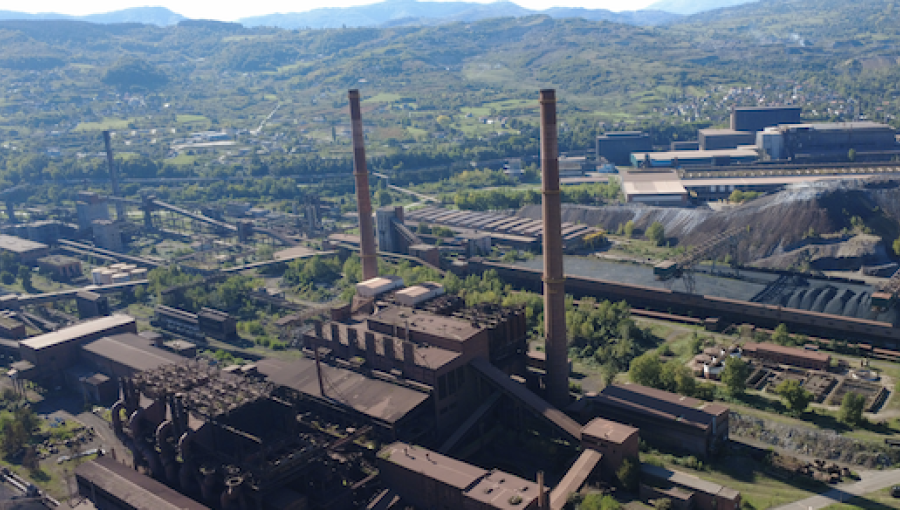
The suspension of steel production at Bosnia’s flagship plant in Zenica is sending shockwaves across the country’s industrial base and into neighbouring Croatia, disrupting rail freight, port operations and regional supply chains in what industry officials warn could become one of the most significant economic ruptures in the Western Balkans in recent years.
Railway operators in both entities of Bosnia & Herzegovina have reported an immediate and severe hit to revenues following the shutdown of core facilities linked to the steel value chain, including the Zenica steelworks, the Lukavac coke plant and the Ljubija iron ore mine near Prijedor. The fallout is already reverberating through logistics networks that for decades depended on the steady flow of raw materials and finished steel products.
The Railways of the Federation of Bosnia and Herzegovina warned before the shutdown that the consequences could be existential. “The cessation of operations at the Steelworks in Zenica would cause very harmful consequences for the Railways of FBiH,” the company said in an appeal to government institutions posted on its website, noting that the loss of the steelworks would put “the business and existence of 2,500 workers… in question.”
The company stressed the scale of dependence: “The survival of Nova Željezara Zenica is also crucial for the survival of Željeznica FBiH, because we used to generate 30% of the total turnover in the transport of goods for this company.”
The ripple effects extend beyond Bosnia’s borders. Croatian port operator Luka Ploče, a key logistics hub for bulk cargo linked to the steel industry, said it expects a decline in volumes following the decision by its Bosnian partner to suspend production. In a regulatory filing, the company said Nova Željezara Zenica — “one of the company's significant business partners” — had halted integral steel production after deeming it economically unviable.
“The company is currently conducting an analysis of the potential impact of the decision on the volume of business cooperation, delivery dynamics and revenue generation in the coming periods,” Luka Ploče said, warning that “the above changes could have an impact on revenues in subsequent reporting periods.” It added that it expects “a reduction in turnover related to the current supply model,” while seeking to mitigate risks by diversifying customers and adjusting business plans.
On April 23, Nova Željezara Zenica completed the suspension of its integrated production process, bringing to an end a production cycle that has defined the city and much of Bosnia’s industrial identity for generations.
“The hardest day for our team: Integral steel production at Nova Željezara Zenica suspended,” the company said in a statement. “Thus ending a decades-long production cycle that was the foundation of the industrial development of Zenica and the wider region.”
Management said the decision was unavoidable after months of mounting losses and failed efforts to secure state support. “In conditions of pronounced uncompetitiveness in the market, where imported steel is significantly cheaper than domestic production, the company could no longer incur additional financial losses,” it said. “The continuation of integrated production was economically unsustainable, and its suspension had become inevitable.”
The company placed particular emphasis on what it described as a failure by authorities to introduce protective measures. “The request for protection of domestic steel production has been underway for six months… Despite this, the Council of Ministers of Bosnia and Herzegovina rejected the proposed regulation on two occasions in March this year, after which concrete and implementable institutional solutions were lacking.”
General manager Ahmed Hamzić was blunt in his criticism. “I still cannot believe that the state did not protect the domestic producer in time and allowed the complete economic system of Bosnia and Herzegovina to be endangered,” he said. “It is unfortunate that the state failed in the most important step.”
Hamzić said the company had even offered to increase state ownership to secure support. “We expressed our readiness to offer an additional ownership share… however, to date, we have not received any official statement or proposal,” he said, adding that last-minute proposals presented through the media came “without consultation as the majority owners of the company.”
Despite the halt, the company insists the plant is not permanently closed. “The suspension of integral production does not mean the closure of the factory,” it said, outlining plans to develop a new business model that could involve restructuring and job cuts.
The shutdown comes amid a broader collapse of Bosnia’s traditional heavy industry base. The RMU Zenica coal mine, which supplied the steelworks, is itself undergoing closure after 144 years of operation due to “extreme financial losses, low productivity, and obsolete, dangerous technology,” affecting hundreds of workers.
At its peak, Bosnia’s metal industry employed around 225,000 workers, according to trade union data, forming the backbone of the country’s manufacturing and export capacity.
The symbolic and economic weight of the Zenica steelworks is difficult to overstate. Founded in the late 19th century, the plant has been a cornerstone of industrial development since 1892, surviving world wars, the breakup of Yugoslavia and the devastation of the 1992-95 conflict.
“There has not yet been a child born in Zenica who has not been fed, directly or indirectly, with the bread of the Ironworks,” union representatives said during May Day protests in the city, according to a statement from the Syndicate of Metalworkers of the Federation of Bosnia and Herzegovina (SMFBiH). “Without the Ironworks there is no industry, without industry there is no state of Bosnia and Herzegovina.”
The scale of public mobilisation reflects the depth of concern. Around 3,000 people took part in May 1 protests organised by the Metalworkers’ Union, bringing together workers, union representatives and citizens from across the country in a show of solidarity.
“We are here to support the workers and the union of Nova Željezara Zenica… Their fight is our fight, we are with them until the end,” the union said in a statement. “Shutting down steel production and the Zenica Steel Plant and losing thousands of jobs is not and will never be an option for us.”
Union leaders framed the crisis as part of a broader struggle for industrial survival and workers’ rights. “There is no house, building, factory, hospital, school… that does not have at least a kilo of Zenica steel built into it,” they said. “And these people have built a part of themselves and their lives into that steel.”
The protests also highlighted the risks of deindustrialisation. “All those who think that one can live only from shopping malls or that budgets fill themselves are mistaken,” the union said, warning that multiple sectors—from energy and construction to transport—are intertwined with the fate of the steelworks.
Railway operators echoed those concerns, describing the situation as a systemic threat. In a joint appeal, industry representatives warned that “11,000 jobs would be directly threatened by the cessation of production… and several dozen indirectly,” urging authorities to act.
“Any postponement and prolongation of the adoption of the Decision on the protection of domestic steel production directly leads to extremely negative consequences for the economy and the railway sector,” acting general director of Republika Srpska Railways Dragan Zelenković said, according to a statement from the company. “Future decisions… are now the only way to survival and sustainability.”
The immediate cause of the shutdown — competition from cheaper imported steel — reflects broader global pressures on energy-intensive industries in Europe, where high input costs and environmental regulations have eroded competitiveness.
But in Bosnia’s case, industry leaders argue that policy failure has compounded these challenges. The absence of protective measures, delays in decision-making and lack of coordinated industrial strategy have left companies exposed, they say.
As supply chains adjust, the long-term implications remain uncertain. Luka Ploče said the extent of the impact will depend on “the further reorganisation of the company's business and the establishment of possible alternative production or logistics solutions.” Rail operators are scrambling to find replacement cargo, but acknowledge that volumes are unlikely to recover quickly.
For Zenica, the shutdown represents not just an economic turning point but a profound social rupture. Generations of workers have defined their lives around the steelworks, often under difficult and dangerous conditions.
“Working at the Ironworks has never been easy or safe,” union representatives said, noting that “seven steelworkers have lost their lives at work since 2007” and many more have suffered illness or injury.
Yet even in the face of closure, calls for revival persist. The union has backed proposals for state intervention and potential restructuring, arguing that the plant could still become “the driver of the reindustrialisation of the entire Federation of BiH”.
Whether such plans materialise will depend on political will and economic realities. For now, the furnaces in Zenica have gone cold, and with them a central pillar of Bosnia’s industrial economy—leaving railways, ports and thousands of workers grappling with the fallout.

No comments:
Post a Comment