Sunday, November 07, 2021


Yellowknife nurses, at breaking point, complain to ministers


Nurses in Yellowknife have told NWT politicians they feel unsupported by senior management, morale is low, and they need “fair compensation” for their hazardous pandemic work environment.

Staff at Stanton Territorial Hospital have long complained of what they perceive to be poor management. Many have left their posts, a fact acknowledged by the NWT government when it backed a survey being launched to understand why people leave.

But the fall Covid-19 outbreak, in which dozens of people have been hospitalized, is understood to have pushed some nurses to the edge as operating hours lengthened and conditions worsened.

In a letter to ministers and MLAs, healthcare workers say southern provinces have provided extra compensation during the pandemic but the NWT’s health authority has not.

“During a time where most government employees were sent home to work, healthcare professionals did not have that option. When the pandemic began in March 2020, many healthcare professionals were recalled from their vacations. This lost vacation time was not returned to their leave banks,” the letter states.

“Existing vacations were cancelled and all new leave requests were denied due to ‘operational requirements.’ This caused great stress and exhaustion in healthcare professionals. The workplace was filled with frequent policy changes, shift changes, and redeployment. Staff members were left uncertain and worried about their ability to provide safe patient care.

“Staff members have also reported being required to use time from their personal sick leave bank when isolating due to becoming symptomatic after Covid-19 exposure at work. We propose that this should be considered ‘injury on duty’ and be paid as such.”

The five-page letter asks for the NWT government to:

  • return lost vacation time;
  • return personal sick time used for Covid-19;
  • provide wage premiums when working in high-risk areas (e.g. intubating Covid-19 patients);
  • institute a $4/hour wage increase retroactive to March 2020;
  • provide retention bonuses to current staff;
  • provide signing bonuses to recruit new staff; and
  • clarify where federal Covid-19 funding has been allocated.

Staff signing the letter say they don’t know where federal funding designed to alleviate the pandemic’s effects on the healthcare system has gone.

“We have not received new equipment or compensation for the risk to our personal health,” they write.

The letter states Alberta, British Columbia, Ontario, Manitoba, Newfoundland and Labrador, Nova Scotia, Prince Edward Island, Quebec, and Saskatchewan have all agreed to lump-sum payments or hourly wage increases to act as hazard pay for front-line healthcare workers.

At least a dozen nurses said on Friday they were sending the letter to all 19 MLAs. Others were expected to follow suit.

The NWT’s health authority said in a statement it had no immediate comment.

“However, we take the concerns of our staff seriously and will review the issues raised in the letter,” spokesperson Jack Miltenberger wrote.

The nurses tell MLAs: “Staff morale is low and management has not adequately implemented solutions. Please advocate for the healthcare workers to receive fair compensation for the many hazardous working conditions we have been faced with during this pandemic.”

‘Every time I come in, I cry’

Nurses have described a stressful and unsustainable environment at Stanton Territorial Hospital for most of the year, even before the fall outbreak arrived.

In July, one nurse talked of being allowed two days’ vacation in early summer and then being told they could receive no further time off until at least October.

That nurse said staff were resigning their permanent positions and becoming relief nurses – meaning they can be hired back as needed but retain control of their schedule – in order to escape an environment where many staff are virtually never given the leave dates they request. At the time, there were no active Covid-19 cases in the NWT.
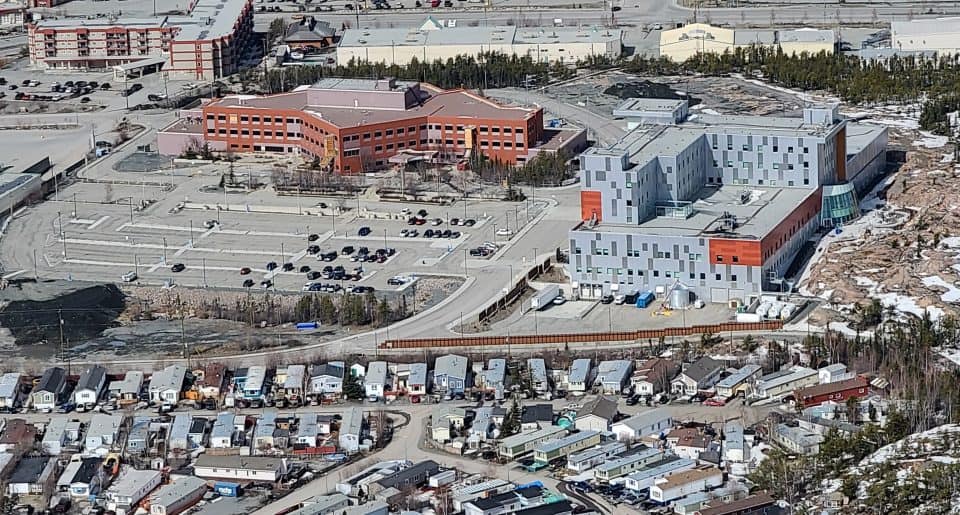
Stanton Territorial Hospital, right, and the former hospital building are seen in May 2020
Stanton Territorial Hospital, right, and the former hospital building are seen in May 2020. Ollie Williams/Cabin Radio

“People are taking stress leave,” the nurse said in July. “They are asking to take important time off – to take just one day off – and they’re not getting it. Then they’re going to a doctor and getting five weeks off, to say screw you.

“This is not good practice. People say they can’t even come near the building. They’ve worked more than 20 years, they’ve never taken a sick day, and they ask for one day off and they can’t get it. One nurse told me: ‘Every time I come in, I start to cry. So I’m just going home.'”

In recent months, the NWT’s registered nurses’ association has been planning a survey in part to understand why the territory struggles to retain nurses.

“Anecdotally, there’s this sense that people are planning to leave,” Denise Bowen, executive director of the Registered Nurses Association of the Northwest Territories and Nunavut, said in August.

“There are nurses who are feeling particularly disappointed, particularly upset about policies that have been implemented regarding Covid,” Bowen said, referring in part to earlier news reports.

The association’s survey was planned for September and October. After this report was first published, the association said it had chosen to delay the survey until later in the year. Once it is complete, the NWT government will receive a report with its findings.

It’s the first time such a survey has been carried out since 2005.

Stress ‘rained down’

In the past two months, the NWT’s Covid-19 situation has worsened significantly.

From the start of September to the end of October, the territory reported more than 1,400 Covid-19 cases. In the same period, 49 people with Covid-19 required hospital treatment.

Only now is the situation subsiding. As of Friday there were 47 active Covid-19 cases in the NWT, down from a daily high of 456 over Thanksgiving.

On Friday, a group of nurses signing the letter to ministers spoke with Cabin Radio. All asked for their identity and even their units to be suppressed as they fear retribution from hospital senior management. When staff raised concerns with reporters in the past, internal investigations attempted to unearth who had spoken.

“Any time someone makes a complaint, there’s an active investigation to discipline them,” one nurse said.

A second nurse told Cabin Radio: “This whole pandemic, we’ve been told how valued we are and how important we are. To know other provinces and territories have been given extra money for the work they’re doing and risk they’re taking, as a way to be thanked, and knowing the government here hasn’t done that, feels like a bit of a slap in the face.

“We’ve been really privileged in the North, not being super-exposed to Covid in the first few waves. But when this wave hit us we realized how small a hospital we are, how much of an area we service, and how things can quickly go wrong for us here.

“There was no backup. That was the straw that broke our backs. It was tiring and frustrating before, but we didn’t have it at that level. When the last wave hit, it showed us what’s expected of us and what’s not being given back.”

Nurses say they are expected to risk contracting Covid-19 daily and, more than that, must risk bringing the virus home to their loved ones.

Some say more than 18 months into the pandemic, provision of personal protective equipment remains inadequate with fresh masks not always readily available.

“It’s been a huge stress on all of us,” said a third nurse. “Just the risk.”

The first nurse said: “I didn’t see my family for six months because I was terrified I was going to bring Covid home and give it to them.

“I didn’t really see any attempts to help us and say yes, you deserve PPE. You should have it.

“The stress, it just rained down on our heads every day. Every day, they changed their policies and procedures. I know this is happening all across Canada, this is not new to us or specific to us. But everywhere else, they got reimbursed as a thank-you. What the nurses here got was a sign on the fence across from the hospital.

“And the sign is great. But it doesn’t feel like we’ve been appreciated by the government or by the hospital management.”

Minister has ‘questions’ about workplace environment

An NWT public health nurse earns between $94,380 and $112,730 annually, according to information published by the territorial government. In August, the CBC reported resident family doctors in the NWT received a base salary of $213,748 to $340,368 annually, “plus up to another $100,000 in recruitment and retention bonuses, plus other benefits.” Some specialists can earn between $7,045 and $9,790 per week to backfill in the territory.

In August, NWT health minister Julie Green told Cabin Radio the pay offered to northern healthcare workers was in line with that paid elsewhere in the country.

“Those are standard compensation rates,” said Green at the time. “So you could come to the NWT and earn that money, or you could get a job in another location and earn that money.

“We need to make ourselves different. What do we have to offer that no other jurisdiction has to offer, in order to attract both nurses and doctors? They’re in very high demand and there’s stiff competition. So you know, in addition to paying the standard rates for service, I think we need to promote that the NWT is a great place to live and practise your medical profession.”

Health minister Julie Green listens to NWT Covid-19 operations co-lead Scott Robertson at a news conference in January 2021
Health minister Julie Green, left, in January 2021. Pat Kane/National Geographic Society Covid-19 Emergency Fund

Asked if the NWT was creating the good working environment she described, the minister acknowledged she was aware of concern among staff.

“We have questions about that,” Green said in August, pointing to the nurses’ association survey and other work being done to understand why people leave healthcare roles in the NWT.

“I do recognize that we ask a tremendous amount from our healthcare professionals,” the minister told Cabin Radio.

“Many of them have been with us since the move to the new hospital, which was very labour-intensive. And the startup was rough. I know people worked a lot of extra hours and didn’t get enough vacation time.

“And we rolled right from that into Covid and the same situation again. This business of being short-staffed means that it’s harder and harder to grant people their vacation requests and time-off requests. And it just ends up leading to more and more exhaustion and turnover.

“We seem to be caught in a vicious cycle where, if we could increase our workforce, we would have greater job satisfaction in terms of vacation time and time off to offer our existing staff. So my message to them is we’re making every effort to bring more nurses on, so that people who have worked straight through can take the time off that they need, that we want them to have.

“There’s no point in exhausting people to the point where they feel their only option is to quit in order to get relief.”

Bosses say they are listening

Kim Riles – the NWT health authority’s new chief executive and a former chief operating officer at Stanton – said a national nursing shortage had led to higher-than-normal vacancy rates at the hospital this year.

In August, Riles told Cabin Radio she had held meetings to understand the sources of staff frustration. “Access to leave is a key concern,” she acknowledged.

“In terms of how I sympathize with nurses who want access to leave, I have a huge amount of sympathy for that,” said Riles at the time, before the fall Covid-19 outbreak.

“There have been a number of factors that have impacted people’s ability to have time off, people’s ability to connect with their families, to just rest and recharge. So I think it’s immensely important for us to hear that and to be able to decide how that impacts our ability to be flexible as we move forward.

“We have to balance our obligations to the public – for continuity of services, access to care and programs that we provide – with needing to hear from our staff that they’re tired, that they need their time off. Hearing this feedback is important and I just want to assure people that we are listening.”

Two months later, the nurses’ letter to MLAs concludes: “We have brought our concerns up with multiple levels of management within the NTHSSA [the NWT’s health authority]. Our requests for the return of vacation and sick leave along with the introduction of hazard pay for Covid-19 have not been addressed. We have not been given clear reasons for the lack of these benefits.

“Healthcare workers have worked tirelessly throughout the Covid-19 pandemic and have not been adequately compensated for their sacrifices. Many staff members have put their personal health at risk and are burnt out.

“Healthcare workers are leaving their professions at an alarming rate, and every area in the NTHSSA has multiple vacancies. The NTHSSA is not supporting us.”


Correction: November 6, 2021 – 12:23 MT. This report initially stated a survey of NWT healthcare workers had been taking place in September and October. After publication, the nurses’ association responsible for the survey said it had in fact chosen to delay the survey, which is now set to begin this month.

Cargill workers vote in favour of strike action as bargaining negotiations stall

The High River Cargill plant was home to Canada's largest COVID-19 outbreak in the spring of 2020 when close to 950 workers tested positive

Author of the article: Dylan Short
Publishing date: Nov 05, 2021 •
The Cargill meat packing plant near High River, where more than 900 workers tested positive for COVID-19 in April and May 2020.
 PHOTO BY JIM WELLS/POSTMEDIA

A majority of employees of the Cargill meat processing plant in High River have voted in favour of taking strike action as the union accuses the company of doing little to advance negotiations.

United Food & Commercial Workers Union, Local 401, issued a statement online Friday saying close to 1,400 members who work at the plant voted 97 per cent in favour of going on strike if Cargill does not provide a fair offer.

Union spokesman Scott Payne said members have grown increasingly angry over the negotiations that began in March after the previous collective agreement expired at the end of 2020. He said the employer has not come to the table in order for any offers to be presented.

Payne said the union is looking to address issues around health and safety, movement within the company and wage concerns.

“Cargill has dragged its feet in two ways,” said Payne. “One way is its willingness to actually make proposals and respond to our proposals, and dragging their feet in that regard.

“But they’ve also dragged their feet in terms of their availability. They’ve given us a couple days here, a couple days there. They just haven’t given us enough of their time and attention to actually making any progress on negotiations.”

The two sides met with a government-appointed mediator on one occasion before UFCW’s bargaining committee made the decision to ask the mediator to leave the talks to move forward with a strike vote, according to the union’s statement online.

Payne said he believes a strike is the most likely outcome of negotiations. He said the bargaining team is set to meet with Cargill representatives next week and that strike action could take place following those meetings.

“We’re looking at 1,000 people ready to stand out in front of that plant on strike, and it’s looking very likely that’s what it’s going to come to,” said Payne.

Requests for comment were not returned by Cargill Friday afternoon.

The High River Cargill plant was home to Canada’s largest COVID-19 outbreak in the spring of 2020 when close to 950 workers tested positive.

Three deaths were linked to the site’s outbreak. Workers Benito Quesada, 51, and Hiep Bui, 67, both died from the virus last spring. Armando Sallegue, 71, the father of another plant worker, also died from the disease while visiting from the Philippines.

A second outbreak was declared at the plant in March 2021 as 11 cases were connected to the worksite.

About 2,000 employees work at the High River Cargill plant.

dshort@postmedia.com

— With files from Jason Herring


Deere says rejected deal Is ‘best-and-final’ offer to union

Joe Deaux, Bloomberg News


Deere & Co. workers hold signs during a strike outside the John Deere Des Moines Works facility in Ankeny, Iowa, U.S., on Friday, Oct. 15, 2021. Thousands of workers at Deere & Co., the world’s biggest farm machinery maker, began picketing Thursday for the first time in more than three decades to demand better pay as the company heads for its most profitable year ever. , Bloomberg

Deere & Co. said the new contract it provided to striking union employees is the company’s best and final offer, and they aren’t returning to the bargaining table.

The world’s largest maker of farm equipment said it remains in contact with the United Auto Workers union that represents workers, but that it has nothing else to bargain about. The comments come a day after workers voted down a second tentative agreement, extending the strike by some 10,000 workers into a third week.

“The agreement that we provided is frankly our best and final offer,” Marc Howze, chief administrative officer for Deere, said in an interview. “In order for us to be competitive we have gone as far as we’re gonna go.”

The latest rejected deal offered larger wage increases, no new tiers to retirement benefits and a signing bonus of US$8,500. The wage increase affecting 14 of Deere’s facilities was larger than nearly a dozen other collective bargaining agreements the UAW has negotiated since 2018, according to Bloomberg Law’s database of labor contracts.

The Moline, Illinois-based company said Tuesday it would move into a new phase of its customer service continuation plan. Howze, though, would not give details, other than to say that the company is focused on meeting customer demand, especially for its parts business. The parts business is crucial at this time of year, because farmers are harvesting and need their equipment running at full capacity.

Currently, Deere is keeping its operations running by staffing facilities with salaried employees. Howze wouldn’t say how many striking workers the company was able to replace.

“We’re not going back to the bargaining table,” Howze said. “There’s nothing else to bargain about.”

Inuk multidisciplinary artist Laakkuluk Williamson Bathory wins Sobey Art Award

Iqaluit-based artist is known for performing uaajeerneq, a

 Greenlandic mask dance

Laakkuluk Williamson Bathory is seen in an undated handout photo. Williamson Bathory has been awarded the Sobey Art Award and its $100,000 prize. (Jamie Griffiths/Chickweed Arts/The Canadian Press)

Laakkuluk Williamson Bathory has won this year's Sobey Art Award for emerging artists.

The Iqaluit-based Inuk multidisciplinary artist received the $100,000 prize at a ceremony at the National Gallery of Canada on Saturday.

She is known for performing uaajeerneq, a Greenlandic mask dance that involves storytelling centred around three elements: fear, humour and sexuality.

In a news release announcing the award, Williamson Bathory said she uses her art to tell her own story and that of her family, which she says is one of "joy and celebration, awe and difficulty, beauty and destruction all at once."

"In a time when we recognize that this Canadian soil bears the small bodies of many thousands of Indigenous children, in an era when we work through colonial institutions to keep our families safe in the pandemic and at a moment when the Arctic city I live [in] does not have potable water coming from the taps, I am proud to be recognized as I tell you the story of a momentous experience my family had on the land," she said.

'Defies preconceived notions'

The Sobey Art Award celebrates emerging talent in the contemporary visual arts and is jointly administered by the Sobey Art Foundation and the National Gallery of Canada.

The jury consisted of Canadian curators and two international jurors. In the release, they said Williamson Bathory "provocatively transforms the framework of references for contemporary art."

"Williamson Bathory's performance practice courageously defies preconceived notions through embodied lived experience," the jury said. "Her works invite us to share in a world abundant with possibility infused with the interconnections of land, family, community and cultural knowledge."

Williamson Bathory was chosen from a shortlist of five artists, each one representing a geographic region of Canada.

The four other shortlisted artists — Lorna Bauer, Rémi Belliveau, Gabi Dao, and Rajni Perera — received $25,000 each.

Along with Williamson Bathory, they are currently featured in an exhibition at the National Gallery of Canada until Feb. 20, 2022. 

The remaining 20 longlisted artists received $10,000 each.

A Full Beaver Moon and partial lunar eclipse will illuminate the sky this month

Lunar eclipse. (Photo courtesy of Backyard Astronomer Gary Boyle)

Stargazers across Southwestern Ontario will have a ringside seat to a lunar eclipse this month.

A Full Beaver Moon will rise on Friday, November 19, and be accompanied by a near-total lunar eclipse.

Backyard Astronomer Gary Boyle says even though it is not officially a total eclipse, the lunar surface will still show darkness and some colour, typically seen in a total event.

“This one will be extra special and appear very close to a total eclipse,” said Boyle. “It’s a wonderful phenomenon to see.”

It will reach its peak illumination at 4:02 a.m. (EST) Friday morning, so be sure to look up after sunset on November 18 to catch a glimpse when it’s nearly full.

“The moon will be in the larger shadow of the earth except for a mere three per cent, leaving only the edge in sunlight,” said Boyle.

According to Boyle, it will be best viewed in western Canada however, people in Southwestern Ontario will still get a chance to enjoy it.  He said the best way to enjoy the eclipse is to get out of city. However, it can been seen by looking out of the window.

“We see about two or three eclipses throughout the year. Some are total and some are partial,” said Boyle. “It’s not rare but it is a beatiful thing to see nature in motion.”

LOOKING SHARP
LOOK: 55 YEARS AGO, NASA TOOK ‘THE PICTURE OF THE CENTURY’


Lunar Orbiter 2 showed us the Moon in a whole new light.


JON KELVEY
11.6.2021 3:00 AM

MORE THAN A HALF-CENTURY AGO, NASA led a revolution in lunar science. In the 1960s, the space agency launched five orbital expeditions to map the surface of the Moon and scout out potential landing sites for a crewed mission. Dubbed the Lunar Orbiters 1 through 5, these missions were the key to the United States beating the Soviet Union to land a human on the Moon. Along the way, the Lunar Orbiters changed how we look at our nearest cosmic neighbor — and especially Lunar Orbiter 2.

Technically, all five of the Lunar Orbiter missions did their job — they mapped the Moon and made human trips possible. But Lunar Orbiter 1 had a rocky start.

“[NASA] figured that they needed three successful missions to actually fulfill the primary mission, which was studying various candidate landing sites for the Apollo missions,” Matt Shindell, curator at the National Air and Space Museum, tells Inverse.

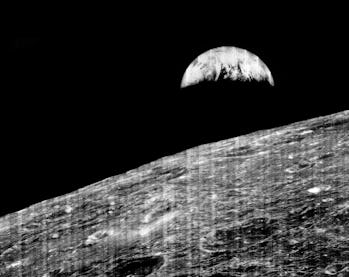
Lunar Orbiter 1, launched in August 1966, was a mixed bag. It successfully entered orbit around the Moon, the first American spacecraft to do so (the Soviets got there first in April that year with Luna 10), and took the first image of the Earth from the perspective of the Moon.

But Lunar Orbiter 1’s high-resolution camera failed, so the images are pretty low-res. These blurry images lacked the kind of detail necessary to scout Apollo Landing sites — NASA had to try again with Lunar Orbiter 2.


The first image of Earth, taken from orbit around the Moon by Lunar Orbiter 1. NASA


“Lunar Orbiter 2, on the other hand, was a perfect success,” Shindell says. Launched from Cape Canaveral on November 6, 1966, Lunar Orbiter 2 flew to the Moon and stayed active until October 1967, snapping photos that “made headlines for just how impressive and clear they were,” Shindell adds.

For that, Lunar Orbiter 2 claims the accolade of being the first entirely successful Lunar Orbiter mission, paving the way for Neil Armstrong’s boot print on the Moon.

NAILING THE PICTURE — The Lunar Orbiter spacecraft were technically identical to one another, and all shared a unique imaging system different from any of NASA’s other planetary science spacecraft.

For example, NASA’s Ranger missions to the Moon — also in the 1960s — used television cameras, while later spacecraft would use digital imaging systems. In comparison, the Lunar Orbiters used an intricate mechanical system to shoot on 70mm Kodak aerial film, develop the film themselves, and then scan and transmit the resulting images back to Earth. Each probe was also equipped with an 80mm wide-angle lens and 610mm high-resolution lens, the latter designed to take detailed photos of the lunar surface.

On Lunar Orbiter 1, the high-resolution camera malfunctioned, and the images turned out to be a fuzzy mess. But the craft did manage to snap a breathtaking wide-angle shot of the Earth and Moon. It was a captivating and thought-provoking image, but only half of the probe’s intended mission.

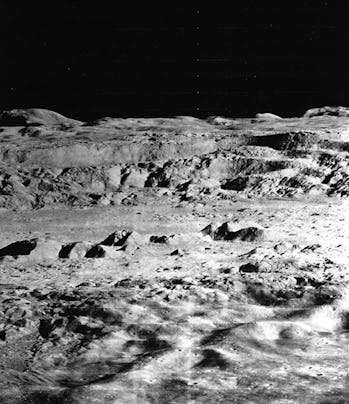
Both of Lunar Orbiter 2’s lenses functioned beautifully, snapping stunning, never-before-seen details of the lunar surface, including an image of the Copernicus Crater.


The image of Copernicus Crater on the Moon hailed as “The Picture of the Century” by LIFE Magazine. NASA


“It was called ‘The Picture of the Century,’ by Life Magazine,” Shindell says. This image and others from the mission have since been eclipsed by the many subsequent majestic, full-color photos we hungrily devour every time NASA releases them for general consumption.

Yet, Shindell says, “for its time, these Lunar Orbiter 2 images were incredibly impressive and people took note of them.”

PICTURES WITH PURPOSE — The crisp and clear pictures didn’t just make headlines. NASA used these images to understand what they might be dealing with if and when they put boots on the regolith, as it were.

Essentially, the Lunar Orbiters were just one part of a massive reconnaissance project that included four successful Ranger missions, hard landers that crashed into the Moon and took pictures all the way down, and five successful soft-landing Surveyor landers.

At the time, a team led by Egyptian-American geologist Farouk El-Baz studied the images from the Lunar Orbiter missions, applying the same principles used to study aerial photography to understand geology on Earth. From the photographs, they gleaned vital clues about the realities of the lunar surface, “based on the angle at which the shadows were falling, and other types of physical evidence in the image that revealed different geologic information,” Shindell says.


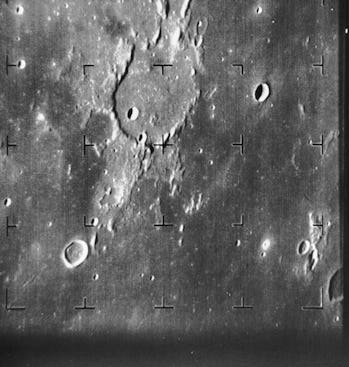
An image of the Moon’s Guericke Crater, taken by Ranger 7.NASA

There was a critical difference in El-Baz’s work on Earth: On our planet, geologists can visit the place by air to “ground truth” their image analysis. El-Baz and his team had to rely on second-hand information coming from the Ranger and Surveyor landings for the Moon.


Shindell says they still learned a great deal, but he points out that NASA ultimately decided to play it safe in case the assumptions about the lunar surface turned out to be wrong when it came to the Apollo crewed missions.

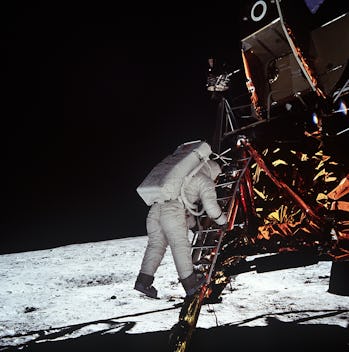
“If you look at the lunar module when sitting on the surface of the Moon, on the Apollo 11 landing, the ladder is actually pretty high up,” Shindell says.

Astronauts Neil Armstrong and Buzz Aldrin had to hop down from the lander to the Moon’s surface, and “that was partly because they have built-in this extra kind of margin for, ‘what if the lunar module sinks a little bit into the regolith?’”


Buzz Aldrin dangling above the lunar surface.NASA


The caution would prove unnecessary since the lunar surface — as El-Baz, the geologists, and the Lunar Orbiters, Rangers and Surveyors predicted — was relatively stable and capable of supporting humans and machines.

A FORGOTTEN LEGACY — Lunar Orbiter 2 sent more than 200 images of the Moon and space to Earth. The pictures show almost 1.6 million square miles of the lunar surface, including the site of Ranger 8’s crash-landing, which occurred in 1965. This location, not coincidentally, is just 15 miles away from where Apollo 11 eventually landed in the Sea of Tranquility.

These images have slipped from public memory, obscured by time and other stunning images like those taken by Neil Armstrong’s Hasselblad camera on the lunar surface itself. Yet 55 years later, the Lunar Orbiter missions should be celebrated for capturing — for the first time — the entire near-side of the Moon and 95 percent of the far side in detailed aerial photographs. These photographs are still used — and improved — by researchers today as they study Earth’s natural satellite.

“There’s been an effort at NASA Ames to reprocess a lot of the images that came back from the Lunar Orbiter program,” Shindell says. To do this, scientists are using new digital processing techniques invented long after the Lunar Orbiter went up to space.

“We now know there was even greater detail in those images than we were able to at first see.” Truly a cosmic gift that keeps giving.

Your smile's cosmic history: We discovered the origin of fluoride in early galaxies

Your smile's cosmic history: we discovered the origin of fluoride in early galaxies
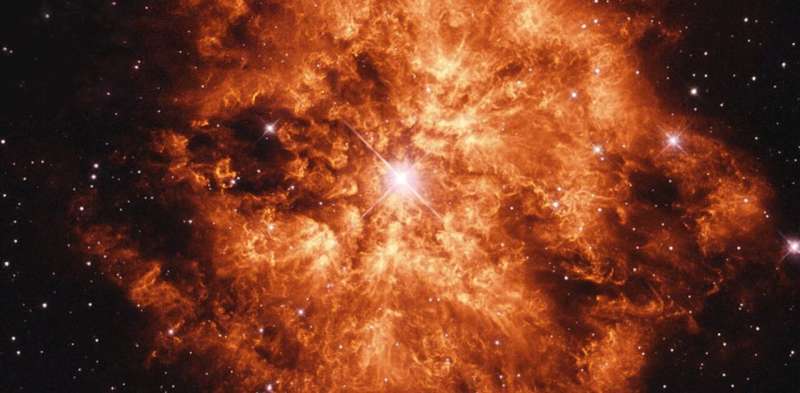
Flouride is created by Wolf–Rayet stars, here seen in the Milky Way by the Hubble Space
 Telescope. Credit: NASA/Judy Schmidt, CC BY-SA 4.0

Look at the ingredients on a tube of toothpaste and you will probably read something like "contains sodium fluoride." Fluoride, as you probably know, is important for healthy teeth. It strengthens enamel, the hard, protective layer around a tooth, and so helps prevent cavities.

You may not think too deeply about toothpaste. But like all things on Earth, from the majestic to the mundane, fluoride—and the story of a smile—has a cosmic origin. Now, my colleagues and I have published a paper in Nature Astronomy that sheds some  on it.

Virtually all  were formed long ago in the history of the universe. Hydrogen is the oldest element: it formed very shortly after the big bang, about 14 billion years ago. Within a few minutes of the big bang, the light elements helium, deuterium and lithium were also formed in a process called big bang nucleosynthesis. Since then, nearly every other element has been forged in processes associated with the life and death of stars. But those stars were not always around.

We still don't know exactly when the  ignited in the universe, but it probably didn't happen for about 100 million years or so after the big bang. Before this, the universe was filled with a fog of hydrogen, mingled with the mysterious, invisible substance astronomers call dark matter. This fog was not smooth, but rippled—slightly denser in some places. It was these regions that started to contract, or "collapse," due to gravity, to form the first . Where the gas got dense enough, stars ignited and lit up the universe.

The following few billion years was a time of rapid growth: the rate of star formation in the universe rose sharply until it reached a peak, 8 to 10 billion years ago. Ever since that "cosmic noon," the overall rate of star formation in the universe has been in decline. That's why astronomers are so interested in the early phases of the history of the cosmos: what happened then shaped what we see around us today.

While we have quite a lot of information about how the growth of galaxies "ramped up" in terms of their star formation, we have relatively little insight into their chemical evolution at the earliest times. This is important because, as stars live and die, the elements they produce become dispersed throughout a galaxy and beyond. Many years later, some of those elements can form new planets like ours.

Your smile's cosmic history: we discovered the origin of fluoride in early galaxies
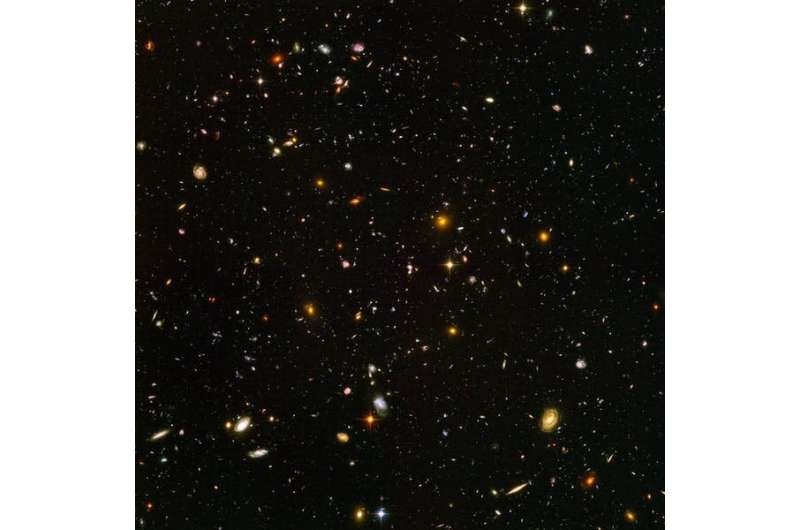
Ancient galaxies seen by the Hubble Space Telescpope. Credit: NASA/ESA

Rapid evolution

We observed a distant galaxy called NGP-190387 with the Atacama Large Millimeter/sub-millimeter Array (Alma)—a telescope that detects light with a wavelength of around one millimeter. This allows us to see the light emitted by cold dust and gas in distant galaxies. The data revealed something unexpected: a dip in the light at a wavelength of exactly 1.32 millimeters. This corresponds exactly to the wavelength at which the molecule hydrogen fluoride (HF), comprising a hydrogen atom and , absorbs light (taking into account a shift in wavelength that happens due to the universe's expansion). The deficit of light implies the presence of clouds of hydrogen fluoride gas in the galaxy. This light has taken over 12 billion years to reach us, and we see the galaxy as it was when the universe was 1.4 billion years old.

This is exciting, because it provides information about how galaxies first became enriched with chemical elements shortly after they first formed. We can see that even at this early time, NGP-190387 had a high abundance of fluorine. Although we have observed other elements in distant galaxies, such as carbon, nitrogen and oxygen, this is the first time fluorine has been detected in a star-forming galaxy at such a distance. The greater the variety of elements we can observe in early galaxies, the better our understanding of the process of chemical enrichment at that time.

We know that fluorine can be produced in different ways: for example, in star explosions called supernovas and in certain "asymptotic giant branch" stars—red supergiant stars nearing the end of their life, having burned most of the hydrogen and helium in their cores and now swollen in size.

Models of how elements form in stars and in supernovae can tell us how much fluorine we should expect from these sources. And we found that the abundance of fluorine was too high in NGP-190387 to be explained by supernovas and asymptotic giant branch stars alone. An extra source was needed, and this is probably another type of star called a Wolf-Rayet. Wolf-Rayet stars are quite rare—there are only a few hundred cataloged in the Milky Way, for example. But they are extreme.

Wolf-Rayet stars are a phase in the lifecycle of very massive stars—with more than ten times the mass of our Sun. Approaching the end of their short life, these stars burn helium in their cores, and are millions of times more luminous than the Sun. Unusually, Wolf-Rayet stars have lost their envelope of hydrogen via powerful winds, leaving the helium core exposed. They will eventually explode in dramatic core-collapse supernova explosions. When we added the amount of fluorine expected from Wolf-Rayet  to our model, we could finally account for the dip in light from NGP-190387.

This adds to a growing body of evidence that shows that the growth of galaxies was surprisingly fast-paced in the early universe: a frenzy of star formation and chemical enrichment. Those processes lay the foundations for the  we see around us today, and this work provides new insight into the detailed astrophysics at play, over 12 billion years ago.

But perhaps the main take away is that it shows that the story of your smile is a tale as old as time.Astronomers make most distant detection yet of fluorine in star-forming galaxy

Journal information: Nature Astronomy 

Provided by The Conversation 

Astronomers make most distant detection yet of fluorine in star-forming galaxy

Astronomers make most distant detection yet of fluorine in star-forming galaxy
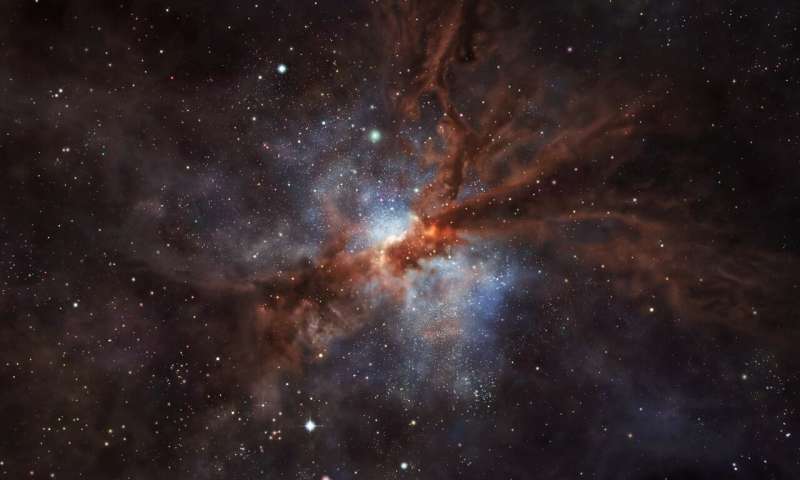
This artist’s impression shows NGP–190387, a star-forming, dusty galaxy that is so far
 away its light has taken over 12 billion years to reach us. ALMA observations have
 revealed the presence of fluorine in the gas clouds of NGP–190387. To date, this is the
 most distant detection of the element in a star-forming galaxy, one that we see as it was 
only 1.4 billion years after the Big Bang — about 10% of the current age of the Universe. 
The discovery sheds a new light on how stars forge fluorine, suggesting short-lived stars 
known as Wolf–Rayet are its most likely birthplace. Credit: ESO/M. Kornmesser

A new discovery is shedding light on how fluorine—an element found in bones and teeth as fluoride—is forged in the universe. Using the Atacama Large Millimeter/submillimeter Array (ALMA), in which the European Southern Observatory (ESO) is a partner, a team of astronomers have detected this element in a galaxy that is so far away its light has taken over 12 billion years to reach us. This is the first time fluorine has been spotted in such a distant star-forming galaxy.

"We all know about fluorine because the toothpaste we use every day contains it in the form of fluoride," says Maximilien Franco from the University of Hertfordshire in the UK, who led the new study, published today in Nature Astronomy. Like most elements around us, fluorine is created inside stars but, until now, we did not know exactly how this element was produced. "We did not even know which type of stars produced the majority of fluorine in the universe!"

Franco and his collaborators spotted fluorine (in the form of hydrogen fluoride) in the large clouds of gas of the distant galaxy NGP–190387, which we see as it was when the universe was only 1.4 billion years old, about 10% of its current age. Since stars expel the elements they form in their cores as they reach the end of their lives, this detection implies that the stars that created fluorine must have lived and died quickly.

The team believes that Wolf–Rayet stars, very  that live only a few million years, a blink of the eye in the universe's history, are the most likely production sites of fluorine. They are needed to explain the amounts of hydrogen fluoride the team spotted, they say. Wolf–Rayet stars had been suggested as possible sources of cosmic fluorine before, but astronomers did not know until now how important they were in producing this element in the early universe.

"We have shown that Wolf–Rayet stars, which are among the most massive stars known and can explode violently as they reach the end of their lives, help us, in a way, to maintain good dental health," says Franco.

Besides these stars, other scenarios for how fluorine is produced and expelled have been put forward in the past. An example includes pulsations of giant, evolved stars with masses up to few times that of our sun, called asymptotic giant branch stars. But the team believes these scenarios, some of which take billions of years to occur, might not fully explain the amount of fluorine in NGP–190387.

"For this galaxy, it took just tens or hundreds of millions of years to have fluorine levels comparable to those found in stars in the Milky Way, which is 13.5 billion years old. This was a totally unexpected result," says Chiaki Kobayashi, a professor at the University of Hertfordshire. "Our measurement adds a completely new constraint on the origin of fluorine, which has been studied for two decades."

The discovery in NGP–190387 marks one of the first detections of fluorine beyond the Milky Way and its neighboring . Astronomers have previously spotted this element in distant quasars, bright objects powered by supermassive black holes at the center of some galaxies. But never before had this element been observed in a star-forming galaxy so early in the history of the universe.

The team's detection of fluorine was a chance discovery made possible thanks to the use of space and ground-based observatories. NGP–190387, originally discovered with the European Space Agency's Herschel Space Observatory and later observed with the Chile-based ALMA, is extraordinarily bright for its distance. The ALMA data confirmed that the exceptional luminosity of NGP–190387 was partly caused by another known massive galaxy, located between NGP–190387 and the Earth, very close to the line of sight. This massive galaxy amplified the light observed by Franco and his collaborators, enabling them to spot the faint radiation emitted billions of years ago by the  in NGP–190387.

Future studies of NGP–190387 with the Extremely Large Telescope (ELT)—ESO's new flagship project, under construction in Chile and set to start operations later this decade—could reveal further secrets about this galaxy. "ALMA is sensitive to radiation emitted by cold interstellar gas and dust," says Chentao Yang, an ESO Fellow in Chile. "With the ELT, we will be able to observe NGP–190387 through the direct light of , gaining crucial information on the stellar content of this galaxy."

This research was presented in the paper "The ramp-up of interstellar medium enrichment at z > 4" to appear in Nature AstronomyALMA scientists detect signs of water in a galaxy far, far away

More information: Maximilien Franco, The ramp-up of interstellar medium enrichment at z > 4, Nature Astronomy (2021). DOI: 10.1038/s41550-021-01515-9. www.nature.com/articles/s41550-021-01515-9

Journal information: Nature Astronomy 

Provided by ESO 

COYOTES ARE URBAN DWELLERS
Reports of coyotes down but bold behaviour up: Edmonton biologist

SINGLE THEY ARE OPPORTUNIST
THEY HUNT IN PACKS AND USE DISTRACTION

Author of the article: Blair McBride
Publishing date: Nov 06, 2021 •

Through her Edmonton Urban Coyote Project, Dr. Colleen Cassady St. Clair has documented a slight decrease in coyote sighting reports in the city so far in 2021 in Edmonton, Nov. 5, 2021. 
PHOTO BY ED KAISER /Postmedia


Reported sightings of coyotes in Edmonton are down in 2021 but the canids seem to be getting bolder over time, suggests University of Alberta biologist Dr. Colleen Cassady St. Clair.

“I think people are getting used to seeing more coyotes and maybe less likely to report them,” said St. Clair, who operates the Edmonton Urban Coyote Project (EUCP) that documents coyote sightings and behaviour in the city.

The project has received 1,095 reports from the public of coyote sightings in 2021 up to Oct. 20, down from 1,519 sightings reported for all of 2020.

But she urges Edmontonians not to get too comfortable because since she started the coyote project in 2010, she has seen increases in their numbers and boldness.

“There are more (media) reports of people being bitten and dogs being bitten. At least one paper in peer-reviewed literature of media analysis of North American cities documented that. And there were 45 people bitten by coyotes in Stanley Park in Vancouver this year.”

In Edmonton, a toddler was hospitalized in April last year after a coyote lunged at her, biting her head and ear while she was in Coronation Park.

St. Clair estimates the city’s coyote population ranges between 500 and 1,000 animals, with a core group living in the river valley.

Hair-raising reports aside, the professor stresses that attacks on humans are still rare, and an EUCP field study conducted this year showed that most coyotes fled when they came within 20 to 39 metres of study volunteers.

Out of 54 occasions when volunteers observed one or more coyotes, only one coyote approached them.

Gabrielle Lajeunesse, a master’s student in ecology who works with the EUCP, said that w hen a volunteer assessed that the coyote was less than 40 metres away, the animal was considered “bold.”

If a coyote approaches someone, Lajeunesse suggests people shout, run towards it and throw things in its direction.

“Make them fear humans,” she said.

Food or compost shouldn’t be left outside of homes because coyotes can associate humans with food and become even more bold, increasing the chances of aggressive behaviour, she said.

St. Clair recommends keeping large dogs on leashes while walking outside and to pick up and hold small dogs. Cats should be kept indoors because coyotes are known to stalk and eat them.

Edmontonians can further protect dogs and properties by building tall fences or installing on fence tops a ‘ coyote roller ,’ a pipe made of polyvinyl chloride (PVC) that rolls if a coyote tries to climb it, St. Clair added.

Reitmans removes clothing from factory suspected of North Korean forced labour after Marketplace investigation

'CBC has brought new information to light,' Canadian retail

 giant says

CBC journalists found jackets made by a factory accused of using North Korean labour at multiple Penningtons locations across the Greater Toronto Area. Penningtons is operated by Reitmans Ltd. Material specs listed in U.S. shipping records were used to track down the jacket. (Katie Pedersen/CBC)

Canadian retail giant Reitmans Ltd. will remove from its stores all remaining inventory made at a factory in China suspected of using North Korean forced labour, according to a press release from the company.

The release was posted on its corporate website and Facebook pages on the evening of Nov. 5,  just as a CBC Marketplace episode that featured the linen jacket aired.

"The story outlined by CBC has brought new information to light," read the post. The longer press release on the company's website emphasized that its previous audits of the factory had not found evidence of "any guest workers or forced labour."

The Canadian women's fashion retailer says it will pull not only the jacket identified by Marketplace but also three other Penningtons styles and two Reitmans styles that were also sourced from Dandong Huayang Textiles and Garment Co. Ltd., a Chinese factory on the border of North Korea. Reitmans says it will donate the clothing to local charities.

Some comments on Reitmans' and Penningtons' Facebook posts praise the company for taking action, while others are more critical.

Stephanie Rook, a 48-year-old school teacher who regularly shops at Reitmans, told Marketplace before the story aired that she was "disappointed" the retailer had decided to keep selling clothing from older stocks even after it was made aware of the allegations. She says she has mixed feelings about the actions that are now being taken by the company.

"I'm happy that they're not just trashing the clothes that they have taken off the shelves, but my mixed reaction is: Why did it take for [Marketplace] to bring this story to light for Reitmans to realize what was actually going on?" she said in an interview with CBC. "To me that's the disappointing part."

Stephanie Rook says she has a ‘mixed reaction’ to the news that Reitmans will now remove six clothing styles from its shelves. (CBC)

Reitmans — which operates 413 stores across Canada, including Reitmans, Penningtons and RW&CO — had told Marketplace it stopped submitting new orders with the factory last December when allegations arose that the factory may be using North Korean workers in forced-labour conditions — although an audit came back with no red flags.

Reitmans continued to receive clothes that were already in production, and it was selling those clothes on store shelves up until the day the Marketplace broadcast aired on Nov. 5.

Penningtons will no longer sell four styles of clothing that it sourced from a Chinese factory accused of using North Korean labour. Reitmans has also pulled two more styles from its shelves. (Anu Singh/CBC)

Anika Kozlowski, an assistant professor of fashion, design, ethics and sustainability at Toronto's Ryerson University, says she thinks companies can take more of an active role in putting pressure on factories to act ethically.

"Codes of conduct and audits don't work.... We keep having the same problems over and over again," she said.

"If you knew you were doing everything right and you wanted to actually ensure this, you would have been concerned right from the get-go," Kozlowski said. "It's only when someone points a finger at you ... that all of a sudden we get these reactionary measures."

Ideally, she says, retailers would own their own factories and source their clothes from Canada, but she adds that more transparency from companies would "definitely help."

Sen. Julie Miville-Dechêne has been trying for years to get transparency legislation passed in Canada that would require companies to monitor their supply chains and report on their findings.

Sen. Julie Miville-Dechêne says the situation at Reitmans shows how a law requiring brands to monitor their supply chains and report on their findings could make a difference. (Submitted by Julie Miville-Dechêne)

She says the fact that Reitmans was aware of allegations about this factory for so long but waited until its brand was named in a news story to take action shows how a transparency law could make a difference.

"I think they could have done it before, considering that they were alerted," she said, but acknowledged that it's "better late than never."


Read Reitmans' full response to CBC's investigation here, and watch the full Marketplace episode on CBC Gem.