Wednesday, November 10, 2021

Loss of glaciers will hurt tourism, power supplies and more


This combination of satellite images provided by Planet Labs Inc. shows glaciers at Mt. Kilimanjaro in Tanzania in 2016, left and 2021. With many glaciers rapidly melting because of climate change, countries around the world are facing trouble from the disappearance of the ice sheets. (Planet Labs Inc. via AP)


JAKARTA, Indonesia (AP) — From the southern border of Germany to the highest peaks in Africa, glaciers around the world have served as moneymaking tourist attractions, natural climate records for scientists and beacons of beliefs for indigenous groups.

With many glaciers rapidly melting because of climate change, the disappearance of the ice sheets is sure to deal a blow to countries and communities that have relied on them for generations — to make electricity, to draw visitors and to uphold ancient spiritual traditions.

The ice masses that formed over millennia from compacted snow have been melting since around the time of the Industrial Revolution, a process that has accelerated in recent years.

The retreat can be seen in Africa, on the border of Uganda and the Democratic Republic of the Congo, where the jagged peaks of the Rwenzori Mountains jut into the sky above a green jungle. The peaks once held more than 40 glaciers, but fewer than half of them remained by 2005, and the melting continues. Experts believe the last of the mountains’ glaciers could disappear within 20 years.

The disappearance means trouble for land-locked Uganda, which gets nearly half of its power from hydroelectricity, including the power plants that rely on steady water flow from the Rwenzori glaciers.

“That hydroelectric power runs much better on more regular flows than it does peak and troughs,” said Richard Taylor, a professor of hydrogeology at the University College in London.

A continent away, on the southern edge of Germany’s border with Austria, only half a square kilometer (124 acres) of ice remains on five glaciers combined. Experts estimate that is 88% less than the amount of ice that existed around 1850, and that the remaining glaciers will melt in 10 to 15 years.

That spells bad news for the regional tourism industry that relies on the glaciers, said Christoph Mayer, a senior scientist in the geodesy and glaciology group at the Bavarian Academy of Sciences and Humanities in Munich.

“At the moment, tourist agencies can advertise, ‘You can visit some kind of the highest mountains in Germany with glaciers. You can walk on the glaciers,’” Mayer said. “People living around these regions really live from tourism ... there will be an impact on them if they lose these glaciers.”

The same issue faces Tanzania, where experts estimate that Mt. Kilimanjaro — the highest mountain in Africa and one of the country’s main tourism attractions — has lost about 90% of its glacial ice to melting and to sublimation, a process in which solid ice transitions directly to vapor without becoming a liquid first. Travel and tourism accounted for 10.7% of the country’s GDP in 2019.
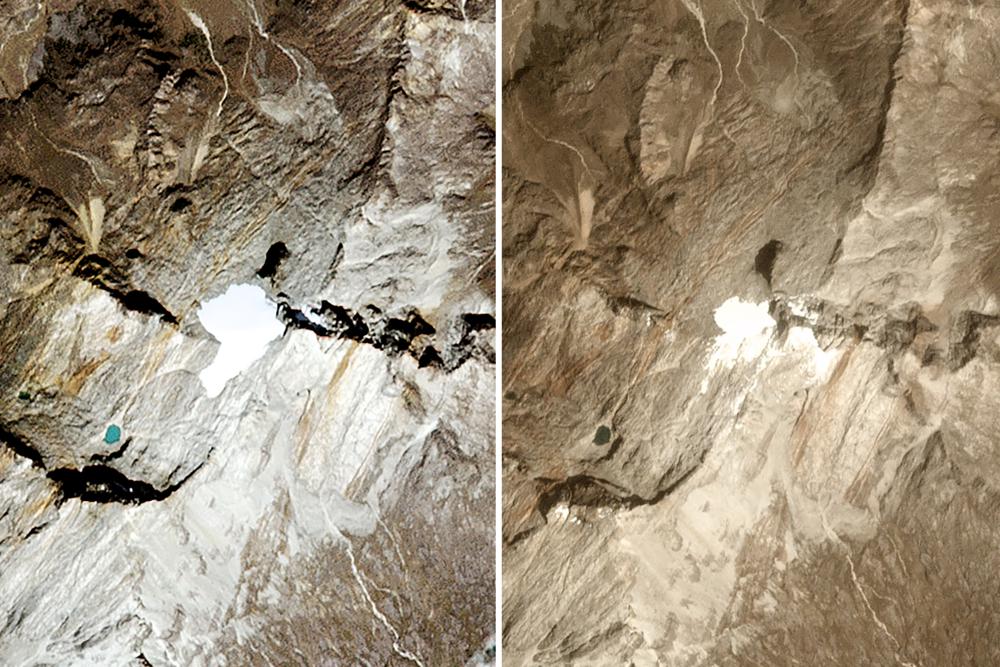

This combination of satellite images provided by Planet Labs Inc. shows the Humboldt glacier in Venezuela in 2010, left, and 2021. With many glaciers rapidly melting because of climate change, countries around the world are facing trouble from the disappearance of the ice sheets.
 (Planet Labs Inc. via AP)

There are intangible losses for many indigenous communities that reside within sight of glaciers as well, said Rainer Prinz, a glaciologist at the University of Innsbruck in Austria.

In the history of the local populations, “the ice in the mountains is the seat of god. It has a very spiritual meaning,” he said, discussing communities near Mt. Kilimanjaro. “Losing the glaciers there would also impact spiritual life, I think.”

The layers of ice that make up a glacier can be tens of thousands of years old and contain year-by-year information about past climate conditions, including atmospheric composition, temperature variations and types of vegetation that were present. Researchers take long tube-like ice cores from glaciers to “read” these layers.

During a 2010 research trip to the Carstensz glacier in Indonesia’s western Papua province, oceanographer Dwi Raden Susanto was excited to be part of a team that took a core sample from the remote glaciers. But once the sample was taken, Susanto said, scientists quickly realized the rapid decline of the ice allowed them to get records dating back only to the 1960s.

“It is sad because it’s not only a loss of local or national heritage for Indonesia, but this is also the loss of climate heritage for the world,” Susanto said.

As glaciers vanish, experts say, local ecosystems will begin to change as well— something already being studied at the Humboldt Glacier in Venezuela, which could disappear within the next two decades.

Experts warn that the fate of smaller glaciers offers a warning for larger glaciers.

For example, while many of the world’s smaller glaciers no longer serve as the main freshwater source for countries, some larger glaciers still do, including in Peru, which lost nearly 30% of its glacier mass between 2000 and 2016, said Lauren Vargo, a research fellow at the Antarctic Research Centre in Wellington, New Zealand.

“Those communities are much more dependent on glaciers for having water for their communities,” she said.

Increased melt will also lead to rising seas and changes in weather patterns — something that is bound to affect society on a global level, Mayer said.

“The disappearance of these small glaciers is really a warning sign of what is coming in the future,” he said. It “should make you aware that something is going on, which is not just peanuts.”

___

The Associated Press Health and Science Department receives support from the Howard Hughes Medical Institute’s Department of Science Education. The AP is solely responsible for all content.
REST IN POWER

Family ‘heartbroken’ following death of founding SDLP figure Austin Currie, a key figure in NI’s civil rights movement

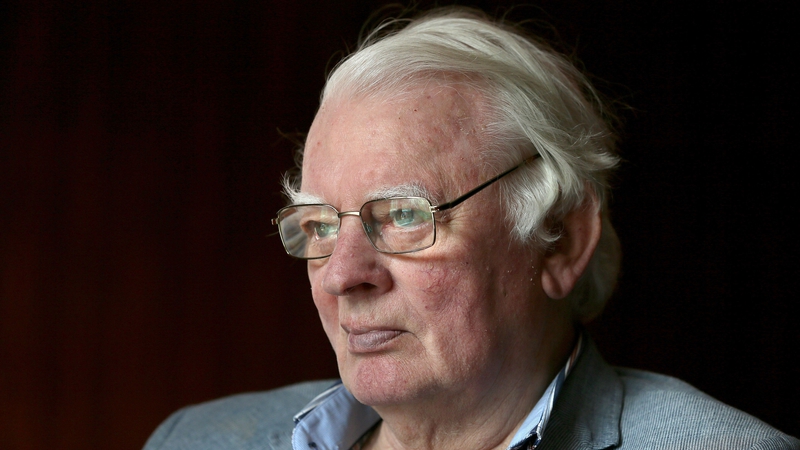
Austin Currie, one of the founding members of the SDLP, has died at age 82.

THE NORTHERN IRELAND  
SOCIAL DEMOCRATIC & LABOUR PARTY

By The Newsroom
Tuesday, 9th November 2021, 9:13 pm

Mr Currie, who was a key figure at the beginning of Northern Ireland’s civil rights movement, died at his home in Derrymullen, Co Kildare.

His family have said they are heartbroken at his death.

Mr Currie died in his sleep at his home in Derrymullen, Co Kildare, on Tuesday. He had recently celebrated his 82nd birthday

John Hume and Austin Currie talking at an SDLP Conference in Newcastle in 1980. 
Photo: Pacemaker

A family statement said: “The Currie family is heartbroken to announce the death of Austin Currie.

“Austin was married to Annita for 53 years. They were a formidable team whose love for each other and their family saw them through some of the worst times in Northern Ireland’s recent history.

“He is survived by his children Estelle, Caitriona, Dualta, Austin and Emer, their partners and 13 grandchildren.”

Mr Currie was born in Co Tyrone, the eldest of 11 children.

Austin Currie during The Funeral of Seamus Mallon at St James Church in Mullaghbrack, Co Armagh in 2020. Photo Colm Lenaghan/Pacemaker Press

His decision to squat at a council house in Caledon in June 1968 is widely seen as the beginning of the civil rights movement.

He was one of the founding members of the SDLP along with John Hume and Gerry Fitt.

In 1989, he won a seat in Dublin West for Fine Gael and pursued a career as TD and minister until he retired in 2002.

The family statement continued: “Our Daddy was wise, brave and loving and we thank him for the values that he lived by and instilled in us.
Austin Currie addresses the crowd.

“He was our guiding star who put the principles of peace, social justice and equality first.

“From Edendork in county Tyrone to the bog of Allen, Daddy was most at home with his beloved Annita and his family, surrounded by newspapers and grandchildren.

“We will miss him deeply.”

SDLP leader Colum Eastwood said Mr Currie was a “titan” of the civil rights movement.

A Social Democratic and Labour Party press conference at the Tribine offices in Smithfield. (l-r) Austin Currie MP, Gerry Fitt MP, John Hume MP, Ivan Cooper MP and Paddy O'Hanlon. Behind them is Edward McGrady (left) and Paddy Devlin MP.

He added: “His housing protest in Caledon in 1968 was one of the key sparks for the civil rights campaign that followed and he spoke for a generation of young nationalists when he refused to allow his constituents to be treated as second class citizens anymore.

“His radical activism led him to join together with other young leaders and together they formed our party on the principles of a shared society where everyone got a fair shot at life, something so many of their contemporaries had been denied.

“Each time we lose a political giant like Austin we lose a piece of our history.

“While moments like this bring us great sadness, it also gives us the opportunity to celebrate the man and the huge contribution he made to politics in both the North and South of our island.”

Irish Taoiseach Micheal Martin described Austin Currie as a “peacemaker”.

Mr Martin tweeted: “Saddened to hear of the death of Austin Currie, one of the founding fathers of the civil rights movement in Northern Ireland.

Austin Currie, centre, in protest mode.

“He did so much for people, as a peacemaker and in politics, serving in the Dail and as Minister of State with distinction.

“My sympathies to his family.”

Irish Tanaiste Leo Varadkar has described Austin Currie as one of the “outstanding politicians of his generation”.

Mr Varadkar said: “I am deeply saddened to hear of the death of Austin Currie, and extend my sympathies to his family.

“A pioneer of the civil rights movement in Northern Ireland, Austin was one of the outstanding politicians of his generation, highlighting discrimination against nationalists in issues like housing with a famous sit-in protest at Caledon.

“He helped to organise one of the first civil rights marches in Northern Ireland, and went on to co-found the Social Democratic & Labour Party with John Hume and Gerry Fitt.”

He added: “Austin moved his political career south of the border in the 1980s and became a Fine Gael TD in Dublin West, the constituency which I am currently honoured to represent alongside his daughter, Senator Emer Currie.

“He served as a minister for children’s affairs in the Rainbow Coalition under Taoiseach John Bruton, before retiring from politics in 2002.

“I knew Austin as a brave, courageous and principled man. He was blessed with extensive political insight and boundless humanity.

“Above all, he cared most about bringing peace to this island by peaceful means, something he worked towards throughout his political career, and was vehemently opposed to political violence.”


Civil rights activist Austin Currie dies aged 82
Updated / Wednesday, 10 Nov 2021 
Austin Currie was a founding member of the SDLP in the 1970s

President President Michael D Higgins has led tributes to former Northern Ireland civil rights activist and Fine Gael TD Austin Currie, who has died aged 82.

President Higgins said Ireland has lost a "dedicated, sincere and very committed politician".

"His outstanding service to the people of this country as an advocate and politician will stand as his proud legacy. It was pleasure and privilege to have worked with him as a colleague in politics," President Higgins said.

"He will be remembered as a public representative who gave outstanding service to people of the island of Ireland over so many decades."

Mr Currie was also a founding member of the SDLP in the early 1970s.

He had a long political career and was one of the few elected to parliament on both sides of the border. He moved to Dublin in the 1980s and joined Fine Gael, running for president in 1990.

Mr Currie served as a minister of state in the rainbow coalition a few years later.

He is survived by his wife Annita and their five children, including their daughter Senator Emer Currie.

In a statement issued this evening, the Currie family said they were "heartbroken" by his death.

Born in Coalisland, Co Tyrone, he became the youngest MP elected to the parliament at Stormont at the age of 24 when he took a seat for the Nationalist party in East Tyrone.

Four years later in 1968, he was one of a group that occupied a house which had been allocated by the council to a young unmarried woman who was the secretary to a local Unionist politician.

It came at a time when there were 250 people on the housing waiting list and many Catholic families were living in overcrowded conditions.


Austin Currie was a Stormont MP from 1964 until 1972 and became a TD in 1989
 (Pic: RTÉ Stills Library)

In 1970, Mr Currie was one of the founding members of the SDLP with John Hume, Ivan Cooper, Gerry Fitt, Paddy Devlin and Paddy O'Hanlon. He went on to serve as the Minister for Housing in Northern Ireland's first powersharing executive in 1974.

He contested Westminster elections in Fermanagh-South Tyrone in 1979 and 1986 and was elected to represent that constituency in the Northern Ireland Assembly in 1982.

In 1989, he moved south after winning a seat in Dublin West in that year's General Election. In 1990, he was Fine Gael's candidate for the President. He came third behind Fianna Fáil's Brian Lenihan and winner Mary Robinson.

During the Fine Gael-led rainbow coalition government from 1994 to 1997 he was minister of state at the Departments of Education, Justice and Health.

He lost his Dáil seat at the 2002 General Election and retired from electoral politics.

The Currie family said: "After a long and eventful life, he died peacefully in his sleep at his home in Derrymullen, Co Kildare. He had just celebrated his 82nd birthday.

"Austin was married to Annita for 53 years. They were a formidable team whose love for each other and their family saw them through some of the worst times in Northern Ireland's recent history.

"Austin, who was born in Co Tyrone, was the eldest of eleven children. His decision to squat a council house in Caledon in June 1968 is widely seen as the beginning of the Civil Rights Movement.

Read more
Currie highlights importance of civil rights movement


"One of the founding members of the SDLP along with John Hume and Gerry Fitt, Austin played a key role in the politics of that era.

"In 1989, he won a seat in Dublin West for Fine Gael and pursued a successful career as TD and minister until retirement in 2002.

"Our Daddy was wise, brave and loving and we thank him for the values that he lived by and instilled in us. He was our guiding star who put the principles of peace, social justice and equality first.

"From Edendork in county Tyrone to the bog of Allen, Daddy was most at home with his beloved Annita and his family, surrounded by newspapers and grandchildren. We will miss him deeply."


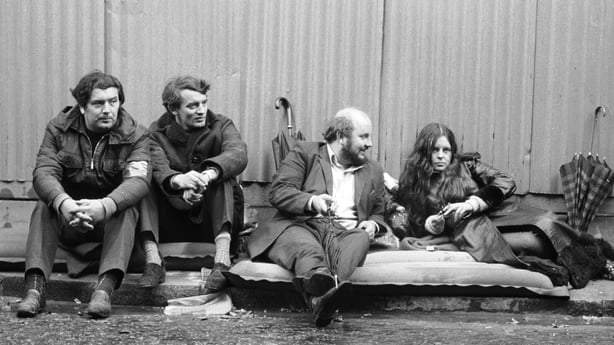
Austin Currie (2nd L) alongside John Hume, Paddy O'Hanlon and Bernadette Devlin
 at a protest outside Downing Street in 1971 

SDLP Leader Colum Eastwood has paid tribute to Mr Currie, describing him as a "titan of the civil rights movement".

He added: "His housing protest in Caledon in 1968 was one of the key sparks for the civil rights campaign that followed and he spoke for a generation of young nationalists when he refused to allow his constituents to be treated as second class citizens anymore.

"Each time we lose a political giant like Austin we lose a piece of our history. While moments like this bring us great sadness, it also gives us the opportunity to celebrate the man and the huge contribution he made to politics in both the North and South of our island.

"It's because of brave men and women like Austin who saw the way their community was being treated and refused to be silenced, that we all enjoy the freedoms and privileges we have today."

Taoiseach Micheál Martin paid tribute to Mr Currie, saying he was "one of the founding fathers of the civil rights movement in Northern Ireland".

Tánaiste and Fine Gael leader Leo Varadkar described him as "one of the outstanding politicians of his generation".

Mr Varadkar added: "I knew Austin as a brave, courageous, and principled man. He was blessed with extensive political insight and boundless humanity.

"Above all, he cared most about bringing peace to this island by peaceful means, something he worked towards throughout his political career, and was vehemently opposed to political violence.

"My thoughts are today with his family, and his extensive circle of friends and acquaintances."

Minister for Foreign Affairs Simon Coveney said he was "a man of extraordinary generosity & conviction, he campaigned for social justice, equality and peace all his life, North and South. Sincere condolences to his family".

Chair of the John and Pat Hume Foundation Dr Seán Farren said Mr Austin was a "true giant of civil rights and constitutional politics".

"He was a courageous leader who dedicated his political life to non-violent peaceful change.

"He was a pioneer in the movement for civil rights. His decision to lead a sit-in at a house in Caledon to highlight discrimination in housing allocation by Dungannon Council was a key moment in the movement's campaign to achieve fairness and civil rights for all."
US Meat producers group vows to meet Paris Agreement climate goals in 2020s
By UPI Staff

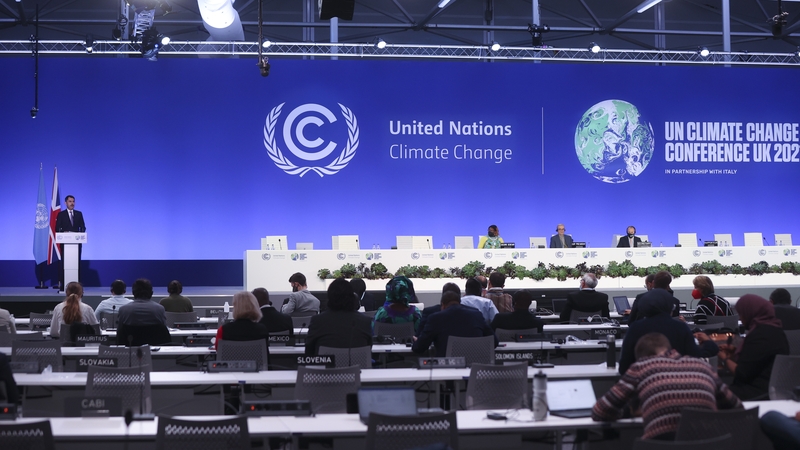
British Prime Minister Boris Johnson is pictured at COP26 on November 1 in Glasgow, Scotland.
 Photo by Kiara Worth/UPI | License Photo

Nov. 9 (UPI) -- The North American Meat Institute, a nonprofit industry trade group, announced on Tuesday that all of its members have committed to meeting emissions goals set out in the Paris climate agreement by the end of the 2020s.

The institute, which represents about 95% of U.S. meat producers, said it will help members reach the goals and they will be authenticated by independent experts.

The emissions goals are in line with the Paris Agreement's central tenet of restricting climate change to below 1.5 degrees Celsius of preindustrial levels.

The institute announced the goals with a broader sustainability framework called the Protein PACT, short for People, Animals, and Climate of Tomorrow, which is a partnership of 12 U.S. agricultural groups.

"Our comprehensive sustainability framework will drive momentum and generate technical support for meat packers and processors of all sizes to establish independently approved science-based targets to reduce greenhouse gas emissions while producing the leading source of safe, high-quality protein in Americans' diets, sustaining healthy animals and a thriving workforce along the way," NAMI President Julie Anna Potts said in a statement.

NAMI said the emissions goals will be approved by the Science Based Targets Initiative.

The institute also outlined other targets, including animal care, feeding needy American families and cutting workplace injuries in half.

"By 2025, 100% of Meat Institute members who handle animals will pass third-party audits for animal care during transportation and handling and all members will require all suppliers to implement mandatory employee training and follow species-specific standards for animal care," the institute said in a statement.

Meat plants have faced problems with COVID-19 outbreaks since the start of the pandemic.

Consumers are gravitating toward veganism as a lifestyle choice -- a trend that's expected to rise along with the global meat substitute market. Animal and environmental welfare are top contributing factors.

Though reports show that the global food system is responsible for nearly a quarter of all greenhouse gases, governments at COP26 haven't announced plans to reduce meat production yet.
New Zealand's APEC host Ardern calls for 'bold' climate action


New Zealand's APEC host Ardern calls for 'bold' climate actionThe summit was originally slated to be held in Auckland but is being held online for a second time due to Covid-19 after Malaysia hosted virtually in 2020 (AFP/Handout)More

Tue, November 9, 2021


Pacific Rim trade and foreign ministers agreed to push for a freeze on fossil fuel subsidies at a virtual summit Wednesday but host Prime Minister Jacinda Ardern of New Zealand said more "bold" action on climate change was needed.

Ministers from the 21-nation Asia-Pacific Economic Cooperation (APEC) group met online to discuss their Covid-19 response ahead of a meeting of national leaders on Saturday including US President Joe Biden and his Chinese counterpart Xi Jinping.

New Zealand Trade Minister Damien O'Connor said highlights included a plan to voluntarily freeze fossil fuel subsidies and commitments to liberalise tariffs on vaccines and other pandemic medical supplies.

Ardern hailed the move on fossil fuel subsidies, saying it had the potential to divert billions of dollars from a heavily polluting sector into green technology.

But as APEC leaders face pressure for meaningful action on climate change amid COP26 talks in Glasgow, Ardern said it did not go far enough.

"Do we need to be more ambitious than this? Absolutely," she said.

"We would of course like to see a world where there are no fossil fuel subsidies in our economies, that's long been a position of New Zealand, which we will continue to advocate."

She added: "If the world is not ready to take bold action on climate change, then the world must be ready for the disastrous results of climate change."

The issue was highlighted at the COP26 climate talks in Glasgow, where the heads of 91 major global companies called for the elimination of fossil fuel subsidies.

- Protectionism 'rejected' -

O'Connor said there was overarching agreement on the need to avoid erecting trade barriers in response to the challenges thrown up by the pandemic.

"It is free, fair and open trade that will help economies move forward out of this pandemic... we need openness to drive global growth, indeed it is trade that presents the solution to our challenges," he said.

"Some 81 million jobs have been lost across the region due to Covid-19 and the impact on supply chains has been significant, but APEC members have rejected protectionism during this crisis."

APEC's 21 member economies collectively account for almost 40 percent of the world's population and around 60 percent of the global economy.

The summit was originally due to be held in Auckland but is being held online for a second time due to Covid-19 after Malaysia hosted virtually in 2020.

It allowed Ardern to call an unprecedented early leaders' meeting in July, which carried out much of the heavy lifting on agreements surrounding international trade in vaccines and medical equipment.

When APEC leaders meet again early Saturday New Zealand time, topics will include how to reopen borders without spreading the virus, ensuring an equitable pandemic recovery and moving toward a carbon-free economy.

Debate on the virtual sidelines of the summit will be dominated by bids from China and Taiwan to join the Comprehensive and Progressive Agreement for Trans-Pacific Partnership -- a huge 11-nation free trade pact.

Beijing, which lays claim to Taiwan, would oppose any recognition of the island nation while Australia is unwilling to allow China into the grouping amid a festering trade dispute.

The United States will also be keen to use the event to reaffirm its commitment to trade in the Indo-Pacific after years of protectionist policies under former president Donald Trump.

Washington has offered to host APEC in 2023 after Thailand takes its turn next year, although the US bid is yet to be confirmed.

ns/arb/jah
UN climate agency publishes draft of final Glasgow deal
Updated / Wednesday, 10 Nov 2021 
Negotiators from nearly 200 countries will work from the draft

The United Nations climate agency has published a first draft of the political decision countries will issue at the end of the COP26 summit.

Negotiators from nearly 200 countries will work from the draft to strike a final deal before the summit ends on Friday.

The "COP cover decision" is being closely watched for what it might commit countries to do to bridge the gap between their current climate targets and the more ambitious action scientists say is needed to avert disastrous levels of warming.

Negotiators are also trying to hammer out agreement on technical parts of the global climate treaty, the Paris Agreement, including common timeframes for national commitments on emissions reductions and agreed ways for countries to report on their progress, to help turn pledges into action.

There are also negotiations on providing finance for developing countries to cope with climate change and address the issue of loss and damage to people, livelihoods, land and infrastructure caused by global warming in poorer nations.

British Prime Minister Boris Johnson has urged countries to "pull out all the stops" in the final days of COP26.

He is returning to the Glasgow summit today and will be joined by the UN Secretary General Antonio Guterres in meeting with heads of delegations and other groups.

Countries are positioning themselves for the final days of negotiations, with Nick Mabey from climate think tank E3G suggesting "a high ambition outcome is still on the table" and momentum is with those countries pushing for ambition.

A "High Ambition Coalition" of vulnerable countries and others including the US and Europe countries is calling for nations to submit action plans in line with limiting temperatures to 1.5C in the next year and long term plans to meet the target by 2023, though there is pushback from other countries.

Finance for developing countries is also key to the talks.

Minister for Foreign Affairs Simon Coveney is also due to travel to Glasgow.

He is expected to speak at an event in support of small island developing states, one of the groups of countries already dealing with the consequences of global warming.

Climate talks draft agreement expresses ‘alarm and concern’

By SETH BORENSTEIN and FRANK JORDANS

1 of 7

Extinction Rebellion climate campaigners take part in a 24-hour vigil protest outside offices of the JP Morgan bank as the COP26 U.N. Climate Summit takes place in Glasgow, Scotland, Wednesday, Nov. 10, 2021. The U.N. climate summit in Glasgow has entered its second week as leaders from around the world, are gathering in Scotland's biggest city, to lay out their vision for addressing the common challenge of global warming. (AP Photo/Alastair Grant)

GLASGOW, Scotland (AP) — Negotiators at the United Nations climate talks are considering a draft decision that highlights “alarm and concern” about global warming the planet already is experiencing and continues to call on the world to cut about half of its emissions of heat-trapping gases by 2030.

The early version of the cover decision released Wednesday at the climate talks in Glasgow, Scotland, doesn’t provide specific agreements on the three major goals that the U.N. set going into the negotiations.

The draft mentions the need to cut emissions by 45% by 2030 from 2010 levels and achieve “net-zero” by mid-century. Doing so requires countries to pump only as much greenhouse gas into the atmosphere as can be absorbed again through natural or artificial means.

It urges countries to “accelerate the phasing out of coal and subsidies for fossil fuels,” but makes no explicit reference to ending the use of oil and gas.

The draft also acknowledges “with regret” that rich nations have failed to live up to their pledge of providing $100 billion a year in financial help by 2020 to help poor nations dead with global warming.

The draft reaffirms the goals set in Paris in 2015 of limiting warming to 2 degrees Celsius (3.6 degrees Fahrenheit) since pre-industrial times, with a more stringent target of trying to keep warming to 1.5 degrees Celsius (2.7 degrees Fahrenheit) preferred.

Highlighting the challenge of meeting those goals, the document “expresses alarm and concern that human activities have caused around 1.1 C (2 F) of global warming to date and that impacts are already being felt in every region.”

Separate draft proposals were also released on other issues being debated at the talks, including rules for international carbon markets and the frequency by which countries have to report on their efforts.

The draft calls on nations that don’t have national goals that would fit with the 1.5 or 2 degree temperature rise limits to come back with stronger targets next year. Depending on the language is interpreted, the provision could apply to most countries. Analysts at the World Resources Institute counted this element of the draft as a win for vulnerable countries.

“This is crucial language,” WRI International Climate Initiative Director David Waskow said Wednesday. “Countries really are expected and are on the hook to do something in that timeframe to adjust.’’

In a nod to one of the big issues for poorer countries, the draft vaguely “urges” developed nations to compensate developing countries for “loss and damage,” a phrase that some rich nations don’t like.

Whatever comes out of the meeting in Glasgow has to be unanimously approved by nearly 200 nations attending the negotiations.

A lot of negotiating and decision-making is to come in the next three or possibly four days. The deadline for the talks is Friday, but climate talks often go past planned end dates. The cover decisions provide more than anything the parameters for the issues that need to be resolved in the last few days of the annual U.N. conference, Waskow said.

___

Follow AP’s climate coverage at https://apnews.com/hub/climate

TAX THE CHURCH
French Catholic Church to sell assets to compensate abuse victims

Updated / Monday, 8 Nov 2021 
Church officials have been under growing pressure to compensate victims

French Catholic bishops have agreed to sell part of the Church's extensive real estate holdings to compensate the thousands of victims of child sex abuse at the hands of clergy.

Church officials have been under growing pressure to indemnify victims after a landmark inquiry confirmed extensive sexual abuse of minors by priests dating from the 1950s to 2020.

An independent commission will be set up to evaluate the claims, "and we are going to provide the means to accomplish this mission... of individual indemnities for the victims", said Eric de Moulins-Beaufort, head of the Bishops' Conference of France (CEF).

His comments came at the close of days of meetings by the conference's 120 members on how to respond to the devastating inquiry into the "massive phenomenon" of child sexual assault that was often covered by a "veil of secrecy".

The inquiry had urged the Church to pay victims with its own assets, instead of asking parishioners to donate funds to compensate for crimes committed by the clergy.

The Church had already promised to set up a fund to start making payouts next year, and it will now be bolstered "by selling real estate assets owned by the Bishops' Conference of France and by dioceses", Moulins-Beaufort said after the meeting at the Catholic shrine of Lourdes.

He also said that a loan would be sought from banks if needed, and that the Vatican would be asked to send an observer to help examine the French Church's response.

'Institutional responsibility'


The 2,500-page report released last month detailed abuse of 216,000 minors by clergy over the period, a number that climbs to 330,000 when claims against lay members of the Church are included, such as teachers at Catholic schools.

The commission's president denounced the "systemic character" of efforts to shield clergy from prosecution and issued 45 recommendations of corrective measures.

In particular, the Church was urged to pay reparations even though most cases are well beyond the statutes of limitations.

On Friday, France's bishops for the first time formally recognised that the Church bore an "institutional responsibility" for the abuse, and senior members of the clergy knelt in prayer Saturday in a show of penance.

But victims' associations have said words are far from enough, and are demanding compensation that would cost the Church tens of millions of euros (dollars).

Evaluate all claims


Hugues de Woillemont, a CEF spokesman, said all claims of compensation would be examined by the new commission, including those dating back decades that are usually beyond statutes of limitation for prosecution.

It will be presided by Marie Derain de Vaucresson, a senior civil servant and legal expert specialising in child welfare.

French bishops also plan new measures to prevent sexual assault and ensure that offending priests are prosecuted, though some could require Vatican approval.

Pope Francis expressed his "shame" after learning of the abuse, which has become one of his biggest worldwide challenges since his election in 2013.

But compensation could be put in place relatively quickly, and the CEF has already promised that the first payments will be made in 2022.

Questions of doctrine still appeared to be a problem last month, when the government summoned the Archbishop of Reims, Eric de Moulins-Beaufort.

He had provoked anger by saying that priests were not obliged to report sexual abuse if they heard about it during an act of confession.

He was later forced to walk back his comments.

Protecting children from sexual abuse is an "absolute priority" for the Catholic Church, said the archbishop after meeting Interior Minister Gerald Darmanin - at the request of President Emmanuel Macron.
Mother who fought for Srebrenica massacre victims dies


Catic lost 20 male relatives in the massacre 
(AFP/Elvis BARUKCIC)

Tue, November 9, 2021,

Hajra Catic, a leading figure in the drive to find the remains of more than 8,000 Bosnian Muslims killed in the 1995 Srebrenica massacre and bring their attackers to justice, died on Tuesday.

Catic, 78, failed to find the remains of her son, who perished in Europe's worst atrocity since World War II that was deemed a genocide by two international courts.

She lost 20 male relatives including her husband and son Nino Catic, the Srebrenica correspondent for several Bosnian newspapers and other media during the 1992-1995 war, who was 26 years old when he died.

"Hajra Catic died today without being able to attend the funeral of her son Nihad Nino Catic," the Srebrenica memorial centre said in a statement.

For 26 years "she kept the memory of the courage of this war reporter from Srebrenica, encouraging others that the fight for the truth and justice cannot and should not cease," it said.

Nino Catic's last despatch was sent a day before the town was captured by Bosnian Serb forces on July 11, 1995.

The Serbs killed more than 8,000 men and boys in the following days and buried them in mass graves in the region.

- 'Something to bury' -


"If only I could find a finger of my son I would have something to bury," Catic told AFP in 2010.

Local media reported that she died after a long illness in Sarajevo.

Catic headed the Women of Srebrenica association in the northeastern town of Tuzla, where she fled after the massacre.

She organised a protest on the 11th day of every month to seek the arrest of those responsible.

Bosnian Serb wartime leader Radovan Karadzic and his army chief Ratko Mladic were later sentenced to life by a UN war crimes court, notably for the genocide in Srebrenica.

But Serb leaders in both Bosnia and Serbia as well as many ordinary Serbs usually fall short of labelling it genocide and opt for the term "great crime".

Meanwhile, in Serbian capital Belgrade police briefly detained two human rights activists who threw eggs at a mural of Mladic, N1 regional television reported.

Activists had been planning to paint over the mural in downtown Belgrade but police banned the gathering citing security concerns, aiming to prevent possible clashes with nationalists who see Mladic as a national hero.

Late Tuesday, several hundred people marched towards the mural in support of the detained activists but the police blocked access to it, N1 reported.

A small group of right-wingers remained close to the mural, chanting support for the war criminal and insults to the protesters.

rus/ljv/dl
Poland accuses Putin of orchestrating Belarus border crisis to destabilise EU


Hundreds of desperate migrants are trapped in freezing weather on the Belarusian-Polish border, where the presence of troops has raised fears of a confrontation. 
© Leonid Shcheglov, Belta/AFP

Issued on: 10/11/2021 - 
Text by: NEWS WIRES

Polish Prime Minister Mateusz Morawiecki accused Russian President Vladimir Putin of orchestrating a wave of migrants trying to illegally enter Poland from Belarus, saying the “attack” threatens to destabilise the European Union.

The accusation came as thousands of desperate migrants were trapped in freezing weather on the Belarus-Poland border, where the presence of troops from both sides has raised fears of a confrontation.

Western critics have for months said Belarus’s strongman leader Alexander Lukashenko is luring migrants from the Middle East to his country and then sending them across the border in retaliation for EU sanctions.

Morawiecki visited guards, troops and police at the border on Tuesday before turning his sights on Russia, Belarus’s main international backer.

“This attack which Lukashenko is conducting has its mastermind in Moscow, the mastermind is President Putin,” Morawiecki told the Polish parliament.

He said migrants were being used as “human shields to destabilise the situation in Poland and the EU”.

Germany, which accused Lukashenko of “unscrupulously” exploiting migrants by sending them to the Polish border, called Wednesday for new EU sanctions against Belarus.

“Lukashenko must realise that his calculations are not working,” German Foreign Minister Heiko Maas said. “The European Union cannot be blackmailed.”

EU diplomats told AFP the bloc was working to expand the existing sanctions. The EU said it was also pushing more than a dozen countries, mainly in the Middle East and Africa, to prevent their nationals from leaving for Belarus.

‘I am not a madman’

The EU accuses Lukashenko of trying to destabilise the EU by encouraging migrants to its borders—especially Poland and Lithuania—in retaliation for sanctions imposed on Belarus over his regime’s dismal human rights record.

“This is part of the inhuman and really gangster-style approach of the Lukashenko regime,” European Commission spokesman Peter Stano told journalists Tuesday.

Belarus denies the claims and accuses Poland of violating human rights by refusing to allow the migrants in.

“We are not seeking a fight,” Lukashenko told the state news agency Belta.

“I am not a madman, I understand perfectly well where it can lead,” he added.

“But we will not kneel.”

Russian Foreign Minister Sergei Lavrov blamed Western military “adventures” in the Middle East for prompting migrants to flee the region.

“Why, when it comes to refugees heading to the European Union from Turkey, did the EU provide funding to keep them on Turkish territory?” he told reporters.

“Why can’t the Belarusians be helped in the same way?”


Border crisis

The crisis came to a head on Monday when hundreds of migrants attempted to cross the border but were blocked by rows of Polish police, soldiers and border guards behind barbed wire.

Both Poland and Belarus said Tuesday that between 3,000 and 4,000 migrants were now in an improvised camp at the border, near the Polish village of Kuznica.

Journalists have been blocked from the area, but videos released by Belarusian and Polish authorities showed the migrants massed along the razor-wire, huddling by fires and in tents as temperatures hovered around freezing.

The Belarusian border guard service said the migrants in the camp were mostly Kurds, that their physical and mental condition was “extremely poor”, and they lacked water, food and the means to wash themselves.

“The situation is aggravated by the large number of pregnant women and infants among the refugees, who must spend the night on the ground in negative temperatures,” it said.


Thousands of migrants have crossed or attempted to cross from Belarus into the eastern EU member states of Latvia, Lithuania and Poland in recent months.

Lithuanian lawmakers voted Tuesday to impose a state of emergency along the Belarus border, effective from midnight.

Some migrants who made it into Poland told AFP last month that they had been trapped in the woods for a week, with Belarus refusing to allow them to return to Minsk and fly home, while Poland would not let them cross to make asylum claims.

Warsaw has drawn sharp criticism for its hardline approach to the crisis that has seen guards routinely push back migrants and refugees on the border.

(AFP)

CRIMINAL CAPITALI$M SINKS SHIPS
US Navy boosts monitoring of subs after falsified steel tests


The Virginia-class attack submarine USS New Mexico undergoing sea trials in 2009 (AFP/Handout)

Tue, November 9, 2021,

The US Navy has stepped up monitoring of its submarines after a former metallurgist for a company that supplied steel for the vessels was found to have falsified test results.

Elaine Thomas, 67, of Auburn, Washington, pleaded guilty on Monday to falsifying test results that measured the strength and toughness of steel used in navy subs, the Justice Department said.

Thomas, former director of metallurgy at Bradken Inc., a steel foundry in Washington state, admitted to carrying out the fraud for more than 30 years, assigning passing grades to steel that had failed tests.

Bradken is the leading supplier of cast high-yield steel used by prime contractors such as General Dynamics and Huntington Ingalls Industries to build submarine hulls.

The steel castings must meet "rigorous" navy specifications for strength and toughness and the Justice Department said about half of the Bradken castings had failed laboratory tests.

"(Thomas) falsified test results to hide the fact that the steel had failed the tests," the department said in a statement.

"Thomas falsified results for over 240 productions of steel, which represent a substantial percentage of the castings Bradken produced for the Navy," it said.

The fraud was discovered in May 2017 by a lab employee who found that test cards had been altered by Thomas and alerted Bradken management.

Thomas worked at the Tacoma foundry from 1977 to May 2017 and was named director of metallurgy in 2009. She pleaded guilty to falsifying tests from about 1985 until her retirement in 2017.

"Thomas's false statements and misrepresentations caused the prime contractor to install substandard components on naval submarines, and caused the Navy to accept those submarines and place them into service, thereby potentially placing naval personnel and naval operations at risk," the government complaint against Thomas said.

The US Navy had no immediate comment on Thomas's conviction but the Justice Department said the navy "has taken extensive steps to ensure the safe operation of the affected submarines."

"Those measures will result in increased costs and maintenance as the substandard parts are monitored," it said.

The Pentagon took delivery of dozens of submarines between 1985 and 2017, about 40 of which are still in service.

According to the complaint, Thomas told investigators that she had used her "engineering judgment" while changing the results of certain tests.

Thomas criticized a particular test that was conducted at -100 degrees Fahrenheit (-73 degrees Celsius) on the grounds that it was a "stupid requirement" and a "stupid number" to test because nothing operated at -100F in the water.

Thomas will be sentenced on February 14, 2022 by US District Court Judge Benjamin Settle. She faces up to 10 years in prison and a $1 million fine.

sl/cl/jh
Climate change and fires: Bolivia's forests in peril

Martín SILVA
Tue, 9 November 2021


The hyacinth macaw is listed as "vulnerable" by the International Union for Conservation of Nature, with only about 4,300 specimens left (AFP/AIZAR RALDES)

Forest fires release vast amounts of planet-warming carbon dioxide into the air -- the equivalent of 192 million metric tons for Bolivia in 2020, according to Global Forest Watch 
(AFP/AIZAR RALDES)


In Bolivia, one of the world's most biodiverse countries, climate change and fires are threatening the survival of many species 
(AFP/AIZAR RALDES)


Authorities said wildfires, mostly originating from land-clearing activities, had scorched almost 600,000 hectares of land in eastern Bolivia between January and August 2021 (AFP/AIZAR RALDES)

The road through San Matias, Bolivia, is a no man's land. Hundreds of thousands of hectares of once lush forest are now a wasteland of twisted, carbonized tree stumps.

It is a protected area, but San Matias -- which also hosts subsistence farmers, cattle ranches and quartz mines -- burns every year as land is cleared for the next planting season.

The practice is legal during May and June, after the rainy season, with each farmer allowed to burn 20 hectares -- also in the reserve located in Bolivia's eastern Santa Cruz department, near the border with Brazil.

The limit is often deliberately exceeded, and the fines negligible. And increasingly, the fires just take on a life of their own, fueled by ever drier, hotter conditions.

"It came from that bush... over there!" said Antonio Tacuchava, 76, pointing to the spot where the most recent blaze came within a kilometer (0.6 miles) of his straw house in September.

A former farmer who now keeps a few chickens and other small animals for domestic consumption, Tacuchava is one of 130 families in Comunidad Candelaria, a hamlet at the gates of the San Matias park.

Locals raise cattle and grow corn, cassava, bananas and sugar cane on small plots.

- 'Like a match' -


Like the handful of large, commercial ranches in the park, the subsistence farmers take part in the annual burning at the start of the dry season -- before it gets too hot, dry and risky.

"A spark here, near these houses, is like a match," said Tacuchava, with his neat white moustache and sun-tanned face.

Yet despite their precautions, multiple out-of-control fires raged around the settlement from July to September this year.

Authorities said wildfires, mostly originating from land-clearing activities, had scorched 2.6 million hectares of land in Santa Cruz in the first ten months of the year.

The Friends of Nature Foundation, a Bolivian NGO, estimates that forest fires destroyed more than 2.3 million hectares of forests and grassland in the country in 2020, and 6.4 million hectares in 2019.

According to the NGO Global Forest Watch, Bolivia in 2020 became the country with the third-largest loss of virgin forest after Brazil and the Democratic Republic of Congo -- passing Indonesia for the first time.

It is a vicious cycle of climate change fueling forest fires, and vice versa.

- Fauna, flora at risk -


Forest fires release vast amounts of planet-warming carbon dioxide into the air.

According to green group WWF: "To have any chance of restricting the rise in global temperatures to 1.5 degrees Celsius in line with the Paris Agreement (on curbing climate change), more needs to be done to cut carbon emissions from forest fires."

As temperatures rise in step with greenhouse gas emissions, dwindling green vegetation and water resources make fires more likely.

Already, the WWF said, fires in many parts of the world are bigger, more intense and longer-lasting than they used to be.

In 2009, Bolivia's environment ministry estimated that at loss rates then, all the country's forests would be gone by 2100.

Environmentalists blame laws enacted under former leftist president Evo Morales, who for years encouraged burning of forest and pasture land to expand agricultural production.

Santa Cruz is the Bolivian department most affected by fires.

In San Matias park, which at 30,000 square kilometers (11,600 square miles) is the size of Belgium, the dirt roads are cracked and dry and lined with thousands of half-burnt trees that creak as they are slowly consumed from inside.

"Recovering from fires can take decades," Bolivian biologist Juan Carlos Catari told AFP.

"There are places that have lost more than half their wealth of flora."

- 'No water' -


At Santo Corazon, another settlement in San Matias some 200 kilometers (124 miles) south of Comunidad Candelaria, residents say longer, more frequent droughts are making life difficult.

Dalcy Cabrera, a housewife of 36, opens a tap in her house, but nothing comes out.

"In times of drought, there is no water," she told AFP.

According to village chief Jorge Suarez, 54, "this year, we had no spring." The rains that usually mark the arrival of spring only came months later.

"It is worse for the animals that live in the forest," he said. "This worries me a lot."

According to Catari, "most large animals can escape the fires because they move quickly, but reptiles like lizards and snakes get caught in the fire and become intoxicated with smoke because they don't move fast."

In Bolivia, one of the world's most biodiverse countries, climate change and fires are threatening the survival of many species.

One of them is the hyacinth macaw, listed as "vulnerable" by the International Union for Conservation of Nature, with only about 4,300 individuals left.

There are some 300 in San Matias, trying to hatch eggs this year despite fires raging all around them.

Fire ash accumulates in bodies of water, asphyxiating fish and crustaceans that serve as food for other species including the park's many lizards, which are at risk of "a mass die-off," according to veterinarian Felix Rivas.

msr/yow/lbc/mlr/to