Sunday, March 09, 2025

Phone bans sweep US schools despite skepticism


By AFP
March 8, 2025


Students at Twain Middle School in Virginia must store their phones in magnetic pouches at the start of each day - Copyright AFP Jim WATSON

Ben Turner

At a red-brick school in Virginia, Hayden Jones is one of 1,000 students banned from using their phones as part of a trial hoping to boost learning.

But the 12-year-old’s verdict on the restrictions — a shrug of his shoulders — reflects the skepticism shared by some students and parents.

The phone ban at Twain Middle School is among a wave of measures implemented around the United States, and is part of a global movement replicated in Brazil, France and beyond.

Supporters believe restrictions will guard pupils from the apparent harms of smartphone use while at school, but opponents say the measures fail to prepare teenagers for the digital world they will inevitably enter.

Since September, Jones must now place his Android phone in a magnetic pouch each morning, which is locked until the end of the school day as part of a pilot scheme this academic year.

Jones, speaking to AFP in a corridor lined with classrooms, said he hopes the ban will be gone by the time he starts eighth grade in September.

“I like being able to go to my locker and call my parents. That’s a big concern for me,” he said, adding that some pupils have found ways to still use their devices — including by bringing a “dummy phone” to put in the pouch.

School principal Matthew Mough admitted that enforcing the ban — and winning over students — has proved challenging, though he said most follow the rules.

“The majority of kids who have phones don’t love it,” he said. “However, if you dig deeper with them in the conversation, they will acknowledge that it’s helped them remain focused.”

Mough said the phone ban has reduced classroom distractions, cyberbullying and instances of students meeting up to skip lessons.


– ‘Heads in the sand’ –


Cell phone bans come alongside research suggesting that social media use increases the likelihood of mental illnesses like anxiety and depression in young people.

Advocacy groups regularly cite these studies as justification for school phone bans, which have seen rare political consensus in a nation deeply divided on virtually every other political issue.

Around 76 percent of US public schools — from liberal California to conservative Florida — had some sort of ban on non-academic phone use, according to the latest Department of Education figures, with several state-wide measures also in place or under consideration.

They are largely backed by teachers, with the National Education Association saying 90 percent of its members support policies banning phones during lessons.

“The biggest problem is that kids aren’t in a place developmentally where they’re able to handle the type of technology that we’re talking about,” said Sabine Polak, co-founder of the Phone-Free Schools Movement, which backs full-scale phone bans.

Critics of the restrictions argue that educating children about the potential risks of social media and smartphone use is better than prohibition.

“The answer is not to just ban and put our heads in the sand,” said Keri Rodrigues, president of the National Parents Union, which represents over 1,000 parent organizations in the United States.

She compared efforts to ban phones to “abstinence education,” noting that failing to properly teach children about complicated issues such as sex has failed in the past.

“It’s not effective, and frankly, it’s dumb,” Rodrigues told AFP. “What we need to do is equip our kids with the information, with the skills and the strategies they’re going to need to navigate a digital future.”

At the school in Virginia, Jones said the phone ban has not changed how he interacts with his device, still using it for games, social media and watching YouTube videos.

His one complaint about his phone? “Nothing really, honestly, I mean besides the fact that it weighs a ton in my pocket.”
Emboldened by Trump, Hungary ups anti-Kyiv disinfo: researcher


By AFP
March 7, 2025


Hungary's Prime Minister Viktor Orban (R) regularly breaks EU unity on Ukraine - Copyright AFP Ludovic MARIN

Ede ZABORSZKY and Andras ROSTOVANYI

A country that “never existed” or a “problem called Ukraine”: Hungary’s government and affiliated media have attacked their war-torn neighbour with increased pace since Prime Minister Viktor Orban’s “dear friend” Donald Trump took power.

Orban and his allies have long used the same “hostile narratives” against the West and Ukraine as Russia, Dorka Takacsy, a research fellow at the Budapest-based Centre for Euro-Atlantic Integration and Democracy (CEID) think tank told AFP.

But the government — a close EU ally of Washington under Trump and the Kremlin — is more emboldened since the election of the US Republican.

“It seems Hungarian leadership saw Trump’s victory as an opportunity to do whatever they want with Ukraine,” Takacsy said, noting the number of anti-Kyiv messages from Orban and his allies has increased lately.

Trump last month called Volodymyr Zelensky, Ukraine’s president since 2019, a “dictator” for not holding elections, even though martial law precludes any vote because of the war.

Amid a rush of online disinformation targeting Ukraine, here are some key Hungarian statements:

– West provoked Russia into war –


Orban regularly breaks EU unity on Ukraine, to which he has refused to send arms since Russia invaded in 2022, while slamming EU sanctions on Moscow.

In his weekly radio address on Friday, he warned again EU membership of Ukraine would “ruin” the bloc.

The nationalist leader also did not join EU leaders, shaken by the prospect of US disengagement, in signing a text on Thursday in support of Ukraine.

In late February, Orban blamed the West for provoking Moscow into the conflict.

“The war is not really about Ukraine, it is about the fact that the territory called Ukraine — which has been a buffer zone, a buffer state, between NATO and Russia — should be brought under the auspices of NATO,” Orban said in his annual state of the nation address.

“Why European and American liberals thought that the Russians would stand idly by and watch this, is still a mystery,” he added.

Trump has blamed Ukraine over the war, saying “you should have never started it”.

Russian President Vladimir Putin launched a full-scale invasion of Ukraine on February 24, 2022, with Russia occupying almost 20 percent of the country’s territory.

– ‘Never existed’ –


Echoing a narrative often employed by Putin, Hungary’s parliamentary speaker Laszlo Kover this week said Ukraine was a “country that actually has never existed in history”.

“It has no real political history, no real political elite, no tradition of governance,” the ultraconservative politician and Orban ally said in a Tuesday radio interview, adding that only those remain “who are incapable of defending themselves and those who have unscrupulously exploited the weaker”.

Ukraine, a nation of more than 40 million people, has had a series of elected leaders since gaining independence from the Soviet Union in 1991.

Top Orban aide Balazs Orban — who has the same last name as the premier but is not related to him — in a Facebook post on Monday referred to the neighbouring country as a “problem called Ukraine” that now “must be dealt with by the pro-war Europeans”.

Hungary’s pro-government newspaper Magyar Nemzet published opinion pieces, calling Ukraine a “rotten mafia monster state” and referred to the killings in Bucha — where Russian forces are accused of slaying hundreds of civilians — as “false flag theatrics”.

A 2022 UN Human Rights report said Russian forces killed civilians in Bucha and other cities.

AFP reporters were among international journalists to document bodies in the streets of Bucha, including some with their hands tied.


– ‘Bought’ celebrities –


Hungary’s nationalist premier has also referenced in interviews conspiracy narratives about a “global left-wing network” having supposedly “bought” journalists and even US celebrities to boost Zelensky’s popularity.

“Hollywood stars were paid to go to Kyiv. They paid them millions of dollars,” Orban said in a recent interview with state radio.

The Hungarian government did not respond to AFP’s inquiry about the source of the allegation.

The claim may originate from a debunked video, purported to be from the US entertainment show E! News, which was shared by Elon Musk and prominent American conservatives.

It alleged without proof that the US Agency for International Development (USAID) “sponsored American celebrity visits to Ukraine… to increase Zelensky’s popularity among foreign audiences, particularly in the United States.”

Russian state media often quotes Orban’s remarks on Ukraine at length, according to Takacsy.

Orban “paints the same picture of the world that the Kremlin’s domestic propaganda would like to suggest… If they can quote the same criticisms of the West, the same accusations, from the mouth of an outsider, it gives extra credibility to the same criticisms,” the researcher said.

Did Ukraine have to become a partisan US issue?


By AFP
March 8, 2025


Ukraine's President Volodymyr Zelensky addresses the US Congress as US Vice President Kamala Harris and US House Speaker Nancy Pelosi hold a Ukrainian national flag he gave them on December 21, 2022 - Copyright AFP Yasin AKGUL

Shaun TANDON

Could support for Ukraine have survived the bitter and increasingly polarized politics of Washington?

When Ukrainian President Volodymyr Zelensky made Washington his first foreign destination after Russia invaded his country, leaders of both major US parties escorted him to address Congress, where in his military fatigues he made the case for help.

Some Republicans stayed away during the holiday-season visit in 2022 but even many critics of aid came and listened. Joe Biden, then president, affectionately put his arm around Zelensky at the White House and his administration announced nearly $2 billion in additional weapons.

Such scenes, and the bipartisan veneer around them, are long gone.

When Zelensky visited President Donald Trump on February 28, an Oval Office meeting descended into an unprecedented on-camera feud, with Trump and Vice President JD Vance accusing Ukraine of ingratitude and the administration soon afterward freezing US assistance.

Even some Republicans supportive of Ukraine said Zelensky misread the politics, as he talked back to Vance by questioning the credibility of any promises by Russia.

Senator Lindsey Graham, a Republican ally of Trump, said he met with Zelensky ahead of the White House meeting and told him, “Don’t take the bait.”

After the White House meeting, Graham went so far as to say that Zelensky should quit. But Zelensky has since worked to repair the rift, writing a letter to Trump and agreeing to talks with US officials in Saudi Arabia.

– Politicized by Trump –


“It wasn’t at all inevitable that Ukraine would become a divisive political issue,” said Jordan Tama, an American University associate professor who has researched the effects of US polarization on foreign policy.

Tama said the turning point came when Trump and media pundits who share his “America First” worldview, notably Tucker Carlson, began to criticize aid to Ukraine.

Trump “has politicized Ukraine policy, moving it from an issue where there was bipartisanship to one where there’s more polarization,” he said.

Vance once said that he does not care what happens to Ukraine, as China is the larger priority.

The president’s son Donald Trump Jr. has taunted Zelensky on social media, recently sharing a deepfake video of an effete dancer with the Ukrainian leader’s likeness.

Tama said Trump pulled away Republicans who otherwise would have supported Ukraine, even though many in the party still do.

“Trump has generated more partisan division than there would otherwise have been. But the issue is not yet entirely split along partisan lines,” Tama said.

Immediately after Russia’s invasion, nearly 80 percent of Americans backed aid to Ukraine, according to the Chicago Council on Global Affairs.

A recent CBS News/YouGov poll, however, found the public almost evenly divided on whether to send more assistance to Ukraine, with far more Democratic voters supporting aid.


– War-weary –


Leslie Shedd, until recently a top advisor to the Republican chairman of the House Foreign Affairs Committee, said there was still strong bipartisan support for Ukraine but that Zelensky had ignored advice.

“Many Republicans have used their own political capital to help Ukraine and are rightfully frustrated that President Zelensky seemed unwilling to help himself in that meeting,” said Shedd, now a fellow at the Atlantic Council.

She blamed Biden for not sending more decisive weapons earlier that could have benefited Ukraine.

It became more politically difficult to support aid when seeing a slow war of attrition, especially when voters are concerned about other issues such as inflation and illegal immigration, Shedd said.

“Republican voters in particular have had long grievances with the US government spending billions of dollars overseas while not addressing the problems they face at home,” she said.

Polls also show fewer US voters perceive a threat from Russia three years into the war.


Polling shows a mirror image of the Ukraine debate on the Middle East, with Republican voters overwhelmingly backing billions of dollars in weapons to Israel and Democrats more critical due to concerns over the rights of the Palestinians.


Foreign policy drew far more consensus in Washington during the Cold War, with both parties united in their opposition to the Soviet Union.

Tama, the political scientist, said polarization was aggravated by the consolidation of the two parties along ideological lines and by media fragmentation that has often left voters consuming slanted news or social media.

“More foreign policy issues are polarized along partisan lines than used to be the case,” he said.

“It’s hurting America’s reputation because it makes America look inconsistent and unreliable to our partners overseas.”
Attack on Iran nuclear plant would leave Gulf without water, Qatar PM warns


By AFP
March 8, 2025


The skyline of Qatar's capital Doha, which like other Gulf Arab states is in an arid desert region - Copyright AFP/File KARIM JAAFAR

Qatar’s Prime Minister Sheikh Mohammed bin Abdulrahman bin Jassim Al-Thani has warned that an attack on Iran’s Gulf coast nuclear facilities would leave countries across the region without water.

In an interview with right-wing United States media personality Tucker Carlson, who is close to US President Donald Trump, the premier said Doha had simulated the effects of an attack,

The sea would be “entirely contaminated” and Qatar would “run out of water in three days”, he said.

The construction of reservoirs since then had increased water capacity, he added, but the risk remained for “all of us” in the region.

“No water, no fish, nothing… no life,” Sheikh Mohammed added in the interview published on Friday, the same day that Trump said he had invited Iran to nuclear talks.

Alluding to military action, Trump said he would “rather see a peace deal” but that “the other will solve the problem”.

Qatar, which sits 190 kilometres (120 miles) south of Iran, relies heavily on desalination for its water supply, as do other Gulf Arab countries in the arid desert region.

Iran has a nuclear power plant at Bushehr on the Gulf coast, though its uranium enrichment facilities, key to building atomic weapons, are located hundreds of kilometres (miles) inland.

Referring to sites “on the other side of the coast”, Sheikh Mohammed said Qatar had “not only military concerns, but also security and… safety concerns”.

He said Qatar opposed military action against Iran and that it would “not give up until we see a diplomatic solution between the US and Iran”.

Tehran was “willing to engage”, he said.

“They are willing to get to a level that creates comforts for everybody. And most importantly, they are focused on mending their relationship with the region, and that’s something in itself.”

Western powers have long accused Iran of pursuing nuclear weapons, which it denies. In 2015, it signed a deal to lift sanctions in exchange for reining in its nuclear programme, but Trump withdrew from the deal in 2018 during his first term.
Hamas pushes for phase two of Gaza truce talks

ISRAEL WANTS WAR

By AFP
March 8, 2025


The initial phase of the Israel-Hamas truce brought relative calm to Gaza after more than 15 months of war devastated the territory - Copyright AFP Eyad BABA

Hamas reiterated on Sunday its insistence on moving directly into negotiating a second phase of the Gaza truce, as Israel announced it would dispatch a delegation to Doha for further talks.

Representatives of the Palestinian militant group met with mediators in Cairo at the weekend, emphasising the need for humanitarian aid to re-enter the besieged territory “without restrictions or conditions”, according to a Hamas press release.

The high-level delegation also stressed the need for “moving directly to begin negotiations for the second phase” of the deal, which will aim to lay the groundwork for a permanent ceasefire.

Hamas’s demands for the second phase include a full Israeli withdrawal from Gaza, an end to the blockade, the reconstruction of the territory and financial support, an official told AFP.

Hamas spokesperson Abdel Latif Al-Qanoua said indicators were so far “positive”.

Israeli Prime Minister Benjamin Netanyahu’s office meanwhile said it would send delegates to Doha on Monday.

Israel has maintained it wants an extension of the truce’s first phase until mid-April.

That initial period ended on March 1 after six weeks of relative calm that included the exchange of 25 living hostages and eight bodies for the release of about 1,800 Palestinian prisoners held in Israel.

The truce largely halted more than 15 months of fighting in Gaza, where virtually the entire population was displaced by Israel’s relentless military campaign in response to Hamas’s October 7, 2023 attack.

It also enabled the flow of vital food, shelter and medical assistance into Gaza.

After Israel turned the pipeline off again, UN rights experts accused the government of “weaponising starvation”.

Displaced Palestinian widow Haneen al-Dura told AFP she and her children spent a month and a half living on the street “among dogs and rats” before receiving a tent.

“As the family’s provider, it was distressing and I couldn’t sleep at all during the night,” she said.


– ‘Last warning’ –


Last week, US President Donald Trump threatened further destruction of Gaza if all remaining hostages are not released, issuing what he called a “last warning” to Hamas leaders.

He also warned of repercussions for all Gazans, telling them: “A beautiful Future awaits, but not if you hold Hostages. If you do, you are DEAD!”

Hamas said Trump’s threats would only encourage Israel to ignore the terms of their truce.

The Trump administration has also confirmed the start of unprecedented direct talks with Hamas, which Washington had previously refused contact with since designating it a terrorist organisation in 1997.

Of the 251 hostages taken by the Palestinian militants, 58 remain in Gaza, including five Americans. Four American captives have been confirmed dead, while one, Edan Alexander, is believed to be alive.

The White House said Trump met with eight of the freed captives, who “expressed gratitude” for his efforts to bring them home.

The US president previously floated a widely condemned plan to relocate Palestinians from Gaza, prompting Arab leaders to offer an alternative. Their proposal would see Gaza’s reconstruction financed through a trust fund, with the Palestinian Authority returning to govern the territory.

“We need more discussion about it, but it’s a good-faith first step,” Steve Witkoff, Trump’s Middle East envoy, told reporters in Washington in response to the plan.

Witkoff will be returning to the region this week as he travels to Saudi Arabia for talks on the war in Ukraine.

At their regular weekend rally in Tel Aviv, families of Israeli hostages demanded the government fully implement the ceasefire.

“The war could resume in a week — they have even picked a name for the operation,” Einav Zangauker, the mother of Matan Zangauker, told the candle and poster-wielding crowd.

“The war won’t bring the hostages back home, it will kill them.”

Recently released hostages have also joined those beseeching Netanyahu to implement the ceasefire.

Hamas’s attack resulted in the deaths of 1,218 people on the Israeli side, most of them civilians, according to official figures.

Israel’s retaliatory campaign has killed at least 48,446 people in Gaza, the majority of them civilians, according to the Hamas-run territory’s health ministry. The UN considers these figures reliable.
US shipbuilders, a shadow of what they were, welcome Trump’s support


By AFP
March 8, 2025


The USNS Harvey Milk leaves the General Dynamics NASSCO shipyard in San Diego, California, on November 6, 2021 - Copyright AFP/File ARIANA DREHSLER

Elodie MAZEIN

Shipbuilding has been in steady decline in the US since the end of the Cold War but some in the industry now hope for a revival of the sector, as was promised last week by President Donald Trump.

The United States was once a world leader in both commercial and naval construction, but has fallen far behind its main rival China.

Trump has now promised to reverse this, declaring in an address to Congress on Tuesday that he would “resurrect” the sector and create an Office of Shipbuilding in the White House.

“We used to make so many ships,” Trump said, promising tax breaks. “We’re going to make them very fast, very soon.”

American shipbuilders say they are ready to seize the moment, but experts warn that even a concerted effort to respond to China’s overwhelming dominance of the sector will take years — and cost many billions of dollars.

“This is a historic moment,” said Matt Paxton, president of the Shipbuilders Council of America (SCA), which represents more than 150 US shipbuilding companies.

The US Navy, when asked for comment, referred AFP to the White House.

“We are waiting to learn more,” Cynthia Cook, who heads the defense-industrial group at the Center for Strategic and International Studies (CSIS), told AFP. “It is clear that shipbuilding is an industrial weakness of the United States.”

But, she added: “You cannot immediately get more ships by throwing money at the problem.”

US ship production is down 85 percent from the 1950s, and the number of naval shipyards capable of building the largest vessels has fallen by 80 percent, according to the McKinsey consultancy.


– ‘Not what it was’ –


In the 1970s, five percent of commercial ships built in the world (in gross tonnage) came from American shipyards.

That share has since plunged to a scant one percent, a drop in the water compared to China (50 percent), South Korea (26 percent) or Japan (14 percent).

“We need some solutions to our shipbuilding gaps,” said the CSIS’s Cook, while noting that Seoul and Tokyo, at least, are US allies.

“I absolutely admit that US shipyard capacity is not what it once was,” Paxton said last month before a congressional committee.

“Our market has changed dramatically since World War II, when shifting administrative priorities, from Republican and Democratic administrations, curbed programs to support our industry,” he said.

The US naval fleet has shrunk from 471 vessels after the Cold War in 1992 to 295 today, Paxton said.

According to the Congressional Budget Office (CBO), the US Navy’s current plan to build a fleet of 390 vessels by 2054 — with the purchase of 364 new vessels because of the decommissioning of older models — would cost an average $40 billion a year.

Paxton said the Trump administration needs a comprehensive strategy for the industry — including ways to reduce administrative and regulatory obstacles — if it is to achieve its shipbuilding goals.

Republican Senator Roger Wicker painted a dire picture during a confirmation hearing last month for businessman John Phelan as navy secretary.

“Just about every major US shipbuilding program is behind schedule, over budget or irreparably off track,” said Wicker, who chairs the Armed Services Committee.


– Worker shortage –


Shipbuilders say their work is regularly complicated by last-minute changes requested by the navy, which cause delays and budget overages.

Another problem is a severe worker shortage.

The Covid-19 pandemic prompted a wave of early retirements and career-switching, while slowing training. And amid historically low US unemployment, industry wages have had trouble competing.

Still, naval shipbuilding contributes, directly or indirectly, more than $40 billion to the country’s GDP.

The industry continues to build “lots of ships,” mainly for the domestic market, said Paxton, while adding that Trump probably wants a much larger US share of the global market.

US shipyards not only produce and maintain ships for governmental bodies — from the US Navy to agencies like the National Oceanic and Atmospheric Administration (NOAA) — they also produce and maintain the roughly 40,000 commercial vessels.

But competition is fierce, with the industry in many countries — notably China — enjoying extensive subsidies and tax breaks, sources say.

A spokesman for Huntington Ingalls Industries said HII, one of the largest US shipbuilders, was “grateful” for Trump’s comments and was working with the government to help “meet a generational increase in demand.”
Trump says dairy, lumber tariffs on Canada may come soon


By AFP
March 7, 2025


Beiyi SEOW

US President Donald Trump said Friday that he could impose reciprocal tariffs on Canadian dairy and lumber within days — a move set to fuel tensions with Ottawa just days after an earlier wave of levies.

Since taking office in January, Trump has unleashed a series of tariffs and threats targeting US allies and adversaries, including duties of up to 25 percent on imports from Canada and Mexico.

On Thursday, he provided the vital trading partners temporary reprieve, exempting goods coming in from both countries under a North American trade pact.

But he has vowed broader “reciprocal tariffs” as soon as April 2, aimed at remedying practices that Washington deems unfair.

On Friday, Trump signaled that such levies could come as soon as Friday: “Canada has been ripping us off for years on tariffs for lumber and for dairy products.”

“They’ll be met with the exact same tariff unless they drop it, and that’s what reciprocal means,” the president added.

“We may do it as early as today, or we’ll wait till Monday or Tuesday,” he said of the two sectors which have long been affected by trade disputes between the neighbors.

Economists warn that blanket levies could weigh on US growth and raise inflation, adding that they also weigh on business and consumer sentiment.

But Trump kept the pressure up on Canada on Friday: “It’s not fair. Never has been fair, and they’ve treated our farmers badly.”

Rising tariffs? –

In an earlier interview with Fox Business, Trump said that tariffs affecting Canada and Mexico could rise in the future.

Asked if companies might get more clarity on his trade policies, Trump said: “I think so. But, you know, the tariffs could go up as time goes by.”

White House senior counselor Peter Navarro told CNBC in a separate interview he rejected the idea that there was uncertainty surrounding Trump’s trade policies.

“The uncertainty is created by the fact that people don’t take President Trump at his word,” he said.

Trump’s move to back off some tariffs on Canada and Mexico came after stock markets tumbled as his levies of up to 25 percent took effect this week.

On Thursday, the White House said adjustments exempting goods under the United States-Mexico-Canada Agreement (USMCA) recognize “the unique impact that these tariffs could have on American automotive manufacturers.”

A White House official told reporters that about 62 percent of Canadian imports will still face the fresh levies, though much of them are energy resources slapped with a lower 10 percent rate.

For Mexico, the proportion of imports affected is around 50 percent, the official added on condition of anonymity.


Trump’s tariff rollback brings limited respite as new levies loom


By AFP
March 8, 2025


Experts have warned it is often Americans who end up paying the cost of tariffs on imports. - © GETTY IMAGES NORTH AMERICA/AFP/File SPENCER PLATT

Beiyi SEOW

US President Donald Trump imposed vast tariffs this week on key partners Canada and Mexico, roiling cross-border ties before offering temporary relief to manufacturers — but with more levies kicking in next week, the respite may be fleeting.

US companies faced a series of duties starting Monday, with Trump doubling an additional levy on Chinese goods before allowing 25 percent tariffs on Canadian and Mexican imports to take effect Tuesday.

The moves rattled markets, sending major Wall Street indexes down, and the president on Thursday announced exemptions for Canadian and Mexican goods entering the United States under a North American trade pact.

But some 62 percent of Canadian imports are still hit by the new levies, even as much of them are energy resources covered by a lower 10 percent tariff.

For Mexican goods, this proportion is around half, the White House estimates.

“It’s surprising because it’s such a self-destructive policy,” said Philip Luck, director of the economics program at the Center for Strategic and International Studies (CSIS).

Referring to the initial imposition of 25 percent Canada and Mexico tariffs, Luck called it “economic kryptonite.”

Although Trump partially rolled back levies — taking into consideration heavily integrated North American auto supply chains — the fact that tariffs came on has lingering effects, Luck said.

“The damage was done for the week they were on, and the damage continues to be done in terms of the fact that we just have a much more uncertain trade environment,” he told AFP.

– Steel, aluminum hit –

Looking ahead, Trump’s 25 percent tariffs across steel and aluminum imports are due to take effect next Wednesday.


US President Donald Trump’s steep tariffs on Canadian and Mexican imports rattled markets – Copyright AFP/File ROBERTO SCHMIDT

Trump has said he would not modify the levies.

These tariffs will also affect Canada and Mexico, both of whom export steel to the United States, alongside other trading partners like Brazil, South Korea and European countries.

But even as Washington seeks to help domestic steel producers, experts warn that targeting the metals harms various other industries.

Steel and aluminum are inputs to construction, data centers and automobiles, said Luck of CSIS.

And it is unclear if such tariffs do more good than harm.

In 2002, the George W. Bush administration placed tariffs on imports of certain steel products to guard the domestic sector.

But Luck noted that more jobs were lost in steel-consuming industries than the total number employed by the American steel industry itself.

Scott Paul, president of the Alliance for American Manufacturing (AAM), estimates that existing steel and aluminum tariffs currently cover less than half of all such US imports.

But Trump’s moves next week are “essentially a reset” of levies to 25 percent.

– Cost concerns –

To guard against volatility from upcoming tariffs, some manufacturers will look to source more products domestically or renegotiate their import contracts, said Paul of AAM.

Businesses may also delay orders, and others are likely stocking up on inventory, he told AFP.

No matter what, there will be an “adjustment period” for firms, he said.

The speed of policy rollout now, Paul added, means a “rapid reset” of trade ties — a sharp contrast to the slow spread of deindustrialization over decades previously.

This week alone, he said, the additional 20 percent tariff targeting China raises the effective average rate on Chinese products to about 30 percent.

“When you look at what’s actually been put into place so far, from a tariff point of view, the focus has certainly been China,” he said.

“I don’t think they’re done yet,” he added, referring to the world’s second biggest economy.

Industries are on edge as they eye the possibility of more levies to come — with Trump promising “reciprocal tariffs” as soon as April 2.

On Friday, trade association the National Association of Home Builders (NAHB) expressed concern that “the continued threat of tariffs will make it harder for builders and their customers to move ahead with new construction projects.”

“With the nation facing a housing affordability crisis, we continue to believe that critical construction materials should be exempt from any future tariffs,” said NAHB chairman Buddy Hughes.

Trump tariffs: What’s been done and what is to come?


By AFP
March 7, 2025


US President Donald Trump has justified the tariffs on vital trade partners as a response to illegal immigration and the deadly drug fentanyl coming into his country - Copyright AFP/File ANGELA WEISS

It was another roller-coaster week in US President Donald Trump’s trade war as tariffs against China came into force while Mexico and Canada were given a temporary reprieve.

Here is what happened this week and what’s looming in the coming weeks:

– North American standoff –

Trump unveiled 25-percent tariffs on Canadian and Mexican goods on February 1, with a lower rate of 10 percent for Canadian oil.

But hours before they were due to take effect on February 4, Trump agreed to delay the move for a month.

Fast-forward to March 4: the tariffs come into force, hitting imports from Mexico such as avocado or tomatoes and Canadian goods such as lumber.

Three days later, Trump gave the two countries another one-month delay, this time on products covered under the United States-Mexico-Canada Agreement (USMCA) — a pact that the US leader signed into law during his first term in office in 2020.

More than 50 percent of Mexican goods and 38 percent of Canadian goods entered the United States under the USMCA last year, according to a White House official.

Trump had already given automakers a similar reprieve, which will last until April 2, following talks with Ford, General Motors and Jeep owner Stellantis.

In response to the pause, Canada delayed its own second wave of retaliatory tariffs on Can$125 billion ($87 billion) worth of US products until April 2.

Trump has justified the tariffs on the United States’ neighbours and vital trade partners, along with China, as a response to illegal immigration and the deadly drug fentanyl coming into his country.

– China –

Trump has not given China such breaks

Ten percent tariffs on goods from the country considered as the world’s factory came into effect on February 4 — and they were increased to 20 percent on March 4.

Beijing retaliated, saying it would impose 10- and 15-percent levies on a range of agricultural imports from the United States.

Those come into effect next week and will impact tens of billions of dollars in imports, from US soybeans and corn to chicken and beef.

Beijing had earlier responded to US trade measures with duties of 15 percent on coal and liquefied natural gas, and 10 percent on oil and other goods.

China has pushed back on its alleged role in the deadly fentanyl supply chain, saying Beijing has cooperated with Washington and arguing that tariffs would not solve the drug problem.

– Next target: EU –

Trump has said that products from the 27-nation European Union would be hit with a tariff of 25 percent, adding that the bloc has “taken advantage of us.”

The EU has vowed to retaliate with proportionate countermeasures.

– Steel and aluminium –

Trump signed orders in February to impose 25-percent tariffs on US steel and aluminium imports from March 12.

Canada is the leading supplier of steel to the United States, followed by Brazil.

– Chips, pharmaceuticals –

Trump has said tariffs on automobiles, semiconductors and pharmaceuticals could come as early as April 2, with a rate of around 25 percent.

For computer chips and pharmaceuticals, he said they could “go very substantially higher over (the) course of a year.”

– Reciprocal tariffs –

Trump has also signed plans for sweeping “reciprocal tariffs” that could hit both allies and adversaries by April 2.

The levies would be tailored to each US trading partner and consider the tariffs they impose on American goods, alongside taxes the White House has said are discriminatory, such as value-added taxes.

On Monday, Trump also signalled tariffs on imported agricultural products. A White House official told AFP this came under his plans for reciprocal tariffs.

– Probes on lumber and copper tariffs –

Trump ordered a probe on Saturday into potential tariffs on lumber imports.

The review, due by November, takes aim at exporters like Canada, Germany and Brazil, with White House officials earlier accusing them of “dumping” lumber into the US market.

Last month, Trump also ordered an investigation into possible levies on US copper imports, which could fuel trade tensions with Chile, the biggest US supplier, as well as Canada.

– Chips, pharmaceuticals –

Trump has said tariffs on automobiles, semiconductors and pharmaceuticals could come as early as April 2, with a rate of around 25 percent.

For computer chips and pharmaceuticals, he said they could “go very substantially higher over (the) course of a year.”


‘Grieving’: US federal workers thrown into uncertain job market


By AFP
March 8, 2025


US unemployment is low but experts warn highly-skilled federal workers returning to the labor market may have trouble finding new jobs - Copyright AFP/File Hector RETAMAL

Myriam LEMETAYER

Unprecedented cuts to the US government overseen by President Donald Trump’s billionaire advisor Elon Musk are sending thousands of federal workers and contractors back to the labor market — but experts warn that hiring is low at this time.

Official data released Friday showed federal government employment declined by 10,000 in February, the first full month of Trump’s return to the White House.

“We’re trying to shrink government and grow the private sector,” Trump told reporters in the Oval Office after the data was released.

Analysts say the full effects of his government cuts are yet to be seen, and they warn of a possible mismatch between workers’ skills and the jobs available in the marketplace.

For some, like staff in the international development sector, their whole industry has been upended.

“I’m grieving, trying to figure out what next to do for a paycheck,” said a 38-year-old contractor for the US Agency for International Development (USAID).

The Trump administration has sought to dismantle USAID, ending many humanitarian and other support projects globally.

The worker, who declined to be named, told AFP: “It’s going to be quite difficult to find alternative jobs, because basically an entire industry has been wiped out in less than a month.”

She has been on unpaid leave since mid-February and is living on her savings.

She has applied for other jobs but not heard back, and said she cannot afford to live in Washington indefinitely without a job.

– Major employer –

The US unemployment rate is fairly low, at 4.1 percent, but how easily workers find new jobs will depend on whether their skills translate to the private sector.

The federal government is the country’s largest employer, with around 2.4 million employees, excluding active-duty military and US Postal Service personnel.

While the thousands of layoffs within the federal workforce may not seem large on paper, numbers could balloon once government contractors are included, said Dean Baker, a senior economist at the Center for Economic and Policy Research.

Economists expect the government layoffs to show up in employment data over the coming months.

“We’ll see it unfolding over time,” said economist Aaron Sojourner at the W.E. Upjohn Institute for Employment Research.

In the US capital Washington and its neighboring states Maryland and Virginia, nearly six percent of employees work for the federal government, according to the Pew Research Center.

Sojourner points out that 80 percent of civil servants are based outside this area, however.

In states like Wyoming, New Mexico or Oklahoma, they represent more than two percent of total employment.

– Low hiring rate –

“It could be quite hard to find alternative employment if there’s a big flood of people onto the market at once,” Sojourner warned.

The hiring rate is currently low, noted economist Nancy Vanden Houten at Oxford Economics.

While some sectors have higher hiring rates, these include less skilled occupations in areas like leisure and hospitality, as well as retail trade.

This could prove to be a mismatch for federal workers who “are generally more educated and skilled than the private sector workforce,” she said.

Baker noted that highly educated researchers, especially younger ones, may seek employment in other countries.

“It’s a fantastic opportunity for them to pick up talent,” he said.

Saturday, March 08, 2025

Wildland-urban fires trigger biological changes in firefighters


By  Dr. Tim Sandle
March 7, 2025
DIGITAL JOURNAL


Firefighters help control the spread of the Auto Fire in Oxnard, northwest of Los Angeles, California - Copyright AFP ETIENNE LAURENT

Firefighters who fight fires in wildland urban interface zones, where undeveloped and developed land meet, appear to experience genetic changes that may help explain their elevated risk for certain cancers as well as for other diseases.

This health issue is according to a study led by the University of Michigan.

In a collaboration with the Los Angeles and Orange County fire departments, local and federal agencies and public health and medicine researchers from UCLA, the University of Miami and the University of Arizona, scientists used blood samples available through the Fire Fighter Cancer Cohort Study to compare changes in microRNAs and DNA methylation.

The comparison was between firefighters who were exposed to wildland-urban interface, or WUI, fires and those who were not. Firefighters’ exposures to WUI fires are distinct as compared to structure or wildland fires.

Firefighters responding to wildland urban interface fires face special occupational hazards. These occur through exposure to a complex mix of chemicals from burning vegetation, structures, vehicles and other human-made materials.

Fire fighters do so often without respiratory protection and for extended periods. This news comes as Los Angeles is recovering from devastating fires in January and as climate change appears to be increasing fire risk worldwide.

“The molecular changes we’re seeing may help to explain why firefighters face higher rates of certain cancers and other health conditions later in their careers. Understanding these biological pathways gives us potential targets for developing protective strategies that could reduce health risks for firefighters,” Jackie Goodrich, the study’s lead author and research associate professor of environmental health sciences at the U-M School of Public Health, explains in a research note.Wildfires have inflicted unprecedented destruction on Los Angeles, America’s second largest city – Copyright AFP JOSH EDELSON
A key study finding showed that 50 microRNAs had changed in the 10-month follow-up in firefighters who responded to at least one WUI fire. More specifically, one microRNA with known tumour suppression activity decreased in firefighters who had responded to a WUI fire in the prior 10 months versus those who had not.

The affected microRNAs play a role in regulating immune function, inflammation, neurological disorders and cancer, among other conditions and diseases. No significant changes in DNA methylation were found.

“This study builds upon previous evidence from our studies in firefighters that show epigenetic changes accumulating from years of exposure. These new results suggest that even exposure to one-time big events like WUI fires can trigger changes in microRNA expression linked to various disease pathways,” Goodrich adds, noting “Our next steps are to determine whether these changes persist long-term and to develop interventions that could protect firefighter health.”

The study appears in the journal Environmental and Molecular Mutagenesis, and it is titled “Epigenetic Modifications Associated With Wildland–Urban Interface (WUI) Firefighting”.

 Man with Palestinian flag scales London’s Big Ben clock tower


By AFP
March 8, 2025


Supporters below chanted 'Free Palestine' and 'You are a hero' - Copyright AFP STRINGER

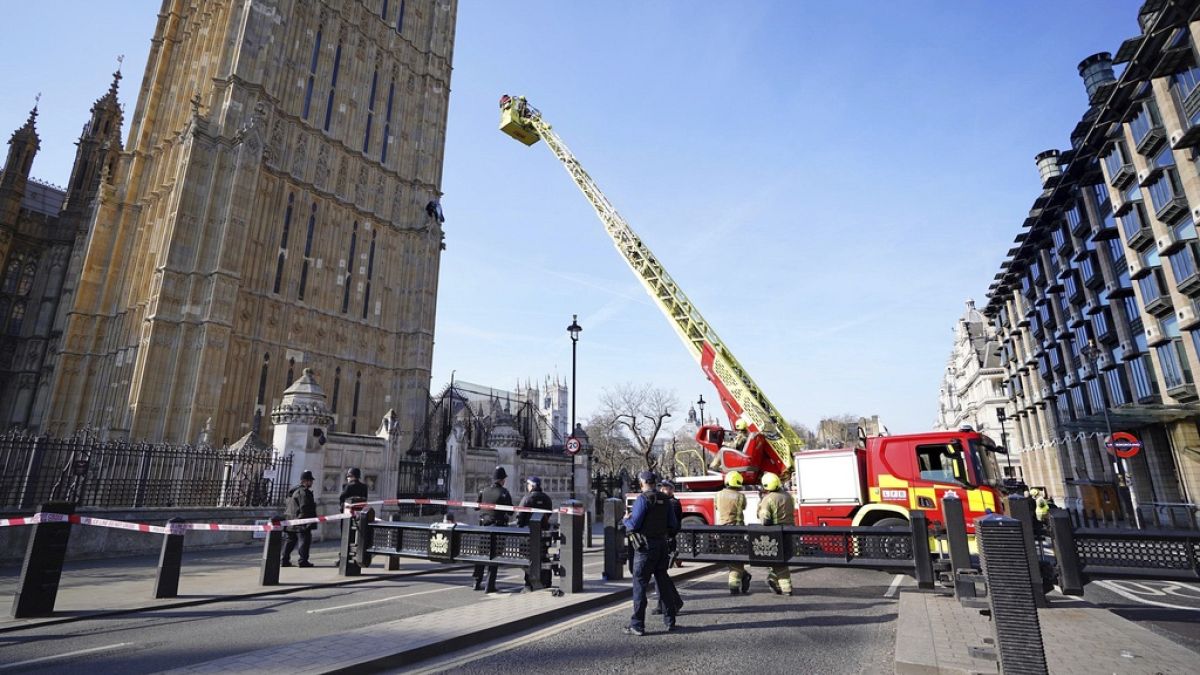
A man with a Palestinian flag who climbed London’s Big Ben clock tower early on Saturday was still perched on the famous landmark after nightfall, even as emergency crews urged him to come down.

Police said they were first alerted shortly after 0700 GMT and the man has spent the day barefoot on a ledge several metres up the historic structure.

Crowds have been watching from behind a police cordon, with supporters chanting “Free Palestine” and “You are a hero.”

Negotiators boarded a fire truck lift and used a megaphone to speak with the man, but footage on social media showed him saying: “I will come down on my own terms.”

Police closed off the surrounding area including Westminster Bridge and the Houses of Parliament cancelled tours.

AFP journalists at the scene earlier said the man appeared to be bleeding from his foot.

“Officers are at the scene working to bring the incident to a safe conclusion,” London Metropolitan Police force told AFP.

“They are being assisted by the London Fire Brigade and the London Ambulance Service.”

Pro-Palestinian protester climbs onto the UK parliament's tower

Emergency services at the Palace of Westminster in London after man with a Palestine flag climbed up Elizabeth Tower, which houses Big Ben,Saturday, March 8, 2025.
Copyright James Manning/AP
By Daniel Bellamy
Published on 

Emergency services were outside Palace of Westminster in London on Saturday after a man holding a Palestinian flag climbed onto Big Ben tower, police said.

A nearby street was closed and several emergency services vehicles were at the scene as crowds looked on from behind a police cordon up to the protester.

Photos showed the barefoot man standing on a ledge several meters up Elizabeth Tower, which houses Big Ben.

The Metropolitan Police said officers were at the scene “working to bring the incident to a safe conclusion," alongside firefighters and ambulance services.

Three emergency workers were seen lifted up on a fire brigade ladder platform to try to speak to the man on the ledge.

Sleeping man is struck by train in Peru but survives


By AFP
March 8, 2025


Train tracks in Peru: A drunken man fell asleep recently on tracks in another part of the country and was hit by a train, but survived - Copyright AFP Cris BOURONCLE

An apparently drunken man somehow survived after being struck Saturday by a cargo train while sleeping along train tracks in Peru, local authorities said.

“The train knocked him over but through some miracle did not kill him,” General Javier Avalos, a security official for the town of Ate in Lima province, told AFP.

“He apparently was in a state of intoxication, fell asleep along the train tracks and did not feel the train coming,” Avalos said.

The train was on a regular run toward the Peruvian Andes when it struck 28-year-old Juan Carlos Tello, he said, adding that it stopped quickly.

Surveillance footage released by the city shows the locomotive dragging the young man for several yards (meters).

He suffered only minor injuries to his left arm, Avalos said.

Accidents have been common on this train line. In August 2024, a young man wearing headphones was struck and killed by a cargo train while trying to cross the tracks.