Saturday, May 16, 2026

Electricity Industry Faces Risks from Three New Technologies

  • Utilities face growing long-term disruption risks from emerging technologies like advanced batteries, perovskite solar cells, and nuclear fusion that could reduce dependence on centralized power grids.

  • Cheap storage and next-generation solar could enable more homes and businesses to self-generate electricity, threatening utility revenues and potentially triggering a “utility death spiral.”

  • Analysts warn the industry is underestimating technological disruption, with utilities spending very little on R&D.

Electric company annual reports describe technological risk in the vaguest of terms, asserting that firms face numerous, generalized risks— boiler plate to provide legal cover just in case something happens, such as an ET invasion. What specific risks do the companies face? You’ll never know from reading their reports. Anyway, it often takes years for something to happen in the utility industry, so why bother worrying now? Brokerage reports, generally optimistic, focus on a utility’s rate base growth (mostly their assets), AI demand, ongoing regulatory complacency all within a 3-5 year horizon. Technological disruption of business that may be 5-10 years out seems beyond the decision time horizon of big investors. They can always sell out ahead of time, right? “What, me worry?” sums up the picture, aided by lofty market valuations.

This relaxed attitude of utilities toward technology risk and their present business makes little sense for three reasons. First, tech innovation can sneak up faster than expected, so the investor (the capital provider) might not have enough time to exit in an orderly fashion, and the company might not have enough time to prepare to deal with the financial disruption. Second, a likely or probable event even five years in the future affects the value of utility capital investments made today that have expected 20-30 year lives. Third, the utility industry overall pays so little attention to science and technology (it spends a pathetic 0.1% of revenues on R&D) that it may be the last to know when new technologies are about to emerge and disrupt their business. We could go into other reasons why the industry and its investors will tardily perceive or act on risks, including herd mentality, cultural issues, indexing, paradigm shifts, and regulation, but why bother? Simply put, we think that emerging technological developments, all staring us in the face right now, could start to disrupt the electricity industry’s structure and market in the coming 5-10 years. This should affect the industry’s financing picture even sooner. Investors will react to possible adverse business developments sooner than entrenched utility managers and quickly reflect those new worries about the industry’s declining prospects into stock prices and interest rates.

Before going on, though, let’s accept two academic definitions of risk: either the possibility of loss or the possibility that actual returns will not rise to expected levels.  If your investment cannot earn its expected return, it probably will decline in value, whether you sell it or not, so the second definition really says the same thing as the first, but less directly.

Now, let us examine a trio of obvious risks. There are more, of course.

Risk one: Batteries

Batteries have already changed the electricity industry, reducing the need for transmission and redundant generating capacity and enabling the industry to treat renewable resources in the same way as ordinary generation. We expect more change and not just from lower costs. The battery industry suffers from massive overcapacity while in the midst of a huge product improvement program. Surely it will seek more markets, with residential and small commercial customers as likely targets. They consume over half the electricity output and pay the highest prices of any customer class. Imagine combining inexpensive solar (see RISK TWO) with inexpensive, compact, safe storage. Many customers, especially in rural areas, might finally cut the cord that ties them (expensively) to the electrical grid. If enough customers begin to exit and self generate, the grid will become more and more a provider of last resort for those who cannot install or afford to own their own on-site equipment, in other words, small and low income consumers. This prospect should really alarm public policy makers. A grid with a shrinking customer base of this sort is likely to require meaningful government support (or face financial distress). We’d bet on commercial development of low cost, small residential and commercial batteries within five years.

Risk Two: Perovskites

Photovoltaic cells made with perovskite mineral compounds are more efficient than silicon cells but they are not as durable and have not achieved flexibility targets. Manufacturers and researchers have launched an impressive effort to solve those problems in order to produce high efficiency, durable, and flexible perovskite cells within a few years. These improvements will do more than increase the efficiency of the cells. Buyers of the new flexible cells could install them anywhere, wrap them around buildings, put them in window blinds or even on clothes, making the perovskite cells ubiquitous. Think about it. The new cells will produce 30-50% more electricity per cell than the old ones, and wrapping an entire building might increase installation surface by 50-100%. That would permit twice the power production on the site. Combined with a low cost battery, the perovskite cell will make off-the-grid electricity even more attractive. Is this science fiction? No, read the technical papers. Commercialization seems likely within five years.

Risk Three: Nuclear Fusion

Privately financed firms have announced plans to build fusion reactors within 5-10 years — plants roughly the size of planned small modular reactors (SMRs) which will, supposedly, enter commercial operation within the same time period. SMRs are like present day fission reactors, just smaller, with a modular build out, and even more expensive than current gigawatt scale nuclear designs. And, if you don’t like existing nukes for environmental, national security, ideological or safety reasons, you probably won’t like SMRs, either. However, fusion reactors won’t require uranium, emit carbon dioxide, produce long-lived radioactive wastes, enable nuclear proliferation and can’t melt down — a list which might convince even hard core anti-nuclear activists to give them a pass. Fusion is nuclear power without the baggage. (And it's not based on a recycled submarine propulsion technology either.)  It does not present a threat to central station electricity, per se, but rather to SMR development (fusion and SMRs are competitors) and ultimately to fossil-fueled power plants which fusion could replace. Opponents of renewables insist that the country and the utility industry need base load power plants. Fusion could provide base load power without either carbon dioxide emissions or the nuclear fission liabilities. Of course, fusion is all talk, right now but as we previously pointed out, a lot of new capital is entering the field. If it should work, and produce competitively priced electricity, though, the age of electrification will really come.  Renewables and fusion reactors would power the economy. But that seems unlikely for at least a decade. Best advice: rest easy but be wary.

Why Worry?

Admittedly, we did not discuss all technological risks, such as plug-in solar (already big in Europe), which will dampen utility sales, or solar power satellites (a goal for billionaire space entrepreneurs), which could upend the generation market. You can never tell what will come along. Nor did we consider the risks to the natural gas industry, which are substantial, given that electric generators consume 40% of gas sold, and that is the only gas market that has shown any dynamism. Technological innovation in the electricity sector (mostly batteries right now) will reduce natural gas sales to the power sector and sales of gas for heating and cooking, too. The natural gas industry will have to export a lot of gas to make up for those losses. Then there is the impact of tech change on the consumption patterns of high-tech electricity users. Try this one. Quantum computers or space-based computer centers render earth-bound AI obsolete.  For that matter, what might happen if the next administration in Washington takes environmental issues seriously, thereby forcing tech change on the industry? And finally, we admit it, we did not discuss technological changes that might offset the risks posed in this essay, or technological changes that might boost industry prospects. That is because risk was the topic. Anyway, everyone touts the benefits, so they probably are in the stock prices.

Finally, why worry? The short answer is that the utility industry we know is fragile in ways we don’t often talk about. Capital-intensive industries are often like that. So, how about this back- of- the -envelope calculation that takes into account that much of the industry’s costs are fixed, that is, won’t decline proportionately with the loss of sales. We concluded that a 5% loss of residential and commercial sales (if consumers deserted the grid) could reduce electric company pretax net income by 15-20%. Plus, the now distressed utility would also have to account for losses on assets rendered redundant after a meaningful decline in sales. (These are not assets that could be transferred to an AI customer.)  Finally, consider that once a consumer trend begins, and people see that their neighbors are on board, the trend can snowball. In other words, 5% may be the beginning. We have repeated here a form of the utility “death spiral" argument to show how these new and emerging technologies represent a real and persistent threat to future utility revenues and business prospects.

This discussion may sound like science fiction to you, an inventory of non-existent risks based on academic musings and commercial hyperbole, but we already live in a world resembling that of science fiction: rockets to the moon, autonomous vehicles, thinking machines, people with mechanical parts. So, what is so outlandish about people making their own electricity from the sun, storing it in boxes, or producing power in machines fueled by products extracted from water and left over from a nuclear reaction. And what are the risks of those technologies to a nineteenth-century industry model? We may find out sooner than you expect.

By Leonard Hyman and William Tilles for Oilprice.com

Middle East War Threatens Renewable Energy Rollout

  • Renewable energy projects across the Middle East face delays of three to 12 months.

  • Solar imports into Gulf markets have collapsed as maritime disruption and cost pressures intensify.

  • Higher oil and LNG prices strengthen the long-term case for Gulf states to deploy renewables domestically.

War in the Middle East has reshaped near-term energy market expectations, with direct implications for hydrocarbon supply affecting power sectors across liquified natural gas (LNG) imports, oil imports, and spot gas-dependent economies, mainly in Europe and Asia. While Middle Eastern countries retain access to abundant domestic fossil fuels, the effective closure of the Strait of Hormuz and the crisis extends disruption beyond hydrocarbons. The combination of conflict proximity, supply chain vulnerability, capital diversion, and institutional resilience is critical for renewables deployment. Rystad Energy analyzes how the conflict is affecting renewable energy deployment across key Middle Eastern markets.

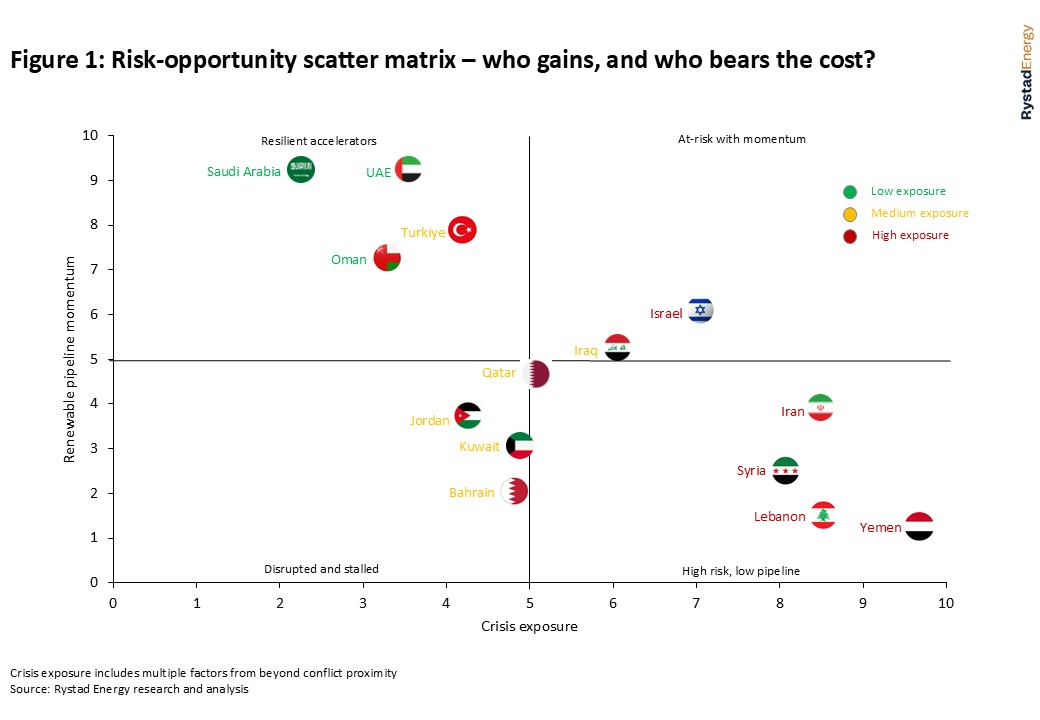
The crisis is expected to result in a net delay of between three and 12 months across the active renewable energy pipeline in the Middle East, while simultaneously strengthening the medium to long-term strategic commitment to the energy transition. The overall effect is a short-term delay followed by a sharper medium-term acceleration in Saudi Arabia, the UAE, Oman, and Turkiye, while Qatar, Kuwait, Iraq, Bahrain, and Jordan are expected to face moderate delays with recovery contingent on market stabilization. Additionally, Iran, Israel, Syria, Lebanon, and Yemen remain high risk and are likely to face prolonged delays in renewables deployment (Figure 1).

Renewable Energy

Supply chain disruption

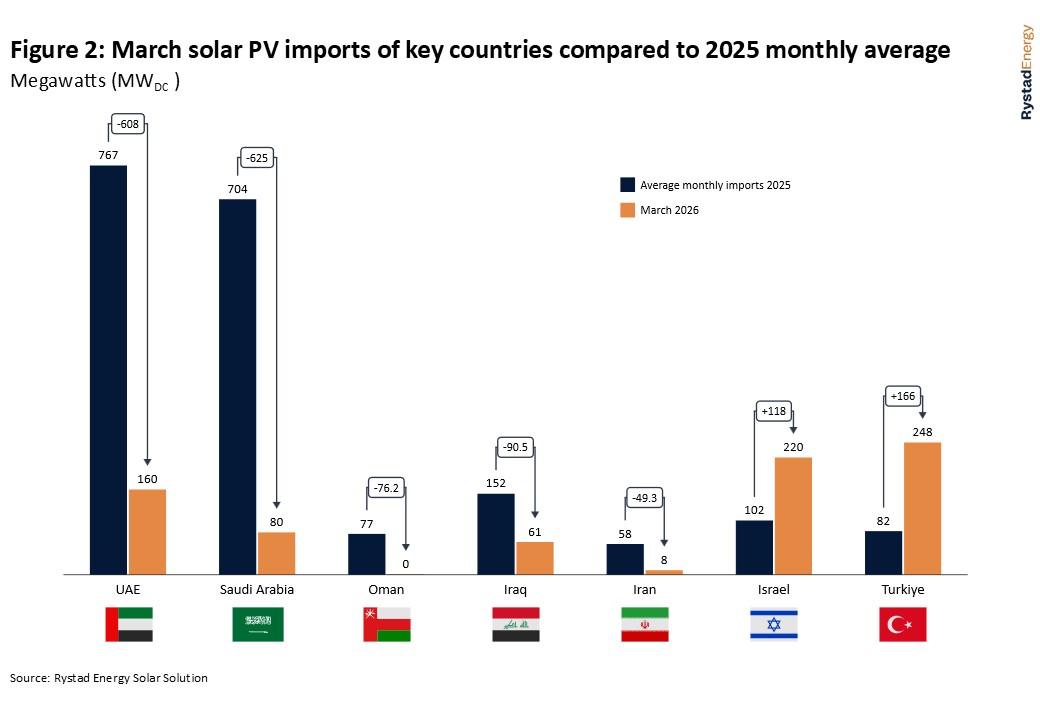
There is a clear disruption across key maritime routes that is already pushing back project timelines. While other regions have registered high module imports due to China's elimination of the VAT export rebate on 1 April, the Middle East region lagged behind. The March 2026 solar PV imports collapsed against 2025 monthly averages across every Persian Gulf market- the UAE fell 608 MW from 767 MW to just 160 MW, Saudi Arabia dropped 625 MW from 704 MW to 80 MW, and Oman fell to zero from 77 MW. The contrast with Türkiye importing 248 MW (+166 MW above its 2025 average) and Israel at 220 MW (+118 MW), reflecting their independence from Hormuz and Red Sea routing (Figure 2).

The impact is more severe because multiple cost pressures have materialized simultaneously. The freight rates for the Asia-Mediterranean route are up from $2,826/FEU in late February to $3,594/FEU by early April. Additionally, China's elimination of the VAT export rebate on 1 April added a direct 9% cost impact on module pricing, while silver prices in the USD 70–80/oz range are pushing up cell costs, prompting OEM suppliers, EPC contractors and developers to revisit signed contracts, repricing risk, and consider redirecting capital toward more stable, lower-risk markets within the Middle East.

The region's highly competitive auction market, which results in world-record bids in the range of USD 10.5 - USD 20/MWh, gives a thin margin to the developers. To achieve this, the CAPEX intensity for these projects is already at a lower end. Multiple cost pressures and with war risk premium now being embedded into project finance, EPC contractors are repricing force majeure and logistics exposure into new bids. Countries like Kuwait, progressing to awarding their first large-scale solar projects totaling 1.6 GW, are particularly vulnerable to this repricing. For projects that have already reached financial close across the Middle East, the result is margin compression.

Solar pv

Middle East solar module manufacturing capacity is expected to grow from 4.7 GW in 2025 to 35.8 GW by 2030 — a sevenfold expansion in five years. Türkiye, already plateaued at 22.2 GW of domestic manufacturing capacity from 2026 onward, is effectively import-independent for solar modules and fully insulated from any future Hormuz disruption.

The financial incentive for renewables deployment for oil and gas-exporting Gulf states such as the UAE, Saudi Arabia, Qatar, Kuwait, and Iraq has strengthened under this crisis. At more than $90 per barrel of Brent crude oil and between $15 and $20 per million British thermal units of LNG, every megawatt of solar or wind deployed domestically frees up hydrocarbons for export at elevated prices. The opportunity cost of burning liquids/gas in a domestic power station has never been higher. However, the effective closure of the Strait of Hormuz remains a significant constraint for countries reliant on the route for exports. Gulf renewables programs are facing logistical and financial delays, not strategic ones, and striking the right balance between restoring hydrocarbon exports and renewables deployment will result in an optimal outcome.

By Rystad Energy

India-Pakistan Wars And Crisis: Realism In Washington’s Policy – Analysis

May 16, 2026 
 Observer Research Foundation
By Kartik Bommakanti


The possibility of the United States (US) limiting India’s response to a Pakistani-sponsored terrorist attack on Indian soil or a conventional attack against Indian forces is now a source of consternation within the Indian strategic community. American officials have reportedly conveyed to India that it won’t automatically extend support to India in the face of Pakistani aggression. Washington will pursue its national interests as it deems fit, and thus, will not feel obliged to support India because of shared democratic values or morality. Recently, a former American envoy to India, Kenneth Juster, stated that improved US-Pakistan ties may compel New Delhi to exercise caution in retaliating against Pakistan-backed terrorism. Pakistan believes that its current rapprochement with Washington and its current role in the US-Iran negotiations will insulate it from Indian retaliation in the event of a conflict.

The possibility of the US withholding unconditional support for India in the face of Pakistani terrorism or aggression is not new. Since 1947, India’s response to Pakistani aggression conventionally and unconventional, has been conditioned by how much external and internal pressure the Indian governments have felt to retaliate against Pakistani aggression. Historically, Washington never extended automatic support to New Delhi following a Pakistani attack, regardless of whether the administration was Democrat or Republican.

In the 1965 war between India and Pakistan, the US suspended military supplies to both countries, even though Rawalpindi precipitated that conflict. India was not deterred from retaliating against Pakistani aggression, irrespective of American military supplies to Pakistan preceding the war. Pakistan procured military hardware to align itself with Washington against the Communist Soviet Union and, through its membership in various treaties such as the Middle East Defence Organisation (MEDO), the Central Treaty Organisation (CENTO), and the Southeast Asia Treaty Organisation (SEATO). Washington, under the Johnson administration, took a neutral position in this war and did not construe Pakistan’s treaty membership as a license to attack India. If anything, Washington’s neutrality helped India, because Pakistan was more dependent on American military hardware.

During the 1971 India-Pakistan war, the US “tilted” in favour of Pakistan, a favour for Rawalpindi’s role in enabling the rapprochement between the US and China. The US even dispatched the USS Enterprise as part of the United States Navy’s (USN) Seventh Fleet to signal deterrence against any Indian attempt to expand military operations into West Pakistan. India’s military action on its western border was primarily defensive. As Henry Kissinger told Chinese Premier Zhou Enlai in October 1971: “It is our judgment that the Indians see in this situation no longer a legal problem of East Pakistan but an opportunity to settle the whole problem of Pakistan [including West] which they have never accepted.” Yet American intervention on behalf of Pakistan in this case was irrelevant to the outcome of the conflict.


In the 1970s, Pakistan embarked on an “orographic offensive,” coupled with “cartographic confusion,” claiming that the entirety of the Saltoro Ridge, which includes the Siachen Glacier, was part of Pakistan-occupied Kashmir (PoK). Pakistan dispatched mountaineering expeditions across the glacier, and American maps from the Central Intelligence Agency (CIA) and the Pentagon showed the Saltoro Ridge to be a part of Pakistan. Washington, in this instance, tacitly accepted Rawalpindi’s cartographic warfare. In any case, Washington’s support was also a quid pro quo for Pakistan’s involvement in training and arming the Mujahideen, who were fighting against the Soviet Union’s invasion and occupation of Afghanistan beginning in 1979. Concerned by these developments, the Indian Army (IA) launched “Operation Meghdoot” under orders from the Indira Gandhi government. India was able to secure the most tactically advantageous positions on the Saltoro Ridge, which it continues to hold today.

Similarly, following the outbreak of the 1999 Kargil war, the Clinton administration did not extend automatic support to India. While Washington recognised Pakistan’s responsibility for initiating the conflict, it was concerned about India’s decision to escalate vertically to reverse Pakistan’s territorial seizure, as it was about the origins of the conflict. Washington’s position evolved as the conflict progressed, with the Americans reluctantly aligning with India because the latter threatened to escalate the conflict.


The 2001-2002 crisis led to a massive military mobilisation by India against Pakistan following the Lashkar-e-Taiba (LeT)—a Pakistani terror outfit’s attack on the Indian Parliament in December 2001. The aim was to coerce and compel Pakistan to shut down its terror training camps, which Rawalpindi promised to do. This crisis, however, eventually led India to back down from attacking Pakistan due to American pressure. Further, India chose to exercise restraint despite opportunities to strike across the Line of Control (LoC) and the International Border (IB) with Pakistan in early 2002; however, delays in kinetic action, shifting demands, and poor civil-military alignment on New Delhi’s part compounded its problems as the crisis progressed. Washington, which was by now in the middle of the Global War on Terror (GWOT) as a result of the 9/11 terror attacks, would not countenance an Indian attack on Pakistan.

Pakistan was roped in as a frontline non-NATO ally to fight the Taliban and Al Qaeda, and India’s military mobilisation was threatening American objectives in Afghanistan. Consequently, Pakistani military resources that were needed against Al Qaeda terrorists fleeing from Afghanistan were diverted to defend against India. Once the US saw its interests directly jeopardised, New Delhi had no choice but to demobilise. If anything, the US brought compelling pressure to bear against New Delhi, including a travel advisory warning Americans not to travel to the subcontinent. This was only the second occasion, after the 1971 war, that Indian and American interests were opposed to each other. Otherwise, for the US, South Asia has been a tertiary or secondary theatre to its larger geopolitical goals.

In the aftermath of the 26/11 attacks, Washington again pressured India not to retaliate against Pakistan. The Indian government obliged under American duress not to respond militarily, although, internally, too, there was resistance against a military response, which was likely the primary reason for Indian restraint.

It is after the 2019 Pulwama attack that India retaliated with airstrikes against the JeM terror camp in Balakot in the Khyber Pakhtunkhwa province of Pakistan. On this occasion, India, for the first time since the 1971 war, struck targets inside Pakistan. Yet Washington was not outrightly opposed to an Indian response. Indeed, President Trump even went to the extent of saying in the run-up to the Indian Air Force (IAF)’ Balakot strikes that India was considering action that was “….very strong…So I can understand that also.”


Six years later, the Pahalgam terror attack in April 2025 compelled India to launch air strikes inside Pakistan. These strikes were the most extensive since the 1971 war, as Pakistani terrorist training camps in Muridke and Bahawalpur were struck by the IAF. U.S. Vice President J.D. Vance said about the fighting between India and Pakistan in May 2025, it was “none of our business”, and the only thing the US was pursuing was back-channel diplomacy to defuse hostilities. Yet, it was Pakistan, after suffering heavy losses, that sought a ceasefire on May 10, 2025, which India accepted. Pakistan, however, declared that President Trump deserved all the credit, which he readily accepted and continues to claim.

Implications for India

It is evident that US policy following the outbreak of an India-Pakistan conflict has varied considerably over the last 80 years: neutrality between the belligerents; outright opposition to India; tacit accommodation of, and gradual alignment with, Pakistan; reluctant alignment with India; sympathy and empathy for India; and, finally, helplessness in defusing hostilities. In each instance, Washington’s mixed positions on India-Pakistan conflicts have reflected its interests. Despite playing the role of a conduit between Iran and the US today, Pakistan must not construe this as a quid pro quo that permits it to overplay its hand against India. This is why New Delhi has to remind both Rawalpindi and Washington that it will not hesitate to retaliate to any provocations.

About the author: Kartik Bommakanti is a Senior Fellow with the Strategic Studies Programme at the Observer Research Foundation.

Source: This article was published by the Observer Research Foundation.
Iran Is Smuggling Millions Of Liters Of Fuel To Pakistan Every Day – Analysis
File photo of work on Iran-Pakistan pipeline. Photo Credit: Tasnim News Agency

May 16, 2026 
RFE RL
By Daud Khattak

Iran is smuggling at least 6 million liters of fuel each day to neighboring Pakistan, traders and transporters in the South Asian country told RFE/RL, in violation of US sanctions on the Islamic republic.

Fuel trafficking is a lifeline for cash-strapped Iran, which is under a US naval blockade that has disrupted its lucrative oil exports. Weeks of US-Israeli bombing has also left the Middle Eastern country’s key infrastructure and industries in tatters.

Iran has smuggled gasoline and diesel to Pakistan since around 2013, when the United States significantly tightened economic sanctions against Tehran. But there are signs that the volume of fuel that Iran is trafficking has increased since the war began on February 28.

In response to the US-Israeli bombing campaign, Iran closed the Strait of Hormuz, a key artery for global oil supplies, triggering a surge in world fuel prices and upending the global economy.


Pakistan, a US ally, could come under pressure to clamp down on the smuggling of Iranian oil, experts say. Islamabad has acted as a mediator in negotiations between Washington and Tehran to end the war.
Smuggling Routes

Iranian fuel is transported to the nearly a dozen crossings along the porous 900-kilometer-long border with Pakistan. The gasoline and diesel are then loaded on to hundreds of pickup trucks and even motorcycles in cannisters before they are transported across Pakistan’s vast and impoverished province of Balochistan and beyond.

Akbar Notezai, a journalist in Balochistan, said each cannister can carry around 60 liters of fuel. A pickup truck can transport up to 30 cannisters, or 1,800 liters, he said. Motorcycles can each carry several fuel cannisters.

Iranian fuel is also smuggled by sea in boats to Pakistan’s Gwadar port, according to experts. It is unclear how the US naval blockade of Iran has affected the maritime trafficking.

In May 2024, a leaked report written by two Pakistani intelligence agencies suggested that Iran smuggled over $1 billion worth of petrol and diesel into Pakistan annually.

The report said up to 6 million liters of smuggled Iranian fuel was entering Pakistan daily, accounting for around 14 percent of the country’s annual consumption.

About 2,000 vehicles and 1,300 boats were involved in the daily smuggling of fuel, the report said, adding that Iran was paid through hawala, an informal system of lenders. Using individual brokers rather than banks, the system is difficult to trace and has been used by armed groups.

Pakistan’s military spokesman, Ahmed Sharif Chaudhry, told a news conference in August 2024 that “consistent efforts” were being made to enhance security along the country’s border with Iran to restrict oil smuggling.

“If you look at the numbers, [the fuel smuggling] has come down from 15-16 million liters per day to 5-6 million liters per day,” Chaudhry said.


A Pakistani oil trader, who spoke to RFE/RL on condition of anonymity, said currently around 300 vehicles are loaded with fuel at each of the crossings along the Iran-Pakistan border every day. That is down from around 600 vehicles before a clamp down by Pakistani authorities in 2024, he said.

Shahzada Zulfiqar, an analyst based in Quetta, the provincial capital of Balochistan Province, said there are indications that the smuggling is again increasing.

Previously, he said the smuggling network was active for five days a week. “After the Iran-US war, the dealers continue the business seven days a week.”
Turning A Blind Eye

Traders, transporters, experts in Pakistan say local and provincial officials turn a blind eye to the trafficking of fuel.

The smuggling provides Pakistan with cheap fuel. The South Asian country of some 240-million people has witnessed fuel shortages since the start of the war in the Middle East. Prices have soared from around 250 rupees ($0.90) to over 400 rupees since early March.

The smuggling is also a key source of income for the Baluch, an ethnic group that straddles the Iran-Pakistan border. Pakistan’s volatile Balochistan Province has been the scene of a low-level insurgency for years.

Syed Ali Shah, a journalist in Quetta, told RFE/RL that the government has been unable to generate sufficient employment opportunities in Balochistan, the country’s most underdeveloped province.

“As a result, the authorities have tolerated oil smuggling as a means of sustaining livelihoods in the border regions,” he said.

Iran, too, benefits from fuel smuggling. Tehran has for years used trafficking and shadow fleets to circumvent crippling US sanctions and export its oil, the lifeline of its economy.

The smuggling networks are overseen by Iran’s Islamic Revolutionary Guards Corps, a key political and economic player in the country, according to experts.

Experts say Islamabad could come under US pressure to crack down on fuel smuggling from Iran.

Washington has intensified the economic pressure on Iran by imposing a naval blockade since April 13, as part of an attempt to force Tehran to agree to a peace deal on its terms.

“There could be objections [from the United States],” said Mehtab Haider Syed, an Islamabad-based analyst. “But the counterargument is that this is a long porous border where security has been a serious matter.”

Daud Khattak is a senior international correspondent covering the Near East in RFE/RL’s Central Newsroom. He was previously the managing editor of RFE/RL’s Radio Mashaal.
GCC States: From De-Risking To Longer-Term Security – OpEd

Member countries of the Gulf Cooperation Council (GCC). Credit: VOA

May 16, 2026 
Arab News
By Dr. Abdel Aziz Aluwaisheg


Iran’s 7,000-plus attacks against Gulf Cooperation Council countries and the closure of the Strait of Hormuz have transformed how the GCC looks at Iran in fundamental ways. Perceptions of threats emanating from Iran have critically sharpened and the need to counter them has never been more urgent.

The first reaction is de-risking by improving air defenses. Although their interception rates exceeded 90 percent, there is room for improvement. There is a need to restore normality in the Strait of Hormuz by getting the UN Security Council to shoulder its responsibility, assert the international nature of the waterway and insist that no country is allowed to interfere with international shipping through it. The draft UN Security Council resolution that is currently under discussion was proposed by the GCC and it tracks the maritime rules stipulated by the UN Convention on the Law of the Sea on international waterways such as the Strait of Hormuz.

Next, a system should be put in place to manage the strait as long as necessary. It could be run by the UN’s International Maritime Organization and supported by a UN peacekeeping force, similar to forces deployed by the organization in other hot spots around the world. There are currently 11 active UN peacekeeping missions deployed by the UNSC in Africa, Asia, Europe and the Middle East in spots less critical than the Strait of Hormuz. They are supported by about 60,000 military, police and civilian personnel from more than 117 countries.

These arrangements can remain in place as long as they are needed, overseen by the UNSC. They could serve several important functions by asserting the rule of international law, including the UN Convention on the Law of the Sea. They can also serve as a model for other waterways under threat, such as the Bab Al-Mandab Strait, which has seen ship traffic cut by half.


Russia and China vetoed the draft resolution when it was first voted on last month. Their objections were inexplicable because China is among the countries most affected by the closure, as it gets a third of its oil from the Gulf and its significant trade with the Gulf has been seriously disrupted. Even if Iran were to allow Chinese ships to pass, the US maritime blockade would not allow that.

There are hopeful signs regarding China’s position on the draft resolution. On Thursday, US Secretary of State Marco Rubio said following the China-US summit in Beijing: “The Chinese side said they are not in favor of militarizing the Strait of Hormuz and they’re not in favor of a tolling system, and that’s our position.”

Russia is also contradicting its own declared desire to be part of any Gulf security arrangements. By putting the arrangements under Chapter VII of the UN Charter, Russia gets a front seat as a permanent UNSC member.

Bahrain, the GCC’s rotating presidency, has resubmitted the draft with the confidence that it will pass this time around. Seventy-five days of closure have severely affected nearly every country in the world. Rejecting this balanced draft would ignore the serious damage the closure has done to the lives and livelihoods of billions of people.


Once the UNSC resolution is adopted, the UN could step in to implement it. In addition, the UK and France have put together a coalition of some 50 countries with the aim of securing the strait and helping restore freedom of navigation.

Until that happens, the GCC states are using alternative routes to export their products and are planning on building additional pipelines and routes to bypass the strait. Escorts are also useful. The US launched an initiative, although it is currently on hold. There are multiple forces in the region that can take part in these escorts. The Combined Maritime Forces, a coalition of 47 nations, is based in Bahrain and spread across 3.2 million sq. miles of international waters, including key shipping lanes in the Red Sea, Gulf of Aden and Indian Ocean. The EU and others also have forces in the region. Clearly, adopting the UNSC resolution currently under discussion would make their work much easier.

Longer term, the GCC states are immunizing themselves against future attacks along four parallel tracks.

First, they are beefing up their militaries, especially their missile and drone defenses and maritime security forces.

Second, they are giving unprecedented priority to integration and connectivity, both between member states and with the rest of the world, to ensure the safety and security of supply chains. Additional pipelines for oil, water and other products are planned and railroads and air links are being given a higher priority.

Third, they are strengthening their alliances and partnerships in light of the war. They are also coordinating with like-minded regional states, such as Pakistan, Turkiye and Egypt, all of which have an abiding interest in restoring regional security.

Fourth, they are preparing legal cases against Iran to demand reparations for the unprovoked attacks against their territories.

Trust between the GCC states and Iran has clearly been broken by the latter’s attacks and its closure of the Strait of Hormuz. Restoring that confidence is going to be difficult without some concrete action from Iran, including it demonstrating contrition and committing not to attack them again. Iran’s acquiescence with the international regime securing the strait could serve as the first building block toward restoring that lost trust.

Dr. Abdel Aziz Aluwaisheg is the GCC assistant secretary-general for political affairs and negotiation. The views expressed here are personal and do not necessarily represent those of the GCC.

Chinese Tankers Resume Hormuz Transit Under Iran Coordination

  • During Donald Trump’s visit to China, Washington and Beijing agreed that no country should impose tolls or restrictions on shipping through the Strait of Hormuz.

  • Iranian state media said around 30 Chinese vessels have been granted safe passage through Hormuz in coordination with Iran’s IRGC naval forces.

  • China is pushing to restore Persian Gulf energy flows as it remains heavily dependent on Middle Eastern oil imports

During President Trump's ongoing state visit to China, he and President Xi Jinping agreed that the ‌Strait of ‌Hormuz must be open for ‌the free flow of energy. They along with their senior officials have expressed agreement that no country can be allowed to exact shipping tolls in the Strait of Hormuz.

Following this, Thursday saw Iranian state media proclaim that some 30 Chinese vessels are being allowed safe passage by IranBloomberg also reports, "The vessels were allowed to pass the Strait of Hormuz with the coordination of the Iranian authorities and Islamic Revolutionary Guard Corps’ navy, state TV reports, citing an IRGC naval official." While it's as yet unknown or unclear whether the US Navy side of the de facto blockade will also let them pass, Reuters has also reported the following:

Iran ‌has begun allowing some Chinese vessels to transit through the Strait of Hormuz following an understanding over Iranian management protocols for the waterway, the semi-official Fars news agency said on Thursday, citing an informed source.

via Reuters

In particular the move also follows formal requests by China's foreign minister as well as Beijing's ambassador to Iran, with Tehran reportedly agreeing based on safeguarding the two allies' strategic partnership.

Bloomberg cited the IRGC official as saying of the Iranian protocol for passage, "A new era in the Strait of Hormuz has started as many countries of the world and fleets have accepted that the best, quickest and simplest way for transiting this very important waterway is only though coordination with the IRGC’s naval forces."

This was after Wednesday saw the key milestone of a Chinese supertanker carrying 2 million barrels of Iraqi crude having successfully passed through the Strait of Hormuz, after previously being stranded for more than two months.

Also of note is that the Chinese Cosco Shipping tanker did not have to pay tolls. According to The Wall Street Journal:

Lloyd’s List Intelligence data show the Yuan Hua Hu crossed the waterway through the corridor in the north controlled by the Islamic Revolutionary Guard Corps.

Ship trackers said the vessel switched off its transponder while sailing from an anchorage in Dubai towards Larak, then came back online for a couple of hours before going dark again. Ships crossing through Larak pay an average of $2 million each, according to brokers.

The Yuan Hua Hu is the third Chinese state-owned tanker to leave the Gulf since the start of the war.

State Department spokesperson Tommy Pigott emphasized earlier this week that Washington and Beijing "agreed that no country or organization can be allowed to charge tolls to pass through international waterways like the Strait of Hormuz."

China imports the bulk of its energy from the Middle East, and while it has amassed substantial crude oil stockpiles that are helping it weather the worst of the crisis - anecdotally over 1.4 billion barrels - restoring normal flows from the Persian Gulf is important for one of the world’s top energy importers.

By Zerohedge.com

Baltics Back Hormuz Mission, But Not At Expense Of Russia Deterrence


May 16, 2026 
EurActiv
By Charles Cohen, Alice Tidey, and Pietro Guastamacchia

(EurActiv) — Eastern EU member states are signalling a willingness to contribute to a possible European mission to secure the Strait of Hormuz, while stressing that any deployment must not come at the expense of NATO’s eastern flank.

Robertas Kaunas, Lithuania’s defence minister, told reporters on Wednesday in response to a Euractiv question that Vilnius backed a “360-degree” approach to European security, including participation in a Hormuz mission, but warned allies against losing focus on Moscow.

“This mission is very important for Greece, Italy, other countries, and for Lithuania too,” he said. “But we also must show the rest of Europe that right now the biggest threat comes from the east, from Russia and Belarus.”

Neighbouring Latvia is also prepared to assign capabilities for a Strait of Hormuz mission, Euractivunderstands. It is already contributing staff and funds to Operation Aspides, an EU naval mission created in 2024 to protect shipping in the Red Sea from attacks by Yemen’s Houthi rebels.


The debate comes as Western countries, including European states, scramble to find a solution to reopen navigation in the Strait of Hormuz, a key waterway through which a fifth of the world’s oil and gas passes.

France and the UK have been leading a so-called coalition of the willing, bringing together more than 40 countries that have been working on military plans to secure navigation once hostilities in the Middle East cease.

Kaja Kallas, the EU’s foreign policy chief, is now pushing to expand the mandate of Operation Aspides, arguing it could be the bloc’s contribution to the coalition of the willing.

Speaking on Tuesday following a meeting of EU defence ministers in Brussels, Kallas said Aspides could be extended to Hormuz without changing its mandate, requiring only an updated operational plan. She added that several additional member states had already indicated a readiness to contribute additional ships.
Limited naval assets

Greece currently hosts the operational headquarters for Aspides, while France, Italy and Germany were among the first countries to contribute naval assets. Belgium, the Netherlands and Sweden have also provided personnel or support to the operation.


Two EU diplomatic sources told Euractiv that three more EU countries signalled during Tuesday’s meeting that they were prepared to provide assets for Aspides. Capitals had previously discussed reinforcing the mission after a ceasefire, but none had publicly committed additional vessels until now.

Still, officials acknowledge the limits of European naval power and that any expansion of Aspides could result in Baltic Sea patrols and NATO deterrence missions competing for the same ships or capabilities.

One diplomat told Euractiv that naval assets are “in high demand everywhere, including in the Baltic Sea and the Arabian Sea. We can’t take our eyes off the Russian navy either.”

“In terms of burden sharing on Ukraine and on defence, the Nordic and Baltic countries do much more than some bigger European states, which is a problem. Burden sharing is always raised at Foreign Affairs Council, because more is needed,” the source added.

In a joint statement on Wednesday, the Bucharest Nine and Nordic countries highlighted ongoing efforts in northern Europe, praising “Baltic Sentry”, “Eastern Sentry” and “Arctic Sentry” initiatives aimed at strengthening NATO’s regional posture.

Andrius Kubilius, the EU Defence Commissioner, said the conflict involving Iran posed “real threats” to southern and Mediterranean member states, even as Russia’s war against Ukraine continued to dominate the threat perception in Eastern Europe – exposing the EU’s increasingly divergent regional security priorities.

Eastern flank countries, he said on Wednesday, “defend the whole EU against Russian threats”.

“That is why they deserve the solidarity of the whole European Union and they deserve solidarity investment into their defence capabilities and into mitigation of the negative consequences of the ‘frontier status’ to their economic and social development,” he added.


India’s Oil Crisis Deepens as Hormuz Remains Shut

  • The rupee hit a new all-time low this week and foreign investors have pulled more than $20 billion from Indian equities in the first four months of 2026, already surpassing last year’s full-year record outflows.

  • India’s GDP growth is forecast to slow to 6.7% in fiscal 2026/2027 from 7.7% last year, with analysts warning fuel price hikes are likely in Q2 if the Middle East conflict drags on.

India’s economic pains are intensifying every day that the Strait of Hormuz remains closed.

Two and a half months after the Middle East conflict began, one of the highest-performing emerging markets in recent years and the world’s third-largest crude oil importer is scrambling to contain the oil shock that is spreading to consumer prices, foreign exchange reserves, and economic growth.

Since the war began and cut off over 40% of India’s crude oil flows, those that passed through the Strait of Hormuz, one of the highest-flying economies in Asia has seen its oil import bill soar, investors fleeing the capital market, and the local currency plunging to an all-time low against the U.S. dollar.

Analysts have started to raise inflation estimates and reduce forecasts of this year’s economic growth in India, which is beginning to feel the oil supply shock well beyond the actual disruption of deliveries of oil, LNG, and liquefied petroleum gas (LPG), the primary cooking fuel in the world’s most populous country.

Fuel Crunch

While India still has enough supply and reserves of all these fuels for dozens of days, authorities are urging conservation to reduce consumption and the resulting strain on public finances and foreign exchange reserves and rates.

India’s Prime Minister Narendra Modi this weekend urged Indians to curb gasoline and diesel consumption, use public transportation where possible, and car pool as much as possible.

“Measures such these will help the nation conserve energy, save on the energy import bill and overcome the challenges arising out of the serious military conflict involving many energy producing nations,” Oil Minister Hardeep Singh Puri said.

Some LPG tankers have passed through the Strait of Hormuz since the war began, including one that exited the chokepoint for the first time since the U.S. blockade was placed mid-April.

Meanwhile, India is paying higher prices for LPG imports from elsewhere, as well as higher prices for crude oil that doesn’t need to pass through the Strait of Hormuz, pressuring the current account and foreign reserves.

The government, while urging fuel conservation, is avoiding any panic rhetoric. Puri, the oil minister, earlier this week said that India doesn’t have a supply issue and it has 69 days’ worth of crude oil stocks and 45 days of LPG supply.

To address the collapse of LPG supply from the Middle East, India has asked state refiners to maximize the output of the cooking fuel, and redirected LPG supply from industrial users to household consumers.

To shield consumers from high gasoline and diesel prices, India has kept prices at the pump much lower and has cut taxes on gasoline and diesel.


Economic Pain

But this policy is hitting local oil marketing companies (OMCs).

“Our energy sector is absorbing the brunt of the impact,” Puri said.

“OMCs are buying crude, gas and LPG at higher cost, but in order to protect consumers, they are selling final products at lower cost leading to massive mounting losses of up to ?1,000 crore per day. However, the OMCs have ensured uninterrupted energy imports and supply,” he added.

This policy may not be sustainable for much longer, and eventually retail fuel prices would have risen if the supply shock from the Middle East persists, analysts say.

“I am assuming that sometime in Q2, rather sooner than later, they will have to hike retail fuel prices because neither the fiscal buffers nor (the) buffers with the OMCs (oil marketing companies) are enough to withstand a prolonged shock,” Dhiraj Nim, an economist at ANZ bank, told Reuters last week.

The energy sector is not the only one suffering from the war-induced oil shock. India’s currency, the rupee, hit a new all-time low against the dollar on Wednesday amid high oil prices and importer demand for hedging.

PM Modi’s call on Indians this weekend also included urging citizens to reduce foreign travel and gold purchases to help conserve foreign currency reserves, which India is splashing for increasingly costly imports because of the higher oil prices.

Due to the higher oil prices, India’s annual inflation accelerated in April from March, although it was below projections. But analysts warn further acceleration is in the cards in the coming months if the Middle East crisis drags on.

If the Strait of Hormuz remains closed for more months, India’s central bank may have to intervene with monetary policy and India may have to eventually raise gasoline and diesel prices, Reserve Bank of India (RBI) Governor Sanjay Malhotra said this week.

Moreover, a massive withdrawal of foreign investors from the local capital markets is also weighing on forex reserves. Foreign investors pulled more than $20 billion out of Indian equities in the first four months of 2026, government data showed this week. These outflows have already topped last year’s record annual withdrawals, as investors have become averse to India and other emerging markets amid the Iran war.

The oil shock that the war has created will weigh on India’s economic growth in the current fiscal year to March 2027. BMI, part of Fitch, expects India’s GDP growth to slow to 6.7% in the 2026/2027 fiscal year, down from 7.7% in 2025/2026, largely due to the oil price shock.

By Tsvetana Paraskova for Oilprice.com