Sunday, May 17, 2026

Cannes: Iranian director Farhadi condemns both US-Israeli attacks, crackdown on protesters

Iranian director Asghar Farhadi on Friday condemned both the civilian deaths caused by Israeli and US air strikes in Iran and the “massacring” of protesters by the Islamic Republic. The Oscar-winning director was premiering his latest film "Parallel Tales" at the Cannes Film Festival.


Issued on: 15/05/2026 
By: FRANCE 24

Director Asghar Farhadi attends a press conference for the film "Histoires parallèles" (Parallel Tales) at the 79th Cannes Film Festival on May 15, 2026. 
© Sarah Meyssonnier, Reuters

Oscar-winning Iranian director Asghar Farhadi condemned Friday both the killing of civilians in US and Israeli attacks on his country and the "massacring" of protesters by the Islamic republic.

Farhadi, who travelled from Tehran last week, trod a fine line when asked for his thoughts about events in his war-hit homeland at the Cannes Film Festival, where his latest film, the French-language "Parallel Tales", received its premiere.

Cannes 2026 Palme d’Or picks include Iran’s Farhadi, Spain’s Almodovar

Speaking of two "tragic events" this year, Farhadi referred to "the death of many innocent people, children, civilians who were killed during the war, during the attack that Iran has suffered".

"And before this war, there was the death of many demonstrators, people who had taken to the streets to protest, who were just as innocent, and who were massacred," he added.

"Every murder is a crime. From no point of view, or with any justification, can I accept life being taken away from someone, whether it's a war, an execution, or massacring protesters."

Iran has been at war with Israel and the United States since February 28, with a shaky ceasefire in place since April 8.

Since the start of the conflict, Tehran has ramped up executions, particularly in cases involving alleged espionage or security-related charges.

Iran was rocked by huge anti-government protests that peaked in January.

The government acknowledged more than 3,000 deaths during the protests, but blamed the violence on "terrorist acts" orchestrated by the US and Israel.

Human rights groups and researchers outside Iran estimate that anywhere from 7,000 to 35,000 people were killed in indiscriminate shooting by security forces.


Inside Iran's crackdown: Legacy of a bloodbath
THE DEBATE © FRANCE 24
43:15


Filmmakers in Iran face strict censorship rules and constant pressure from authorities, with several prominent directors from Jafar Panahi – who won Cannes' top prize last year – and Mohammad Rasoulof either jailed or forced into exile.

Farhadi has won two Oscars for best foreign language movie, for "A Separation" (2011) and "The Salesman" (2016).

"Parallel Tales", a story about voyeurism and art in Paris with an all-star French cast, garnered disappointing reviews after its Cannes showing on Thursday.

Film magazine Screen called it "convoluted and superficial" while Variety called it "weirdly muddled".

(FRANCE 24 with AFP)

Why is African cinema out of the picture at the Cannes Film Festival?

Does the absence of African films in the main competition at this year’s Cannes Film Festival point to a glass ceiling? Or is African cinema still slowly but surely finding its way to the top table?


Ben’imana by Rwandan director Marie-Clémentine Dusabejambo will be screened in the Un Certain Regard section. © Festival de Cannes

By: Alison Hird with RFI
Issued on: 16/05/2026 - 

The absence of African-made films among the 22 contenders for this year's Palme d’Or might suggest African filmmakers are still struggling to break into the world’s most prestigious film festival.

Not least because there is no shortage of film production across the continent.

Nigeria alone produces around 2,500 films a year via what's known as "Nollywood", while South Africa has become a major base for international shoots and both Morocco and Tunisia have built strong state-backed industries. Senegal, Rwanda and Kenya are investing in new talent.

Yet when the Palme d’Or line-up was announced, Africa was missing.

“Many media outlets noted with disappointment that, given all the current political tensions, the Cannes Film Festival has focused overwhelmingly on European and Western productions rather than truly opening up to cinema from the Global South," said Claire Diao, a French-Burkinabè film programmer and distributor.

African films are, however, present in other competition categories at the festival.

Diao points to Rwanda’s Ben’Imana by Marie-Clémentine Dusabejambo, the Central African film Congo Boy by Rafiki Fariala and Moroccan director Leïla Marrakchi’s Strawberries, all of which are screening in the Un Certain Regard section.

Nigerian cinema will also be represented at the Directors’ Fortnight by the Esiri brothers’ Clarissa.

This year’s Cannes jury includes the Ivorian actor Isaach de Bankolé and the Irish-Ethiopian actor Ruth Negga. The opening ceremony was hosted by the Franco-Malian actor Eye Haïdara.

"African cinema is here too. Not just because of what’s on the screen," said producer Joaquim Landau.

Jury president Park Chan-wook, fourth from left, appears with, from left, Elijah Wood, Gong Li, Jane Fonda, Demi Moore, Eye Haidara, Isaach de Bankolé, Ruth Negga, Chloé Zhao, Laura Wandel, Stellan Skarsgard and musicians Theodora and Oklou at this year's opening ceremony. Scott Garfitt/Invision/AP - Scott A Garfitt


Western validation

The African cinema industry's lack of globally recognisable figures can hamper the visibility of a film, according to Diao.

“Very often, selection committees first look at who is behind the film,” she explained. “Is it a sales agent we know? Is it a distributor we know? Is it a producer we know? When the filmmaker is unknown, the cast is unknown, the country is unknown, they don’t start with the same chances as a film with a Pierre Niney or an Isabelle Huppert.”

In practice, African films often need Western validation before Cannes takes notice and the films that do make it through often arrive with European backing already in place.

Diao points to My Father’s Shadow by the Nigerian-British director Akinola Davies Jr. – selected at Cannes last year after recognition at Sundance and support from the British Film Institute.

Landau is not convinced Cannes is actively excluding African productions, noting that of the roughly 2,500 films submitted this year, only around 20 made the main competition.

“There are no Canadian films, no South American films, no Oceanian films this year,” he says. "And yet, do Canadians find themselves thinking, ‘Wow, our film industry isn’t good enough to make it to Cannes’?”

He also questions what the label "African cinema" means, given most successful filmmakers now work through international co-productions.

"What exactly is an African film? Is it a film directed by an African filmmaker of mixed heritage? Is the subject matter African? Is the funding African?“

African films at Cannes tell unexpected stories of power, migration and identity
Nollywood paradox

Nollywood – the world’s second-largest film industry by volume after Bollywood – produces films on an industrial scale and employs millions. In 2023, the industry generated around $8m in ticket sales in Nigeria alone, and the cinema sector is the country’s second-largest employer after agriculture.

But while Nigeria is one of the few African countries with a genuinely self-sustaining film economy, its output has not so far made its mark internationally.

Many Nollywood productions are made primarily for domestic television and streaming audiences, not European arthouse festivals.

“The priority of producers remains the local market,” said Serge Noukoué, co-founder of the Nollywood Week Film Festival in Paris, “because the local market is important.”

"For a long time, Nollywood has suffered from certain stigmas, such as the notion that it is a low-quality industry," he added. "In reality, Nigeria is brimming with talent and actually boasts a much broader cinematic spectrum than one might imagine. The quality is there and it keeps increasing.”

A younger generation of Nigerian directors is emerging – such as CJ Obasi whose Mami Wata premiered at Sundance in 2023, won an Independent Spirit Award nomination and represented Nigeria at the 96th Academy Awards.

Lagos has also become a regular stop for international festival scouts.

And yet the route to Cannes is usually paved with European money and networks. Eighteen of the 22 films competing for the Palme d'Or had some form of French participation.

“There's also a form of protectionism,” Noukoué says, pointing to subsidy systems and quotas that favour films tied to European co-productions.
Writer Wale Davies, Misan Harriman and director Akinola Davies Jr. at a screening of 'My Father's Shadow', which was selected at Cannes last year. Millie Turner/Invision/AP - Millie Turner


Cracks in the glass ceiling

Morocco, Tunisia and South Africa have state-backed film centres and long-term support for productions. Landau says their industries are now among the continent’s most visible internationally and their films often do well abroad.

New state-backed initiatives are also emerging in Senegal, Benin and Kenya, he notes.

Elsewhere, filmmakers have to work with limited public funding and rely on piecemeal international partnerships.

“We are often dealing with survival cinema,” Diao says, with African directors frequently doubling as producers and distributors simply to get films made.

This impacts both who gets financed and what kind of stories are seen as exportable.

Landau says European distributors have spent years searching for films that confirm Western expectations of Africa – poverty, violence and war, what the industry sometimes calls “poverty porn”.

But a new generation, he says, "wants to tell stories about people who love each other, people who laugh, people who have a good time. Sometimes that translates into very commercial films, and ones that do well. So I get the sense that, little by little, the glass ceiling is still there, but it keeps getting cracked in all sorts of places".

That process is being helped by festivals such as Fespaco in Burkina Faso, Carthage in Tunisia and Durban in South Africa, which continue to grow as centres of African cinema in their own right.

Franco-Senegalese documentary 'Dahomey' wins Berlin's Golden Bear

Diao, who is both a distributor and programmer, no longer likes the phrase “African cinema”, preferring instead to speak of “cinemas from Africa, in the plural”.

“There's creativity, and what's needed is greater curiosity, particularly from the programmers at these major festivals that launch filmmakers' careers – including dedicated roles to actively seek out films from Africa, as is the case in Venice, Berlin, Toronto. But that is not the case at the Cannes Film Festival."

This article is based on interviews from RFI's Debat du Jour in French.


American actor Jane Fonda and Chinese star Gong Li open 2026 Cannes Film Festival

The 2026 Cannes Film Festival began on Tuesday with actors Jane Fonda and Gong Li presenting the opening ceremony, and New Zealand's Peter Jackson, who directed the Lord of the Rings trilogy, receiving an honorary Palme d'Or award for his career.


Issued on:  13/05/2026 
By: FRANCE 24

Gong Li and Jane Fonda on stage at the opening ceremony for the 79th Cannes Film Festival in Cannes, France on May 12, 2026. © Manon Cruz, Reuters
01:41

American cinema veteran Jane Fonda and Chinese star Gong Li opened the 79th Cannes Film Festival on Tuesday in front of a celebrity-studded audience on the French Riviera.

Fonda hailed cinema's role as "an act of resistance" at the end of a ceremony that also saw "The Lord of the Rings" director Peter Jackson receive an honorary Palme d'Or award for his career.

"I believe in the power of voices, voices on the screen, voices off the screen, and definitely voices on the street, especially now," said Fonda, a vocal critic of US President Donald Trump and long-standing campaigner, to loud applause.

"I believe that cinema has always been an act of resistance because we tell the stories... stories that bring empathy to the marginalised, stories that allow us to feel across difference, stories that let us see that there is an alternative future that is possible," she said.

"So let's celebrate audacity, freedom, and the fierce act of creation."


FRANCE 24 reports from Cannes ahead of festival opening ceremony

arts24 © FRANCE 24
08:19

Jackson was presented with his award by American actor Elijah Wood, who recounted how his life had "been divided into before and after" the moment he was cast as the hero Frodo Baggins in "The Lord of the Rings" trilogy aged just 18.

New Zealand filmmaker Peter Jackson with an Honorary Palme d'Or Award during the opening ceremony at the 79th Cannes Film Festival in Cannes, France on May 12, 2026. © Gonzalo Fuentes, Reuters

Jackson, 64, was typically self-deprecating as he spoke on stage, saying it was a "stunning surprise, miraculous... I am not a Palme d'Or sort of guy."

"I have been trying to work out why I won" only to realise "this morning that this is the Cannes Film Festival's way of apologising for not giving 'Bad Taste' the Palme d'Or," the New Zealander said, referring to the first movie he made.

(FRANCE 24 with AFP)
WAR IS ECOCIDE

Middle East war imperils rare vultures' yearly odyssey to the Balkans

Gjirokastër (Albania) (AFP) – Endangered Egyptian vultures, with their vivid yellow face and white plumes, would usually be nesting across the Balkans in their dozens by April. But experts tracking the rare birds say local teams have struggled to find more than a handful in recent weeks, raising fears that the wars in the Middle East may have further disrupted their already perilous journey from Africa.


Issued on: 16/05/2026 - RFI

An Egyptian vulture flies over Gjirokaster, Albania.
 © Raimond Kola / AFP

"The war is adding to the risks already present along this species' migration route," Nikolai Petkov, project manager at the Bulgarian Society for the Protection of Birds, told the French news agency AFP.

From electrocution to poaching, the scavenger faces many hazards on its 5,000-kilometre annual migration to its Balkan breeding sites.

"The Middle East is a crucial migration corridor, and the war can have a considerable impact on this already sharply declining population," said Xhemal Xherri from the group Protection and Preservation of Natural Environment in Albania (PPNEA).

With thousands of people killed in bombing campaigns and the threat of further military action, any information on the impact on wildlife is hard to find, even for experts.

"Bombardments disturb not only Egyptian vultures, but also many other birds," he said, warning that the decline of the specific species could be a wider signal.

Ornithologist Xhemal Xherri observes birds in the mountains near Tepelene 
© Adnan Beci / AFP

A stark decline

In the last 30 years, their numbers have fallen by 80 percent in the Balkans, according to Petkov, and the International Union for Conservation of Nature classifies the species as endangered worldwide.

Due to their key role in clearing carcasses – which prevents the spread of disease – conservationists and NGOs have long pushed efforts to protect the animal across their range.

Protecting resting places along with breeding programmes has helped their numbers improve slightly in Bulgaria, where the majority of the vultures now nest in the Balkans, Petkov said.

But they remain particularly vulnerable to accidental poisoning from bait use on farmland, which often means the birds eat tainted carrion.

A hopeful wait

In the rugged wilderness of southern Albania, the shepherds of Salaria are usually the first to notice the vultures return as a signal of the coming European spring.

As the season nears its end, they have recently spotted two soaring over their flocks.

Even for experts like Xherri, it took hours of scouring mountainous nesting sites to confirm the shepherds' report.
Xherri scoured mountain nesting sites for hours © Adnan Beci / AFP

"Good news!" he exclaimed, as he squinted through binoculars at the white dot descending onto a ledge about 400 metres up a rockface.

He would have another long wait before confirming that a second of Europe's smallest vultures had also safely returned to its lofty perch.

The painstaking nature of the work makes it almost impossible to know how many animals actually reached nests in Albania, even before the war.

But Petkov remained optimistic, suggesting they may have delayed their journey due to colder weather earlier this year.

"So they might be a bit late, but hopefully, as we often say, you count the birds in autumn."
The murky waters of Chile's salmon industry

Issued on: 15/05/2026 - FRANCE24

Salmon is one of the most widely consumed fish in the world, with global demand exploding in recent years. In Chile, salmon farming has become the country's second-largest industry after mining, accounting for more than a quarter of global production. For the country's southern regions, it has brought an economic boom. But this success comes at a cost: deadly workplace accidents, polluted waterways and a disastrous effect on wildlife in the area. FRANCE 24's Agathe Fourcade and Martin Chabal report.


06:41 min  From the show
Protections for emperor penguins in focus as Antarctica talks start in Japan


Greater protections for Antarctica's emperor penguins, which could put restrictions on shipping and tourism, come under discussion on Tuesday as around 400 government officials and researchers from 50 countries meet in Hiroshima for an annual summit on the world's southernmost continent.


Issued on: 12/05/2026 
By: FRANCE 24


The number of emperor penguins has plummeted primarily due to climate change that causes the sea ice where they live, hunt and breed to break up earlier in the year. 
© Peter Bucktrout, British Antarctic Survey, AFP

Greater protections for endangered emperor penguins and how to manage growing tourism will top the agenda at talks on Antarctica opening in Japan on Tuesday.

The annual meeting comprises the original 12 nations that signed the Antarctic Treaty – which now has 58 parties – as well as 17 others that conduct substantial research activity there.

The continent and its abundant wildlife are protected under the 1959 treaty, which designates it as a land of science and peace, while freezing territorial claims.

"The discussions taking place here in Hiroshima are especially important at a time when Antarctica is increasingly affected by global challenges such as climate change," Francisco Berguno, executive secretary of the Antarctic Treaty Secretariat, told a news conference in Hiroshima on Tuesday.

Berguno warned the continent "plays a critical role in regulating the Earth's climate and oceans," and urged "long-term thinking, careful management, and international trust".

"Decisions taken here help ensure that human activity in Antarctica remains carefully managed, environmentally responsible and scientifically driven," he added.

Around 400 government officials and researchers from some 50 countries, including the United States, China, Russia and Ukraine, will take part in the meeting, according to Jiji Press.

Among the most closely watched issues this year will be the status of emperor penguins, which last month the International Union for the Conservation of Nature (IUCN) declared endangered.

Conservation group WWF is urging the animal be designated a specially protected species at the Hiroshima meeting, which could put restrictions on shipping and tourism that are adding pressure to the penguins.

Their numbers have plummeted primarily due to climate change that causes the sea ice where they live, hunt and breed to break up earlier in the year.

"These icons on ice may well be heading down the slippery slope towards extinction by the end of this century unless we act now," WWF's chief advisor for polar and oceans, Rod Downie, said in a statement.

But it remains unclear if the meeting can reach consensus on upgrading protections, with some sources saying a decision was unlikely in Hiroshima.

Also high on the agenda will be a sharp rise in tourists – almost 120,000 visited Antarctica in 2024-25 – and delegates will mull potential restrictions on areas or activities, as well as possible quotas.

Experts warn existing frameworks do not take into account the increasing diversity of touristic activity in the region, from kayaking and hot air ballooning, to motorbiking.

"How to regulate and manage tourism in Antarctica has become a key issue," said Hideki Uyama of Japan's foreign affairs ministry, who will chair the meeting.

(FRANCE 24 with AFP)

REST IN POWER


Whale Timmy is dead, GPS tracker confirms identity

Timmy the Humpback Whale
Copyright (c) Copyright 2026, dpa (www.dpa.de). Alle Rechte vorbehalten

By Sonja Issel & Sonja Issel
Published on

For days, it remained unclear whether the whale found dead off the Danish coast was Timmy. Authorities have now confirmed that the well-known humpback whale did not survive his journey through the Baltic Sea.

After several days of uncertainty, authorities have confirmed that the dead whale stranded off a Danish island is the humpback whale known as "Timmy".

The confirmation came from Denmark’s Environmental Protection Agency, according to the Ritzau news agency, with broadcaster TV 2 among the first to report it.

Mecklenburg-Western Pomerania’s Environment Minister Till Backhaus has since also confirmed the whale’s death.

Denmark’s nature protection agency, Miljøstyrelsen, said a GPS transmitter was found on the carcass, confirming it was the same humpback whale previously sighted in the Baltic Sea and later stranded off the German coast.

"We can now confirm that the humpback whale stranded off Anholt is the same whale that had previously stranded in Germany," agency head Jane Hansen said in a written statement.

Authorities have so far been unable to recover the GPS device because of poor weather conditions.

The whale had been released just two weeks ago following a dramatic and highly debated rescue operation after repeatedly becoming stranded along Germany’s Baltic Sea coast, authorities said on Saturday.

Timmy was first spotted off the German coast on March 3. It remains unclear why the humpback whale entered the Baltic Sea, a region far outside its natural habitat and poorly suited to the species. Some marine experts believe the animal may have become disoriented while following shoals of herring or during migration.


A call to stop the global housing crisis: World Urban Forum, why it matters?

By Nadira Tudor & Saida Rustamova
Published on

More than 40,000 participants are set to gather in Baku for the UN's World Urban Forum as UN-Habitat warns that 3 billion people lack adequate housing and slum populations could triple by 2050.

At least 3 billion people do not have adequate homes, and over 1 billion are living in slums and informal settlements, according to UN-Habitat, which is calling for action in the midst of a "global crisis" in housing.

Most of those suffering reside in Asia and Africa, and the agency is urging decision-makers to recognise that without intervention as many as 3 billion could end up living in slum conditions by 2050 – a threefold jump.

To bring discussions and debates to the fore, more than 40,000 people from 182 countries are expected to gather in Azerbaijan's capital Baku for the 13th session of the World Urban Forum (WUF13), the United Nations’ leading global conference on sustainable urbanisation, to take place between 17 and 22 May.

The event, held every two years and organised by UN-Habitat, is now arguably one of the world’s most significant platforms for discussing the future of cities, housing and urban resilience. The theme this year is “Housing the world: Safe and resilient cities and communities.”

She noted that WUF13 matters because it offers a platform “where governments, mayors, urban planners, academia, businesses, civil society and communities can discuss and exchange practical solutions on how to build safer, more resilient and more inclusive cities.”

The scale of this crisis is increasingly viewed as an economic, political and environmental one, not only a humanitarian predicament.

Soave explained that the benefits for the host country lie in representing “far more than an international event.”

“It places the country at the centre of the global urban agenda at a time of rapid urban transformation and major investment in infrastructure, housing, connectivity, post-conflict reconstruction and territorial development," Soave said.

Why housing has become a global issue

The world reached a turning point in 2009, when urban dwellers made up the majority of the global population.

As a consequence, cities have been facing mounting pressure to better accommodate population growth, migration, climate change and rising living costs.

UN-Habitat has estimated that one in five households globally now spends more than 40% of its income on housing, while housing costs have quadrupled since 2010.

Its figures show that more than 300 million people are homeless worldwide, and over 100 million people are currently displaced by conflict, instability and climate-related crises.

In addition to the reasons mentioned, the COVID-19 pandemic has added to that pressure, reshaping national thinking around housing policy and once again joining the dots between public health, economic resilience and housing.

The UN has responded to these challenges by placing housing and urban development at the centre-stage of its sustainable development agenda – Sustainable Development Goal (SDG) 11 focuses on making cities inclusive, safe, resilient and sustainable.

Why Baku?

Azerbaijan has made significant efforts to promote urban redevelopment and infrastructure modernisation as a long-term strategy.

Hosting WUF13 represents an opportunity for it to engage and position itself within the broader international housing conversation on reconstruction, urban development and redevelopment and sustainability in the sector.

“Baku is a fitting host for WUF13, a city that embodies the opportunities and challenges faced by urban professionals around the world, such as rapid modernisation alongside heritage preservation, and innovation alongside cultural continuity,” said Dr Thomas Kovári, founding partner at the Swiss architecture and urban design company SA partners.

“What makes Azerbaijan particularly compelling is the wealth of experience it has to share. In the Karabakh region, for example, the country is developing genuine expertise in ‘building back better’ by combining sustainability, affordable housing and smart city principles in one of the world’s most ambitious reconstruction projects,” he added.

Kovári said the reconstruction efforts would be discussed during a dedicated WUF13 side event focused on post-conflict urban transformation and sustainable rebuilding models.

Speaking about the experience that Azerbaijan has gained in managing complex international operations and being chosen to host WUF13, CEO of the WUF13 Azerbaijan Operations Company Adil Mammadov said “it shows the level of trust placed in Azerbaijan by international partners such as UN-Habitat and highlights the country’s growing role as a regional hub for large-scale global gatherings."

“In other words, WUF13 brings legacy for future global-scale events that will take place in the country”, Mammadov added.

Solutions-based discussions

This year’s WUF is expected to focus on solutions through practical policy discussions on social housing, land rights, finance, and informal settlements. As cities continue to grow, urban policy is increasingly linked to wider debates around inequality, migration, governance and climate adaptation.

UN-Habitat said more than 41 million people have moved out of slum-like conditions through its programmes between 2020 and 2025, while millions more have gained access to clean water, safe public spaces and secure land tenure rights.

The organisation advocates what it describes as a “twin-track” approach: upgrading existing informal settlements while simultaneously expanding the supply of affordable housing.

Other priorities expected to dominate discussions in Baku include climate resilience, flood protection, digital urban planning, public transport integration and financing models for low-income households.

For many attending WUF13, the challenge facing governments is no longer simply how to build more homes, but how to create cities capable of remaining stable, inclusive and resilient in an era of mounting global pressure.

From Nairobi to Baku

Established by the UN General Assembly in 2001, alongside the creation of UN-Habitat, the World Urban Forum resides in a different city every two years.

The first forum took place in Nairobi in 2002 with around 1,200 participants.

Previous host cities have included Barcelona, Vancouver, Rio de Janeiro, Abu Dhabi, Katowice and Cairo.

Analysts say the focus on housing in 2026 reflects a growing recognition that access to affordable, safe housing is becoming central to long-term economic stability and social cohesion.

WUF13 in Baku is expected to become the largest edition of the forum to date.

GREEN CAPITALI$M

Are solar panel prices about to surge? Why now might be the perfect time to invest

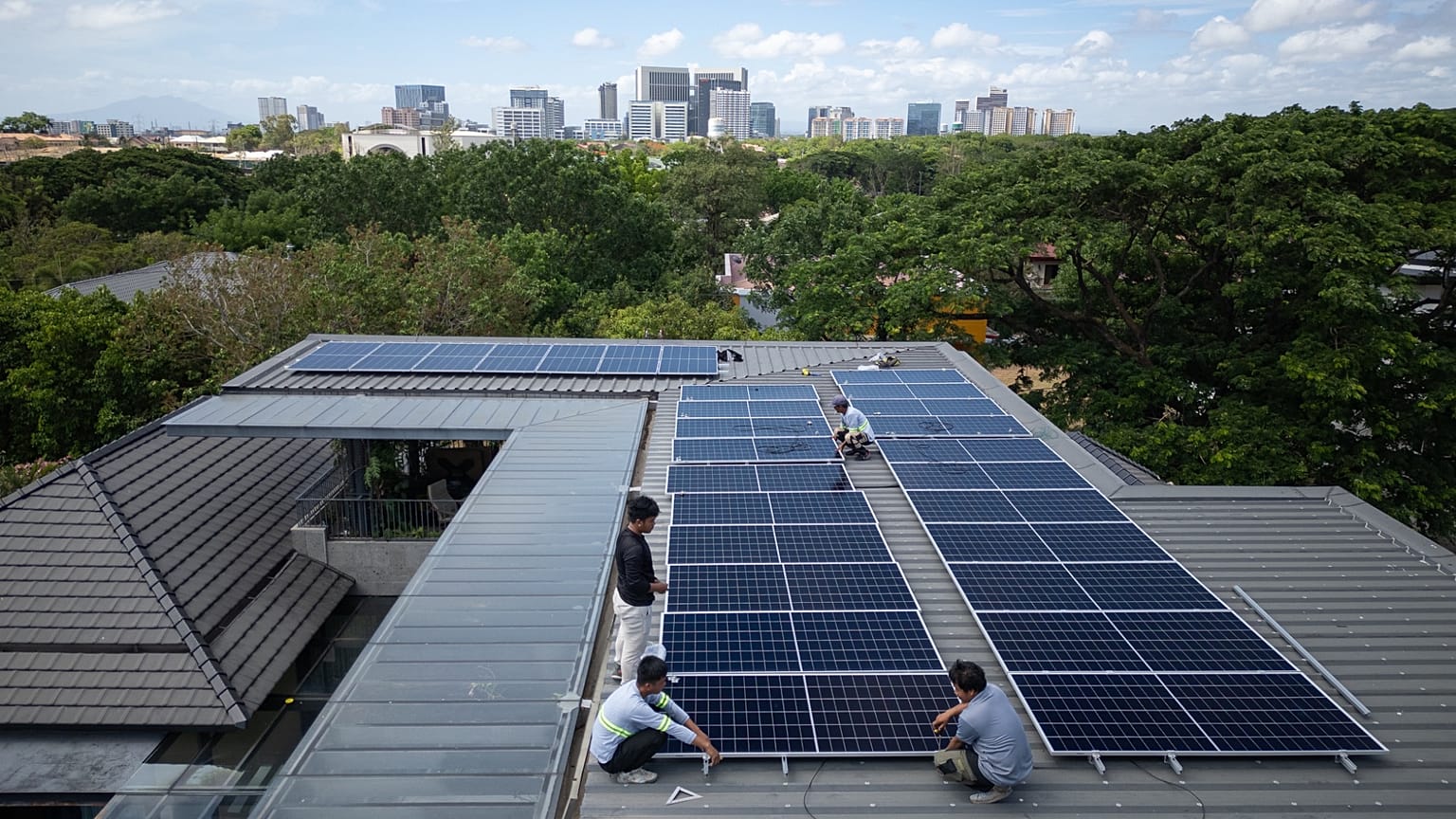
A team of solar installers set up a new rooftop solar system at a home in Manila, Philippines, on May 1, 2026.
Copyright Copyright 2026 The Associated Press. All rights reserved.


By Liam Gilliver
Published on

Geopolitical uncertainty, supply shortages and China’s recent tax reform are threatening to send the prices of solar panels soaring. But, is it really that severe?

Once an extortionate investment reserved for the ‘eco-elite’, solar has rapidly become one of the cheapest electricity sources in the world. But, are the tables about to turn?

Solar photovoltaic (PV) panels, composed of individual solar cells that convert sunlight into electricity, have plummeted in price by a staggering 90 per cent in the last decade. According to Our World In Data, costs have dropped by around 20 per cent every time the global cumulative capacity doubles.

At the same time, the price of solar batteries, which allow households to store electricity during peak times, have also decreased by 90 per cent since 2010 due to advances in battery chemistry and manufacturing.

The EU now describes solar as a “shining star” of Europe’s clean transition, accounting for almost a quarter (23.4 per cent) of its electricity consumption in 2024. In June last year, the sun was the main source of the electricity generated in the EU.

Amid the war on Iran, solar is helping to cushion households from volatile fossil fuel shocks. Recent analysis found that harnessing sunlight for power saved Europe more than €100 million per day throughout March by reducing gas imports.

If prices remain high, due to Iran’s stranglehold on the Strait of Hormuz, experts say these savings could reach €67.5 billion by the end of the year.

The ongoing conflict in the Middle East has also bolstered interest in household electrification, with multiple energy firms across Europe reporting a recent spike in solar panel and solar battery inquiries.

However, as demand for solar panels soars, foreign tax policy, the price of silver and other influences could soon ignite a price surge.

Where does Europe get its solar panels from?

While the EU describes solar as having a “significant role in its transition towards cleaner, more affordable and secure” energy, it remains heavily reliant on countries outside of the bloc to make PV panels.

In 2024, the EU imported €14.6 billion in green energy products, including €11.1 billion worth of solar panels. China was by far the largest supplier of these panels, accounting for 98 per cent of all imports.

According to the International Energy Agency (IEA), China has invested more than $50 billion (€43 billion) in new PV supply capacity – 10 times more than Europe – and created more than 300,000 manufacturing jobs across the solar PV value chain since 2011. Today, the country’s share in all of the manufacturing stages of solar panels exceeds 80 per cent globally.

“Chinese manufacturers have reached scale and cost levels that cannot be matched outside of China,” Jannik Schall of clean tech startup 1KOMMA5° tells Euronews Earth.

“There are factories in other countries, even in Europe, but they only focus on the final assembly of solar panels and cannot compete with China from a cost perspective.”

China’s monopoly on solar panels hasn’t been a clear victory for the country, with tight competition pushing companies to sell below cost. An IEA report from last year found that China-based solar companies had made cumulative net losses of around $5 billion (€4.3 billion) since the beginning of 2024.

This led to China’s Ministry of Finance and State Tax Administration announcing major reform to its generous renewables subsidies, which were originally designed to support foreign trading.

From 1 April 2026, the nine per cent VAT export rebate on solar products was eliminated, while the nine per cent VAT export rebate on battery products was reduced to six per cent. The VAT rebate on battery products will be completely scrapped from 1 January 2027.

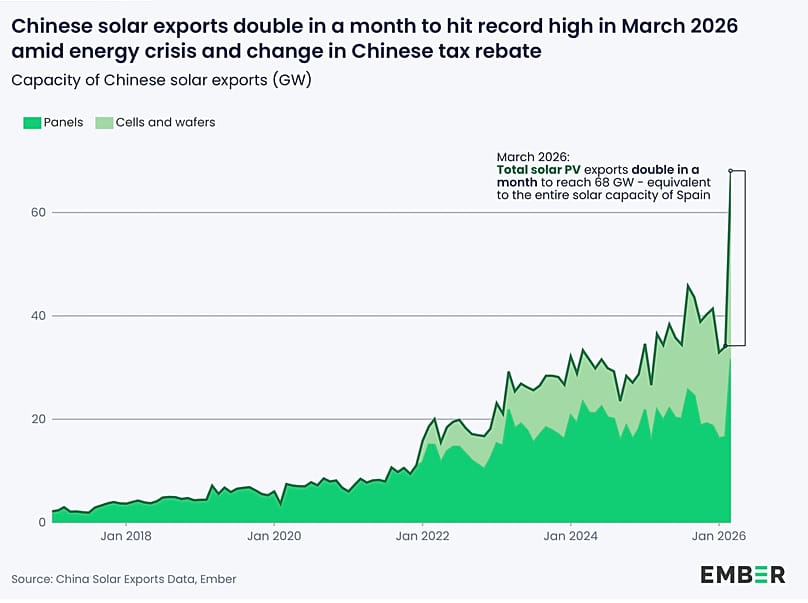
Graph detailing China's solar exports.
Graph detailing China's solar exports. Ember

Just before the tax reform came into place, Chinese solar exports skyrocketed as countries scrambled to beat the price hike.

Energy think-tank Ember found that during March 2026, several European countries, including France, Italy, Poland and Romania, hit all-time records for the number of Chinese solar imports.

Will China’s VAT reform increase the cost of solar?

“The elimination of China’s VAT export rebates alone will cause module prices to rise by around 10 per cent,” Schall tells Euronews Earth. Solar modules is the standard-industry term for a single PV unit.

British newspaper The i has warned that one national solar installer has been forced to charge £800 (€918) more for an average rooftop installation.

So is a blanket price rise expected across the board? It’s not that simple.

Experts say that the market does not react this quickly, and the increasing price of solar panels won’t bite straight away.

Analysts do not expect the rise in cost to limit demand for solar, given its competitive pricing, either. However, it does demonstrate that even renewables are not completely shielded from the intricacies of geopolitics – an argument that frequently arises when speaking about fossil fuel shocks.

InfoLink Consulting, a Taipei-based firm that provides market intelligence, price forecasting and supply chain analysis for solar PV, says that while ground-mounted projects (often used in large-scale solar farms) have edged up in recent weeks, high order volumes have constrained any rise in average prices.

Meanwhile, the price of small-scale or ‘distributed’ solar power systems, like those installed directly on rooftops or carports, has continued to fall marginally, InfoLink said earlier this week (13 May).

How silver became solar’s crux

To understand why solar costs fluctuate, it’s important to understand how PV panels are designed.

Solar panels are predominantly made of glass, plastic polymer and aluminum. Silver, which is the most effective metallic conductor of electricity and heat, is also a key material for PV panels.

Despite representing less than five per cent of a total PV panel in terms of weight, silver paste accounts for up to 30 per cent of total solar cell costs, analysts at German technology group Heraeus state.

According to the Silver Institute, around 4,000 tonnes of silver, equivalent to 14 per cent of global silver consumption, were used for PV panel production in 2023 alone. Researchers warn this share is expected to increase to 20 per cent by 2030, a fourfold increase since 2014.

Chinese manufacturers have therefore been boosting efforts to tackle this, by replacing silver with cheaper metals such as copper. Experts predict switching from silver to copper-based metallisation could save the solar industry roughly $15 billion (€12.8 billion) per year globally.

However, the price of copper has also increased in recent years, albeit at a slower pace than silver.

“Driven by geopolitical uncertainty, supply shortages and increasing demand from AI data centres, prices for copper, aluminum and lithium have increased significantly since Q4 of 2025,” Schall explains.

“Silver prices have reached 150+ per cent increases within a few weeks in the beginning of 2026, making silver the biggest cost contributor in solar panels. These cost increases on the raw material side need time to trickle down through the value chain and are expected to reach end consumers this summer

1KOMMA5° forecasts that the additional high raw material costs, alongside China’s VAT elimination, could cause price increases of 15 to 20 per cent for individual components.

Schall adds that while residential customers will be affected by this in the “medium term” those wanting to install PV panels can still benefit from “more favourable prices” right now.

Euronews Earth reached out to two energy firms in Europe to ask whether they intend to raise their solar panel prices following China’s tax reform and the increasing price of silver. Both declined to comment.

Despite uncertainty, experts point out that solar prices are still around 50 per cent down compared to 2023, making it one of the cheapest sources of electricity in the world.


Germany revamps its energy laws, but risks locking itself into decades of costly gas import dependence

Germany revamps its energy laws, but risks locking itself into decades of costly gas import dependence
Germany is revamping its energy laws, but with a bias for gas over batteries risks locking itself into an expensive dependency. / bne IntelliNews
By Ben Aris in Berlin May 14, 2026

Germany risks locking itself into decades of costly gas import dependence unless policymakers give battery storage equal treatment in upcoming power market reforms, energy think-tank Ember has warned.

In a report published on May 13, Ember said Germany’s electricity system was at a “critical inflection point” as lawmakers debated reforms to the country’s renewables support scheme, grid legislation and the long-delayed Electricity Supply Security and Capacity Act, known as StromVKG. The legislation is expected to launch tenders for backup power capacity from September 2026 to secure electricity supplies during periods of low wind and solar generation, known in Germany as “Dunkelflaute”.

The think-tank warned that proposals favouring new gas-fired power plants in those auctions could slow the deployment of battery storage despite rapidly falling technology costs due to the battery revolution and a growing project pipeline.

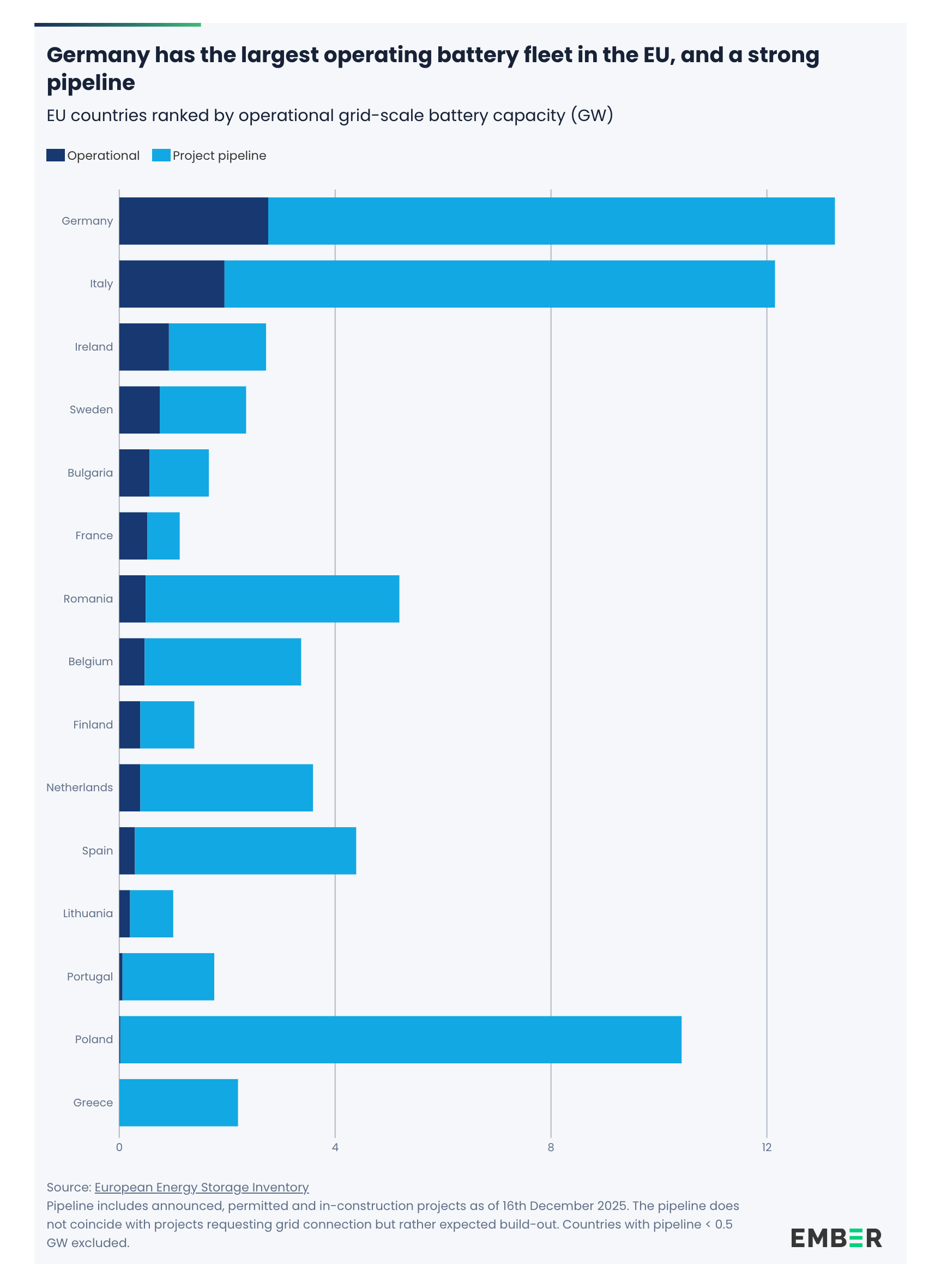
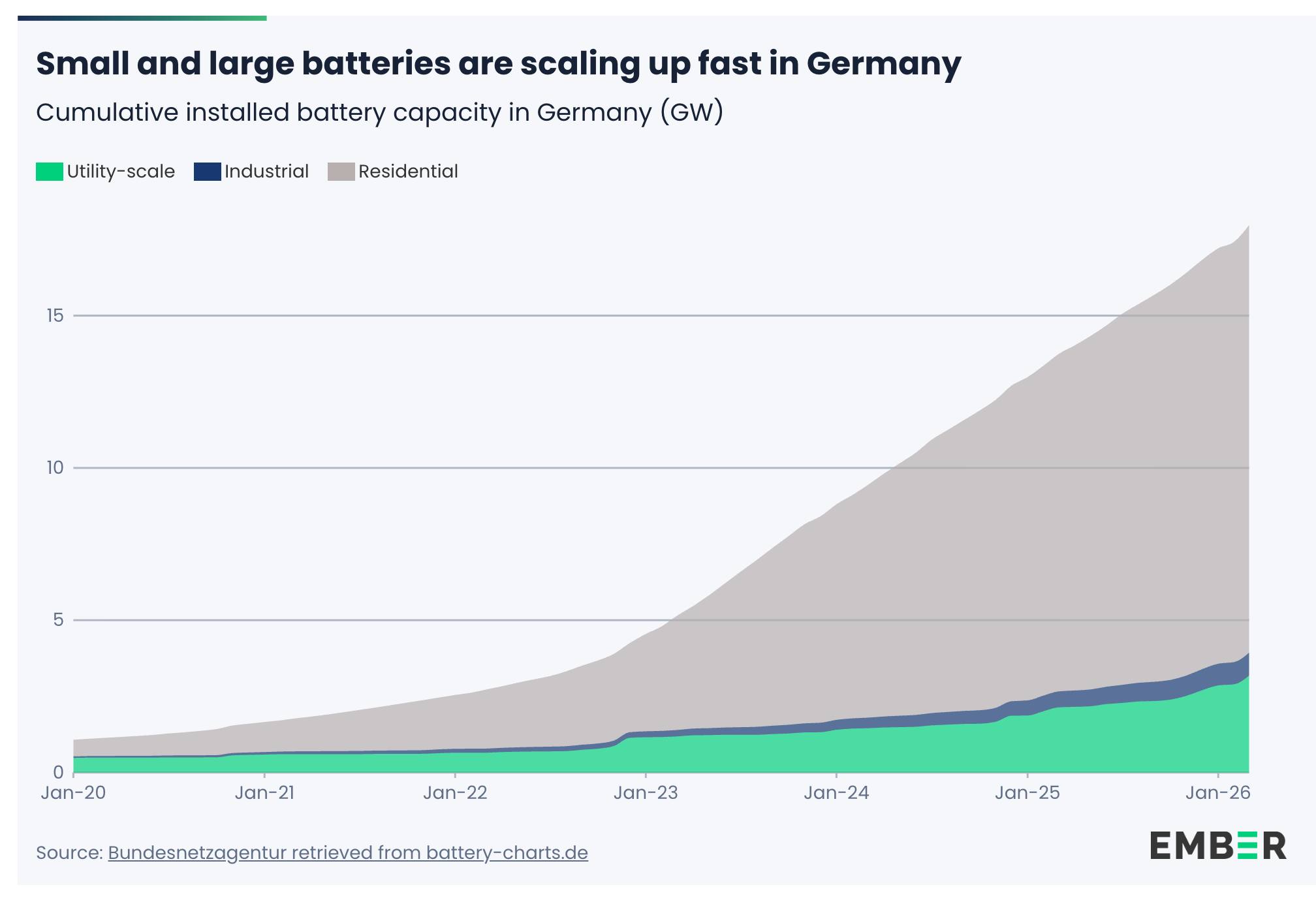
Germany currently hosts about 25% of the EU’s large-scale battery storage capacity, with more than 2.5GW operational by the end of 2025, according to Ember. That figure has more than doubled from 1.2GW two years earlier. The group said more than 10GW of additional battery projects were in development as of December 2025, including 1.5GW already under construction. However, as IntelliNews reported, due to a battery gap Europe as a whole and Germany in particular, only has 15 minutes of battery storage time at a grid level, not enough to impact peak period prices. It needs to scale up to at least 60 minutes and trails other European countries.

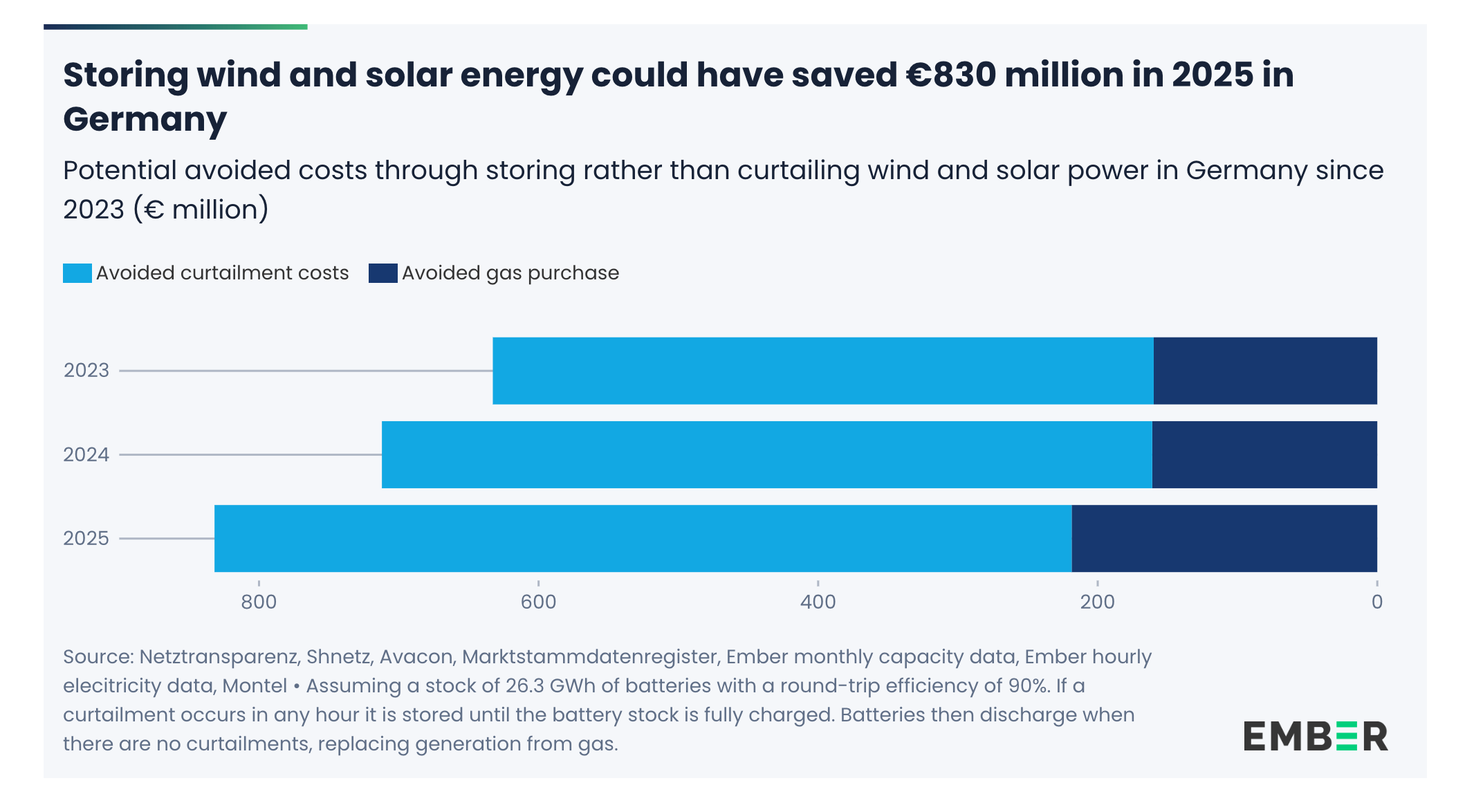
Ember estimated that if Germany’s planned battery pipeline of 10.5GW and 26.3GWh had been operational in 2025, it could have prevented roughly one-third of wind and solar curtailment. Germany curtailed 8TWh of renewable electricity last year, equivalent to 3.4% of total wind and solar output.

The avoided curtailment could have reduced redispatch costs and gas purchases by about €0.8bn, exceeding the estimated annual investment cost of €145mn ($163mn) required over the batteries’ lifetime, the report said.

Germany’s residential battery market is also expanding rapidly. More than two million home battery systems have been installed, with roughly one in six homeowners already using the technology. A survey by the Institute for Demoscopy Allensbach found that 30% of homeowners were considering purchasing a battery within the next five years.

“What is missing is regulatory clarity. The upcoming Electricity Supply Security and Capacity Act and grid package should treat battery storage as a first-order solution for grid stabilization and flexibility – not an afterthought. Preferential pathways for gas in capacity auctions – as envisaged in the current draft bill – would delay the deployment of clean technologies that are already cost-competitive and shovel-ready. What Germany needs is a coherent clean flexibility strategy: a framework that gives equal standing to batteries at all scales, demand-side flexibility (including from electric vehicles and heat pumps) and smarter grid infrastructure, alongside concrete targets for non-fossil flexibility capacity,” Ember said.

Bangalore: India's Silicon Valley, a city straining under pressure


Issued on: 15/05/2026 - FRANCE24


15:31 min From the show


Over the past 25 years, Bengaluru, still popularly known as Bangalore, has transformed into India's Silicon Valley. The South Indian city of nearly 15 million people is now home to global tech giants including Apple, Microsoft, Intel, Adobe and Boeing, as well as thousands of startups. But this rapid development comes with environmental consequences. Our correspondents report.

Bangalore's transformation began in the 1990s, after India opened up its economy and introduced new software and computer policies. Global companies like Dell, IBM and Bosch started outsourcing operations to Bangalore, attracted by lower labour costs, a large English-speaking workforce and the city's strong educational ecosystem.

Alongside IT services, Bangalore also became a major hub for Business Process Outsourcing, handling customer support, finance and back-office operations for companies around the world.

In the 2010s came a shift: the city was no longer just outsourcing, it was innovating. Bangalore shifted from backend services to R&D and entrepreneurship. The city saw a startup boom and is now home to over 16,000 startups.

From seven to 15 million inhabitants in a quarter of a century

But Bangalore's growth came at a cost. Millions of people moved there in search of opportunities, placing enormous pressure on the metropolis. Bangalore is now ranked as the world's second most congested city after Mexico City.

Wetlands, lakebeds and natural drainage channels have been built over to make space for offices and housing, leaving parts of the city flooded during monsoon rains. Shrinking lakes and excessive groundwater extraction have also deepened water shortages. With a daily water deficit of nearly 500 million litres, many residents now depend on private water tankers.

As India pushes to become a global data-centre hub, concerns are growing over sustainability. Bangalore alone hosts around 31 data centres, with a single one-megawatt facility consuming nearly 68,000 litres of water every day for cooling. Environmentalists warn that unchecked urban growth without ecological planning could leave the city increasingly vulnerable to climate change.