Sunday, May 17, 2026

Hope in a Time of Democratic Decline

Two major reports released this year tell a grim story: Global freedom continues to decline and the US has lost its longstanding classification a liberal democracy. But hope lies in the data.
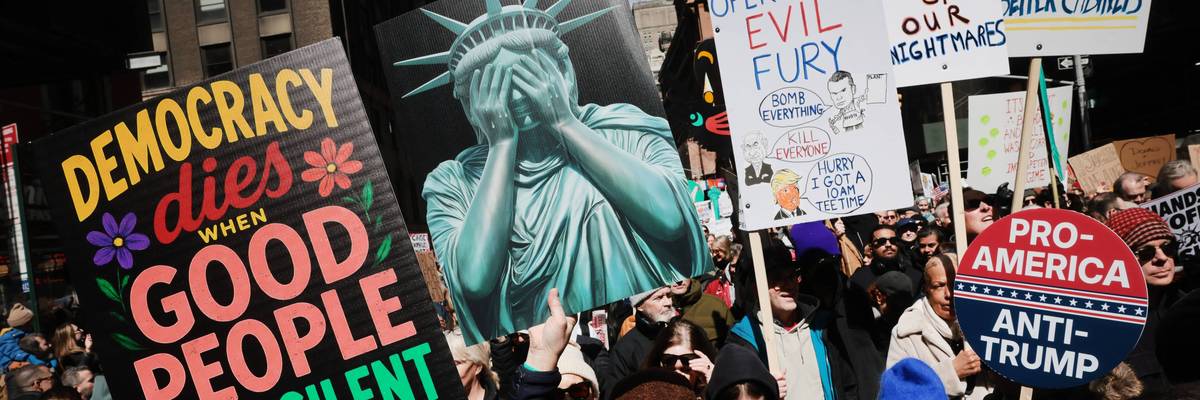

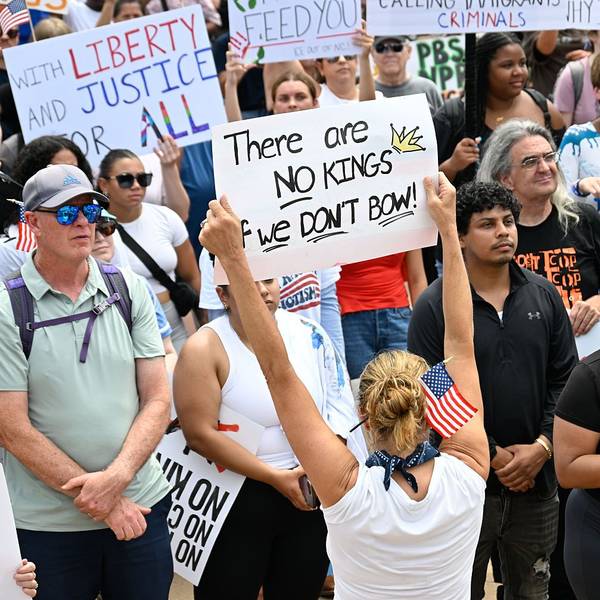
Protesters hold signs as they participate in a “No Kings” protest in Manhattan on March 28, 2026 in New York City.
(Photo by Spencer Platt/Getty Images)
Common Dreams

The US score on the University of Gothenburg’s V-Dem Liberal Democracy Index declined by 24% in only one year, while its world rank dropped from 20th to 51st place out of 179 nations.“ The US joins nearly a quarter of the world’s nations undergoing democratic backsliding, and is on its way to joining the three-quarters of the world population, some 6 billion people, who live in autocracies. If President Donald Trump’s first term “laid the foundation”, according to the report, the second term has seen the backslide quicken.


The bad news is now measurable. V-dem rates the US as an elected democracy, losing its higher position as a liberal democracy. V-dem points to a breakdown of liberal characteristics including freedom of expression, respect for civil liberties, and well-functioning checks and balances, especially those between the executive branch and the judiciary. Freedom House reports a similar dramatic decline. As does the Democracy Meter.

Such a democratic crash is typically associated with coup d’etats. According to V-Dem we are back to the lowest level of democracy since 1965, when President Lyndon B. Johnson signed the Voting Rights Act, establishing the US as a democracy that enfranchised, at least in law, all citizens.

Trump did not create our democratic weaknesses, but he is exploiting them. Power has been unevenly coalescing in the presidency since at least Andrew Jackson’s administration. Democrats have done little to roll back the executive overreach that marked George W. Bush’s post 9/11 War on Terror or Barack Obama’s drone strikes. Even former President Joe Biden could not help but overuse executive orders to overcome congressional gridlock. These precedents emboldened Trump. If the imperial presidency has previously been restricted to despotic rule abroad, it is now directed to the US’ own citizens and subjects. Trump is the domestic return of the imperial boomerang, establishing what political theorist Nikhil Pal Singh calls a “Homeland Empire.”

The 2026 midterm elections are more than a referendum on Trump. They are a test of whether American democracy can repair itself.

We were warned. This most recent executive power grab was foreshadowed by the Project 2025 Heritage Foundation plan to enact “unitary executive theory.” By 2026, according to Project 2025 Tracker, half of the 320 objectives have been met. We have entered what former Republican adviser Gregg Nunziata calls “the age of American Caesarism.

Still, buried within V-dem’s report are two important lessons of hope. The first lesson is that demand for democracy, as both a norm and practice, remains strong. Democracy remains powerful as an ideal, which is why even autocrats rarely reject elections outright and often rely on the appearance of democratic forms to confer legitimacy. Trump may troll liberals by cosplaying a king, selling 2028 merch, or even quipping in relation to the midterms that “when you think of it, we shouldn’t even have an election.“ But Trump still requires elections to be viewed as legitimate—even within the Republican Party. Uncertainty in elections can never fully be removed while democracy remains the norm.

The second lesson is that the first election after a democratic slide is a pivotal moment to reverse the trend. This means the 2026 midterm elections are more than a referendum on Trump. They are a test of whether American democracy can repair itself. Elections remain dangerous to autocrats precisely because they cannot fully control what voters will do.

Nevertheless, autocrats still attempt to tilt the playing field in their favor. To consolidate their grip on power, autocrats engage in what Stephen Levitsky and Lucan Way call “competitive authoritarianism.” Opposition remains legal and elections are still contested. But authoritarians weaponize the executive and judicial machinery of the state to make opposition costly.

Taking a page out of the authoritarian playbook, Trump has worked to discipline institutions that might constrain him. He has filled the administrative state with party sycophants, hollowed out government agencies, and targeted media and universities. He wields violent rhetoric to delegitimize opposition, both antifa bogymen and centrist liberals, and pardons those who illegally act in the administration’s interests, encouraging others to act with impunity. The list goes on. The point is to intimidate civil society and silence dissent. Historian Timothy Snyder calls this “anticipatory obedience.”

The danger, however, is that Trump is not alone. His impulses have become intertwined with party strategy. Voting rights are the clearest example of this unified threat. Trump’s SAVE Act has stalled in the Senate, but the Roberts Court has arrived with the cavalry to fulfill the Republican party’s long-awaited agenda. The recent Callais v Louisiana has already revealed itself to be a cudgel in Black voting districts. In a perverse acceptance that racism no longer exists, the ruling has green-lit a gerrymander race to the bottom.

Trump is a political bully. He seeks to whittle us down with near constant reminders that he has the power and we do not. Broadly, this thumb-on-his nose strategy underpins his social media message. This is its only message: Power begets power. Trump is relying on us to accept defeat that has not yet occurred. But power is not the same as inevitability. Despite the increasingly stacked odds, the upcoming midterm elections are a pivotal moment to repudiate autocracy.

Justice Elena Kagan, in her stinging dissent in the Callais v Louisiana decision, reminds us that the Voting Rights Act “was born of the literal blood of Union soldiers and civil rights marchers” and “[brought] this Nation closer to fulfilling the ideals of democracy and racial equality.” Rights were born in struggle. They can be lost in despondency. We must remind ourselves that democratic institutions are not self-executing: We are the guardrails.

What I call a “living democracy” builds on the uncertainty and hope that lies within the heart of the democratic project. The late political theorist Sheldin Wolin named this hopefulness “fugitive democracy,“ something fleeting that must be continually renewed. As Wolin writes, ”The possibility of renewal draws on a simple fact: that ordinary individuals are capable of creating new cultural patterns of commonality at any moment.“ It is up to us to rebuild hope in our political communities and in such numbers that we can defeat the electoral odds stacked against us.


Our work is licensed under Creative Commons (CC BY-NC-ND 3.0). Feel free to republish and share widely.

Frances Moore Lappé
Frances Moore Lappé is the author of 20 books, beginning with the acclaimed "Diet for a Small Planet." Most recently she is the co-author, with Adam Eichen, of the new book, "Daring Democracy: Igniting Power, Meaning, and Connection for the America We Want." Among her numerous previous books are "EcoMind: Changing the Way We Think to Create the World We Want" (Nation Books) and "Democracy's Edge: Choosing to Save Our Country by Bringing Democracy to Life." She is co-founder of the Cambridge, Mass.-based Small Planet Institute.
Full Bio >

Lewis D’Avigdor
Lewis d’Avigdor, PhD, is the managing director of Small Planet Institute. A former lawyer and historian, having taught at Cornell, Harvard, and Wheaton College, his work focuses on American and African-American politics and culture.
Full Bio >
FIGHT CORRUPTION!

How the Left Can Flip Crime From a Political Liability to a Political Advantage


Democrats can go on offense by defining what it actually means to be serious about safety: not by stoking fear, but by advancing a clear, consistent, solutions-driven agenda that both prevents crime and breaks its cycle.


Aiden Cotter
May 17, 2026
Common Dreams

As the economy falters, prices surge, and yet another Middle East conflict grinds on with no clear endgame, Donald Trump’s presidency appears to be slipping into free fall. His support has eroded among the very voters who once powered his return to office, and Americans are losing confidence in the issues that once defined his appeal—especially the economy and immigration. With the midterms looming, Republicans are flailing.

But Trump and the Republicans always have a tried-and-true political playbook: fearmongering about crime. And unless Democrats go on the offensive, it just may work.

Trump has already signaled that crime will once again be a centerpiece of the midterms. In support of that aim, he has repeatedly urged Congress to pass “a tough new crime bill,” falsely taken credit for bringing down crime rates, and exploited crime victims to cast Democrats as cold and uncaring in the face of tragedy. But crime is not the strength it once was for Trump.

Thanks to his unpopular federal troop deployments and violent mass deportation tactics, voters are losing confidence in his approach to public safety.

As ICE, the National Guard, and other federal forces expand their footprint in communities across the country, voters are getting a clearer picture of what “tough-on-crime” governance looks like in practice—and most don’t like what they see.

To be clear, Republicans still hold an overwhelming advantage on crime in public opinion. But that edge is driven less by outcomes than by emphasis: They talk about crime relentlessly—even when rates are near historic lows—amplifying and exploiting understandable fears. Democrats, by contrast, too often cede the narrative—either by pivoting to safer ground or by trying to one-up Republicans with “tough-on-crime” rhetoric that voters don’t find convincing.

Today, Democrats of all stripes are talking loudly and often about affordability—the right tactic after being perceived as out of touch in the wake of the 2024 election. But they have yet to find a unified message around public safety, leaving them vulnerable to the inevitable barrage of GOP attack ads stoking fears of crime and immigration.

My team and I have briefed dozens of candidates and elected leaders over the past several months, and the message we are so often left with is one of hesitation and uncertainty around public safety. From our work with Hill offices to mayoral candidates, the reality is that the party is not prepared to truly address crime. Unless Democrats define the issue on their own terms, they’ll once again be forced to play defense on one of the most politically potent issues in American life.

Democrats cannot afford to go silent on crime, nor can they afford the “tough-on-crime” approach that some in the party are advocating—a familiar playbook that echoes the advice many received last year on immigration enforcement. But those who followed that guidance are now finding themselves under attack for it. Votes once seen as smart politics—backing measures like the Trump-backed Laken Riley Act, resolutions praising US Immigration and Customs Enforcement (ICE) officers, or increased funding for the Department of Homeland Security—are quickly becoming political liabilities. As ICE, the National Guard, and other federal forces expand their footprint in communities across the country, voters are getting a clearer picture of what “tough-on-crime” governance looks like in practice—and most don’t like what they see.

This moment presents an opportunity. Democrats can go on offense by defining what it actually means to be serious about safety: not by stoking fear, but by advancing a clear, consistent, solutions-driven agenda that both prevents crime and breaks its cycle. In a country where nearly half of all people have had a family member incarcerated and about 3 in 10 people say they or a member of their household have been a victim of a crime, we must chart a new path forward. Democrats don’t have to look far to see which solutions truly deliver on safety.

Democratic mayors are working to drive historic declines in crime—through sustained investments in youth programs, community violence intervention, crisis response, targeted gun enforcement, and rebuilding trust between police and the communities they serve. Leading cities of all sizes, they’ve seen firsthand how violence shatters families and makes everyday life feel unsafe. They’ve also seen the damage of blunt “law and order” approaches that destabilize neighborhoods, limit opportunity, and erode cooperation with law enforcement.

These leaders are channeling a broader political reality: Most Democratic and independent voters want leaders who are serious about safety, not a return to reflexive “tough-on-crime” politics. That means a comprehensive approach that responds swiftly to stop violence, solve crime, and prevent it in the first place. It pairs accountability with fairness—holding everyone to the same standard, including police and elected officials. And it reflects a continued belief that public safety is strengthened not just through enforcement, but by giving people a real chance to break cycles of incarceration and build stable lives. Importantly, as we head toward the midterms, polling shows that when Democrats demonstrate to voters that they are truly serious about safety, this approach consistently outperforms “tough-on-crime” rhetoric.

Notably, these local leaders come from across the Democratic spectrum. Regardless of whether they consider themselves progressives, moderates, or something in between, they share an approach that works to deliver safety and win elections. They know that safety isn’t about scoring political points; it’s about building credibility and delivering what works. It’s time Democrats learned that lesson as well.


Our work is licensed under Creative Commons (CC BY-NC-ND 3.0). Feel free to republish and share widely.

Aiden Cotter
Aiden Cotter is the director of federal advocacy for Vera Action.
Full Bio >


From Gas to Groceries, Rural Americans Paying Heaviest Price for Trump’s Iran War

A Center for American Progress analysis found that the war is “forcing rural households to pay at least $26 more per week at the pump and threatening to push grocery prices even higher in the months ahead.”


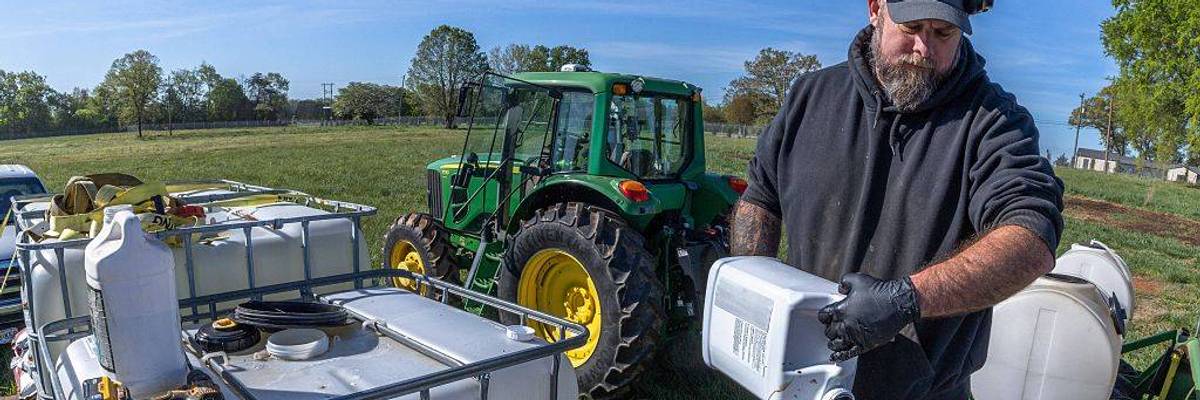
A worker fuels a tractor on a farm in Rocky Hill, Connecticut on April 2, 2026.
(Photo by Mark Mirko/Connecticut Public via Getty Images)

Brett Wilkins
May 15, 2026
COMMON DREAMS

President Donald Trump won the 2024 election largely on a promise to alleviate the affordability crisis, but an analysis published Friday underscores how rural Americans—the bedrock of the MAGA base—are disproportionately paying the price for the US-Israeli war of choice on Iran.

“Rising gas and fertilizer prices tied to the Trump administration’s war in Iran are driving up costs for rural families, farmers, and consumers across the country,” notes the analysis from the Center for American Progress (CAP), a liberal think tank.

“Gas prices rose 52% between February 27, the day before the war with Iran began, and May 14, forcing rural households to pay at least $26 more per week at the pump and threatening to push grocery prices even higher in the months ahead,” the publication continues.

“The economic fallout from the conflict is disproportionately affecting rural America, where households already spend significantly more on gasoline and energy and where farm operations depend heavily on diesel fuel and fertilizer,” CAP added. “As oil prices rise and shipping through the Strait of Hormuz remains disrupted, farmers are facing mounting input costs during an already difficult economic period.”

CAP researchers also found that the gap between urban and rural fuel costs has increased from $46 to $70 per month since the start of the war.

With diesel fuel accounting for over 60% of their fuel expenditures, farmers are facing the prospect of paying at least $350 more per day to operate a single tractor.

“There are 453 farming-dependent counties across the country, and rising fuel and fertilizer costs could force more small and medium-sized farms out of business if disruptions continue,” the analysis warns.

As Common Dreams reported this week, Trump’s illegal war of choice and erratic tariff policies are hurting farmers and consumers while Big Ag profits from fast-rising fertilizer and food prices.

Likewise, while consumers feel the pain of skyrocketing pump prices, Big Oil is reaping prodigious profits fueled by scarcity and market uncertainty due to the closure of the Strait of Hormuz and other war-related causes.

A report published earlier this month by the office of Sen. Ed Markey (D-Mass.) projects that US drivers could pay an additional $876 per year—or $1,753 for a family with two cars—on gasoline per year if pump prices remain at their current levels.

The CAP analysis comes on the heels of the latest consumer price index, released earlier this week, which revealed that inflation has risen to its highest level in three years largely due to rising fuel and food costs.

According to CAP, lower-income households—which spent a third of their pretax income on food in 2024—“will be hit hardest” by rising grocery prices, as the highest-income households spent just 6.4% of their before-tax earnings on food.

“Families in rural communities are already stretched thin, and this conflict is making everyday necessities even more expensive,” CAP senior fellow and analysis co-author Anne Knapke said Friday. “Higher gas prices, rising fertilizer costs, and more expensive groceries are all contributing to an affordability crisis that this president is making worse every day.”

Asked earlier this week if he thinks about the financial hardship his war is inflicting on Americans, Trump flippantly replied, “Not even a little bit.

Could High Fertilizer Prices Change the Face of Farming?

The development of agroecological and regenerative approaches would see a food system that is not only less vulnerable to the supply chain shocks being felt today, but would be better for the environment, human health, and animals.


Farmer Russell Hedrick prepares a blend of minerals, biologicals, and fertilizers to be sprayed onto his fields while they are being seeded in Hickory, North Carolina, on April 10, 2026.
(Photo by Grant Baldwin / AFP via Getty Images)

Frances Macguire
May 17, 2026
Common Dreams

The global disruptions caused by the war in Iran have brought renewed focus to the vulnerability of global fossil fuel supply chains. But what has received less attention is how the war also highlights the vulnerability of industrial agriculture supply chains reliant on massive amounts of chemical fertilizers and other inputs. Like oil and gas, these frequently travel long distances through turbulent waters.

A big advantage of renewable energy technologies like solar is that sunlight doesn’t have to pass through the Straits of Hormuz. The same can be said for many of the inputs required for agroecological and regenerative farming systems. The development of these approaches would see a food system that is not only less vulnerable to the supply chain shocks being felt today, but would be better for the environment, human health, and animals. It would be healthier, kinder, and more resilient.

A global economic recession and possible food shortages are looming as the war in Iran grinds on. While the devastating impact of the current conflict on people, their families, and communities must be foremost in our minds, the shock waves from the crisis are having system-wide impacts on energy supplies, cost of living, and food prices. As the seasons turn and farmers prepare to plant their crops, they are facing a new pressure: a sudden and critical rise in fertilizer and fuel costs.

As the price of petrol and diesel have skyrocketed since the closure of the Strait of Hormuz, so too have fertilizer costs due to shortages of urea and ammonia. A third of the world’s key fertilizer chemicals pass through the Strait, and prices have risen steeply since the outbreak of war, with predictions that prices for nitrogen-based fertilizers like urea could roughly double if the war drags on. Alongside a rise in red diesel prices, agricultural profit margins are highly volatile.

The current war is heinous, but inadvertently it has created an inflexion point, a moment to rethink global distribution of goods, and our broken food system.

Farmers taking the financial hit will likely pass on the costs to the consumer, but this isn’t sustainable and undermines the financial, social, and environmental health of the global food system. What if we flip it? Could the Middle East War not only accelerate a shift to renewable energy but also reduce our dependency on fertilizer-hungry crops? Legumes such as beans and peas, which fix nitrogen in soils, root vegetables, soybeans, and hardy grains such as rye could be viable alternatives.

Since the Second World War, a burgeoning (and hugely profitable for a few) chemical industry has created food systems dependent on inputs such as fossil fuel-based fertilizer, pesticides, herbicides, and fungicides. While delivering greater crop surplus, industrial farming has brought new problems: algal blooms, less wildlife and pollinators, monocultures, local air pollution, global climate change, and the loss of small-scale farming and farmers.

We’ve reached a tipping point; we overproduce food, a third of which is wasted, and too many people are eating too much of the wrong types of food. Noncommunicable diseases such as cardiovascular disease and diabetes are becoming a much bigger health burden than infectious diseases. Meanwhile, entrenched inequalities mean that, despite a global food surplus, millions of people go hungry every day, and 2.6 billion people can’t afford a healthy diet. An insatiable demand for meat now means that there are over 76 billion farmed chicken, pigs, and cattle in production around the planet, driving a largely invisible burden of animal suffering.

The current war is heinous, but inadvertently it has created an inflexion point, a moment to rethink global distribution of goods, and our broken food system. Growing crops that don’t need so many fossil fuel-derived chemicals but still provide enough food to feed our populations, and sustainable farming for current and future generations, is where we should be heading. We need to transition away from industrial agriculture, to food systems built on fairness—to people, animals, and the planet—not one geared toward feeding animals to feed ourselves. It’s a stark reality that over one-third of land used to grow arable crops is used to grow crops for animal feed.

Animal farming industry groups have been calling for public money to weather supply shocks, which begs the question of how resilient are the industrial systems we currently rely on. The US government provided $1 billion in response to avian flu, for example, while the European Union directed €46.7 million to Italian farmers, plus another €15 million for weather and animal-disease-related impacts in parts of Europe, and Canada extended livestock tax relief linked to bovine TB and extreme weather. The Food and Agricultural Organization of the United Nations (FAO) is also calling for urgent action in the form of government funds to protect the countries heavily exposed to import disruptions.

It’s clear that the current industrial animal farming model is not resilient. It depends heavily on unstable supply chains exposed to geopolitical shocks, climate change, extreme weather events, and disease outbreaks, and is a deeply inefficient use of plant resources to feed the world. Yet public money keeps being used to stabilize food systems that are structurally fragile, rather than directed toward sustainable and humane agriculture.

The current crisis in the Middle East has once again spotlighted our dependence on fossil fuels for energy and for food production. The growing success of renewable energy technologies—wind, solar, electric vehicles, and heat pumps—provides a roadmap to achieving energy independence at local and national levels. This has been achieved through several decades of policy and fiscal support, such as feed-in tariffs, technological advances, and growing public support.

Changing how we produce food could advance rapidly on the coat tails of our energy revolution. Calls for a just transition in farming and food production are growing from independent, small-scale farmers to development organizations, from Indigenous people’s groups to animal welfare charities. This transition would pivot away from destructive, insecure industrial agriculture toward more equitable, humane, and sustainable forms of agriculture, such as agroecology.

Rethinking food is not a nice to have, it’s essential if we are to strengthen the resilience of farmers, consumers, and nations, reducing exposure to geopolitical tensions, supply-chain disruptions, and future global shocks.


Our work is licensed under Creative Commons (CC BY-NC-ND 3.0). Feel free to republish and share widely.


Frances Macguire
Frances MacGuire is the director of research and animal welfare at World Animal Protection.
Full Bio >
In Alabama, Organizers Declare ‘Day One’ of Mass Mobilization to Stop GOP Attacks on Voting Rights

Labor rights and voting rights groups were among those who gathered in Selma and Montgomery, Alabama for the All Roads Lead to the South Day of Action.


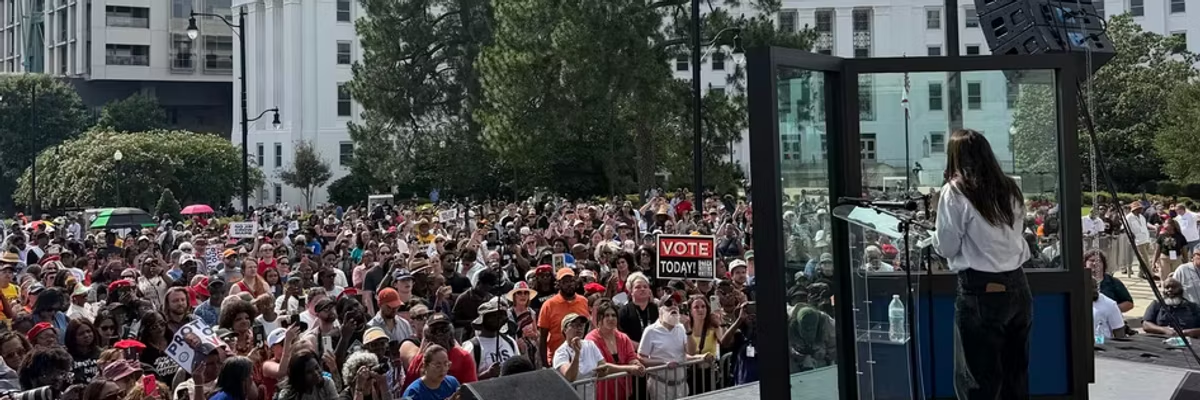
US Rep. Alexandria Ocasio-Cortez (D-NY) addresses voting rights supporters at the All Roads Lead to the South rally in Montgomery, Alabama on May 16, 2026.
(Photo by @saedaaya/X)

Julia Conley
May 16, 2026
COMMON DREAMS

This is a developing story... Please check back for possible updates...

In a show of resistance to the US Supreme Court’s dismantling of the Voting Rights Act and Republicans’ efforts to redraw congressional districts across southern states in a bid to retain power despite their party’s unpopular agenda, labor and voting rights groups were among those that arrived in Montgomery, Alabama Saturday for “Day One” of a mass mobilization against GOP lawmakers who they said are intent on “resurrecting Jim Crow.”


No Kings Movement and ‘All Roads Lead to the South’ to Protest GOP Voting Rights Attacks


Alabama, South Carolina Join GOP Push to Dilute Black, Democratic Districts


While groups including the Movement for Black Lives and National Jobs With Justice boarded buses in Atlanta Saturday morning to join more than 250 organizations at a rally at the Alabama State Capitol, other organizers began the “All Roads Lead to the South” National Day of Action with a march across the Edmund Pettus Bridge in Selma, Alabama—the same site of the historic 1965 voting rights march that became known as Bloody Sunday."We started here because we wanted to stand on sacred ground and consecrate ourselves," said organizer LaTosha Brown, co-founder of the group Black Voters Matter. "You cannot fight hate with hate, you have to stand in the spirit of love, and so look around—this is what love looks like."


The march and rally were organized in response to a ramp-up of efforts by the Republican Party and right-wing courts, including the far-right majority on the US Supreme Court, to redraw electoral maps in states including Louisiana, Alabama, and Tennessee.

The mass mobilization was organized after the Supreme Court handed down its ruling in Louisiana v. Callais last month, effectively eviscerating Section 2 of the Voting Rights Act, which has held that voters of color have the right to legally challenge racially discriminatory congressional maps.

The Supreme Court this week allowed Alabama to revert back to an electoral map with just one majority-Black district out of seven, despite that fact that 26% of Alabama residents are Black.

Tennessee Republicans also adopted a new electoral map that splits up the state’s only majority-Black district, and the Missouri Supreme Court approved a congressional map that targets the state’s 5th District, represented by Rep. Emanuel Cleaver.

Arriving in Montgomery, Tennessee state Rep. Justin Jones (D-52) said voters across the South need “a united front... to take on this new Confederacy... We know what the intent of these governors and state lawmakers are, to dismantle every gain made during the civil rights movement and dismantle the crown jewel of the civil rights movement, which was the Voting Rights Act.”


“Our parents and grandparents marched, organized, bled, and won,” said organizers ahead of the rally. “The Voting Rights Act was theirs. The fight to keep it is ours. Right now, state by state, that law is being dismantled. We know that we cannot fight the same battles the same way. New times demand new tactics—economic pressure, political organizing, community action, culture, and faith. But we know what we know: Organizing works. And we have unfinished business.”

At the rally, US Rep. Alexandria Ocasio-Cortez (D-NY) emphasized the need for solidarity from across the US, with supporters of voting rights mobilizing in states near and far from the South—the current center of the GOP’s attacks.

“They think they can draw us out of power. They do not know the sleeping giant they just awakened,” said Ocasio-Cortez. “When Black Americans have the right to vote and that vote is protected, our schools get funded. When voting rights are protected, healthcare gets expanded. When voting rights are protected, our country moves forward. And Montgomery, that’s what they’re actually afraid of.”


Erica Smiley, executive director of Jobs With Justice, said labor groups joined the mass mobilization because “the bridges we have to cross are not only in Selma.”

“Jim Crow didn’t just come for the ballot. It came for anyone who tried to organize and have a voice,” said Smiley. “Efforts to rollback equality and democracy are happening in the occupied cities, shop floors, and now the halls of the Capitol across the country.”

Rep. Terri Sewell (D-Ala.) called for the rally to mark the beginning of a “Freedom Summer,” with rallies at “every State House” in the country to pressure state legislators to end the GOP gerrymandering efforts, which President Donald Trump has explicitly called for.

“Let’s declare a Freedom Summer and go to every courthouse this summer, to tell those legislators, ‘We will not go back,’” said Sewell.

Dozens of satellite events were also taking place across the US on Saturday.

Cuban Envoy Draws ‘Red Lines’ Amid Specter of US Invasion and DOJ Targeting Castro Like Maduro

Cuban Chargé d’Affaires Lianys Torres Rivera said her government is willing to negotiate with the US, but “the only exception is our sovereignty, independence, and right to self-determination.”


Former Cuban President Raúl Castro (center, in military uniform) and other officials attend a rally marking International Workers’ Day in Havana on May 1, 2026.
(Photo by Yamil Lage/AFP via Getty Images)

Brett Wilkins
May 15, 2026
COMMON DREAMS

Cuba’s top diplomat in the United States on Friday underscored the inviolability of her country’s sovereignty amid tenuous negotiations with the Trump administration and mounting fears that the US is planning to criminally indict a former Cuban president and possibly invade the island to abduct him.

Cuban Chargé d’Affaires Lianys Torres Rivera told The Hill that her country’s socialist government is open to negotiating with the US, but that “the only exception is our sovereignty, independence, and right to self-determination,” adding that “those are the red lines.”

Following Pattern Set by Venezuela and Iran Assaults, US Surveillance Flights Off Cuba Surge

Torres Rivera acknowledged that ramped-up US pressure—including President Donald Trump’s invasion threats and tightening of the internationally condemned 65-year economic embargo—is inflicting tremendous suffering on the Cuban people.

“It’s difficult. What the Cuban people are enduring these days is difficult,” she said. “They are under a collective punishment from the US.”

The Cuban government said Thursday that Trump’s oil blockade has left the island and its 11 million people without fuel—a situation United Nations experts last week described as illegal “energy starvation.”

“We have reorganized the whole country, the healthcare system, the education system, the transportation system, to keep the basic services running,” Torres Rivera told The Hill. “But it doesn’t mean that they are running normally. They are running under huge stress.”

Still, “a serious country that respects yourself... won’t put on the table your political system or your internal order that the people of our country decide in a sovereign way,” she stressed.

The delicate balancing act Cuba is being forced to perform was on stark display on Thursday as Central Intelligence Agency Director John Ratcliffe traveled to Havana for talks aimed at pressuring Cuban officials into complying with demands that critics say would inrfinge upon the nation’s sovereignty. These likely include political and economic reforms, releasing political prisoners, and ending or weakening Cuba’s alliances with US adversaries including China, Iran, Russia, and Venezuela.

It was a bitter pill to swallow for Cubans, as the CIA was behind myriad efforts to topple their government, from assassination attempts against revolutionary leader Fidel Castro to the failed Bay of Pigs invasion to supporting Cuban exile terrorists who carried out deadly attacks that Havana says killed thousands of people.

Further stoking fears of aggression from the Trump administration,r unidentified US officials told CBS News that the Department of Justice is preparing to criminally indict 94-year-old former Cuban President Raúl Castro for the 1996 shoot-down of planes belonging to the subversive US-based group Brothers to the Rescue after they violated Cuban airspace.

Some observers noted the 1976 midair bombing by US-based anti-Castro militants of Cubana de Aviacion Flight 455, a commercial airliner carrying 73 passengers and crew. The CIA, under then-Director George H.W. Bush, knew that Cuban exiles were plotting to blow up a Cubana plane, but did not warn Havana. The perpetrators of the bombing eventually made their way back to Florida, where they were welcomed as heroes.

Others surmised that the reported planned indictment is a pretext for a US invasion and arrest of Castro similar to January’s abduction of Venezuelan President Nicolás Maduro on dubious—and partially retracted—narco-terrorism allegations.Thirty-two Cubans, including military and police officers providing security for Maduro, were killed by US forces during the abduction operation.

“To me, this signals that the Pirate State could be planning another kidnapping operation against Cuba like they did in Venezuela,” British journalist Richard Medhurst said in response to the reporting, referring to the US. “This is the lawless behavior they want to normalize around the world.”

ACLU head of digital engagement Stefan Smith said on social media: “Remember Maduro and Venezuela? If you’re a foreign leader indicted in American courts, we claim the right to send the military to kidnap you. Indictment is permission to invade.”


Following his visit to Cuba, Ratcliffe said that negotiations “will not stay open indefinitely,” remarks that followed numerous threats by Trump to “take” Cuba.

“Whether I free it, take it—I think I can do anything I want,” the president said in March as his fuel embargo caused blackouts that brought deadly suffering to the most vulnerable Cubans, including sick people and children.

Torres Rivera insisted that protests over the blackouts don’t mean Cubans won’t rally in defense of their homeland.

“When they are enduring 20 hours of blackouts, they have grievances, and they express it,” she told The Hill, cautioning US officials against a “wrong reading” of the demonstrations.

“We are preparing to defend ourselves,” Torres Rivera said, adding that a US invasion “could be a big mistake. It could be a bloodbath.”

“We don’t want Cubans dying in Cuba,” she stressed, nor “any American soldier.”

‘Sinister and Ominous’: CIA Posts Photos of Director in Havana as US Blockade Leaves Cuba Without Fuel

Democratic Rep. Pramila Jayapal called for an immediate end to the US blockade, warning that “we are contributing to immense suffering in Cuba and a worsening humanitarian crisis.”


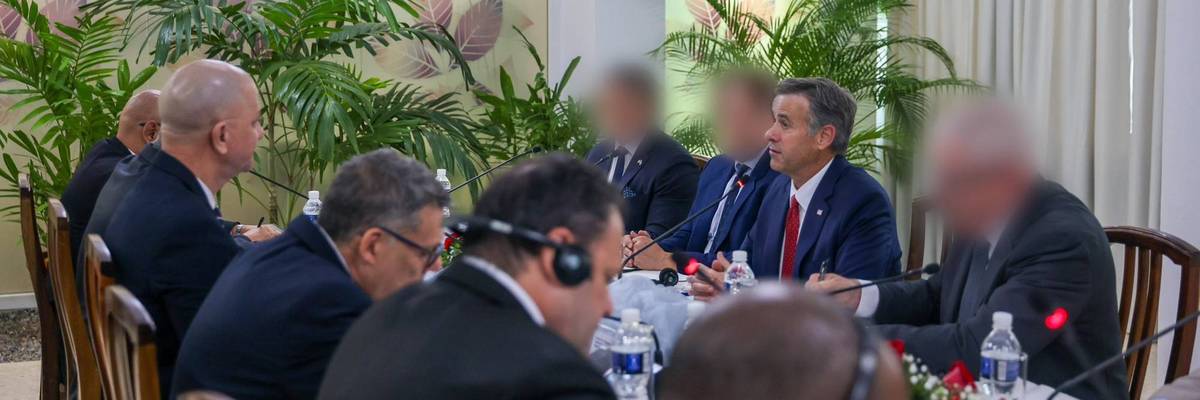
John Ratcliffe, director of the US Central Intelligence Agency, is pictured during a meeting with Cuban officials in Havana on May 14, 2026.
(Photo: US Central Intelligence Agency)

Jake Johnson
May 15, 2026
COMMON DREAMS

The director of the US Central Intelligence Agency met with Cuban officials in Havana on Thursday after the island nation’s government said it had completely run out of fuel due to the Trump administration’s oil blockade.

The CIA’s X account posted photos of some of Director John Ratcliffe’s meetings, blurring the faces of US intelligence officials who accompanied the agency chief. In a statement, the CIA said it met with Raúl Rodríguez Castro, the grandson of former Cuban President Raúl Castro; Interior Minister Lázaro Álvarez Casas; and the head of Cuba’s intelligence services.


“This is one of the most sinister and ominous social media posts I’ve ever seen,” legal scholar Maryam Jamshidi wrote in response to the CIA photos.

Ratcliffe, the highest-ranking Trump administration official to visit Cuba, decided to visit “to personally deliver President Donald Trump’s message that the United States is prepared to seriously engage on economic and security issues, but only if Cuba makes fundamental changes,” the CIA said.

A CIA official told NewsNation that “while the director emphasized that President Trump prefers dialogue, the Cubans should have no illusions that the President will not enforce red lines.”

Trump has repeatedly threatened to seize Cuba by force, describing the island country as his next military target after Venezuela and Iran. Fears of an imminent military attack have grown in recent weeks amid Trump’s belligerent rhetoric and surging US surveillance flights off Cuba’s coast.

“I think I can do anything I want with [Cuba], if you want to know the truth,” Trump told reporters in the Oval Office in March. “A very weakened nation.”

“This failed policy needs to end immediately. Every day, we are contributing to immense suffering in Cuba and a worsening humanitarian crisis.”

The spy chief’s trip came a day after Cuba’s energy minister announced that months after Trump imposed an oil blockade on the island, “we have absolutely no fuel oil, absolutely no diesel.”

The same day, the US State Department dangled “$100 million in direct humanitarian assistance to the Cuban people.” Cuban Foreign Minister Bruno Rodríguez Parrilla said Cuba’s leadership is “willing to hear the details of the offer and the manner in which it would be implemented.”

“We hope it is free of political maneuvers and attempts to exploit the shortages and suffering of a people under siege,” he added. “The best aid that the US government could provide to the noble Cuban people at this or any time is to de-escalate the measures of the energy, economic, commercial, and financial blockade, intensified as never before in recent months, which severely affects all sectors of the Cuban economy and society.”

Cuban President Miguel Díaz-Canel echoed that sentiment, writing in a Thursday social media post that “the damage could be alleviated in a much easier and more expeditious way by lifting or easing the blockade, as it is well known that the humanitarian situation is coldly calculated and induced.”

Progressive lawmakers in the US are imploring the Trump administration to end US economic warfare against Cuba, engage diplomatically with the country, and drop any plans for a military assault.

Rep. Pramila Jayapal (D-Wash.), who has come under attack from Republican lawmakers for visiting Cuba in April, said Thursday that “Cuba has run out of diesel and fuel oil and is enduring some of the worst blackouts in decades because of the US’ cruel oil blockade.”

“This failed policy needs to end immediately,” said Jayapal. “Every day, we are contributing to immense suffering in Cuba and a worsening humanitarian crisis.”


World ‘Burning Through Oil Safety Net’ as Trump Weighs Plans to Restart Iran Assault

“You can only decrease consumption so much, and when inventories run out, they are going to run out,” said one energy industry expert.


Fuel prices are displayed on a sign as a customer fills their vehicle at a gas station on April 13, 2026 in Miami, Florida.
(Photo by Joe Raedle/Getty Images)

Brad Reed
May 15, 2026
COMMON DREAMS

The global energy crisis caused by President Donald Trump’s illegal war with Iran is set to worsen in the coming months, as The Wall Street Journal reported on Friday that the world is “burning through its oil safety net.”

Even though oil prices surged at the start of the war, which led Iran to close the Strait of Hormuz to commercial ships, that increase was temporarily mitigated by crude surpluses that allowed countries to add more petroleum to the market.

However, the Journal reported that those reserve stocks are being depleted at an unprecedented pace, with inventories declining by nearly 250 million barrels in just the first two months of the conflict.

This rapid drawdown has led oil executives and analysts to warn that “a harsh reckoning is set to upend the relative calm in energy markets” as “acute shortages of key fuels and soaring prices could emerge within weeks if the Strait of Hormuz remains shut,” according to the Journal.

The Journal cited a report from consulting firm Eurasia Group estimating that, at the current rate of depletion, US diesel reserves are set to fall below 100 million barrels for the first time in 23 years by the end of this month.

Ellen Wald, senior fellow at the Atlantic Council’s Global Energy Center, told the Journal that while the increased price of oil would be partially offset by a decrease in consumption, the sheer scale of the coming supply crunch is so big that prices will continue to spiral upward.

“You can only decrease consumption so much, and when inventories run out, they are going to run out,” Wald explained. “At some point the market is going to collide and prices are going to shoot up.”

This problem could be exacerbated further if Trump decides to renew attacks on Iran, which could lead to devastating Iranian counterstrikes on oil production facilities throughout the region.

Zeteo reported on Thursday that “preparations for an imminent new phase of Trump’s Iran war have accelerated,” as the president “has grown increasingly frustrated by the state of peace talks.”

According to Zeteo’s sources, the US military campaign is set to ramp up shortly after Trump returns from his visit to China, with options that include “a potential massive new bombing campaign against the Iranians.”

The US military bombed Iranian military targets and civilian infrastructure throughout the early weeks of the conflict, but the country has still refused to reopen the Strait of Hormuz.

With peace talks stalled and the prospect of renewed hostilities on the table, the price of Brent crude futures surged on Friday, topping more than $108 per barrel.

Average gas prices in the US remained above $4.50 on Friday, and petroleum industry analyst Patrick De Haan estimated on Thursday that prices could soon jump to over $5 per gallon if the Strait of Hormuz isn’t opened soon.
BOYCOTT CAT

Israeli bulldozers raze about 50 Palestinian shops ahead of settlement-linked road project

AL-EIZARIYA, West Bank (AP) — Israel says the demolitions are needed to make way for a road serving Palestinian communities. But Palestinian officials say the road is part of a broader plan to keep Palestinian vehicles off a new highway being built to serve nearby Israeli settlements.


Sam Metz and Mahmoud Ilean
May 14, 2026

AL-EIZARIYA, West Bank (AP) — Israeli bulldozers tore down dozens of Palestinian shops on the edge of a town southeast of Jerusalem this week, clearing land ahead of a settlement-linked road project in the occupied West Bank.

Israel says the demolitions are needed to make way for a road serving Palestinian communities. But Palestinian officials say the road is part of a broader plan to keep Palestinian vehicles off a new highway being built to serve nearby Israeli settlements.

That project is part of a strategic section of the West Bank known as E1, which Israel is developing with the intention of preventing the establishment of a Palestinian state.

“The shops that were demolished are where Israel is planning to build a new road that will divert all Palestinian traffic to that road so that they can close down the whole area of E1 for Palestinians,” said Hagit Ofran, director of the antisettlement group Peace Now.

Tuesday’s demolitions took place in the town of al-Eizariya, less than a week after some owners received notices to evacuate shops built without permits. Attorneys appealed, up to Israel’s Supreme Court, but the demolitions went ahead.

Israeli authorities said the buildings including car washes, scrap metal shops and vegetable stands were built illegally and owners had been warned for “several years” enforcement was forthcoming.

COGAT, the Israeli military body overseeing civil affairs in the West Bank, said the structures obstructed construction of the planned road to connect Palestinian towns.

The new road system is meant to solve congestion and improve the quality of life of Palestinian towns in the area, Israel says.

Rights groups and the internationally backed Palestinian Authority say the demolitions are connected to Israel’s plans to overhaul transportation and create separate road systems for Israeli and Palestinian ID holders. They say Israel’s planned tunnel-and-bypass road will reroute Palestinian traffic off a major Israeli highway linking nearby West Bank settlements to Jerusalem, in effect cutting off drivers from large swaths of the territory.

Some of the demolished shops partially blocked sidewalks and roads leading into the town. But Palestinians say proper construction permits are nearly impossible to obtain from Israeli authorities, even as Israeli settlements rapidly expand.

Mohammad Abu Ghalieh, a 48-year-old shop owner, was dumbfounded that he would have to start over after the demolitions.

“Forty-eight years of night and day to build something for his children and himself, and in one day and one night, everything was gone,” he said.

Daoud al-Jahalin, the head of nearby village council, said more than 200 families would lose their incomes.

The E1 project is especially contentious because it runs from the outskirts of Jerusalem deep into the occupied West Bank, isolating the cities of Ramallah and Bethlehem and hindering north-south movement for the Palestinians.

Both Israeli leaders and critics of settlements say the E1 plan would complicate efforts to establish of a contiguous Palestinian state in the West Bank. Israel is planning to build some 3,500 apartments next to the existing settlement of Maale Adumim.

Israel captured the West Bank in the 1967 Mideast war. The international community overwhelmingly considers Israeli settlement construction in the occupied territory to be illegal and an obstacle to peace.

___

Metz reported from Ramallah, West Bank. Shlomo Mor contributed from Al-Eizariya.
Associated Press religion coverage receives support through the AP’s collaboration with The Conversation US, with funding from Lilly Endowment Inc. The AP is solely responsible for this content.


Palestinian activist Ramy Shaath faces deportation from France

Palestinian activist Ramy Shaath is facing deportation proceedings from France, as his presence in the country is now considered a “serious threat to public order” by authorities, his lawyer said on Friday. The activist, a co-founder of the Urgence Palestine organisation, had been detained in Egypt between 2019 and 2022 before being released and allowed to join his wife in France.


Issued on: 15/05/2026 
By: FRANCE 24

In this undated image from the Free Ramy Shaath Facebook page, Ramy Shaath poses for a picture in Cairo. © AP

Palestinian activist Ramy Shaath is facing deportation from France after authorities deemed his presence a "serious threat to public order", his lawyer told AFP on Friday.

Shaath, 54, was a prominent figure of the 2011 uprising in Egypt and the coordinator of the country's chapter of the Boycott, Divestment and Sanctions (BDS) movement against Israel.

He spent 900 days in detention in Egypt between 2019 and 2022 before he was released and allowed to leave for France, a decision French President Emmanuel Macron welcomed at the time.

Freed activist Ramy Shaath says 'arbitrary detentions' on the rise in Egypt

THE INTERVIEW © FRANCE 24
11:54


"The Nanterre prefecture has notified us that it intends to initiate deportation proceedings," Shaath's lawyer, Damia Taharraoui, said, referring to the western Paris suburb.

The prefecture's notice, seen by AFP, cites his links to "figures of the Palestinian cause in France" and organisations including Urgence Palestine – which he co-founded after Hamas's October 7, 2023 attack on Israel triggered the Gaza war – as grounds for opening deportation proceedings.

The notice also points to "repeated controversial actions and remarks" allegedly made during public appearances, including at a November 2023 protest in Paris, where he denounced what he called "Israel's criminal occupation of Gaza" and referred to "Israeli 'terrorists' who bomb houses and hospitals".

An investigation into the offence of "defending terrorism" opened over the remarks was closed in October 2024.


He is to appear before a deportation committee on May 21 after which the prefecture "may immediately issue a deportation order that can be enforced at any time", Taharraoui said.

"He cannot be deported to Egypt, because he no longer holds Egyptian nationality, nor to Palestine, because the country is at war," the lawyer added.

For his part, Shaath said he had attended several demonstrations calling for "an immediate ceasefire, an end to the genocide, sanctions, arms embargoes and international action" against Israel.

"My stance has never changed since the time France worked to secure my release from Egyptian prisons where I was a political prisoner ... but today, it seems they want to silence me," he told AFP.

Contacted by AFP, the Nanterre prefecture and the Interior Ministry did not immediately respond.

(FRANCE 24 with AFP)
GOP civil war growing as party 'splinters' over Israel ties: report

Tom Boggioni
May 16, 2026 
RAW STORY


President Donald Trump talks with Israel's Prime Minister Benjamin Netanyahu at the Knesset, Monday, Oct. 13, 2025, in Jerusalem. Evan Vucci/Pool via REUTERS


A significant schism is emerging within the Republican Party over the extent to which the United States should support Israel and Prime Minister Benjamin Netanyahu — with a substantial number of MAGA voters showing unwavering loyalty while non-MAGA conservatives increasingly question America's commitment to the longtime ally.

According to Politico, new polling from The POLITICO Poll reveals stark divides among Republican voters on Israel policy, with the party's traditional unity on Middle East issues fracturing amid Trump's unpopular Iran war and growing skepticism about U.S. interventionism.

Nearly half of self-identified MAGA Trump voters say they back Israel and approve of Netanyahu's government's actions, while just 29 percent of non-MAGA Trump voters say the same. The divide is even more pronounced on specific military operations: 41 percent of MAGA voters say Israel is justified in its military campaign in Gaza, compared with 31 percent of non-MAGA voters.

On whether Israel has overextended militarily, 24 percent of MAGA voters believe the country was initially justified but has gone too far — compared with 31 percent of non-MAGA voters.

Non-MAGA voters are notably more critical of Israeli influence on U.S. policy. They are 10 percentage points more likely than MAGA Trump voters to believe the Israeli government has too much influence over American foreign policy, Politico's Lisa Kashinsky and Erin Doherty are reporting.

The emerging fractures have spilled into an ugly public debate, with prominent Republicans including Tucker Carlson, former Georgia Rep. Marjorie Taylor Greene, and Steve Bannon all criticizing America's close relationship with Israel — particularly as the Iran war escalates.

Most Republican members of Congress and conservative influencers like Laura Loomer and Ben Shapiro have remained steadfast pro-Israel voices defending the administration's foreign policy approach.

Republicans were powerfully unified in support of Israel in the immediate aftermath of Hamas' October 7 attack. But amid the Iran war and growing unease about Trump's foreign interventions, Israel's standing appears increasingly fragile among the non-MAGA wing of the GOP and among young conservatives.

"There is a sentiment right now within the Republican Party of, 'America First,' let's get out of all of the conflicts in the world, let's not be committed to those conflicts," said Amnon Cavari, an associate professor at the Lauder School of Government, Diplomacy and Strategy at Reichman University in Israel, told Politico.

According to the report, the emerging Republican divide carries "significant implications" for the future of the U.S.-Israel alliance and GOP efforts to maintain the coalition that powered Trump's return to the White House.