
Cuban Envoy Draws ‘Red Lines’ Amid Specter of US Invasion and DOJ Targeting Castro Like Maduro
Cuban Chargé d’Affaires Lianys Torres Rivera said her government is willing to negotiate with the US, but “the only exception is our sovereignty, independence, and right to self-determination.”
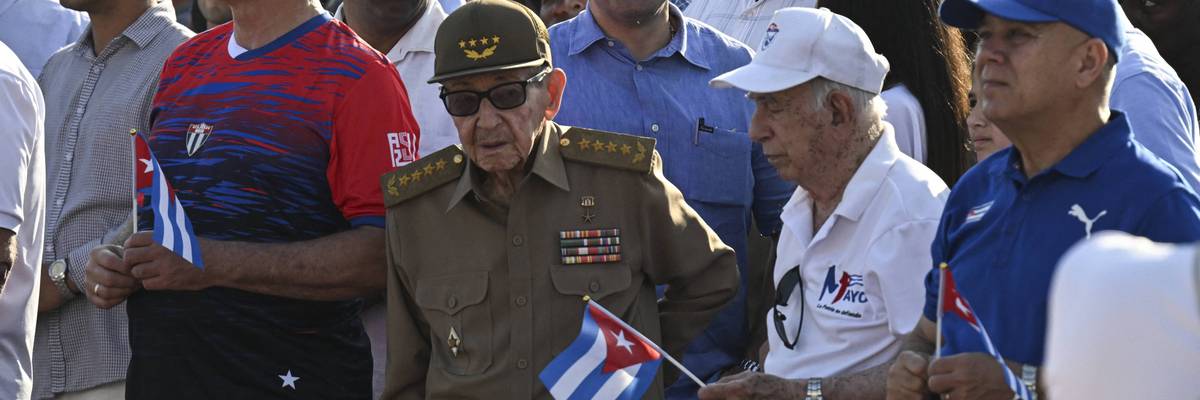
Former Cuban President Raúl Castro (center, in military uniform) and other officials attend a rally marking International Workers’ Day in Havana on May 1, 2026.
(Photo by Yamil Lage/AFP via Getty Images)
Brett Wilkins
May 15, 2026
COMMON DREAMS
Cuba’s top diplomat in the United States on Friday underscored the inviolability of her country’s sovereignty amid tenuous negotiations with the Trump administration and mounting fears that the US is planning to criminally indict a former Cuban president and possibly invade the island to abduct him.
Cuban Chargé d’Affaires Lianys Torres Rivera told The Hill that her country’s socialist government is open to negotiating with the US, but that “the only exception is our sovereignty, independence, and right to self-determination,” adding that “those are the red lines.”
Following Pattern Set by Venezuela and Iran Assaults, US Surveillance Flights Off Cuba Surge
Torres Rivera acknowledged that ramped-up US pressure—including President Donald Trump’s invasion threats and tightening of the internationally condemned 65-year economic embargo—is inflicting tremendous suffering on the Cuban people.
“It’s difficult. What the Cuban people are enduring these days is difficult,” she said. “They are under a collective punishment from the US.”
The Cuban government said Thursday that Trump’s oil blockade has left the island and its 11 million people without fuel—a situation United Nations experts last week described as illegal “energy starvation.”
“We have reorganized the whole country, the healthcare system, the education system, the transportation system, to keep the basic services running,” Torres Rivera told The Hill. “But it doesn’t mean that they are running normally. They are running under huge stress.”
Still, “a serious country that respects yourself... won’t put on the table your political system or your internal order that the people of our country decide in a sovereign way,” she stressed.
The delicate balancing act Cuba is being forced to perform was on stark display on Thursday as Central Intelligence Agency Director John Ratcliffe traveled to Havana for talks aimed at pressuring Cuban officials into complying with demands that critics say would inrfinge upon the nation’s sovereignty. These likely include political and economic reforms, releasing political prisoners, and ending or weakening Cuba’s alliances with US adversaries including China, Iran, Russia, and Venezuela.
It was a bitter pill to swallow for Cubans, as the CIA was behind myriad efforts to topple their government, from assassination attempts against revolutionary leader Fidel Castro to the failed Bay of Pigs invasion to supporting Cuban exile terrorists who carried out deadly attacks that Havana says killed thousands of people.
Further stoking fears of aggression from the Trump administration,r unidentified US officials told CBS News that the Department of Justice is preparing to criminally indict 94-year-old former Cuban President Raúl Castro for the 1996 shoot-down of planes belonging to the subversive US-based group Brothers to the Rescue after they violated Cuban airspace.
Some observers noted the 1976 midair bombing by US-based anti-Castro militants of Cubana de Aviacion Flight 455, a commercial airliner carrying 73 passengers and crew. The CIA, under then-Director George H.W. Bush, knew that Cuban exiles were plotting to blow up a Cubana plane, but did not warn Havana. The perpetrators of the bombing eventually made their way back to Florida, where they were welcomed as heroes.
Others surmised that the reported planned indictment is a pretext for a US invasion and arrest of Castro similar to January’s abduction of Venezuelan President Nicolás Maduro on dubious—and partially retracted—narco-terrorism allegations.Thirty-two Cubans, including military and police officers providing security for Maduro, were killed by US forces during the abduction operation.
“To me, this signals that the Pirate State could be planning another kidnapping operation against Cuba like they did in Venezuela,” British journalist Richard Medhurst said in response to the reporting, referring to the US. “This is the lawless behavior they want to normalize around the world.”
ACLU head of digital engagement Stefan Smith said on social media: “Remember Maduro and Venezuela? If you’re a foreign leader indicted in American courts, we claim the right to send the military to kidnap you. Indictment is permission to invade.”
Following his visit to Cuba, Ratcliffe said that negotiations “will not stay open indefinitely,” remarks that followed numerous threats by Trump to “take” Cuba.
“Whether I free it, take it—I think I can do anything I want,” the president said in March as his fuel embargo caused blackouts that brought deadly suffering to the most vulnerable Cubans, including sick people and children.
Torres Rivera insisted that protests over the blackouts don’t mean Cubans won’t rally in defense of their homeland.
“When they are enduring 20 hours of blackouts, they have grievances, and they express it,” she told The Hill, cautioning US officials against a “wrong reading” of the demonstrations.
“We are preparing to defend ourselves,” Torres Rivera said, adding that a US invasion “could be a big mistake. It could be a bloodbath.”
“We don’t want Cubans dying in Cuba,” she stressed, nor “any American soldier.”
Democratic Rep. Pramila Jayapal called for an immediate end to the US blockade, warning that “we are contributing to immense suffering in Cuba and a worsening humanitarian crisis.”
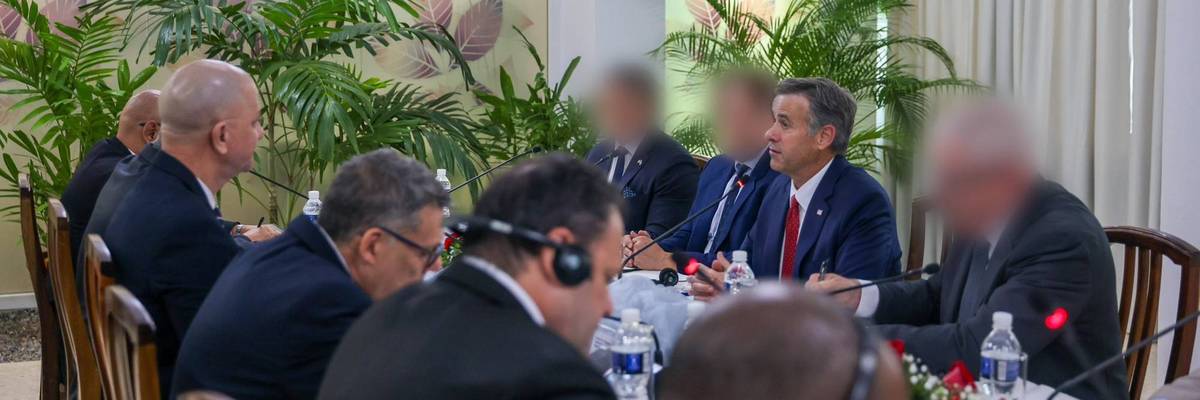
John Ratcliffe, director of the US Central Intelligence Agency, is pictured during a meeting with Cuban officials in Havana on May 14, 2026.
(Photo: US Central Intelligence Agency)
Jake Johnson
May 15, 2026
COMMON DREAMS
The director of the US Central Intelligence Agency met with Cuban officials in Havana on Thursday after the island nation’s government said it had completely run out of fuel due to the Trump administration’s oil blockade.
The CIA’s X account posted photos of some of Director John Ratcliffe’s meetings, blurring the faces of US intelligence officials who accompanied the agency chief. In a statement, the CIA said it met with Raúl Rodríguez Castro, the grandson of former Cuban President Raúl Castro; Interior Minister Lázaro Álvarez Casas; and the head of Cuba’s intelligence services.
“This is one of the most sinister and ominous social media posts I’ve ever seen,” legal scholar Maryam Jamshidi wrote in response to the CIA photos.
Ratcliffe, the highest-ranking Trump administration official to visit Cuba, decided to visit “to personally deliver President Donald Trump’s message that the United States is prepared to seriously engage on economic and security issues, but only if Cuba makes fundamental changes,” the CIA said.
A CIA official told NewsNation that “while the director emphasized that President Trump prefers dialogue, the Cubans should have no illusions that the President will not enforce red lines.”
Trump has repeatedly threatened to seize Cuba by force, describing the island country as his next military target after Venezuela and Iran. Fears of an imminent military attack have grown in recent weeks amid Trump’s belligerent rhetoric and surging US surveillance flights off Cuba’s coast.
“I think I can do anything I want with [Cuba], if you want to know the truth,” Trump told reporters in the Oval Office in March. “A very weakened nation.”
“This failed policy needs to end immediately. Every day, we are contributing to immense suffering in Cuba and a worsening humanitarian crisis.”
The spy chief’s trip came a day after Cuba’s energy minister announced that months after Trump imposed an oil blockade on the island, “we have absolutely no fuel oil, absolutely no diesel.”
The same day, the US State Department dangled “$100 million in direct humanitarian assistance to the Cuban people.” Cuban Foreign Minister Bruno Rodríguez Parrilla said Cuba’s leadership is “willing to hear the details of the offer and the manner in which it would be implemented.”
“We hope it is free of political maneuvers and attempts to exploit the shortages and suffering of a people under siege,” he added. “The best aid that the US government could provide to the noble Cuban people at this or any time is to de-escalate the measures of the energy, economic, commercial, and financial blockade, intensified as never before in recent months, which severely affects all sectors of the Cuban economy and society.”
Cuban President Miguel Díaz-Canel echoed that sentiment, writing in a Thursday social media post that “the damage could be alleviated in a much easier and more expeditious way by lifting or easing the blockade, as it is well known that the humanitarian situation is coldly calculated and induced.”
Progressive lawmakers in the US are imploring the Trump administration to end US economic warfare against Cuba, engage diplomatically with the country, and drop any plans for a military assault.
Rep. Pramila Jayapal (D-Wash.), who has come under attack from Republican lawmakers for visiting Cuba in April, said Thursday that “Cuba has run out of diesel and fuel oil and is enduring some of the worst blackouts in decades because of the US’ cruel oil blockade.”
“This failed policy needs to end immediately,” said Jayapal. “Every day, we are contributing to immense suffering in Cuba and a worsening humanitarian crisis.”


No comments:
Post a Comment