Thursday, July 02, 2026


‘We’ve been too dependent on the United States’: B.C.’s premier headed to China in hopes of expanding trade


Published:

B.C. Premier David Eby spoke to the media before heading to China in hopes of expanding trade.

B.C. Premier David Eby spoke with the media on Saturday before catching a flight to China in hopes of diversifying trade relationships.

Eby said this trip, among others to Japan, South Korea, and Singapore, is part of a provincial goal to double international trade in the next decade.

“We want to double our international trade beyond where it is right now, outside of the United States, he said. “The U.S. has been historically a very good trading partner for us, but we’ve been too dependent on the United States.”

The premier called China B.C.’s second-largest trading partner, and said he and Minister of Transportation Mike Farnworth will be making stops in Beijing, Shanghai, and Wenzhou. Eby said his focus on this trip will be “jobs and opportunity for British Columbians.”

“We have lots of connections, people-to-people connections with China, 500,000 Canadians of Chinese descent in British Columbia alone,” he explained. “Those people-to-people relationships have gotten us through some tough times.”

Eby pointed to Prime Minister Mark Carney having “opened the door” for this opportunity to expand trade with China, and outlined that he’ll be “at the table” to discuss lumber trade, agricultural products, and “opportunities like tourism” that can grow B.C.’s economy at home.

When asked about specific projects he’ll focus on in his trip, the premier mentioned LNG Canada Phase Two, which he said is reaching its “final investment decision in September.” He said addressing any “final concerns” is something he’s seeking to achieve.

“It’s a consortium of four different countries, including China through Petro China ... It’s worth about $28 billion in terms of provincial revenue to pay for public services,” he said.

Eby says he’ll “provide as much information” about his meetings in China as he can when he returns, although he adds that some of these meetings are “a little more sensitive.”

James Paracy

Opens in new window

CTVNewsVancouver.ca Journalist

Shipping rates soar as retailers race to beat looming Trump tariffs


Published:

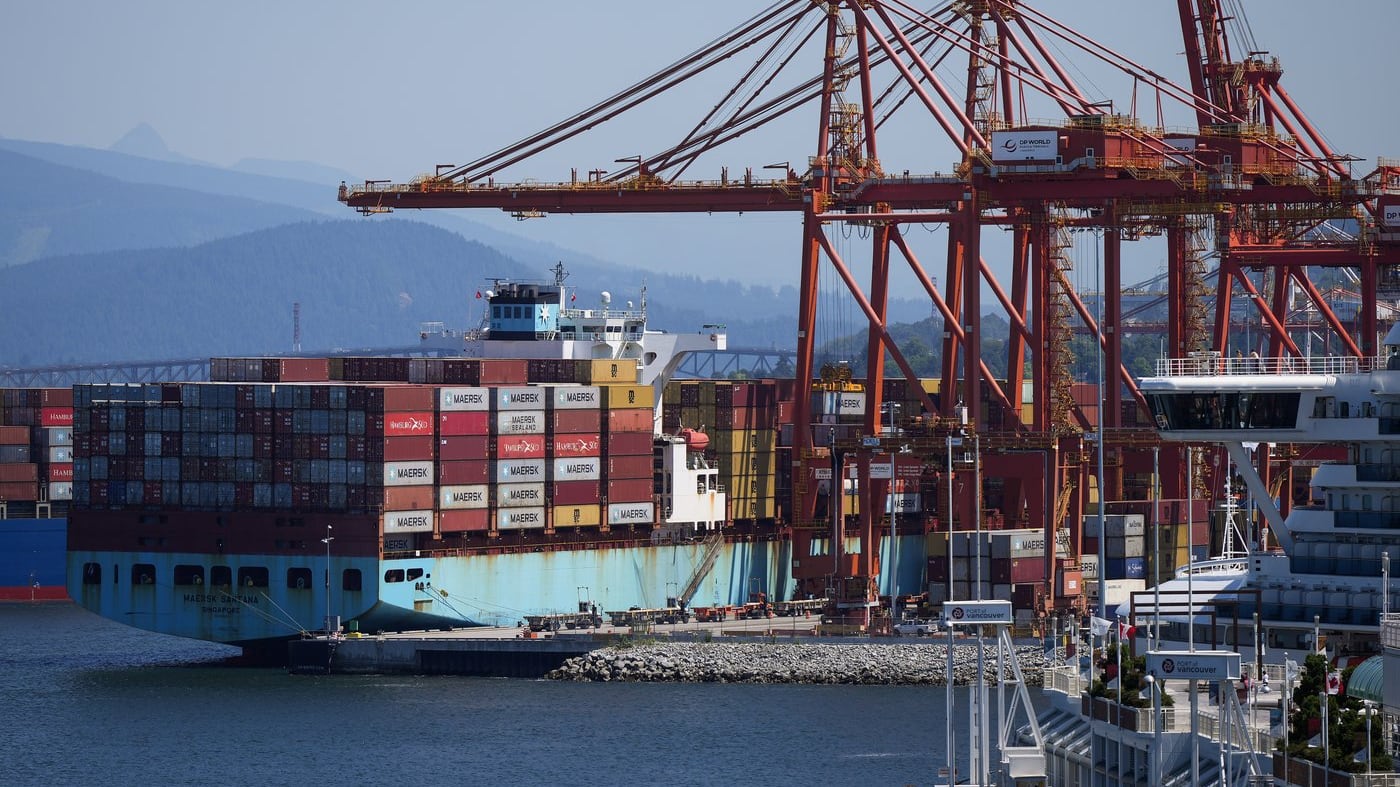
A gantry crane operator removes a container from a cargo ship while docked at port, in Vancouver, on Tuesday, July 16, 2024. THE CANADIAN PRESS/Darryl Dyck

MONTREAL — Christmas is coming early this year. And it’s pushing up shipping rates.

A glut of early wholesale orders for everything from holiday decorations to home furniture has propelled maritime shipping costs to four-year highs as a result of tariff uncertainty and the Iran war, with potential repercussions for consumers.

Industry specialists say retailers and importers — especially in the United States — are rushing to book shipments to get ahead of a potential fresh round of U.S. tariffs on dozens of countries that’s expected near the end of July.

The surge in demand is boosting seaborne transport prices across the globe.

“Taken together, the early start to peak-season demand is the main cause of spiking freight rates,” said Judah Levine, head of research at shipping platform Freightos, in an email.

He attributed the “front-loading” primarily to presumed tariffs, but also to fuel price increases that stem from the months-long closure of the Strait of Hormuz.

Large shippers have long-term contracts with carriers where fuel costs are adjusted quarterly. The higher fuel costs those carriers incurred over the past three months will be passed along to shippers starting this summer, Levine said.

Similar arrangements between importers and manufacturers — whose costs have also gone up due to the spike in energy prices — give shippers all the more motivation to get their orders in now.

“In this sense, part of the early jump (in shipping) is an indirect impact of the Hormuz closure,” Levine said.

According to the Platts Container Index, global shipping rates for containers leaped about 80 per cent in the 30 days ended June 24 to hit their highest level since April 2022, when pandemic-related supply chain problems peaked.

Rates close to home have vaulted even higher. The average price of a 40-foot container hauled from East Asia to North America’s west coast climbed 120 per cent over the past six weeks to US$6,200, according to Freightos.

“People are stocking up,” said John Corey, president of the Freight Management Association of Canada.

Angst over potential U.S. levies of at least 10 per cent on countries undergoing an American probe into forced labour practices makes up part of the explanation. So does the fragility of the United States-Mexico-Canada Agreement, whose July 1 renewal deadline just passed.

“It’s the uncertainty of what’s going to happen,” Corey said.

The White House said last month Canada is among the 59 countries plus the European Union that should be subject to an additional tariff over allegations they allow goods produced by forced labour into American supply chains. However, the vast majority of merchandise exported to the U.S. from Canada is compliant with the existing continental trade pact and exempt from levies.

As for the July 1 renewal deadline on that deal, Corey considers it “much ado about nothing,” as do most business leaders. Nonetheless, the uncertainty lingers, prompting companies to play it safe and order supplies before the situation shifts.

“All this ambiguity creates a frenzy of booking, which drives prices up,” said Lisa McEwan, co-owner of customs brokerage Hemisphere Freight.

“I’m telling all of my clients, ‘Get it booked, get it shipped.’”

She says her clients are ordering everything from clothing and holiday decor to tables, televisions and tiles earlier than usual, and that customers will pay the price at the checkout counter.

“The people who are going to be affected the most are going to be the average household consumer,” she said.

“They will bear the brunt of it.”

This report by The Canadian Press was first published July 2, 2026.

Christopher Reynolds, The Canadian Press

$10 million proposed settlement reached in CIBC class action lawsuit


Published:

A CIBC sign is shown in the financial district in Toronto on Tuesday, August 22, 2017. (THE CANADIAN PRESS/Nathan Denette)

The Canadian Imperial Bank of Commerce has agreed to pay a $10 million settlement in a class action lawsuit over non-sufficient funds (NSF) fees.

According to joint announcement from CIBC and the Koskie Minsky LLP law firm, the proposed settlement was reached on June 24 after lengthy negotiations and the assistance of a mediator. A judge must still approve the proposed settlement during an Ontario Superior Court of Justice hearing scheduled for Oct. 19.

The class action took aim at CIBC’s practice of charging duplicative NSF fees on failed pre-authorized debit transactions. In other words, if a customer had insufficient funds for a pre-authorized payment like a phone bill or monthly gym membership, and if the billing company repeatedly tried to withdraw money from a customer’s account, CIBC would charge NSF fees for every failed transaction.

Koskie Minsky LLP, which was appointed as class counsel, alleged that the practice violated consumer protection legislation and CIBC’s customer contract. CIBC reportedly charged the duplicative NSF fees between Sept. 21, 2020, and May 31, 2024.

As part of the terms of the proposed settlement, CIBC avoids admitting any liability. If the settlement is approved, CIBC will directly deposit funds into the account of affected customers, unless they choose to opt out of the class action.

The class action began in September 2022 and was certified in June 2024. Koskie Minsky LLP has also pursued similar class actions against the Bank of Montreal, TD Bank, Scotiabank and the Royal Bank of Canada. Proposed and approved settlements have already been reached with TD, Scotiabank and RBC.

Ottawa caps NSF fees

The settlement comes after Ottawa instituted a limit on NSF fees in March. Under the new rules, banks and financial institutions must cap NSF fees at $10 for personal and joint accounts.

Banks are also now prohibited from charging NSF fees for accounts that have an overdraft of less than $10, and they are now only allowed to charge one NSF fee per account within a two business day period. The caps do not apply to corporate or business accounts.

According to the federal government, NSF fees in Canada previously ranged from $45 to $48.

“These fees disproportionately impact the financial well-being of low-income Canadians who do not have access to overdraft protection and can perpetuate debt cycles by reducing the amount of available funds with which a consumer could pay their bills,” Canada’s Department of Finance said when it announced the changes.

“These fees are often applied regardless of the size of the account shortfall and can be charged in rapid succession as a result of multiple declined payments.”

With files from The Canadian Press.

ALBERTA


Green light for Greenlight: Pembina, partners go ahead with gas plant for data centre


Published:

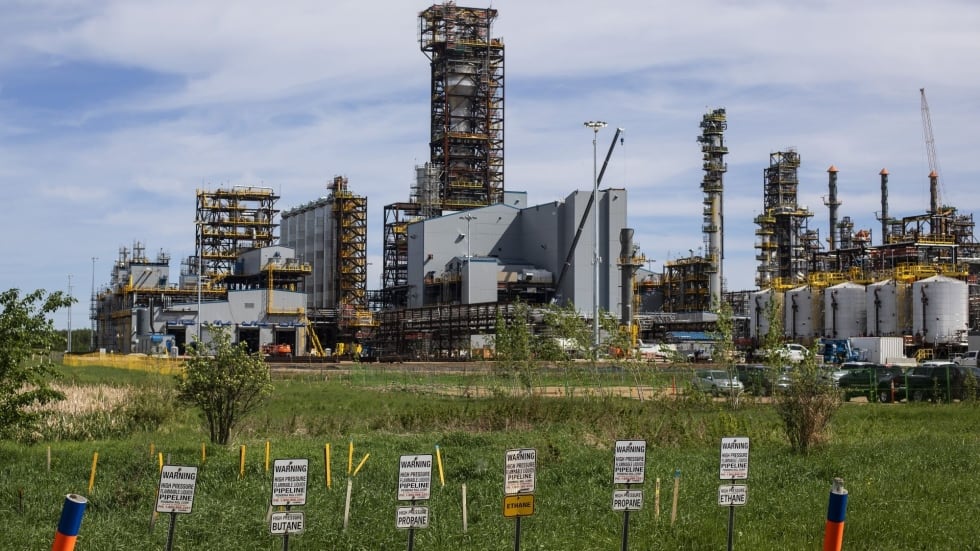
Pembina NGL pipeline warning signs outside the Inter Pipeline Heartland Petrochemical Complex under construction in Strathcona County, Alberta, Canada, on Wednesday, June 2, 2021.

CALGARY — Pembina Pipeline Corp. and two partners have given the go-ahead to the Greenlight Electricity Centre, a natural gas plant serving a data centre customer.

Pembina, Morgan Stanley Infrastructure Partners and Kineticor Asset Management expect the cost of the project to come in at $4.6 billion.

The 932-megawatt plant would be built in Sturgeon County, part of Alberta’s Industrial Heartland region north of Edmonton, with startup targeted for the second half of 2030.

Data centres house the computer hardware required to power various tech applications, and their scale has ballooned with the boom in artificial intelligence and cloud computing.

Alberta has been actively trying to court so-called hyperscale developers, like Meta and Google, to set up shop in the province, but its electricity grid currently does not have enough capacity to accommodate several such projects.

So Alberta is prioritizing projects that build their own power generation, like what the Greenlight partners are providing.

This report by The Canadian Press was first published July 2, 2026.

ADF Group announces proposed financing from Investissement Québec


Published:

ADF Group Inc., a Quebec-based maker of steel superstructures, fabricated the steel beams supporting the decks of the Samuel De Champlain Bridge, which opened in 2019, connecting Montreal to the South Shore across the St. Lawrence River. A span of the bridge is seen on Monday, June 17, 2019. THE CANADIAN PRESS/Paul Chiasson

TERREBONNE — ADF Group Inc., a producer of steel structures used in buildings and infrastructure, says it plans to sign a deal with Investissement Québec for a loan of up to $10 million for its Métabetchouan project.

The plan at ADF’s Groupe LAR Inc. subsidiary includes improvements at its current plant in the Saguenay-Lac-Saint-Jean region of Quebec, construction of an adjacent extension and acquisition of new equipment.

It will be carried out in parallel with a plan to modernize ADF’s facilities in Terrebonne, Que.

The company says it has also signed an agreement for loans under Quebec’s ESSOR program, managed by Investissement Québec, totalling $5 million, including $4 million, interest-free, for the Métabetchouan project, and $1 million, bearing interest at a fixed rate of 4.1 per cent for the Terrebonne project.

The financing is in addition to an agreement with the federal government through its strategic response fund.

The federal contribution is for up to $12.5 million, with half being non-repayable and the other half being repayable but interest-free.

This report by The Canadian Press was first published July 2, 2026.