SPACE/COSMOS
Rocket Lab to Buy Iridium for $8 Billion
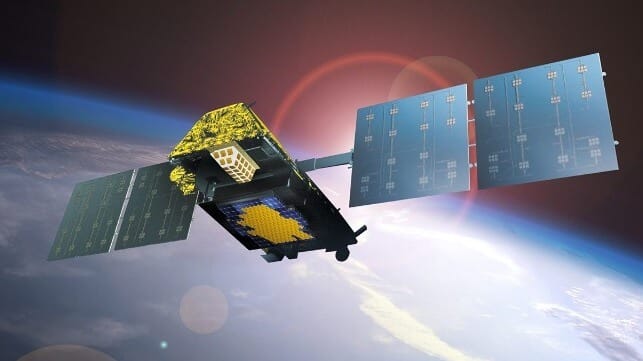
Iridium, the high-uptime LEO satcom operator, will soon be acquired by launch services company Rocket Lab, the two firms announced Monday. The $8 billion deal will create a vertically integrated rocket-plus-satcom company, comparable in structure to the core businesses of SpaceX/Starlink.
Rocket Lab plans to pay each Iridium shareholder $27 per share in cash, plus new shares of Rocket Lab to bring the total near to about $54 per share. The deal should close in mid-2027, once shareholder approvals are received.
"As the worlds of space and terrestrial communications continue to converge, more critical services will depend on space-based capabilities," said Iridium's CEO, Matt Desch. "Success will come from those who can bring new innovations to space quickly and sustain them over time as efficiently as possible."
Iridium is a well-established and well-known service provider for shipping, one of the company's core markets. It has been in operation since 1998, and is an authorized provider of GMDSS satellite emergency messaging. Its new network also supports resilient positioning, navigation and timing, performing functions comparable to GPS. Iridium's 66-strong constellation has full polar coverage, a virtue of the low earth orbit model, and its L-band network is less affected by weather than most broadband services. It has 2.5 million subscribers across aviation, maritime, commercial and government user bases.
"By marrying Iridium's deep heritage, trusted infrastructure, and highly sought-after spectrum with Rocket Lab's extensive and proven launch and manufacturing capabilities, we have the capability to unlock entirely new markets," said Rocket Lab founder and CEO Peter Beck in a statement.
The merged entity will look more like SpaceX's business, which combines orbital launch services (for other satellite operators) and its own broadband satcom fleet (launched into orbit on its own rockets). The two businesses are synergistic and have propelled SpaceX to a remarkable valuation, driving the largest single IPO of all time.
US space agency NASA is preparing to launch a robotic rescue mission to haul an ageing telescope into a higher orbit to save it from burning up as it falls back down to Earth. The next launch attempt is set for Wednesday after a previous liftoff was pushed back due to the weather.
Issued on: 30/06/2026 -

NASA is set to launch a daring robotic rescue mission to prevent one of its ageing telescopes from vanishing into dust.
If successful, the effort could pave the way for giving other satellites a second life.
The operation is set to last several months, kicking off with the launch of a robot designed to rescue the Swift space telescope that's currently falling towards Earth.
Without intervention, Swift is expected to soon burn up in the atmosphere.
The rescue spacecraft developed by the US startup Katalyst was slated to lift off Tuesday at 1023 GMT from a Pacific Ocean atoll aboard a small rocket named Pegasus.
But NASA postponed the launch, citing unfavourable weather conditions, and set the next launch attempt for "no earlier than Wednesday, July 1" at 0943 GMT.
The rocket-propelled launch vehicle will not take off from a launch pad. Instead, it will be released from a jet.

"Everything about this mission is so crazy," NASA astrophysicist Regina Caputo said with a laugh.
After it reaches an orbit near that of the telescope, the robot must locate Swift across the vastness of space.
The aim is then for the robot to maneuver around the telescope and latch on with three movable arms.
It will then vie to tow Swift into a stable orbit over the course of at least a month, rescuing it from destruction by moving it about 300 kilometres higher.
Only China has attempted a mission like the upcoming one, successfully boosting a satellite into a higher graveyard orbit four years ago.
"This is a lot of firsts stacked on top of each other," said Shawn Domagal-Goldman, the director of NASA's astrophysics division, during a recent call with reporters.
"I'm just deeply thankful that we're even giving this a go."
'Special' telescope
The idea of such a rescue might seem odd at first glance.
The Neil Gehrels Swift Observatory telescope was launched in 2004, and was originally designed for a two-year mission.
The device was intended to study gamma-ray bursts, what Caputo called "the most energetic things that happen in the universe".
She likened it to a supercharged version of a supernova, which is a dramatic, explosive death of a star.
Gamma-ray bursts are extremely brief, she explained, so the telescope was placed at an altitude of approximately 600 kilometres in low Earth orbit, so it could remain in constant communication with researchers.
But with that pro came a con – at such an altitude, the device without its own propulsion would eventually drift closer to Earth and burn up in the atmosphere.
Caputo said that phenomenon was expected and normal, because when the Sun is in its more active cyclical stages, it emits more particles and causes an expansion of Earth's atmosphere.
That creates drag, meaning satellites in low Earth orbit lose altitude.
Yet when forecasts in early 2025 indicated the telescope was nearing the end of its life, NASA began considering a possible rescue.
"We decided, yeah, we want to go save this one this time, because of how special it is," said Domagal-Goldman.
'50-50'
Despite its age, the Swift telescope remains in high demand within the scientific community, not least for its rapid response capabilities.
Should it burn up, it could not be immediately replaced.
The mission attempting unprecedented maneuvers has a projected cost of $30 million to save the device, which originally cost $250 million.

10:44
The rescue robot, named LINK, has its work cut out for it.
Engineers do not have a clear picture of what the back of the telescope actually looks like – even though that's where the robot must latch on.
With a laugh, Caputo projected the chances of success at "maybe 50-50".
Still, both NASA and the company Katalyst believe the mission – which could run into the fall – might pave the way for new possibilities in spacecraft management, and is worth a shot.
Robert Lamontagne, a vice president at Katalyst, said during a call with journalists that it could represent the "start of a new model" to "refuel, reposition, repurpose, repair, and even upgrade satellites, even if they were never prepared for it".
Italian astronaut Luca Parmitano will be the first European to participate in Nasa's lunar programme, as part of the Artemis III mission in 2027. He spoke to RFI about the challenges of such a mission, and the risks.
Issued on: 27/06/2026 - RFI

Nasa's Artemis III mission follows the successful Artemis II flight completed in April – the farthest humans have travelled from the Earth.
The crew will undertake a series of challenging tests in Low Earth Orbit in 2027, in preparation for Artemis IV, the first planned crewed mission to the lunar South Pole, in 2028.
At the helm will be Italy's Luca Parmitano, heading up a four-member crew expected to remain in space for around two weeks.
Selected by the European Space Agency (ESA) as an astronaut in 2009, Parmitano has a master’s degree in experimental flight test engineering from the Institut Supérieur de l’Aéronautique et de l’Espace in Toulouse. He has logged more than 2,000 flight hours across 40 types of aircraft.
RFI: Nasa announced on 9 June that you will be part of the next Artemis mission in 2027 – the first European to participate in a mission of the American space agency's lunar programme. How does it feel to be selected for such an adventure?
Luca Parmitano: It's incredible. I'm truly honoured to have been chosen for this role and this pilot position. It was completely unexpected. I'm approaching this role with humility because I know it's a very complex mission. I have a lot to learn.
RFI: What do you think made Nasa choose you?
LP: I think they looked at the experience, the background, the rank of the test pilots, and I think they looked at my experience as an astronaut with two missions to the International Space Station, station controls, spacewalks... They looked at all of that. They also looked at the coordination between who was going to fly, with what experience. So I was there at the right time, where my experience had the characteristics they were looking for.
RFI: You've already spent more than a year in space with two missions aboard the International Space Station – as a European on an American mission. Would you say international space cooperation still exists?
LP: I think this is a very good sign of international collaboration. In fact, I think it's a statement that Nasa believes everything we have to offer – our experience, our technology, our science, but also our personnel – is valuable, something that Nasa needs. And that's why I think it's a really good sign for now and for the future, because the Artemis project is very large, and so there are still many European contributions to this major exploration programme [to come].
RFI: So you'll be the first European on this Artemis programme, but perhaps not the last?
LP: I'm sure I won't be the last. I'm the first for this mission. But afterwards, the goal is to broaden our contribution in order to have boots on the moon.
RFI: There will be four of you on the mission, and you will be testing two lunar modules. What sort of activities will you be doing?
LP: With our crew, we're going to create the procedures for the in-orbit connection between the Orion space shuttle and the Human Landing System, the shuttles that will take the astronauts to the lunar surface until that point. We don't have anything like this yet. This procedure doesn't exist. We have to develop it. Our mission is to do it twice.
You might think it's simple because we're not going to the Moon, but in fact that's why it's much more complex, because the spacecraft is a Deep Space Shuttle. It was designed to work in space around the Moon, so working with it around Earth is much more difficult. And on top of that, we'll be working with two shuttles that have never flown. So it's really an experimental, testing mission, and that's why I'm so busy as a test pilot.
RFI: Do you think about the risks when you embark on this kind of mission?
LP: It's clear there will be risks. That's why we're going to do them in an environment we can control more easily. Because if there are major problems, we can quickly get back on the field. But risks are a bit like the salt of life. If there's no salt, life has no flavour. If there's too much, you can't enjoy it. You need the right level of risk to appreciate life.
RFI: During your first trip to the ISS, you had a problem during a spacewalk that could have been fatal when water got into your helmet and you nearly drowned...
LP: It was an experience that showed us that space flight is never what you expect. There will always be situations we haven't experienced. And you have to be prepared for them. [But] even when you're not prepared, it's clear that the training you receive is enough to give you the ability to cope, even when you don't have a procedure to follow.
RFI: The Artemis mission is at the end of 2027, almost a year and a half away. What will you be doing between now and then?
LP: We've started with training on the Orion shuttle. It's a shuttle that I don't know at all. I need to know it like my own car, or even better, within a few months, because the team will be working with this shuttle, along with other shuttles we don't know at all. So the Orion system needs to become my area of expertise, something I know very well, including the procedures and systems. So I have a lot of work to do.
This interview has been adapted from the original version in French by Arnaud Pontus and lightly edited for clarity.

No comments:
Post a Comment