CMA CGM deploys world's largest LNG-powered container ship on Asia-Europe route
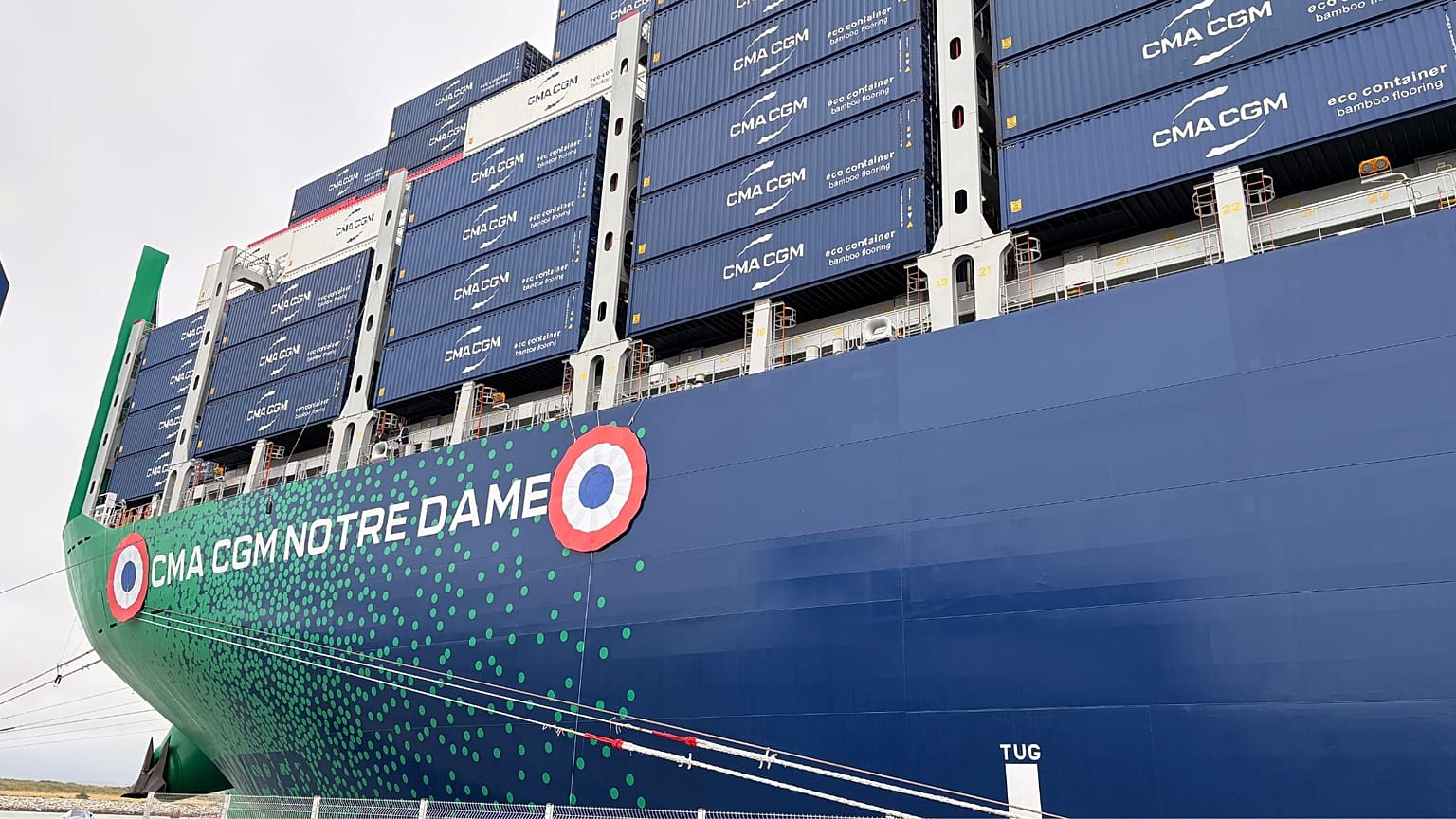
Europe is investing in ever larger, cleaner container ships at a time when maritime sovereignty and supply-chain resilience have become strategic priorities.
Europe's strategic push to strengthen maritime trade received a boost on Thursday as French shipping group CMA CGM inaugurated the CMA CGM Notre Dame, the world's largest LNG-powered container ship and the first of a new fleet that will operate on the company's flagship Asia-Europe trade route.
Stretching almost 400 metres—roughly the length of four football pitches—the CMA CGM Notre Dame dominates the quayside in Le Havre. Towering stacks of containers rise above the deck, carrying everything from trainers to cars as the vessel prepares to enter service on one of the world's busiest trade routes.
The vessel measures, which is more than 62 metres wide and can carry up to 24,000 containers, is powered by liquefied natural gas (LNG) and is the world's largest container ship using the fuel.
After its inaugural stop in Le Havre, the vessel is due to leave for Asia on Monday. It will call at Rotterdam, Hamburg, Antwerp, Tanger Med, Port Klang, Singapore, Yantian, Shanghai and Ningbo before returning to Europe, completing the round trip in just over 100 days.
On the voyage to Asia, it carries chemicals, food products, wine and spirits, pharmaceuticals, industrial machinery and luxury goods. On the return journey to Europe, it transports electronics, clothing, household appliances and a wide range of consumer goods. Depending on the cargo mix, the value of the goods on board can reach €2.5 billion to €3 billion.
The CMA CGM Notre Dame is the first of ten ultra-large container ships to sail under the French flag, with the remaining sister vessels scheduled for delivery between 2026 and January 2028.
CMA CGM says expanding capacity on the Asia-Europe route is essential to Europe's economic competitiveness, arguing that recent geopolitical crises have exposed vulnerabilities in global trade.
"There is a real risk that freedom of navigation could be challenged in other major global straits that underpin international trade—and for France, whose prosperity relies heavily on international exchange, this is a matter of competitiveness," CMA CGM Chairman and CEO Rodolphe Saadé said during the inauguration.
Technology on board
Compared with conventional heavy fuel oil, LNG produces around 20–25% fewer carbon dioxide emissions, almost eliminates sulphur oxide emissions, reduces nitrogen oxide emissions by up to 85% and cuts particulate matter by around 95%.
However, LNG is not without controversy. It can produce so-called methane slip, where unburned methane escapes into the atmosphere, potentially offsetting part of its climate benefit.
The vessel's 80,000-horsepower engine has also been designed to operate on bio-LNG and synthetic e-LNG once those fuels become commercially viable.
According to Saadé, the ship features one of the "most efficient natural gas propulsion systems available, supporting our ambition to achieve carbon neutrality by 2050."
CMA CGM has committed to reaching net-zero carbon emissions by 2050, as the shipping industry comes under increasing pressure to decarbonise.
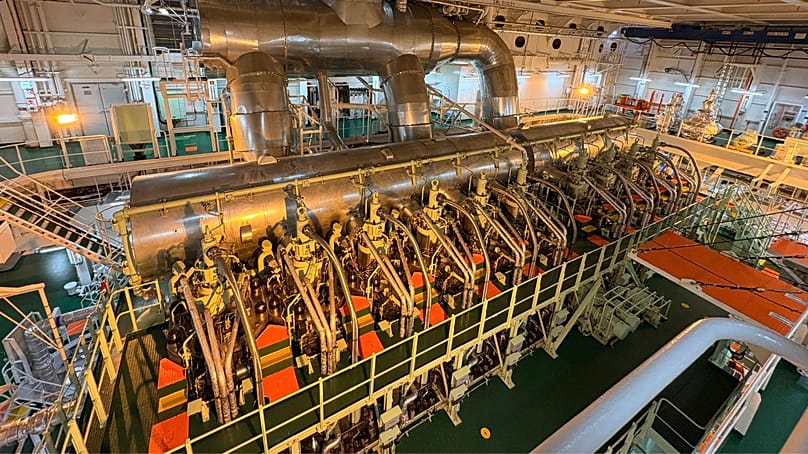
For ships calling at EU ports, including the CMA CGM Notre Dame, the EU's FuelEU Maritime regulation sets progressively stricter limits on the greenhouse-gas intensity of the energy used on board, to reduce it by 80% by 2050.
The vessel also makes extensive use of artificial intelligence, allowing real-time navigation adjustments, optimised energy consumption and improved environmental performance.
Across its fleet, CMA CGM says AI helps save around 600,000 tonnes of CO2 every year by creating digital twins of the vessel, simulating entire routes and selecting the most fuel-efficient options.
Shipping has become a strategic issue for Europe
Recent geopolitical crises, including the Iran war, have served as a reminder that around 80% of global trade by volume travels by sea. When shipping routes are disrupted, supply chains seize up, industries slow down, inflation rises and jobs come under pressure.
In March 2026, the European Union adopted two strategies aimed at strengthening a sector considered vital to the bloc's trade, economic growth, security and defence: the EU Ports Strategy and the Industrial Maritime Strategy. Together, they seek to reinforce strategic ports as energy, logistics and security hubs, strengthen supply-chain resilience, support the energy transition and digitalisation, and boost Europe's shipbuilding and maritime technology industries.
"If global trade has a backbone, it is maritime transport. Europe's ports handle around 75% of the EU's external trade, and the European maritime economy supports around 4.5 million jobs," European Commissioner for Sustainable Transport and Tourism Apostolos Tzitzikostas said during a keynote speech at the Transforming Transportation 2026 conference organised by the World Bank.
Although the CMA CGM Notre Dame was built in China using the French company's expertise, it sails under the French flag, a decision the company sees as reinforcing France's maritime tradition.
The inauguration was attended by France's First Lady, Brigitte Macron, alongside the vessel's godmother, Delphine Arnault, LVMH billionaire Bernard Arnault's daughter, the chief executive officer of Christian Dior Couture.
Arnaultpraised CMA CGM's decision "to sail this ship under the French flag. In an increasingly competitive international landscape, this decision reflects a strong conviction: that France must continue to rank among the world's great maritime powers."
CMA CGM Grows North American Logistics Buying FedEx Supply Chain for $1.4B
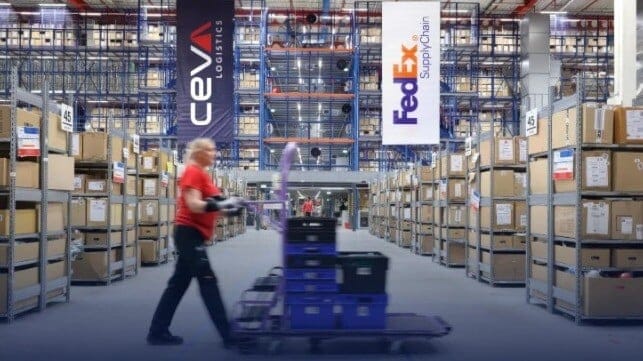
CMA CGM, like other major shipping carriers, is continuing its efforts to transform its business into an integrated shipping and logistics operation. On July 1, it announced it had an agreement to acquire FedEx Supply Chain, a subsidiary of FedEx Corp.
Valued at $1.4 billion enterprise value, the acquisition will nearly triple the size of the North American contract logistics operations of CMA CGM’s subsidiary CEVA Logistics. By integrating FedEx Supply Chain, CEVA Logistics will become a leading contract logistics provider in North America. It will have approximately 150 warehouses and a combined workforce of 20,000 people.
Currently, CEVA Logistics is one of the top five global players, operating 1,000 warehouses. It handled 15 million shipments in 2025. The company was acquired by CMA CGM in 2019 and was assembled through acquisitions.
“We are strengthening our ability to provide customers with integrated supply chain solutions,” said Rodolphe Saade, Chairman and Chief Executive of the CMA CGM Group. “These deals also reinforce our long-term commitment to investing in the United States and supporting the resilience and efficiency of its supply chain.”
The acquisition will accelerate CMA CGM’s strategy to provide comprehensive end-to-end logistics solutions. It also expects to enter into multi-year commercial agreements related to air and ocean freight. CMA CGM will become a preferred ocean carrier for FedEx. The companies will also work together on select air cargo capacity solutions.
FedEx stated that the sale aligns with its strategy to focus on high-value verticals. It said it is streamlining its portfolio to better position the business. The sale of the logistics business follows the spin-off of FedEx Freight, completed last month.
The sale of FedEx Supply Chain is expected to close in 2026. The air cargo and ocean freight agreements are expected to be phased in between now and 2028.
CMA CGM has been working to expand its logistics and terminals businesses, growing CEVA. Additionally, Saade had promised Donald Trump during an Oval Office meeting in 2025 to invest $20 billion in the United States over a four-year period.

No comments:
Post a Comment