It’s possible that I shall make an ass of myself. But in that case one can always get out of it with a little dialectic. I have, of course, so worded my proposition as to be right either way (K.Marx, Letter to F.Engels on the Indian Mutiny)
Saturday, July 18, 2026
U.S. Intensifies Attacks on Iranian Ports on Sixth Day of Bombing Campaign
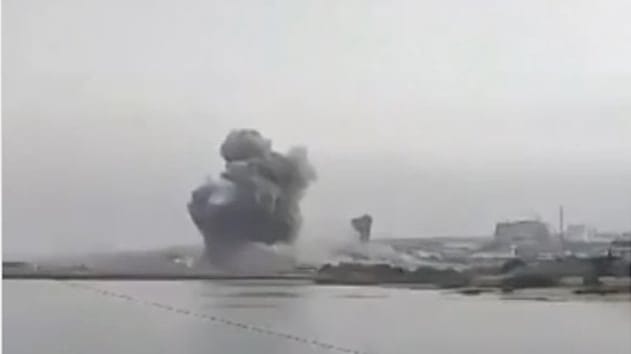
Image from Iranian TV of a reproted earlier attack on the southern prot complex
U.S. Central Command is confirming that it undertook a sixth consecutive night of bombings targeting infrastructure in Iran. It reported attacks on the southern port complex of Chah Bahar Shahid Kalantari, while other reports also said the U.S. has increased attacks in and around Bandar Abbas.
Iran has been cooperating with India for the past 20 years on the operation of Chah Bahar Shahid Kalantari as a regional center. It was also used to open overland trade routes into Afghanistan.
Centcom reported on Friday morning that U.S. forces had destroyed the port surveillance tower at Chah Bahar Shahid Kalantari. Iran said it was the third day of attacks on the port complex and contended that the tower was traffic control for the two ports in the complex. Centcom, however, said that the Islamic Revolutionary Guard Corps (IRGC) was also using the tower to track and target commercial vessels in the Strait of Hormuz.
Centcom released video showing the attack on the tower and port complex
U.S. forces used fighter jets, drones, and warships, Centcom reported, as it continued to target coastal surveillance and other targets, air defense sites, military logistics, infrastructure, and maritime capabilities. U.S. officials did not directly mention the power infrastructure and bridges, but the Associated Press reports the attacks were expanded to include these targets.
There were also reports of strikes on the roads and bridges leading to the Bandar Abbas port. AP writes that it appears the U.S. is attempting to cut off Iran’s main port.
Iran responded by launching missiles and drones toward Qatar, Bahrain, and Kuwait. While it says it is targeting U.S. military installations, Kuwait reported damage to the country’s power and water desalination plant.
The attacks also continued against vessels attempting to take the Omani route through the Strait of Hormuz. UKMTO reports a tanker came under attack. The ship sustained minor damage. However, the attacks continue to affect shipping volumes.
AXSMarine analyzed transits through the Strait of Hormuz in the week since the bombings resumed. It says between July 8 and July 16, the number of transits is down by more than half. In the first days of July, it calculated average daily crossings of over 34 vessels, down to just under 30 on July 8-9, and now down to 14 vessels between July 12 and 16. Nearly two-thirds (63 percent) of the transits are now confirmed on the Iranian corridor with only 10 percent on the Omani route. Dark transits also rose from 37 percent at the beginning of July to 44 percent this week.
CENTCOM asserts that its strikes are protecting the freedom of navigation in the regional waters. It has also said it will continue to implement the naval blockade on Iranian vessels and shipping bound for Iranian ports.
Video: U.S. Marines Board Falsely-Flagged Tanker in Gulf of Oman
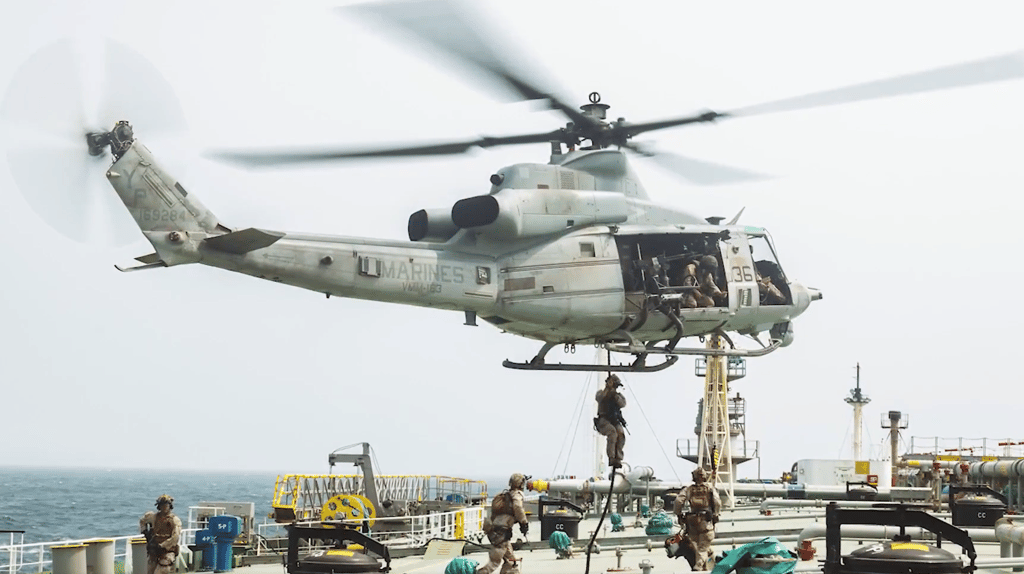
On July 16, the USS Boxer Amphibious Ready Group intercepted and boarded a "shadow fleet" VLCC in the Gulf of Oman, part of the large-scale effort to enforce the Trump administration's newly-reinstated blockade on Iranian seaports.
U.S. Marines from the 11th Marine Expeditionary Unit used helicopters to access the deck of the 300,000 dwt tanker Wen Yao in the Gulf of Oman. The operation was a flag verification boarding, according to U.S. Central Command.
Wen Yao is falsely flagged in San Marino, according to her Equasis record. Though the tanker's most recent name is Chinese, she is owned and operated in Dubai, a popular hub for shadow fleet shipmanagement.
Wen Yao is fully laden with a cargo of Iranian fuel oil, and her crew took several curious steps while under pursuit by U.S. forces, according to TankerTrackers.com. She changed her name and her flag repeatedly on the 16th, ending up as the "Azhin" and flying an Iranian flag by the time of the boarding.
The boarding is one of several actions that the Navy has taken to divert Iran-bound traffic since the restart of the blockade. Three vessels have been redirected with warnings; one was disabled with Hellfire missiles; and one has now been boarded.
"The Strait of Hormuz and the surrounding waters remain free and open, except for vessels attempting to violate America’s steel wall blockade," said Central Command in a statement late Thursday.
In addition to the vessel interdictions, Iranian state media outlets claim that American forces destroyed two road bridges connecting the Iranian port of Bandar Abbas to inland locations to the west. Up until recently, Central Command has refrained from striking civilian infrastructure targets in Iran. Anecdotal reports indicate that a bridge in Hormozgan and a rail station west of Bandar Abbas were also hit. In a statement, CENTCOM confirmed that it had launched strikes on "military logistics infrastructure."
Between strikes, boardings and escalatory rhetoric, the tensions between Iran and the U.S. are having a material effect on commercial transit volume, according to Kpler. Crude and condensate cargoes through the Strait of Hormuz are down to just four million barrels per day, a sharp reversal from the recovery seen during the ceasefire. Loadings have fallen by half in recent days, setting back GCC states' plans for normalizing production. "The larger test is whether Gulf producers can establish a repeatable loading cycle, rather than move cargo only between periods of escalation," assessed Kpler.
Kuwait Reports Attack on Offshore Oil Platform as US and Iran Trade Fire
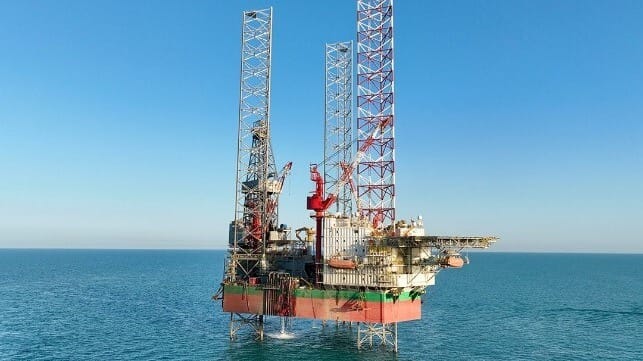
Kuwait's ministry of defense has reported a drone attack on an offshore drilling platform operated by the state-owned Kuwait Petroleum Company near Shuwaikh Port, causing substantial damage to the rig and injuring one worker. In a statement, the ministry called the strike a "criminal" act.
The platform strike - a likely but unconfirmed operation by Iranian forces - is among the first attacks on energy infrastructure in the GCC states since the ceasefire began. The recent Iranian missile and drone volleys have focused on U.S. military bases and the nations that host them, without the damage to oil and gas facilities seen in the first round of intense hostilities in March and April.
Dozens of targets around the region were hit over the weekend. After Iran struck and damaged a container ship in the Strait of Hormuz on Saturday, Iranian and American forces traded fire on July 11-12 - the most intense exchange since the beginning of the ceasefire agreement last month, with extensive damage reported on both sides.
In addition to the Kuwaiti platform strike, Iranian attacks or attempted attacks have been reported in Oman, Qatar, Bahrain and Jordan. Open-source intelligence researchers have spotted apparent impact sites via Sentinel-2 low-resolution satellite imaging, notably at Prince Hassan Air Base in Jordan, one of the staging points for long range U.S. Navy-operated surveillance flights near Iran. The extent of any damage at the air base remains unconfirmed, but satellite imaging shows clear visual changes in the vicinity of one large hangar and a nearby apron.
Iran ???????? ballistic missile hit in Jordan ???????? Prince Hassan AB POSS MISSED that US ???????? drone hangar ????
Looks to have hit apron. Most of what we see is pulverized concrete debris. Hangar POSS still there.
U.S. strikes hit 140 Iranian targets overnight Saturday, according to U.S. Central Command. Targets included Iranian missile and drone launch sites, naval units, ammunition storage sites, communications systems and coastal surveillance locations.
Additional follow-up strikes on Sunday night included more attacks on air-defense systems, coastal radars, and small boats. For the first time ever reported, the U.S. military used "one-way attack sea drones" in combat, Central Command said.
Satellite imaging also appears to show impact damage on the site of Iran's Bushehr nuclear power plant complex, though the timing of the damage is unclear; satellite data suggests a physical event occurred sometime between July 7-12, and caused damage to a building located several hundred yards from the main reactor. Residents in the Bushehr region reported strikes and air defense activity overnight July 11-12.
In a statement carried by state media, the Atomic Energy Organization of Iran dismissed reports of an attack on the Bushehr nuclear site, claiming that "the plant remains fully operational, secure, and stable, with all systems running continuously and without any disruption."
Bushehr is undergoing a planned expansion with the addition of two more Russian-built reactors. The project has been delayed by the conflict, which prompted state atomic agency Rosatom to withdraw its advisors and workers in March, but Rosatom director Rosatom Director General Alexei Likhachev has said that both Russia and Iran remain committed to completing the reactors. An attack on an Iranian nuclear site - if confirmed - would mark a major escalation.
Historic WWII Submarine Arrives at Fincantieri Bay Shipbuilding for Repairs
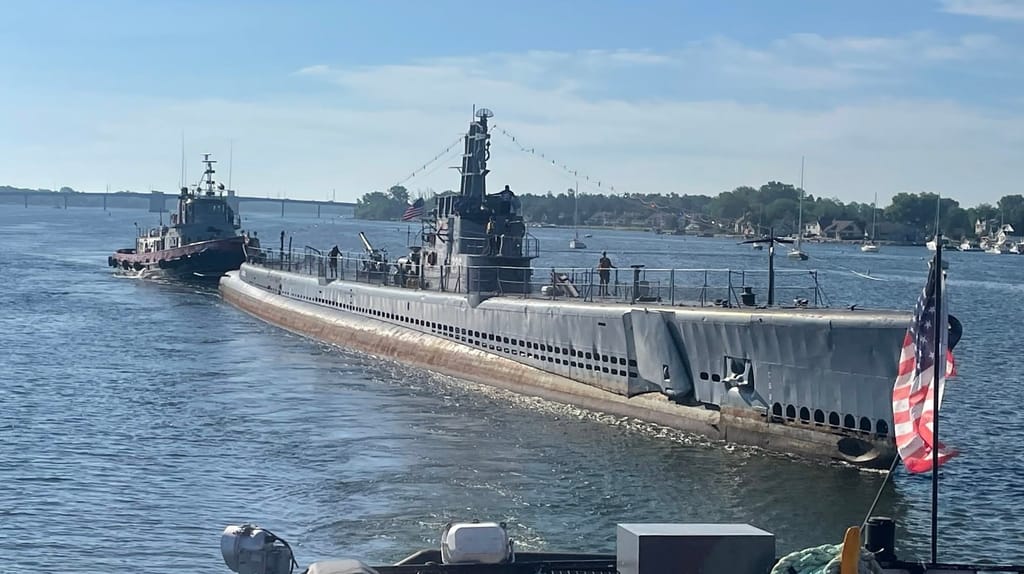
USS Silversides under tow to Fincantieri Bay Shipbuilding (Keith Gill / USS Silversides Museum)
The historic WWII submarine USS Silversides has arrived at Fincantieri Bay Shipbuilding for a much-needed drydocking. The sub's last yard period happened during the Cold War, and she needs preservation in order to continue in service as a museum ship. For the first time in 50 years, this decorated icon of the Pacific Theater will come out of the water for steel renewal, sandblasting and painting.
Silversides is a Gato-class diesel-electric attack submarine commissioned on December 15, 1941. The boat entered service eight days after the attack on Pearl Harbor, and swiftly deployed to join the war in the Pacific. Over the course of 14 patrols, Silversides attacked and sank 23 Japanese ships and damaged many more. Credited with destroying more than 90,000 tons of Japanese shipping, Silversides ranks in the top-five most successful U.S. Navy submarines of the war. She received 12 battle stars for her wartime service, along with a Presidential Unit Citation, the military's highest honor.
After the war, Silversides retired to a berth in Chicago and became a stationary training vessel. After finishing her service to the Navy, she was taken over by a volunteer-led historic preservation association in 1973, and was gradually restored to habitable condition. She relocated to Muskegon, Michigan, home of the Great Lakes Naval Memorial and Museum, and has been welcoming visitors there ever since.
Silversides got under way for a long-awaited drydocking on July 13, under tow on a 20-hour voyage to Sturgeon Bay. (Her propellers were removed long ago, but her Fairbanks-Morse diesel engines still run.) Having arrived at Fincantieri Bay Shipbuilding, she will undergo a $3.5 million preservation project led by Valkor Energy Services. The National Parks Service is contributing $750,000 to the cost of the work, but private donations make up most of the budget. The museum is still raising funds to close a small gap, but has achieved most of its fundraising goals; donations may be made at https://silversidesmuseum.org/dry-dock-uss-silversides/
Royal Navy Retires Aging Ships Due to High Maintenance Costs
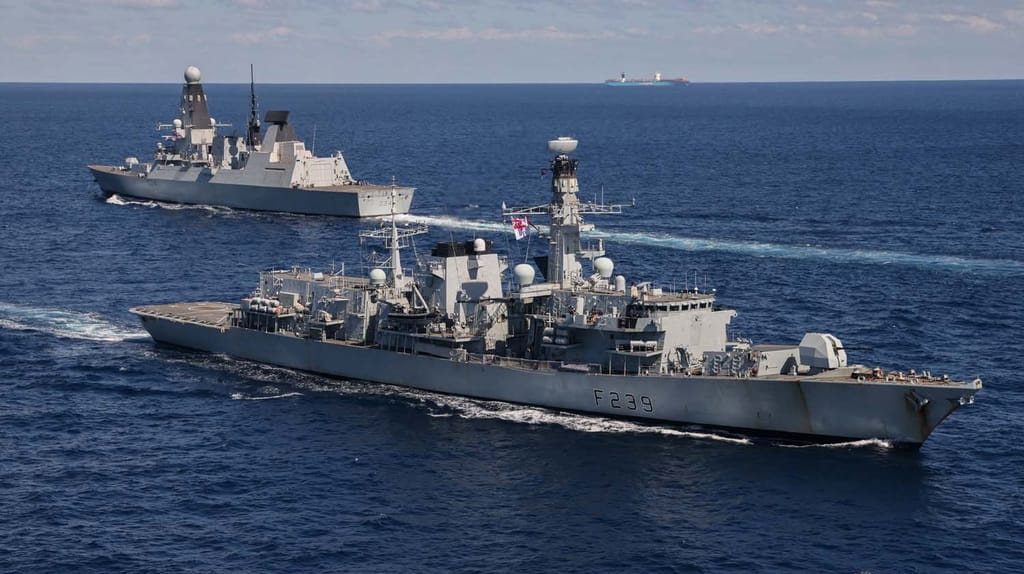
The Royal Navy said HMS Iron Duke, seen her in the Channel, along with HMS Richmond and the minehunter HMS Chiddingfold are being decommissioned due to the costs of maintaining the vessels (Royal Navy)
The United Kingdom government has, in recent years, repeatedly admitted that keeping the aging Type 23 frigates in service has become an extremely expensive affair. To save taxpayers from further financial hemorrhage, the Royal Navy has decided to retire two Type 23 frigates alongside a Hunt-class minehunter.
The Navy said that HMS Iron Duke and HMS Richmond, as well as HMS Chiddingfold, have been decommissioned after clocking more than a century of combined service. The Royal Navy said the aging Type 23 frigates are being retired due to their costs, and the risk of maintaining them has become exorbitantly high. The government contends that taking the ships out of service has become the most prudent move to allow resources to be redirected to building Type 26 and Type 31 frigates, which will be their replacement.
There is no doubt that the Type 23 frigates, which were built in the 1980s, have been bleeding the British taxpayers in desperate efforts to keep them in service. In the case of Iron Duke and Richmond, the government spent £103 million ($139.5 million) and £56 million ($75 million), respectively, to undertake life extension programs (LIFEX) that would have seen the ships serve until the early 2030s. Despite the investments, the ships have remained unreliable, with long periods out of service.
Despite their unreliability in recent years, both Iron Duke and Richmond, alongside Chiddingfold, have, over their many decades of service, played significant roles in maritime security and supporting UK interests around the globe. The ships were deployed in countering submarine threats, safeguarding vital shipping routes, humanitarian relief efforts, and global maritime security missions.
Among the Iron Duke’s last missions was deployment to monitor and track Russian warships approaching areas of national interest, while Richmond played an important role in the UK Carrier Strike Group's deployment to the Indo-Pacific last year. In 2003, she supported landings in Iraq.
For her part, the minehunter Chiddingfold has spent much of the past two decades supporting maritime security in the Middle East, operating from Bahrain alongside allies and partners to ensure freedom of navigation through some of the world's busiest and most strategically important waterways.
The third vessel to carry the name, the current HMS Iron Duke, was launched on March 2, 1991, as the fifth Type 23 Frigate. She was commissioned to the fleet in May 1993. HMS Richmond (F239) followed as the 10th of 16 Type 23 Duke-Class Frigates to join the Royal Navy, commissioned in 1995, and as the seventh vessel to carry the name. HMS Chiddingfold was commissioned in 1983.
“Richmond, Iron Duke, and Chiddingfold have each played a key role in safeguarding the UK’s security and interests worldwide. As they are retired from service, their legacy continues through the next generation of warships and advanced autonomous systems,” said Vice Admiral Steve Moorhouse, Fleet Commander.
Following their retirement, the Royal Navy has outlined that their roles will be replaced by some of the eight Type 26 ships, which are currently under construction and which are expected to enter service between 2028 and 2035, and the five Type 31 ships that are planned to be in service by the early 2030s.
The City-Class Type 26 frigates, which are being built at BAE Systems, are primarily designed for anti-submarine warfare but are also capable of supporting air defense and general-purpose operations. They have a displacement of approximately 6,900 tonnes, a length of 149.9 meters (492 feet). HMS Glasgow, the lead vessel in the class that is due for commissioning in 2028, will take over Richmond's anti-submarine warfare role.
The Inspiration Class Type 31 ships are being built at Babcock, with the first three at different stages of construction. The general purpose frigates are engineered to meet the challenges of the future maritime environment. The ships will take over Iron Duke's responsibilities when they enter service. For mine warfare, Chiddingfold's legacy is expected to continue through the Royal Navy's pioneering autonomous and remotely operated mine hunting systems.
Recently, the UK government unveiled an elaborate plan to transition the Royal Navy to a hybrid navy, committing to invest £1.3 billion ($1.7 billion) in a hybrid fleet and £1.1 billion ($1.4 billion) for the mine hunting capability program. The goal is to combine autonomous systems with next-generation warships, aircraft, submarines, and uncrewed platforms.
Syrians Outline Future Russian Port Presence in Tartus
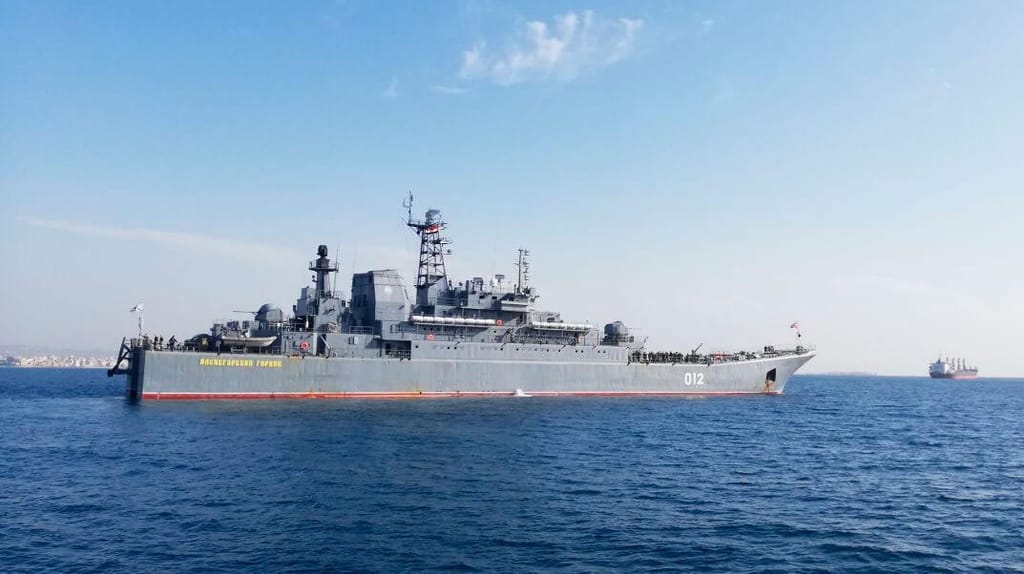
A Russian tank landing ship at Tartus (Russian MOD)
After months of struggling to maintain a naval presence in the Mediterranean, and speculation surrounding the future of Russia's tenancy of its long-standing Station 720 naval base in Tartus, Syrian commercial sources have outlined the prospective shape of Russia's presence in the port.
Executives from the Syrian company Rus Line have said that of the two pierheads which made up the old Russian naval base, one will be retained by the Russian navy and the other – Pier 4 – will be devoted to handling Russian commercial cargo traffic. The remainder of the port, which used to be operated commercially by Stroytransgaz, remains covered by the $800 million, 30-year DP World concession which edged out the Russian company.
Rus Line is targeting initial cargo volumes of 250,000 tons per month through the new facility, handling Russian wheat, grains, animal feed, vegetable oils, timber, steel, clinker, coal, rice, sugar and mineral oils, all within the curtilage of the Russian naval base. This dockside would also host light manufacturing and finishing, and act as a distribution center for Russian goods.
The first shipment of 30,000 tons of grain is planned for mid-July. If the grain is sourced from occupied Donetsk and Luhansk, then it will attract the attention of the Ukrainian authorities, as will sea traffic on the intended route from the Black Sea port of Novorossiysk.
Most of the discussion of the plans has come from Russian sources, in particular the Russian-Syrian Business Council. Syrian officials from the General Authority for Ports and Customs denied that Russia would operate a commercial logistics hub. But an agreement in principle is said to have been reached between Syria's President Ahmed Al Shara'a and President Vladimir Putin at a meeting in Moscow in late January.
Both Russia and Syria will be seeking to capitalize on the need to expand overland trade routes from the Mediterranean to Iraq, Jordan and the Gulf countries, in light of the disruption to shipping traffic through the Strait of Hormuz. This ambition was also heralded by President Trump, who in an opening gambit during the Saudi–United States Investment Forum in Riyadh on May 13 announced that sanctions against Syria would be lifted.
Indications of the Russian intent to maintain its Syrian presence were apparent in early June, when three Russian specialist port security vessels were seen in the Tartus harbor basin, protecting two visiting Russian warships — the Gorshkov Class frigate RFS Admiral Kasatonov (F461) and the oiler Akademik Pashin. These port security vessels would not have been deployed unless there were a long-term requirement for them. Since the two warships left Tartus en route to Algiers, no further Russian warships have been spotted at the Station 720 berths.
The Russian plan is nevertheless fraught with obstacles. The Russian presence will attract a naval response from the Ukrainians — not only on the dockside at both ends but also on the shipping route from Novorossiysk. While sanctions may have been lifted on Syria, they have not been lifted on Russian entities likely to be using or engaged on the trade route. There will be commercial advantage for many if the US Treasury were tipped to pay close attention to any entities — whether financial, logistics or port-service firms— that might contemplate dealing with OFAC-listed entities.
No Time to Stop: Maintenance & Machinery Reliability in Cruise Operations
In cruise shipping, reliability is not simply an engineering target. It is the foundation of the entire voyage experience. A cruise ship may be designed with redundancy, automation, planned maintenance systems, and class-approved equipment, but it still operates in a demanding commercial environment where time is limited, and expectations are high. Unlike many vessels that can absorb delay as part of cargo operations, a cruise ship carries passengers whose itinerary, comfort, and safety depend on continuous technical performance.
This creates one of the most difficult challenges in modern cruise operations: keeping a highly complex vessel running safely while having very little time to stop. Propulsion machinery, generators, stabilizers, HVAC systems, freshwater production, wastewater treatment, elevators, galley equipment, refrigeration systems, and safety equipment must all remain reliable across changing routes, climates, and port schedules. A technical defect on a cruise ship is rarely just a technical defect. It can become a passenger issue, an itinerary issue, a regulatory concern, and, in serious cases, a liability exposure.
The Problem with Limited Repair Windows
The maintenance challenge begins with the cruise schedule itself. Cruise vessels often operate on repeated itineraries with short port stays and limited repair windows. Technical teams must plan inspections, servicing, corrective maintenance, and contractor attendance around passenger movement, port operations, bunkering, stores loading, safety drills, and hotel operations. Even when the ship is alongside, the vessel is not truly inactive. Air conditioning, lighting, elevators, galleys, refrigeration, freshwater, sewage systems, and hotel services continue to operate. For the technical department, the ship remains alive even when the engines are stopped.
This means that maintenance planning must be more disciplined than simply following calendar intervals. Modern cruise operations require risk-based maintenance decisions. Equipment should be assessed not only by manufacturer recommendations, but by operational consequences. A minor defect in a non-critical system may be managed until the next port call, while a developing problem in a generator, chiller plant, steering system, fire-detection loop, wastewater plant, or stabilizer system may require immediate escalation. The key question is not only "what is wrong?" but "what happens to the voyage if this system fails?"
Risk-Based Maintenance and Early Detection
Machinery reliability also depends heavily on early detection. Many major failures begin as small warning signs: abnormal vibration, temperature deviation, repeated alarms, oil analysis results, pressure fluctuation, unusual noise, increased consumption, or minor leakage. In a busy shipboard environment, these weak signals can be overlooked when the vessel is under schedule pressure. A strong technical operation treats these indicators seriously before they become failures. Condition monitoring, trend analysis, and disciplined reporting are therefore not administrative exercises; they are practical tools for protecting the voyage.
Spare-part planning is another major pressure point. Cruise ships cannot always rely on immediate shoreside support, especially when operating in remote regions or on tight itineraries. A missing spare part can convert a manageable defect into an operational disruption. Technical managers must therefore understand not only what parts are required, but which parts are voyage-critical. Inventory decisions should be guided by equipment criticality, supplier lead time, route availability, class requirements, and the potential consequences of failure. Over-reliance on last-minute procurement creates unnecessary risk.
Dry Dock Is Not the Whole Strategy
Dry dock remains essential, but it cannot be the only maintenance strategy. A ship that depends entirely on a dry dock to restore reliability is already operating reactively. Dry dock should be used for major overhauls, statutory work, structural repairs, underwater work, class surveys, and significant upgrades. However, daily reliability is built during normal operations. Planned maintenance, defect closeout, crew competence, spare management, and condition monitoring between dry docks determine whether the vessel arrives at its next major repair period in a controlled condition or in a state of accumulated technical debt.
Cruise ships also face a unique challenge because technical systems are closely connected to passenger perception. On a cargo vessel, a machinery issue may remain largely invisible if the ship can continue safely. On a cruise ship, passengers immediately feel the effect of air-conditioning failure, elevator outages, toilet system problems, hot-water issues, galley delays, internet failure, or excessive vibration. These issues may not always threaten seaworthiness, but they can damage the guest experience and create complaints, compensation demands, and reputational consequences. Technical reliability must therefore be understood as part of service delivery as well as marine safety.
Compliance, Crew Competency, and Commercial Pressure
Class and regulatory requirements add another layer. Cruise ships must remain compliant with statutory certificates, safety management systems, environmental rules, lifesaving appliances, fire systems, and machinery standards. When repairs are postponed, the technical team must understand whether the issue affects class, flag, port-state expectations, or safe manning obligations. Temporary repairs and operational limitations may be acceptable in certain circumstances, but they must be properly assessed, documented, and approved where necessary. Poor documentation can turn a manageable technical issue into a compliance problem.
Crew capability is central to machinery reliability. Modern ships are equipped with sophisticated automation and monitoring systems, but technology does not replace engineering judgment. Officers and engineers must understand the machinery, not merely respond to alarms. Training should focus on fault diagnosis, emergency response, system interdependence, and the operational consequences of technical decisions. A technically strong crew can often prevent disruption by identifying the correct problem early. A poorly trained crew may lose valuable time responding to symptoms rather than causes.
The relationship between technical operations and commercial operations must also be managed carefully. Commercial pressure is unavoidable in cruise shipping, but it should not override technical judgment. The safest operators create a culture where technical concerns can be escalated before they become emergencies. A delayed departure may be costly, but sailing with an unresolved critical defect may be far more expensive. The role of technical management is to balance voyage continuity with safety, compliance, and long-term reliability.
The Liability Dimension
From an insurance and liability perspective, machinery failures can have wide consequences. A propulsion problem may lead to deviation, missed ports, passenger claims, tug assistance, or salvage involvement. A blackout can affect safety systems and passenger welfare. A wastewater system failure can create environmental exposure. A fire-related machinery defect can involve crew injury, passenger risk, and regulatory investigation. In many cases, the technical cause becomes the starting point for a much larger claim chain.
The practical solution is a more integrated maintenance philosophy. Cruise operators should combine planned maintenance, condition monitoring, spare-part forecasting, defect trend review, class planning, and operational risk assessment into one clear technical picture. Maintenance should not be treated as a back-office engineering function. It is a front-line risk-control system that protects passengers, crew, itinerary, reputation, and financial performance.
Conclusion
The modern cruise ship has little room for technical complacency. Its systems are too interconnected, its schedule too compressed, and its public exposure too high. Keeping the vessel running is not simply a matter of fixing machinery when it breaks. It requires anticipation, planning, discipline, and the confidence to act before a defect becomes a voyage disruption. In cruise operations, there is often no time to stop, which is exactly why maintenance planning must start long before the machinery fails.
The Eight-Hour Test: How Cruise Ships Complete a Turnaround Day
A cruise ship's turnaround day is often viewed from the passenger side as the end of one holiday and the beginning of another. For the vessel's crew and technical teams, however, it is one of the most demanding operational periods of the entire voyage cycle. Within a compressed window, thousands of passengers disembark, thousands more embark, luggage moves in both directions, provisions arrive, waste is discharged, inspections may take place, fuel or lubricants may be supplied, contractors may board, crew changes occur, and the ship must be prepared to sail again safely and on time.
This is why turnaround should not be treated as only a hospitality or terminal operation. It is a coordinated marine operation with significant technical, safety, and liability consequences. The ship may be alongside, but operational risk does not disappear. In some ways, it increases because many departments and outside parties are working at the same time in a limited space under strict time pressure.
Congestion, Time Pressure, and Sequencing
The first challenge is congestion. Turnaround involves simultaneous activity across the gangway, shell doors, mooring areas, stores-loading zones, waste-landing points, bunker stations, luggage routes, passenger terminals, engine spaces, and hotel areas. Each individual task may be routine, but the combination creates a complex risk environment. A contractor carrying equipment, a forklift moving provisions, a waste truck operating near the berth, passengers moving through the terminal, and crew preparing safety systems may all be part of the same operational picture. If coordination is weak, safe individual activities can create unsafe collective conditions.
Time pressure is the second challenge. Cruise ships operate on published itineraries, and departure delays can affect port slots, pilotage, weather routing, fuel consumption, guest satisfaction, and the next port call. This pressure can lead to shortcuts if the operation is not properly controlled. A strong turnaround operation recognizes that speed is important, but sequence is more important. The objective is not simply to finish quickly; it is to complete the necessary work in the correct order, with proper communication and risk controls.
Passenger Movement and Gangway Safety
Passenger movement creates one of the most visible risks. During disembarkation and embarkation, gangways, terminals, elevators, stairways, and public areas experience heavy traffic. Elderly passengers, children, mobility-impaired guests, and large volumes of luggage can increase the risk of slips, trips, falls, and congestion-related incidents. From a technical and safety perspective, gangway condition, lighting, handrails, weather exposure, tidal movement, ship movement, and terminal interface must all be monitored. A gangway is not just an access point; it is a controlled safety zone.
Stores loading is another area that deserves close attention. Cruise ships require large quantities of food, beverages, hotel supplies, spare parts, chemicals, cleaning products, and technical stores. Loading operations often involve cranes, forklifts, pallets, shell doors, elevators, and internal distribution routes. The risk includes dropped objects, lifting accidents, damaged provisions, blocked escape routes, fire-door obstruction, and contamination of food or sensitive supplies. The technical department must ensure that stores related to engineering, safety equipment and environmental systems are received, checked, and routed properly without interfering with passenger operations.
Bunkering, Waste Discharge, and Environmental Control
Bunkering and lubricant supply can create additional exposure. Even when fuel transfer is routine, it remains a high-consequence operation. Spill prevention, hose condition, communication with suppliers, scupper control, emergency shutdown arrangements, drip trays, documentation, and weather conditions all matter. The risk is greater when bunkering occurs alongside passenger embarkation, stores loading, or waste discharge. These operations must be separated, sequenced, or controlled so that one activity does not compromise another. A small spill during turnaround can quickly become a regulatory issue, a delay, and a reputational problem.
Waste discharge is equally important. Cruise ships must land garbage, food waste, recyclables, sludge, or other permitted waste streams in accordance with port requirements and environmental rules. The challenge is not only disposal, but documentation and segregation. Incorrect handling can create compliance issues and operational delays. Technical and environmental officers must confirm that waste streams are properly recorded and transferred to approved reception facilities. On a busy turnaround day, paperwork can be treated as secondary, but environmental documentation is part of the evidence that the ship operated correctly.
Maintenance and Contractor Control
Technical maintenance during turnaround requires careful judgment. Port time may provide the only opportunity to repair equipment, inspect systems, change parts, or bring contractors on board. However, this work must be assessed against sailing requirements and operational interference. A repair that disables a critical system too close to departure can create a delay or force the ship to sail with limitations. Work permits, isolation procedures, hot-work controls, enclosed-space entry, testing requirements, and class or flag approval must be considered. Turnaround is a useful maintenance window, but it is not an excuse for uncontrolled work.
Contractor management is another recurring issue. Contractors may be familiar with shoreside industrial work but less familiar with cruise ship operations, passenger movement, shipboard emergency procedures, or restricted areas. They may board for HVAC repairs, elevator maintenance, galley equipment service, automation work, safety-system testing, or hotel refurbishment. Every contractor should be properly briefed, supervised, and integrated into the permit-to-work system. A contractor accident or defective repair can expose the vessel to operational, legal, and insurance consequences.
Crew Change and Operational Handover
Crew changes also affect operational continuity. Joining crew members may need familiarization, safety briefings, cabin assignments, documentation checks, and department handover. Signing-off crew may still be involved in operational duties until relieved. Poor handover can lead to missed information about defects, pending work, temporary arrangements, or equipment limitations. In technical operations, handover quality is not a formality. It directly affects the ship's readiness for the next voyage.
A disciplined turnaround strategy begins before the vessel arrives in port. Departments should conduct pre-arrival planning that identifies critical activities, responsible persons, expected contractors, stores, waste operations, inspections, maintenance tasks, bunkering plans, and potential conflicts. The goal is to build one shared operational picture. When each department plans only for itself, the ship may meet individual task requirements while still creating overall risk.
iCommunication during turnaround must be clear and structured. Deck, engine, hotel, security, terminal staff, port agents, and contractors should understand what is happening, when it is happening, and who has the authority to stop an unsafe activity. Escalation procedures are essential. If a gangway becomes unsafe, a fuel-transfer issue arises, a contractor cannot complete work, or a critical defect is discovered, the ship must have a clear process for decision-making. Delay is not an option, but confusion may result in a risk.
From a P&I and liability perspective, turnaround incidents can create significant exposure. Passenger injury, crew injury, contractor accidents, pollution, cargo or provision damage, delay claims, equipment failure, and regulatory non-compliance can all begin during a few compressed hours alongside. The fact that the ship is in port does not reduce the operator's duty of care. In some respects, the number of interfaces with third parties increases the need for control.
Conclusion
The most effective cruise operators treat turnaround as a formal risk event rather than a routine port call. That means planning, sequencing, supervision, documentation, and post-operation review. Near misses should be recorded and discussed. Repeated congestion points, contractor delays, equipment failures, baggage bottlenecks, or unsafe passenger-flow issues should be analyzed. Each turnaround provides data that can improve the next one.
The "eight-hour test" is therefore not simply whether a ship can clear one group of passengers and welcome another. It is whether the vessel can complete a dense sequence of marine, technical, hotel, environmental, and safety operations without losing control of risk. A successful turnaround is not measured only by an on-time departure. It is measured by whether the ship sails with its systems ready, documentation complete, passengers safe, crew aligned, and unresolved risks properly managed.
Cruise ships are designed to deliver seamless experiences, but behind that appearance is a highly compressed operational reality. Turnaround day exposes the vessel to some of its most concentrated risks. Managing that risk requires more than efficiency. It requires technical discipline, interdepartmental coordination, and the willingness to slow down when safety requires it. In modern cruise operations, the ship's most important test may occur not at sea, but during the few hours when everyone believes it is simply getting ready to leave.
Priyatham Sanjeeva Reddy, Ramidi currently works in maritime technical and operational roles with a focus on the intersection of ship technical operations and risk management. The views expressed in the article are presented independently and do not represent those of any employer or organization.
The opinions expressed herein are the author's and not necessarily those of The Maritime Executive.
Toxic Spill Shuts Down Two Container Terminals at Port of Antwerp
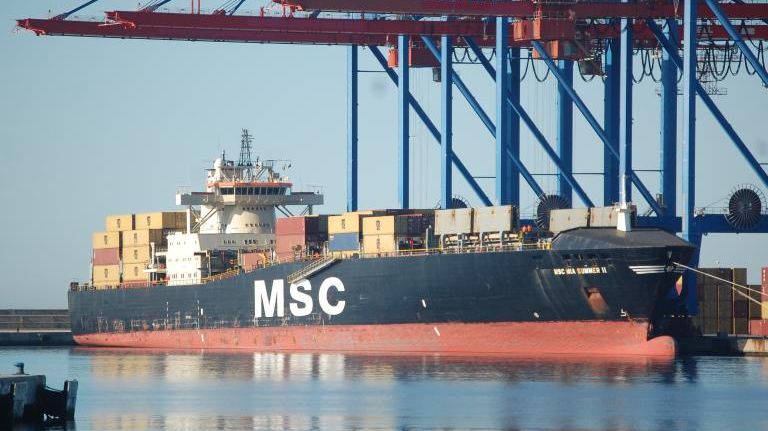
The Port of Antwerp-Bruges shut down several terminals Wednesday in response to a highly toxic acid spill from a shipping container, including the DP World Antwerp Gateway terminal.
Initial reports indicated that a container aboard the boxship Mia Summer II began leaking hydrofluoric acid. The ship was alongside the pier at the Deurganck Dock area of Antwerp, a busy district, and more than 150 people were potentially exposed to HF fumes.
28 people developed more serious symptoms of HF inhalation and were hospitalized for care and observation, including one individual who is intensive care, according to Antwerp's city government.
Traffic in nearby waterways was temporarily suspended, and the port activated cordon and evacuation plans for nearby areas, including the Kieldrecht Lock complex and all of the Deurganck Dock. The area is home to some of Europe's biggest container facilities, including the Antwerp Gateway and MPET terminals.
Antwerp Gateway reopened early Wednesday afternoon, and marine traffic partially resumed, but MPET remained closed
The fumes did not reach residential areas, and the exposure only impacted crewmembers and port workers. The leak began to slow down by Tuesday evening, and first responders made plans to seal up the container and take it away for safe disposal.
Belgian prosecutors have opened a criminal inquiry into the circumstances of the release. Few details have been made public, but it is understood that the leak began during cargo operations.
Hydrofluoric acid is a reactive, poisonous substance used in several manufacturing processes. It is extremely corrosive, powerful enough to dissolve glass in high concentrations; it is stored in liquid form but evaporates readily to create a toxic vapor. Even in lower concentrations, it penetrates the skin to cause severe, deep burns, liquefying the underlying tissue as it progresses. On reaching the bloodstream, it binds with calcium and magnesium ions in the blood, potentially leading to cardiac arrythmia and heart attack. Even inhalation of the vapor can be life-threatening, as HF causes swelling of the airway, obstructing breathing.
Depending on the concentration of the acid, the health effects can manifest up to a day after exposure, so potential victims require careful evaluation and monitoring. Early treatment can reduce the effects and can be lifesaving.
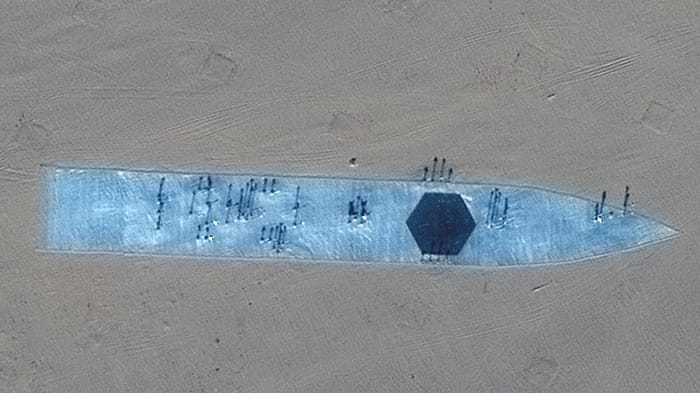
China's military is building increasingly detailed and sophisticated models of U.S. Navy warships at its target range out in Xinjiang, according to open-source intelligence analyst Damien Symon and UK paper The Telegraph.
China has been building out military testing and bombing ranges in its remote western deserts since at least the 2000s, and has added more and more realism to its mockups as time has gone by. Back in 2021, satellite imaging company Maxar Technologies released high-resolution photos of a Chinese test range that appeared carefully tailored for practicing attacks on U.S. Navy warships. The Taklamakan Desert site's most notable feature was an extra-wide-gauge rail line to nowhere. Supported on the rails was a mockup of a ship on wheels, ready to "maneuver" over the landscape to provide a realistic, moving, ship-like target. Nearby, two-dimensional mockups of familiar American warships - an Arleigh Burke-class destroyer and a Ford-class carrier - were laid out on the moonscape of the desert sand.
At the time, analysts suggested that the purpose of the site was likely for ballistic-missile target practice. China possesses multiple anti-ship ballistic missiles, including the DF-21D, DF-26, and the hypersonic maneuvering YJ-21. Ship-shaped targets would be ideal for live-fire testing of these munitions.
New imaging obtained by the Telegraph confirms that China has indeed used the site for munitions testing, as suspected five years ago. The rail-mounted ship is still there at the Taklamakan site, but shows signs of heavy damage. Likewise, a 2D mockup of three destroyers in a seaport - a diorama that happens to resemble U.S. 7th Fleet's Yokosuka naval base - shows signs of multiple impacts, including a substantial crater.
In addition, the realism of the targets appears to be increasing, and is tailored specifically to mimic real-world assets. A new mockup of a warship started construction this February at the Taklamakan site, and has already taken final form: it is a detailed, three-dimensional Arleigh Burke-class destroyer, down to the VLS cell hatches, the five-inch gun, the radar configuration and exhaust stacks. It may not be seaworthy, but from the perspective of a missile's seeker head, it might look identical.
Nearby sites contain rows of mockup F-16, F-22 and F-35 fighters, including some destroyed on the ground. Famously, another nearby desert site used for training assault troops contains full-size replicas of Taiwan's main government buildings, including the presidential residence and the parliament, all sited on a street layout mimicking downtown Taipei.
The Telegraph noted that all of these mockups are on open-air display, visible to anyone with access to a high-resolution satellite imaging service. That makes them not only a weapons testing program, but a message to the world - and specifically, a message to Taiwan and to the U.S. Navy.