Saturday, July 18, 2026

Spain’s Global Presence Inches Up – Analysis


Key Takeaways:

Spain ranks 13th in the 2025 Elcano Global Presence Index (score 312.1), the only major EU country in the top 20 to see a slight increase from 2024, driven by strong service exports, tourism recovery, and scientific output.

Economic presence dominates (61.8% of Spain’s global score), followed by soft presence (26.6%, boosted by tourism and migration) and a declining military share (11.7%).

Spain has undergone a remarkable transformation since 1990, with its global presence rising significantly (from isolation under Franco) thanks to EU integration, multinational expansion, and demographic support from immigration — though challenges remain in manufacturing and long-term demographic sustainability.


Spain remains in 13th position in the 2025 Elcano Global Presence Index and among the other EU countries in the Top 20 –Germany, France, Netherlands, Italy and Belgium– is the only one whose score is higher than in 2024, although only marginally (see Figure 1). The UK, which left the EU in 2020, recorded a fall, part of which can be put down to Brexit. The Conservative government’s post-Brexit foreign policy slogan ‘Global Britain’ has been little more than a hollow promise. The Labour government scrapped it in 2024.

Figure 1. Top 20 countries in the 2025 Elcano Global Presence Index and score change since 2024

RankingScoreChange 2024/25RankingScoreChange 2024/25
1. US3,323.6+32.711. South Korea408.3+13.1
2. China1,980.1+82.812. Italy381.0-3.1
3. Germany904.7-23.013. Spain312.1+0.5
4. UK824.5-44.014. Australia276.3-4.4
5.Japan787.9-11.915. Turkey261.2+2.1
6. France691.7-2.016. Switzerland244.1-13.9
7. Russia639.5+49.717. Singapore239.9+3.4
8. Canada501.4-54.518. UAE235.2+1.1
9. Netherlands450.8-28.619. Belgium209.8-21.9
10.India381.0-10.620. Saudi Arabia207.0-3.4
Source: Elcano Royal Institute.


Methodology: https://www.realinstitutoelcano.org/en/work-document/the-elcano-global-presence-index-methodology/. Source: Elcano Royal Institute.

The index, first calculated for 1990 and now covering 150 countries, is the result of adding together 17 indicators of external projection which are aggregated according to the criteria of experts in international relations. It measures the ability of countries to project themselves beyond their borders and the extent to which they are participating in and shaping the process of globalisation. Global presence is measured on three dimensions: economic presence, including outward foreign direct investment and other elements such as energy, services and exports; military presence, which is determined by the number of troops deployed abroad and; the equipment available for deployment, and; soft presence, which is based on a wide number of factors including exports of cultural products, tourist arrivals and official development aid.

Spain’s economic presence accounts for 61.8% of its global presence (50% in 1990), soft presence 26.6% (14.4%) and military presence 11.7% (35.6%, see Figure 2). Its score rose slightly in the latest index as it was able to make up for losses in some indicators, such as manufacturing and culture, with increases in tourism, sports and information, among others. As one would expect, the EU and the rest of Europe together account for most of the global presence (around 55%).


Figure 2. Spain’s global presence index: absolute values and % share in the index of the economic, military and soft presence dimensions, 1990-2025

Variable19901995200020052010201520202025
Economic presence77.1102.2153.0207.2246.5195.3191.7192.8
% of global presence50.054.763.866.966.465.363.361.8
Energy25.111.127.738.937.165.551.345.9
Primary goods53.6103.3120.0150.1152.4188.1175.5180.6
Manufactures303.3417.2487.9572.5498.8510.5480.0448.0
Services372.3439.9534.3663.7647.1591.2609.9686.6
Investments73.9135.9462.8771.81248.1737.6728.7693.1
Military presence54.952.848.152.958.440.239.036.4
% of global presence35.628.220.017.115.713.412.911.7
Troops1.328.747.346.942.516.331.347.4
Military equipment456.1418.3364.9405.5455.1323.1301.7267.5
Soft presence22.231.938.849.466.463.872.482.9
% of global presence14.417.116.216.017.921.323.926.6
Migrations47.159.390.1210.0307.2270.9297.5284.2
Tourism271.8242.3317.5358.5319.8374.2454.9487.9
Sports30.499.544.396.1103.9117.4105.5113.7
Culture7.061.592.2104.5123.8235.2217.6250.3
Information24.565.973.051.5103.885.784.4103.0
Technology21.128.333.072.089.783.3120.7143.0
Science44.976.1109.2141.4194.5241.7275.8282.9
Education22.848.083.033.888.795.0125.2176.4
Development cooperation108.6144.5149.9215.8394.2117.8171.1227.6
Climate119.9139.4154.1202.1224.9228.3236.4321.7
Global presence index value154.2186.9239.9309.5371.3299.3303.1312.1
Position in the index1311111111131313
Methodology: https://www.realinstitutoelcano.org/en/work-document/the-elcano-global-presence-index-methodology/. Source: Elcano Royal Institute.


The Index measures a country’s actual external projection rather than its power, reputation, or image. Because a strong international presence does not automatically translate into global or regional influence, the link between presence and power ultimately depends on the effectiveness of a nation’s foreign policy. Consequently, the Index reveals not just how present a country is on the global stage, but also the specific nature of that presence

The Index gauges the results of internationalisation, not its means. For example, a country may have deployed a significant number of troops abroad with a defence expenditure that is relatively smaller than that of another country with a smaller military presence abroad. Nor does the Index measure the openness of countries, though it may help to analyse it. The Index considers the external projection of countries and not so much the way in which they absorb the external action of other countries in their national territory. That is why the Index considers the exports of manufactured goods but disregards imports.

Spain’s economic presence is characterised by a strong services sector (75.4% of GDP), a relatively low manufacturing sector compared with Germany or even Portugal and a relatively higher weight of agriculture (3%) than France and Italy. Spain’s economic presence is the key factor in its global presence and largely explains the fluctuations in Figure 3. The global presence rose inexorably until the 2008-14 financial crisis and the Great Recession when it plummeted, intensified during COVID, and since 2022 has picked up again but has yet to reach the previous high (see Figure 3).


The increased economic presence since 1990 has been powered by the surge in exports of goods and commercial services, particularly the latter in recent years, and the expansion of Spanish companies and banks abroad. Service exports rose from €77.9 billion in 2020 to €225.3 billion in 2025, a significant success story that is generally not known, while merchandise exports over the same period increased from €266.3 billion to €392.8 billion. Spain’s global share of service exports is 2.5% compared to 1.7% for goods.

Spain has a hard core of multinationals that began to expand abroad in the 1990s. The outward stock of investment rose from US$15.6 billion in 1990 to US$828.9 billion in 2025. In comparison, Italy’s rose from US$60.2 billion to US$702.7 billion and in GDP terms was also lower than Spain’s.

Of the four largest EU economies, Spain’s global presence has increased the most since 1990, albeit from a much lower starting point (see Figure 4). Its score rose 50.6% compared to 29.3% for Germany, 12.2% for France and 4.7% for Italy.

Spain’s soft presence has been on an almost constant upward path. One of the key drivers of the soft presence is international tourism, which has recovered since the disastrous COVID year in 2020 when the number of visitors plummeted to 18.9 million from 83.5 million in 2019. In 2021, there were 31.1 million, in 2025 96.8 million and this year at least 100 million, double the population. Other factors are the progress made in renewable energy –in 2025 it generated an historic 55.5% of electricity– and greater publication of scientific material.


Another key element of the soft presence is immigrants. Just over 20% of Spain’s population of some 50 million is foreign-born compared to less than 3% of the 38.8 million population in 1990. But for net migration, Spain’s population would have declined in the past 36 years as the fertility rate (1.1 children today) has been consistently below the replacement rate (2.1) at which existing population levels would be maintained. Roughly half the 10 million foreign-born population is Latin American, more than in the rest of the EU together. In a country with a rapidly ageing population –life expectancy of 84 years is one of the world’s highest– and more deaths than births (since 2015), migrants are supporting key sectors such as tourism, agribusiness, social care and construction.

Lastly, the military presence’s share of the global presence has been steadily declining, but Spain still maintains a significant number of military personnel deployed in international missions and bases abroad. More than 170,000 military and police personnel have been deployed overseas since 1989 (4,000 at present).

Although the Index only dates from 1990, it serves as a powerful indicator of Spain’s profound transformation since the isolation of the Franco dictatorship. Entering the multilateral arena later than other major European powers, Spain underwent an intense period of internationalisation that has seen its global footprint expand significantly. The trajectory since 1990 underscores this historical leap: a nation that was once turned inward now enjoys a robust, diversified presence on the world stage.About the author: William Chislett (Oxford, 1951) is Distinguished Senior Fellow at the Elcano Royal Institute. He covered Spain’s transition to democracy for The Times of London between 1975 and 1978. He was then based in Mexico City for the Financial Times between 1978 and 1984. He returned to Madrid on a permanent basis in 1986 and since then, among other things, has written more than 20 books on various countries.


Source: This article was published by Elcano Royal Institute

About Elcano Royal Institute
The Elcano Royal Institute (Real Instituto Elcano) is a private entity, independent of both the Public Administration and the companies that provide most of its funding. It was established, under the honorary presidency of HRH the Prince of Asturias, on 2 December 2001 as a forum for analysis and debate on international affairs and particularly on Spain’s international relations. Its output aims to be of use to Spain’s decision-makers, both public and private, active on the international scene. Its work should similarly promote the knowledge of Spain in the strategic scenarios in which the country’s interests are at stake.
View all posts by Elcano Royal Institute →
Why The Indus Waters Treaty Matters, In A Warming World – OpEd


Map of the Indus River basin. Credit: Kmhkmh, Wikipedia Commons.


July 18, 2026 0 Comments
By Amina Jabbar

Key Takeaways:

Climate change is fundamentally altering the Indus Basin’s hydrology, with faster glacier melt, erratic monsoons, prolonged droughts, and more frequent floods creating new levels of uncertainty for water availability across South Asia.

Cooperative transboundary governance is becoming essential for climate resilience, as shared data, early warning systems, joint forecasting, and coordinated planning enable better preparation for extreme events than unilateral action.

The article argues that effective river basin management must integrate climate science, ecosystem health, and food security, positioning ongoing dialogue and institutional cooperation as critical tools for regional stability and sustainable development in an era of accelerating environmental change.


Climate change is, in a practical sense, changing how the world’s river systems behave. Across South Asia, higher temperatures, faster glacier breakdown, monsoons that act more erratically, long dry spells, plus more common flooding events are all reshaping the hydrology in the Indus Basin. What used to look like a straightforward question of how to share water is turning into something else climate resilience, and also basic human security.

The Indus Basin is home to hundreds of millions of people, and many of those communities depend on relatively steady river behavior. Farming depends on seasonal water timing, drinking water systems follow the same pattern, hydropower needs predictable volumes, fisheries rely on water levels, and wetlands plus nearby local ecosystems are tied into the basin’s natural pulse. But climate change is unsettling that pulse, and it is doing it with a level of uncertainty that is new and hard to plan around.

Against this backdrop cooperative handling of shared rivers becomes more and more crucial, because if you do not coordinate it, the whole system just gets harder. With more stable institutional arrangements, regular technical discussions, and openly shared information, riparian states can usually react better to climate related threats than they would by acting alone.


What the research shows is that the Himalayan glaciers, which are basically the origin of many key South Asian rivers, are changing in noticeable ways as temperatures climb. Even if glacier melt can give a short-lived boost to river flows in certain places, the longer-term loss of glacier mass might shift and reduce the seasonal water supplies. On top of that, precipitation patterns are also moving, so you end up with intense flooding in some periods and prolonged dry stretches in others. This combination makes water planning way more intricate than before, in a kind of ongoing back and forth.

Extreme weather events seem to be happening more and more across South Asia. Big, catastrophic floods have pushed millions of people out of their homes, smashed parts of infrastructure, and basically disrupted farming production. At the same time, drought conditions have been doing their own damage, lowering crop yields, draining groundwater, and raising the stakes for water access when resources are already limited.

It’s clear that transboundary water governance can’t just lean on old historical hydrological patterns, like everything will behave the same way. Climate adaptation needs institutions that can deal with uncertainty, and they have to do it through scientific cooperation, sharing data, and synchronized planning. One of the most useful parts in international river agreements is the regular back-and-forth exchange of hydrological and meteorological information. Measurements of river flow, precipitation logs, and flood forecasts give authorities a better chance to prepare for emergencies, well before disasters actually happen.


Early warning systems are kinda really important in the Indus Basin, because upstream rainfall or glacial lake outburst floods can hit downstream communities fast. When communication happens in time between riparian states, emergency agencies are able to mobilize resources, get people to safer areas, and ultimately lower the overall disaster losses, not just the immediate damage.

Climate adaptation also rides on improving the accuracy of seasonal forecasting and honestly that means better timing and fewer surprises. With shared scientific data, the water allocation choices get more solid, reservoir management becomes more controlled, and agricultural planning can be done with more confidence. And as climate variability keeps ramping up, this kind of cooperation becomes more and more valuable, even if that wasn’t obvious at first.

Food security is another big challenge. Agriculture in much of the Indus Basin still relies heavily on irrigation. So farmers need reliable water availability to decide planting schedules, choose crops, and set irrigation practices. If that predictability drops, the whole season can turn into a real problem.

Climate induced uncertainty kind of complicates these choices. Like delayed monsoons, irregular snowfall, and shifting river flows can mess with agricultural output quite a lot. Cooperative basin management can help create a more steadier working situation for both governments and farming communities. At the same time, environmental sustainability should get more focus too. Rivers aren’t just water supplies for people to drink; they also hold up wetlands, forests, fisheries, and biodiversity, which in turn provide important ecosystem services. Environmental flows, for instance, help keep water quality healthier, sustain wildlife habitats and also improve resilience when climate shocks happen.


Healthy ecosystems, kind of like natural infrastructure, they often do a lot of the heavy lifting. For instance, wetlands can reduce flood severity by soaking up excess water, and forests improve watershed stability, also lowering erosion. Keeping these ecological “assets” in place pairs well with more conventional engineering, and it helps climate adaptation last longer.

International water law has, more and more, acknowledged that when rivers cross borders the answer usually isn’t unilateral control, it’s cooperation. Even though countries naturally try to safeguard their national interests, shared river basins tend to work better when there are clear, predictable legal rules, plus ongoing technical engagement.

Climate change actually reinforces this principle, a bit like its “pushes” on everything already there. When uncertainty gets bigger than the value of institutions that help people communicate, sort out technical disputes and also nudge evidence-oriented decisions goes up too. Trust building steps become especially important when the water world is changing quickly in hydrological terms, like the baseline starts to move, fast. The Indus Basin shows the wider global dilemma of governing shared natural resources during a period of environmental shift, not just locally but across borders. Similar complications show up for nations dealing with the Mekong, the Nile, the Danube and plenty of other cross boundary rivers. What the basins have been teaching, over time, is that steady dialogue generally leads to more durable results than long institutional disengagement periods, even if disengagement feels “cleaner” in the moment.

Future water governance should, therefore start weaving climate science in a more systematic way into basin management. Like, joint research helps, but also better monitoring technologies and satellite observations together with modern forecasting systems can strengthen the shared view of emerging risks . That means investment in climate resilient infrastructure, groundwater management, efficient irrigation technologies and ecosystem restoration should go alongside legal agreements. Technical cooperation between scientists, engineers and water managers might prove just as vital as the diplomatic negotiations themselves.

Ultimately, climate change is turning water from something pretty predictable, into one that is getting more and more uncertain. And with that shift, cooperation, transparency and institutional resilience kind of move to the front row. Governments might argue about political questions, sure, but the shared environmental realities across the Indus Basin push everyone to keep talking and keep working together. South Asia’s future stability will hinge not just on how much water there is, but also on how well the countries cooperate to deal with climate risks that are getting larger all the time. In an era where environmental change is accelerating, cooperative river governance stays one of the more practical levers for building regional resilience, safeguarding ecosystems, and backing sustainable development.


About Amina Jabbar
Amina Jabbar is a Research Fellow at Quaid e Azam University. She can be reached at missaminajabbar@gmail.com


Poland builds EU coalition to push ETS reform

Poland builds EU coalition to push ETS reformFacebook


By Wojciech Kosc in Warsaw July 17, 2026

Poland has assembled a 10-country coalition to press Brussels to slow the tightening of the bloc’s emissions trading system (ETS) and reconsider a carbon market for buildings and road transport, the country’s climate minister said on July 16.

The initiative is backed by Italy, Bulgaria, Cyprus, the Czech Republic, Estonia, Greece, Hungary, Romania and Slovakia. Together with Poland, they can form a blocking minority that could halt changes unless their demands are met.

“We are fighting to repair the ETS and secure a fair energy transition for Poland,” Climate and Environment Minister Paulina Hennig-Kloska told PAP, the Polish state-run news agency. 

Launched in 2005, the ETS requires power plants, factories, airlines and shipping companies to surrender a permit for each tonne of emissions. It covers 40% of EU emissions and has cut power and industry emissions by about 47% since 2005.

The planned expansion of the system, known as the ETS2, aims at expanding it to put a carbon price on fuels used in buildings and road transport from 2028, a plan that meets objections from Poland and other countries.

The coalition assembled by Warsaw says households should not face new climate-related costs in the current economic and geopolitical environment.

The group wants a “realistic path” for cutting emissions and had sent its proposals to the European Commission, Hennig-Kloska said.

The group wants a slower annual reduction in carbon dioxide emissions allowances, so permits remain available closer to 2050 rather than being exhausted around 2039. Warsaw has argued for a reduction rate of just over 2%, compared with 4.4% planned from 2028.

It also wants more free allowances for energy-intensive industry, revised allocation benchmarks, an extension of the Modernisation Fund beyond 2030 and predictable carbon prices. Funding rules should reflect energy mixes and income levels.

The Commission is due to propose an ETS overhaul on July 17. 

Draft plans would slow the annual decline in the emissions cap from 2031 and extend free industrial allowances until 2037, while linking part of them to companies completing decarbonisation investments.

Poland and Italy oppose conditions on free permits, while countries like Germany and Sweden support ETS2 as necessary to encourage cleaner heating and transport. 

BRINGING THE WAR HOME

War enters brutal tit-for-tat phase as Ukraine strikes civilian targets destroying Wildberries warehouse

War enters brutal tit-for-tat phase as Ukraine strikes civilian targets destroying Wildberries warehouse
Ukrainian drones destroyed the warehouse of Russia's largest online retailer Wildberries, as the war moves into a new brutal tit-for-tat phase, hitting civiian targets. / bne IntelliNews


By Ben Aris in Berlin July 18, 2026

The Ukraine war enters brutal tit-for-tat phase with escalating strikes on civilian targets, Wildberries warehouse destroyed

The Ukraine war has entered a new brutal tit-for-tat phase where both sides are increasingly targeting civilian infrastructure in an effort to make life unliveable for the population.

The Missile War is escalating. Waves of Ukrainian medium- and long-range drones have moved beyond targeting Russian oil refineries and are increasingly hitting warehouses and factories.


A swarm of Ukrainian drones destroyed the Wildberries logistics centre outside of Moscow, killing seven warehouse workers and injured dozens more on July 18. Another attack sparked a fire at an oil depot in the wider capital region, the regional governor said on state TV on the morning after the attack.

"Seven people working the night shift died on the spot," Governor Yevgeny Pervyshov wrote on Telegram, adding that 28 more drones were shot down on approach. "If they had achieved their goal, the number of civilian casualties could have been much higher," he said, cited by Reuters.

Zelenskiy said that defence forces also hit two important logistics facilities in the Moscow and Tambov regions, which were used to supply sanctioned components for the production of drones and navigation equipment. An oil facility was also hit, and Ukrainian long-range weapons of destruction were used against targets in the Azov and Black Seas, as well as the Crimea.

"They were used by the aggressor to ensure the supply of sanctioned components for the production of drones and navigation equipment," Zelenskyy said in a social media post.

Russian press reported that the drones that struck the Wildberries warehouse were packed with ball bearings to cause maximum casualties.

"The enemy intentionally used metal ball-shaped projectiles in drones, which inflicted the maximum damage on civilians," according to Pervyshov after visiting the wounded at the Tambov regional hospital. It has not been possible to independently confirm the claim. Russian Ombudsman Yana Lantratova has sent an appeal to the UN High Commissioner for Human Rights.

Punishment strategy

Known as the “Amazon of Russia,” the warehouse was in the city of Kotovsk in the Tambov region, roughly 475km southeast of Moscow. Wildberries logistics complex in Elektrostal is one of the largest facilities in the company's network which is the leading e-commerce business in Russia as well as the largest retail business of any sort based on turnover revenue.

It also plays an important role in the war. Like Ukrainians, Russians use the post to send necessary supplies to the frontlines to their men. Russia has likewise targeted the warehouses of Nova Poshta, which plays the same role, and now Ukraine has finally got round to striking back.

Zelenskiy confirmed he had ordered the attack and said it was in retaliation for Russia’s new campaign of targeting civilian assets in Ukraine.

Ukraine’s campaign to damage or destroy Russia’s oil refineries in the last year has led to widespread fuel crisis across the entire country. In retaliation, Russia has started to systematically hit Ukraine’s petrol stations with drones to cause similar shortages. As IntelliNews reported, both sides have increasingly adopted a punishment strategy, taking out civilian infrastructure to make life for ordinary citizens as hard as possible.

Wildberries co-founder, CEO and Russia’s richest woman, Tatiana Kim, said it had been a "terrible night" for Russia and for the company, offering her condolences to the victims' families.

To limit the financial damage to the company, both Wildberries and its biggest rival Ozon, updated  terms and conditions in June to say the companies are not liable for the losses if the stock of its merchant partners stored in the warehouses were destroyed by acts of war.


Escalation trap

The logic behind the latest attacks is that steadily increasing the economic and social cost of the war will eventually inflict enough pain on Russia to force Vladimir Putin into negotiations. But the central problem, as journalist and IntelliNews columnist, Leonid Ragozin, argues in a recent op-ed for The American Conservative, is the timescale.

Russia is too large, economically resilient and politically repressive for coercion to produce a rapid capitulation. Its energy infrastructure, transport network and civilian economy can be damaged, but as IntelliNews argued, in the drones vs missiles conflict this has turned into, Ukraine’s drones don’t pack enough punch to destroy an oil refinery, although they are becoming increasingly effective at damaging them. Despite the sustained hits on refineries, the throughput has only been reduced by 13.5%, according to Sergey Vakulenko, an independent energy analyst, although that number appears to be rising steadily. Russia’s oi products sector is battered but not broken, Vakulenko argues. In the meantime, Russia has boosted its imports of petrol from Belarus, Kazakhstan and India.

Where drone strikes used to take a refinery offline for a few days while fire damage was repaired, a recent strike against the Moscow refinery has taken it offline for the rest of the year, Reuters reports. Converting the damage into decisive political pressure could take many years — perhaps a decade, says Ragozin.

“The problem is that Russian resilience is just beginning to be tested. Meanwhile, Ukraine’s society and economy have worn down to a dangerous level that Russia, if the war of attrition continues, would take decades to reach,” Rogozin said. “There is virtually no way for Ukraine and the West to make Russia so unliveable that Putin would end the invasion before Ukraine itself becomes completely lifeless."

For Ukraine, that timetable is potentially catastrophic. Russian forces have continued to advance despite Ukrainian strikes on refineries, fuel depots and logistics routes.

“What Russia is doing now in response to Ukrainian strikes is inching towards total war, with Russian drones and missiles methodically knocking out petrol stations in addition to energy infrastructure,” Rogozin wrote. “Moscow has also begun to target food-processing facilities, agricultural equipment, and trucks on highways. Ukrainians are bracing for another horrific winter in unheated apartments, while Russians are merely at the stage of making an extra effort to fuel their cars. The contrast couldn’t be starker."

Ukraine’s allies appear either not to recognise this asymmetry or to be willing to discount it. European governments continue to argue that additional funding, more advanced weapons and further escalation can finally force Moscow to retreat, even though successive rounds of pressure have failed to halt Russia’s eastern offensive.

Ragozin’s point is not that Russia cannot be hurt, but that the time needed to turn that pain into political surrender is far longer than Ukraine can safely endure. Prolonging and escalating the conflict without a credible path towards negotiations therefore risks becoming a fundamental strategic error.

This strategy resulted in the recent flood of “turning point” rhetoric, which claimed that Russia was losing the war and Ukraine “has already won,” according to comments by Finnish President Alexander Stubb ahead of the Ankara Nato summit on July 8. However, battlefield reports paint a very different picture. Updates of the milblogger site Deep State were suspended in the run up to the Nato summit, but now they are being refreshed again, they show Russian forces moving into artillery range of the last two key cities in the Donbas Fortress Belt, which are now in danger of falling into Russian hands after the crucial Donbas logistics hubs of Pokrovsk and Kostiantynivka have already been captured over the last six months.

“The “turning tide” campaign rests on a constellation of dubious assumptions about the state of the war, Russia’s society and economy, and the West’s ability to contain the conflict without it sliding into nuclear apocalypse...” said Ragozin.

Bankova’s political crisis

The latest attacks come as the Ukrainian administration is in the midst of a political crisis that has left Ukraine without a defence or foreign minister. Following Zelenskiy decision to shake-up the government after Prime Minister of Ukraine Yuliia Svyrydenko resigned last week, triggering the resignation of the entire cabinet, squabbling broke out over who should replace the highly effective, but much disliked by the establishment, Defence Minister Mykhailo Fedorov.

“Ukr security source tells me of “intense turbulence” at the heart of Zelenskiy’s operation tonight. “At noon there was one decision on the new defence minister, at 2pm another, and at 6pm a third.” Zelenskiy, he says, is focused on one thing alone: Fedorov and what to do about the protests,” The Economist’s Ukraine correspondent Oliver Carroll said in a social media post.

Analysts believe that Zelenskiy decided to reshuffle the government in anticipation of a brutal winter attack by Russia where Putin will once again target what remains of Ukraine’s power sector and attempt to freeze Ukraine into submission. Energy was a major theme in his choices for replacement candidates to the top jobs in the government.

Lawmakers approved chairman of the national gas company Naftogaz's board, Serhii Koretskyi as the new Ukrainian Prime Minister on July 16, but the key posts of defence minister and foreign minister remain vacant, with acting minister appointed to run the ministries until the Rada comes back from its summer break on August 18.

As IntelliNews reported, Zelenskiy is facing a growing domestic political crisis as parliament frustrated the president by refusing to approve his choices for the new Defence Minister.

The president subsequently named Major General Yevhenii Khmara, acting head of the SBU security service and a former commander of its Alpha special-operations unit, as acting defence minister. Zelenskiy has not yet proposed a replacement for the foreign minister, leaving the incumbent Andrii Sybiha in place for now as acting foreign minister.

The turmoil comes at the worst possible time as Russian forces capture the Kostiantynivka and threaten to take the two remaining cities of Slovyansk and Kramatorsk, which would complete Russia’s occupation of the region if successful – Russian President Vladimir Putin’s stated war goal.

Ukraine war exposes widening missile defence gap as strikes reshape energy markets

Ukraine war exposes widening missile defence gap as strikes reshape energy markets
Ukraine has demonstrated growing effectiveness in striking Russian energy infrastructure, but without significantly reducing Moscow's oil export revenues. / IntelliNewsFacebook
By IntelliNews July 16, 2026

Ukraine's struggle to defend its skies against ballistic missile attacks is increasingly highlighting the strategic importance of interceptor production, while successful Ukrainian strikes on Russian energy infrastructure are reshaping fuel markets without significantly reducing Moscow's oil export revenues, argued independent analyst Shanaka Anslem Perera.

Kyiv's air-defence challenges were highlighted during a large-scale Russian attack on July 6, when Ukrainian officials said 28 people had been killed by the following morning. According to Reuters, Ukraine intercepted only four of 54 ballistic missiles launched during the early-July assault, illustrating the growing strain on the country's limited stock of advanced interceptor missiles.

President Volodymyr Zelenskiy has repeatedly urged allies to release additional Patriot missiles, arguing that interceptors stored in partner countries could immediately strengthen Ukraine's air defences.

The shortage reflects not only political decisions but also the limited pace of global production. During the opening days of the recent conflict involving Iran, US and Gulf air-defence forces reportedly expended hundreds of Patriot interceptor missiles within several days. By comparison, Lockheed Martin produced a record 620 PAC-3 MSE interceptors during 2025, highlighting how quickly inventories can be depleted during high-intensity warfare.

The imbalance has created a strategic asymmetry. Russia can launch repeated ballistic attacks while Ukraine depends on lengthy production schedules, allied political approvals, international deliveries and integration of new systems before additional interceptors become operational.

At the same time, Ukraine has demonstrated growing effectiveness in striking Russian energy infrastructure. Ukrainian drones have targeted Russia's ten largest oil refineries since the start of the campaign, disrupting domestic fuel production and contributing to periodic gasoline shortages.

Despite the refinery damage, Russia has maintained strong crude oil exports. In June, the country exported 5.8mn barrels per day of crude, its highest monthly volume since February 2022, suggesting Moscow has increasingly compensated for reduced refining capacity by exporting more unprocessed crude while importing some refined petroleum products.

The broader geopolitical environment has further complicated the picture. Concerns over instability in the Middle East briefly pushed Brent crude prices to their highest levels in weeks, temporarily increasing export revenues for Russia just as its domestic refining sector faced mounting pressure.

Perera argued the conflict is increasingly becoming a contest of industrial capacity as much as battlefield performance. They point to the time required to design, manufacture, approve and deploy sophisticated missile-defence systems, compared with the speed at which combatants can exploit temporary shortages or damage critical infrastructure.

For Ukraine and its allies, maintaining adequate supplies of air-defence interceptors has become one of the central challenges of the war, while for Russia the resilience of its energy sector remains essential to sustaining export revenues despite repeated attacks on refining facilities. The balance between industrial production, logistics and military adaptation is likely to remain a defining factor as the conflict enters another phase.


Ukrainian forces strike 'major' logistics hubs in central Russia


 The Associated Press. 
Published on 18/07/2026 

"The aggressor used them to supply sanctioned components for drone production and navigation equipment," Zelenskyy said of the targeted facilities.

Ukraine carried out large-scale strikes on central Russia overnight, targeting a number of warehouses and an oil facility, according to Kyiv and local Russian authorities.

Ukrainian President Volodymyr Zelenskyy said on Saturday that Ukrainian forces had hit two "major" logistics facilities in the regions of Moscow and Tambov as part of Kyiv's "long-range sanctions" against Russia.

"The aggressor used them to supply sanctioned components for drone production and navigation equipment," Zelenskyy wrote in a post on social media, adding that an oil facility was also hit.

Two warehouses belonging to Russian online retailer Wildberries were targeted in the strikes, according to Tatyana Kim, the company's founder.

"Seven people working the night shift were killed at the scene," Yevgeny Pervyshov, the head of the Tambov region, wrote on Telegram, adding that 25 others were injured in the attack.

One person was also killed and 37 were injured in a drone attack on a Wildberries logistics centre in Elektrostal in the Moscow region, authorities reported.

Video footage circulating on social media appears to show a large fire at the scene of one strike.

Earlier on Saturday, Moscow Mayor Sergey Sobyanin announced that 370 drones were heading for the Moscow region. He said that air defences had "neutralised" most of the drones and that 64 were destroyed. Euronews has been unable to independently verify these figures.

For its part, Russia has repeatedly targeted Ukrainian logistics facilities, including sorting facilities operated by Nova Poshta, a private Ukrainian mail and courier service. The Russian Ministry of Defence has said that such facilities are used by Ukraine to store and assemble drones.

In June, Nova Poshta CEO Yevhen Tafiichuk said a Russian missile attack had destroyed the company's "largest and most innovative terminal."

The Ukrainian air force said Russia launched 90 attack drones and seven missiles at Ukraine overnight, particularly targeting the Odesa region. As of early Saturday morning, local air defences had intercepted one missile and 69 drones, it added.

A drone attack on Kherson on Saturday morning also injured at least nine people, according to the Kherson Oblast Military Administration.

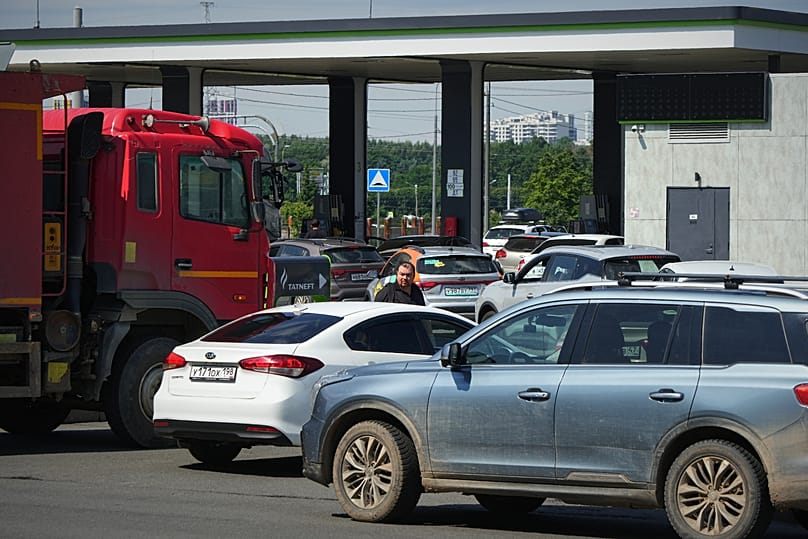
Vehicles line up at a Tatneft gas station in St. Petersburg, Russia, Tuesday, June 30, 2026. Copyright 2026 The Associated Press. All rights reserved

Ukraine has ramped up its long-range attacks on Russian industrial and energy sites in recent months, particularly targeting oil facilities such as refineries and depots.

Ukraine's strikes have led to a fuel crisis across large parts of Russia and Russian-occupied territories, with many locals facing petrol shortages and rising prices.

In response, the Kremlin moved to ban diesel exports in an effort to soften the impact, while fuel rationing has also been introduced in some regions.