Sunday, July 19, 2026

AIPAC has spent a record amount on Michigan's Senate primary, the biggest test of its influence yet

JOEY CAPPELLETTI
Updated Sun, July 19, 2026 


From left foreground, U.S. Rep. Alexandria Ocasio-Cortez, D-N.Y., Michigan Democratic U.S. Senate primary candidate Abdul El-Sayed, and U.S. Sen. Bernie Sanders, I-VT. join hands together following a campaign rally, Saturday, July 18, 2026, in Detroit. (AP Photo/Jose Juarez)(AP Photo/Jose Juarez)

Michigan Democratic U.S. Senate primary candidate Abdul El-Sayed addresses the crowd during a campaign rally, Saturday, July 18, 2026, in Detroit. (AP Photo/Jose Juarez)(AP Photo/Jose Juarez)


Michigan U.S. Sen. candidate, Rep. Haley Stevens, D-Mich., speaks with media after a debate at WoodTV studios on Tuesday, July 7, 2026, in Grand Rapids, Mich. (AP Photo/Kristen Norman)(AP Photo/Kristen Norman)


SOUTH HAVEN, Mich. (AP) — Senate candidate Haley Stevens talks often about manufacturing, taking on President Donald Trump and why she's the Democrat best positioned to win Michigan. The congresswoman has far less to say about the pro-Israel group that has spent millions trying to get her elected.

The American Israel Public Affairs Committee, or AIPAC, and its affiliated groups have spent close to $30 million backing Stevens — their largest investment ever in a single race — as they seek to defeat progressive favorite Abdul El-Sayed in the Aug. 4 primary.

Stevens has largely avoided discussing the organization directly, even as its spending has reshaped the race. Asked twice about AIPAC during a July campaign stop in West Michigan, she responded for more than 800 words without mentioning the group a single time. Israel came up only once, when she said she "wanted to see the U.S. and Israel working together to rebuild Gaza."

"Anyone who supported me is supporting me because of my dedication to the people of Michigan, and the things that I have done for Michiganders," Stevens told The Associated Press when asked whether she welcomed AIPAC's support.

The exchange illustrates how politically fraught AIPAC has become in Democratic politics as the war in Gaza has divided the party over U.S. support for Israel. AIPAC works to elect lawmakers who support its mission of strengthening the U.S.-Israel relationship and advancing policies it says enhance the security of both countries.

AIPAC did not respond to a request for comment. The organization's super PAC, United Democracy Project, declined to comment.

The issue carries particular weight in Michigan, home to the nation's largest Arab American population. Beyond Michigan, El-Sayed's progressive allies are framing the race as a broader test of whether grassroots organizing can overcome unprecedented outside spending.

"One of the laws of nature in politics is whoever spends the most money wins," said New York Rep. Alexandria Ocasio-Cortez, who has been campaigning for El-Sayed in Michigan this weekend.

"It is an opportunity to show that things other than money can win in America."
Stevens has spent $1 million on advertising. Her backers have spent $50 million

The four-term congresswoman raised half of what El-Sayed did in the latest fundraising period until June 30. Her team said in a statement that the campaign "is raising the resources we need to win this race."

She spent only $12,000 of her own campaign funds on advertising through early July, before bumping it up to close to $1 million, according to AdImpact. Outside organizations, meanwhile, have poured close to $50 million into boosting her candidacy. One of them, A Stronger Michigan, has spent roughly $12 million without disclosing its donors.

El-Sayed has made AIPAC and the tens of millions of dollars spent to support Stevens a centerpiece of his campaign. He and his allies have accused Stevens as being a mouthpiece for her large donors.

"She is nothing more than an employee of these billionaires," said Sen. Bernie Sanders, who is also campaigning with El-Sayed this weekend at rallies in Detroit, Lansing and Grand Rapids.

Stevens has said she supports "comprehensive campaign finance reform."

Most voters are unlikely to realize many of the ads blanketing Michigan's airwaves are funded by AIPAC. They never mention Israel, instead highlighting Stevens' work on manufacturing and featuring former President Barack Obama.

"AIPAC never runs on AIPAC. They never even talk about Israel and Palestine," said former Rep. Andy Levin, whom Stevens defeated in a 2022 Democratic primary after redistricting. AIPAC spent millions opposing Levin, who is Jewish. "If you're just a voter and you see a million ads, you don't know who paid for it."
A stark divide on Israel in a state with large Muslim and Jewish populations

The surge of spending from AIPAC comes as the Democratic candidates have taken sharply different positions on Israel's war in Gaza.

While Stevens is not Jewish, she has long been one of Congress' most outspoken supporters of Israel. She has described herself as a "proud pro-Israel Democrat" and once said during a Hanukkah celebration that "Israel comes to me in my dreams."

Stevens has criticized Israeli Prime Minister Benjamin Netanyahu. During a recent debate, she said he "has not made us safer, has not brought us closer to peace, and he's endangered Jews here in America and around the world."

El-Sayed has embraced the contrast. The son of Egyptian immigrants, he has called Israel's military campaign in Gaza a "genocide," described the Israeli government as "evil," and repeatedly argued that AIPAC's influence distorts Democratic politics.

"The reason that we've seen this war fought is because of the impact of AIPAC in our politics," El-Sayed said during a recent debate.

The war in Gaza began after Hamas' Oct. 7, 2023 attacks in Israel that killed about 1,200 people and took 251 hostage. It has since waged on for over 1,000 days. Israel has killed more than 73,000 Palestinians in its retaliatory offensive, Gaza's Health Ministry said.

If elected, El-Sayed would become the first Muslim U.S. senator. He recently addressed questions about whether his faith would hurt his electability in the battleground state.

"When they raise questions about my 'electability,' they are usually pointing to the most obvious thing about me that makes me 'different' — that's my name and my Muslim faith," he wrote in an email to supporters. "Faith, to me, isn't just about an identity. It's about the choices that I make every single day about how I live my life."

El-Sayed has spent about $3.2 million from his own campaign account on advertising, with around $1 million in outside spending. His campaign has instead emphasized grassroots organizing, saying it has recruited more than 10,000 volunteers statewide.

Asked how many volunteers Stevens has, her campaign said it has "hundreds across Michigan."

"This election will come down to the many versus the money," El-Sayed wrote.
The Democratic divide is occurring beyond Michigan

Once-firm support for Israel has eroded within parts of the Democratic Party in the fallout from the war in Gaza. As divisions over Israel have deepened, criticism of AIPAC has intensified.

Earlier this week, 103 House Democrats voted unsuccessfully to block $3.3 billion in U.S. aid to Israel, the clearest sign yet of the party's divide. Among them was New York Rep. Pat Ryan, who had previously voted to send aid to Israel and accepted support from AIPAC.

"I expect groups like AIPAC will not support me in my future elections and frankly, I don't want their support," Ryan said on social media, later adding that he was returning the money.

The tension also played out in 2024. In Michigan's Senate race, Democratic activists pressured now-Sen. Elissa Slotkin to take a harder line on Israel's war in Gaza. Slotkin, who is Jewish, had already distanced herself from AIPAC years earlier. She ultimately defeated Republican Mike Rogers by fewer than 20,000 votes.

Rogers is running for Senate again this year, and is unopposed in the GOP primary.

While the issue still remains divisive for Democrats, some question whether it will ultimately shape how most primary voters cast their ballots, with concerns such as the economy carrying greater weight.

"It's not that Democratic primary voters love AIPAC. They obviously don't," said Michigan political strategist Adrian Hemond. "But this doesn't even register as an issue that's influencing voting behavior for the overwhelming majority of primary voters."

New York Times raises eyebrows by referring to AIPAC as 'hard-right' pro-Israel group

Joseph A. Wulfsohn
Fri, July 17, 2026
FOX NEWS


The New York Times building

The House of Representatives voted on a bill to cut military and humanitarian aid funding to Israel, which failed to pass but earned majority support among Democratic lawmakers, resulting 103-98.


The New York Times is raising eyebrows among critics over how it characterized the American Israel Public Affairs Committee (AIPAC), the U.S.-based group that has become a target of anti-Israel advocates.

On Wednesday, the House of Representatives voted on a bill brought by outgoing anti-Israel Rep. Thomas Massie, R-Ky., to cut military and humanitarian aid funding to Israel, which ultimately failed to pass but still earned majority support among Democratic lawmakers, resulting 103-98. Massie was the sole Republican vote.

In the Times' report on the vote, it highlighted how Democrats have increasingly vowed not to accept donations from AIPAC, which historically gave to both Democrats and Republicans who are supportive of Israel and its alliance with the U.S. Among those who have committed not to accept AIPAC money is Rep. Seth Moulton, D-Mass.

"Mr. Moulton, who is running for Senate, has also said he would no longer accept donations from AIPAC, the hard-right pro-Israel lobbying group that has recently become a toxic brand among Democrats," the Times wrote.

Founded in 1954, AIPAC says its mission is to "encourage and persuade the U.S. government to enact specific policies that create a strong, enduring and mutually beneficial relationship with our ally Israel," and that it helps "elect Democrats and Republicans who support the alliance."

Prominent Democrats once joined Republicans in speaking at AIPAC's annual Policy Conference, which hasn't been held since the COVID pandemic. Among the top Democrats who spoke at its last conference in March 2020 were Senate Minority Leader Chuck Schumer, Sen. Cory Booker, D-N.J. Rep. Hakeem Jeffries, D-N.Y. and then former Vice President Joe Biden via a video message. Rep. Nancy Pelosi, D-Calif., spoke at the conference the year prior while serving as House speaker — she notably voted in favor of defunding money to Israel this week while Jeffries voted against the bill.

Critics on social media were puzzled by the Times' description of the pro-Israel group.

"@anniekarni , a veteran NYT reporter, published a piece tn which she calls AIPAC a 'hard-right lobbying group.' What possible defense can you have of this formulation about an organization whose staff is probably 70 percent Democratic, Annie? Is it fun joining the jackals?" Commentary Magazine editor John Podhoretz called out the Times reporter on Friday.

"I wish AIPAC was hard right. Or even kind of right," New York Post columnist Karol Markowicz reacted.

"AIPAC is a bunch of left-center squishes. It's only 'hard right' if you think Israel defending itself is 'extreme,'" California Post opinion editor Joel Pollak wrote.

"Shows how detached from reality a lot of media coverage of Israel has become. Most pro-Israel Jews are Democrats!" Jewish Insider editor-in-chief Josh Kraushaar exclaimed.


The American Israel Public Affairs Committee (AIPAC), led by its president, Michael Tuchin, has become a prominent target among anti-Israel progressives.

Neither The New York Times nor AIPAC responded to Fox News Digital's requests for comment.

In the post-Oct. 7 political climate, support for Israel has dropped dramatically among Democrats while maintaining a much larger swath among Republicans. AIPAC itself has widely been scapegoated by anti-Israel advocates, many of whom falsely push the narrative that the Jewish state is buying influence through AIPAC despite the fact that AIPAC is an American organization run by pro-Israel U.S. citizens.

Standing against Israel has become a litmus test for the progressive base of the Democratic Party for political hopefuls and is widely expected to be a major issue during the 2028 presidential election.

Fox News' Brian Flood contributed to this report.

Iran Says Real ‘Foreign Influence’ Campaign in US Is Being Directed by Israelis Working With Trump Ally

“Americans are being warned of foreign influence. How about the extensive Israeli campaign to bamboozle the US administration into an unwinnable war of choice?”


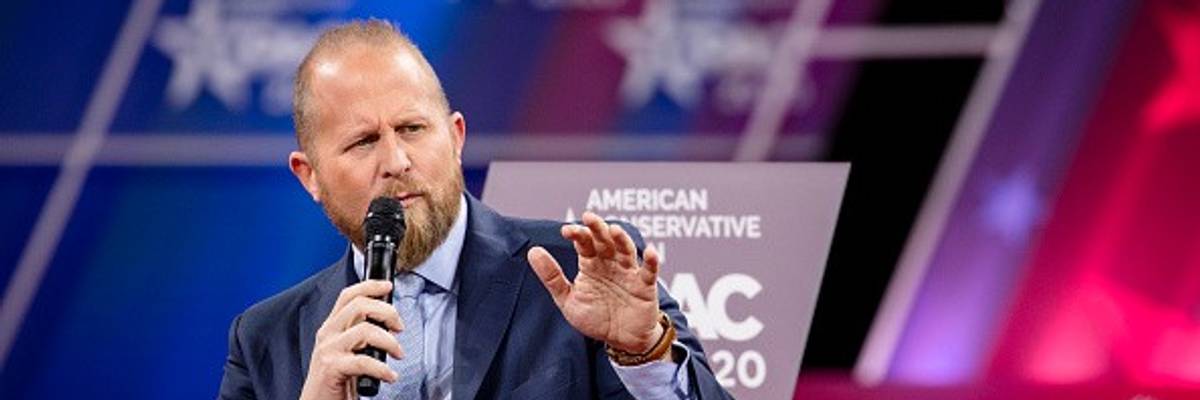
Brad Parscale, campaign manager for Trump’s 2020 reelection campaign, speaks on stage during the Conservative Political Action Conference 2020 (CPAC) on February 28, 2020 in National Harbor, Maryland.
(Photo by Samuel Corum/Getty Images)


Brad Reed
Jul 17, 2026
COMMON DREAMS

President Donald Trump on Thursday accused the Chinese government of trying to meddle in US elections in a lengthy speech rattling off baseless conspiracy theories about his 2020 loss to former President Joe Biden.

However, Iranian Foreign Minister Seyed Abbas Araghchi on Friday said that the president was overlooking a foreign influence campaign being carried out by one of his longtime allies.

In a social media post, the Iranian diplomat pointed to a report in Time about Brad Parscale, Trump’s former campaign manager, who is now a registered foreign agent of Israel conducting influence operations on behalf of its government.

“Americans are being warned of foreign influence,” wrote Araghchi. “How about the extensive Israeli campaign to bamboozle the US administration into an unwinnable war of choice? Even worse: Israel is using US taxpayer dollars to silence any US critics. It will all soon unravel.”

According to Time, Parscale’s Clock Tower X firm last year signed an agreement to produce content across multiple platforms aimed at shoring up support for Israel among young US conservatives.

An anonymous Israeli Foreign Ministry official told Time that Parscale “presented himself as uniquely positioned to improve Israel’s reputation among young conservatives,” while stressing “his experience at the helm of Trump’s political operation, with a grasp of both the architecture of the modern internet and the political movement Trump had built” during his three runs for the presidency.

“Three people familiar with the campaign describe a messaging operation run through a network of interconnected firms overseen by Parscale or other firms he owns or created,” reported Time. “Through private group chats, they say, conservative influencers receive suggested language for posts on social media sites such as X, Instagram and TikTok. They were then compensated based on the impressions and engagement their content generated.”

One Trump official told Time they suspected that Parscale was also behind an operation aimed at undermining the president’s efforts to broker a deal to end his illegal war with Iran.

Parscale, however, denied pushing messages that attacked the deal shortly after its announcement.

“I have never funded, organized, or participated in any effort to undermine President Trump—ever—including his [memorandum of understanding] or ceasefire proposal,” the former Trump 2020 campaign manager told the magazine. “The claim that I am coordinating an effort to prolong the war is completely false.”
Donald Trump Met With Boos At World Cup Final

Kelly Coffey-Behrens
Sun, July 19, 2026 


ZUMAPRESS.com / MEGA

President Donald Trump made history as the first sitting U.S. president to attend a World Cup final held on American soil, but his brief appearance on the stadium screens was met with scattered boos from the crowd.

Donald Trump's dramatic arrival at the World Cup final drew a decidedly mixed reception from soccer fans. The president flew over New York New Jersey Stadium aboard Marine One before landing near the venue on Sunday, July 19. He later appeared alongside FIFA President Gianni Infantino as Spain faced defending champion Argentina for soccer's biggest prize.

Trump's appearance carried historical significance, making him the first sitting U.S. president to attend a World Cup final held on American soil. However, his brief appearance on the stadium's video screens was met with scattered boos from the crowd.

Donald Trump Arrives Aboard Marine One

Marine One flew over the stadium approximately 45 minutes before kickoff, according to The Guardian. The presidential helicopter landed nearby minutes later.

Trump took his place in a glass-enclosed luxury section on the west side of the stadium shortly before the game began. First Lady Melania Trump, Secretary of State Marco Rubio and Infantino joined the president. Other dignitaries in attendance included Spain's King Felipe VI, Canadian Prime Minister Mark Carney and Mexican President Claudia Sheinbaum.

The president was briefly shown on the stadium screens after Jennifer Hudson performed the U.S. national anthem. While some fans booed, the reaction was reportedly less hostile than those Trump has received during previous appearances at sporting events.

Fox's broadcast team acknowledged that viewers might have had difficulty spotting the president behind the glass. "As you see the president of the United States, a little bit hard to see with the glare on the glass in front of him," an announcer said.

The President Was Expected To Present The Trophy

Trump was also expected to join Infantino for the trophy presentation after the match, Reuters reported. During the early stages of the game, the president was seen reaching out and touching the World Cup trophy from his seat.

The ceremonial role has traditionally been given to the host country's political leaders. Qatar's Emir Sheikh Tamim bin Hamad Al Thani joined Infantino when Argentina received the trophy in 2022, while Russian President Vladimir Putin participated in the presentation after France's 2018 victory.

Trump's attendance also marked a departure from the last time the United States hosted the tournament. Former President Bill Clinton did not attend the 1994 final, leaving former Vice President Al Gore to help present the trophy to Brazil.

Donald Trump And Gianni Infantino Have Grown Close

The final was hardly Trump's first high-profile appearance beside Infantino. The two have developed a close relationship as FIFA expanded its presence in the United States ahead of the tournament. Trump also played a controversial role in the competition after personally asking Infantino to review the suspension of U.S. striker Folarin Balogun.

Balogun had received a red card that would ordinarily have triggered an automatic one-match ban. FIFA ultimately suspended that punishment for a one-year probationary period, allowing him to face Belgium in the round of 16.

The reversal sparked questions about political interference in FIFA's disciplinary process. The decision did not save the American team, which was eliminated by Belgium.

World Cup Appearance Draws Online Criticism

Trump's smiling appearance at Sunday's final also generated criticism on social media, particularly from users who accused him of celebrating at the match while American troops remained involved in the escalating conflict in the Middle East.

"What a disgrace," one X user wrote, while another chimed in with, "He looks really happy considering our troops are dying in the Middle East for another worthless conflict that he created. Draft dodging piece of sh-t."

Trump Previously Drew Loud Boos At The Stadium


Sunday's final was Trump's first match at the 2026 World Cup, despite the United States co-hosting the tournament with Canada and Mexico. He was already familiar with the East Rutherford venue after attending the 2025 Club World Cup final there. Trump helped present the trophy to Chelsea but drew loud boos from spectators during the ceremony.

The president has become an increasingly visible presence at major sporting events since returning to office. He has attended the Super Bowl, the Daytona 500, the U.S. Open, the Ryder Cup and multiple golf tournaments. His appearance at an NBA Finals game involving the New York Knicks also prompted boos from the home crowd.
ITALY

Venice protesters clash with police as Trump envoy’s mega yacht crashes their party

Barbie Latza Nadeau, 
CNN
Sat, July 18, 2026


Protesters gather near the super yacht Boardwalk, used by US Ambassador to Italy Tilman Fertitta, during a demonstration in Venice, Italy, on Friday. - Manuel Silvestri/Reuters


Around 300 protesters clashed with riot police in Venice on Friday evening over the arrival of US ambassador to Italy Tilman Fertitta's $450 million mega yacht Boardwalk during the city's annual Redentore (Redeemer) festival, police said.

Fertitta, a close ally of and donor to US President Donald Trump, has been cruising around Italy this summer with his family and some staff on his private yacht as part of what he calls a "coastal diplomacy" effort to celebrate the United States' 250th anniversary, according to his social media.

His arrival was greeted in Venice by protesters holding signs saying "Venice is not for sale" and insulting Trump. Police were seen pushing back protesters who were trying to reach the ambassador's ship. Many held signs with photos of Trump, some threw inflatable pool toys at police, others used megaphones to yell insults at the American administration.

Daniele Giordano, secretary of the CGIL union in Venice, told those who had gathered that it was "a disgrace" that Venice was welcoming Fertitta's mega yacht during the festival, and that its presence "represents the exact opposite of our idea of ​​environmental and social sustainability."

One demonstrator, Emanuele Lepore, told Reuters news agency: "It is almost strange that we have to struggle so much to make people understand that this city is not for sale, as any other city where people are actually struggling just to live, a city which is constantly emptied out of spaces, houses, public services, and welfare, and it is constantly sold out to billionaires."


Demonstrators clash with riot police during a protest against the visit of US Ambassador to Italy Tilman Fertitta, who arrived aboard his 117-metre mega yacht in Venice on Friday. - Piero Cruciatti/Anadolu/Getty ImagesMore

The ambassador, whose net value is listed by Forbes at just under $11 billion, owns casinos, sports teams and restaurants in the United States. Fertitta says he is paying the yacht expenses personally for his family and his guests onboard, but neither the US embassy nor Italian officials have revealed what has been spent by Italian taxpayers to ensure the security needed to protect him and his entourage.

At each of the 13 ports on his itinerary through Labor Day, his plans include meeting with local business leaders, celebrities and Americans on board the yacht, which has required extra security on both land and sea.

His arrival in Venice ahead of one of the city's most celebrated festivals drew out the same organized groups of demonstrators, who called followers to action on social media, as protested last summer against the celebrity wedding of Amazon billionaire Jeff Bezos and former journalist Lauren Sanchez, which was held over several days in the lagoon city.

The fact that Fertitta's towering 117-meter (384-foot) yacht docked in front of an area where Venetians would normally be able to watch the impressive festival fireworks from shore added insult to injury. The festival is held annually to celebrate the end of an outbreak of the plague in 1576 and is attended by thousands of people in boats and on the city's canals, culminating in a fireworks show over the city.

The US embassy has not publicly commented on the protests, but a spokesperson for Italy's Foreign Ministry said that the coastal diplomacy was working. It comes at a time of tense relations between the US president and Italian Prime Minister Giorgia Meloni. Trump last month doubled down on the feud when he described Meloni as insisting on having a photo taken with him at the G7 in France.

The yacht, which has twin helipads, has until recent weeks been docked in the Civitavecchia port near Rome since Fertitta's ambassadorship began in 2023. The ambassador and his family lived on the yacht last summer while renovations were made at the official residence in Rome.

For more CNN news and newsletters create an account at CNN.com
Women sand miners toil stripped Cape Verde beach

Lucie PEYTERMANN
Thu, July 16, 2026


Vania Tavares collects black sand from the beach near the town of Ribeira da Barca, Cape Verde (PATRICK MEINHARDT)

On a rocky Cape Verde beach, Maria and Vania fill their buckets with black sand the moment that waves recede, transporting it on their heads to a stockpile where it will be sold illegally.

The women struggle to keep their footing against the rough ocean while balancing the loads, which weigh dozens of kilograms (pounds).

The beach is far from the typical picture postcard image of the west African archipelago and Vania Tavares makes the sign of the cross before stepping into its dangerous waves.

The women, known as "sand thieves", have performed this gruelling task almost daily for more than 15 years in order to survive in one of the island nations' poorest regions.

With solemn expressions, the pair plus four other neighbouring women move in a silent, hours-long dance during low tide at Charco Beach near the town Ribeira da Barca, located on the main island of Santiago.

Maria Eleonore Monteiro's slender frame sways under the weight of the bucket as she climbs towards dry land to empty it beside a dozen large piles, which will be sold to contractors or resellers.

Buyers pay around $140 for a load of sea sand, often gathered over weeks, which is still cheaper than what is legally extracted from quarries.

"It's my only alternative, I have no other job", Monteiro told AFP, exhausted after a trip to the piles.

Her legs are scarred from falls and accidents on the rocks: "I've been gathering sand for so long that I have back pain. Sometimes I spend three days in bed", she said.

- Stones and craters -

Far from the idyllic white or black sand beaches found on some Cape Verdean islands, Ribeira da Barca attracts no tourists, much like the majority of Santiago Island's beach areas.

For decades these sites have served as artisanal open-pit mines for harvesting sand sold at rock-bottom prices, leaving behind a desolate landscape of stones and craters.

The actual beach at Charco has mostly vanished, forcing the women to extract the remaining sand from the water, even though many of them cannot swim.

Sand mining is illegal in Cape Verde under laws passed between 1997 and 2017, punishable by fines or imprisonment.

Yet the practice persists, with authorities sometimes turning a blind eye when it's a matter of survival.

The women interviewed by AFP have not had any run-ins with the police in three years.

As the only natural resource in the impoverished archipelago, sand fuelled urban expansion in the 1980s and 1990s.

Most of the capital, Praia, was literally built with it, Ana Veiga, director of the NGO Lantuna, told AFP.

To reach the remote beach where they gather sand, Monteiro and her neighbours walk half an hour from their poor community, which lacks running water.

This is where Tavares also lives. She was forced to drop out of school at age 13 to work, and has been harvesting sand for the last 16 years to feed her children.

On the day AFP visited, she was cooking over a wood fire that emits an acrid smoke, unable to afford gas.

Sand mining is one of the few means of survival for single mothers like Tavares's sister, Vanilda, 32, who has three children by three different fathers, "none of whom help" raise them.

- 'Disastrous consequences' -

The illegal beach sand trade has been curbed in recent years via a crackdown and awareness campaigns.

"Sometimes we wait a month before selling a truckload of sand", Tavares said.

Decades of sand harvesting have also left their mark on what was once the vast beach of Praia de Areia Grande, on the island's east.

The sand mining has left the area with "disastrous consequences for agriculture", said Samuel Leal, a 34-year-old agricultural engineer and representative from the Ministry of Agriculture and Environment for the municipality of Santa Cruz.

"The natural barrier was broken, seawater penetrated the land and the soil degraded due to salinisation".

Behind the Praia de Areia Grande beach, farmland has vanished, replaced by acacia trees that Leal pointed out. Nearly 100 farmers have had to abandon their fields in this region alone.

- Hoping for change -

Leal praises the government's prevention efforts in recent years, which have "helped reduce the impact" of sand harvesting.

Veiga, of the NGO Lantuna, takes a much more critical view. She slams the authorities' inaction and calls for a plan to reintegrate into society the women harvesters "who feel marginalised".

Thanks to her NGO, dozens have already transitioned to raising pigs or sheep over the past two years.

"When authorities told us the beach would end up like this, we didn't believe them", said Monteiro.

She is sad to see her surroundings scarred by decades of a practice to which she has contributed.

"If I ever find help, I won't come here to collect sand anymore", she said.

lp/bfm/cw
Toyota Exec Says Japanese Automakers Must Increase Cooperation to Withstand Chinese Onslaught

Brendan McAleer
Sat, July 18, 2026 
Toyota Exec Wants Japanese Brands to Share More PartsToyota · Toyota

Toyota's vice chairman, Koji Sato, is also the head of Japan's major automaker association, and he is calling for more collaboration rather than competition.

Specifically, that would involve more sharing of standardized parts, such as wiring harnesses.

The move would benefit both struggling larger automakers like Nissan, and also the smaller companies like Mazda.

In the 1950s, Japan's industrial output was still something of a global punchline. So much so that, in Back to the Future, Doc Brown scoffs, "No wonder this circuit failed, it says 'Made in Japan.'" Products from across the Pacific were cheap, disposable, and not often well-made. However, between 1960 and 1970, the country went from producing the obscure and cartoonish Fairlady SPL213 to the world-class Datsun 240Z.

How? Consolidation and streamlining. Under pressure from the Japanese government, Japan's hodgepodge of various automakers coalesced into larger groups, capable of ramping up both production and quality. Now, with the looming threat of Chinese manufacturing, Toyota's former CEO is calling for a modern version of this cooperation to weather the coming storm, as reported by Automotive News.

David Bush - Car and Driver · David Bush - Car and Driver

Koji Sato wears at least a couple of hats, serving as vice chairman of Toyota after stepping back from the CEO role earlier this year, and also acting as chairman of the Japanese Automobile Manufacturers Association. JAMA covers all the major automakers, including smaller ones like Daihatsu, which sits under Toyota's corporate umbrella.


This week, Sato called for automakers like Nissan and Honda to pivot from competition to a more collaborative construction process, starting from the ground up. Specifically, he suggested that greater standardization of parts would simplify supply chains and reduce costs across the board.

To some extent, this already happens. Mitsubishi and Subaru were famous rallying rivals in the 1990s and early 2000s, but if you pop the hood on a WRX, you should be able to find at least one component featuring the diamond star logo, simply because Mitsubishi is such a large supplier of parts.

Further, what Sato is calling for is not Honda giving up VTEC and Subaru changing to inline-four engines, but the sharing of basic parts from wiring harnesses to cooling components and right on down to fasteners. With these simplified across multiple manufacturers, R&D dollars can be brought to bear on improving software, efficiency, and developing new technologies.

Chinese automakers like BYD have been able to develop cars much faster than Japanese automakers.
Charlie Magee - Car and Driver · Charlie Magee - Car and Driver

On the one hand, a greater homogeneity of Japanese-made cars is not great fun to think about. As enthusiasts, we want a wonky lineup of oddballs to obsess over, Nissan GT-Rs and hot hatchbacks and Pokemon-shaped kei cars.


On the other hand, the Chinese car industry was once as much of a joke as Japan in the 1950s was, but has long progressed far past that point. There, government regulation and control of the industry has a long reach, and has helped the industry evolve with incredible rapidity.


For Japan, surviving will require everyone pulling together, and there is a silver lining to this for enthusiasts. Consider how relatively tiny Mazda and Subaru are compared to giants like Nissan and Honda, who are already struggling. With greater cooperation on the small stuff, Hiroshima's engineers can keep pouring resources into ensuring the MX-5 Miata's replacement is a home run. Maybe Subaru could get around to building the WRX STI again. Just saying.

In the past, Toyota swallowed up Hino and we got the Toyota Hilux pickup truck. Nissan absorbed Prince and we got the Skyline GT-R. Consolidation has paid dividends for both corporate survival and automotive enthusiasm in the past. Perhaps it will again now.

Sovereignty: Jamaica, Cuba, Venezuela and Israel


 July 17, 2026

Veteran Intelligence Professionals for Sanity (VIPS) recently issued a memo which states:  Cuba is not Venezuela.  What does that mean?  “The same people who keep ’57 Chevrolets on the road with a coat hanger will wreak havoc against a foreign-imposed regime.”

In 1975, Jamaica’s socialist Prime Minister Michael Manley expressed support for Cuba’s solidarity with the Angola liberation struggle. He later described Henry Kissinger’s response:  “Suddenly he [Kissinger] raised the question of Angola and said he would appreciate it if Jamaica would at least remain neutral on the subject of the Cuban army presence in Angola. I told him that I could make no promises but would pay the utmost attention to his request…and that before taking any official position on it internationally, I would communicate with him in Washington.  Afterward, Kissinger…brought up…the Jamaican proposal for the hundred million dollar trade credit…I had the feeling he was sending a message.

“We took the Angolan situation seriously.  We knew what Jamaica’s duty must be.  Within five days of his leaving, I let Kissinger know that Jamaica had decided to support the Cuban army presence in Angola because we were satisfied that they were there because of the South African invasion. The Jamaican government then publicly announced its support for Cuba in Angola. I never heard another word about the hundred million dollar trade credit.  Soon after the news that Jamaica was supporting Cuba, Kissinger confidante, James Reston of the New York Times, wrote a vicious and utterly inaccurate article about Jamaica….This started a chain reaction in the US press which never ceased until we were finally defeated in the elections of October 1980.”

The days of Michael Manley’s support of Cuba are long gone, but recently, Jamaica’s [US lapdog] Prime Minister Andrew Holeness expressed concern for the humanitarian crisis in Cuba.  As a result, soon thereafter, the US directed Jamaica to end its five-decade program with Cuba to provide doctors and other healthcare workers to Jamaica’s poor, and Jamaica complied. Sovereignty means the power of a country to control its own government.   If Jamaica needed to comply, is it sovereign?

Has Venezuela compromised its sovereignty?  Kit Klarenberg recently published The White Helmets Invade Venezuela, which states that on June 27th, a “specialized” team of “highly trained search and rescue specialists” flew into Venezuela from Damascus. Syrian head-chopper/leader Ahmad al-Sharaa ordered the group to assist disaster efforts in response to Venezuela’s devastating twin earthquakes. “Among them are members of the notorious White Helmets. A bogus humanitarian group constructed by MI6, they played a central role in Britain’s protracted coup of Bashar Assad. Are the White Helmets similarly in Venezuela to assist regime change?”

It is stark irony that the White Helmets’ expertise in dealing with complex rubble and the extraction of trapped survivors thanks to the West’s dirty war against Assad, will be used to participate in international emergency response missions, “with Venezuela being their debut,” states Klarenberg.  He continues: “The White Helmets will ‘work in close coordination’ with international rescue units in shattered Caracas for up to 10 days, ‘with the possibility of extending the mission depending on operational requirements and developments on the ground.’ An ‘operational requirement’ of the rescuers may be assisting in the construction of quasi-state structures in Venezuela, a la Syria, ensuring Western powers have the requisite people, organisations and structures in place locally to take over when the embattled interim government of Delcy Rodríguez finally collapses.”

There is still a dispute about reports in the Miami Herald that former Venezuelan Vice President Delcy Rodríguez, now acting President with the approval of the US, had reached out to Washington to present a “more acceptable” alternative to the Maduro regime before his kidnapping in January.  The Telegraph quotes Francisco Santos Calderón, Colombia’s former vice-president of eight years: “I’m absolutely certain Delcy Rodríguez handed [Maduro] over. All the information we have, you start to put it together and say: ‘Oh, this was an operation in which they handed him over…’ They didn’t remove him.  They handed him over.”

Regardless of whether Rodriguez explicitly cooperated with the plot to remove Maduro, these facts are not in dispute.  After Maduro and his wife were kidnapped, Trump threatened, “If she [Rodriguez] doesn’t do what’s right, she is going to pay a very big price, probably bigger than Maduro.”  It appears she did what Trump declared was “right.”  According to Venezuela Analysis, since Maduro’s abduction, Rodríguez has fast-tracked a diplomatic rapprochement with the US, and reformed oil and mining legislation to favor Western investment.  The US continues to dictate conditions on Venezuela’s energy industry for the benefit of US and Western corporations and issued multiple sanctions waivers to allow Western corporations to secure favorable energy and mining agreements .The US seized control of Venezuelan export revenues, disbursing a portion back to Caracas at US officials’ discretion.  Transactions between Caracas and its allies China, Russia, Cuba, and Iran are prohibited by the waivers and subject to secondary sanctions.  The U.S. demands “ending oil shipments to Cuba, halting cocaine trafficking routes [allowing extrajudicial murder on the open seas, ed], curbing Iranian and Russian access, and opening Venezuela’s energy sector to U.S. companies…”

Trump then declared, “Because of this cooperation, I have cancelled the previously expected second Wave of Attacks,…however, all ships will stay ‌in place for safety and security purposes.” The US then lifted sanctions on Rodriguez herself, and in April, the US Department of the Treasury announced it would issue new licenses to allow transactions with certain Venezuelan banks and individuals.

The Grayzone recently published a scathing piece, Delcy’s ‘gatekeeper’: sources say ex-Trump official Claver-Carone holds keys to Caracas.   “In fact, according to an insider who enjoys close contacts within both the Venezuelan and US governments, [Marco] Rubio’s influence over Rodriguez is said to be traced to one ‘gatekeeper’: former Trump Latin America envoy Mauricio Claver-Carone. ‘Mauricio [Claver-Carone] is picking who can operate and Delcy [Rodriguez] is taking instructions.  Now he’s got a lock on everything…He could say to anyone who wants to work in Venezuela, I’m the guy. I have the keys. If you want to play ball, invest with me,”  the source told The Grayzone.   A former senior US official with access to leadership in both Caracas and Washington offered the same assessment, remarking to The Grayzone, ‘Mauricio’s calling the shots on private sector economic positions, and if anyone wants in, they have to go to him.'”  When the Trump administration announced that Venezuela could hire a financial advisor to assist with its sovereign debt, Rodriguez initially planned a public bidding process for the coveted post, but Claver-Carone ultimately chose the person.

Consortium News reported that Trump announced, “We are going to run the country until such time as we can see a proper and judicious transition.  We can’t take a chance that someone else takes over Venezuela who doesn’t have the good of the Venezuelan people in mind.”

If Trump were truly concerned about the Venezuelan people, he would end the sanctions to facilitate disaster relief.  But to add insult to injury, even after the double earthquakes, Washington is maintaining its punishing economic sanctions against Venezuela.  The US Treasury Department issued a general license to authorize transactions related to earthquake relief efforts, but Venezuelan assets abroad, including bank accounts, remain frozen, so aid efforts still face hurdles or require US approval.  Caracas has also been unable to access around $4.8 billion in gold held by the Bank of England as well as nearly $5 billion in IMF Special Drawing Rights.

CodePink states: “Too often, we’ve seen the US and other Western countries exploit natural disasters like this in order to deepen foreign control. In Haiti, the US and its allies have repeatedly pushed militarization and politically conditioned aid instead of genuine recovery led by the country itself…The world must refuse to allow Venezuela to be forced down the same path.”

So not only is Venezuela unable to exercise their sovereign rights as a country, but their capitulation to Uncle Sam has not even resulted in true assistance with this national tragedy. Regime change is never for the benefit of the country targeted, but only for US financial and hegemonic interests.  When choreographed from outside the target country, regime change is an attack on sovereignty.

Then to add further insult to injury, Venezuela Analysis reports that the Venezuelan government has welcomed an official Israeli delegation for hurricane relief, in the first significant bilateral engagement since former President Hugo Chavez severed ties with Tel Aviv in 2009.  “Chavez fiercely denounced Operation Cast Lead as ‘genocide’ and voiced solidarity with the Palestinian people.  Maduro maintained Chavez’ policy position condemning Israeli military occupation and war crimes in Gaza and Lebanon, as well as the June 2025 Twelve-Day War against Iran. The Madeira government publicly endorsed South Africa’s activation of the Genocide Convention against Israel at the International Court of Justice (ICJ) in 2024.

“The arrival of an Israeli mission has drawn backlash from the Chavista grassroots. Hindu Anderi, spokesperson for the Platform of Solidarity with the Palestinian cause, slammed the ‘hypocrisy’ of Tel Aviv claiming the mantle of humanitarianism amid its ongoing genocides in Gaza and Lebanon.  ‘The Zionist regime wants to whitewash its record through rescue teams […] after condemning the Palestinian people to rubble.’” Was Rodriguez free to say no?  If not, is Venezuela sovereign?

The proposed merger of the US and Israeli military raises the question of sovereignty as well.  Dennis and Elizabeth Kucinich recently condemned Congress’ plans in the 2027 NDAA to deepen U.S. strategic integration with Israel as a plan to surrender sovereignty.  Section 224 of the House Armed Services Committee chairman’s mark for the FY27 NDAA would expand cooperation in defense research, development, testing, evaluation, production and sustainment.  The proposal goes beyond traditional foreign military sales and existing cooperative programs by encouraging closer collaboration among government agencies, defense contractors, research institutions and technology developers from both countries.

With the large majority of Americans opposed to Israel’s daily acts of genocide, why would Congress propose such a military partnership?  President John F. Kennedy was assassinated not only for his eventual opposition to regime change in Cuba, but for his position that Israel’s nuclear program needed to be subject to IAEA inspections and that AIPAC needed to register as a foreign agent.  Because of the astronomical Congressional contributions by AIPAC, some say Congress is Israeli occupied territory. If the US puts Israel first, and not its own interests, is the US sovereign? Whose interests are shaping foreign policy?  The Epstein Syndicate?

Cuba is one of the few challengers to US hegemony still standing. The US has waged a bipartisan war against Cuba for the “sin” of reclaiming national sovereignty, punishing Cuba for its defiance.  Eric Ross asserts that “Despite this long war against Cuba, the Cuban government and people have not abandoned their revolutionary project. They have continued to build socialism and a new social order toward what Che Guevara described as the construction of ‘new [people]‘: human beings whose motivations, commitments and social relations are not governed by opportunistic self-interest at the expense of others, but by solidarity and a shared sense of collective humanity.

“For more than six decades then, Cuba has represented the “threat” of example: the possibility of building a more just and humane society in which the state serves the people and not the other way around…Since 1959, Washington has pursued a singular, near-fanatical obsession with reversing the Cuban Revolution and restoring the neocolonial shackles it once imposed on the island. Its aim has been not only to undermine Cuba’s social transformation and internationalist commitments, but to extinguish the example the revolution represented: that an alternative to U.S. hegemony and capitalist underdevelopment was possible.”

Recently C.I.A. Director John Ratcliff went to Havana to demand economic “reforms” and the closing of Russian and Chinese listening posts in exchange for U.S. assistance after Cuba declared its fuel reserves had run out.  Cuba has not succumbed yet.

Instead, the Cuban people have vowed to resist a new U.S. invasion. The small island of Cuba,  with its indefatigable, courageous and compassionate people, will never succumb to threats and give up their sovereignty. Cuban President Miguel Diaz-Canel said Cuba is a “free sovereign state” with the right to “self-determination,” and it is not “subject to the designs of the United States.”  Apparently, Cuba is not Venezuela. Cuba would rather go down fighting.

“It’s better to die free, than live as a slave.”

Frederick Douglass

Riva Enteen is a lifelong peace activist, social worker, lawyer, advocate for justice and editor of “Follow the Money,”  a collection of Pacifica Radio’s Flashpoints Interviews. Riva can be reached at rivaenteen@gmail.com