Showing posts sorted by relevance for query SLAVE REVOLT. Sort by date Show all posts

Friday, December 03, 2021

'Spirit of resistance': Marking 500 years since the first slave revolt in the Americas

Kynala Phillips

Five hundred years ago this month, the Americas saw its first revolt of enslaved people, when Black Africans rose up against colonial powers in the Caribbean.

Historians believe the Santo Domingo Slave Revolt took place on Dec. 26, 1521, starting at a sugar plantation owned by Diego Columbus, son of Christopher Columbus. He was governor of La Española, the present-day Dominican Republic and Haiti, according to a monograph on the revolt published by the CUNY Dominican Studies Institute (DSI) at the City College of New York.

The enslaved people marched 62 miles from the plantation to a village in an attempt to reach other Black Africans seeking freedom. The uprising was strategically planned during the Christmas season, because the enslaved knew that the white Spaniards would be distracted and deep in prayer, according to the monograph.

“This was so well planned, which is also very interesting to me as a sociologist, that they came from different places in Africa," said scholar Ramona Hernandez, director of CUNY DSI and a professor of sociology at City College. "So they spoke different languages yet they found ways of putting together an insurrection."


“It reveals this spirit of resistance, and not taking on oppression passively," Hernandez said.


The Spanish soon sent in military reinforcements that effectively halted the revolt. But the legacy of the rebellion, which is considered the first recorded revolt in the Americas, reverberated throughout the region.


© Provided by NBC NewsSlaves Attempt To Overcome Their Spanish Owners 
(Theodor de Bry / Heritage Images/Getty Images)

The start of 'Black Codes'


The year after the revolt, La Española introduced laws targeting Black people that were set in place to restrict the rights and movements of any person who was Black, whether they were free or not. This was one of the first versions of “Black Codes” seen in the Americas, according to Hernandez.

“These are the first laws that are going to tell masters and others that were a part of the power structure in La Española how the black enslaved people are going to be treated,” Hernandez said.

She noted that many enslaved people did manage to escape after arriving on the island in the late 1400s. But the Santo Domingo Revolt was the first time Black Africans were combating authorities head-on, which led to strict and punitive treatment.

Overall, there is a lot that is still unknown about how the enslaved people of La Española managed to attempt such a bold insurrection. To further the conversation and unpack the significance of this history, CUNY DSI and the Black Studies Program at City College is hosting a two-day conference titled “The Struggle for Freedom in La Española.”

In collaboration with nearly 13 other schools and institutions, including the Eduardo León Jiménes Cultural Center in the Dominican Republic, the multidisciplinary conference looks at how this uprising confronted the Spanish colonials and defied the status quo.

“We need to commemorate this, that this happened 500 years ago, that the civil rights movement that we saw here [in the U.S.] was simply a continuation of something that our ancestors have done, so that our people continue to think that it is their job to combat what is evil in humanity," Hernandez said.

Although the conference is set to engage well-known scholars and voices on the subject, Hernandez expects to tap younger generations who can benefit from understanding and exploring the history of liberation in the Americas.

“Any action that one of our people have taken anywhere, anytime to undermine what has been done to us, we need to remember it," said Hernandez, "and we need to acknowledge it so that the younger generation doesn't forget."


Sunday, October 20, 2024

BOOK REVIEW

Explaining slavery in the era of industrial capitalism

Robin Blackburn, the premier chronicler of capitalism and the slave trade, returns with third volume
(Wikimedia Commons)

Robin Blackburn
Published by Verso, £29.99


By Ken Olende
Thursday 17 October 2024
SOCIALIST WORKER Issue 2927


Chattel slavery—the buying and selling of black people as property—was a key part of capitalism’s development in the first half of the 19th century. Historian Robin Blackburn argues in his new book, The Reckoning, that the rise of industrial capitalism did not end slavery.

In fact, he points out, it “generated a more thoroughgoing slavery in the New World.” Blackburn calls this period the Second Slavery, “a turbo-charged and financialised version of servitude.”

In the earlier phase of the Atlantic slave trade, slaveowners could work the enslaved to death and replace them with people captured in Africa. But, by the 19th century this was no longer practical, and slavers had to rely on “breeding” new generations. And this in turn forced plantation owners to become more efficient.

These shifts meant that in the Southern United States cotton output per slave increased fourfold in the first half of the 19th century. In the early decades of the 19th century international exports from the US slave states were $34 million, while those from non-slave states were $17 million.

Blackburn does not argue that capitalism rose out of the slave trade, as banking and mercantile trade were already in existence. Instead, he says that slavery was a key part of the system’s early development.

However, Blackburn does show that for the system as a whole, slavery was not the most efficient way of making money and exploiting labour. That meant that its dominance became a problem in the future—and that its spread was uneven.

He comments that in South America, “slaves numbered only around 3-6 percent of the population in most of Spanish America at any point in the eighteenth century. However, in Cuba, slaves were about a third of the total population in 1770, rising to a half over the next 50 years.”

But slave owners everywhere faced constant resistance. Slaves would push to gain more time to grow food and be with their families, they would escape and they would lead armed rebellions.

The whole period exists in the shadow of the successful slave revolt in Sant-Domingue, in what is today Haiti. Led by Toussaint Louverture and later Jean-Jacques Dessalines, slave armies defeated the major powers of the day—France, Spain and Britain—to win independence.

Britain banned the slave trade in 1807 —though not in plantations across its empire. It then tried to suppress other traders, to stop them making profits that Britons could not.

Blackburn points out that despite this British companies continued to manufacture the shackles used in 19th century slave ships.

As well as describing these developments, Blackburn shows the people who fought slavery. He details those who led uprisings and the organisers of the Underground Railroad escape routes.

And he talks of the growing movement of “ultras”, militant abolitionists who believed in “uncompromising direct action” to end slavery. He adds that there is no hard and fast divide between “fugitive slave politics” and “revolutionary abolitionism” and the two strands often merged and radicalized one another.

The white revolutionary abolitionist John Brown led an assault on the military armoury at Harper’s Ferry hoping to inspire a slave insurrection. He and ten of his men were captured, put on trial and executed. The great black emancipator Frederick Douglass had warned him that “a slave insurrection could not be detonated by the exemplary actions of a small group of outsiders”.

Yet Brown became a hero to the radical wing of the anti-slavery movement and as the civil war broke out volunteer troops made John Brown’s Body their marching song.

After Abraham Lincoln won the 1860 presidential election, slave states left the Union, wrongly believing that his Republican party planned to free slaves. One slaver wailed, “If things go on as they are it is certain that slavery is to be abolished … we will have black governors, black legislatures, black juries, black everything…”

Unfortunately, the Union generals’ plans were nowhere near so radical.

It was only as the Civil War that followed turned into a stalemate that the more radical leaders on the Union side came to the fore. They argued that the one section of society that would fight uncompromisingly for the Union were the enslaved—on condition that it promised an end to slavery.

Once the word got out that President Lincoln had said this in the Emancipation Proclamation, tens of thousands of enslaved people stopped working, ran away from the plantations and showed readiness to join the War.

The South collapsed.

In Charleston, victorious Union troops marched into town headed by two black regiments. One was “led by a soldier carrying a banner with the inscription ‘Liberty’, while Black infantrymen were singing John Brown’s Body to the enthusiastic cheers of the Black population, most of whom had been slaves the day before.”

This long, and sometimes academic book, is a vital to our understanding of how slavery and racism grew alongside capitalism, and the reasons why the system ended.

Thursday, October 31, 2024

UK treads fine line on slavery legacy, while ruling out reparations

By AFP
October 31, 2024

The Commonwealth's 56 members agreed the 'time has come' for talks about the legacy of the 'abhorrent' transatlantic slave trade in a landmark summit declaration - Copyright POOL/AFP William WEST


Alexandra DEL PERAL

Commonwealth countries want talks on slavery reparations but the United Kingdom — engaged in soul-searching over its former empire for several years now — is not open to financial compensation, officials and analysts say.

“I think segments of British society might be ready to talk about reparation but you have other sectors, the majority really, that strongly oppose it,” Sascha Auerbach, director of the Institute for the Study of Slavery at Nottingham University, told AFP.

Meeting last week at a summit in Samoa, the Commonwealth’s 56 members said the “time has come” for talks about the legacy of the transatlantic slave trade, in a landmark declaration that raised the prospect of future reparations.

African, Caribbean and Pacific nations want Britain — and other colonial powers — to apologise for slavery and other ills of colonisation, and to start talks about compensation.

Labour Prime Minister Keir Starmer, a former human rights lawyer, has rejected both requests, arguing that he wants to “look forward” rather than have “very long endless discussions about reparations” involving the past.

“I think he is concerned that the country is not ready to have this conversation,” said Alan Lester, a historian at the University of Sussex, noting that any talk of restorative justice a few months after far-right riots rocked England is seen as politically risky.

The issue is divisive. Figures in centre-left Labour — which came to power in July — have long been open to the debate, but the Conservatives reject it outright.

Robert Jenrick, one of the candidates to be the new Tory leader, has said that criticising the British Empire is anti-patriotic.

He wrote recently that “the territories colonised by our empire were not advanced democracies”.

“Many had been cruel, slave-trading powers. Some had never been independent. The British empire broke the long chain of violent tyranny as we came to introduce — gradually and imperfectly — Christian values,” he added.

While Britain has expressed remorse for slavery in broad terms, London has baulked at the idea of paying financial reparations, which would likely come with a hefty price tag.

A 2023 report co-authored by a United Nations judge, Patrick Robinson, concluded that the UK likely owed more than £18 trillion (or 21 trillion euros) for its involvement in slavery in 14 countries.

This figure took into account the unpaid wages of slaves, trauma caused, and damages owed to their descendants.

So far, the Commonwealth countries have not put forward any figures of their own.

“It’s very unlikely that countries would ask for that figure,” Lester, the historian, told AFP.

Auerbach suspects that money is not the countries’ “main goal”.

“What they want is recognition and accountability,” he said.

Opponents in Britain point out that a public apology could open the doors to legal action against the country. Auerbach notes that the Netherlands’ government and king apologised last year for slavery and has not yet been sued.

For its part, the British royal family has so far stopped short of apologising.


King Charles III did, however, on a visit to Kenya last year, express his “greatest sorrow and deepest regret” over the “abhorrent and unjustifiable acts of violence committed against Kenyans” during colonial rule.

“It’s a delicate subject. I would say that the monarchy has navigated this debate very skillfully,” Professor Pauline Maclaran at Royal Holloway, University of London, told AFP.

Other British institutions have issued apologies or owned up to mistakes, including the Church of England which officially said sorry in 2020.

The National Trust, which protects heritage sites, published a report the same year detailing links between dozens of properties it runs and the slave trade.

Earlier this year, the esteemed Royal Academy of Arts held an exhibition about how British art was implicated by slavery — a first in its more than two centuries of existence.

“At least we’re having the conversation in the Anglo-Saxon world, which is not the case in Spain or France,” said Auerbach.


Tory Robert Jenrick condemned after claiming former British colonies owe ‘debt of gratitude’


“These comments are deeply offensive and an obnoxious distortion of history."


Robert Jenrick continues to show just how far-right he is during the Tory leadership contest, this time claiming that ‘former British colonies owe us a debt of gratitude’, comments which have resulted in condemnation.

Jenrick made the remarks in a column for the Daily Mail, in which he claimed that British colonies should be grateful for the legacy of empire.

He wrote: “Many of our former colonies — amid the complex realities of empire — owe us a debt of gratitude for the inheritance we left them.”

Jenrick made his disgraceful comments after Commonwealth leaders agreed at the weekend that the “time has come” for a conversation about reparations for the slave trade.

The Tory leadership hopeful was condemned by Labour MP Bell Ribeiro-Addy, who chairs the All-Party Parliamentary Group on Afrikan reparations. She told the Independent that Jenrick’s remarks were deeply offensive.

She said: “These comments are deeply offensive and an obnoxious distortion of history.

“Enslavement and colonialism were not ‘gifts’ but imposed systems that brutally exploited people, extracted wealth, and dismantled societies, all for the benefit of Britain.

“To suggest that former colonies should be ‘grateful’ for such unimaginable harm disregards the legacy of these injustices and the long-term impact they still have on many nations today.”

Dr Shola Mos-Shogbamimu, lawyer and activist posted on X: “The ingratitude of this political illiterate @RobertJenrick. Britain would be nothing without colonised African & Asian nations. It’s Industrial Revolution & Capitalist Wealth were built on the blood, sweat, forced labour & lives of our forebears.

“The ‘inheritance’ it left were the resources it stole, lands it pillaged, genocides committed, division of nations, systemic rape & collective punishment committed in the name of its racist British empire – a genocidal & thieving empire that still profits off former colonies to date.”

Historian William Dalrymple described Jenrick as a ‘Tory moron’ in reaction to his comments.

Basit Mahmood is editor of Left Foot Forward


Why Robert Jenrick is wrong about the British Empire

Tory MP Robert Jenrick has absurdly claimed that former British colonies 'owe us a debt of gratitude for the inheritance we left them'


Robert Jenrick at a Tory leadership hustings (Picture: The Conservative Party)


By John Newsinger
Wednesday 30 October 2024
 SOCIALIST WORKER Issue 2929
Comment

The Tory leadership contender Robert Jenrick’s shamelessly declared in the Daily Mail newspaper that the victims of British imperialism should be grateful to the British Empire.

To be fair, this was very much the view of New Labour, of the likes of Tony Blair and Gordon Brown and there is every reason to think that Keir Starmer shares this view today. His response to the demand for reparations for slavery has been little better, and makes this pretty clear.

The claim is, of course, absolutely outrageous. Nothing better demonstrates this than the history of slavery.

The horrors of British involvement in the slave trade and the appalling exploitation of slaves in Britain’s Caribbean colonies—men, women and children worked to death for profit—are not the focus of Jenrick’s attention.

Instead, it is the British abolition of slavery that is celebrated as showing the Empire’s humanitarian side. This is a gigantic distortion of history.

Slavery was not abolished out of any humanitarian concerns, but because the British government had become convinced that the slaves could no longer be kept in chains. Successive slave revolts, culminating in the great Jamaican revolt that broke out on 27 December 1831, doomed British slavery.

The revolt began as a general strike involving over 60,000 slaves, but the British unleashed bloody repression and it turned into a rebellion. One slave woman, shot for her part in burning down her owner’s sugar works, defiantly told her executioners, “I know I shall die for it, but my children shall be free.”

Troops killed over 400 slaves and executed another 326 in the aftermath of the revolt.

The last to die was the leader of the revolt, Samuel Sharpe, hanged on 23 May 1832, who made it clear that he “would rather die on yonder gallows than live in slavery”.

The military brutally flogged hundreds more, with some being flogged to death.

What worried the British government, however, was that this bloody repression did not appear to intimidate the slaves. According to one minister they seemed to be “burning for revenge for the fate of their friends and relations” with many of them “regarding death as infinitely preferable to slavery”.

He was convinced that if slavery was not abolished, then the slaves would free themselves. The minister was worried that news might arrive at any time that “Jamaica is in the possession of the negroes”.

It was this fear of slave revolt that led to the abolition of slavery, not any humanitarian concerns on the part of the British ruling class. The slaves would continue revolting until they had overthrown their masters and the only way to pre-empt this was abolition.

There was a powerful mass movement in Britain demanding abolition at this time, a movement rooted in the working class, with petitions signed by more than 1.3 million people.

Establishment historians reduce this movement to the respectable figure of politician William Wilberforce. They present persuasion, appealing to the conscience of our rulers, as the way forward rather than struggle and revolt.

What about the question of reparations? The British government has already paid reparations—but to the slave owners, not to the slaves. The government borrowed some £20 million to compensate the slave owners, an unprecedented sum.

In today’s money it would amount to £300 billion. But the people being compensated were rich and influential so it was accepted.

The £20 million loan was not finally paid off until 2015. This means that the descendants of Caribbean slaves living in Britain, the Windrush generation, would have been paying taxes that went towards the cost of their ancestors’ emancipation.

This is what the British Empire was all about.


-- -- -

colonial world without an engagement with Eric Williams's Capitalism and ... tion of the Slave Trade', was published as Capitalism and Slavery in 1944,.


- -- -


Monday, July 06, 2020

THE SLAVE TRADE IS THE ORIGIN OF CAPITALISM
Some Facts About London’s Role in Insuring the Slave Trade

By Guy Faulconbridge | June 19, 2020 INSURANCE JOURNAL


London is facing up to its role in insuring the slave trade as part of a sweeping global reassessment of history and racism.

This reappraisal was triggered by the death of George Floyd, a black man who died after a Minneapolis police officer knelt on his neck for nearly nine minutes while detaining him.

For centuries, London has maintained a pre-eminent role in financing global trade and on Thursday the Lloyd’s of London insurance market apologized for its “shameful” role in the 18th and 19th Century Atlantic slave trade.

About 17 million African men, women and children were torn from their homes and shackled into one of the world’s most brutal globalized trades between the 15th and 19th centuries. Many died in merciless conditions.

By the late 18th Century, Britain was the leading slaver nation, carrying about 40% of Africans transported between 1761 and the abolition of the trade in 1807.

Update: Lloyd’s of London Apologizes for Its ‘Shameful’ Role in Atlantic Slave Trade

Lloyd’s grew to dominate the shipping insurance market, a key element of Europe’s global scramble for empire, treasure and slaves, who were usually in the 18th Century included in insurance policies in the general rate for ship cargo.


Other major traders were Portugal/Brazil, with about 32% of the market, and France, with about 17%. American and Dutch ships were also involved, with around 6% and 3% respectively.


How important was slavery to British maritime insurance?

There is a lack of documentary evidence from the time, but historians have estimated that the slave and West India trades combined accounted for 41% of British marine insurance in the 1790s.

(For more information: Insuring the Transatlantic Slave Trade.)

“Between a third and 40 percent of London marine insurance in the 18th Century was accounted for by the slave trade and by the movement of slave grown produce across the Atlantic,” said Nick Draper, former director of the Centre for the Study of the Legacies of British Slave-ownership.

“Those ships bringing sugar to Britain had a valuable cargo and the ships themselves were valuable and often coming through enemy waters because Britain was at war for long periods.”


Who were the big players?

There were three main marine insurers in the 18th Century: London Assurance, Royal Exchange and Lloyd’s of London.

“Lloyd’s had the dominant insurance business – probably had 80-90 percent of the market,” said Draper.

“By 1807 when the slave-trade was abolished, it was relatively unimportant to marine insurance and by the 1830s when slavery was abolished the sugar economy in turn had become less important. We were shipping then huge amounts of raw slave-grown cotton, for example, back to the UK from the American south.”
How did it work?

Slaves were seen as cargo by the insurance market of the time and generally included in the general insurance rate.

Often slaves were termed as a “parcel” whose value was determined by ethnicity, size, height, age, gender and health.

Slaves were also classified by underwriters as “perishable goods,” alongside cattle. Underwriters and courts dealt with slave losses arising from revolt as the equivalent of damage and losses caused by livestock panicking during a tempest.

“Most insurance policies for the slave trade excluded the death of enslaved people from disease or insurrection – they were insuring the ship against the perils of the sea,” said Draper. “But they were not insuring so that people were disembarked at the other end in a healthy condition.”

(Reporting by Guy Faulconbridge; editing by Alexander Smith)

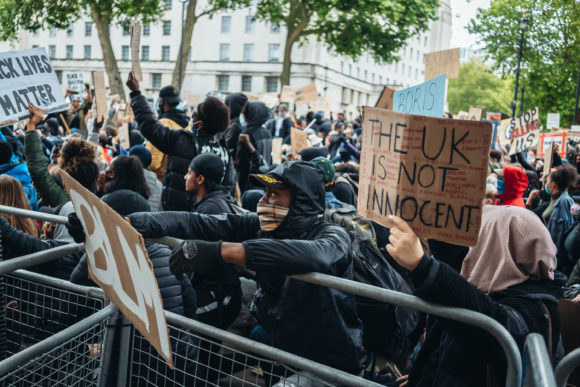
Photograph: Black Lives Matter protest in London on June 6, 2020 during the coronavirus lockdown.

Related:
Update: Lloyd’s of London Apologizes for Its ‘Shameful’ Role in Atlantic Slave Trade


Copyright 2020 Reuters. Click for restrictions.

Friday, February 07, 2025

While Hollywood ignored stories of Black resistance, Cuban filmmakers celebrated Black power


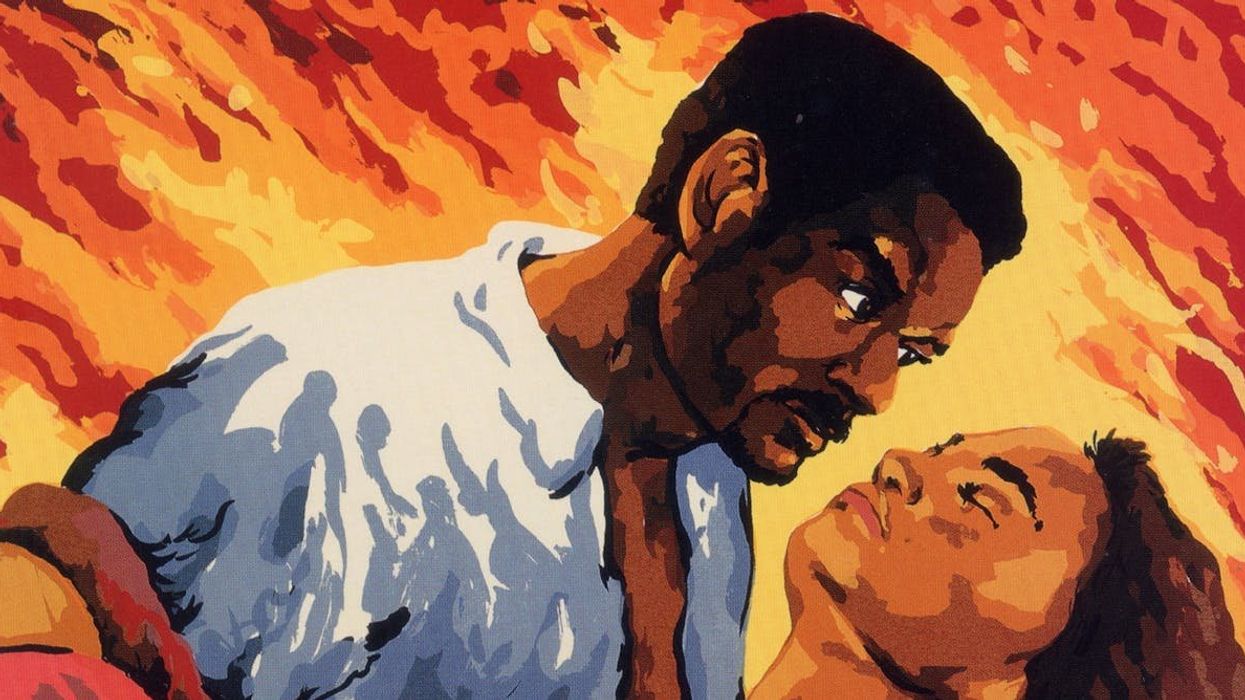
‘Gone with the Macho’ print by Elio Rodriguez. Contemporary debates over slavery, race and racism continue to take place in a public sphere that has been shaped in part by cinematic films. 
(Elio Rodriguez/532 Gallery) , Author provided (no reuse)


The Conversation
February 06, 2025

In recent years, there has been an increased push for more diversity and representation on our entertainment screens. The #OscarsSoWhite campaign of 2015 and the enduring social justice movement it generated increased public awareness of the longstanding problematic issues of discrimination and exclusion in Hollywood.

The movement drew needed attention to Hollywood as an insular industry characterized by institutionalized racism and entrenched disparities. Nearly a decade later some progress has been made, but race, class and gender remain sources of inequality in Hollywood.

Hollywood’s depictions of slavery are emblematic of the persistence of this problem. Although Hollywood has produced several notable films on slavery, more often than not, these films reveal partial and biased views.

For example, one of the world’s first slavery films dating from 1903, is an adaptation of Harriet Beecher Stowe’s 1852 anti-slavery novel, Uncle Tom’s Cabin. In that film, Black people are portrayed by white actors in blackface and slaves are seen dancing at a slave auction.

In general, Black points of view, Black voices and Black historical achievement have been marginalized or overlooked in Hollywood. And in particular, there is a notable lack of films that centre Black resistance to slavery. From overt anti-Black racism in slavery films dating from the earlier part of the 20th century, to a deep-seated and enduring aversion to depicting Black resistance, Hollywood has always lived in a fantasyland when it comes to Black history.

While conducting research into the history of the representation of slavery in cinematic history, I learned that, in contrast to films coming out of the United States, Cuban cinema depicted a very different Black history and culture. Starting in the 1970s, Cuban filmmakers told stories to revalorize Black history and culture.


Black representation in Cuban cinema

Following the Cuban Revolution of 1953–1959, a film industry grew that sought to construct an assertive and representative picture of Black Cuban history and culture, including the history of Black resistance to slavery, which had long been overlooked and misrepresented.

Initially, this work took the form of documentary films that profiled the African roots of Cuban music, a form of cultural expression saturated with a sensibility of resistance. Then, in the 1970s, this work blossomed into a series of feature-length films.

Some examples include the 1976 film La última cena (The Last Supper) by Cuba’s most feted filmmaker, Tomás Gutiérrez Alea. The film is an ironic historical drama of slave revolt and religious hypocrisy set in 1780s Cuba.


A still from the film La última cena (1976), by Tomás Gutiérrez Alea.(Instituto Cubano del Arte e Industria Cinematográficos)

An aristocratic Havana plantation owner decides one Easter week, in imitation of Christ, to invite 12 of his slaves to sup with him at his dinner table. However, far from mollifying the enslaved workers or reconciling them to their status, the count’s 12 chosen slaves respond to their master’s antics by organizing an uprising and burning down the sugarcane mill, thereby demonstrating their selfhood and asserting their agency.

A trilogy of films by one of Cuba’s most underappreciated filmmakers, Afro-Cuban director, Sergio Giral: El otro Francisco (The Other Francisco, 1974), Rancheador (The Slave Hunter, 1976), and Maluala (1979) are also worthy of note. Giral’s trilogy has been regarded as a “welcome tonic to the cloying melodrama of American period films like Gone with the Wind” that erased Black agency as part of their romantic sanitization of slavery.

In El otro Francisco, sentimental, bourgeois perspectives of slavery and abolition are turned upside down. In Rancheador, the perspectives of various poorer whites — smallholder farmers and slave catchers — are brought to the fore to emphasize the insufficiency of race, when taken in isolation, as an explanation for the social dynamics of oppression in slave holding societies.

In Maluala, the strategic and political dilemmas faced by the leaders of Cuba’s maroon communities are emphasized as part of the film’s depiction of the growth of Afro-Cuban consciousness. By foregrounding perspectives that had been sidelined, Giral’s trilogy recovers the history of slave resistance and narrates a counter-history of Cuban slavery and abolition.

Hollywood’s historical inaccuracies


Meanwhile, in the U.S., slavery films have established a popular historiography of slavery for a global audience and have also exerted influence on those in positions of power. One of the most notorious slavery films of all time, D.W. Griffith’s grotesquely racist The Birth of a Nation of 1915, was the first film to be screened in the White House as well as the first film to be projected for the justices of the U.S. Supreme Court and the members of the United States Congress.

It projected flagrant historical inaccuracies, including the perception that the slave-holding American South had been a rural idyll where a noble, chivalrous and pious culture had flourished. The U.S. president of the day, Woodrow Wilson, was among the many millions duped by the film’s depictions; on viewing the film he remarked, “It is like writing history with lightning, and my only regret is that it is all so terribly true.”

The regressive impact of Griffith’s film on American and global public conversations about race should not be underestimated.
Adaptation of a slave narrative

Since The Birth of a Nation, Hollywood has produced several acclaimed movies about slavery in the U.S., but it took nearly a century before the first cinematic adaptation of a slave narrative would appear — Steve McQueen’s celebrated triple Oscar winner 12 Years a Slave of 2013.

Lauded by some critics as “the greatest feature film ever made about American slavery,” 12 Years a Slave received a special screening at the United Nations’ New York headquarters and undeniably represents a significant moment in the history of slavery on screen.


A trailer for ‘12 Years a Slave.’


Nevertheless, and notwithstanding the film’s progressive aspirations, McQueen’s adaptation inadvertently gave new life to sentimental ways of apprehending the history of slavery. The accounts of Black resistance that are present in the source material on which the film was based, Solomon Northup’s 1853 narrative, Twelve Years a Slave, are omitted and the film overlooks the attention paid in the original to slavery as a social and economic system.

For example, the 1853 narrative carefully noted the inadequacy of explaining the evil of slavery by leveling blame at individuals: “It is not the fault of the slaveholder that he is cruel, so much as it is the fault of the system under which he lives.” However, as I argue in my book, McQueen’s adaptation emphasizes the cruelty of individuals. With this focus, the film could be seen as tracing the atrocities of slavery to individuals’ cruelty.

Contemporary debates over slavery, race and racism continue to take place in a public sphere that has been shaped in part by cinematic films produced in Hollywood that have always perpetuated potent fantasies and misunderstandings about slavery.

Cuban cinematic treatments of slavery have sought to correct the record. They celebrate Black power and remind us of the extraordinary efforts of countless Black men and women throughout the history of transatlantic slavery to resist their enslavement.

Philip Kaisary, 2023–2025 Ruth and Mark Phillips Professor of Cultural Mediations, Carleton University

This article is republished from The Conversation under a Creative Commons license. Read the original article.


Sunday, January 08, 2023

How two men shaped Haiti’s bloody revolutionary history

Paul Lay
Sat, January 7, 2023 

In this article:

Toussaint Louverture
Haitian general and revolutionary

Henri Christophe
President and King of Haiti (1767-1820)

Jean-Jacques Dessalines
Leader of Haitian Revolution and first ruler of independent Haiti (1758-1806)


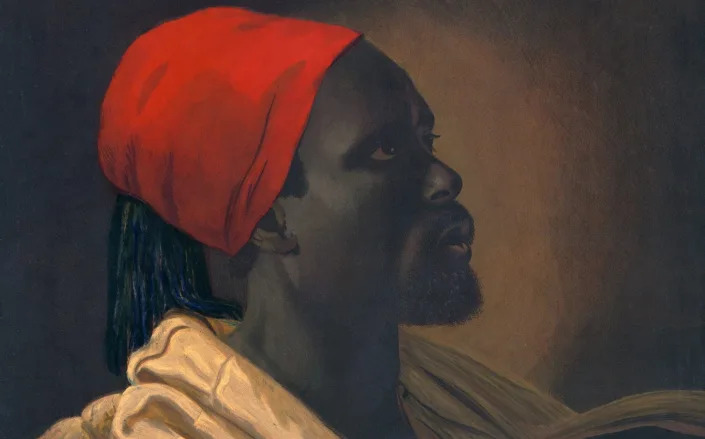
'Black Spartacus': Toussaint Louverture, leader of the Haitian Revolution by de Baptiste (1875) - Photo 12/ Universal Images Group via Getty Images

By the time of the French Revolution, France’s colony of Saint-Domingue, the western portion of the Caribbean island of Hispaniola (now Haiti), was the most valuable plot of land on Earth. The wealth of the “Pearl of the Antilles” came from the new-found European taste for sugar and coffee – it produced half the world’s supply of both and was responsible for one third of French maritime trade.

But the economy of Saint-Domingue was underpinned by the violence and suffering inflicted on almost half a million enslaved Africans, who vastly outnumbered the white population of 40,000, and the slightly smaller – and free – mixed-race population. More than 300 Africans arrived in chains every week to be “fed into the slave machine”.

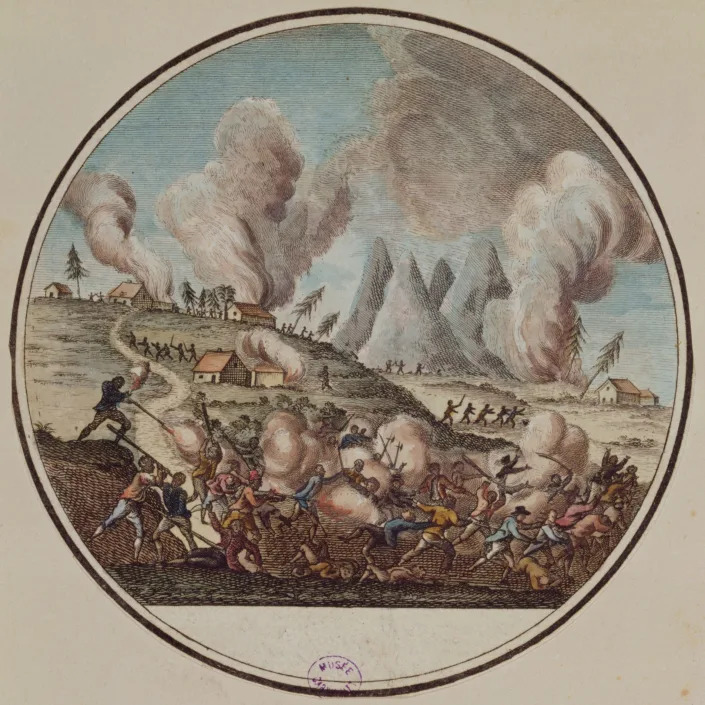
A slave revolt had long been feared, and brute force was the plantation-owning class’s way of maintaining order. Memories remained fresh of the fate of François Makandal, a Maroon – an escapee from slavery – who had been taken to the bustling, metropolitan city of Cap-Français to be burned at the stake in 1758 for inciting rebellion. The fear was finally realised in August 1791, amid tensions between the ruling classes exacerbated by the French Republic’s declaration of the Rights of Man and its opposition to slavery. Hundreds of plantations in the fertile north were ravaged, and both white and mixed-race settlers were massacred on a horrendous scale.

The aftermath of these tumultuous events is now the subject of two very different books. Sudhir Hazareesingh’s Black Spartacus (★★★☆☆), an “epic life” of François-Dominique Toussaint Louverture, the leader of the Haitian Revolution, has already won high praise and the 2021 Wolfson History Prize. Scholarly and highly readable, it is occasionally too much of a love letter to its subject: “Great Man” history, long disparaged among academics, is still acceptable, it seems, with a change of cast. Paul Clammer’s Black Crown (★★★★☆), however, a life of the less well-known Henry Christophe, who became King Henry I of Haiti in the years after the revolution, grasps the essential tragedy of history, in all its ambiguity and contingency.

Christophe, born into slavery on Grenada, would become a lieutenant of the much-feted Toussaint Louverture, a former coachman who became a free man in his 30s. Louverture subsequently owned slaves of his own, as a coffee-planter.

The Rebellion of the Slaves in Santo Domingo by the French School, an 18th century coloured engraving of the 1791 insurrection - Archives Charmet

Where historical fact is sparse, mythology flourishes, and there is uncertainty about what role Louverture actually played in the 1791 slave revolt. The plot appears to have been hatched on August 14, and unleashed a week later, when the Colonial Assembly was due to meet in Cap-Français. Its leader was Boukman Dutty, another coachman but also a priest.

The violence, according to one witness, “would make Nero blush”, and panicked whites fled to the cities and towns. It can be said with some certainty, however, that Louverture saved the wife of his former master by escorting her to safety from their plantation. Louverture, unlike many of his fellow revolutionaries, was open to white allies and believed to the end that the plantation system – albeit one manned by free labourers – was essential to future prosperity.

The embattled white colonists invested their hopes of restoring the old order in the British, who arrived to do just that in 1793; they failed when their forces were devastated by yellow fever. France, desperate to keep Saint-Domingue within its orbit, endorsed its commissioners’ decision to abolish slavery there in 1794.

By then, Louverture’s star was in the ascendant, though dependent upon the support of his army of former slaves and a strong relationship with the governor, Etienne Laveaux, who was the first to proclaim him “Black Spartacus”. He was faithful to France, sending his two sons to be educated there, but with Laveux’s departure, the metropole became ambivalent in its commitment to the freedom of Saint-Domingue’s black population – a red line for Louverture.

Napoleon, now similarly ascendant, had no such uncertainty and, having made peace with Britain in 1802, he launched an expedition to Saint-Domingue, led by his brother-in-law, Charles Victor Emmanuel Leclerc. Louverture was outlawed and cracks appeared in his already fractious alliance. Then he made a fatal mistake. He sought a truce with the French, but was arrested, transported to France – on a ship called The Hero – imprisoned in a medieval castle in the Jura mountains, and died within eight months.

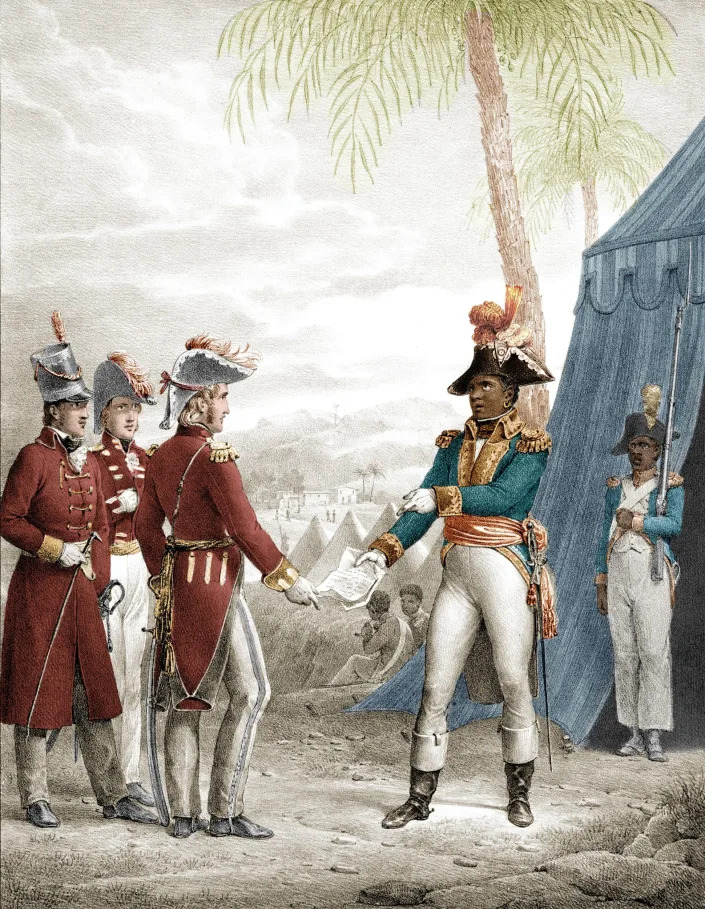
An illustration of English General Thomas Maitland and Haitian revolutionary Toussaint L'Ouverture as they sign a treaty in March 1798 - Science Source/Photo Researchers History/Getty Images


The fate of his cause was now in the hands of two men, once his deputies, who may have conspired against him: Jean-Jacques Dessalines and Henri Christophe. Learning from the errors of Louverture, they sought to eliminate all rivals, press labourers back to work on the plantations, and indulge the French forces on Saint-Domingue just long enough that they would succumb to yellow fever, just as the British had done and Leclerc would do.

Their plan worked, and at the Battle of Vertières they defeated the weakened French. Soon the last of the colonial forces would be shepherded into captivity on Jamaica courtesy of the Royal Navy. On December 5 1803 – the same day that, 311 years before, Columbus had made landfall on the island – a new free nation was born: Haiti.

A Declaration of Independence was signed on January 1 1804, first by Dessalines, then by Christophe. Dessalines’s secretary observed that the ideal arrangement would be for “the skin of a white to serve as parchment, his skull as an inkwell, his blood for ink, and a bayonet for a pen”.

The slaughter of French residents followed, as did war against the French garrison that remained in Santo Domingo, the Spanish, eastern side of the island. It was clear that power rested on military strength and the regime commissioned the vast Citadelle fortress, designed by Henry Barré, which was to tower over northern Haiti. Restrictions were placed on labour and movement, and Dessalines became Emperor Jacques I. He would soon fall victim, in the southern city of Port-au-Prince, to an alliance of northern Maroons and the southern free mixed-race population crushed by Louverture. “Cruel poetry,” observes Clammer.

Civil war followed between north and south, with former ally Alexandre Pétion president of the southern Republic of Haiti. After Dessalines’s death in 1806, Christophe declared himself King Henry I. Apologists argued that the institution of monarchy was a link to Africa’s own dynasties: “Are there not in Africa an infinity of empires, kingdoms, and independent states?” And did the Taino, Haiti’s original inhabitants, not have their own hereditary chiefs, the caciques?

‘Destroyer of tyranny’: King Henry I of Haiti (formerly Henri Christophe); - Chronicle / Alamy Stock Photo

Whatever the reasoning, Christophe enjoyed the trappings. He took the additional titles of “Destroyer of Tyranny, Regenerator and Benefactor of the Haitian Nation…” and so on. He expanded the aristocracy, threw banquets, and built a palace, Sans Souci (named, probably, after a celebrated Maroon rather than Frederick the Great’s Potsdam residence). It was decorated with Greek gods and heroes depicted as Africans.

More productively, his navy intercepted slaving vessels, freeing those aboard to make a new life in Haiti. On one occasion, rescued Hausa children danced before him at court. His actions caught the attention of Joseph Banks, president of the Royal Society, who wrote: “To see a set of human beings emerging from slavery, and making rapid strides towards the perfection of civilisation, must I think be the most delightful of food for contemplation.” The abolitionist William Wilberforce paid for the passage to Haiti of Prince Saunders, a teacher in Boston’s African school, who introduced smallpox inoculation and played a key role in education policy.

But amid the progress, there was capricious brutality. Typical of this was the fate of a merchant, Vilton, a godfather of Christophe’s daughters, who in 1802 had tried to persuade him to surrender to Leclerc. He was put to death in 1819 for an alleged affair. An adulterous countess, meanwhile, was “obliged to ride through the streets of Sans Souci in a state of perfect nudity, at noon-day, on the back of a donkey, with her face toward the tail”.

It all came crashing down when, on August 15 1820, the king had a stroke while attending mass, just as a huge fire swept through Port-au-Prince. Knowing both the south and the French were empowered, King Henry committed suicide with a shot to the heart. Amid scenes of more brutality, his male heirs were butchered and his wife and daughters sent into exile. While Toussaint Louverture’s story is a heroic one, it is Henry’s tragedy that is the more compelling.

Black Spartacus by Sudhir Hazareesingh is published by Penguin at £10.99. To order your copy, call 0844 871 1514 or visit Telegraph Books

Black Crown by Paul Clammer is published by Hurst at £25. To order your copy for £19.99. call 0844 871 1514 or visit Telegraph Books

Monday, January 01, 2024

“Are We the Baddies?”

Western support for genocide in Gaza means the answer is yes

The desperate smear campaign to defend Israel’s crimes highlights the toxic brew of lies that’s been underpinning the liberal democratic order for decades.

In a popular British comedy sketch set during the Second World War, a Nazi officer near the front lines turns to a fellow officer and, in a moment of sudden – and comic – self-doubt, asks: “Are we the baddies?”

For many of us, it has felt like we are living through the same moment, extended for nearly three months – though there has been nothing to laugh about.

Western leaders have not only backed rhetorically a genocidal war by Israel on Gaza, but they have provided diplomatic cover, weapons and other military assistance.

The West is fully complicit in the ethnic cleansing of some two million Palestinians from their homes, as well as the killing of more than 20,000 and the injuring of many tens of thousands more, a majority of them women and children.

Western politicians have insisted on Israel’s “right to defend itself” as it has levelled critical infrastructure in Gaza, including government buildings, and collapsed the health sector. Starvation and disease are starting to pick off the rest of the population.

The Palestinians of Gaza have nowhere to run, nowhere to hide from Israel’s US-supplied bombs. If they are ultimately allowed to escape, it will be into neighbouring Egypt. After decades of displacement, they will be finally exiled permanently from their homeland.

And as western capitals seek to justify these obscenities by blaming Hamas, Israeli leaders allow their soldiers and settler militias, backed by the state, to rampage across the West Bank, where there is no Hamas, attacking and killing Palestinians.

In defending Gaza’s destruction, Israeli leaders have reached readily for an analogy with the allies’ firebombing of German cities like Dresden – apparently unembarrassed by the fact that these were long ago acknowledged as some of the worst crimes of the Second World War.

Israel is waging an old-style, unabashed colonial war against the native population – of the kind that predates international humanitarian law. And western leaders are cheering them on.

Are we sure we are not the baddies?

Slave revolt

Israel’s attack on Gaza provokes revulsion from so many because it seems impossible to rationalise it. It feels like a reversion. It lays bare something primitive and ugly about the West’s behaviour that has been obscured for more than 70 years by a veneer of “progress”, by talk about the primacy of human rights, by the development of international institutions, by the rules of war, by claims of humanitarianism.

Yes, these claims were invariably bogus. Vietnam, Kosovo, AfghanistanIraqLibya and Ukraine were all sold based on lies. The true goal of the US, and its Nato sidekicks, was plundering the resources of others, maintaining Washington as the global top dog, and enriching a western elite.

But importantly, the deception was sustained by an overarching narrative that dragged along many westerners in its wake. Wars were to counter the threat of Soviet communism, or Islamic “terror”, or a renewed Russian imperialism. And as a positive corollary, these wars claimed to be liberating oppressed women, protecting human rights, and fostering democracy.

None of that narrative overlay works this time.

There is nothing humanitarian about bombing trapped civilians in Gaza, turning their tiny prison enclave into rubble, reminiscent of earthquake disaster zones but this time an entirely man-made catastrophe.

Even Israel does not have the gall to claim to be liberating the women and girls of Gaza from Hamas as it kills and starves them. Nor does it pretend to be interested in democracy promotion. Rather, Gaza is full of “human animals” and must be “flattened”.

And it has been all but impossible to make Hamas, a group of a few thousand fighters penned into Gaza, appear a credible threat to the West’s way of life.

Hamas cannot send any kind of warhead into Europe, let alone in 45 minutes. Their prison camp, even before its destruction, was never the plausible heart of some Islamist empire ready to overrun the West and subject it to “sharia law”.

In fact, it has been barely feasible to refer to these past weeks as a war. Gaza is not a state, it has no army. It has been under occupation for decades and under siege for 16 years – a blockade in which Israel has counted the calories allowed in to maintain low-level malnutrition among Palestinians.

As the American Jewish scholar Norman Finkelstein has noted, Hamas’ breakout on 7 October is better understood not as a war but as a slave revolt. And like slave rebellions throughout history – from Spartacus’ against the Romans to Nat Turner’s in Virginia in 1831 – it was inevitably going to turn brutal and bloody.

Are we on the side of the murderous prison guards? Are we arming the plantation owners?

Mass gaslighting

In the absence of a persuasive justification for assisting Israel in its genocidal campaign in Gaza, our leaders are having to wage a parallel war on the western public – or at least on their minds.

To question Israel’s right to exterminate Palestinians in Gaza, to chant a slogan calling for Palestinians to be free of occupation and siege, to want equal rights for all in the region – these are now all treated as the equivalent of antisemitism.

To demand a ceasefire to stop Palestinians dying under the bombs is to hate Jews.

The extent to which these narrative manipulations are not only abhorrent but themselves constitute antisemitism should be obvious, were we not being so relentlessly and thoroughly gaslit by our ruling class.

Those defending Israel’s genocide suggest that it is not just Israel’s ultra-right government and military but all Jews who will the destruction of Gaza, the ethnic cleansing of its population, and the murder of thousands of Palestinian children.

That is the real Jew hatred.

But the path to this mass gaslighting operation has been paved for a while. It began long before Israel’s levelling of Gaza.

When Jeremy Corbyn was elected Labour leader in 2015, he brought for the first time a meaningful anti-imperialist agenda to the heart of British politics. And as a staunch supporter of Palestinian rights, he was viewed by the establishment as a threat to Israel, a critically important US client state and the lynchpin of the West’s projection of military might into the oil-rich Middle East.

Western elites were bound to respond with unprecedented hostility to this challenge to their forever war machine. This appears to have been duly noted by Corbyn’s successor, Keir Starmer, who has since made sure to present Labour as Nato’s number one cheerleader.

During Corbyn’s tenure, little time was lost by the establishment in working out the best strategy for putting the Labour leader permanently on the back foot and undermining his well-established anti-racist credentials. He was recast as an antisemite.

The campaign of smears not only damaged Corbyn personally but tore the Labour Party apart, turning it into a rabble of feuding factions, eating up all the party’s energy and making it unelectable.

Smear campaign

That same playbook has now been rolled out against much of the British and US public.

This month the House of Representatives overwhelmingly passed a resolution equating anti-Zionism – in this case, opposition to Israel’s genocidal war on Gaza – with antisemitism.

Protesters who have turned out to demand a ceasefire to end the massacres in Gaza are characterised as “rioters”, while their chant of “from the river to the sea” calling for equal rights between Israeli Jews and Palestinians is denounced as a “rallying cry for the eradication of the state of Israel and the Jewish people”.

Tellingly again, this is an inadvertent admission by the western ruling class that Israel – constituted as a Jewish chauvinist, settler-colonial state – can never allow Palestinians equality or meaningful freedoms any more than apartheid South Africa could for the native Black population.

In a complete inversion of reality, opposition to genocide has been reframed by US politicians as genocidal.

This mass smear campaign is so unmoored that western elites are even turning on their own to shut down freedoms of speech and thought in the institutions where they are supposed to be heavily protected.

The heads of three top US universities – from which the next members of the ruling class will emerge – were grilled by Congress about the threat of antisemitism to Jewish students from campus protests calling for an end to the killing in Gaza.

The West’s order of priorities was laid bare: protecting the ideological sensitivities of a section of Jewish students who fervently support Israel’s right to kill Palestinians was more important than either protecting Palestinians from genocide or defending basic democratic freedoms in the West to oppose genocide.

The reticence of the three university presidents to cave in to the politicians’ demands for the snuffing out of free speech and thought on campus led to a campaign to defund their colleges as well as calls for their heads.

One, Elizabeth Magill of the University of Pennsylvania, has already been forced out of office.

Crisis on all fronts

These developments are not the outcome of some strange, temporary, collective psychosis overtaking western establishments. They are yet more evidence of a desperate failure to stop the West’s long-term trajectory towards crises on multiple fronts.

They are a sign, first, that the ruling class understands it is again visible to the public as a ruling class, and that its interests are beginning to be seen as completely divorced from those of ordinary people. The scales are falling from our eyes.

The simple fact that one can again use the language of “establishments”, a “ruling class” and “class war” without sounding unhinged or like a throwback to the 1950s is an indication of how perception management – and narrative manipulation – so central to upholding the western political project since the end of the Second World War is failing.

Claims about the triumph of the liberal democratic order declared so loudly in the late 1980s by intellectuals such as Francis Fukuyama – or “the end of history”, as he grandly termed it – now look patently absurd.

And that is because, second, western elites clearly have no answers for the biggest challenges of our era. They are floundering around trying to deal with the inherent paradoxes in the capitalist order that liberal democracy was there to obscure.

Reality is breaking through the ideological cladding.

The most catastrophic is the climate crisis. Capitalism’s model of mass consumption and competition for the sake of competition is proving suicidal.

Limited resources – especially in our oil-addicted economies – mean growth is proving an ever-more costly extravagance. Those raised from birth to aspire to a better standard of living than their parents are growing not richer, but more disillusioned and bitter.

And the promise of progress – of kinder, more nurturing and equal societies – now sounds like a sick joke to most westerners under the age of 45.

Brew of lies

The claim that the West is best is starting to look like it rests on shaky foundations, even to western audiences.

But that idea crumbled long ago abroad, in the countries either devastated by the West’s war machine or waiting for their turn. The liberal democratic order offers them nothing except threats: it demands fealty or punishment.

Which is the context for the current genocide in Gaza.

As it claims, Israel is on the front lines – but not of a clash of civilisations. It is an exposed, precarious outpost of the liberal democratic order, where the brew of lies about democracy and liberalism are at their most toxic and unconvincing.

Israel is an apartheid state masquerading as “the only democracy in the Middle East”. Its brutal occupation forces masquerade as “the most moral army in the world”. And now Israel’s genocide in Gaza masquerades as “the elimination of Hamas”.

Israel has always had to obscure these lies through intimidation. Anyone daring to call out the deceptions is smeared as an antisemite.

But that playbook has sounded grossly offensive – inhuman even – when the matter at hand is stopping genocide in Gaza.

Where does this ultimately lead?

Nearly a decade ago, the Israeli scholar and peace activist Jeff Halper wrote a book, War Against the People, warning: “In an endless war on terror, we are all doomed to become Palestinians.”

Not just the West’s “enemies”, but its populations would come to be seen as a threat to the interests of a capitalist ruling class bent on its permanent privilege and enrichment, whatever the costs to the rest of us.

That argument – which sounded hyperbolic when he first aired it – is beginning to seem prescient.

Gaza is not just the front line of Israel’s genocidal war on the Palestinian people. It is also a front line in the western elite’s war on our ability to think critically, to develop sustainable ways to live, and to demand that others be treated with the dignity and humanity we expect for ourselves.

Yes, the battle lines are drawn. And anyone who refuses to side with the baddies is the enemy.


Jonathan Cook, based in Nazareth, Israel is a winner of the Martha Gellhorn Special Prize for Journalism. His latest books are Israel and the Clash of Civilisations: Iraq, Iran and the Plan to Remake the Middle East (Pluto Press) and Disappearing Palestine: Israel's Experiments in Human Despair (Zed Books). Read other articles by Jonathan, or visit Jonathan's website.

Friday, February 18, 2005

The Many Headed Hydra

ATLANTIC HISTORY

I had just finished my article on Goth Capitalism when my special book order for The Many Headed Hydra arrived. I have been devouring it ever since. Written in 2001 it inspires and completes many of the trajectories I have tried to touch on in my essay on gothic capitalism, the horror of accumulation and the commodification of humanity. Below are some reviews and background on the Many Headed Hydra and other works of its activist authors ;
Peter Linebaugh and Marcus Rediker. I would be remiss in not thanking Sam Wagar for having told me about this excellent book, which one writer compared to E.P. Thompson's The Making of the English Working Class.

Atlantic History as it is now called is the history of the under class the lumpen (german for 'rags') or ragged proletariat, those without a trade, and of course slaves. It is a history of those who built the British and American empires by the sweat of their brow, the hewers of wood and drawers of water, the perennial dispossed. This "motely crew" that became pirates, antinominal rebels, and revolutionaries against industrial capitalism.

This paradigm is contested by establishment historians, and thus falls under the rubric of 'revisionist' history, which unfortunately has been besmirched by those who use the term to justify their anti-semitic conspiracy theories. Authentic revisionst history, or historical deconstruction began with Marx, and we call it historical materialism. E.P. Thompson expanded that to include the study of the culture of the working class and proletariat, and there is a difference between these two. For the working class are former craftsmen or artisans who become part of the factory system that evolves out of artisanal production and manufacturing. The proletariat are the landless propertyless class of workers and peasants forced by enclosures into the city to find work and shelter.

That 'proletarianization' is continuing today, as it did in 16th and 17th Century Britain and North America, in the newly industrializing countries of the Third World, China, India etc. It is the crisis of the metropolis versus the privatized countryside, and in fact as I write in Global Labour in the Age of Empire, it is privatization that is currently the project of global capitalism which is mistakenly called; 'globalization'.
Rediker and Linebaugh agree with this permise, as they discuss in the British move to enclose the Fens, swampland, that was held in common, those 'drawers of water' in the 17th century were replaced with privately owned water works.

Linebaugh has written other works on the dispossed in London, and Rediker has written on Pirate culture.

Both also focus on the economic importance of enclosure, the stealing of the common lands for use as private property, and slavery; the indentured servitude of the poor as well as Africans, in the birthpangs of capitalism. I have some refernces and links to these works as well below.

Marcus Rediker has an excellent web site which includes excerpts from Hydra and several of his other books, it includes the synopsis below, as well as a sample Chapter. It also includes further articles on revisionist proletarian history and his univeristy course work on Atlantic History.

The Many Headed Hydra Synopsis

Long before the American Revolution and the Declaration of the Rights of Man, a motley crew of sailors, slaves, pirates, laborers, market women, and indentured servants had ideas about freedom and equality that would forever change history. The Many Headed-Hydra recounts their stories in a sweeping history of the role of the dispossessed in the making of the modern world.
When an unprecedented expansion of trade and colonization in the early seventeenth century launched the first global economy, a vast, diverse, and landless workforce was born.
These workers crossed national, ethnic, and racial boundaries, as they circulated around the Atlantic world on trade ships and slave ships, from England to Virginia, from Africa to Barbados, and from the Americas back to Europe.
Marshaling an impressive range of original research from archives in the Americas and Europe, the authors show how ordinary working people led dozens of rebellions on both sides of the North Atlantic. The rulers of the day called the multiethnic rebels a "hydra" and brutally suppressed their risings, yet some of their ideas fueled the age of revolution. Others, hidden from history and recovered here, have much to teach us about our common humanit
y.

Harry Cleaver author of Reading Capital Politcally, itself an excellent text on the politics of the revolt from below, and other "Autonomous Marxist" works has the introduction and samples of chapters on the American proletarian revolts, of Many Headed Hydra in PDF. Harry Cleaver Excerpts including Intr0duction in PDF

REVIEWS:

Reviewed by Michael Guasco, Department of History, Davidson College.
Published by H-Atlantic (June, 2003)

The Many-Headed Hydra : The Hidden History of the Revolutionary Atlantic
liveDaily Store Home

Review: The Many-Headed Hydra
An article from Do or Die Issue 10. In the paper edition, this article appears on page(s) 322-329.

Bookshelf Review: The Many Headed Hydra: Sailors, Slaves, Commoners, and the Hidden History of the Revolutionary Atlantic

DEMOCRATIC PIRATES The History of Decapitating Commoners by Nicolas Veroli

Canadian Journal of History, Dec 2001
History from below decks [The Many-Headed Hydra: Sailors, Commoners, and the Hidden History of the Revolutionary Atlantic]

Northeastern Naturalist, 2001 by St Hilaire, L
The Many-Headed Hydra: Sailors, Slaves, Commoners, and the Hidden History of the Revolutionary Atlantic

Lumpen-Proletarians of the Atlantic World, Unite!
Review by Graham Russell Hodges

New York Review of Books 'The Many-Headed Hydra': An Exchange By Marcus Rediker, Peter Linebaugh, Reply by David Brion Davis

A ship of fools - Review New Statesman, Sept 3, 2001 by Stephen Howe

Review
by Robin Blackburn

This book can be read as both an homage to, and correction of, E. P. Thompson's famous study The Making of the English Working Class (1964). Like that book, The Many-Headed Hydra is eloquent, unconventional in its sources and angle of vision, and "history from below"—it emphasizes the large historical significance of the sensibilities and conduct of ordinary people. But where Thompson described the world of British workers during the Industrial Revolution, and explored the formation of the English working class as a self-conscious political actor, this history is oceanic rather than national in scope—it is the story of the making of an Atlantic proletariat. Peter Linebaugh and Marcus Rediker are so steeped in their subject matter that they spot patterns and links that others would not notice. They evoke the bygone mentalities of the seventeenth- and eighteenth-century Atlantic, in ways that transport us to a world that is quite strange—yet with startling premonitions of current globalization. In his last work, Customs in Common, Thompson suggested that pre-industrial capitalism could illuminate aspects of the post-industrial era. The Many-Headed Hydra, without lapsing into anachronism, bears out this claim.

As it happens, Linebaugh and Thompson both contributed to Albion's Fatal Tree, a collection devoted to the still topical issue of capital punishment, and its meanings for the wider society, while Thompson wrote a glowing review of Rediker's Between the Devil and the Deep Blue Sea, a study of eighteenth-century mariners. Yet The Many-Headed Hydra also challenges some of Thompson's Anglocentric assumptions. While Thompson was attuned to French influences and had respect for the "old Jakes" (English Jacobins), his work paid little attention to the leavening effect of Irish and transatlantic influences and connections. Thus the remarkable figures of Olaudah Equiano, the African (or African American) anti-slavery campaigner, or Robert Wedderburn, son of a Jamaican slave and a leader of the Spencean socialists in early nineteenth-century London, made only fleeting appearances in Thompson's work, but are allotted chapters here. Thompson did give space to the activities of the Irish Revolutionary Colonel Edward Despard, but he did not mention his conflicts with English proprietors in the Caribbean nor weigh the significance of his marriage to Catherine, his Afro-Caribbean wife. In Thompson, the anti-slavery movement was represented by William Wilberforce, a persecutor of Jacobins; its more radical proponents, such as Thomas Clarkson, were not discussed.

The "hidden history" that Linebaugh and Rediker refer to in their subtitle links the radical sects of England's seventeenth-century Civil War to the later emergence of the nineteenth-century labor and anti-slavery movements, a theme which builds on the suggestion of another British Marxist historian. (The Many-Headed Hydra is dedicated to Christopher and Bridget Hill, and it is from the former that the idea is taken.) In about four hundred pages, The Many-Headed Hydra covers two hundred years of history on both sides of the Atlantic. The account combines provocative and sweeping generalization with intimate individual examples of the resistance and solidarity that grew in the wake of the growth of oceanic commerce and the rise of the maritime state.

The book opens with the real-life story of an expedition that wrecked on Bermuda and prompted Shakespeare's Tempest, though Linebaugh and Rediker use the story to highlight the rebelliousness of the crew and colonists. Then they describe the evictions and hangings that were visited on the common people by the new breed of English capitalist landlord and merchant as they sought to enclose land, establish plantations, and secure "hewers of wood and drawers of water." The third chapter supplies a close reading of the tantalizing scraps of evidence available concerning the life and beliefs of "a Blackymore Maide Named Francis" who died a Baptist in Bristol in the Civil War period, and of what was meant by those, like Francis, who declared that "God was no respecter of faces." The fourth chapter is devoted to the implications of the Putney debates—the remarkable 1647 political arguments in the General Council of Cromwell's New Model Army—and explores the maritime background of Colonel Thomas Rainborough, who enunciated democratic principles at that assembly. The fifth chapter argues that the ocean-going sailing vessels of the epoch were cradle of a picaresque proletariat—mariners, rovers, and dock-workers who evolved their own distinctive traditions of struggle and solidarity, ranging from the rough-and-ready egalitarianism and democracy of the pirate crew to the practice of striking (that is, lowering the sails of the ship). The sixth chapter establishes links between a slave conspiracy in Antigua and a 1741 plot to seize power in New York hatched by John Gwin, "a fellow of suspicious character"; Negro Peg, "a notorious prostitute"; and a "motley crew" of disreputable Irish, blacks, Dutch, and other "outcasts of the nations of the earth."

The succeeding chapter on "the motley crew in the American Revolution" argues that the revolutionary radicalism of the mariners and dockworkers made a vital contribution to the ideology of the struggle for independence. For example, they prompted the young Samuel Adams to move from the rhetoric of the "rights of Englishmen" to the more universal idiom of the "rights of man." More generally, it was within the mixed, waterfront milieu that anti-slavery ideas first gained support and then influenced at least some of the Patriots. The book concludes with chapters that trace the return across the Atlantic of revolutionary aspirations as exemplified in the lives of Edward and Catherine Despard, Robert Wedderburn, and William Blake. Vignettes full of surprising detail are interspersed with bold claims for the transcontinental spirit of revolution and virtuoso exercises in parsing the sometimes-obscure rhetoric of millennial enthusiasts.

The Many-Headed Hydra repeatedly puts familiar landmarks in a new light by showing how they reflect mercantile and Atlantic constellations of class, ideology, and power. It is interesting to be reminded that among the 39 Articles that provided the Church of England's founding principles, one permitted the state to punish Christians by death (Article 37), and another insisted "the riches and goods of Christians are not in common as touching the right, title and possession of the same, as certain Anabaptists do falsely boast" (Article 38). And the sketch of the plan of the book I have offered above fails to do justice to many learned and fascinating digressions—for example, on the adventures of Prince Rupert of the Rhine, or on the Masaniello revolt in Naples, and the ways that each illuminates the making of the maritime state and the emergence of its "hydra-headed" proletarian antagonist.

Some will say that Linebaugh and Rediker have taken hold of some venerable bones of Marxist analysis and made them sing by means of a postmodern voodoo philosophy. The authors skillfully deploy scripture, song, and poetry to give the reader a salty taste of the distinctive cultures of their "many-headed" and motley crew. But do they not romanticize? We are told that Colonel Rainborough's father, William, rescued 339 European prisoners from enslavement in North Africa and that Rainborough himself wore on his finger a signet ring bearing a Moor's head. This emboldens the authors to hail Rainborough as a champion of anti-slavery. Maybe he was. But opposition to European enslavement in Morocco and the sporting of Moor's Heads were not at all unusual in seventeenth-century England, and did not, unfortunately, betoken general opposition to slavery or an entirely favorable view of the Moor. The authors are not wrong to see in piracy opposition to the pretensions of the maritime state. But they overdo it when they flatly announce: "Pirates were class-conscious and justice-seeking, taking revenge against merchant captains who tyrannized the common seaman and against royal authorities who upheld their prerogatives to do so." Unfortunately pirates were also quite capable of trading slaves and slaughtering innocents. In fairness, I should add that there are limits to the authors' idealization of pirates: they do not endorse an improbable recent claim that buccaneers were champions of sexual enlightenment.

Nevertheless Linebaugh and Rediker are always on the lookout for rainbow coalitions of the oppressed. This does not usually lead them to gloss over inconsistencies, such as Tom Paine's fear of a union of insurgent slaves and Indians. But it does allow them to insist that Bacon's Rebellion in Virginia in 1676 was "really two quite separate uprisings," one aimed at mounting an Indian-fighting expedition and the other a challenge to the royal power that led to the freeing of servants and slaves. (Nevertheless these "quite separate" movements were both initiated by Nathaniel Bacon, and the one flowed into the other.) The authors register the scope given to the rulers to foster racial perceptions, but they are too inclined to see a spontaneous union of the oppressed and excluded waiting to emerge. They do not balance their vivid accounts of life on board ship or on the wharves with attention to the very different worlds of the slave plantation or Native American village.

I find welcome, and often persuasive, the authors' insistence that ethnic identities were often labile in this period and that the experience of a common fate aboard ship could create powerful bonds of solidarity. But I have the impression that the authors do not fully take the measure of popular complicity in the new Atlantic order, with its flood of affordable luxuries like tobacco, sugar, indigo, cacao, and so forth. Their account of the shipwreck in Bermuda does not explain how the leader of the expedition managed to restore control when the island offered land for the taking and ready means of subsistence. Shakespeare's sympathies may well have been regrettable, but his account in the Tempest of the way that plebian rebels could be sidetracked by dangling finery in front of them may not have been simply hostile caricature. Caliban is shown as possessed of better judgement when he urges his co-conspirators to shun the proffered apparel.

Here is a passage from Linebaugh and Rediker's conclusion:

… 1680-1760 witnessed the consolidation and stabilization of Atlantic capitalism through the maritime state, a financial and nautical system designed to acquire and operate Atlantic markets. The sailing ship—the characteristic machine of this period of globalization—combined features of the factory and the prison. In opposition, pirates built an autonomous, democratic, multiracial social order at sea, but this alternative way of life endangered the slave trade and was exterminated. A wave of rebellion ripped through the slave societies of the Americas in the 1730s, culminating in a multiethnic insurrectionary plot by workers in New York in 1741.

The observation concerning the sailing ship is arresting and novel, that concerning the maritime state more conventional, and the concluding flourish rhetorical. The plot of 1741 is revealed by the book to have been of broad and heartening scope. Yet it was a failure. Defeats have an undeniable pathos, yet they should not on that ground command more attention than victories.

The quoted passage continues: "In 1760-1835, the motley crew launched the age of revolution in the Atlantic, beginning with Tacky's Revolt in Jamaica and continuing in a series of uprisings throughout the hemisphere." Yet Tacky's Revolt, if scrutinized, was limited by the fact that its leaders gave it a pronouncedly Akan character, something unappealing to those from other backgrounds. During the revolt the English overseer Thomas Thistlewood took the calculated risk of arming the slaves on his plantation, and it paid off. While "history from below" has had a hugely positive impact on the writing of history, it misleads if it fails to see that power—including the power of the high and mighty—invariably rests on substructures, and distributions of load, down below on terra firma. The "continuing series of uprisings" were to have different characteristics as they mingled with such various clusters of ideas as Patriotism, Jacobinism, Free Masonry, and abolitionism, often championed by middle-class or even aristocratic revolutionaries. Indeed, it was often the campaigns and quarrels of the middling or "better sort" that gave the "motley crew" its chance. In any full account, they should receive more attention than Linebaugh and Rediker are willing to bestow upon them.

The publishers compare this book with Paul Gilroy's deservedly influential The Black Atlantic, and they are right. But the hidden Atlantic history recounted here is overwhelmingly English-speaking. The great slave uprising in Saint Domingue in 1791, the difficult alliance between black and white Jacobins in 1793, the ending of slavery in the French colonies in 1794, and the defense of this liberation against its attempted reversal by Napoleon take place off-stage. The story of the Haitian revolution has often been told, so the omission is understandable. But the role of sailors in Saint Domingue still needs to be illuminated. Moreover, following the establishment of Haiti, the wider Caribbean of the 1810s was to witness a new wave of piracy and privateering that fed into a revolt that, with the help of President Pétion, would destroy the power of Spain on the mainland. The wider Caribbean witnessed the true culmination of the heroic and fateful struggles of the picaresque proletariat so powerfully delineated by Linebaugh and Rediker.

The Many-Headed Hydra is a major work and a turning point in the new Atlantic history. It gives back to mariners their central role in the unmaking of colonialism and slavery in the Age of Revolution. And it powerfully reminds us that we owe many of the most important political ideas, such as a world without slavery, not to philosophers, still less statesmen, but to the everyday struggles of working people. •


Robin Blackburn teaches social history at the University of Essex. His books include The Making of a New World Slavery and The Overthrow of Colonial Slavery.

Originally published in the February/March 2001 issue of Boston Review


Revolution at the docks
Sukhdev Sandhu on the slaves and radicals at the heart of Empire in The Many-Headed Hydra by Marcus Rediker and Peter Linebaugh

Sukhdev Sandhu
Guardian

Saturday January 27, 2001

The Many-Headed Hydra: Sailors, Slaves, Commoners, and the Hidden History of the Revolutionary Atlantic
Marcus Rediker and Peter Linebaugh
352pp, Verso, £20.31
Buy it at a discount at BOL

Who now remembers labour? Both its dignity and its many indignities rarely feature in public discourse. In a matter of decades the nation has been virtually deindustrialised. Leisure is sovereign. Docks, where for centuries so many people toiled and lived, are in most British cities merely places to go to for a drink and to eyeball the luxury riverside apartments opposite.

The older world of docks and quays is the territory of Marcus Rediker and Peter Linebaugh's magnificent study, The Many-Headed Hydra . The authors chart the process by which powerless and dispossessed peoples - commoners, felons, religious radicals, pirates, urban labourers, soldiers, sailors, and African slaves - were, from the early 15th to the 17th centuries, marshalled into serving the cause of colonial expansion. A common metaphor, used by philosophers such as Francis Bacon, was the need for Hercules (regal authority, imperial rule, mercantile self-interest) to "strangle the Hydra of misrule". Hydra, in this context, refers to anyone - lippy prole and conscientious objector alike - who stood in the way of profit.

A central chapter of the book is concerned with what came to be known as the New York Conspiracy. In March 1741, radicals set fire to New York. Fort George, the prime military fortification in British America, was reduced to ashes. Soon, other metropolitan landmarks were torched. These were no random conflagrations. Lying on the west side of Manhattan, Fort George was a site of huge strategic importance for the Atlantic trade and a nodal point of the Britain-Africa-Americas triangle. Slaves and slave products were imported there. It was also populated by a swarm of people whose labours underwrote the city's wealth, but who themselves were wholly despised.

These "outcasts of the nations of the earth", as the authorities called them, feasted and caroused in wharf taverns. Practising a form of proto-communism, they allowed the poor to eat for free. Some, such as John Gwin, a black American slave who had a child by a young Irish prostitute, gleefully hopped the colour line. What bound them together was their desire to overthrow the system that made these pleasures so hard-won.

They hailed from all corners of the globe: Africans from the Gold Coast of West Africa who, before being shipped across to America, had served as local soldiers; Irish men and women who had taken to the oceans after the famine of 1728, and who were eager to take revenge on the Protestant English; Spanish-American sailors, skilled in both seamanship and fighting, who had been captured and enslaved by the British Navy.

Social and political instability was not confined to the east coast. Throughout the 1730s and 1740s revolts had been springing up all across the Americas. Men who had either witnessed or helped to foment rebellion across the world were to play a large part in the New York Conspiracy. Men such as "Will", who in 1733 was involved in a slave revolt on Danish St John, in which black rebels seized control of the island's military installation. He was captured and sold first to a planter in Antigua and then to a trader in New York, where he passed on to dock-workers the seditious lesson he had picked up over the years.

The sea monster that spawned liberty
The Many-Headed Hydra: the hidden history of the revolutionary Atlantic by Peter Linebaugh and Marcus Rediker (Verso, £20)
By Frank McLynn
Published : 24 January 2001

In all eras, political élites have appropriated symbols from classical myth to legitimise their own oligarchy. In the 250 years from Elizabeth I to the accession of Victoria, the preferred symbol for the British ruling class was Hercules, symbol of order and progress. Conversely, the urban proletariat - labourers, indentured servants, soldiers, sailors, African slaves, the criminal classes and groups such as religious radicals and pirates - were regarded as the heads of the hydra slain by Hercules. Yet for the authors of this fine "history from below", they are the true heroes of a centuries-long class war.

America is the key. The New World was a garbage tip to which the "dangerous classes" could be consigned. Yet an élite that used the axe and the noose to maintain social control on land had to use even more bloody expedients on board ship. Peter Linebaugh and Markus Rediker do not shrink from a recital of the gruesome forms of punishment practiced at sea. On the other hand, the maritime world of the Americas and beyond gave the dispossessed the chance to sample unheard-of liberties. Living among the savages as a way out of the nightmare of "civilisation" had a long history, culminating in the Bounty mutiny.

The authors' main thesis is simple. The discovery of sea routes to the Americas and East Indies marked a new stage in history, making it more important for the élite to keep the dispossessed classes and expropriated nations - factory workers, plantation slaves, sailors on the one hand; the Irish, Africans and West Indians on the other - under tighter control. Beginning with the fears expressed by that arch-reactionary Francis Bacon, progressing through the 1647 Putney debates and Cromwell's suppression of the Levellers and the Diggers (at the same time as his atrocities in Ireland), the authors arrive at the 18th century, where they are acknowledged experts.

We are shown the many heads of the hydra, and the acts of revolt, resistance and rebellion to which class tensions led. There are fascinating sections on the proletarian rebellion in Naples in 1647, the similar rising in New York in 1741, Tacky's slave revolt in 1760, and the Irish rebel Edward Despard's 1802 conspiracy to assassinate George III and seize both the Tower of London and the Bank of England.

Battle raged over the enclosure of commons, working methods in plantations and factories, discipline on ships and, in general, the attempt to convert large portions of mankind into hewers of wood and drawers of water. The most significant phase of the struggle came from 1680 to 1760, when Atlantic capitalism stabilised "the maritime state" - a financial and nautical system designed to operate Atlantic markets. The sailing ship - the engine of globalisation - was therefore half-ship and half-factory. To those below deck it was jail with the added risk of being drowned, as Dr Johnson defined shipboard life.

The chief resistance to the maritime state came from pirates. Their short-lived seaborne supremacy for a while (1670-1730) blocked the notorious "middle passage" of the slave trade between Africa and America. This prevented capital accumulation, was a "fetter" on capitalism and - obviously - had to be destroyed.

The sections on piracy are perhaps the best parts in a generally splendid book. But even more seminal for historical research are the many vistas Linebaugh and Rediker open up in the history of blacks, women, the United Irishmen, the "Left" in the American War of Independence, and religious millenarianism. Strikingly, the authors write from the heart as well as the brain. Having established that the years after 1780 were a kind of general Thermidorean reaction in the Anglo-American world, they point to 1802 as an annus horribilis - when the revolts of Despard, Robert Emmet and Toussaint l'Ouverture all came to grief. In elegiac mood, they conclude: "These men were peaks of the Atlantic mountains, whose principles of freedom, of humanity and of justice belonged to a single range."

The reviewer's book 'Villa and Zapata' is published by Cape
© 2005 Independent News & Media (UK) Ltd.

Capital & Class, Spring 2003 by Roberts, John Michael

The Many-Headed Hydra: Sailors, Slaves, Commoners, and the Hidden History of the Revolutionary Atlantic

Verso, London and New York, 2000, pp. 433

ISBN 1-85984-798-6 (hbk) 19:00

Reviewed by John Michael Roberts

In 1991 Penguin published a book called The London Hanged. Documenting the changing nature of public executions in eighteenth century London, a central theme of the book was to explain why more and more people were being hanged during this period for crimes against private property: many of these 'crimes' had earlier been deemed customary rights. Drawing upon a wealth of primary documentary evidence the book rediscovered the lost voices of those about to be 'launched into eternity' in London and, at the same time, rediscovered a particular manifestation of proletarian struggle against early capitalist forms of exploitation. The author of this tremendous historical exploration was an ex-student of E. P. Thompson's named Peter Linebaugh. With Marcus Rediker, an established historian in his own right with an equally impressive number of books to his credit, Linebaugh has extended this tradition of Marxist history writing to focus upon the (extra)ordinary struggles of those who found themselves labouring for the first global economy across the Atlantic in the sixteenth and seventeenth centuries.

Linebaugh and Rediker begin their marvellous book by first explaining the meaning of the term 'many-headed hydra'. Derived originally from one of numerous Ancient Greek myths, the many-headed hydra was symbolic of disorder and resistance to the centralising force of Hercules. For the Greeks and Romans Hercules' quest to rid the world of the hydra was symptomatic of their respective ambitions of 'the clearing of land, the draining of swamps, and of the development of agriculture, as well as the domestication of livestock, and establishment of commerce, and the introduction of technology' (p. 2). To slay the hydra meant for the ruling classes to slay all of that which stood in the way of their imperial ambitions. Given this, it is perhaps unsurprising that the hydra myth was to become a potent ideology for generations of elite thinkers and practitioners. Nowhere is this clearer than with bourgeois ideologues during the period covered by the book. Linebaugh and Rediker note how a whole spectrum of social thinkers appropriated the hydra myth and gave it a new form to justify 'the violence of the ruling classes, helping them to build a new order of conquest and expropriation, of gallows and executions, of plantations, ships, and factories' (p. 6). In short, insist Linebaugh and Rediker, the hydra myth gave these thinkers 'a hypothesis' about the vast social changes wrought by the multiple connections of global commodity capitalism.

Linebaugh and Rediker begin their story proper by focusing upon the 1609 voyage of the Sea-Venture, a ninety-eightfoot, three hundred ton vessel sailing from Plymouth to England's first new world colony in Virginia. With the original intention of lending assistance to the new plantation owned by the Virginia Company of London, the Sea-Venture never reached her destination and instead ended up wrecked in Bermuda due to a hurricane. While on Bermuda a division emerged between the sailors who wanted to enjoy a communal life on the island and those who wanted to continue the commercial journey to Virginia. Several rebellions were mounted by sailors against the dominance of the Virginia Company and by recounting these rebellions Linebaugh and Rediker set up a narrative for the rest of the book: 'a story about uprooting and movement of peoples, the making and deployment of "hands". It is a story about exploitation and resistance to exploitation... It is a story about cooperation among different kinds of people for contrasting purposes of profit and survival' (p. 14).

From this starting point Linebaugh and Rediker take us, the reader, through a list of lost histories. We learn, for instance, that the 'hewers and the drawers of water' (those whose labour cleared woodland and drained fens for enclosures) also built vast ports for global trade. In addition this labouring class supported land and sea communities through their efforts at chopping and gathering materials and pumping water. In an era when wood and water were the basics for survival on long sea journeys such labour was integral for a nascent global capitalist economy. We learn how the ideas of the Ranters, Levellers and the Diggers filtered into the common-sense of this labouring class. And far from being a white and male preoccupation, Linebaugh and Rediker demonstrate through the example of a black seventeenth-century female servant named Francis that revolutionary ideas seized those from different genders and from different races. By focusing upon Francis, Linebaugh and Rediker show how notions of freedom were mixed with a religious discourse intermingled with a discourse heralding the destruction of the global condition of commodity capitalism (Babylon) and the creation a new order by global (slave) labour (a New Jerusalem). We learn how the maritime state was an integral moment in the development of the first wave of global capitalism and how its efforts were hampered through the democratic practices of pirate ships. We learn about the role of militant crews in keeping alive the spirit of a radical liberty during the American Revolution. We learn about those dispossessed Irish in England who were executed for their 'conspiracies' for justice. And, finally, we learn about uprisings by slaves against their brutal existence.

In short, Linebaugh and Rediker have given us a breathtaking account of the historical foundations of globalisation and, as such, go beyond many of the superficial narratives by contemporary commentators of capital's worldwide dominance. By working within the best traditions of Marxist history writing, the authors have presented a truly phenomenal expos& of capitalism whilst demonstrating the humanity that capital must face in its global plunder of value. One not to be missed.

Copyright Conference of Socialist Economists Spring 2003
Provided by ProQuest Information and Learning Company. All rights Reserved.

ATLANTIC HISTORY AND THE SLAVE TRADE

The New York Review of Books
Volume 48, Number 11 · July 5, 2001
Review
Slavery—White, Black, Muslim, Christian
By David Brion Davis
The Many-Headed Hydra: Sailors, Slaves, Commoners, and the Hidden History of the Revolutionary Atlantic
by Peter Linebaugh and Marcus Rediker

Beacon, 433 pp., $30.00
Abolitionists Abroad: American Blacks and the Making of Modern West Africa
by Lamin Sanneh

Harvard University Press, 291 pp., $29.95

The origins of African slavery in the New World cannot be understood without some knowledge of the millennium of warfare between Christians and Muslims that took place in the Mediterranean and Atlantic and the piracy and kidnapping that went along with it. In 1627 pirates from the Barbary Coast of North Africa raided distant Iceland and enslaved nearly four hundred astonished residents. In 1617 Muslim pirates, having long enslaved Christians along the coasts of Spain, France, Italy, and even Ireland, captured 1,200 men and women in Portuguese Madeira. Down to the 1640s, there were many more English slaves in Muslim North Africa than African slaves under English control in the Caribbean. Indeed, a 1624 parliamentary proclamation estimated that the Barbary states held at least 1,500 English slaves, mostly sailors captured in the Mediterranean or Atlantic.

THE BIG BUSINESS OF SLAVERY
By Steven Flanders, Reply by David Brion Davis

In response to A Big Business* (June 11, 1998)

To the Editors:

David Brion Davis, in his wide-ranging account of the "Big Business" of slavery [NYR, June 11, 1998], is led by one of the authors under review to address the claims-rather tired in the 1990s-that the industrial revolution rested upon slavery and the slave trade. We are offered the perspectives that slavery's horrific "discipline" contributed to the industrial revolution not only by providing profits for investment but by establishing "the evolution of industrial discipline and principles of capitalist rationalization."

This seems a stretch. Professor Davis would have done well to include a more plausible and very old account of the economic impact of slavery in nineteenth-century America: that its impact was negative, corrupting of the spirit of enterprise, and demonstrably destructive of the masters as well as of the slaves. Making the best of the meager research materials available to him in addition to his own observations, Alexis de Tocqueville achieved before 1830 a remarkably compelling demonstration that slavery made everybody worse off.

In the Democracy in America chapter on "The Present and Probable Future Condition of the Three Races that Inhabit the Territory of the United States," de Tocqueville made the valley of the Ohio into a sort of controlled experiment on the economic impact of slavery. "Upon the left bank of the Ohio labor is confounded with the idea of slavery, while on the right bank it is identified with that of prosperity and improvement...." "Upon the left bank of the stream the population is sparse; from time to time one descries a troop of slaves loitering in half-desert fields; the primeval forest reappears at every turn; society seems to be asleep...." "From the right bank, on the contrary, a confused hum is heard, which proclaims afar the presence of industry; the fields are covered with abundant harvest; the elegance of the dwellings announces the taste and activity of the laborers, and man appears to be in the enjoyment of that wealth and enjoyment which is the reward of labor."

Remarkably, our most prescient foreign booster was able also to bring to bear useful population and economic data to demonstrate that Ohio was more attractive to immigrants and more economically successful than Kentucky, notwithstanding a bit of a head start for the latter. And he adds that "the activity of Ohio is not confined to individuals, but the undertakings of the state are surprisingly great: a canal has been established between Lake Erie and the Ohio...."

Professor Davis's otherwise scholarly contribution needed this perspective.

Steven Flanders
Pelham, New York

David Brion Davis replies:
In Slavery and Human Progress (Oxford University Press, 1984), I not only discuss Tocqueville's comparison of the northern and southern banks of the Ohio River but show that he had been thoroughly prepared to make such observations by Joel Poinsett, Josiah Quincy, John Quincy Adams, and especially Joseph Story. I also point out that Lord Durham, who traveled along the Canadian-American border in 1838, used almost identical imagery to contrast the "activity and bustle" of the American side with the "waste and desolate" of the "unenterprising" Canadians. Clearly slavery could not account for Canada's seeming backwardness, nor can northern Kentucky give us insight into the extraordinary economic growth of the antebellum South.

Before generalizing about the economics of American slavery, I respectfully suggest that Mr. Flanders consult more recent sources than Tocqueville (whose work on America was published in 1835 and 1840, not "before 1830"), such as Without Consent or Contract: The Rise and Fall of American Slavery (Norton, 1989), by Robert William Fogel, who in 1993 won the Nobel Prize in Economic Science. While there is still some controversy over relatively minor issues, there can be no doubt that Fogel, Stanley L. Engerman, and their many students have demolished the myths about slavery that Steven Flanders describes.

THE LUMPEN PROLETARIAT

Letter
The New York Review of Books
'THE LONDON HANGED'
By Peter Linebaugh, Reply by Keith Thomas

In response to How Britain Made It* (November 19, 1992)

To the Editors:

Sir Keith objects to my argument in The London Hanged [NYR, November 19] that the gallows were central to the labor discipline of capitalism, because more people were hanged in pre-industrial than industrial England. But are industrialization and capitalism the same thing? There was plenty of capitalism before the factory and the steam engine. This was axiomatic to an earlier generation of historians such as Paul Mantoux and R.H. Tawney, and behind them to Karl Marx. First, they explained that capitalism existed in the domestic mode of production and in the manufacture stage, called now proto-industrialization. Second, we must add, in the factories of west Africa and in the machinery of the Caribbean sugar mills it becomes clear that the power of English capital to command labor long preceded industrialization.

To read his characterizations of The London Hanged as "careless in detail," "frequently careless with names and references," "worryingly unreliable" causes me grief. Four times Sir Keith generalizes, and three times he provides no evidence at all. Coming as it does from an historian known for his voluminous citation of examples, I note that he finds only a single instance, and he gets that one wrong. It is the case of the unhappy John Masland.

"There are many omissions which have the effect of putting the accused in a more favorable light and their prosecutors in a harsher one," he charges. He criticizes me for informing the reader that Masland was an unemployed sailor while omitting that he "was hanged for rape and had been guilty of child abuse, infecting his own daughter with a venereal disease." It is true I do not bring this up. Sir Keith finds Masland guilty on reading the Ordinary's Account of the Malefactors Executed at Tyburn. Had Sir Keith read Masland's trial perhaps he would not have been so quick to judgment. At the trial, on three different occasions Masland said, "I am as innocent as an Angel." Was he? Opinions varied then, and they may vary now. In any event, it was not my business to try him again. Why does Sir Keith?

But I cannot leave the matter there. Sir Keith does some omitting of his own. In fact I do not write about Masland merely that he was unemployed. I write of his employment: "John Masland was a man who had spent most of his working life in the Guinea trade, and he looked it. A hatchet scar across his face was the result of a mutiny and shipboard slave rebellion." I should not have thought that this was to slant the evidence in favor of the accused. Does Sir Keith? If so, what exactly is it about the slave trade that is favorable? It seems that Masland had a relation, a merchant in the City, involved in this trade. He was apprehended at the hanging of another sailor of the slave trade.

Does Sir Keith assume that it is more favorable to be a sailor in the slave trade than to abuse his homeless daughter? Does he think it more favorable to suppress violently a slave rebellion than to befoul his family with venereal disease? Why compare them? Surely, it is not a question of what is favorable or harsh in the case. This is simple-minded moralism. The question is understanding a violent syndrome, fueled by alcoholism, of huge profit to City merchants, of lasting consequence to three continents, and producing sick and diseased men whose cruelty has been a violent scourge to those weaker. Owing to its methodology The London Hanged can avoid such moralizing which it leaves to magistrates, jurors, the Ordinaries, and Oxford dons. Moralizing, whether it is pity or condemnation, has a way of putting an end to investigation.

Sir Keith admits that his knowledge of the Ordinary's Accounts is casual, but he is wrong to imply that mine is. I have collected them for modern scholarship, and I have evaluated them as a source of historical knowledge in "The Ordinary of. Newgate and His Account" in J.S. Cockbur (ed.), Crime in England 1550–1800 (Princeton 1977). Sir Keith accepts the Ordinary's language, a discourse based upon the triumph of private property. It is not that I challenge this, but that, as an historian, I bring forth evidence that the propertyless challenged it, and they were criminalized for doing so.

Sir Keith is an eminent historian of the 16th and 17th centuries, but his touch is unsure in the 18th century. Jack Sheppard was not a highwayman, as he writes, but a burglar. He writes of "Tyburn prison" and there was no such place. In confusing Tyburn, the site of hangings until 1783, with Newgate prison, three miles away, he omits the municipal salience of the procession of the condemned across the town. What on earth does he mean by "unofficial perquisites"? There is a complex argument here that Sir Keith is only partly familiar with. It is notorious how weak Marx is on the subject, at least in his chapter on wages in Capital. And why does Sir Keith speak of "the poor" so? It is a gentry-made locution.

Finally, may I say that in comparing my book with Linda Colley's, Britons: Forging the Nation 1707–1837, Sir Keith misses an opportunity to explore the relationship between the Nation and the gallows? Whose Britain was it and to whom was it Great? These are the unanswered questions of this review.

Peter Linebaugh
Brookline, Massachusetts
Keith Thomas replies:
I am sorry that Mr. Linebaugh has been upset by my review of The London Hanged. I tried to give a fair and honest impression of a book which seemed to me stimulating and often original, but sometimes perverse in argument and careless in detail. I must, though, plead guilty at once to two of his charges. Jack Sheppard was, of course, a burglar; it was Dick Turpin, mentioned in the same sentence, who was the highwayman. I am afraid that the description got transposed in the typing. "Tyburn prison" was not my term, but an editorial insertion into my text. I am sure that my knowledge of the eighteenth century leaves a lot to be desired, but I am not as ignorant as that.

Otherwise, I think that Mr. Linebaugh protests too much. I see nothing wrong with the expression "unofficial perquisites" to indicate appropriations which the workers made as if of right, but which employers refused to recognize, or with "the poor" as an objective description of a large segment of the eighteenth-century population. As for John Masland, I would not presume to judge his guilt or innocence. I merely noted that he was convicted of a sexual crime which Mr. Linebaugh chose not to mention, but which surely helped to determine Masland's fate.

Mr. Linebaugh asks, rather masochistically, for more evidence of his carelessness with details. Let me confine myself to cases in which his text omits or misrenders passages in the Ordinary of Newgate's Account in such a way as to put the accused in a more favourable light. My copy of The London Hanged is heavily annotated with examples which I excluded from my review out of consideration for your readers. For instance, I did not think that they would want to know that James Appleton was hanged for stealing not just three wigs, but also two suits, six guineas, and other goods (p. 130); that Mary Cut-and-Come-Again was hanged not merely for stealing an apron worth 6d, but also for assaulting a woman on the highway and putting her in fear, and for stealing an apron worth 3/-, a shift worth 12d, and a mob cap (p. 145); that Sarah Allen did not suffocate her infant in the workhouse, but threw the baby out of a window in Holborn and was sent to the workhouse when arrested, and that she was not forced to leave her job when she became pregnant (p. 148); that William Brown was not "cast off" his lands in Wiltshire, but spent beyond his income and had to give up his lease (p. 185); that the dowry brought by the wife of George Robins was £300 not £30 (p. 185); that the reason for John Tarlton's unemployment was that he had idled his time and taken up with "loose women" (p. 254); that John Lancaster did not make the remark attributed to him (p. 258); that James Buquois was not out of work, but had a job as a bricklayer's assistant and fell into bad company (p. 258); that John Ross was a house-breaker not a highway robber, and did not have a wife and three children (pp. 258–259); that Patrick Bourn (not Brown) was hanged for stealing a watch worth £3 and money, not just his employer's spurs (p. 295); that Patrick Hayes was hanged not merely for stealing keys and spectacles, but for letting in thieves to rob his mistress's house and assault her and her maid (p. 295); that William Bruce stole money as well as a wig and a silk handkerchief (p. 295); and that only one of these people appears in Mr. Linebaugh's index.

I could prolong this tedious list, though I have checked only a tiny portion of Mr. Linebaugh's book. If he really wants more examples of this sort of thing he can easily compile them for himself by comparing his text against the sources on which it is based.

I should stress that none of this detracts from the larger intellectual interest of Mr. Linebaugh's book, which is considerable. Historians will continue to discuss the many important general issues which he raises and they will look with fresh eyes at the material he has unearthed. But authors who put forward controversial arguments are well advised to follow the ancient advice (given by another Oxford don, I am afraid) that they should always verify their references.