The US has had birthright citizenship since the ratification of the 14th Amendment to the Constitution in 1868.
By Shireen Akram-Boshar ,
May 21, 2026
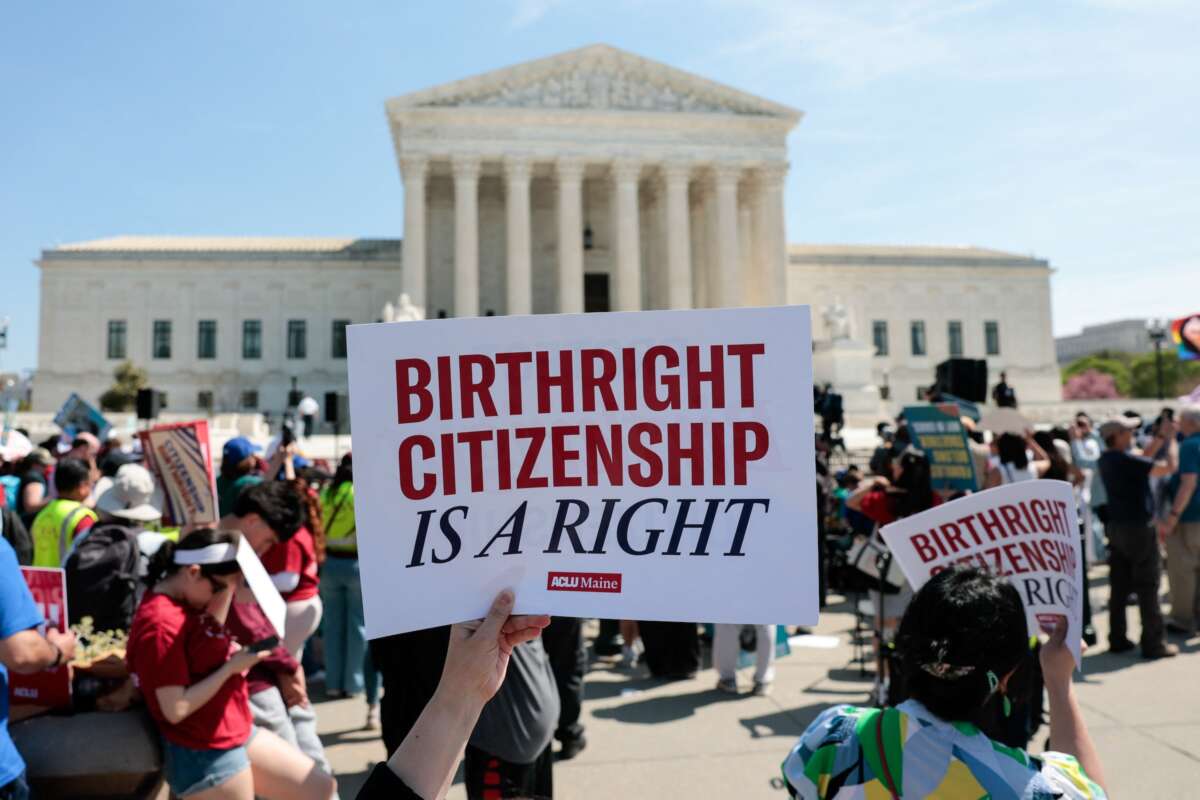
Demonstrators rally in support of birthright citizenship outside the US Supreme Court in Washington, DC on April 1, 2026. President Donald Trump attended in person as the US Supreme Court heard a landmark case weighing the constitutionality of his contentious bid to end birthright citizenship.Kent Nishimura / AFP
On Thursday, Trump said in a press conference that “it would be a disgrace” if the Supreme Court upholds birthright citizenship.
“Twenty to 25 percent of the people coming into our country will come in through birthright citizenship; they’ll become citizens through birthright citizenship,” he said, grossly exaggerating the amount of children born in the U.S. to undocumented people or temporary visitors.
Trump then declared that birthright citizenship costs the U.S. inordinate sums of money. “They’re using the system, and it’s usually people that hate our country,” he said.
“No other country in the world” does birthright citizenship “the way we’re doing it,” he went on, a claim he has repeatedly peddled since announcing his aim to get rid of birthright citizenship in January.
In reality, 32 other countries have birthright citizenship laws that are similar to those of the U.S., including Canada and Mexico. And at least 50 other countries have limited variations of birthright citizenship.
Contrary to Trump’s claim that birthright citizenship costs the U.S., studies have found that it actually benefits the U.S. economy, and that putting an end to it would be more costly.
Trump has been denouncing birthright citizenship since his first term, but doubled down in an attempt to end birthright citizenship at the start of his second term.
On January 20, 2025, hours into his first day in office, Trump signed an executive order to withhold citizenship from children born in the U.S. to parents who are undocumented or temporary visa holders – a right that the U.S. Constitution had upheld for over 150 years.
The American Civil Liberties Union (ACLU) and other groups immediately challenged this order, and multiple federal judges blocked its implementation, saying that it violated the Constitution. But the Supreme Court has agreed to take up the issue, and will hand down a ruling by July.
The executive order stated that infants born to undocumented mothers or mothers with temporary visa status whose fathers are not citizens or permanent residents would not receive citizenship, and would be denied Social Security cards, U.S. passports, and other legal documents. The order defines mother and father as “biological progenitors,” making it unclear how it would affect infants of single mothers or LGBTQ+ couples.
If implemented, this would affect an estimated 255,000 children born in the U.S. each year, leaving many of them stateless. Over the course of a decade, this would amount to 2.5 million undocumented children in the U.S., many with little recourse for gaining nationality or citizenship in the U.S. or elsewhere. Researchers warn it could create “an underclass excluded from social membership for generations” that “would experience far fewer opportunities for upward mobility, further exacerbating inequality in the United States.”
But on the Supreme Court’s initial day of hearing arguments in the case in April, even conservative judges “seemed open to rejecting” Trump’s order, according to CBS News reports on the court proceedings and analysis by the American Immigration Council.
The U.S. has had birthright citizenship since the ratification of the 14th Amendment to the Constitution in 1868. The 14th Amendment was adopted to guarantee citizenship for formerly enslaved people who were newly free.
This article is licensed under Creative Commons (CC BY-NC-ND 4.0), and you are free to share and republish under the terms of the license.
On Thursday, Trump said in a press conference that “it would be a disgrace” if the Supreme Court upholds birthright citizenship.
“Twenty to 25 percent of the people coming into our country will come in through birthright citizenship; they’ll become citizens through birthright citizenship,” he said, grossly exaggerating the amount of children born in the U.S. to undocumented people or temporary visitors.
Trump then declared that birthright citizenship costs the U.S. inordinate sums of money. “They’re using the system, and it’s usually people that hate our country,” he said.
“No other country in the world” does birthright citizenship “the way we’re doing it,” he went on, a claim he has repeatedly peddled since announcing his aim to get rid of birthright citizenship in January.
In reality, 32 other countries have birthright citizenship laws that are similar to those of the U.S., including Canada and Mexico. And at least 50 other countries have limited variations of birthright citizenship.
Contrary to Trump’s claim that birthright citizenship costs the U.S., studies have found that it actually benefits the U.S. economy, and that putting an end to it would be more costly.
Trump has been denouncing birthright citizenship since his first term, but doubled down in an attempt to end birthright citizenship at the start of his second term.
On January 20, 2025, hours into his first day in office, Trump signed an executive order to withhold citizenship from children born in the U.S. to parents who are undocumented or temporary visa holders – a right that the U.S. Constitution had upheld for over 150 years.
The American Civil Liberties Union (ACLU) and other groups immediately challenged this order, and multiple federal judges blocked its implementation, saying that it violated the Constitution. But the Supreme Court has agreed to take up the issue, and will hand down a ruling by July.
The executive order stated that infants born to undocumented mothers or mothers with temporary visa status whose fathers are not citizens or permanent residents would not receive citizenship, and would be denied Social Security cards, U.S. passports, and other legal documents. The order defines mother and father as “biological progenitors,” making it unclear how it would affect infants of single mothers or LGBTQ+ couples.
If implemented, this would affect an estimated 255,000 children born in the U.S. each year, leaving many of them stateless. Over the course of a decade, this would amount to 2.5 million undocumented children in the U.S., many with little recourse for gaining nationality or citizenship in the U.S. or elsewhere. Researchers warn it could create “an underclass excluded from social membership for generations” that “would experience far fewer opportunities for upward mobility, further exacerbating inequality in the United States.”
But on the Supreme Court’s initial day of hearing arguments in the case in April, even conservative judges “seemed open to rejecting” Trump’s order, according to CBS News reports on the court proceedings and analysis by the American Immigration Council.
The U.S. has had birthright citizenship since the ratification of the 14th Amendment to the Constitution in 1868. The 14th Amendment was adopted to guarantee citizenship for formerly enslaved people who were newly free.
This article is licensed under Creative Commons (CC BY-NC-ND 4.0), and you are free to share and republish under the terms of the license.

Shireen Akram-Boshar is a socialist writer, editor and Middle East/North Africa solidarity activist.

No comments:
Post a Comment