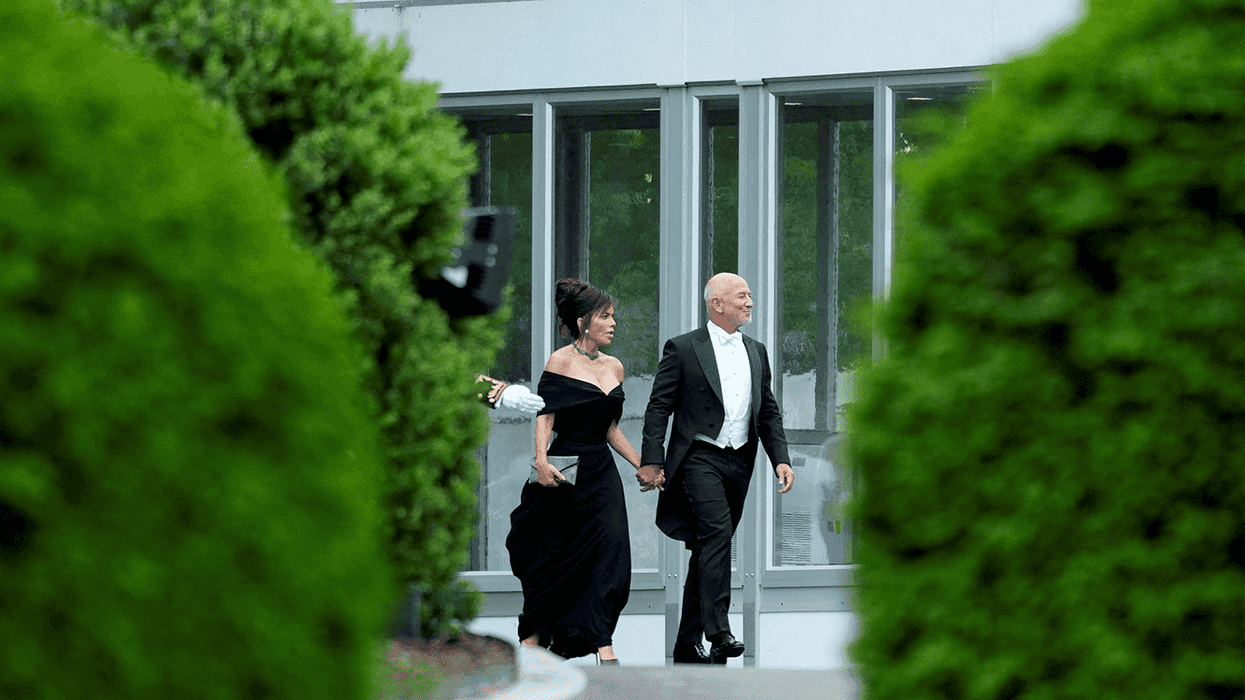
Amazon founder Jeff Bezos and his wife Lauren Sanchez Bezos arrive to attend a state dinner for Britain's King Charles and Queen Camilla hosted by U.S. President Donald Trump and first lady Melania Trump at the White House in Washington, D.C., U.S., April 28, 2026. REUTERS/Ken Cedeno
May 22, 2026
ALTERNET
When President Donald Trump was inaugurated for his second term in January 2025, he was flanked by tech billionaires who at the time seemed confident that his victory was theirs, and they’ve been cozying up to him ever since. Now, according to Nobel-winning economist Paul Krugman, it’s becoming increasingly clear that allying with Trump wasn’t the “smart political move” they hoped. Evidence of this, he says, was in the CNBC interview with Amazon founder Jeff Bezos earlier this week.
“Last year Bezos and other tech billionaires evidently believed that they could insulate themselves from criticism — and secure their wealth against both taxation and regulation — by allying themselves tightly with Donald Trump,” writes Krugman. “But Trump is now exploring new frontiers in presidential unpopularity, and Republicans are facing a wave of public revulsion so strong that it will probably overwhelm even their strenuous efforts to rig the midterm elections. So paying court to the mad king isn’t looking like the smart political move Bezos and his ilk thought it was.”
And according to Krugman, they’re coming around to this realization. The proof was in the fact that during his interview, an unprepared Bezos flailed while trying to justify cutting taxes.
As Krugman notes, Bezos was quick to “peddle the classic zombie lie” that rich Americans pay the overwhelming majority of tax revenue, asserting that the top 1 percent pays 40 percent while the bottom half only pays 3 percent. “These numbers aren’t remotely right,” notes Krugman, explaining that between federal, payroll, state and local taxes, the uber-rich only have a slightly higher tax burden than middle and working class households.
“So Bezos doesn’t understand the most basic facts about taxes, nor did he make any effort to inform himself,” says Krugman. “He went instead with some numbers he thinks he heard somewhere — numbers that tell a story he wants to hear.”
What’s more, Bezos attempted to obscure just how little he actually pays. While he argued that “people sometimes say that I don’t pay taxes — that’s not true,” Krugman notes that while he indeed does pay some taxes, the fact is that he pays less than 1 percent of his income.
More interesting than Bezos’s muddled assertions, says Krugman, is the question of why he felt the need to give the interview in the first place.
“The answer, almost surely, is that Bezos is feeling the heat,” asserts Krugman. “There is a broad political backlash brewing against the excessive power of billionaires and the corrupting effect of their money on our democracy. This backlash is especially severe for tech oligarchs. A decade ago, Bezos and other tech billionaires were popular, almost folk heroes. No longer.” As evidence of this, he points to a Gallup survey showing positive perceptions of the tech industry have fallen precipitously over the past decade, while negative perceptions have climbed.
So now, tech billionaires are seeing the writing on the wall, and in the face of Trump’s plunging approval ratings and the likelihood of a major political sea-change over the coming elections, they’re feeling the pressure to “defend themselves against the threat of taxes and regulations that might make them slightly less rich.”
“Bezos evidently thought that the threat to his billions was sufficiently important to justify going on CNBC to lecture the rest of us about the evils of taxation — but not sufficiently important for him to learn a few facts first,” Krugman concludes. “Somehow, I don’t think this new political strategy will work.”
ALTERNET
When President Donald Trump was inaugurated for his second term in January 2025, he was flanked by tech billionaires who at the time seemed confident that his victory was theirs, and they’ve been cozying up to him ever since. Now, according to Nobel-winning economist Paul Krugman, it’s becoming increasingly clear that allying with Trump wasn’t the “smart political move” they hoped. Evidence of this, he says, was in the CNBC interview with Amazon founder Jeff Bezos earlier this week.
“Last year Bezos and other tech billionaires evidently believed that they could insulate themselves from criticism — and secure their wealth against both taxation and regulation — by allying themselves tightly with Donald Trump,” writes Krugman. “But Trump is now exploring new frontiers in presidential unpopularity, and Republicans are facing a wave of public revulsion so strong that it will probably overwhelm even their strenuous efforts to rig the midterm elections. So paying court to the mad king isn’t looking like the smart political move Bezos and his ilk thought it was.”
And according to Krugman, they’re coming around to this realization. The proof was in the fact that during his interview, an unprepared Bezos flailed while trying to justify cutting taxes.
As Krugman notes, Bezos was quick to “peddle the classic zombie lie” that rich Americans pay the overwhelming majority of tax revenue, asserting that the top 1 percent pays 40 percent while the bottom half only pays 3 percent. “These numbers aren’t remotely right,” notes Krugman, explaining that between federal, payroll, state and local taxes, the uber-rich only have a slightly higher tax burden than middle and working class households.
“So Bezos doesn’t understand the most basic facts about taxes, nor did he make any effort to inform himself,” says Krugman. “He went instead with some numbers he thinks he heard somewhere — numbers that tell a story he wants to hear.”
What’s more, Bezos attempted to obscure just how little he actually pays. While he argued that “people sometimes say that I don’t pay taxes — that’s not true,” Krugman notes that while he indeed does pay some taxes, the fact is that he pays less than 1 percent of his income.
More interesting than Bezos’s muddled assertions, says Krugman, is the question of why he felt the need to give the interview in the first place.
“The answer, almost surely, is that Bezos is feeling the heat,” asserts Krugman. “There is a broad political backlash brewing against the excessive power of billionaires and the corrupting effect of their money on our democracy. This backlash is especially severe for tech oligarchs. A decade ago, Bezos and other tech billionaires were popular, almost folk heroes. No longer.” As evidence of this, he points to a Gallup survey showing positive perceptions of the tech industry have fallen precipitously over the past decade, while negative perceptions have climbed.
So now, tech billionaires are seeing the writing on the wall, and in the face of Trump’s plunging approval ratings and the likelihood of a major political sea-change over the coming elections, they’re feeling the pressure to “defend themselves against the threat of taxes and regulations that might make them slightly less rich.”
“Bezos evidently thought that the threat to his billions was sufficiently important to justify going on CNBC to lecture the rest of us about the evils of taxation — but not sufficiently important for him to learn a few facts first,” Krugman concludes. “Somehow, I don’t think this new political strategy will work.”

No comments:
Post a Comment