Sunday, May 17, 2026


‘Some hide their crosses’: Jerusalem nun attack highlights Israel’s growing anti-Christian problem

‘To be Israeli is to be Jewish’


LONG READ


When a foreign nun was the victim of violent physical assault in Jerusalem last month, local activists and clergy say they were shocked but not surprised. In the past few years, anti-Christian incidents have surged in Israel – illustrating how a small minority of insular and mainly ultra-religious nationalist or ultra-Orthodox Jews are becoming increasingly emboldened to act out their anger and hate.


Issued on: 15/05/2026 - 
FRANCE24

An Orthodox Christian woman holds a cross during Good Friday processions in Jerusalem's Old City © Bernat Armangue, AP/ File


On Wednesday evening, Yisca Harani spent several hours at a local police station.

“I got a report about a ‘spitter’,” the Jewish activist said over a patchy phone line from Jerusalem, explaining that a Christian monk had been the latest target of such humiliation.

Harani, who heads the Religious Freedom Data Center (RFDC) – an Israeli NGO that documents anti-Christian incidents and help victims report them to authorities – said there are so many cases now that she and her roughly 100 volunteers are kept busy “24/7”.

“The most common is spitting,” she said. “But it can also be graffiti on [Christian] signs with crosses on them, vandalism or different forms of harassment.”

The perpetrators, she said, belong to a very tiny part of Israel’s population of 10 million – “most Jews would never do this” – and mainly identify as ultra-Orthodox, Shas-style Sephardis or nationalist religious Jews.

“They all wear kippah [traditional Jewish skullcaps]. I’ve not seen one secular Jew misbehave toward Christians.”

In 2024, her organisation recorded 107 incidents. Last year, the number jumped to 181.

“There isn’t a month that goes by without at least ten incidents reported,” she said, but noted that in reality, the numbers are likely much higher. This is in part because victims either do not know how to report, or do not want to “make a fuss” over less serious offences like spitting.

Why the spitting?

The question of spitting takes us centuries back through the history of Jewish-Christian relations, throughout which Jews, as a minority, suffered immensely at the hands of a Christian majority – from anti-Semitism and persecution to attempts at extermination.

In the 11th century, Jews (then being persecuted during the Crusades) were accused of spitting at the cross in an act of religious contempt, Rabbi Alon Goshen-Gottstein explained in a Times of Israel blog post. Some Jewish communities then adopted this gesture to show resistance and defiance. Over time, “the spitting Jew” became a negative stereotype for Jews.

When the state of Israel was created in 1948, Jews became a majority group for the first time, with Christians in the minority, and the spitting became even more symbolic.

Goshen-Gottstein wrote that the problem is that some insular Jewish communities have not followed modern developments in the Christian world, and do not know that many churches have since revised their theologies, legitimised Judaism, issued apologies and are even fighting anti-Semitism.

“The spitters and attackers are, of course, clueless,” Goshen-Gottstein said.

Far-right politician Itamar Ben-Gvir added fuel to the fire in 2023, when he, as Israel’s sitting national security minister, told Army Radio that spitting at Christians was not a crime, and that not everything “justifies an arrest”.


Jewish ultra-nationalists celebrate at Damascus Gate during the annual Jerusalem Day march commemorating Israel's capture of East Jerusalem in the 1967 Mideast war, Jerusalem's Old City, May 14, 2026. © Leo Correa, AP

‘Think twice about going out’

The brutal physical assault of a French Dominican nun in East Jerusalem on April 28, however, sent new shock waves throughout the Christian community. In CCTV footage capturing the attack, an Orthodox man is seen running up behind a Christian nun, shoving her to the ground, and returning to kick her once before bystanders intervene.


“This is the most extreme case we’ve seen. During the three years since I founded RFDC, there may have been three or four physical interactions,” Harani said, but stressed that none of them had been this violent.

Since then, her NGO has been called upon to “escort” Christians through Jerusalem. While accompanying the faithful, the RFDC volunteers keep their phone cameras open at all times, ready to film any potential assaults they may be targeted by.

On Wednesday, the Knesset held a special committee session on the attack against the nun and the way Christians are being treated. Prime Minister Benjamin Netanyahu firmly condemned the incident, but critics say the meeting was mainly called because the footage went viral, embarrassing the Israeli government on the international stage.

Several of the Christian representatives present at the hearing recounted routine harassment on the streets of Jerusalem’s Old City, the Haaretz newspaper reported, and cited incidents in which Israeli security forces had prevented devotees access to prayer sites or in which Christians had been the victims of stone-throwing or kicking.

"I call on the Israeli government to call these acts by their name: hate crimes," Father Aghan Gogchian, the chancellor of the Armenian Patriarchate, said.

Neighbours staging protests


According to the Central Bureau of Statistics, some 185,000 Christians were registered in Israel at the end of 2025, accounting for about 1.9 percent of the population. Most of these are Arab Christians – a minority that is often overlooked, rarely talked about and whose Arabic heritage makes them especially vulnerable in a Jewish state like Israel.

Hana Bendcowsky, program director of the Jerusalem Center for Jewish-Christian Relations at the interreligious Rossing Center, said there had been incidents where local demonstrations had been staged in front of Arab Christian homes because their Jewish neighbours did not want them living there.

“Maybe because they are Christian, maybe because they are Arabs. It is not clear.”

Another group that is regularly targeted are those who wear visible Christian symbols or religious clothing, such as pilgrims, nuns and monks.

“Every priest you talk to will tell you that spitting is almost a daily experience,” Bendcowsky said.

Some, especially after the attack on the nun, have therefore become more careful in showing their religious affiliations.

“They hide their crosses in their pockets and so on, or avoid wearing their habits when they go to certain places.”

Father David Neuhaus SJ, who has lived in Jerusalem for almost five decades and for several years served as superior of the Jesuit community at the Pontifical Biblical Institute, said that after the assault on the nun “there are people who think twice before going out unless it is absolutely necessary”.

Although he refuses to give in to the fear himself, he said: “There is now an awareness that you need to look around you, think about where you are going, think about how you dress. There is a feeling that at any moment your life could suddenly take a turn for the worse.”

‘To be Israeli is to be Jewish’

All three interviewees FRANCE 24 spoke to said the intolerance against non-Jews in Israel – whether Christians, Muslims or others – has spiked in recent years, fuelled by new government policies, war, and of course, the October 7, 2023 terror attacks.

Father Neuhaus said it did not help that Israel has been an extremely militarised state from the start and has been “built on settler colonialism”.

“We’re a very violent society,” he said. “Take a bus, take a train, walk down the street – everyone is armed. That already is an incredible violence.”

An armed Israeli walks in Jerusalem's Old City ahead of a march marking Jerusalem Day, an Israeli holiday celebrating the capture of east Jerusalem in the 1967 Mideast war, on May 14, 2026. © Ohad Zwigenberg, AP

Harani, of RFDC, said the 2018 “Nation-State Law” marked the real first turn for the worse in Israel’s religious intolerance.

“This law is the epitome of this whole psychosis: that to be Israeli is to be Jewish – religiously and nationalistically.”

The law defined Israel as national home of the Jewish people and encouraged the use of Jewish symbols in Israeli society. Critics say this quickly forged a climate of religious nationalism and contributed to religious minorities feeling increasingly marginalised.

Since then, Harani said Netanyahu’s government shows “absolute disregard for certain behaviours in the radical sector. Their behavior is tolerated, and therefore gives them the green light. It’s passive encouragement.”

And, she said, “they [the perpetrators] are becoming more and more audacious”.

Father Neuhaus agreed. “When lower-level incidents like spitting are ignored, the message is that violence is OK.”

The trauma, anger and frustration linked to the October 7 attacks led some insular Jewish groups to start “dehumanising the other”, Bendcowsky said. She pointed particularly to the uptick in settler violence against Palestinians in the occupied West Bank. She noted that many of them are either in denial of, or have no knowledge of, the death and pain Israel has brought to civilians in Gaza, Lebanon and Iran.


“So what we see with Christians is just one symptom of the general atmosphere,” she said.

However terrible the aggression on the nun might have been, Harani said it did serve at least one meaningful purpose: shining a light on the Israeli government’s treatment of Christians.

“I’m in almost daily contact with the nun and visited her yesterday,” Harani said. “I told her: ‘In a way, you were chosen to be the stop sign for what is happening’.”

FRANCE 24’s correspondent in Jerusalem Noga Tarnopolsky contributed to this report.


The Assault on a French Nun and the Forgotten Story of Palestinian Christians


by | May 15, 2026 |

The video is horrifying, though it is the kind of horror now synonymous with the behavior of Israel, its military, its armed settlers, and society that has been conditioned to see the ‘other’ as subhuman.

Yet, this was not the typical viral video that emerges almost daily from occupied Palestine. The victim, this time, was not a Palestinian. She was an elderly French nun.

On May 1, footage surfaced from Jerusalem showing a 36-year-old Israeli man running behind a French nun – a researcher at the French School of Biblical and Archaeological Research – and shoving her violently to the ground.

In a chilling display of cruelty, the assailant did not simply hit and run. He walked away a few paces, then returned to the fallen woman to kick her repeatedly and mercilessly as she lay helpless.

What was most astonishing was the sense of normalcy that followed. The assailant remained on the scene, conversing with another man who appeared entirely unperturbed by what should have been a devastating event in any other context.

The video briefly imposed itself on the mainstream media scene, garnering perfunctory condemnations. Many explained the event as part of the larger landscape of Israeli violence, highlighting the ongoing genocide in Gaza as the most obvious example of this unchecked aggression.

But even the context of general violence does not fully explain why a French nun was targeted. She is not dark-skinned, she is European, she is Christian, and she holds no historical or territorial claims that would typically trigger the ‘security’ paranoia of the Zionist state.

Still, the incident was anything but ‘isolated,’ despite the rush by Israeli officials to label it a ‘shameful’ exception. To the contrary, the nun was attacked specifically because she is Christian.

This raises the question: why?

To answer this, we must acknowledge how Palestinian Christians have been systematically written out of the history of their own land.

Palestinian Christians are not merely present in the land; they are among the most historically rooted communities in Palestine. They are anything but ‘foreigners’ or ‘bystanders’ caught in a supposed religious conflict between Jews and Muslims.

In fact, the Christian Arab presence in Palestine predates the Islamic era by centuries. They are the descendants of historic tribes who shaped the region’s identity long before the advent of modern political labels.

The marginalization of Palestinian Christians is a relatively new phenomenon, deeply linked to Western colonialism. For centuries, European powers used the pretense of ‘protecting’ Christian communities to justify their own imperial interventions.

Consequently, this framed the native Christian not as a sovereign Arab with agency, but as a ward of the West – a narrative that effectively stripped them of their indigenous status and alienated them from their own national fabric in the eyes of the world.

Zionism added a lethal layer to this erasure. It has often projected itself as a ‘protector’ of Christians to avoid raising the ire of its Western backers.

In reality, Palestinian Christians have been subjected to the same policies of ethnic cleansing, racism, and military occupation as their Muslim brothers and sisters. How else can we explain the catastrophic dwindling of the Christian population?

Before the 1948 Nakba, Palestinian Christians made up roughly 12% of the population. Today, that number has plummeted to a mere 1%. During the Nakba alone, tens of thousands were expelled from their homes in West Jerusalem, Haifa, and Jaffa, their properties looted and their communities dismantled.

A quick look at the map of Jerusalem and Bethlehem today tells the story of an ongoing erasure. Jerusalem is being systematically emptied of its native population, both Christian and Muslim. Christian properties and houses of worship are restricted, and the ‘Little Town’ of Bethlehem has been swallowed by a ring of illegal settlements and an 8-meter-high Apartheid Wall that has transformed the birthplace of Christ into an open-air prison.

Yet, despite this, we rarely hear about the struggle for survival of Palestinian Christians. Instead, the world occasionally glimpses ‘incidents’ – like the common habit of Jewish extremists spitting on foreign pilgrims and clergy in Jerusalem. This behavior has become so normalized that Israeli ministers, such as Itamar Ben-Gvir, have previously defended the act as an “ancient custom” that should not be criminalized.

The reason the Palestinian Christian story is rarely told is that it fails to factor neatly into the convenient narratives used by Western governments. They are keen on presenting the ‘conflict’ as a Jewish state fighting for its identity against a monolithic ‘Islamic’ threat. Israel is heavily invested in this same ‘Clash of Civilizations’ trope, positioning itself as the vanguard of “Western civilization” against Arab extremism.

But some Palestinians – Muslim and Christian alike – are, to a lesser degree, also guilty of falling into this trap. The former often frame the Palestinian resistance as an exclusively Muslim struggle; meanwhile, some Christians participate in the very discourse that led to their marginalization in the first place.

The Gaza genocide, however, has proven this logic not only erroneous but unsustainable. Throughout the slaughter, Israel has destroyed over 800 mosques, but it has not spared the Christian sanctuaries.

On October 19, 2023, an Israeli airstrike targeted a building within the compound of the Church of Saint Porphyrius – one of the oldest churches in the world.

In that massacre, 18 Palestinian Christians were killed, their blood mixing with the dust of a sanctuary that had stood for 1,600 years. It was a devastating reminder that the Israeli missile does not distinguish between a mosque and a church, nor between the blood of a Muslim and a Christian.

The story of the French nun is worth every bit of the attention it received, as is the targeting of pilgrims. But as the headlines move on, we must remember that Palestinian Christians endure a suffering that is collective and rooted in the very soil of Palestine. They are now an endangered community, and Israel is the culprit. Without them, Palestine is not the same.

The Palestinian homeland is only whole when it is the cradle of religious coexistence, and Palestinian Christians sit at the very heart of that history, dating back two millennia. Their survival is not a ‘minority issue’ – it is the survival of Palestine itself.

Dr. Ramzy Baroud is a journalist, author and the Editor of The Palestine Chronicle. He is the author of six books. His forthcoming book,Before the Flood,’ will be published by Seven Stories Press. His other books include ‘Our Vision for Liberation’, ‘My Father was a Freedom Fighter’ and ‘The Last Earth’. Baroud is a Non-resident Senior Research Fellow at the Center for Islam and Global Affairs (CIGA). His website is www.ramzybaroud.net


Palestinian man shot dead while climbing West Bank barrier into Israel in search of work

JERUSALEM (AP) — An increasing number of Palestinians from the occupied West Bank have attempted to enter Israel illegally to work in recent years.


Sam Metz
May 15, 2026

JERUSALEM (AP) — Palestinian authorities said Israeli police shot and killed a Palestinian man as he attempted to climb the concrete barrier separating the occupied West Bank from Jerusalem.

The Palestinian Health Ministry and the Palestinian Red Crescent identified the man as Zakaria Qatusa, 44, from the town of Deir Qadis, about 20 kilometers (13 miles) northwest of the site of the shooting Tuesday evening in the West Bank town of Al-Ram, which abuts the wall.

Israeli police didn’t immediately respond to queries about the shooting. The funeral for the man was held on Wednesday.

Khalid Qatusa, his brother, said that he was a father of four who was crossing the wall in order to work in Israel.

“He was forced to resort to this method as there was no other opportunity to meet the needs of his household and live a dignified life. This was the only way,” he said. “He was neither an aggressor nor a threat.”

An increasing number of Palestinians from the occupied West Bank have attempted to enter Israel illegally to work in recent years. Before the Israel-Hamas war, tens of thousands of Palestinians held permits to work in Israel, but access was sharply restricted after the attack by Hamas-led militants on southern Israel on Oct. 7, 2023.

Since then, unemployment has surged amid a deep economic slowdown and a shortage of jobs in the occupied West Bank. Other shootings have taken place at the same location separating the West Bank town of Al-Ram from Beit Hanina, an east Jerusalem neighborhood.

Also on Wednesday, a Palestinian teenager was killed in a clash with Israeli settlers in the northern West Bank village of Al-Lubban al-Sharqiya. The Ramallah-based Palestinian Health Ministry identified the victim as 16-year-old Youssef Kaabneh.

The Israeli military said soldiers and police officers entered the area in response to reports that livestock from an Israeli outpost was stolen. They said they worked to disperse a violent riot and were investigating the incident.

Family members said settlers and Israeli soldiers descended on the Bedouin community and that Kaabneh was shot during a confrontation involving a sheep herd. As Israeli settlers expand their presence and outposts, livestock theft has been a major source of conflict between Israelis and Palestinians this year.

“Our lives have become a living hell. Settlers can now enter any house or farm and confiscate whatever they want, as if we are spoils of war,” said Ismail Owais, a 60-year-old resident of the village.

According to the U.N. Office for the Coordination of Humanitarian Affairs, Israeli forces or settlers killed at least 47 Palestinians in the occupied West Bank this year as of May 11. Several, like Kaabneh, have been teenagers.


Associated Press religion coverage receives support through the AP’s collaboration with The Conversation US, with funding from Lilly Endowment Inc. The AP is solely responsible for this content.

The Cherokee Bible, one of the language’s first books, is a window between worldviews

(The Conversation) — Cherokees across the US are working to revitalize their language.


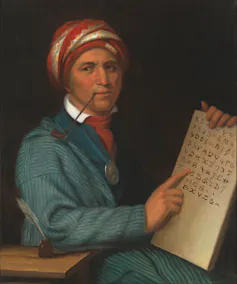
Sequoyah's invention of a Cherokee syllabary helped translate the Bible soon after missionaries' arrival. (Wesley Fryer/Cherokee Heritage Center via Wikimedia Commons, CC BY)

Tom Belt and Margaret Bender
May 13, 2026

(The Conversation) — If you wanted to learn the Cherokee language in the 1990s, there weren’t many written resources: three dissertations from the 1970s and ’80s, one textbook and a handful of college classes in North Carolina and Oklahoma. Even on most Cherokee land, it was unusual to see street or building signs in this endangered Indigenous language.

There are nearly 500,000 enrolled members in the three federally recognized Cherokee Tribes: the Cherokee Nation and United Keetoowah Band, both based in Oklahoma, and the Eastern Band of Cherokee Indians, based in North Carolina. Only about 2,000 of those members speak Cherokee as a first language.

But over the past few decades, opportunities for learners of all ages have exploded. One of the authors of this article, Thomas Belt – a first-language speaker from Oklahoma – has been honored to play a role in that resurgence, working as a teacher, curriculum developer and language consultant. Today there is bilingual signage throughout the Eastern Cherokee reservation, in the Cherokee Nation capital of Tahlequah, Oklahoma, and on tribal buildings and some private businesses throughout Cherokee country.

Cherokees of all ages and in communities across the U.S. are working to revitalize the language in new ways, from apps, games and videos to social media, music and immersion schools.

Today, about 2,000 people speak Cherokee as a first language.

Amid all this innovation, there is also a 200-year-old resource that language learners turn to: the Cherokee translation of the Christian Bible.
New writing system

Translating the Bible into Cherokee began early in the 19th century, shortly after Protestant missionaries arrived in the Cherokee Nation – centered mainly in what are now western North Carolina, north Georgia and eastern Tennessee.


Sequohay’s writing system used a syllabary, not an alphabet.

Henry Inman/National Portrait Gallery via Wikimedia Commons

In 1821, the brilliant Cherokee Sequoyah invented a writing system for the Cherokee language. First, he identified all the vowels, consonants and combinations of them used in the Cherokee language. He then invented and taught characters for every syllable – making his writing system a syllabary rather than an alphabet that assigns a character to each individual consonant or vowel.

The elegance of the system made it easy for speakers to learn, and Cherokee literacy rates were reportedly high soon after its invention. The 1828 launch of the bilingual Cherokee Phoenix, the first Native American newspaper in the U.S., is testimony to the writing system’s popularity.

It also made it easy for the Cherokee to read the Bible, once it had been translated. Teams of Euro-American missionaries and Cherokee converts produced a Cherokee version of the Book of John in 1824. A complete Cherokee New Testament and most of the Old Testament emerged in the following decades.
3 options

For language learners today, the Cherokee Bible is much more than a source of words. In our 2025 book “The New Voice of God,” we found that the text captures the cross-cultural encounter that produced it. The translation does more than show how the Cherokee interpreted Christian theology; it is a window into the Cherokee worldview.

At the time, Cherokee did not have words for many of the concepts found in the Bible – hypocrisy, poverty, power and king, to name just a few. In such situations, translators have three options.

One is to use loan words, borrowed from the foreign language. Texts heavy with loan words, though, often require special training or guides in order for the general public to read them. We did not find any true loan words in the parts of the Bible we studied.

A second option is semantic extension: using a word whose meaning is similar in some way, creating a kind of cross-cultural metaphor. This happens frequently in the Cherokee translation. For example, sheep and shepherds appear frequently in the Bible, but sheep are not indigenous to the Americas. Instead, the translation uses the word for deer, “ahwi,” to translate sheep and represents a shepherd as “ahwi diktiya,” or deer-watcher.

The third option is to create a new descriptive word, a process also seen throughout the translation. For example, the Cherokee word for idols is “unehlanvhi diyelvhi,” meaning imaginary gods.


Cultural differences

In some cases, translators’ challenges suggested deep differences between a Western worldview and their own.

Christian missionaries’ culture drew a clear distinction between the sacred and the secular. In Cherokee culture, however, science, ritual and belief are tightly intertwined.

Specialized Christian terms such as resurrection, repentance, sin, purity, baptism, salvation and blessing didn’t translate well into that worldview. The expression of those concepts in Cherokee thus reads as more ordinary and accessible than in English.

‘Child’ of God


Major differences between the grammars of Cherokee and English also shaped how Cherokee Christians reframed biblical concepts. For example, Cherokee has no gendered pronouns: no equivalents of he, she, him, her, his or hers. This means that beings who are not clearly recognizable as human men or women, such as angels, devils and God, come across as gender-neutral in the Cherokee translation.

God becomes masculine only when referred to as a father, as in “ogidoda,” “our father.” Instead, the Cherokee Bible most commonly translates God as “unehlanvhi,” which is usually interpreted as meaning a gender-neutral creator. Jesus is described as the “uwetsi,” or child, of God – even though there is a fuller Cherokee phrase, “uwetsi atsusa,” boy child, that could have clearly identified Jesus as the son of God.

In English, some speakers consider “mankind” to refer to both men and women. But in Cherokee, the word for man, “asgaya,” is not interpreted that way. Whenever the word man appears in English translations of the Bible, the Cherokee word “yvwi,” person, is used, or occasionally “kilo,” someone. This inclusivity would have resonated much better with traditional Cherokee culture, which was more egalitarian and matrilineal, with ancestry and property passed down through mothers.

Learning today


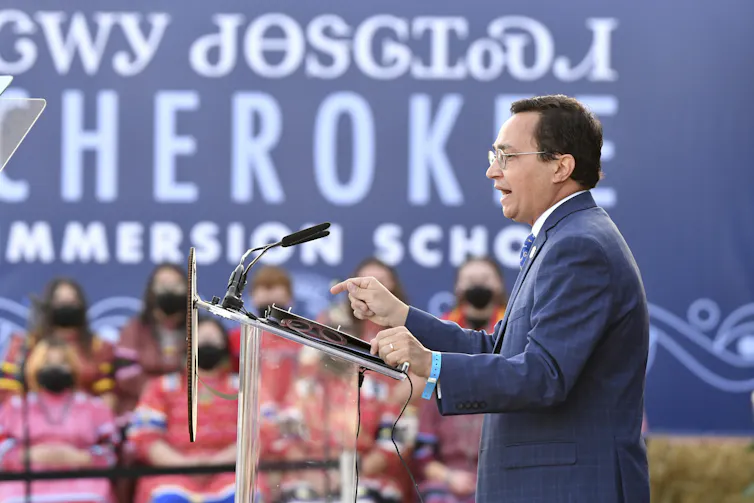
Principal Chief of the Cherokee Nation Chuck Hoskin Jr. speaks at the Cherokee Immersion School on Dec. 3, 2021, in Tahlequah, Okla.

AP Photo/Michael Woods

The Bible plays various roles in today’s Cherokee language learning, including as a source of vocabulary. For example, the most widely used online Cherokee dictionary gives Genesis 28:18 as its sample text for the word “go’i,” oil. But it also models how to form fluent phrases and sentences, mark transitions, narrate events and correctly use Cherokee’s complex grammar.

Perhaps even more importantly, the Cherokee Bible offers invaluable insight into Cherokee-specific meanings, interpretations of social and spiritual concepts, and a benchmark for understanding how the language has changed. Though the history of the relationship between Christian missionaries and Indigenous people is complex, this historic text is supporting an impressive contemporary wave of cultural and linguistic renewal.

(Margaret Bender, Professor of Anthropology, Wake Forest University. Tom Belt, Cherokee Language Expert Translator, Western Carolina University. The views expressed in this commentary do not necessarily reflect those of Religion News Service.)


The Conversation religion coverage receives support through the AP’s collaboration with The Conversation US, with funding from Lilly Endowment Inc. The Conversation is solely responsible for this content.
Georgian Orthodox Church elects new leader at fraught time for the influential institution

(RNS) — ‘It’s really the textbook example of a national church being the cornerstone of national identity,’ Samuel Noble, a scholar of Orthodox Christianity at Belgium’s University of Liège, told RNS.


Patriarch Shio III of the Georgian Orthodox Church during his enthronement at the Svetitskhoveli Cathedral in Mtskheta, outside Tbilisi, Georgia, Tuesday, May 12, 2026. (AP Photo)


David I. Klein
May 12, 2026
RNS


(RNS) — Bishop Shio Mujiri will now be known as Patriarch Shio III, leading the Georgian Orthodox Church, one of the most prominent institutions in the country. He was enthroned in the 1,000-year-old Svetitskhoveli Cathedral in Mtskheta, an ancient capital north of modern Tbilisi, on Tuesday morning (May 12), taking over one of Eastern Orthodoxy’s oldest churches after the death of one of its longest-serving leaders.

On Monday, Shio received 22 out of 39 votes from the Synod of the Georgian Orthodox Church in Tbilisi’s Holy Trinity Cathedral, outpacing the two other hierarchs who had been shortlisted for the role after Patriarch Ilia II died in March. Shio will step into the shoes of a giant as Georgia faces one of the most politically tumultuous periods in its recent history.

The Georgian Orthodox Church is one of the oldest Christian church bodies in the world, stretching back to the Apostle Andrew by tradition and by documentation at least as far back as the fifth century.

Shio, 57, who was born Elizbar Mujiri, became the 142nd leader of the church since it was first granted autocephaly — meaning self-headed in Greek — under the Byzantines in 480 A.D.

The church remains influential in Georgian society. A 2002 constitutional agreement gave the church special privileges far beyond the simple freedom of worship accorded to other religions in Georgia.

“The Church has always been an unshakable pillar of Georgian statehood and spiritual strength,” Georgian Prime Minister Irakly Kobakhidze said in a statement congratulating Shio on his election. “It is the Orthodox faith that has preserved for us those eternal values, thanks to which our country has reached this day.


Georgians with their children carry national flags as they take part in a religious procession to mark Orthodox Christmas in Tbilisi, Georgia, Jan. 7, 2024.
 (AP Photo/Shakh Aivazov)

“I believe that your pastorate will serve the peaceful, united, and strong future of our country. May the Lord protect our country and its new spiritual father,” he added.

Kobakhidze wasn’t just being diplomatic. A 2020 poll by the Carnegie Endowment for International Peace found that nearly 80% of Georgians agreed that the Georgian Orthodox Church is the foundation of their identity. And 50% agreed that Georgian citizens should be Georgian Orthodox — despite the country’s 10% Muslim minority, and long-standing Jewish, Yazidi and non-Georgian Orthodox Christian communities.

“It’s really the textbook example of a national church being the cornerstone of national identity,” Samuel Noble, a scholar of Orthodox Christianity at Belgium’s University of Liège, told RNS. “If you look up any polls done in Georgia, always the most trusted institution is the church, the most trusted individual was Patriarch Ilia.”

Ilia II served in the patriarch role for nearly 50 years. Enthroned in 1977, he is remembered by many as a source of continuity and stability in Georgia.

Under Soviet rule, even when the church was deeply infiltrated by the KGB, he earned respect for sheltering anticommunist Georgian activists. And when the Iron Curtain crashed down, he shepherded the church through the emergence of an independent Georgia, defending its canonical independence, defining its cultural identity and building ties with different political factions in and out of Georgia.


Pope Francis, center left, attends a meeting with Georgia’s Orthodox Patriarch Ilia II in Tbilisi, Georgia, on Sept. 30, 2016.
(AP Photo/Alessandra Tarantino)

“His first two decades were probably the most difficult period for him with how the churches were organized and controlled under the Soviet regime,” Vladimer Narsia, a scholar of Orthodox Christian theology and head of the Canon Law Centre at Tbilisi’s Ilia State University, told RNS. “In the second part of his leadership, after the independence of Georgia, the church gained power and he went through these more than 25 years as a main player not just in the religious life of the nation, but in the political life as well.”

In a country where the median age is 37, Ilia was the only leader many Orthodox Christians knew for their church.

“There’s not really anybody comparable,” Noble said, adding that Ilia was responsible for a “great deal” of cultural rebuilding postcommunism. “ … Under Ilia, it wasn’t just that there was a new freedom for the church, but there was also a reassertion of the Georgianness of the church. … Traditional Georgian church music was revived, traditional Georgian liturgical practice, emphasis on Georgian rather than common Russian saints all came back, and the church was rebuilt in an incredible way.”

But Ilia’s tenure wasn’t without controversy. In 2017, a Georgian Orthodox priest was arrested in Berlin with cyanide in his baggage, allegedly planning on assassinating Ilia’s own secretary over an internal dispute.

In 2021, a leak exposed that Georgia’s state security services had been spying on church leaders, allegedly recording illegal activity for potential blackmail.


Georgian Orthodox priests, opponents of a march, pray as they block off the capital’s main avenue for an LGBTQ march in Tbilisi, Georgia, July 5, 2021.
 (AP Photo/Shakh Aivazov)

The church under Ilia also faced criticism for its reactions to LGBTQ+ activism in Georgia. In 2013, a group of clergymen led thousands to counter a small antihomophobia protest in Tbilisi — an encounter that ultimately devolved into a riot, with activists and journalists assaulted. Days earlier, Ilia had called homosexuality a disease and called for banning LGBTQ+ activists from Tbilisi.


Though Shio doesn’t have the long-standing cultural cachet of Ilia, nine years ago Shio was appointed by Ilia to oversee the leadership transition after the patriarch’s eventual passing. Over the years, Shio had already taken over many of Ilia’s duties as his health deteriorated.

Shio isn’t expected to differ from Ilia much on social issues, but he is taking the helm in the midst of a second year of a protracted political crisis in Georgia, and many are watching to see how he navigates the church’s position. Nearly two years since disputed 2024 elections, Tbilisi is still wracked by protests against the ruling Georgian Dream party, which has responded with authoritarian crackdowns and legislation.

“What happened in 2024 was the most important mark in the recent history of the Georgian nation,” Narsia said. By that point, he noted, Ilia had stepped back from politics due to his health, but the church had been an active participant in earlier years. The same year, in an attempt to court church support, Georgian Dream floated the idea of enshrining the Orthodox church in law as Georgia’s state religion, but Shio and Ilia shot down the idea.

Shio’s ascension to the patriarchal throne comes amid another great divide. For years, the Orthodox world has been defined by a major rift between Moscow, seat of the Russian Orthodox Church, which is the world’s largest Orthodox church, and Constantinople, seat of the Ecumenical Patriarchate, a historical leader of Orthodox Christendom.

In 2018, the Russian church broke ties with the Ecumenical Patriarchate over the latter’s establishment of a Ukrainian Church independent from the Russian church. It created the largest schism in Orthodoxy since the break with Rome in 1054.

In the weeks between Ilia’s death and Shio’s election, both Moscow and Constantinople accused the other of interference in the succession process. Ties with Moscow have also suffered ever since Russia’s 2008 invasion of Georgia, and the Russian church has often been criticized for giving spiritual justification to the war in Ukraine and the Putin regime.

Shio, who completed much of his religious education in Moscow in Russian Orthodox institutions, has many concerned over those ties.

“One of the great challenges that the Georgian Orthodox Church has today will be how the new patriarch reads the influence of the Russian Orthodox Church over the Georgian church,” Narsia said.


Elaborately decorated skeletons in Catholic churches across Bavaria take some visitors by surprise

BAD STAFFELSTEIN, Germany (AP) — While they may seem unfamiliar or even disturbing to some visitors, catacomb saints — or Holy Bodies — can still be found in many Baroque Catholic churches and monasteries across Bavaria.


Kirsten Grieshaber
May 11, 2026

BAD STAFFELSTEIN, Germany (AP) — It is a sight that has sent shivers down the spines of many visitors: four complete skeletons draped in silk and brocade, adorned with precious stones, filigree gold, silver and lace that have been on display for centuries at the Catholic monastery church of Banz in southern Germany.

The skeletons — known as Vincenzius, Valerius, Benedictus and Felix Benedictus — are the remains of so-called catacomb saints that were brought to the Benedictine monastery near the Bavarian town of Bad Staffelstein from Rome in the late 17th and 18th century.

“It’s actually a little creepy,” whispered church custodian Anita Gottschlich as she looked at one of the skeletons. It seemed to be staring right back at her through its hollow eye sockets.

“I notice that when older people come here who visited as children, they always look for the Holy Bodies, because they can still remember them,” she added, noting the enduring fascination the skeletons hold for people of all ages.

While they may seem unfamiliar or even disturbing to some visitors, catacomb saints — or Holy Bodies — can still be found in many Baroque Catholic churches and monasteries across Bavaria.

The skeletons, often presented in glass coffinlike cabinets, are also a familiar sight in churches in neighboring Austria, Switzerland, Czechia, and in Italy.

Holy Bodies are remains found in Roman catacombs in the Middle Ages

Legend has it that these relics are the remains of martyrs from the early days of Christianity in Rome that were discovered in the 16th century in unmarked graves in the city’s catacombs.

“At the time, the church simply designated them all as saints,” said Catholic priest Walter Ries. “And, of course, in many countries, including Germany, people wanted to have such holy remains, such relics, simply because this enhanced the status of their own church or monastery and perhaps turned it into a place of pilgrimage.”

Ries is in charge of several parishes in and around Bad Staffelstein, including the congregation of 211 members that belongs to the monastery church. It’s a far cry from the golden age of the monastery, which was founded by Benedictine monks in 1070 and flourished for hundreds of years until it was dissolved in 1803. Nowadays, only the church is still actively in use; the monastery is home to a political foundation.

“A great deal has changed over the course of the centuries,” the priest said. “Back then, these relics were very important, but today they really aren’t anymore.”

Catacomb saints were supposed to help believers deal with misery

The veneration of the catacomb saints during the late 17th and 18th centuries came at a time when vast stretches of Europe, including Bavaria, were still reeling from the Thirty Years’ War. It began as a religious struggle between Catholics and Protestants and led to an estimated 4 to 8 million deaths from the effects of battle, famine or disease.

“That was a terrible time,” said Ries. “And so people tried to open the gates of heaven through the Baroque. That’s why everything was designed so beautifully. It was an escape from the present, which was often so terrible. That’s also why these eerie skeletons were so beautifully draped and depicted as lifelike as possible.”

The abbots of the Banz monastery and the church, which is ostentatiously adorned with lots of gold, cherubs and paintings in the Baroque style, sent emissaries to Rome in 1680 and again in 1745, who successfully brought home the four skeletons which were then decorated by nuns in the nearby town of Bamberg.

For the faithful, a glimpse of what they’d look like after resurrection

To ensure that viewing the Holy Bodies was an exceptional experience, they were and are still kept out of sight for most of the year by attaching wooden panels depicting the respective skeletons to the front of the display cases. On special occasions, such as All Saints’ Day, the covers are taken off and the Holy Bodies are shown to the believers.

In general, the elaborate decoration “is not meant to show the dead body of a saint, but rather to show his glorified body,” said Günter Dippold, a historian who has been researching the catacomb saints and the Banz monastery.

“It is therefore intended to show the faithful who view it what we will look like after the resurrection, after being raised from the dead, when we no longer have our earthly bodies but rather glorified ones.”

___

Associated Press religion coverage receives support through the AP’s collaboration with The Conversation US, with funding from Lilly Endowment Inc. The AP is solely responsible for this content.


Faiths

Catholic diocese fights Trump administration plan to seize pilgrimage site for border wall

(RNS) — The land targeted by the federal government is at the base of Mount Cristo Rey, a mountain and pilgrimage site topped by a 29-foot-tall limestone statue of Jesus Christ.


Workers have cut a gash, right, through the southern slope of Mount Cristo Rey, which straddles the border between Sunland Park, New Mexico, and Ciudad Juárez, Mexico, to build a new section of border wall, Saturday, March 7, 2026. Most of Mount Cristo Rey is owned by the Diocese of Las Cruces and is a popular pilgrimage and recreational site for locals. (RNS photo/Corrie Boudreaux)


Aleja Hertzler-McCain
May 11, 2026
RNS

(RNS) — The Catholic Diocese of Las Cruces, New Mexico, signaled in a legal filing it intends to fight the Trump administration’s fast-moving attempts to seize its land through eminent domain to extend the southern border wall.

The land targeted by the federal government is at the base of Mount Cristo Rey, a mountain and pilgrimage site topped by a 29-foot-tall limestone statue of Jesus Christ that dates back to 1940. The diocese said the border wall would obstruct pilgrimage routes.

“The erection of a border wall through or along this holy site could irreparably damage its religious and cultural sanctity, obstruct pilgrimage routes, and transfer sacred space into a symbol of division,” the Diocese of Las Cruces said, according to legal documents.

Seizing the land or constructing physical barriers would “constitute a significant infringement on religious freedom and the rights of worship, which are protected under both the First Amendment to the U.S. Constitution and the Religious Freedom Restoration Act,” the diocese wrote in the legal filing Friday (May 8).

The day prior (May 7), the U.S. Department of Homeland Security wrote in its own legal filing that it estimated the value of the 14 acres it plans to seize was $183,071. Eminent domain allows the government to take private property for public use, given appropriate compensation is provided to the owners.

That land would be used to “construct, install, operate, and maintain roads, fencing, vehicle barriers, security lighting, cameras, sensors, and related structures designed to help secure the United States/Mexico border,” according to the government’s filing.


Mount Cristo Rey in Sunland Park, New Mexico, is owned by the Diocese of Las Cruces and is a pilgrimage site for Catholics in New Mexico, Texas, and Mexico, Thursday, March 5, 2026
. (RNS photo/Corrie Boudreaux)

The Diocese of Las Cruces wrote that each fall on the feast of Christ the King, or Cristo Rey in Spanish, up to 40,000 people climb Mount Cristo Rey and participate in Mass. Some pilgrims make the journey barefoot, while a few ascend on their knees, the diocese wrote.

Last month, pilgrims told the El Paso Times that they anticipated that their Good Friday pilgrimage would be impacted by explosions blasting from federal land on the south side of the mountain to shave it away and prepare it for construction.

“The United States Government’s effort to use expedited procedures to condemn Diocesan land to build a border wall is an affront to religious liberty,” Kathryn Brack Morrow, an attorney at a local law firm representing the Diocese of Las Cruces, told RNS in an emailed statement. “The Diocese will use all legal tools at its dispose to stop these heavy-handed tactics.”


Franciscan Brother Joseph Bach, who leads a Las Cruces-based immigrant accompaniment ministry in courts and detention centers, told RNS he was happy the diocese is challenging the administration on the issue after feeling as though the church has been “sitting back.”

“This is an example of religious freedom — the ability to have this pilgrimage,” Bach said. “And if (President Donald Trump is) taking that sacred site away, then he’s taking away the people’s freedom to exercise their faith.”

The diocese’s filing said that if a court granted the government’s motion, the diocese would not be able to make its religious freedom arguments in court, and the Trump administration would immediately acquire the title to the land after paying for it.

DHS did not immediately respond to a request for comment.

The diocese’s legal filing was prepared by attorneys at Georgetown University’s Institute for Constitutional Advocacy and Protection; the center has been the muscle behind several legal challenges to Trump administration immigration policies — including Mennonite Church USA v. U.S. Department of Homeland Security, which challenged the administration’s decision to rescind a policy limiting immigration enforcement in houses of worship and other sensitive locations. Though a wide variety of religious groups were plaintiffs in that suit, Catholic groups were not among them.

Ilya Somin, a law professor at George Mason University in Arlington, Virginia, told RNS that the choice by the diocese and their attorneys to appeal to the Religious Freedom Restoration Act instead of the Religious Land Use And Institutionalized Persons Act stood out.

“RLUIPA is more commonly used when religious land uses are restricted, but there might be some technical reason why they didn’t resort to RLUIPA,” said Somin, who is not involved in the case.

If the Mount Cristo Rey case and its conflict over religious freedom and eminent domain goes to higher courts, it could have broader implications for religious groups at the border as well as for others dealing with eminent domain issues, Somin said.


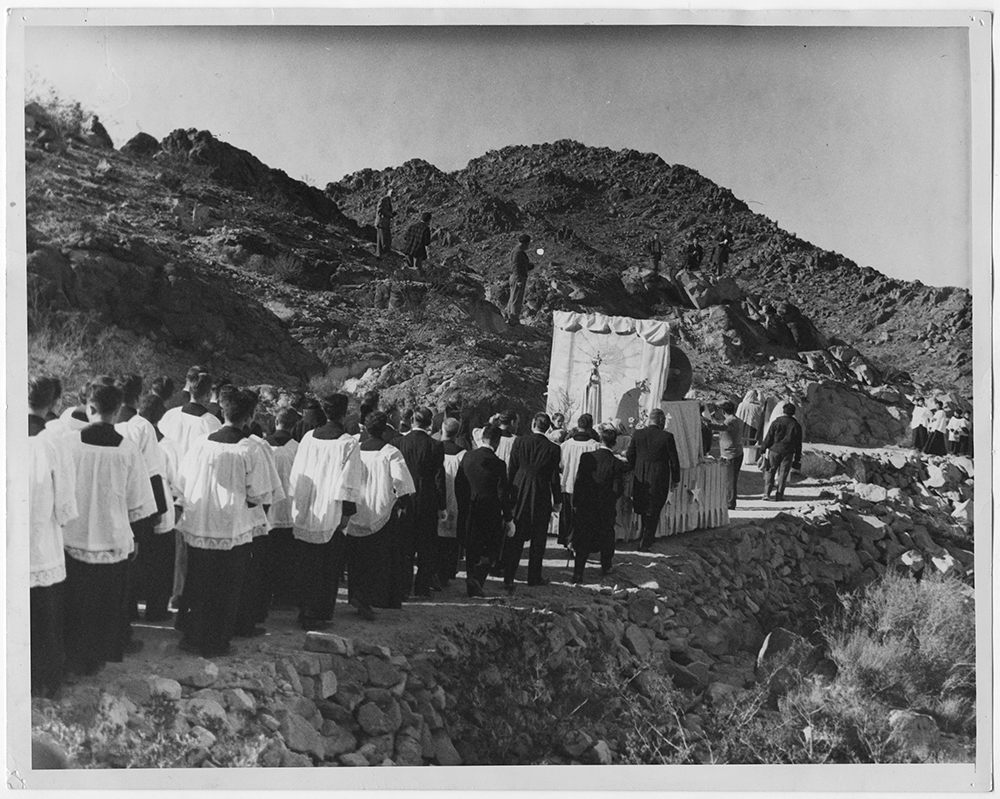
The “Pilgrim Virgin,” a statue of Our Lady of Fatima, is carried during a pilgrimage of 30,000 Catholics to a statue of Christ atop Mount Cristo Rey near El Paso, Texas, in November 1948.
 (RNS archive photo. Photo courtesy of the Presbyterian Historical Society.)


Mount Cristo Rey is the only significant space without a border fence in the El Paso metro area. In 2019, Trump adviser Steve Bannon raised private donations to build a half-mile wall on the eastern side of the mountain on private property. Bannon later pled guilty to defrauding investors.

Last month, construction crews building the border wall in Arizona destroyed a 60- to 70-foot portion of an Indigenous ground etching of a fish thought to be over 1,000 years old. Lorraine Marquez Eiler, a Hia-Ced O’odham elder, told Democracy Now her community questioned whether the construction crews destroyed the intaglio, or etching, on purpose.

And in California last month, Kumeyaay Indigenous people sounded the alarm that the Trump administration was blasting Kuchamaa Mountain, a sacred ceremonial site for their people near the Mexican and Californian towns of Tecate that has been on the National Register of Historic Places since 1992, to prepare for border wall construction.

This article has been updated to add comment from the Diocese of Las Cruces.
Vatican synod report criticizes conversion therapy, features gay Catholic testimony

(RNS) — Advocates for LGBTQ+ Catholics expressed surprise to see the Vatican publishing the testimonies of married gay men.


Some of the hundreds of LGBTQ+ Catholics and their families who joined a Holy Year pilgrimage to Rome, celebrating a new level of acceptance in the Catholic Church and crediting Pope Francis for the change, walk through the Holy Door of St. Peter’s Basilica at the Vatican, Sept. 6, 2025. (AP Photo/Andrew Medichini)

Aleja Hertzler-McCain
May 5, 2026
RNS


(RNS) — The Vatican released a report from a study group of theologians on Tuesday (May 5) that included the testimony of two married gay Catholics and acknowledged the church’s role in “the solitude, anguish, and stigma that accompany persons with same-sex attractions and their families.” The report also reflects on the negative impacts of conversion therapy, or “the devastating effects of reparative therapies aimed at recovering heterosexuality.”

“ It’s a big deal because they included testimonies and published testimonies from two LGBTQ people, both of them married, which is also unusual for the Vatican to do,” said the Rev. James Martin, a founder of Outreach, an LGBTQ Catholic ministry. “As far as I know, it’s the first time that in any official publication of the Vatican, they’ve included witnesses and testimonies and stories from LGBTQ Catholics in any kind of detailed way.”

The report comes from a group of theologians, including bishops, priests, a sister and a layperson, convened by the Vatican to study “controversial” issues raised by the Synod on Synodality, Pope Francis’ signature listening initiative, to which Martin was a delegate. Though church reform advocates hoped — and traditionalists feared — that the synod would bring major changes to church teaching around gender and sexuality, the decision to relegate contentious issues, such as LGBTQ+ inclusion, to study groups instead of general discussion was widely seen as a damper.

As expected, the synod study group report, which was written to advise the pope, does not announce major changes to church doctrine, but it does suggest that the Catholic Church address the impasse between “doctrinal firmness” and “pastoral welcome” by listening and using a transdisciplinary approach, such as incorporating insights from psychology, alongside the Bible and church doctrine.

This synod document was written by the study group, not the pope, but its release to the public would have required his authorization.

“ It’s a really good — I would even say historic — document,” said Yunuen Trujillo, a lesbian lay minister from Los Angeles. “ It’s still calling for all Catholics to engage in a process of discernment that is respectful of people’s lived experiences.”

Trujillo, author of “LGBTQ Catholics: A Guide to Inclusive Ministry,” said it might take a while for LGBTQ+ Catholics in the pews to feel the impact and noted that the document only focuses on lesbians, gays and bisexual people. “But I do believe it would be a positive impact, not a negative one,” she said.


In this Oct. 4, 2023, file photo, Pope Francis, far right, participates in the opening session of the 16th General Assembly of the Synod of Bishops in the Paul VI Hall at the Vatican. (AP Photo/Gregorio Borgia)

Marianne Duddy-Burke, a married lesbian Catholic and DignityUSA’s executive director, said, “ The most significant thing for me was the recognition that top-down trying to dictate behavior and morality on the basis of dogma isn’t working,” adding she was “hopeful” to see the report using the language of a “paradigm shift.”

The “paradigm shift” the report proposes is a move away from applying abstract theological principles to on-the-ground realities and instead seeing theory and practice as a “virtuous cycle.” For the two to effectively inform each other, the report argues, requires a focus on relationships, transparency and learning. The document offers this theological framework not just for LGBTQ+ issues but for broader use, including in nonviolent activism and protest.

The report’s release garnered some blowback, a portion of which fell on Pope Leo XIV. Far-right Catholic news organization LifeSite published a story on the report, raising concerns that the report was questioning “the sinful nature of homosexuality” and leaving unresolved the “debate on same-sex ‘marriage.'” Co-founder John-Henry Westen released a video warning that the report’s pro-LGBTQ+ stance makes clear the meaning of “synodality” under Leo.

But there are also signs Leo is not eager to change church teaching, including remarks he made in interviews last year. On Wednesday, the Vatican published a 2024 letter by the Vatican doctrinal office condemning German Catholic bishops’ plans to create formalized blessings for same-sex couples.

Advocates for LGBTQ+ Catholics expressed surprise to see the Vatican publishing the testimonies of married gay men.

“ I was expecting a rather bland report. And this was not that,” said Francis DeBernardo, executive director of New Ways Ministry, which serves LGBTQ Catholics. “ In days gone by in the church, they would try to tick off the token box by getting someone who had certain traits and characteristics, but who was just not critical of the church in any way.”

Martin said this is the first time he remembers seeing conversion therapy “critiqued that strongly” in a Vatican document. “There have been certain bishops who have been very muted in their critique of conversion therapy, but then there have also been bishops who have used organizations whose techniques really verge on conversion therapy,” he said.

One gay Catholic wrote of “wounds from the Christian community” in his Vatican-released testimony. “I cannot ignore the scars I carry. I have witnessed the devastating effects of ‘conversion therapies’ and the break-up of families, which felt like an attack on God’s sensitive and blameless creation. These experiences deeply hurt, because they target the inherent dignity of a person who simply bears the love of another of the same gender.”

But the married Portuguese man also wrote of his deep faith in the Eucharist and his sharing “a life of faith, service, and love” with his husband. “I live my life in profound peace with God, who knows me from my mother’s womb.”

“I feel the Church needs to move beyond mere ‘welcoming’ and ‘pity,'” he wrote in the testimony. “We need to proclaim the unspoken truth: God loves you and desires your wholeness. Sexuality is one part of our life, and difference is a hallmark of Creation.”

DeBernardo said the testimonies of LGBTQ+ people and their advocates have also been moving for the 17 bishops who have participated in three different meetings with New Ways Ministry in recent years. “We had a bishop at the end of the meeting in tears because he was so regretful of the way he had thought about LGBTQ people,” DeBernardo said.

“Dialogue really is the first step,” said DeBernardo. “ The genius of Pope Francis is that he realized that people had to start talking with one another, and learning about each other and not having the fear and the stereotypes.”

For Duddy-Burke, who represents a grassroots group led by LGBTQ+ Catholics that was banned 40 years ago from meeting in Catholic spaces — and who said she has struggled for years as a result to even have these conversations — the document inspires hope: “We didn’t have a place at the table and, and this document says that it’s time that we did,” she said.

At the same time, Duddy-Burke worries about whether those who hold the power will continue to dialogue and be willing to have their “minds and hearts changed.”

“And how will that be managed in parts of the world where it’s absolutely unsafe and it’s sometimes illegal, you know, for people to come forward as queer?” she asked.

The synod report also addresses “active nonviolence,” highlighting the examples of Martin Luther King Jr., Mahatma Gandhi, Filipino “People Power” and Polish “Solidarity” anti-government movements, as well as the experience of a Catholic Serbian conscientious objector. Peace has been a major focus of Leo’s pontificate, and his recent anti-war statements have led to conflict with the Trump administration, which has used theological language to promote its war in the Middle East.

In the Vatican report, the theologians suggest that “just war theory,” which Catholic U.S. Vice President JD Vance has referenced to defend the war, is “inadequate” in the modern context. “Since war can no longer be confined to military targets but overflows into civilian life, taking on new forms (hybrid, asymmetrical, etc.), the recourse to frameworks used in the past for legitimate defence — and even more so for ‘just war’ — appears increasingly inadequate,” they write.

On Tuesday, the Vatican also released the report of another Synod study group dedicated to bishop selection and other bishop issues. That report proposed broad consultation — including the perspectives of lay people, in addition to clergy and religious — when it comes to potential bishop candidates as well as ideal future bishop qualities.

This story has been updated to add more information about the purpose of the report and details about Leo’s response to the German Catholic bishops’ plans to formalize same-sex blessings.


INTERNATIONALIST FREETHINKER 

Thomas Paine helped start America. In the Trump era, he's under fire.

In some ways, the debate over Paine's legacy today is a proxy for a much larger debate over whose vision gets to govern.


Jack Jenkins
May 13, 2026
RNS

(RNS) — Rep. Jamie Raskin, D-Md., was revving up a crowd of tens of thousands gathered in Philadelphia for the first major No Kings protest last June. His speech, like the demonstration itself, was focused primarily on pushback against President Donald Trump, whom critics such as Raskin likened to a would-be monarch.

But after railing against the president, Raskin paused to focus on one of his favorite Founding Fathers: Thomas Paine, an English-born political writer who supercharged the American Revolution with his wildly popular pamphlet “Common Sense” 250 years ago.

Noting that he named his own late son after Paine, Raskin recalled the corset-maker-turned-revolutionary’s dream of an America that would operate as “an asylum to humanity.” Paine, he told the crowd, envisioned “a place of refuge for people seeking freedom from religious and political and intellectual and economic repression from around the world” — and then helped spur a revolution to make it a reality.

Less than a month later, at the inaugural service of Christ Church DC — a congregation organized by self-described Christian nationalist Doug Wilson and attended by influential conservatives, including Defense Secretary Pete Hegseth — Pastor Jared Longshore delivered a sermon that held up Paine not as a hero, but a cautionary tale. Longshore dismissed Paine as someone who “exalted human reason to the place of a golden calf,” an apparent reference to Paine’s deism and his criticism of organized religion’s entanglements with political power.


Portrait of Thomas Paine by Laurent Dabos, circa 1791.
 (Image courtesy of National Portrait Gallery/Wikimedia/Creative Commons)

“Thomas Paine actually lost all of his old friends,” Longshore said, standing at a pulpit underneath an American flag. He then implied Paine’s fall from grace could be the ultimate fate of modern progressives, saying: “Only a few mourners came to his funeral, and even the Quakers wouldn’t let him be buried in their cemetery. That’s tough. Shows you how people used to think and how people are thinking now.”

The contrast captures not only Paine’s contested place in American memory, but the larger political and religious debate in the US over whose founding vision should govern.

Scholars say Paine’s historical importance is undeniable. A seminal and celebrated voice in the American Revolution, Paine was so influential that John Adams once referred to the late 1700s as “the age of Paine.” What’s more, in addition to his role in America’s founding, Paine, an Englishman, championed democratic values so fervently that he later became a leader in the French Revolution despite not speaking French.

But Paine ultimately proved polarizing in his own lifetime, largely because of his blistering critique of organized religion, historians say. Among other things, he helped initiate debates over the separation of church and state that continue to this day, resulting in a bifurcated legacy: Paine as a champion of freedom or Paine as the “Forgotten Founding Father” — embraced or dismissed, depending on who is doing the remembering.

That fissure appears to be growing amid ongoing celebrations of the 250th anniversary of the U.S., with left-leaning leaders who support the separation of church and state championing Paine even as he is derided by prominent Christian nationalist figures aligned with Trump. And as the Trump administration and its allies prepare a faith-themed event on the National Mall to “rededicate” America “as One Nation to God,” debate over Paine’s ideas — such as his passionate opposition to “mingling religion with politics” — is unlikely to abate.

Paine once enjoyed vocal bipartisan support in Washington. In 1992, bipartisan legislation, signed by President George H.W. Bush, authorized construction of a memorial, but the project stalled. A 2022 bill renewed the push for a Paine memorial that could be erected on the National Mall by 2030, but it is still awaiting approval from the U.S. Department of the Interior and, ultimately, Congress.


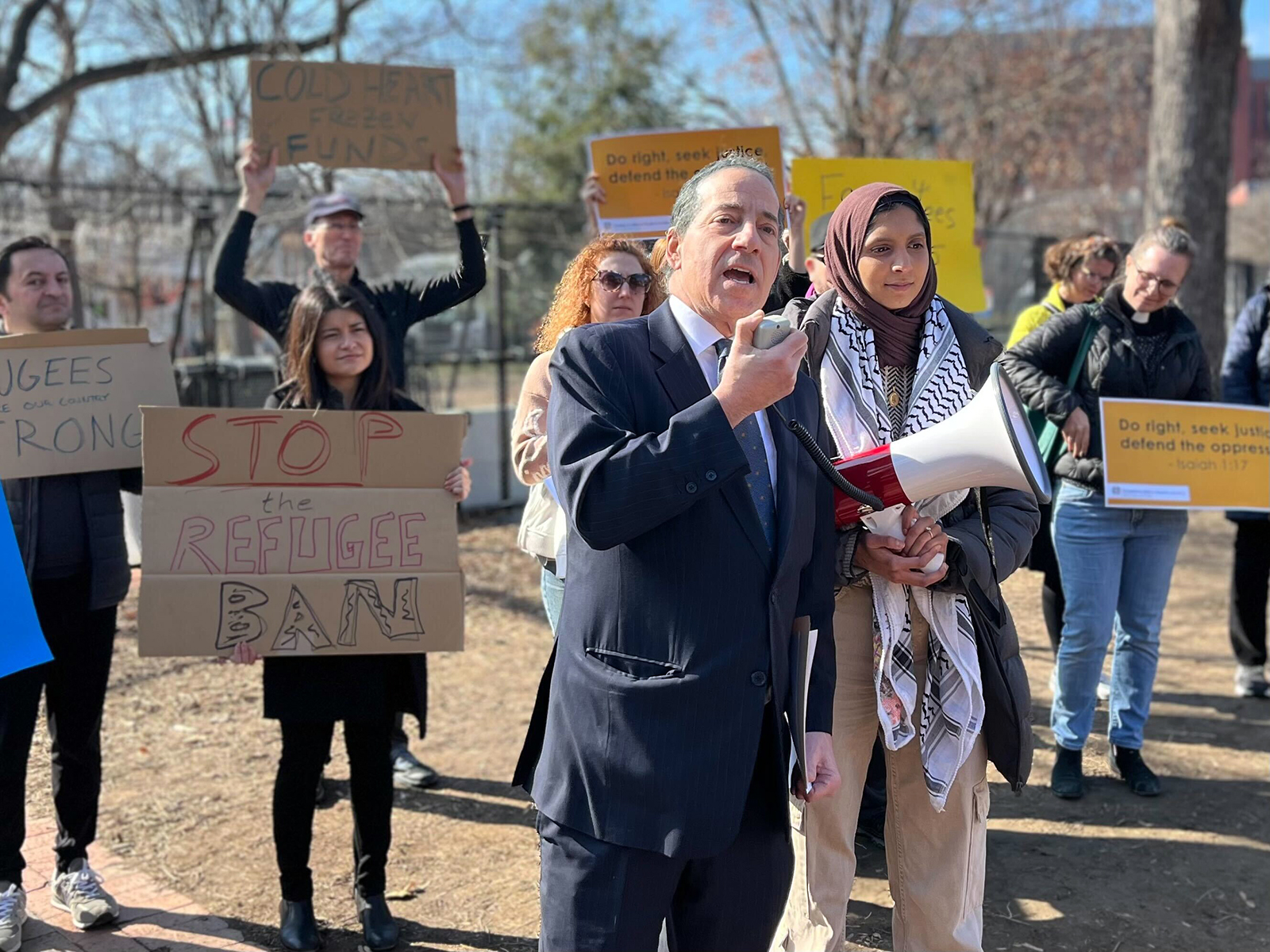
Rep. Jamie Raskin, D-Md., speaks during a protest against the shuttering of the United States Refugee Admissions Program, Feb. 4, 2025, in Washington. 
(RNS photo/Aleja Hertzler-McCain)

As the sponsor of the 2022 bill, Raskin is perhaps Paine’s most visible modern-day champion in Washington. The Maryland congressman told Religion News Service he first encountered Paine in high school by reading the revolutionary’s best-known works: “Common Sense,” “The American Crisis” and “The Rights of Man.” “I read Paine and I just felt like a light bulb went off,” Raskin said, noting that President Abraham Lincoln was also a fan of Paine. “(Paine) had this passionate and unwavering commitment to democracy as the system that will both protect people’s freedom and allow for mutual progress in society.”

Raskin often cites Paine in speeches and even pushed to name a congressional caucus he co-founded with Rep. Jared Huffman the “Thomas Paine Caucus.” The group, which boasts 36 members and is dedicated to both religious freedom and church-state separation, ended up being called the Congressional Freethought Caucus instead, although a portrait of Thomas Paine graces the group’s website.

“Tom Paine is still too radical a figure even in the 21st century, apparently,” Raskin joked.

Liberals, progressives and radicals across the globe have long claimed Paine as one of their own, often pointing to his progressive policy views for his day, such as opposition to slavery as well as support for public education and state-sponsored prenatal and postnatal care.

However, it is Paine’s views on religion — as well as how religion should interact with government — that have likely complicated his legacy. Raised in a Quaker home, Paine made several lengthy theological arguments in “Common Sense,” but ultimately declared himself a passionate deist.

“I believe in one God, and no more; and I hope for happiness beyond this life,” Paine wrote. “I believe in the equality of man, and I believe that religious duties consist in doing justice, loving mercy, and endeavouring to make our fellow-creatures happy.”

"The Age of Reason" by Thomas Paine was controversial, in part because of his blistering critique of organized religion. (Public domain image)

"Common Sense" by Thomas Paine is credited with helping to inspire the American Revolution. (Public domain image)

In 1793, Paine published “The Age of Reason,” a lengthy critique of organized religion — especially what he called “the adulterous connection of church and state.” Among other claims, he wrote that he believed the American Revolution would be followed by revolutions in the religious world.

Seth Perry, who teaches American religious history at Princeton University, told RNS the book was hardly met with the rapturous praise enjoyed by “Common Sense.” Part of the issue, Perry said, was timing: “The Age of Reason” was published just as religious revivals associated with the Second Great Awakening had already swept across the U.S., and Paine’s involvement in the chaotic French Revolution — during which Paine himself was imprisoned — gave his ideological opponents in the U.S. cause to condemn him.

“There’s good scholarship showing how the anti-religious vibe of the French Revolution was used by those at the time who wanted more religion in the government as a cudgel to push back on people like Thomas Paine, who were pushing against religion in the government,” Perry said.

In the 20th century, some prominent conservatives embraced Paine, particularly President Ronald Reagan, who often referenced Paine in public remarks. But these days, Paine has become a target among far-right intellectuals, particularly those aligned with Christian nationalism or Catholic integralism, an ideology similar to Christian nationalism that advocates for a less overt approach to exerting Christian influence over society.

“We can find in Paine antecedents for almost every political ideology we find today,” Ben Wright, a professor of American history at the University of Texas at Dallas, said in an interview. “It’s curious to see who decides to claim him and who doesn’t — and that changes over time.”

It's curious to see who decides to claim him and who doesn't — and that changes over time.Ben Wright, professor of American History at the University of Texas at Dallas

At last year’s National Conservatism Conference in Washington, Patrick Deneen — a professor at the University of Notre Dame who is associated with Catholic integralism — urged conservatives to distance themselves from Paine. After acknowledging Paine’s influence, Deneen argued far-right thinkers have overlooked Paine’s involvement in the French Revolution and his longstanding debate with Edmund Burke, a seminal conservative intellectual figure.

“Paine was no conservative, and nor, really, was his political theology,” declared Deneen, who went on to voice support for more public religious expression in government. “I would submit that by adopting this Painian, Rousseauan, French Revolutionary … political theology that conservatism has been equally the cause of woe and destruction to the values and the institutions that conservatives all along claimed to hold dear.”


Patrick Deneen addresses the National Conservatism conference, Thursday, Sept. 4, 2025, in Washington. (RNS photo/Jack Jenkins)

Gary Berton, president of the Thomas Paine Historical Association, acknowledges that Paine has long made some conservatives uncomfortable. But he insisted Paine’s criticisms of religion continue to inspire young people, many of whom are religiously unaffiliated: Berton said that, in recent years, young people often walk into the association’s building wanting to know more about Paine after reading “Age of Reason.”

Raskin, meanwhile, sees the hostility from conservatives in the Trump era as predictable.

“Monarchists and reactionary conservatives have always hated Tom Paine,” Raskin said, noting that Paine famously railed against the divine right of kings, the theology that monarchs answer only to God.

In the meantime, Raskin said, he is looking forward to a Paine memorial eventually being erected in Washington, and will continue to draw inspiration from a man he insists is unfairly maligned by those on the right.

“Democracy is always a controversial idea,” Raskin said. “Monarchy is obviously a betrayal of that idea. Aristocracy is a radical betrayal of that idea. Theocracy is just somebody dressing up their pretensions to power and dictatorship in religious garb.”


Federal employees sue USDA secretary over Christian messaging

(RNS) — Asked to comment on the suit, a USDA spokesperson said: ‘While we do not comment on pending litigation, we will keep the plaintiffs in our prayers during this process.’


Secretary of Agriculture Brooke Rollins speaks during an event on the South Lawn of the White House, March 27, 2026, in Washington, as President Donald Trump looks on.
 (AP Photo/Alex Brandon)

Adelle M. Banks
May 13, 2026
RNS


(RNS) — Federal employees are suing Agriculture Secretary Brooke Rollins and the U.S. Department of Agriculture, arguing that her use of Christian messaging in the workplace is “unconstitutionally coercive.”

The lawsuit, filed Wednesday (May 13) in the U.S. District Court for the Northern District of California, said Rollins “has adopted a practice of sending increasingly proselytizing communications to the entire USDA workforce, promoting her own preferred brand of Christian beliefs and theology to the captive audience of employees that report to her.”

The complaint was filed by the advocacy groups Americans United for Separation of Church and State and Democracy Forward Foundation and the California-based firm Bryan Schwartz Law on behalf of the National Federation of Federal Employees and seven named plaintiffs of a variety of faiths and no faith — including Jewish, Buddhist, pagan and atheist employees of the USDA, according to the lawsuit.

The union of more than 110,000 federal workers — including more than 19,000 USDA staffers — and the individuals charge that Rollins’ actions do not reflect the secular mission of the department.


Part of an an Easter email sent by Agriculture Secretary Brooke Rollins on April 5, 2026
. (Image via lawsuit)

“The Secretary’s practice reached a crescendo,” their complaint said, with an Easter (April 5) email that described the holiday as marking “the greatest story ever told, the foundation of our faith, and the abiding hope of all mankind.” It went on to declare “Jesus has been raised from the dead. And God has granted each of us victory and new life.” Her entire Easter message to “Team USDA” is attached to the complaint and features an illustration of a tomb with a stone rolled away and the words “Christ is Risen.”

Asked to comment, a USDA spokesperson said: “While we do not comment on pending litigation, we will keep the plaintiffs in our prayers during this process.”

The suing parties said Rollins’ Easter message “communicates that there is a preferred religious ‘in-group’ at USDA,” a sentiment not permitted by the establishment clause of the U.S. Constitution, which states “Congress shall make no law respecting an establishment of religion.” They also said her messaging violates a USDA policy adopted in November 2025 that requires department officials not to “use official authority to pressure subordinates” about their religious beliefs.

The union and individuals also allege that Rollins has not sent messages about holidays for other religions.

The complaint says it seeks to protect the rights of USDA employees from proselytizing and religious coercion, including those who may feel intimidated, fear retaliation for objecting to Rollins’ messages or feel compelled to hide their beliefs if they don’t share those of their department head.

“The Trump administration is waging a relentless and increasingly brazen crusade against church-state separation and the religious freedom of federal workers,” said Rachel Laser, president and CEO of Americans United, in a statement. “Trump is not Jesus, federal agencies are not churches, and cabinet secretaries are not government preachers.”

NFFE President Randy Erwin said employees of other government departments also have expressed concerns about the state of the federal workplace.

“Every agency feels like it’s the epicenter for a new outbreak of Christian Nationalism,” Erwin said in a statement. “We just want to do our jobs without having to fend off proselytizing and preaching.”

The suit goes on to describe “an escalating pattern of subjecting all USDA employees to proselytizing Christian messaging promulgated from (Rollins’) position of authority.” According to the suit, her July 4 message last year said, “May God continue to protect the United States of America and may His favor shine over all her land” and her Thanksgiving message expressed “gratitude towards a loving God.” In a Christmas video message addressed to department staff, she said, “The spirit of generosity flows from the very first Christmas when God gave us the greatest gift possible, the gift of his Son and our Savior Jesus Christ, who came to free us from our sins and open the door to eternal life. This is the reason for the season.”

The suing parties also state that they feel compelled to read Rollins’ email messages because they often include nonreligious information that may affect their job duties.

“And historically, even holiday emails from USDA leadership have included specific job-related announcements, such as, for example, notifications regarding administrative leave,” the plaintiffs said in the suit.


Opinion

How the devil was disguised in the SBC and Paul Pressler's Conservative Resurgence

(RNS) — During the Conservative Resurgence, I thought we were fighting for the Bible. Instead, we were also political pawns for an abuser.


Paul Pressler in a video from 2015. (Video screen grab)

Karen Swallow Prior
May 6, 2026
RNS


(RNS) — There’s a brilliant scene in the film “The Devil Wears Prada” in which a villainous high fashion editor berates her new, plainly dressed assistant for thinking she is above the dictates of the fashion world when the fact is that even the discount items she buys have trickled down from the upper echelons of a ruthless and rabid fashion industry.

In the movies, the devil may wear Prada, but in the Southern Baptist Convention, the devil came cloaked in its so-called Conservative Resurgence.

The Conservative Resurgence within America’s largest Protestant denomination was co-engineered by the late Paul Pressler — a Texas judge and a mover and shaker in the Republican Party and the SBC — along with former SBC seminary and convention president Paige Patterson.

Armed with evidence that liberals were invading the nation’s largest Protestant denomination, the two organized fellow conservatives to fight back, seizing control of the SBC in a decades-long denominational civil war. Now, a new and exhaustive report by Robert Downen at Texas Monthly details the horrific, lengthy history of sexual predation and abuse by Pressler, the facilitation of this abuse, and the cover-up of this abuse and other abuse cases by those within his inner circles of power (including Patterson) in both the SBC and local and national Republican politics.

Much of this history has leaked out slowly over the past few years as a result of various court proceedings, but this new report connects sparse details to a larger picture that begins with the Southern Baptist Convention but extends far beyond.

“You might not know Paul Pressler’s name,” Downen writes. “But your life has been profoundly affected by the fruits of his labor.”

“As the architect of the SBC’s so-called conservative resurgence, Pressler—or the Judge, as many knew him—played a crucial role in the marriage of the Republican Party and the white evangelical voters who still sustain its power.” In other words, the Conservative Resurgence cannot be separated from the merging we see today between the Republican Party and evangelicals. This is the thesis of the 12,000-word article.

But the devil is in the details.

Those details describe a deeply rooted culture of abuse that has been perpetuated for decades in the SBC despite numerous, vocal and at times seemingly serious attempts — mainly by abuse survivors (and some who ultimately did not survive their abuse) — to bring about change.

Those chances for real change, according to Downen’s analysis as well as the conclusions of many who tried to effect reform, are now dead in the water. The history of the Conservative Resurgence shows why.

The resurgence began because the SBC’s seminaries had been influenced by scholars who held to less literal interpretations of the Bible, which clashed with the more conservative views local churches and pastors tended to hold.


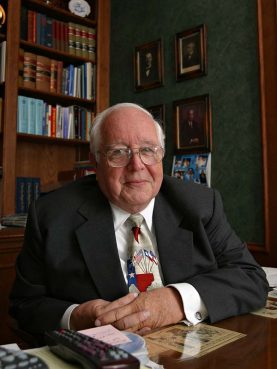
Former Judge Paul Pressler, who played a leading role in wrestling control of the Southern Baptist Convention from moderates in 1979, poses for a photo in his home in Houston on May 30, 2004. (AP Photo /Michael Stravato)

Pressler used that tension to gain power — and along the way, crushed countless vulnerable and innocent people, who were labeled as liberals and enemies of the church.

Tragically, Pressler pretended to believe in conservative Christian sexual ethics while allegedly raping and abusing boys and young men for decades. Some of these victims were supplied to him by his own political party.

Rumors and accusations about Pressler’s conduct — which led to him failing a background investigation for a job in the George H.W. Bush presidential administration — were brushed off as the stratagems of apostate, power-hungry liberals.

Pressler and Patterson were hailed for years as heroes — and many of their disciples went on to positions of power in the SBC, running SBC seminaries and entities, filling powerful pulpits and denominational appointments.

Every leader in today’s SBC pays homage to the idea that the movement led by Pressler and Patterson saved the SBC.

Yet the movement was not just about theology. It was about political power.

I am not a survivor of sexual abuse as too many of my friends in SBC circles are (some of whom are described in the Texas Monthly article). But my life was indeed profoundly affected by Paul Pressler, Paige Patterson and the Conservative Resurgence — years and years before I knew it. Reading the timeline of Pressler’s rise within the SBC and the GOP was like raising the backdrop on the stage of my own life to find the hidden directors behind the scenes.

I had no idea that the choices I was making were, at least in part, the manufactured product of an interconnected web of religious and political powerbrokers whose real interests were far from the ideals of truth and justice they peddled.

In the mid-1980s, just a few years after helping launch the Conservative Resurgence in the SBC, Downen reports, Pressler was advising the Council for National Policy, a secretive conservative networking organization whose partial membership list is a “who’s who” of right-wing politicians, corporate heads and evangelical leaders, on ways to mobilize churches and register voters by working with Jerry Falwell.

These efforts soon reached the small country church my husband and I attended in western New York. Our church was not SBC or even Baptist, but the pastor was a graduate of Falwell’s Liberty Baptist College (now Liberty University), and while we never heard the phrase “Conservative Resurgence,” I know now in looking back that our church was one of the many spoils taken by the victors of that battle.

Here we were instructed that God’s word in the Bible was delivered through full, inerrant, verbal and plenary inspiration (a phrase we were encouraged to memorize), and each term countered liberal views of Scripture that were gaining traction in the culture and undermining the Bible’s authority.

By the late 1980s, Pressler was president of the CNP and, along with other members of the organization, wrote a letter to then-Vice President George H.W. Bush that, Downen reports, “promised to deliver evangelical voters in exchange for ‘direct access’ to the White House.”


Paul Pressler, right, in a stained-glass window that was removed from Southwestern Baptist Theological Seminary. (Photo courtesy of Don Young Glass Studio)

I am one of those voters that was delivered, as promised.

I didn’t just vote, either. I invested time, money and resources into institutions I thought were rooted in Christian conviction, only to realize they were largely fronts for partisan politics.

I was enlisted into the pro-life movement, understanding the issue to be one of social justice, human rights and human dignity, only to learn much later that abortion had been seized upon by the Republican Party as a combat partner in a war against “a malevolent secular state” and the SBC was taken along for the ride.

By 1998, I had been so convinced of the rightness of the religious right and the conservative movement that when news of the Clinton-Lewinsky abuse case broke, I thought the leaders who spoke against Clinton and sought his impeachment actually cared about the immorality of it all.

I thought the politics were flowing from the theology (and surely at times they were). But now I see that too often the theology was being exploited for political gain — especially after many SBC leaders turned into vocal supporters of serial adulterer and self-described abuser Donald Trump.

I am grateful for the theological and ethical questions I was able to wrestle with during those years of and following the Conservative Resurgence. I developed convictions then that remain my convictions today.

But I didn’t need enemies in a trumped-up culture war to gain those convictions. I needed education, reflection, dialogue, curiosity and genuine faith. This is what we all need. Christians, too. Christians especially, because we are called to follow a narrow path.

I see now that I and countless others were pawns in what turned into a devilish enterprise to satisfy lusts of the flesh. Some of these pawns have been horrifically abused; even more have simply been used.

As more and more layers are peeled away and we see more and more the abuse of power — power used to abuse the vulnerable, power used to cover up for friends and allies, power used to curry favor with those with greater power — we must use our power to resist such abuse.

We are actors even as we are acted upon.

For a while, we did not know. But once we do know, we become accountable. The leaders may be dead or gone, but the machine they put in place whirs on. It still depends on our continued quiet consent.


RELATED: Paul Pressler, SBC legend accused of abuse, is dead at 94