Showing posts sorted by relevance for query KNOW NOTHINGS. Sort by date Show all posts

Monday, December 20, 2021

GOP becoming a cult of know-nothings

November 28, 2021·

Supporters of former President Trump are seen the North Carolina Republican Party Convention on June 5

The Republican Party is becoming a cult. Its leaders are in thrall to Donald Trump, a defeated former president who refuses to acknowledge defeat. Its ideology is MAGA, Trump's deeply divisive take on what Republicans assume to be unifying American values.

The party is now in the process of carrying out purges of heretics who do not worship Trump or accept all the tenets of MAGA. Conformity is enforced by social media, a relatively new institution with the power to marshal populist energy against critics and opponents.


What's happening on the right in American politics is not exactly new. To understand it, you need to read a book published 50 years ago by Seymour Martin Lipset and Earl Raab, "The Politics of Unreason: Right-Wing Extremism in America, 1790-1970." Right-wing extremism, now embodied in Trump's MAGA movement, dates back to the earliest days of the country.

The title of Lipset and Raab's book was chosen carefully. Right-wing extremism is not about the rational calculation of interests. It's about irrational impulses, which the authors identify as "status frustrations." They write that "the political movements which have successfully appealed to status resentments have been irrational in character. [The movements] focus on attacking a scapegoat, which conveniently symbolizes the threat perceived by their supporters."

The most common scapegoats have been minority ethnic or religious groups. In the 19th century, that meant Catholics, immigrants and even Freemasons. The Anti-Masonic Party, the Know Nothing Party and later the American Protective Association were major political forces. In the 20th century, the U.S. experienced waves of anti-immigrant sentiment. After World War II, anti-communism became the driving force behind McCarthyism in the 1950s and the Goldwater movement in the early 1960s ("Extremism in the defense of liberty is no vice").

The roots of the current right-wing extremism lie in the late 1960s and 1970s, when Americans began to be polarized over values (race, ethnicity, sex, military intervention). Conflicts of interest (such as business versus labor) can be negotiated and compromised. Conflicts of values cannot.

You see "the politics of unreason" in today's right-wing extremism. While it remains true, as it has been for decades, that the wealthier you are, the more likely you are to vote Republican (that's interests), what's new today is that the better educated you are, the more likely you are to vote Democratic, at least among whites (that's values, and it's been driving white suburban voters with college degrees away from Trump's "know-nothing" brand of Republicanism).

Oddly, religion has become a major force driving the current wave of right-wing extremism. Not religious affiliation (Protestant versus Catholic) but religiosity (regular churchgoers versus non-churchgoers). That's not because of Trump's religious appeal (he has none) but because of the Democratic Party's embrace of secularism and the resulting estrangement of fundamentalist Protestants, observant Catholics and even orthodox Jews.

The Democratic Party today is defined by its commitment to diversity and inclusion. The party celebrates diversity in all its forms - racial, ethnic, religious and sexual. To Democrats, that's the tradition of American pluralism - "E pluribus unum." Republicans celebrate the "unum" more than the "pluribus" - we may come from diverse backgrounds, but we should all share the same "American values."

One reason right-wing extremism is thriving in the Republican Party is that there is no figure in the party willing to lead the opposition to it. Polls of Republican voters show no other GOP figure even close to Trump's level of support for the 2024 GOP presidential nomination. The only other Republican who seems interested in running is Gov. Larry Hogan of Maryland, who recently criticized "Trump cancel culture."

If Trump does run in 2024, as he seems inclined to do, can he win?

It all depends on President Biden's record. Right now, Biden's popularity is not very high. In fact, Biden and Trump are about equally unpopular (Biden's job approval is 52 to 43 percent negative, while Trump's favorability is 54 to 41.5 percent negative). Biden will be 82 years old in 2024. If he doesn't run, the Democrats will very likely nominate Vice President Harris. When a president doesn't run for reelection, his party almost always nominates its most recent vice president, assuming they run (Richard Nixon in 1960, Hubert Humphrey in 1968, Walter Mondale in 1984, George H.W. Bush in 1988, Al Gore in 2000, Joe Biden in 2020). Democrats would be unlikely to deny a black woman the nomination. There is also some talk of Transportation Secretary Pete Buttigieg running if Biden doesn't.

The 2024 election could be a rematch between Trump and Biden. Or a race between Trump and a black woman. Or between Trump and a gay man with a husband and children. Lee Drutman, a political scientist at the New America think tank, recently told The New York Times, "I have a hard time seeing how we have a peaceful 2024 election after everything that's happened now. I don't see the rhetoric turning down. I don't see the conflicts going away. ... It's hard to see how it gets better before it gets worse."

Bill Schneider is an emeritus professor at the Schar School of Policy and Government at George Mason University and author of "Standoff: How America Became Ungovernable" (Simon & Schuster).


How the 19th-Century Know Nothing Party Reshaped American Politics

From xenophobia to conspiracy theories, the Know Nothing party launched a nativist movement whose effects are still felt today


Lorraine Boissoneault
January 26, 2017
Anti-immigrant cartoon showing two men labeled "Irish Wiskey" and "Lager Bier," carrying a ballot box. Everett Collection Historical / Alamy Stock Photo

Like Fight Club, there were rules about joining the secret society known as the Order of the Star Spangled Banner (OSSB). An initiation rite called “Seeing Sam.” The memorization of passwords and hand signs. A solemn pledge never to betray the order. A pureblooded pedigree of Protestant Anglo-Saxon stock and the rejection of all Catholics. And above all, members of the secret society weren’t allowed to talk about the secret society. If asked anything by outsiders, they would respond with, “I know nothing.”

So went the rules of this secret fraternity that rose to prominence in 1853 and transformed into the powerful political party known as the Know Nothings. At its height in the 1850s, the Know Nothing party, originally called the American Party, included more than 100 elected congressmen, eight governors, a controlling share of half-a-dozen state legislatures from Massachusetts to California, and thousands of local politicians. Party members supported deportation of foreign beggars and criminals; a 21-year naturalization period for immigrants; mandatory Bible reading in schools; and the elimination of all Catholics from public office. They wanted to restore their vision of what America should look like with temperance, Protestantism, self-reliance, with American nationality and work ethic enshrined as the nation's highest values.

Know Nothings were the American political system’s first major third party. Early in the 19th century, two parties leftover from the birth of the United States were the Federalists (who advocated for a strong central government) and the Democratic-Republicans (formed by Thomas Jefferson). Following the earliest parties came the National Republicans, created to oppose Andrew Jackson. That group eventually transformed into the Whigs as Jackson’s party became known as the Democrats. The Whig party sent presidents William Henry Harrison, Zachary Taylor and others to the White House during its brief existence. But the party splintered and then disintegrated over the politics of slavery. The Know Nothings filled the power void before the Whigs had even ceased to exist, choosing to ignore slavery and focus all their energy on the immigrant question. They were the first party to leverage economic concerns over immigration as a major part of their platform. Though short-lived, the values and positions of the Know Nothings ultimately contributed to the two-party system we have today.

Paving the way for the Know Nothing movement were two men from New York City. Thomas R. Whitney, the son of a silversmith who opened his own shop, wrote the magnum opus of the Know Nothings, A Defense of the American Policy. William “Bill the Butcher” Poole was a gang leader, prizefighter and butcher in the Bowery (and would later be used as inspiration for the main character in Martin Scorsese’s Gangs of New York). Whitney and Poole were from different social classes, but both had an enormous impact on their chosen party—and their paths crossed at a pivotal moment in the rise of nativism.


In addition to being a successful engraver, Whitney was an avid reader of philosophy, history and classics. He moved from reading to writing poetry and, eventually, political tracts. “What is equality but stagnation?” Whitney wrote in one of them. Preceded in nativist circles by such elites as author James Fenimore Cooper, Alexander Hamilton, Jr. and James Monroe (nephew of the former president), Whitney had a knack for rising quickly to the top of whichever group he belonged to. He became a charter member of the Order of United Americans (the precursor to the OSSB) and used his own printing press to publish many of the group’s pamphlets.

Whitney believed in government action, but not in service of reducing social inequality. Rather, he believed, all people “are entitled to such privileges, social and political, as they are capable of employing and enjoying rationally.” In other words, only those with the proper qualifications deserved full rights. Women’s suffrage was abhorrent and unnatural, Catholics were a threat to the stability of the nation, and German and Irish immigrants undermined the old order established by the Founding Fathers.

From 1820 to 1845, anywhere from 10,000 to 1000,000 immigrants entered the U.S. each year. Then, as a consequence of economic instability in Germany and a potato famine in Ireland, those figures turned from a trickle into a tsunami. Between 1845 and 1854, 2.9 million immigrants poured into the country, and many of them were of Catholic faith. Suddenly, more than half the residents of New York City were born abroad, and Irish immigrants comprised 70 percent of charity recipients.

As cultures clashed, fear exploded and conspiracies abounded. Posters around Boston proclaimed, “All Catholics and all persons who favor the Catholic Church are…vile imposters, liars, villains, and cowardly cutthroats.” Convents were said to hold young women against their will. An “exposé” published by Maria Monk, who claimed to have gone undercover in one such convent, accused priests of raping nuns and then strangling the babies that resulted. It didn’t matter that Monk was discovered as a fraud; her book sold hundreds of thousands of copies. The conspiracies were so virulent that churches were burned, and Know Nothing gangs spread from New York and Boston to Philadelphia, Baltimore, Louisville, Cincinnati, New Orleans, St. Louis and San Francisco.


At the same time as this influx of immigrants reshaped the makeup of the American populace, the old political parties seemed poised to fall apart.

“The Know Nothings came out of what seemed to be a vacuum,” says Christopher Phillips, professor of history at University of Cincinnati. “It’s the failing Whig party and the faltering Democratic party and their inability to articulate, to the satisfaction of the great percentage of their electorate, answers to the problems that were associated with everyday life.”
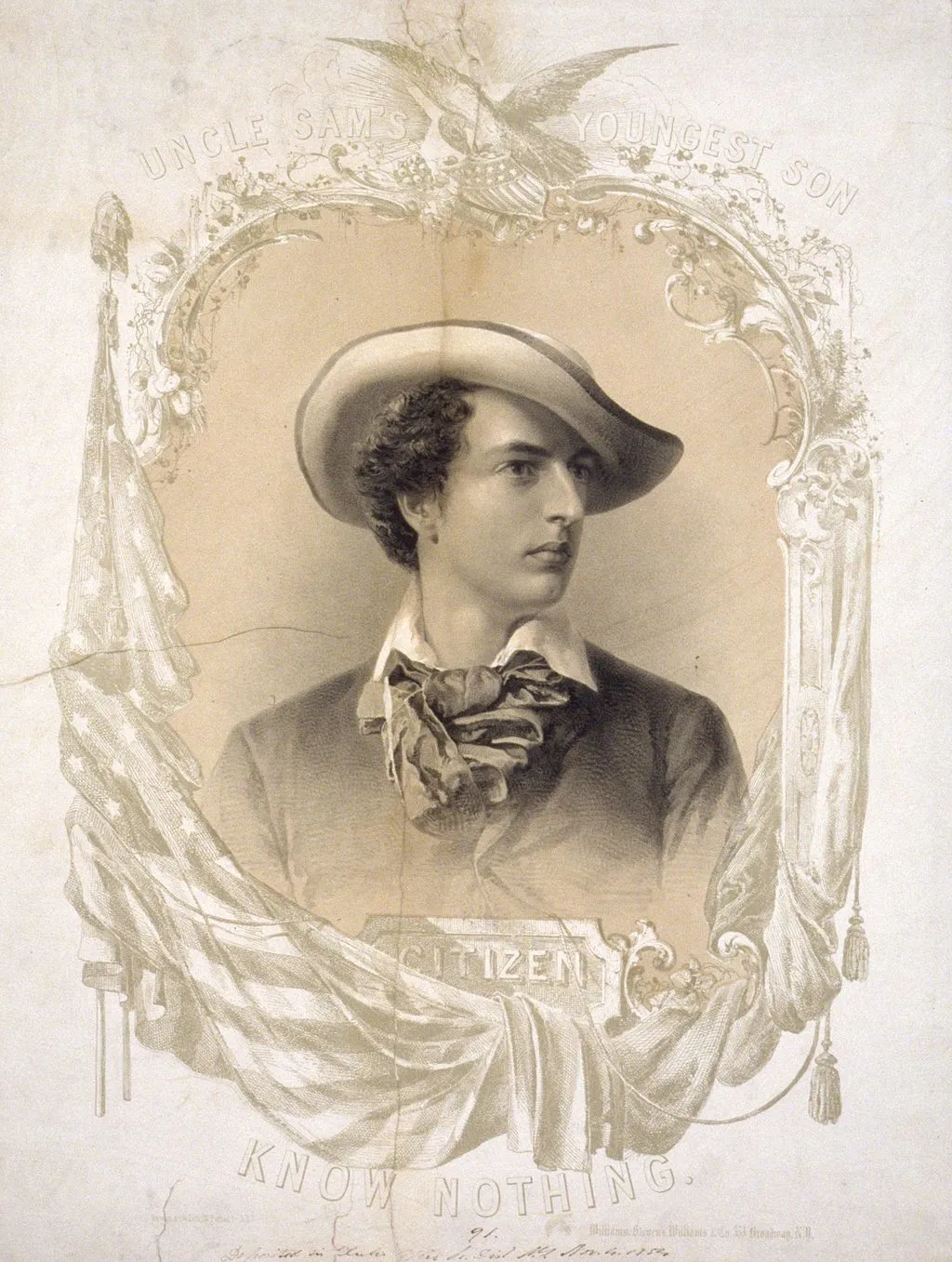

Citizen Know Nothing. Wikimedia Commons

Phillips says the Know Nothings displayed three patterns common to all other nativist movements. First is the embrace of nationalism—as seen in the writings of the OSSB. Second is religious discrimination: in this case, Protestants against Catholics rather than the more modern day squaring-off of Judeo-Christians against Muslims. Lastly, a working-class identity exerts itself in conjunction with the rhetoric of upper-class political leaders. As historian Elliott J. Gorn writes, “Appeals to ethnic hatreds allowed men whose livelihoods depended on winning elections to sidestep the more complex and politically dangerous divisions of class.”

No person exemplified this veneration of the working class more than Poole. Despite gambling extravagantly and regularly brawling in bars, Poole was a revered party insider, leading a gang that terrorized voters at polling places in such a violent fashion that one victim was later reported to have a bite on his arm and a severe eye injury. Poole was also the Know Nothings’ first martyr.

On February 24, 1855, Poole was drinking at a New York City saloon when he came face to face with John Morrissey, an Irish boxer. The two exchanged insults and both pulled out guns. But before the fight could turn violent, police arrived to break it up. Later that night, though, Poole returned to the hall and grappled with Morrissey's men, including Lewis Baker, a Welsh-born immigrant, who shot Poole in the chest at close range. Although Poole survived for nearly two weeks, he died on March 8. The last words he uttered pierced the hearts of the country’s Know Nothings: “Goodbye boys, I die a true American.”

Approximately 250,000 people flooded lower Manhattan to pay their respects to the great American. Dramas performed across the country changed their narratives to end with actors wrapping themselves in an American flag and quoting Poole’s last words. An anonymous pamphlet titled The Life of William Poole claimed that the shooting wasn’t a simple barroom scuffle, but an assassination organized by the Irish. The facts didn’t matter; that Poole had been carrying a gun the night of the shooting, or that his assailant took shots to the head and abdomen, was irrelevant. Nor did admirers care that Poole had a prior case against him for assault with intent to kill. He was an American hero, “battling for freedom’s cause,” who sacrificed his life to protect people from dangerous Catholic immigrants.

COUNT THE STEREOTYPES


On the day of Poole’s funeral, a procession of 6,000 mourners trailed through the streets of New York. Included in their number were local politicians, volunteer firemen, a 52-piece band, members of the OSSB—and Thomas R. Whitney, about to take his place in the House of Representatives as a member of the Know Nothing Caucus.

Judging by the size of Poole’s funeral and the Know Nothing party’s ability to penetrate all levels of government, it seemed the third party was poised to topple the Whigs and take its place in the two-party system. But instead of continuing to grow, the Know Nothings collapsed under the pressure of having to take a firm position on the issue the slavery. By the late 1850s, the case of Dred Scott (who sued for his freedom and was denied it) and the raids led by abolitionist John Brown proved that slavery was a more explosive and urgent issue than immigration.

America fought the Civil War over slavery, and the devastation of that conflict pushed nativist concerns to the back of the American psyche. But nativism never left, and the legacy of the Know Nothings has been apparent in policies aimed at each new wave of immigrants. In 1912, the House Committee on Immigration debated over whether Italians could be considered “full-blooded Caucasians” and immigrants coming from southern and eastern Europe were considered "biologically and culturally less intelligent."

From the end of the 19th century to the first third of the 20th, Asian immigrants were excluded from naturalization based on their non-white status. “People from a variety of groups and affiliations, ranging from the Ku Klux Klan to the Progressive movement, old-line New England aristocrats and the eugenics movement, were among the strange bedfellows in the campaign to stop immigration that was deemed undesirable by old-stock white Americans,” writes sociologist Charles Hirschman of the early 20th century. “The passage of immigration restrictions in the early 1920s ended virtually all immigration except from northwestern Europe.”

Those debates and regulations continue today, over refugees from the Middle East and immigrants from Latin America.

Phillips’s conclusion is that those bewildered by current political affairs simply haven’t looked far enough back into history. “One can’t possibly make sense of [current events] unless you know something about nativism,” he says. “That requires you to go back in time to the Know Nothings. You have to realize the context is different, but the themes are consistent. The actors are still the same, but with different names.”

Lorraine Boissoneault | | READ MORE

Lorraine Boissoneault is a contributing writer to SmithsonianMag.com covering history and archaeology. She has previously written for The Atlantic, Salon, Nautilus and others. She is also the author of The Last Voyageurs: Retracing La Salle's Journey Across America. Website: http://www.lboissoneault.com/

Saturday, July 29, 2023

THE WEIRDEST POLITICAL CONSPIRACY THEORIES IN 19TH CENTURY AMERICA

THE GRUNGE

Though it may seem like a modern plague, conspiracies have been with us for quite a long time. Generations of humans have been worrying about mysterious cabals and shadowy yet powerful figures for ages. In fact, strange conspiracy theories have been bubbling in the human consciousness for millennia, stretching back to ancient Romans fretting over who started the fire that burned much of their capital city in A.D. 64 (via Memory Studies). And, as Lapham's Quarterly notes, Jewish people in medieval Europe could be killed by mobs fueled by false rumors of a well-poisoning conspiracy, all supposedly put in place to eliminate the Gentiles. Around the same time, many also fretted about the specter of a secret yet immensely powerful network commanded by the Knights Templar, while others were constantly on the lookout for an as-yet-unrevealed Antichrist whose appearance had been prophesied in the Bible (per USC News).

When it comes to American history, conspiracies had a serious heyday in the 19th century. It makes sense given the nation was rocked by political parties constantly jockeying for power and increasingly dire tensions over the issue of slavery. Even after the nation had begun its recovery from the Civil War, conspiracies still lingered, pointing to hidden actors in the nation's political system. As so often happens with unfettered speculation over time, things could get pretty strange. These are some of the weirdest conspiracy theories in 19th-century American politics.

19TH CENTURY POLITICAL CONSPIRACIES DIDN'T COME OUT OF NOWHERE


American politics have nearly always been mired in some sort of conspiracy theory. Less than a decade after the American Revolution drew to a close in 1783, political parties were already volleying claims of backroom deals at one another.

The trouble began in the last decade of the 18th century. According to TIME, Massachusetts minister Jedidiah Morse seemed to be the source of the trouble, at least on American soil. In his sermons, Morse began to claim that the "Bavarian Illuminati" had infiltrated American society with the aim to upend both the newly-formed government and Christianity itself. He pointed to the revolution that was at the time tearing France apart, taking particular note of the atheistic Jacobins who were busy closing French churches and promoting a secular way of life. The Illuminati, he claimed, was also ready to promote a lurid way of life that laughed at notions of fidelity, chastity, and social order.

Morse went even further to tie in the future president Thomas Jefferson and his Democratic-Republican party. Morse was a devoted Federalist, counting himself among the political opponents of the Democratic-Republicans. Soon enough, others fell in line with Morse's alarmist thinking, including the president of Yale. As the new century dawned, the conspiracy fell out of favor but never fully went away. Even today, some Americans still fear that the mysterious Illuminati are running things toward evil, despite a considerable lack of evidence.

CATHOLICISM BECAME LINKED TO POLITICAL CONSPIRACY


In the early decades of the 19th century, American nativists were fighting for their rights against the invaders. Only these nativists were not American Indians indigenous to North America. Instead, as Smithsonian Magazine reports, they were members of a quasi-secret society who purported to be of "pure" Anglo-Saxon heritage. And the invaders? Well, Catholics, of course.

The society in question would eventually come to be known as the "Know Nothing" party, so called for its members' habit of feigning ignorance of the group when questioned. Though the political party would grow in power, its main fears centered on the notion that immigrants from majority Catholic nations, such as Ireland, were undermining the fabric of American society.

The United States in the 1840s was indeed accepting a wave of Irish Catholic immigrants, as Politico reports. According to this conspiracy theory, these Catholics were not true Americans, instead holding allegiance only to the Pope, who was set on destroying Protestant America. To that end, Catholic representatives were said to be guilty of lurid misdeeds, such as murdering infants and kidnapping young women. Never mind that no evidence of such crimes was ever uncovered. In response to the accusations, the Know Nothings and other nativist political groups helped pass laws that limited alcohol consumption and restricted immigration. This made it all the more difficult for new arrivals to participate in civic life or even find employment in their new home.


THE KNOW NOTHING PARTY THRIVED ON CONSPIRACY

The Know Nothing party first took shape as a secret society, originally called the Order of United Americans, then the Order of the Star Spangled Banner. According to Smithsonian Magazine, the order eventually became an organization of powerful players, established its own political party, and reached its apex of influence in the 1850s. Know Nothings became governors and legislators throughout the nation, briefly becoming a serious force in American politics. They were elected largely because of their conspiratorial view toward immigrants, who they argued were intentionally destroying the American way of life. It wasn't just Irish Catholics who loomed unnaturally large in the political imagination. The Know Nothings positioned German immigrants and women's rights suffragists as equally nefarious groups. People became so riled up by these opportunistic political conspiracies that they burned churches and formed violent gangs.

The Know Nothings rose to prominence by playing on the fear and rage of their fellow Americans. But this was not a strong enough foundation and the group soon crumbled. As time wore on, it became more and more difficult for the party to ignore the issue of slavery, which it had tried to avoid. Furthermore, devotees of the party may have also realized that its vision of a United States peopled only by "pure" white Protestants was ridiculously unattainable.

ANTEBELLUM SLAVEHOLDERS FEARED A BLACK REPUBLICAN CONSPIRACY


In the lead-up to the American Civil War, political conspiracies became widespread and widely believed, according to "Plots, Designs, and Schemes." They also became more and more focused on what was surely the most divisive issue at that point in American history: slavery.

In the South, slave owners became convinced that agents from the North were infiltrating their communities and wreaking havoc to undermine their way of life. During the 1830s, one of the prevailing theories was that abolitionists were actually being directed by the British, who were intent on destroying rebellious American democracy (and economic competition). Others argued that the call was coming from inside the house and that bigwigs in the Republican Party were engaged in a conspiracy to outlaw slavery. They became known as "Black Republicans."

Some kernels of truth inflamed these conspiracies further. As The Guardian reports, Abraham Lincoln (himself a Republican), referred to the "ultimate extinction" of slavery in 1858. Although the party did work to limit the expansion of slavery, pre-Civil War Republicans did little to actually stop the practice or roll back the institution of slavery as it had been entrenched in the South. For some Southern leaders, those details didn't matter. William Harris, who advocated for the secession of Mississippi, wrote that his state "will never submit to the principles and policy of this black Republican administration." Though it wasn't true, the conspiracy clearly had some very real effects.


ABOLITIONISTS HELD THEIR OWN CONSPIRACY THEORIES

While Southern slave owners were becoming alarmed at the idea of outsiders actively working to disassemble their culture and economy, anti-slavery abolitionists had their own suspicions. The "slave power" conspiracy alleged that slave owners had already infiltrated all levels of the government and were working to make their way of life the norm for all (via "Plots, Designs, and Schemes").

Though abolitionists on their own may not have been able to make it all the way to the Emancipation Proclamation, "Plots, Designs, and Schemes" notes that they were given a boost by the "slave power" conspiracies and similar suspicions. Northerners who were previously indifferent to slavery or who even held some seriously racist beliefs began to believe that maybe, just maybe, the Southerners really were worming their way into too much power. Some even alleged that it went all the way to the top, with the president himself either one of them or too weak to resist the "slave power" conspirators.

Though there was no evidence ever uncovered to support this — in fact, that would have been diametrically opposed to the conspiracies popular in the South — the "slave power" suspicions seem to have united many disparate groups in the buildup to the Civil War. Scholars even argue that, strange as it may have sounded to some, this particular conspiracy led to the rise of the Republican Party in the 19th century.

SOME STATES SECEDED BECAUSE OF CONSPIRACY

While some American political conspiracies may have seemed laughable in the first decades of the 19th century, they became harder to ignore as time went on. Tensions over the issue of slavery grew, as did fights over just how states were supposed to handle the issue. Eventually, things reached a breaking point. On December 20, 1860, South Carolina became the first state to secede from the Union. According to the National Park Service, this and the following secessions were touched off by the 1860 election of Republican Abraham Lincoln. Yet a closer look at secession declarations shows that conspiracies played their role in the breakup, too.

In its declaration of secession, Texas was convinced the North had sent emissaries to wreak havoc in its territory. This didn't just involve undermining the culture of the South or spreading fear and doubt in the minds of Southerners. The purported misdeed also included more obvious crimes, including such nefarious acts as poisoning the water supply of communities and committing arson in towns throughout the state. According to The Atlantic, other states made similar claims, arguing that Lincoln and his allies wanted not only to upend their way of life but to simply kill Southerners. Given Lincoln's recorded intent to reconcile with the South after the Civil War ended — to the point where even his allies thought he was being too soft on the rebels (via History) — this seems all the more unbelievable.

REAL SLAVE REBELLIONS WERE WARPED INTO FEAR-MONGERING CONSPIRACIES

In the 19th century, American slave owners thought the threat of a slave rebellion loomed largely. Could enslaved people have grown so tired of their inhumane treatment that they were planning a large-scale revolt? The idea makes sense. According to Britannica, the Haitian Revolution concluded in 1804 after a rebellion ousted the French and established the first country to be run by former slaves. Was it such a stretch to imagine that a similar thing might happen on U.S. soil?

As The Atlantic points out, slave rebellion did occur in the U.S. So too did conspiracy theories abound of organized slaves on the threshold of revolution, perhaps helped along by the abolitionists. It didn't help that John Brown actually did attempt to encourage an armed uprising amongst slaves in 1859 Virginia. Never mind that his attack fizzled and Brown himself was executed later that year. For some, this was enough evidence to confirm a widespread slave rebellion plot, with a few indulging in fantastical tales of vicious, well-organized people who wanted nothing more than bloody revenge. It was only a short step from that to believe that emancipation would be nothing less than the end of all white people. However, as the rest of United States history after the 1863 Emancipation Proclamation has made clear, no such thing ever happened.

NEWSPAPERS TIED LINCOLN ASSASSINS TO A LARGER PLOT


On April 14, 1865, President Abraham Lincoln's outing at Ford's Theater ended in his assassination by actor John Wilkes Booth. According to History, Booth had assembled a small group of conspirators to first kidnap Lincoln. When that plan failed, they decided instead to murder the president.

But was the assassination really the work of only a few people? As Ford's Theatre reports, some thought that the plot was beyond the abilities of some second-rate actor and his friends. Almost immediately after Lincoln's death, newspapers began hinting that the president's demise was the work of a larger, more organized group of Southern rebels.

The roster of potential masterminds behind the supposed plot included Confederate President Jefferson Davis and Confederate Secretary of State Judah P. Benjamin. Old religious prejudices came into play, with some arguing that Benjamin (who was Jewish) was influenced by a larger network of anti-Lincoln European bankers. Or was it the Catholics? After all, weren't some of the Booth conspirators devout followers of the Pope? Could Irish-Americans, who had largely opposed the war and rioted against a Union draft, be behind it? Heck, the murder might even have been ordered by Union officials who weren't keen on Lincoln's soft approach to the former Confederacy. However, Ford's Theatre points out that none of these conspiracies were ever proven true. Instead, the consensus remains that the assassination was in fact the work of Booth and a few of his associates.


SOME CONSPIRACISTS LIED TO THE PRESIDENT HIMSELF

When it comes to conspiracies, one of their reliable throughlines is that they're usually bunk. For many, most conspiracy theories are utterly ridiculous, like the idea that we are ruled by lizards or that the Earth is flat. Yet, every once in a while, conspiracy theories turn out to be true, like when the Iran-Contra affair really was a conspiracy to sell weapons and fun a Nicaraguan rebellion, as reported by NewScientist.

In the 19th century, one conspiracy theory fooled even the president. But those involved believed they were doing it for a good reason, given that the president was dying. According to The Washington Post, it all began with an assassination attempt. On July 2, 1881, Charles Guiteau — himself the victim of a conspiratorial thought that had him believing he was a political force and not a mentally ill nobody — shot President James Garfield at a train station. Garfield's doctor attempted to find the bullet lodged in his body by digging around in the wound with unsterilized equipment and hands. The president lingered for weeks before dying of a massive infection on September 19. Before that, his doctors issued cheerful reports to the newspapers, saying that he was "sleeping sweetly" or that "his eyes have regained their old-time sparkle." This was apparently an attempt to bolster the confidence of both the American public and Garfield himself, though eventually even the doctors had to admit their lie when the president finally died.


THE CHINESE EXCLUSION ACT WAS BASED ON CONSPIRATORIAL THINKING


By now, it's probably painfully clear to everyone that, wild as they may be, conspiracy theories can have some very serious consequences in the real world. They've been used as excuses to start wars, gain power, and sell newspapers. Even when a conspiracy isn't quite poised to tear a nation to pieces, it can be used to alienate an entire group of people for no reason other than the fact that they are "different."

In the post-Civil War world of American politics, that concept may have reached its zenith with the Chinese Exclusion Act of 1882, which seriously restricted immigrants based on Chinese racial background. According to History, the act didn't come out of nowhere. It followed years of increasing worries that Chinese workers, who entered the country to work in the mining and construction booms of the mid-19th century, were going to bring society and the economy down. Real economic downturns, increasing labor competition, and concerns about "racial purity" led to the passage of the act.

Proponents of the act, such as San Francisco mayor James D. Phelan, alleged that Chinese immigrants weren't just somehow simultaneously barbaric and "cunning", but part of a larger force that would devastate America through disease and erosion of the much-beloved, vaguely-defined American way of life. This anti-Chinese sentiment, tinged with hints of conspiracy, sadly came to light again in the U.S. with the rise of the COVID-19 pandemic .

BY SARAH CROCKER
OCT. 4, 2022 

FOR PICTURES  & GRAPHICS


SEE


Friday, May 29, 2026

Crazy Flows the Don


 May 29, 2026

Screengrab from White House video posted to X.

Leaving aside the amen choir in hard-core MAGA circles, is there anyone out there who doesn’t think Donald Trump is bat-shit crazy? How much more evidence is needed before he is gold-chained to the wall of a padded cell?

The midnight tweets of himself as a cartoon action figure are sufficient proof of cognitive disorientation, but at the state level, we have the course of the war in Iran, which, if laid out on a medical chart, would indicate that American foreign policy is being dictated by someone capable of hiding their own Easter eggs.

+++

The war in Iran did not begin after a new Iranian threat or after a congressional resolution; it began as everything does in Trumptopia—with either a billionaire whispering bizarre sweet nothings into Trump’s ear (between DJ sets at Mar-a-Lago) or as a result of a ninety-minute phone call with Vladimir Putin or Benjamin Netanyahu.

It was Netanyahu who dog-whispered Trump into an air campaign over the Persian Gulf, and subsequently, Trump’s reasons for the Iranian war have bounced from regime change and dealing with terrorists to destroying Iran’s nuclear capability to opening the Strait of Hormuz.

Despite waging such a war, you can be sure—given Trump’s addled brain—that he remains clueless about the geography of the Middle East, the alignment of the various coalitions, or the strategic dilemmas now facing the United States as it tries to put the oil genie back in the $2 gallon of gasoline.

As happens with persons suffering from dementia (and there are many forms, as all of us know from our families), Trump’s earlier impulses have become more exaggerated, the further his mind drifts down the rabbit hole. (I bet that on some bad days, he does not remember that there’s even a war going on.)

Trump was always impulsive (sexually and mentally), but now his impulses come with aircraft carriers and cruise missiles.

+++

In the negotiations to end the war in Iran, the only frame of reference in Trump’s mind is some long-ago Manhattan real estate deal where, if you shout loud enough and long enough, you might just end up with the corner lot at a discount price.

At the same time, we know from Trump’s legacy of bankruptcies that, more often than not, his style of negotiation has led him to failure. And that was when he was in his fifties; now in his eighties, with his mind in free fall, for the most part Trump is negotiating with himself.

When Trump first sent family retainers JD Vance, Jared Kushner, and Steve Witkoff to Islamabad to negotiate with the Iranians, he telephoned Vance some 12 times during the talks (in the middle of the night, Washington D.C. time), which I am sure is one reason why those negotiations and those that have followed have never gone anywhere.

Imagine on one hand, having to negotiate with the Iranians, and on the other, get instructions from Trump. In the latest go-round, Trump has sent the draft peace plan to all “concerned parties,” including Israel, an easy way to ensure it fails.

+++

It does not help the American cause (justice and liberty, not what we have now, which is rape and pillage) that the addled Trump cannot keep straight our friends and our enemies.

He somehow thinks that Israel is helping the United States in the Middle East (not simply wagging its own dog), just as he’s in a muddle about Oman (a traditional ally) and the long game of the Saudis (which is to turn Trump into an off-balance sheet asset of its sovereign wealth fund).

In many ways, the president is another Donny (from The Big Lebowski—itself a film about American ineptitude in the Middle East), to whom Walter Sobchak says: “So you have no frame of reference here, Donny. You’re like a child who wanders into the middle of a movie and wants to know…”

All Trump really can keep in focus is who has promised to pay him money, and my guess is that the short list includes Qatar, Israel, Saudi Arabia, and Russia. The rest of the world might just as well be plumbers in Atlantic City who can easily get stiffed on payday.

+++

Without either memory, a frame of reference, core values, or access to history, the demented Trump clings to his “notions” as if they were toys on his nursery floor—something to throw around for a while at the other kids until he gets bored or Daddy’s chauffeur comes to collect him.

Take these examples of how often the president has indulged in changing whims:

—In 2024 Trump ran for the presidency as a Woodrow Wilson Democrat (“He kept us out of war…”) but then once in office behaved like a cross between William McKinley and William Randolph Hearst (“You furnish the pictures, and I’ll furnish the war…”);

—In the Iranian war, Russia’s intelligence agencies helped Iran to target U.S. troops in the field, but then Trump rewarded Putin’s Russia by lifting sanctions on its oil exports and withdrawing American support for Ukraine and NATO;

—In the broader Middle East—because Trump senses a chance for a few golf resorts in Gaza—he has aligned American policies with Israel’s genocide and then, for good measure, made American customers hostage to the fortunes of the OPEC cartel (which, lest we forget, has Trump and his sons in its deep pockets).

+++

None of these positions adds up to a calculated policy, for the simple reason that Trump himself is incapable of coherent thought. Call it frontotemporal dementia, malignant narcissism, or old style psychosis, but whatever Trump has, his mind no longer functions.

He can send out tweets at midnight of himself as Jesus or a Jedi knight; he can march around a parade ground with Putin, Xi, or King Charles; and he can answer a few questions with airplane engines running in the background, but, despite gambling with the future of American civilization by threatening nuclear war in Iran, he cannot discuss Seven Pillars of Wisdom, Mohammad Mosaddegh, or the Treaty of Sèvres and Sykes-Picot.

Trump can neither read nor write (other than his name with a Sharpie), and I suspect that the day after he has met a world leader (take the dance extravaganza in Beijing) he recalls no details of the meeting, and a week later will say to some aide: Why dont we ever have a summit with the Chinese?”

Even more amazing is that Washington D.C. is full of people earning fat salaries to govern the nation, and yet a majority in Congress or on the Supreme Court refuses to act, even when the president spends most of his days and nights barking/tweeting at the moon.

Matthew Stevenson is the author of many books, including Reading the Rails; Appalachia Spring; The Revolution as a Dinner Party (China throughout its turbulent twentieth century); Biking with Bismarck (France during the Franco-Prussian War); and Our Man in Iran. Out not long ago were: Donald Trump’s Circus Maximus and Joe Biden’s Excellent Adventure, about the 2016 and 2020 elections, and The View From Churchill, about the places that shaped the life of the British wartime prime minister. His next books are Playing in Peoria (by bike across the American Mid-West) and Friends of Kind, a literary travel history of World War I.


Donald (Disaster) Trump And the Fight for a Humane Future


 May 29, 2026

Image by charlesdeluvio.

Donald Trump’s America is a scary place in significant part thanks to an unholy alliance of MAGA devotees who don’t believe in science and see intellectuals as public enemy number one, and a gaggle of Silicon Valley militarists who think that they’re the smartest people in the room, if not the universe. Add in White Christian nationalists who abuse religious precepts to sow hatred and division and you have the foundations of the political base that elected Donald Trump (twice!). And worse yet, those groupings are likely to be with us long after our current president has gone off to that great cheeseburger stand in the sky.

Still, it’s worth reflecting on whether such an odd coalition of allies can survive without Donald Trump, or even with a president whose policies have become so harmful and irrational that they’re doing severe human and economic damage even to his most loyal supporters (not to mention the rest of us). And it’s also worth considering whether the pillars of the MAGA movement can manage to stick together in the ever-grimmer Trumpian years to come, not to speak of the post-Trumpian ones, or whether the rest of us can organize a powerful, humane alternative to his politics of hatred and division that could transform this country and the world.

The Know-Nothings Meet the Know-It-Alls

As a start, we have the latter-day “Know Nothings,” a term borrowed from a nineteenth century political movement. It’s not that members of that group literally know nothing. Some of them are quite skilled in their given professions and astute at assessing certain kinds of situations. Some are intelligent but woefully misguided. Trump supporter and former Secretary of Housing and Urban Development Ben Carson, for example, is a brain surgeon.

Members of the anti-science crowd are also often very good at communicating their messages, however wrongheaded or offensive they may be. The problem isn’t that they can’t take in information; it’s that they are distinctly anti-knowledge when it comes to, among other things, separating compelling conspiracy theories from well-documented facts.

The results of their ingrained antagonism toward basic knowledge are profound, making them a threat to public health and democratic practices. After all, we now live in a country where millions of people are against vaccinating their children to prevent potentially deadly diseases and don’t believe that perhaps the gravest threat to continuing life on this planet — climate change — is caused, or even influenced, by human activity or perhaps is even happening at all.

The dangerous delusions of Trump Secretary of Health Robert F. Kennedy, Jr., now have the stamp of government approval and the power of the U. S. government behind them. There is no way to estimate how many people have already fallen sick or even died unnecessarily due to the implementation of his crackpot theories, but the numbers will undoubtedly be significant. The American Public Health Association captured the grim mood of our moment perfectly in an April 2025 press release entitled “Secretary Kennedy and His Policies Are a Danger to the Public Health.”

On a different spiritual plane, tens of millions of Americans believe in the rapture — the notion that they and their kind will be called up to heaven in the end days, while the rest of us will be left behind, presumably to burn in hell (but not a climate-change version of the same). A 2022 Pew poll found that 39% of Americans believe “we are in the end times.” Already! And such a belief, of course, has an impact on how or even whether one wants to devote time and energy to fixing problems here on Earth.

Such an amalgam of opponents of science and skeptics about basic reality bears a distinct resemblance to the “Know Nothing” movement of the nineteenth century that thrived on anti-immigrant sentiments and half-baked conspiracy theories.

The anti-intellectual faction on the right has been propagandized for decades to believe that the biggest obstacle to a better life for them and their families isn’t the predatory corporations hollowing out our economy and manipulating our democracy, but a group of liberal intellectuals clustered on both coasts who allegedly want to replace this country’s bedrock beliefs with a set of “politically correct” prescriptions about how they should live their lives, especially when it comes to DEI or diversity, equity, and inclusion. In such a rendering of reality, that “new class” is seen as sapping the country’s strength and undermining the basic values that would make America great (again!).

The use of that “new class” as a political epithet emerged from the neoconservative movement of the 1960s and 1970s, as Andrew Hartman has explained at his blog on American intellectual history:

“Out of their political repositioning in the late 1960s and 1970s, neoconservatives developed a critical theory (co-opted from anti-Stalinist thinking) about a so-called ‘new class’ of intellectuals, broadly defined to include all professionals tasked with manipulating language — although more narrowly applied to humanists and social scientists. Members of this ‘new class,’ so the theory went, had turned their backs on the society to which they owed their high-ranking status.”

However, the current Trumpian war on DEI should be considered an extension of a longstanding conservative effort to distract Americans from the real sources of their problems by promoting a politics of division and hatred. Mainstream accounts of the drive to eradicate concerns about diversity, equity, and inclusion from public life rarely point out that fighting DEI can fairly be characterized as fighting to make racism, misogyny, and anti-gay and anti-trans discrimination ever more acceptable in the sort of open, unapologetic fashion that prevailed before the modern-day civil rights, women’s rights, and gay rights movements gained strength.

The crusade — and it’s nothing less than that — against DEI needs to be called out for what it is, not treated as some sort of skirmish over language. And rather than DEI programs that stop at raising tough questions about America’s long history of systematic discrimination, what’s needed are programs that truly change people’s lives by creating better-paying jobs and affordable, quality health care for all, regardless of race, gender, class status, or faith. Getting there will, however, require a flowering of faith of another kind — not religious faith, but faith that we can construct an accountable government that serves the public interest, rather than, as in the present age of Donald Trump, the interests of corporations and inhumane ideologues.

Silicon Valley Saviors

In contrast to the “know nothing” faction of the political right in America is the “know it all” faction — Silicon Valley billionaires like Peter Thiel, Alex Karp, Elon Musk, and Palmer Luckey. They view themselves not just as business executives cashing in on the latest trend, but as superior beings who should be running the planet. They promise better living through technology and, as new age militarists, see robotic weapons as the future of warfare. But the idea that such new technologies will inevitably change our lives for the better or protect us from the worst has, at best, a mixed record. It depends, of course, on just who is using such technologies and for what purpose.

In addition to owning companies that create new systems grounded in artificial intelligence and machine learning, the new age militarists are angling to shape our foreign policy, our federal budget, and the future of our democracy. They literally want to become masters of the universe by figuring out how to live forever and promote the colonization of space. They dream of video games in which, as Palmer Luckey put it, “if you die in the game, you die in real life.”

The political reach of the Silicon Valley crowd has grown dramatically in the age of Donald Trump. JD Vance, his vice president, was, of course, groomed and financed by Peter Thiel, the founder of the omnipresent firm Palantir, which provides technology to patrol the border, helps ICE identify suspects, and has provided software to Israel that its leaders have used to step up the pace of bombing in their genocidal war in Gaza. After a stint at one of Thiel’s venture capital firms, Vance won a Senate election in Ohio with major financial backing from him and his allies.

When Trump chose Vance as his running mate, champagne corks popped in Silicon Valley and the money started flowing to help Trump get elected, including up to a quarter of a billion dollars in dark money from Elon Musk. As a result, Silicon Valley now has its man in the executive branch.

Nor is Vance alone. Former employees of tech firms like SpaceX and Anduril are now embedded in key agencies of the federal government, and Secretary of — yes! — War Pete Hegseth has gone all in on integrating AI into U.S. military planning and practice to the delight of the billionaire tech moguls and their hangers-on.

To say that Thiel, Musk, Palmer Luckey, Alex Karp, and their financiers like Marc Andreessen of the venture capital firm Andreessen Horowitz have a high opinion of themselves — and of the potential of the technology their companies produce — would distinctly be an understatement.

Kathryn Boyle of Andreessen Horowitz, a self-appointed chief ideologist and cheerleader for the Silicon Valley tech takeover of America, gave a speech to the conservative American Enterprise Institute in February 2025 that analyst Gil Duran described as an effort to “equate most government actions with communist dictatorships… while positioning tech bros as the ordained saviors of the traditional family.” Boyle’s bread and butter argument — call it a potentially fatal kind of narcissism — was that only the “founders” (yes, they call themselves that!) are serious enough, skilled enough, and endowed by their creator with enough persistence to solve and reverse America’s imperial decline. The rest of us should just get out of the way and let the new techno-gods do their work.

Will Trump’s Patchwork Quilt Come Apart at the Seams?

The Trump coalition is a strange kaleidoscope of confusing views and contradictory cover stories: the know-nothings; the know-it-alls; the false prophets of White Christian nationalism, the billionaires and millionaires, the people who (once upon a time) watched too many episodes of The Apprentice and think Trump is a good businessman; those who want yet another tax break; those men among us who want to control what women do with their bodies, and the (mostly) men who feel liberated because Trump openly and repeatedly makes racist, sexist, anti-gay, and anti-trans statements, legitimizing vocal expressions of prejudice in a way not seen in decades.

Yes, his is a motley crew, but so far they have rallied around the president, no matter the promises he breaks or the harmful policies he jams down all of our throats (policies that could ultimately hit many diehard Trump supporters who aren’t billionaires as hard or harder than they will hit his opponents). Fortunately, there are at least signs that his ability to thrive politically (even as his policies drive America into a ditch) may be fading. His brutal, illogical, illegal, ill-defined war on Iran — complete with genocidal rhetoric about ending an entire civilization — may be the beginning of the end of his grasp of our politics and our psyche.

Unfortunately, he may be as much a symptom of what’s wrong with America as he is a producer of deep damage to the future prospects of democratic governance and human cooperation in this country and on this planet.

Which Way Out?

Any resistance to such know-nothingism and incipient technofascism must start on a human scale. If we are ever going to build a tolerant, welcoming nation that meets the basic needs of its residents, while leaving ample room for scientific inquiry and creative endeavors of all sorts, we need to get off our machines and start talking to — and crucially, listening to — each other.

This is already happening more widely than you might imagine if you’re a prisoner of your news feed. And it’s happening not just in large gatherings like the No Kings rallies, but in local organizing around schools and housing, voter registration and education efforts, and attempts to help communities survive the double-injury of runaway capitalism and the shredding of the social safety net thanks, at least in part, to Donald Trump’s “Big Beautiful Bill” (which is the ugliest, most inhumane piece of legislation in living memory).

We need to fight on at least three fronts — economically, politically, and culturally. Senator Bernie Sanders has shown just how a truly populist economic program could draw support even among diehard MAGA backers, and such a program is a necessity if we are ever to dig our way out of our current predicament.

But economics is hardly the only problem we have. There’s also the reality of racism to contend with, not to speak of a thriving anti-immigrant sensibility, and misogyny, as well as anti-gay and anti-trans discrimination — all deeply embedded in a nation that was founded as a colonial enterprise fueled by slavery and genocide. Such a history has to be transcended by embracing the values and elevating the leadership of the people most impacted by the legacy of America’s repressive past, while building a new culture based on tolerance, respect, and (yes!) love for our fellow human beings.

To be clear (as President Barack Obama would often say), by “transcend” I don’t mean ignore. We must fully acknowledge and seriously commit our society to repairing the crimes embedded in our development as a nation, not to speak of those being committed right now in Donald Trump’s America against so many of us and our planet as well.

And sadly, it’s all too obvious that coming together to save this planet and retain our basic humanity will not be easy. People are messy and, frankly, can be a pain to deal with (yours truly included). We are, however, all we have, and making the effort will matter.

I believe in the saying, attributed to leaders of the Wobblies (the radical union founded in 1905 and known formally as the Industrial Workers of the World), that we must sow the seeds of any new society in the shell of the old one. The way we treat each other in our homes, workplaces, schools, sites of worship, and other public and private spaces will determine whether we can build a better world or are fated to live in a never-endingly Trumpian one. In that context, it’s important not just to speak truth to power, but to begin trying to create alternative sources of power and good ideas aren’t enough for that. (If they were, we would already be living in a far better world.)

Building alternative power and charting a path to such a world will be a distinctly collective undertaking. A handful of charismatic leaders or courageous organizers can’t do it for us. We all need to be leaders since we are all experts (in the sense of knowing our communities and our bits of the world).

There are no guarantees in life, but in this disastrous Trumpian universe of ours, fighting the power should feel far more fulfilling than bending the knee, and if enough of us join that fight, we at least have a shot at building a society and a world worth sustaining for generations to come.

What are we waiting for?

This piece first appeared on TomDispatch.