Spoilers often undermine fragile peace processes to disastrous effect, and several are currently attempting to derail the Islamabad memorandum of understanding; managing them is an important challenge.
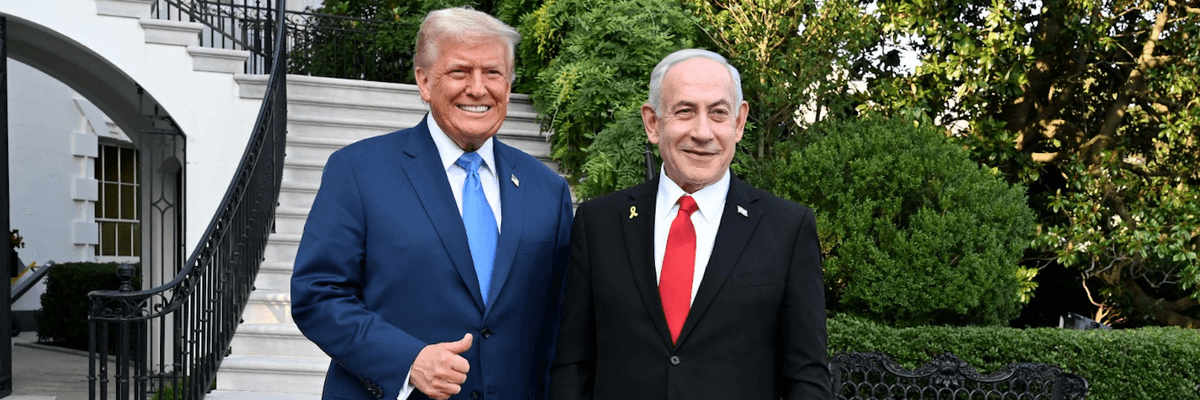
US President Donald Trump and Israeli Prime Minister Benjamin Netanyahu pose for a photo outside the White House in Washington, DC on July 7, 2025.
(Photo by Benjamin Netanyahu/Facebook)
Connie Peck
Jun 29, 2026
Jun 29, 2026
Common Dreams
In a seminal article, entitled “Spoiler Problems in Peace Processes,” Stephen Stedman writes that “peacemaking is a risky business.” The greatest source of risk “comes from spoilers—leaders and parties who believe that peace emerging from negotiations threatens their power, worldview, and interests, and use violence to undermine attempts to achieve it.”
Spoilers can be inside or outside a peace process. Those inside have signed an agreement but fail to fulfill key obligations; those outside are either excluded from it or have excluded themselves. In terms of managing spoilers, it is important to determine why a particular party is refusing to honor a peace agreement.
In a seminal article, entitled “Spoiler Problems in Peace Processes,” Stephen Stedman writes that “peacemaking is a risky business.” The greatest source of risk “comes from spoilers—leaders and parties who believe that peace emerging from negotiations threatens their power, worldview, and interests, and use violence to undermine attempts to achieve it.”
Spoilers can be inside or outside a peace process. Those inside have signed an agreement but fail to fulfill key obligations; those outside are either excluded from it or have excluded themselves. In terms of managing spoilers, it is important to determine why a particular party is refusing to honor a peace agreement.
Spoilers are already causing problems for the memorandum of understanding (MOU) between Iran and the US announced on June 14, after weeks of Pakistani mediators trading proposals back and forth between the parties. The 14-point MOU was officially signed by President Donald Trump on June 17 in Versailles and by President Masoud Pezeshkian in Tehran the next day.
The Process of the Negotiations Following the Signing of the MOU
To develop the MOU into a permanent peace agreement, face-to-face negotiations were scheduled for June 19 in Bürgenstock, Switzerland under the auspices of Pakistani and Qatari mediators. But because heavy fighting in Lebanon between Israel and Hezbollah was violating the first clause of the MOU, which called for the termination of military operations “including in Lebanon,” the Iranians declared that they would not attend and threatened to reclose the Strait of Hormuz. Vice President JD Vance, who was to lead the US delegation, also canceled his flight to Switzerland.
Although the negotiations were successful, several parties—Israel, Hezbollah, Trump, and hardliners in Iran—almost derailed the process and are still attempting to do so.
Nonetheless, on June 20, after Iranian state TV announced that Iran’s delegation, led by the Speaker of Parliament Mohammad Bagher Ghalibaf and Foreign Minister Abbas Araghchi, had arrived in Switzerland, Vance departed the US to join Special Envoy Steve Witkoff and Trump’s son-in-law Jared Kushner, who had traveled there earlier.
The talks, dubbed the Lake Lucerne Summit, began on the morning of June 21 with separate meetings between the leaders of each delegation with the mediators, followed by quadrilateral talks in the afternoon between the two parties and two mediators.
Vance presented a promising opening statement, saying: “Never before has the Iranian and American leadership met at such a high level... What the President has asked us to do is turn over a new leaf to transform our relationship with the people of Iran, and to extend an outstretched hand that says to the people of Iran that if your leadership is willing to give up being a driver of regional instability, if they are willing to give up nuclear weapons ambitions for the long term, then the United States is willing to fundamentally transform our relationship.”
But 80 minutes later, the Iranians got word that Trump (apparently annoyed by the threatened closure of the Strait of Hormuz) told Fox News in a phone call that unless the strait remained open, the negotiators talking to Vance will “never make it back to their country—in fact, they will have no f**king country to return to at all.”
In response, the Iranian delegation protested to the mediators, saying this was an unacceptable threat to their personal safety and then staged a walkout. Their absence was apparently temporary, because Vance, describing the talks as “messy,” later said: “Yes, they did threaten to walk out... but we were negotiating well past one in the morning... so they didn’t [permanently] walk out.” In all, there were about 18 hours of intensive talks and consultations.
The Outcome and Substance of the Negotiations
The talks produced a road map for a final deal within 60 days and created a High-Level Committee for Political Oversight to manage the process and coordinate the three working groups who will report to the committee weekly: a Nuclear Working Group, a Sanctions Tracking Group, and a Monitoring and Dispute-Resolution Group.
Two crisis management mechanisms were also agreed: a Strait of Hormuz Secure Communication Channel (i.e., a hotline) to provide communication links between maritime security forces to “avoid incidents and miscommunication” and guarantee safe passage for shipping through the Strait of Hormuz; and a Lebanon De-Confliction Cell to prevent further military escalation and ensure compliance with the cessation of hostilities.
In the end, the talks were more successful than the first round in April in Islamabad. Vance called them “a good foundation;” Araghchi said the mediators delivered “major progress.” A joint statement by the mediators described “encouraging progress” and cited a “positive and constructive atmosphere.” The Swiss Foreign Ministry also welcomed “constructive progress.” Technical talks between the working groups began the next day.
Spoiler Issues
Although the negotiations were successful, several parties—Israel, Hezbollah, Trump, and hardliners in Iran—almost derailed the process and are still attempting to do so.
The success of the process appears to be due to the mediators employing “the departing train strategy, which implies that the peace process is a train leaving the station at a preordained time: Once set in motion, anyone not on board will be left behind.” It is a determination that the peace process will go irrevocably forward regardless of spoiling efforts. Other strategies that Stedman proposes for managing spoilers include: inducement, socialization, deterrence-coercion, and withdrawal.
Although a comprehensive accounting of each spoiler’s motivation and strategies for dealing with them exceed the scope of this article, some general points can be made.
Israel and Hezbollah
Long-term enemies, Israel and Hezbollah, reengaged in fighting on March 2, when Hezbollah launched missiles against Israel to protest Ayatollah Ali Khamenei’s assassination, followed by intense hostilities between them. Since the first clause of the MOU calls for the termination of military operations, including in Lebanon, this presents a dilemma, since both Israel and Hezbollah were outside the US-Iranian peace process and didn’t agree. Indeed, Israeli Prime Minister Benjamin Netanyahu explicitly stated that since it isn’t a party to the MOU, Israel will not withdraw from Lebanon.
In response, the US established a separate mediation process between Israel and Lebanon (with Hezbollah again outside the process) which agreed to ceasefires of varying lengths, subsequently violated by both Israel and Hezbollah. More recently, Lebanon and Israel have agreed to a lasting peace and security deal, whereby the Lebanese Armed Forces would gradually assume control over all Lebanese territory as Hezbollah is disarmed; in parallel, Israeli forces would engage in a staged withdrawal. Hezbollah, however, rejects this and says that it will not disarm until Israel withdraws totally.
When peace processes are scuttled by spoilers and war resumes, the results are often catastrophic, with the casualties being infinitely higher than those of the original conflict.
Netanyahu, his government, and much of the Israeli public are disappointed with the MOU since it doesn’t address many of their war aims, e.g., regime change, Iran’s ballistic missile program, and its support for proxies. They also oppose sanctions relief and other economic benefits.
Both Israel and Hezbollah fit the description of “total spoilers,” who are often “led by individuals who see the world in all-or-nothing terms” and are opposed to compromise. “Any commitment to peace by a total spoiler tends to be tactical—a move to gain advantage in a struggle to the death.”
The “departing train strategy,” used by the mediators at the Lake Lucerne Summit, is a good way to manage total spoilers. Another effective approach is for the spoiler’s patron to warn the spoiler of dire implications if it escalates attacks, which apparently Trump has done, much to Netanyahu’s annoyance.
It has also been argued that Hezbollah might moderate its actions for now by inducement, e.g., the promise of renewed assistance from Iran if economic benefits accrue from the peace process, but if this allows it to rearm later, that would merely postpone the problem.
Trump
Trump is, of course, inside the peace process and probably fits the description of a “greedy spoiler,” i.e., one who “holds goals that expand or contract based on calculations of cost and risk. A greedy spoiler may have limited goals that expand when faced with low costs and risks; alternatively, it may have total goals that contract when faced with high costs and risks.”
Although Trump reportedly wants out of the war, his firm belief that any provocation must be met with a response of greater intensity inevitably causes conflict escalation. When four days after the Lake Lucerne Summit, Iranian hardliners attacked a vessel trying to exit the strait, Trump ordered bombing of Iranian missile and drone sites.
Hardliners in Iran
Iran’s new Supreme Leader, Mojtaba Khamenei, has given his conditional approval to the MOU, with the qualification that he will not accept excessive demands by the US. He also praised the efforts of the Iranian negotiating team, which is seen as an attempt to silence opposition from hardliners. As well, the Islamic Revolutionary Guard Corps (IRGC) leadership, the Supreme National Security Council, and some members of parliament support it.
The hardline Paydari Front, however, which rejects engagement with the West and considers itself the guardian of revolutionary values, opposes it. There are also hardline members within the IRGC. As well, segments of the population oppose the MOU and demonstrations broke out when it was signed, with calls for death to the negotiating team.
The recent incidents in the Strait of Hormuz are an example of how this opposition can manifest itself. Like Trump, IRGC hardliners believe that every provocation must be met with a greater response, which accounts for their recent attacks on US bases in Kuwait and Bahrain, following Trump’s bombing. These hardliners were also outside the peace process and fit the typology of total spoilers.
Conclusion
The four spoilers mentioned above are currently presenting significant challenges to the MOU and must be managed if the peace process is to go forward.
One problem is that the lack of specificity in the MOU allows for different interpretations that spoilers can exploit to disrupt the process. This relates to how the MOU was negotiated, i.e., through the long-distance exchange of each party’s preferred positions, as opposed to the mediators sitting with the parties to explore their underlying interests before developing options. The current dispute is apparently related to Iranian interests to have control of how clearing of the strait takes place, i.e., with vessels exiting on the Iranian side, rather than the Omani side, which the US is encouraging. If parties’ interests with regard to this issue had been thoroughly explored during negotiations, a more specific formulation could have been included which might have avoided this problem.
In order to keep the peace process on track, the international community needs to be aware of the role of spoilers and do everything in its power to manage any disruptions.
Another issue is the inclusion of conditions in the agreement (e.g., the termination of military operations in Lebanon) that must be fulfilled by parties who are outside the process and don’t agree (notably, Israel and Hezbollah). Attempts to overcome this through US mediation between Israel and Lebanon, but with Hezbollah still outside the process, are not addressing the interests of one of the major parties and are thus stalemated.
It also appears that the procedural mechanisms established at the Lake Lucerne Summit to deal with such problems are not being utilized. A Strait of Hormuz Secure Communication Channel is apparently non-operational. Presumably, the new Monitoring and Dispute-Resolution Group could also be engaged. Hopefully, the mediators will quickly assist the parties in resolving the current dispute and ensure that these mechanisms become operational.
Of particular concern, is Stedman’s warning that history has shown that when peace processes are scuttled by spoilers and war resumes, the results are often catastrophic, with the casualties being infinitely higher than those of the original conflict. Rwanda offers a horrifying example.
Such an ominous possibility is foreshadowed by Trump’s recent post on Truth Social: “There may come a point when we are no longer able to be reasonable, and will be forced to militarily complete the job that we very successfully started. If that happens, the Islamic Republic of Iran will no longer exist.”
In order to keep the peace process on track, the international community needs to be aware of the role of spoilers and do everything in its power to manage any disruptions before the conflict escalates again, perhaps tragically.

No comments:
Post a Comment