Britons support Andy Burnham’s plans to devolve more powers to regional mayors, believing such a move would make the running […]

Britons support Andy Burnham’s plans to devolve more powers to regional mayors, believing such a move would make the running of those areas better, a new poll has found.
The poll, carried out by YouGov, asked voters whether they thought devolving more powers from Westminster to regional mayors would generally make those areas better or worse run, or if it would make no difference.
Around 35% of those asked said they thought devolving more powers from Westminster to regional mayors would make the areas better run, compared to just 13% who said it would make them worse.
24% thought that greater devolution of powers would make no difference.
It comes ahead of a major policy speech due to be delivered by Andy Burnham later today, where he is expected to set out a devolution plan as part of a major shakeup of Whitehall.
As part of his first speech, Burnham will set out a commitment for a “10-year mission” to raise living standards, as well as proposals on youth employment, in order to “lift Britain back up to where it should be”. Burnham’s vision would involve mayors being given greater control over social housing, welfare and education.
5 key takeways from Andy Burnham’s first big leadership speech
Burnham confirmed that he will create a 'No 10' in Manchester and give regions powers to reform utilities, transport and housing
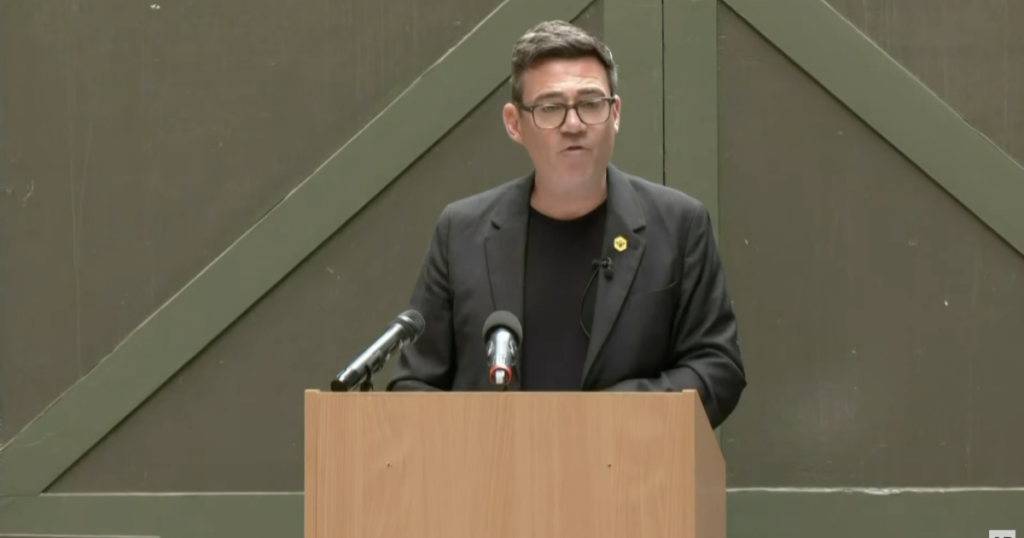
Andy Burnham has set out some of what he plans to achieve as prime minister in his first major speech in his bid to become the next prime minister of the UK. Burnham, who was elected as the MP for Makerfield on 18 June, is the only declared candidate to take over from Keir Starmer, and could be crowned as prime minister within a few weeks.
Here is a recap of the key announcements he made in his speech at the People’s History Museum in Manchester today
1. Changing the culture in Whitehall
Burnham started by talking about how he was “worried” by what he found in Parliament when he returned last week. Burnham said it’s a “more fragmented and disjointed place than the one I left” and that it is also “frankly unhappier”. He said he will work hard to change that culture and bring a greater sense of unity in Parliament.
He said he will let MPs be ‘authentic representatives’, and “not use the whipping system to create fear or close down debate”
2. No 10 in the North
Perhaps one of the most significant ideas Burnham confirmed today was his plan to carry out some of the government’s operations in the North of England. He said that No 10 North will be a “nerve centre of a rewired Britain” and its job will be to make power flow (via devolution) to different regions across the UK.
He said that the operation’s mission will be to strive for equivalent living conditions in all parts of Britain.
3. Reform of utilities, reindustrialisation and regeneration
He said No 10 North will be tasked with supporting regions with these three key tasks. Burnham said No 10 North will enable regions to take greater public control of water, housing, energy and transport, based on the model the former Manchester mayor used to bring buses in Manchester into public ownership.
On reindustrialisation, he said his government will consolidate public and private investment at a place-based level, and help all areas establish “good growth funds”, pots of funding for housing and infrastructure projects.
4. Reducing the welfare bill
Burnham then moved on to speaking about how he would cut the welfare bill in a way that is “fair and lasting”.
As part of this, he spoke about the life chances of young people and the need for a rethink in education. “The days of a school system configured entirely around the university route will be brought to an end,” he said.
He asked “when will we focus on life chances” of kids who “want something different”.
Burnham says they will be “giving every young person a clear path into a reindustrialised Britain”.
He also said he would devolve employment support services.
5. Fixing the housing crisis
Burnham pointed out that one and a half million council homes have been sold off via ‘right to buy’ since the 1980s, and that a similar number of people are on social housing waiting lists.
He said that Britain’s housing crisis and the temporary accommodation bill are having a “ruinous” impact on the UK’s public finances.
Burnham said No 10 North will work with local areas to oversee the biggest council housebuilding programme since the post-war period.
Olivia Barber is a reporter at Left Foot Forward
Burnham sets out vision for Britain with new ‘Number 10 North’
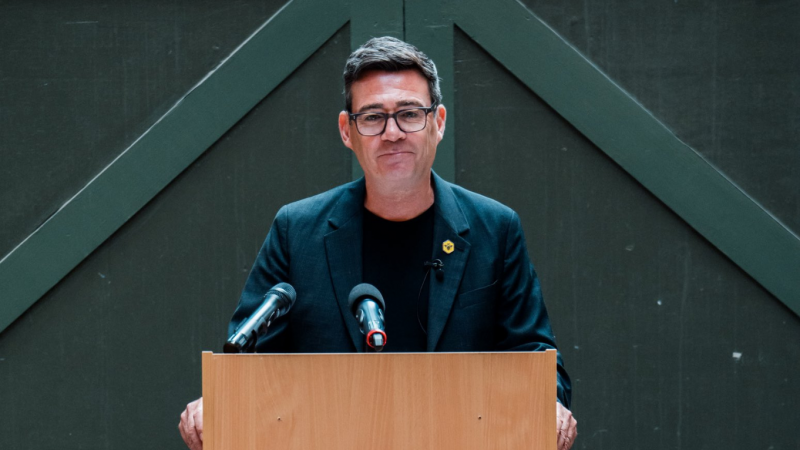
Andy Burnham has set out his comprehensive vision for the future of the country, ranging from greater public control over utilities to the biggest council house building programme since the war.
In a speech in Manchester, Burnham set out plans to roll out greater devolution across the nation and pledged to deliver “good growth in every postcode and hope in every heart”.
Here are the five main takeaways from his first major speech since returning to Parliament, as he stands on the brink of entering 10 Downing Street.
Number 10 North
Andy Burnham confirmed that he will set up a Number 10 operation in Manchester, with the aim of creating “a more streamlined state with a clearer purpose to power up all parts of the country”.
With a “laser-like focus” on growth and regeneration, ‘Number 10 North’ would work to make power flow into communities across the country, with Burnham name-checking the Midlands, South West England, the East of England and London.
Number 10 North would act as the “nerve centre of a rewired Britain”, Burnham explained.
“It will be the conduit through which we redistribute power and resources across the UK. It will co-ordinate all parts of government at national and local level to agree a long-term economic strategy and help all places set new growth ambitions.”
He also said that he wants to see the opportunity offered by devolution rolled out in Scotland, Wales and Northern Ireland.
Greater public control of utilities and prioritising British industry
Burnham outlined plans for Number 10 North to help regions across the UK with reform of utilities, reindustrialisation and regeneration of communities.
As part of a ten-year plan, Burnham said he would ensure all regions are able to take greater public control of essential services, including water, housing, energy and transport – following a similar model to that used to bring Manchester’s bus services into public control.
He said: “Learning from the model that has transformed our bus networks here in Greater Manchester, we will set out ten-year plans to bring down the cost of these essentials to individuals, families and businesses.”
Burnham also outlined his intention to ensure British businesses are favoured in procurement processes, particularly in defence – with all eligible public contracts subject to “social value weighting”.
“We will support every region to set clear and credible industrial ambitions and provide the support to achieve them, encouraging more across UK partnership between places with complementary industrial clusters.”
Ending the ‘housing trap’
Burnham said that Britain was stuck in a “housing trap”, which was having an impact on the country’s public finances.
He said: “When we were growing up here, amongst the friends we had at school, there were two things that were the foundations of working class aspiration: a council home, a secure home that was the foundation for everything, and then good technical education.
“Those things have been taken away in the decade since. So no wonder so many young people struggle to make it work and then don’t make it work.
“That’s what this new era is going to be all about – a sense of hope, of possibility that things are achievable that you might not have thought before.”
To address this, he vowed to launch the “biggest council house building programme in the post-war period”, with a plan to use vacant public land to reduce costs.
A new approach in use of whipping system
Burnham said that politics in Westminster had become a “more fragmented, disjointed place” since he left almost ten years ago and pledged to change the culture in SW1.
He vowed to stop using the party whip system “to create fear or close down debate” and allow Labour’s MPs to be “authentic representatives” of their constituents.
Burnham also said: “While the political direction I set is not up for negotiation, I will build an inclusive team at the very highest level so that all parts of the party and the country can see themselves reflected and represented in it.”
No announcement about Burnham’s top team… yet
Burnham was tight-lipped about which Labour figures will feature in his Cabinet – and said he would not announce those decisions “until the end of this process”.
Addressing the activists, politicians and journalists in the conference hall, he said: “Until then, feel free to discount the wild speculation in circulation”.
It comes amid rumours that Burnham is considering appointing Energy Secretary Ed Miliband as his Chancellor and claims that he may make David Miliband a Labour peer in order to serve as Foreign Secretary.
‘Burnham sets out antidote to populist pessimism’
Editor of LabourList Emma Burnell said: “Today Andy Burnham has set out a vision that is comprehensive, coherent, confident and creative.
“While the setting and inspiration clearly came from Manchester he made a pitch to the whole country. Offering “good growth in every postcode; hope in every heart” he has set out the perfect antidote to the populist pessimism of Reform.
“The question now is how to do it all. When you make an offer this big and filling hearts with hopes – you cannot dash them. So there will need to be concrete plans in place as soon as possible to make the kick off of this radical new direction big, bold and visible to all.”
Labour's priority is rebuilding Britain’s productive base: Manchesterism is not enough
JUNE 29, 2026
The current economic model is exhausted – it’s time to focus on production, skilled work and industrial investment, argues Costas Lapavitsas.
Andy Burnham’s expected ascent to the Labour leadership marks the definitive end of the Starmer-Reeves economic model. The argument that Britain’s problems are primarily issues of distribution—requiring better regulation, fairer taxes, and more competent management of the existing settlement—is exhausted.
The emerging “Manchesterism” agenda, which rightly seeks to bring foundational utilities and transport back under public control, is a necessary and welcome advance. But we must be honest about where it stops. Its central claim is that cheaper energy, transport and housing will unlock productive dynamism. It assumes that a functioning productive economy exists in the British economy’s middle and upper tiers, waiting to be unlocked by cheaper, de-commodified public provision.
That assumption does not hold. Our crisis of provision is fundamentally a crisis of production.
The reality of British capitalism is not simply that it does not distribute wealth fairly but that it has actively shifted its model of accumulation away from manufacturing and other material production toward services, especially finance. The City of London became one of the principal beneficiaries of the emergence of a financialised economy.
De-commodifying utilities is not enough to reverse this. Britain cannot create prosperity, reduce inequality, or regain genuine economic sovereignty without a deliberate, state-led strategy of reindustrialisation.
This has nothing to do with nostalgia for some mythical past. Modern manufacturing is built on advanced engineering, automation, digital technology and clean energy. It remains the sector where productivity rises most consistently, innovation spreads across the economy and skilled employment creates prosperity far beyond the factory gate. Despite what financial circles habitually claim, there is no evidence that an advanced country can achieve sustained prosperity without a strong manufacturing base. Britain will not be the first.
A radical Labour government must therefore pursue an industrial strategy built on three institutional pillars.
First, Britain needs a wave of public investment, backed by a properly capitalised National Investment Bank, that can direct long-term capital into energy, transport, and industrial supply chains. This requires a break from the neoliberal language of the state absorbing the risks so that private capital can extract the yields. A dynamic programme of public investment must be tied to public equity stakes, ensuring the steady rebuilding of public wealth.
Furthermore, public investment must be shielded by an active trade policy. We must use the regulatory space we now have outside the EU single market to deploy domestic content requirements in public procurement, carbon border taxes, and anti-dumping measures. We must also protect emerging British supply chains from subsidised overseas competition. There is no point renationalising our railways if the rolling stock is still built in Spain or Japan.
Second, Britain faces acute shortages of engineers, technicians and skilled manufacturing workers across sectors ranging from defence to renewable energy. Skilled workers are created through apprenticeships, technical education, stable employment and collective bargaining. Without rebuilding the foundational skills of the British working class—welders, precision engineers, technicians—industrial policy will remain a Whitehall fantasy.
Trade unions can play a crucial role in rebuilding our skilled labour force. Unions are not simply a political constituency to be managed or a passive beneficiary of better public services. Organised labour is a mechanism for economic reconstruction and ought to be granted institutional power. This means legally mandated sectoral collective bargaining to coordinate wages across expanding industries, ensuring that productivity gains are broadly shared rather than captured by a tiny elite. It also means statutory union representation on the boards of all new public corporations and the National Investment Bank.
Third, rebuilding the productive base will inevitably bring the government into direct conflict with mobile financial capital. We cannot politely ask the financial system to pivot toward manufacturing. The Bank of England must be fundamentally repurposed and oriented to serve a national industrial strategy. Crucially, Labour must also overcome its fear of the bond markets. The City of London will inevitably retaliate against a genuine industrial strategy by generating pressure on gilt yields and sterling. Surviving this political intervention will require the readiness to use targeted capital controls to prevent speculative capital flight. A leadership that cannot articulate a credible strategy to defend its economic programme from the City has not yet come to terms with the realities of power in Britain.
The strategy of simply seeking better management of our current economic model has come to an end. Labour can now offer something fundamentally different by rebuilding Britain’s productive economy. If the party puts production, skilled work and industrial investment at the heart of its programme, it will create the conditions for stronger public services, rising living standards and a more equal society. This is what the country is calling for. Without sustained rebuilding of wealth creation, every promise of renewal will rest on fragile foundations.
Costas Lapavitsas is a Professor of Economics at the School of Oriental and African Studies, University of London. He was elected as a member of the Greek Parliament for Syriza in January 2015, subsequently joining Popular Unity later that year. The above arguments are developed in greater detail in Reindustrialise Britain: A Strategy for Wealth Creation, co-authored with Larry Elliott and Doug Nicholls (Polity, September 2026).
Image: https://commons.wikimedia.org/wiki/File:Andy_Burnham_on_13_August_2024_%28cropped_2%29.jpg Source: https://www.flickr.com/photos/26320652@N02/53921141434/ Author: Scottish Government, licensed under the Creative Commons Attribution 2.0 Generic license.
‘Doing things differently everywhere’

Today, at the People’s History Museum in the heart of Greater Manchester, the country’s centre of gravity shifted northwards. As Andy Burnham stood to speak, he was surrounded by reminders that this city-region’s economy once powered the country, and that its people inspired social and economic revolutions. But Manchester is focused on the future, not stuck in the past. And that much is clear given its recent economic performance, and the inspiration it is currently providing to Westminster policy makers.
The main thrust of Burnham’s speech set out a step change in devolution of power across England. Tax revenue currently flows into Whitehall departments, where it trickles down slowly through convoluted channels, only to arrive in drops on the ground. Instead, if all goes to plan, the cash will be injected straight into the places where it is needed, so they can decide for themselves. All of this will be overseen by a new expanded Number 10 operation based in Manchester.
READ MORE: Burnham sets out vision for Britain with new ‘Number 10 North’
The fact that this feels like such a revolution, shows just how embedded centralisation is: this is simply common sense asserting itself.
As it was trailed over the weekend, some people raised concerns that it might hold back London or overlook the poverty that exists – not just in the capital, but in southern towns and especially in coastal communities.
That concern is understandable. But done well, devolution means better living standards in all regions, including in London and the south.
That’s because we have two regional problems.
The first is low growth that spans the south west, Wales, the Midlands, the North, Scotland and Northern Ireland – and in many pockets in the south, especially on the coast. This has happened because places haven’t had the local power and resources to adapt to decades of industrial change. It means fewer job opportunities, with all the poverty, health and education consequences that you’d expect.
But it also means a weaker, more fragile national economy. London’s productivity is high, but it has flatlined since the global financial crisis almost 20 years ago and held back national growth. Our economy needs all its engines firing, both to reach its potential and to withstand all the shocks the global economy throws at it. Places need the power to seize opportunities, but also to pick themselves back up.
Become a friend of LabourList and join our community. Our friends support our vital non-factional work and get access to exclusive content and events.
The second problem is so obvious to many it often is regarded as a national, not a regional problem. And Burnham was also clear about this today – the extortionate cost of housing in London, due to an overheating economy where housebuilding has failed to keep up and policy has failed to manage.
These are two sides of the same coin and devolution is the way to solve both problems. The UK’s local economic investment rate is half that of France, Germany and the OECD average. They can’t spend that money because they don’t have control over it – in the UK the Treasury hoards 95 per cent of our taxes and then fails to invest in the infrastructure people need. Other countries don’t have such extreme divides because they are far more decentralised.
Transport, planning and housing are at the heart of this vision. Learning from Greater Manchester, places need both the power and resources to roll out bus franchising, take control of suburban rail routes and build new light rail systems that our major cities conspicuously lack. But it also means backing leaders in London with the powers to finance its own infrastructure, accelerate housebuilding and regulate private rents. We set out our proposals here.
Today, Andy Burnham set out an ambition and a plan. But that plan now needs to become a reality. He must hit the ground running and break the inertia of Whitehall to see this plan realised.
Manchester is rightly proud of its adopted slogan ‘we do things differently here’. If all goes to plan, then other places will start to do things differently too.

‘Is fiscal devolution the missing piece of Manchesterism?’
As the possibility of a leadership contest fizzles out, all eyes are now firmly on what a Burnham premiership will actually entail. In the absence of a formal challenger, the soon-to-be PM will set out his stall in a series of set piece speeches over the next couple of weeks.
The first of these has been billed as majoring on devolution and its role in regional growth. This is quintessential, bread and butter Burnham – what Louise Haigh has called “the heart” of Manchesterism. But it will also be the first serious indication of his level of ambition compared to Starmer and Reeves on this front.
With the English Devolution and Community Empowerment Act recently passed, and Reeves announcing a “roadmap” towards fiscal devolution earlier this year, where might Burnham go next if he is looking for a more “aggressive” programme of devolution?
There’s talk of a slew of new mayoralties – and completing the map will be important if Whitehall itself is to be reshaped through devolution (a task that will now be harder thanks to last minute concessions in the legislation).
READ MORE: ‘Andy Burnham and the impact economy’
But the true test of the depth of Burnham’s commitment will be the role of fiscal devolution in his vision for the country.
This is because tax powers and financial autonomy would be the key to unlocking so much else that Burnham will likely seek from devolution – from regional productivity and growth to place-based public service reform and a new kind of relationship between central and local.
The most commonly cited reason for fiscal devolution in some quarters is to shift incentives. At the moment, when local leaders take decisions that lead to higher growth, they do not directly share in the benefit – the majority of the resulting tax revenues go straight to the Treasury.
But incentivising growth-friendly decision-making is only one part of the picture. The benefit of greater tax decentralisation is also what it enables – and this is particularly the case when it comes to regional infrastructure.
To get England’s mayors building, they need a source of revenue that they can rely on over the long-term, that is buoyant (it goes up when there is growth), and that is theirs to spend freely.
Allowing mayors to retain more of the taxation raised in their areas would mean that they can experiment with new ways to fund infrastructure projects, such as Tax Increment Financing, where future gains in revenue are earmarked to pay back the borrowing that financed them.
If mayors want to move towards setting up new public corporations and issuing ‘municipal bonds’ to fund significant projects – methods that were relied on heavily in the past to fund major municipal public works – then they will need fiscal devolution to convince lenders they can pay them back.
A guaranteed portion of the local tax take would enable a more independent approach to regional transport, for example. Currently, local leaders have to make extensive efforts to convince central government of a scheme’s value for money for the funding to be approved (which has long stifled projects like the Leeds tram).
With proper fiscal devolution, they would be able to go ahead of their own accord – as is common practice for cities in Spain and France, for example.
However, the benefits of fiscal devolution go beyond transport and infrastructure to the very heart of the relationship between Whitehall and the local state. As long as mayors remain dependent on funding that flows through many corridors in Whitehall before reaching them, they will remain subject to the whims of central government, and the ‘begging bowl’ culture will continue.
The integrated settlements that the most mature mayoral strategic authorities currently receive are an improvement on previous practice – a multitude of ring-fenced, tightly focused funding pots – and allow for a greater degree of flexibility in how funds are spent. Nevertheless, they still come with a plethora of conditions and reporting requirements. This is to be expected. It is how our system of accountability works: Whitehall departments need to be able to show good value for money on spending to Parliament.
But it also acts a constraint on the potential of devolution, which is about recognising that interventions work best when they are tailored to the strengths, conditions and priorities of a particular place.
That’s why Re:State’s new report recommends getting rid of these funding settlements altogether and allowing mayoral authorities to retain a portion of the income tax raised in their areas instead.
To rewire the system, this settlement should come directly from Parliament, rather than operating as a repackaged version of another departmental grant. And it should be designed so that when places take decisions that boost their economies, they get to keep the additional revenue.
This would enable proper flexibility over how funds are spent, and give regions real skin in the game, including when it comes to big projects.
A serious, long-term programme of tax reform would also look at the possibility of regional rate varying powers (common in Scandinavian countries); and a land value tax as a replacement for local property taxes – something which Burnham has previously expressed an interest in.
The example of other countries with more mature systems of multi-level governance show that it is perfectly possible to couple greater fiscal autonomy with interregional solidarity through mechanisms that support regions with weaker starting points.
How far he is willing to go on tax decentralisation will be the key litmus test for Burnham’s devolution agenda. Regardless of his mayoral credentials, the devolved governance of England will struggle to mature without it.



No comments:
Post a Comment