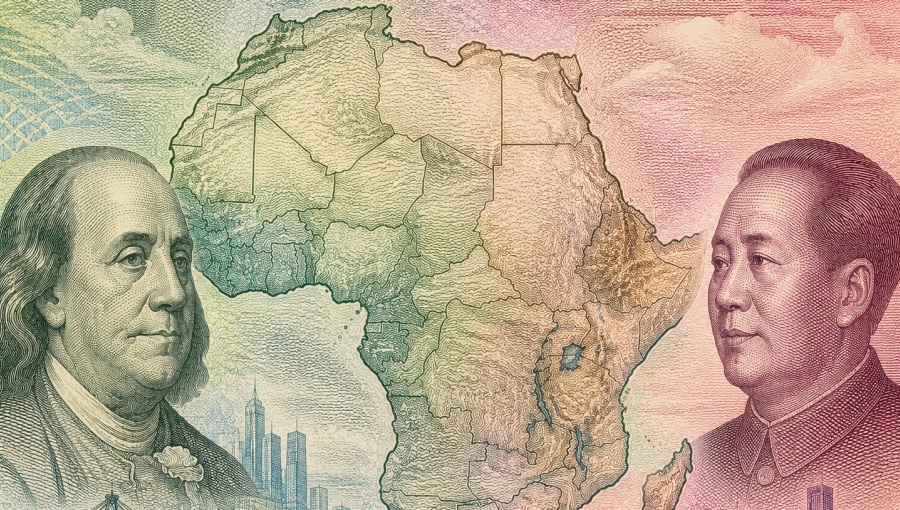
China has taken another step towards expanding the international use of the yuan in Africa by appointing Standard Bank Group (JSE: SBK) and Industrial and Commercial Bank of China (SSE: 601398; HKEX: 1398) to operate the continent's first continent-wide renminbi clearing arrangement, reducing African businesses' reliance on the US dollar when trading with China.
Announced by the People's Bank of China on June 26, the new clearing arrangement will serve 19 countries, allowing cross-border payments in yuan to be settled directly rather than routed through the US dollar. For African importers, it has the potential to reduce transaction costs and settlement times by removing one layer of currency conversion.
The new hub is the first yuan clearing arrangement established for an entire continent rather than an individual financial centre such as London or Singapore, and the first to be jointly operated by two commercial banks, Ecofin Agency writes.
The appointment follows Standard Bank's admission to China's Cross-Border Interbank Payment System (CIPS) in November 2025, making it the first African bank to join the network. CIPS complements, and in some functions provides an alternative settlement infrastructure to, the SWIFT international payments network. During its first four months on CIPS, Standard Bank processed around $500mn in trade-related transactions.
The development comes as China-Africa economic ties continue to deepen. Bilateral trade reached a record $348bn in 2025, up almost 18% year on year, according to Chinese customs data. China now accounts for around one-fifth of Africa's global trade, compared with about 5% two decades ago, according to Afreximbank. Beijing also removed tariffs on imports from 53 African countries on May 1, further strengthening commercial links.
Despite this growth, the yuan still accounts for only a small share of global cross-border payments and foreign exchange reserves, with the US dollar remaining the dominant currency for international trade and finance.
The appointment is not simply an African success story. ICBC has owned a 20% stake in Standard Bank since 2007, meaning the partnership builds on a long-established strategic relationship between the two institutions. Standard Bank has secured a valuable first-mover advantage, but the People's Bank of China could designate additional African clearing banks in future.
Competition is already emerging
Rivals are moving quickly, according to Ecofin Agency. Ecobank Transnational Incorporated (NGX: ETI; BRVM: ETIT; GSE: EGH), which operates in 35 African markets, is in advanced discussions with Bank of China to enable customers to settle directly in yuan by the end of 2026. Chief executive Jeremy Awori has said the initiative responds to growing demand from African businesses importing from China that want to avoid the cost of settling through the US dollar.
The clearing hub also has limitations. The yuan remains only partially convertible because China maintains capital controls over cross-border capital movements. While African companies can use yuan more easily for trade and approved investments in China, the currency still lacks the flexibility and global liquidity of the US dollar.
The longer-term shift may prove more significant in sovereign finance than in trade, Ecofin Agency notes. Kenya agreed to redenominate approximately $3.5bn of Chinese loans into yuan in late 2025, with officials arguing the move would reduce debt-servicing costs. Ethiopia is considering similar arrangements for part of its Chinese debt, while Zambia has begun allowing some mining-related tax and royalty payments to be made in yuan. Together, these developments suggest the yuan is gradually becoming more deeply embedded in Africa's public finances as well as its trade flows.
Several beneficiaries stand to gain. Standard Bank strengthens its position as the principal financial bridge between China and Africa, while African importers gain faster and potentially cheaper settlement options. Governments with large Chinese debt obligations may also benefit from greater flexibility in managing liabilities denominated in yuan. At the same time, banks that specialise in clearing dollar payments on the China-Africa trade corridor could face increasing competition if yuan settlement continues to expand.
The geopolitical contest extends beyond Washington and Beijing. As the future of the African Growth and Opportunity Act (AGOA) beyond the end of 2026 remains uncertain, the United Arab Emirates has also expanded its financial engagement through currency agreements with Egypt, Ethiopia, Kenya and Nigeria. Competition over Africa's financial infrastructure is becoming increasingly multipolar.
None of this threatens the dollar's dominant position, which continues to underpin most of Africa's trade, debt and foreign exchange reserves. Over the next few years, however, yuan settlement is likely to expand steadily in China-related trade and sovereign finance, Ecofin Agency writes.

No comments:
Post a Comment