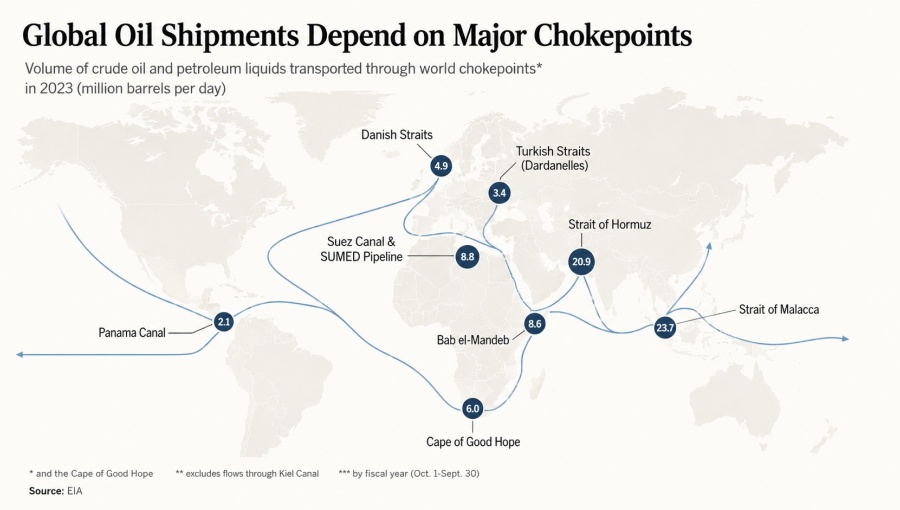
For the first time since records began, both of the Middle East's great oil chokepoints are shut at once. The Strait of Hormuz has been effectively closed since February 28, when the US and Israel opened their war on Iran; the Bab al-Mandeb Strait, at the southern end of the Red Sea, has been under an Iran-backed Houthi blockade since July 20-21, after the militia fired on two Saudi-flagged tankers.
Together the two straits normally carry around a quarter of the world's seaborne oil and gas, according to a Red Sea Monitor analysis citing Kpler and others. As IntelliNews reported, the closing of two of the world’s major maritime transport chokepoints is policy makers’ worst nightmare.
It matters because there is no historical precedent for both chokepoints failing together: Saudi Arabia built its entire Hormuz workaround around shipping oil out via the Red Sea, and that workaround now runs straight through the new embargo.
It has created a multi-front headache: Washington has restarted its bombing campaign against Iran; a scramble by Saudi Arabia to reroute oil the long way around via Suez and Africa; a new and untested US legal manoeuvre to make Iran pay for the damage; and knock-on effects as far afield as Somali piracy and Sudan's food security.
The UN's International Maritime Organization has, for what it is worth, called for calm. “I unequivocally condemn the latest reported attacks on international shipping in the Red Sea area,” IMO Secretary-General Arsenio Dominguez said in a statement on July 24. “These attacks are indefensible... De-escalation is the only solution.” Nobody directly involved shows much sign of listening.
US strikes grind on
The US military struck Iranian targets across the south, southeast and west of the country on July 22-23, US Central Command said, describing it as the 12th consecutive night of strikes — hitting maritime capabilities, missile and drone storage facilities, coastal surveillance sites and air-defence assets as the 60 day Memorandum of Understanding ceasefire definitely collapses. The next day Iranian officials confirmed strikes in Khuzestan, Hormozgan, Bushehr, Sistan-Baluchistan, Kermanshah and Chaharmahal-Bakhtiari provinces; a strike on the Shalamcheh border crossing with Iraq killed two people, including an Artesh communications officer, according to a provincial deputy governor.
Iran's own parliament has tabled a "Hormuz security bill", and a senior Iranian official has already called the closure the central economic cost of the war. Only a single tanker crossed Hormuz on July 24, the lowest daily total since May 7, according to Kpler ship-tracking data cited by Iran International.
Two chokepoints, closed at once
According to the Red Sea Monitor analysis, Saudi Arabia had already rerouted around 70% of its oil exports through its Red Sea terminal at Yanbu to work around the Hormuz closure — and that bypass now runs directly through the new Houthi embargo. The same analysis puts 25% of world oil and gas supply at risk if both chokepoints stay closed, Saudi loadings already down 36% before the embargo even hit, and Bab al-Mandeb's Saudi-linked flow falling from a peak of 9.5mn barrels a day to 6.1mn. A weekly transit chart tracking Bab al-Mandeb traffic, compiled by analyst Anas Alhajji, shows volumes that had been climbing through 2026 dropping sharply in the most recent week.
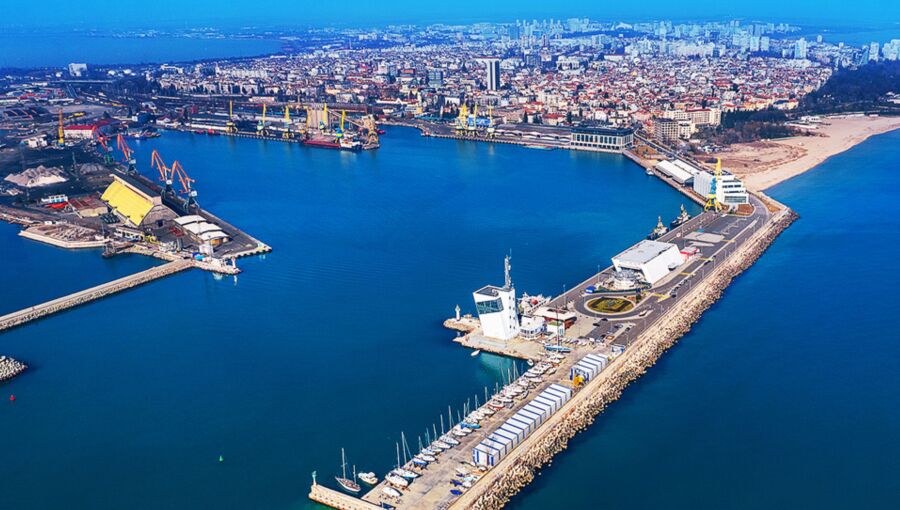
Iran itself gave warning of wider export-route disruption back in mid-July, and shipping giant Maersk had just sent its first cargo back through the Suez Canal since the war began — a tentative normalisation that the new Houthi embargo now complicates. Yanbu itself was flagged as a potential target amid rising Houthi tensions weeks ago, a warning that reads differently now that the port sits at the centre of Saudi Arabia's only remaining workaround.
The knock-on effect reaches well beyond oil. Port Sudan, 180 miles north of the new embargo line, imports 80% of Sudan's wheat and serves as the sole functioning port for 33.7mn people, per the Red Sea Monitor breakdown — with no Atlantic access, no pipeline alternative and no strategic food reserve to fall back on. Re-routing around the Cape of Good Hope adds more than 30 days and 25%-plus in cost, up to $2.5mn per tanker, which the analysis argues is unaffordable for humanitarian supply chains specifically.
Saudi Arabia's costly detour
With both its main export routes disrupted, Saudi Arabia is falling back on the norther escape hatch of the Suez Canal — a route it has not used as a primary export outlet for decades.
The arithmetic is brutal: sailing from Saudi Arabia's Red Sea port of Yanbu to Taiwan takes 19 days via Bab al-Mandeb but 48 days via Suez, the Mediterranean and the Cape of Good Hope, according to Kpler shipping data, roughly doubling fuel costs to around $2.87mn from $1.26mn per voyage before Suez Canal fees — an extra $1mn — are even added. Big tankers will reportedly have to sail through Suez partly empty and top up in the Mediterranean, given the canal's size restrictions.
One workaround: partially unloading tankers into the Sumed pipeline, which runs 320 km (200 miles) from the Ain Sukhna terminal on the Red Sea to Sidi Kerir on the Mediterranean and can carry up to 2.5mn barrels a day, against Saudi Arabia's total exports of around 7mn b/d. State producer Aramco is already offering extra cargoes from Sidi Kerir to bypass Bab al-Mandeb entirely, according to a widely circulated trader note, in what one analyst called Riyadh "hedging the exact route in question" rather than treating the risk as theoretical.
Washington's to make Tehran pay for the damage
President Donald Trump said on July 23 that damage to ships and cargo hit in the conflict will be “paid for out of Iranian money” the US holds and controls, writing on Truth Social that "any and all damages done to Ships, Cargo, or anything related thereto, will be paid for by Iranian Money that the United States has in its possession, and controls." Iranian Foreign Minister Abbas Araghchi called it "an incendiary precedent," warning that "once governments normalise confiscation, no one's assets are safe."
The legal mechanism has a precedent: in 2016 the US Supreme Court ruled in Peterson v. Islamic Republic of Iran (also known as Bank Markazi v. Peterson) that almost $2bn in Iranian central bank bonds held in New York had to be handed to American families of the 1983 Beirut Marine barracks bombing and other Iran-linked attacks — a ruling that took a law written for that single case plus a Supreme Court decision to enforce. Iran subsequently took the seizure to the International Court of Justice, which found in 2023 that the US had violated a bilateral treaty, though the ICJ ruling has not reversed the transfer. Whether — and how — the Trump administration intends to apply a similar mechanism to today's shipping damages remains legally untested and, per reporting so far, unclear even in its basic scope.
Ripple effects: piracy revives, Somalia in the mix
A merchant tanker, the Tanzanian-flagged MT Asana, hijacked in Yemeni waters in the Gulf of Aden last week, is now reportedly being held by Somali pirates rather than its original Houthi-linked hijackers, Reuters reported on July 23, citing residents of Somalia's Puntland region. It fits a broader resurgence of Gulf of Aden piracy since a lull that ran roughly 2018-2023 — a breakdown of the world's piracy hotspots earlier this year traced the rebound directly to the security vacuum left by Houthi attacks — the same dynamic now playing out again as naval and commercial attention is consumed by the wider war.
.jpg)