It’s possible that I shall make an ass of myself. But in that case one can always get out of it with a little dialectic. I have, of course, so worded my proposition as to be right either way (K.Marx, Letter to F.Engels on the Indian Mutiny)
Monday, August 03, 2026
China's stalling car market masks a record global EV surge - IEA
Electric car sales hit record levels in 50 countries in the second quarter as the Middle East energy crisis revived interest in EVs, even as China's own market stagnates. / bne IntelliNews
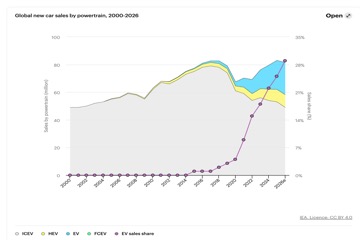
Global electric car sales rebounded sharply in the second quarter of 2026, rising 35% quarter-on-quarter to record levels in 50 countries, even as overall car sales fell around 5% y/y in the first half of the year on weaker demand in China and the US, according to the International Energy Agency's report "Electric Car Markets in a Time of Uncertainty", published on July 30.
The rebound comes in the midst of weak car markets depressed by low growth and rising inflation. First-quarter EV sales had fallen, largely reflecting the same China/US weakness dragging down the wider market, before snapping back hard enough in the second quarter that EVs finished 1H26 only slightly below 1H25 levels.
The IEA ties the rebound directly to the Middle East conflict and the fuel-price volatility it has revived: road vehicles account for nearly half of global oil use, and the energy crisis has renewed policy and consumer interest in electrification precisely where oil-import exposure is highest.
More than 90 countries recorded y/y growth in electric car sales in 1H26, and in Australia, Brazil, India, South Korea and Vietnam sales roughly doubled between March and June compared with the same period in 2025. EVs accounted for 24% of global car sales in 1H26, and the IEA now expects the full-year share to reach 29% - a percentage point higher than its own Global EV Outlook 2026 forecast published in May.
China is the exception pulling the other way. Total car sales there fell more than 20% y/y in 1H26 - around 2.5mn fewer cars, roughly equivalent to the UK and Netherlands' combined 2025 sales - and the IEA expects Chinese EV sales to stagnate in 2026 compared with 2025, the first such stall this decade, even as EVs are set to exceed 60% of China's total car sales, an all-time high.
Chinese manufacturers are compensating by exporting the surplus. Car exports from China grew 65% y/y in 1H26, limiting the domestic production decline to around 6%; electric car exports grew faster still, up more than 120% and fully offsetting the fall in domestic EV sales, lifting EVs' share of China's car exports from around 35% in 2025 to more than 45% in 1H26. The IEA estimates China's 1H26 EV exports almost matched the whole of 2025's total, with only around two-thirds of that stock sold on - leaving over 1mn Chinese-made electric cars still available for global buyers.
The scale of that export wave is already visible, as IntelliNews reported: Tesla has fallen to sixth place among vehicle exporters from China, overtaken by domestic Chinese brands now shipping EVs abroad at scale, while Russia's own EV sales have jumped as its domestic fuel crisis deepens, a smaller-scale echo of the same oil-price-driven shift toward electrification the IEA describes globally. With China and other emerging economies expected to account for roughly 60% of global car demand over the next decade, the report argues that success in exactly these markets - not in Europe or North America - will determine which carmakers end up leading the transition.
Global new car sales by powertrain, 2000-2026. Source: IEA, "Electric Car Markets in a Time of Uncertainty", licence CC BY 4.0.
Wildfires raze neighborhoods in US northwest city of Spokane
Spokane (United States) (AFP) – Firefighters worked to contain huge blazes in the northwestern US city of Spokane early Monday after officials reported hundreds of structures had been reduced to cinders.
Thousands of people were ordered to evacuate their homes over the weekend as three separate fires broke out in and around the city in the east of Washington state.
The National Weather Service (NWS) had warned of "extremely critical fire weather conditions" in the area due to strong winds and exceptional dryness.
Video of the aftermath on Sunday showed scores of homes burned to the ground, with only their brick fireplaces and foundations remaining, while other houses nearby escaped practically unscathed.
"Just driving around looking at the homes -- it's just one of the most heartbreaking things I've ever seen in my life," Spokane resident Geoff Beadles told AFP, after evacuating from his home with his fiancee and two dogs.
Mayor Lisa Brown told a press briefing Sunday afternoon: "Hundreds of homes and structures have been lost. We are still assessing the potential for lives to be lost."
"To the people who are suffering right now in our region from either loss or uncertainty... our hearts go out to you. We are here for you for the long term," she said.
Fire officials said late Sunday that the blazes were still zero-percent contained.
And while more favorable weather, with only light winds, was forecast for Monday, temperatures were expected to rise again later in the week.
Smoke accumulating over the city would likely render air quality "very unhealthy" on Monday, the regional clear air agency said.
Sheriff John Nowels said no deaths or injuries had so far been reported, but "because of the scale of this and what it takes to... do those kinds of investigations in an active fire scene, that could change."
Washington Governor Bob Ferguson, who declared a state of emergency, said the state is enduring a fourth consecutive year of drought as climate change creates conditions conducive to destructive wildfires.
He told the press conference that he had spoken to federal officials about receiving resources to respond to the disaster, including President Donald Trump, who understood "how dire the situation is."
Fire officials warned that "unauthorized" drone incursions into restricted airspace above wildfires were forcing the grounding of helicopters and other aircraft fighting the blazes.
The head of Washington's Department of Natural Resources, David Upthegrove, warned that the fire in Spokane was "one of 15 major fires burning throughout the state of Washington right now."
"This is an extraordinary wildfire season in the Pacific Northwest. It's not a normal season," he said.
"A confluence of weather conditions, a confluence of fires throughout the West, are stretching our resources and challenging the individuals in this response."
The biggest of the three fires burning in Spokane, the Old Trails fire, jumped the Spokane River on Saturday afternoon and crossed into the city proper.
Another resident, Tena Risley, said she saw flames behind trees near her home and, in a panic, she grabbed her dog and a few things. She got stuck in traffic has she tried to flee as the fast-moving fires blocked routes out of the city.
"There were probably hundreds and hundreds of cars," she told AFP.
Authorities issued the highest-level evacuation alert, "Go Now," for swathes of northern Spokane affecting thousands of people within city limits, according to the government's evacuation map.
As of Sunday morning the three fires had charred a total of 5,390 acres (2,181 hectares), CNN reported.
Emergency authorities set up a fire evacuation shelter at the Spokane Convention Center.
Europe's worst wildfire season in years flags a global El Nino already moving commodity markets
The World Meteorological Organization's official August-October outlook confirms a strengthening El Nino and a positive Indian Ocean Dipole - a combination that has already pushed food and power prices around the world before the season it describes has even started. / bne IntelliNews
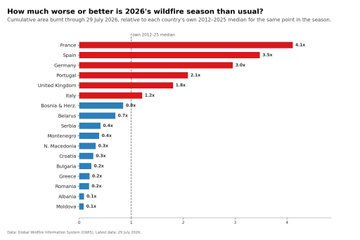
Several European countries are having their worst wildfire year in more than a decade and worst than last year’s record wildfires that burnt over one million hectares, according to data from the EU's Global Wildfire Information System published this week.
France's cumulative burnt area through July 29 is running 4.1 times its 2012-2025 median for the same point in the season, Spain 3.5 times, Germany 3 times, Portugal 2.3 times and the UK 1.8 times. The Balkans, by contrast, have had a quieter year, with Bosnia and Herzegovina, Serbia, Montenegro and North Macedonia all below their historical median.
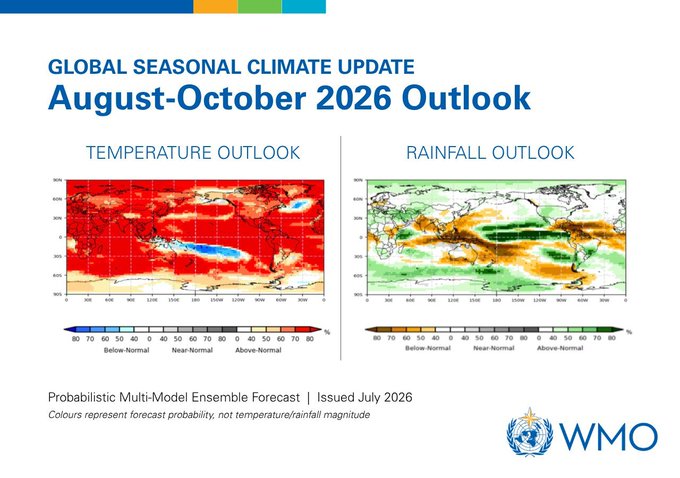
The World Meteorological Organization's Global Seasonal Climate Update for August-October 2026, issued in July, forecasts above-normal temperatures across most of the world alongside a strengthening super El Niño and a developing positive Indian Ocean Dipole - a combination that tends to amplify, rather than offset, extreme rainfall swings in both directions: worse flooding in some regions, worse drought in others.
And it’s going to get worse. Europe's wildfire season is one of the first visible symptoms of a pattern the WMO is only now confirming officially for the months ahead\ through to October.
Markets have not waited for the official confirmation. IntelliNews has tracked a string of El Nino-linked commodity and inflation stories through the second and third quarters of 2026, from Latin American central banks to Southeast Asian crop belts - evidence that the economic transmission channel identified by the WMO's forecast is already live, not merely forecast.
A hotter, more extreme world for three months
The WMO's probabilistic model, built from a multi-model ensemble, shows above-normal temperature probability across almost the entire globe for August-October, with the strongest confidence in the tropics and mid-latitudes. Changes in rainfall patterns is going to make the biggest difference. The same forecast shows a mixed but pronounced pattern of above-normal rainfall probability across parts of South Asia and the tropical Pacific, and below-normal probability across swathes of southern Africa, parts of South America and the Mediterranean basin – a divergence that turns a single global weather pattern into a series of very different regional economic stories.
Already pricing in
Swiss bank UBS warned in mid-July that a strong El Nino threatens to reignite inflation and delay interest rate cuts across Latin America, singling out Colombia as most exposed given its high inflation and weak fiscal position, with Brazil and Peru also flagged and Venezuela's hydropower-dependent grid seen as vulnerable to drought. The US National Oceanic and Atmospheric Administration puts the probability of the current episode being powerful at 63%, with effects expected to persist into early 2027.
The pattern has already hit agricultural commodities further east. In June that Malaysia issued a sovereign warning over crop damage risk to its palm oil plantations even as near-term prices fell on unrelated demand weakness - agricultural economists note the biological lag between an El Nino heatwave and reduced fresh fruit bunch extraction typically runs several months, meaning any supply hit shows up closer to early 2027. Rice told a faster-moving version of the same story: Vietnam's rice export price for 5% broken rice rose to $412 a tonne in May on El Nino-linked drought fears across India, Thailand, Indonesia and Australia, with the UN's FAO Rice Price Index up 2.7% on the month.
Burning in Europe
Europe's wildfire numbers are the clearest evidence yet that this year's pattern is not merely a forecasting exercise. The divergence within Europe itself - a very bad year in France, Spain, Germany, Portugal and the UK against a calmer one in the Balkans - illustrates the WMO's own point about the Mediterranean basin sitting in the below-normal rainfall probability band, a dry bias that raises fire risk independent of any single heatwave.
WMO Global Seasonal Climate Update: temperature and rainfall outlook for August-October 2026. Source: World Meteorological Organization.
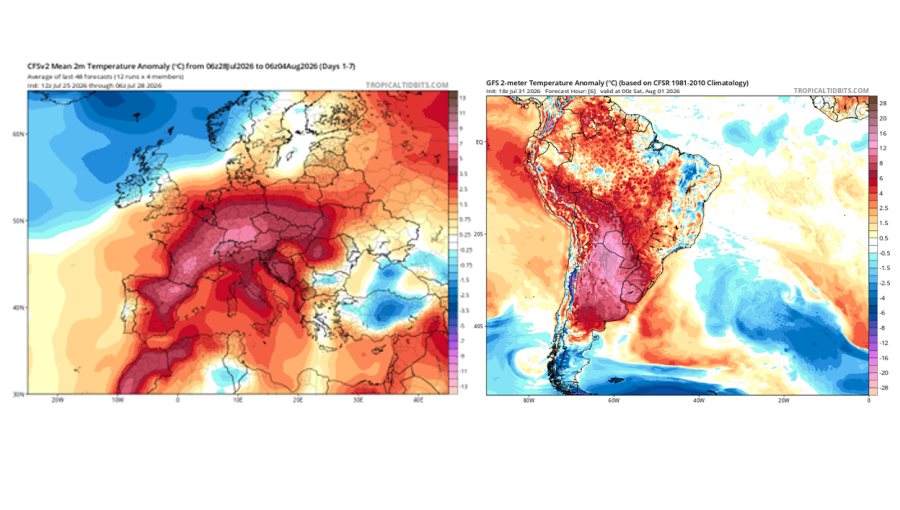
Cumulative burnt area, 2026 season to July 29, relative to each country's 2012-2025 median. Source: Global Wildfire Information System.
None of this guarantees a repeat performance for the rest of the WMO's three-month window - seasonal probabilistic forecasts describe likelihoods, not certainties, and the report itself stresses that its colours represent forecast probability rather than magnitude. But taken together with the commodity moves already logged this quarter, the wildfire data is the strongest sign yet that 2026's El Nino is behaving as advertised rather than fading, as some earlier and weaker episodes have done.
'Climate change is really here: We should seize this crisis moment to create a new momentum'
Issued on: 29/07/2026 - FRANCE24
Oliver Farry is pleased to welcome Jean-Pascal van Ypersele, Climate Scientist and Professor at the Universities of Louvain and Liège in Belgium. Europe's latest heatwave is further evidence of a structural transformation of the continent's climate, warns Professor van Ypersele. His central argument rejects both fatalism and complacency. While insisting that humanity has not yet reached "the point of no return," he argues that the world has entered a period of exceptional urgency in which the costs of delaying climate action are escalating rapidly. He develops three interconnected themes: extreme heat, wildfires and public health crises as manifestations of a changing climate; he criticises the inadequacy of current political responses, suggesting that governments continue to underestimate the scale and immediacy of the challenge despite mounting scientific evidence; and he argues that adaptation and mitigation must proceed simultaneously: societies must become more resilient to unavoidable climate impacts while accelerating the transition away from fossil fuels to prevent even greater disruption.
France's unprecedented wildfires: Convergence of climate change and historical landscape engineering
Issued on: 30/07/2026 - FRANCE24
Delano D'Souza is pleased to welcome Dr. Melissa Sterry, Scientist, Designer, Strategist and Founding Director of Panarchic Codex® : Design for Living with Wildfire. Dr. Sterry reframes wildfire as a systemic phenomenon: climate change intensifies heat and drought, nineteenth century land engineering has produced highly combustible plantation forests, and expanding human activity increases ignition opportunities. Once these factors align, fires can evolve into autonomous systems that generate their own weather and even create new ignition sources. While she praises France's emergency response, Dr. Sterry contends that prevention and firefighting alone cannot solve the problem. The real challenge lies in redesigning landscapes before fires gain momentum, shifting policy from reacting to disasters towards preventing them through long-term ecological resistance and resilience.
'Rethink the forest' amid unprecedented wildfires: Return to 'ancestral ways of managing the land'?
Issued on: 29/07/2026 - FRANCE24
Stuart Norval welcomes Jean-Luc Gleyze, President of the Departmental Council of the Gironde, and Stéphane Delpeyrat-Vincent, former firefighter and founder of WARUCENE, a research firm specialising in wildfire prevention. The Gironde wildfires expose the growing challenges of land management in a warming world. Offering complementary perspectives, Jean-Luc Gleyze, speaking from the front line of the emergency response, presents the fires as a test of social solidarity, institutional coordination, and public resilience. By contrast, Stéphane Delpeyrat-Vincent argues that increasingly destructive wildfires are not simply emergencies to be fought, but symptoms of a deeper structural failure: landscapes managed for a climate that no longer exists. Together, their analysis suggests that the challenge is no longer simply to improve firefighting capacity, but to rethink forests, communities, and urban planning in an era of accelerating climate change.
As France battles unprecedented wildfires, Caroit urges collective global action on climate change
Issued on: 30/07/2026 - FRANCE24
Delano D'Souza is pleased to welcome French Deputy Foreign Affairs Minister Éléonore Caroit. She frames France's response to unprecedented heatwaves and wildfires through three lenses: crisis management, international solidarity, and climate governance. Caroit distinguishes between the immediate demands of emergency response and the longer term structural challenges posed by climate change, including adaptation, infrastructure resilience, and urban planning. While arguing that governments must continually strengthen preparedness and invest in prevention and adaptation, she maintains that domestic policy must be matched by sustained international climate cooperation, making collective global engagement an essential component of both disaster response and long term climate resilience.
In blazing Greece, anger grows among residents forced to evacuate
Issued on: 03/08/2026 - FRANCE24
Greece is facing a growing wildfire catastrophe after a week of destructive blazes across the country was compounded by a deadly mid-air collision between two firefighting helicopters. Fires have sparked across the country, including just seventy kilometres from Athens, forcing many residents to flee as countless homes were damaged or destroyed.
'A giant of the industry, Purja leaves behind a legacy that inspired a generation to climb higher'
Issued on: 01/08/2026 - FRANCE24
Renowned mountaineer Nirmal Purja and his nine climbing companions were killed by an avalanche in Pakistan during an ascent of one of the world's highest mountains, his expedition company said on Saturday, as rescuers tackled treacherous conditions to recover their bodies. A giant of the industry, Purja leaves behind a legacy that inspired a generation to climb higher. Click on this video report by Charlotte Lam for more.
'The #Odyssey': What's missing from #Nolan's film according to Homer's translator
Issued on: 31/07/2026
FRANCE 24
Since Christopher Nolan's "The Odyssey" came out, it has generated over $300 million… and a growing conversation about what is missing compared to the original poem. But what is that exactly? In a scathing review published recently, classicist and translator of Homer’s epic, Emily Wilson, had much to say about what differed from the original poem. Her translation, published in 2017, was widely acclaimed, and Nolan said she was one of the inspirations for his film in early publicity. FRANCE 24 spoke to her a few days before she published her review, and here’s what she had to say.
Stuart Norval is pleased to welcome Camille Le Coz, Director at Migration Policy Institute Europe. Le Coz offers a nuanced interpretation of the recent events in Ceuta that challenges the dominant political narratives emerging across Europe. She shifts attention away from emotionally charged images toward the structural forces shaping migration: demographic pressures in North Africa, labour shortages in Europe, the role of smuggling networks amplified by social media, and the enduring tendency of migration crises to become instruments of domestic political competition. In doing so, she offers a reminder that Europe's migration debate is often driven less by the movement of people itself than by competing political narratives about what those movements represent.
Ceuta: more migrants leave but residents still in shock. Far-right leader visits
Santiago Abascal, the leader of the far-right party Vox, visited the city today and accused the government of being in thrall to Morocco.
Here at the border between Ceuta and Morocco, the situation is much calmer than in recent days. According to Spanish authorities, the majority of the at least 60,000 people who crossed irregularly at this point on Thursday have already returned.
There is still a sporadic but steady stream of people heading back. Most of those returning tell us they entered Spain after receiving social media messages claiming the border was open and that no documentation was required.
Meanwhile, in the city, fear has given way to indignation. Virtually everyone I have spoken to cannot fathom how this situation could have happened and is demanding urgent explanations. It is a tense social atmosphere that is fuelling political debate.
A taxi driver told me:
"I got the feeling that people are very, very angry. I know they’re very angry right now. There are 85,000 of us here, and 60,000 are coming in. So, tell me. What do we do? What are we going to do? We can’t even buy bread. There was no bread. There was nothing. Nothing, nothing. Everything was closed."
While he was reluctant to attribute blame, some residents were more outspoken. Alluding to the initial legal difficulty of sending the migrants back immediately because they came via the sea, a middle-aged man called PM Pedro Sanchez an "accomplice", adding: "this is a disgrace— for me, a disgrace. This has never happened before in my life."
Some Ceutanos do point to a humanitarian duty in connection with the crisis. A 78-year old pensioner told me:
"If there are children there, they need to be given something to drink, they need to be given something to eat. It’s common sense, but that now all of Ceuta, all of Spain—and Spain stands with you—is with you."
However, the situation as a whole he cannot but condemn:
"This is a state of emergency and a declaration of martial law, just to go shopping at Mercadona? I have to pass a soldier every ten meters away from him ten or twenty meters away from him and feed the troops well and the police. That’s a state of siege, and it’s a of national emergency. There’s no question about it."
Santiago Abascal, the leader of Vox, visited the city today, accusing the government of being in thrall to Morocco.
Speaking to the media, Abascal placed the responsibility for what had happened on the government in Rabat and, above all, on Pedro Sánchez himself.
He argued that Morocco acted in the conviction that there would be neither response nor reprisals, because the Spanish prime minister is, in his words, "subservient to the African country".
Spain installs floating barrier in Ceuta after
migration influx
Spanish authorities said Saturday they were installing a floating barrier on the sea border between its North African territory of Ceuta and neighbouring Morocco after a deadly surge of tens of thousands of migrants into the territory earlier in the week prompted alarm across the European Union.
Spain said migrant crossings into its North African enclave of Ceuta stopped overnight, as police began installing a 500-metre (1,640-foot) floating barrier on Saturday off its border with Morocco following a mass rush that killed at least 72 people.
Reuters video on Saturday showed Spanish soldiers and police patrolling a mostly empty Tarajal beach shrouded in fog.
EU calls emergency meeting
Civil Guard police started laying the new barrier at 7:50am (0550 GMT) on the Tarajal breakwater, one of the main points used by people trying to enter the tiny Spanish territory, the government said in a statement.
The pneumatic barrier, alongside a line of anchored naval buoys, is designed to stand 30 to 70 centimetres (12 to 28 inches) above water and extend as much as one metre below the surface, it added, while a channel between the barriers will allow Civil Guard vessels to patrol the area.
The mass crossing prompted alarm across the European Union, and 22 member states wrote a letter asking for coordinated action to protect external borders and other measures.
Ireland, which holds the rotating EU presidency, said it had called an emergency video conference meeting of the bloc's interior ministers to discuss the crisis on Tuesday.
Spain's centre-left Prime Minister Pedro Sanchez criticised Italy's decision on Friday to suspend passport-free Schengen travel arrangements with Madrid for one month.
"In the current international context, the EU cannot afford this kind of selfish, polarising and unlawful reaction," Sanchez wrote in a letter to the EU Commission and European Council presidents.
Death toll rises
"The latest figure that we have is 72," the government's delegate to Ceuta, Miguel Angel Perez Triano, told reporters on Saturday when asked about the number of fatalities. Some migrants drowned and others were crushed while trying to climb the breakwater and border fence.
The previous toll was 67 deaths.
Many were driven to migrate by economic hardship and encouraged by social media rumours.
Spanish Interior Minister Fernando Grande-Marlaska blamed people-smuggling networks for exploiting vulnerable migrants and spreading misleading interpretations of a recent Spanish Supreme Court ruling that migrants intercepted at sea cannot be summarily returned in the absence of a physical barrier.
Speaking from Ceuta, Grande-Marlaska told reporters Spain had largely restored order within 24 hours, but warned that the crisis was not yet formally over and that reinforced police and military deployments would remain as long as needed, though overnight crossings had fallen to about zero.
"Morocco isn't any threat to Ceuta or the rest of Spain – it's a fully reliable partner," he said, adding there had been no intelligence indicating a mass entry was imminent.
The AUGC union for Spain's Civil Guard said it was asking for a reinforcement of at least 200 officers, and warned that more work was needed to stop people swimming round the new inflatable barrier.
Madrid said the people who entered Ceuta irregularly could not travel onwards to mainland Spain or elsewhere in the Schengen zone.
In a statement, the foreign ministry added that travellers leaving Ceuta by sea or air undergo police identity checks, representing a second layer of control after the land border with Morocco.
In contrast to most of Europe, Spain has adopted a more open stance on migrants, introducing a programme to grant residency to more than half a million undocumented people.
But it has rejected suggestions that the regularisation scheme had encouraged the rush into Ceuta, saying applicants must prove residence in Spain before January 1, 2026, and five continuous months of residence when applying.
(FRANCE 24 with Reuters)
Morocco blames Ceuta migrant rush on 'misleading information' on social media
Morocco on Sunday said 11 people died trying to reach Spain's North African exclave of Ceuta this week as the country's interior ministry blamed the sudden surge on the "spread of misleading information" on social media. Morocco’s figure is significantly lower than the death toll issued by Spain, which says at least 72 people died.
Morocco's interior ministry on Sunday issued its first toll for those who died trying to reach Spain's North African enclave of Ceuta last week, saying 11 people had died. The figures are significantly lower than those issued by Spain, which says at least 72 people died. Tens of thousands of would-be migrants crossed into the territory between Wednesday and Friday, sparking a diplomatic row within the European Union as some member states criticised Spain's migration policies Rachid El Khalfi, a spokesman for Morocco's interior ministry, said that of the 11 who died, 10 had drowned, while an eleventh person fell from a rocky area. 'Pure political theatre': Ceuta migrant crisis 'used politically' to make Europe seem 'under attack'
Morocco was working with Spain to check the toll figures and to identify bodies found on Spanish territory. The ministry blamed the sudden surge on the "malicious exploitation" of social media and the "spread of misleading information". But it also cited the "misinterpretations of legal provisions" – a reference to a July 8 Spanish Supreme Court ruling that migrants arriving by sea should not be returned as quickly as others. The ministry said there had been 40,000 attempts to cross into Ceuta illegally. Another 1,135 people had tried to illegally enter the Spanish territory of Melilla, further east, but had been immediately returned to Moroccan territory, the ministry added. Spain says more than 60,000 managed to enter Ceuta in recent days although most have now returned to Morocco. The Moroccan Association for Human Rights (AMDH) has said there were "nearly 130 victims" with dozens more missing. Prosecutors have opened an official investigation into what happened, said the ministry. (FRANCE 24 with AFP)
Europe to hold meeting Tuesday over Ceuta after migration flux
Issued on: 02/08/2026 - FRANCE24
Spain has installed a 500-metre-long sea barrier between its North African enclave of Ceuta and neighbouring Morocco. It comes after tens of thousands of migrants breached the border earlier this week, with at least 67 people dying in the attempt. While most of those who crossed quickly returned to Morocco, the incident has reignited the immigration debate in Europe and beyond. The EU is due to hold an emergency video conference on the issue on Tuesday. Charlotte Hughes reports.
Trump blames Spain for migrant chaos despite return of tens of thousands to Morocco
US President Donald Trump and other far-right leaders on Friday seized on Spain's migration crisis to bolster their political messaging on immigration, while over half of the migrants who had crossed the border made their way back to Morocco voluntarily the same day.
US President Donald Trump led far-right attempts Friday on both sides of the Atlantic to make political capital from Spain's migration crisis, portraying the migrant surge in Ceuta as a warning for America if his opponents get into power.
About 60,000 migrants have crossed from Morocco into Spain’s tiny Ceuta territory in the past 24 hours, Ceuta's president said Friday, a figure that is equivalent to 70% of the population of the city in North Africa.
But over half of them have already made their way back voluntarily, the Spanish government said, after the sudden arrival of so many migrants triggered chaos and a humanitarian crisis.
"I saw Spain yesterday, and I watched the catastrophe that took place," Trump told a meeting of his cabinet at the presidential Camp David retreat in Maryland.
"It looks like an invasion of a country by hundreds of thousands of people, and that same thing's going to happen to us if the Republicans don't get elected, except worse, much bigger."
'It took me two hours': 40,000 migrants swim from Morocco into Spain's Ceuta
With polls showing Trump's support has fallen into the low 30 percent range and opposition Democrats hoping to win at least partial control of Congress in the November midterm elections, the crisis in Spain offers Republicans a chance to return to one of their political strongpoints.
News footage of migrants overwhelming barriers to get into Ceuta – a tiny Spanish territory on the Moroccan coast – aired repeatedly on Fox News and went viral across right-wing Trump-allied social media accounts.
There were similar reactions from a range of right-wing and Trump-linked leaders in Europe.
Far-right Alternative for Germany (AfD) co-leader Alice Weidel claimed in an X post that "Ceuta was left in ruins overnight" by the mass influx from Morocco.
She argued that Germany is "likely the destination for most of these migrants".
"Germany must prepare itself: borders must be secured and rejections rigorously enforced," wrote Weidel, whose party is backed by top Trump officials.
Both Italy's right-wing prime minister Giorgia Meloni and the populist right-wing ruling coalition in Finland called for excluding Spain from the European visa-free zone as a result of the situation.
Czech Prime Minister Andrej Babis, a billionaire Trump supporter, said the Ceuta situation was caused by Spain's policy of offering hundreds of thousands of migrants already in the country a legal status.
"They are replacing Spaniards with migrants," Babis said.
'Invasion of the West'
Trump's election victory over Democrat Kamala Harris in 2024 was fueled by voter worries over uncontrolled migration on the US-Mexico border and his lurid warnings of migrants coming to murder Americans and even to eat their pets.
The Trump administration leapt on the Ceuta crisis in a coordinated messaging barrage.
The State Department issued a statement blaming Spain's government for "deliberate efforts to enable and facilitate mass illegal migration into Europe".
Without giving detail, the statement said Washington was "considering actions to defend Americans at home and abroad from this threat and stand ready to assist other European allies considering similar options".
Trump's vice president, JD Vance, posted news footage of the Ceuta migrant wave and said it highlighted "radical left-wing globalist policies that have enabled the Invasion of the West".
"These images out of Spain are an unfortunate reminder of the consequences of mass migration," Vance posted on X.
Late Thursday, White House Deputy Chief of Staff Stephen Miller, a chief architect of Trump's anti-migration crackdown, posted video of the Ceuta crisis and said: "Democrats will see your home trampled and stolen by invaders and they will rejoice."
4.3 The Multitude against Empire. 393. Notes. 415. Index. 473. Page 11. PREFACE. Empire is materializing before our very eyes. Over the past several decades, as ...
Page 1. MULTITUDE. WAR AND DEMOCRACY. IN THE AGE OF EMPIRE. MICHAEL HARDT ... Empire calls on war for its legitimation, the multitude calls on democracy as its ...
Just as today's. Empire was formed in response to the insurgencies of the multitudes from below, so too, potentially, it could fall to them, as long as those.
Capital One bank cites money-laundering probe to justify closing Trump Organization accounts
Capital One Financial on Friday defended its decision to close more than 300 Trump-affiliated bank accounts back in 2021, stating that it did so after a money-laundering review. The disclosure marks the first time a bank has formally tied money-laundering concerns to US President Donald Trump's family business.
Concerns over money laundering by the Trump Organization led Capital One Financial to close more than 300 bank accounts in 2021, the US bank said on Friday as it defended its decision against a lawsuit for illegal debanking.
The disclosure marks the first time a bank has formally tied money-laundering concerns to US President Donald Trump’s family business. Capital One is seeking to dismiss the case by casting doubt on claims of illegally debanking – or denying services on religious or political grounds – the Trump Organization.
The Trump Organization and Capital One did not immediately respond to requests for comment.
Capital One has never accused the Trump Organization of illegal money laundering. But Friday’s filing argues that “documents and Plaintiffs’ own allegations make clear that Capital One closed Plaintiffs’ accounts for anti-money laundering (“AML”) reasons. The closures were the result of months of analysis and a careful review by Capital One’s AML team in accordance with bank policies and regulatory guidance.”
Capital One gave notice of its plans to close more than 300 Trump-affiliated bank accounts in March 2021. The Trump Organization and Eric Trump, the president’s son, filed a lawsuit in March 2025 in a Florida federal court, alleging the accounts were closed because of Capital One’s “woke” beliefs and its desire to benefit from the political mood after the January 6, 2021 riot at the US Capitol.
Trump pressure on large banks
The federal court in Miami has tossed two complaints in the Capital One case, but gave the plaintiffs opportunities each time to submit an amended complaint. Capital One said that the latest version, filed in July, “suffers from the same fundamental flaws as their prior two pleadings”.
Capital One said in Friday’s filing that the Trump Organization’s allegations of political pretext were “misguided” and “based on cherry-picked quotations unsupported by the full context” of documents submitted to the court.
“The transaction patterns identified by Capital One are among the types of activity flagged by federal banking guidance,” the filing said.
Since the start of Trump’s second term, his administration has put pressure on some large banks, echoing conservative complaints that the institutions are deliberately targeting the political right.
'Trump is tightening his grip on American economic policy and institutions'
Trump signed an executive order in August 2025 barring discriminatory debanking. In January, Trump filed a suit against JPMorgan Chase on the same grounds, underscoring the fraught policy environment Wall Street is navigating during the president’s second term.
In 2019, during his first term, Trump sued Capital One and Deutsche Bank in an attempt to prevent them from sharing financial records with Congress as part of a probe led by Democratic lawmakers. Anti-money laundering professionals at Deutsche Bank reportedly flagged a set of transactions, but executives ignored them; Deutsche Bank denied the report at the time.