It’s possible that I shall make an ass of myself. But in that case one can always get out of it with a little dialectic. I have, of course, so worded my proposition as to be right either way (K.Marx, Letter to F.Engels on the Indian Mutiny)
Sunday, August 02, 2026
Danube dries in heat: skeleton of giant mammoth uncovered in Bulgaria
Copyright AP Photo
By Euronews Roma
Published on
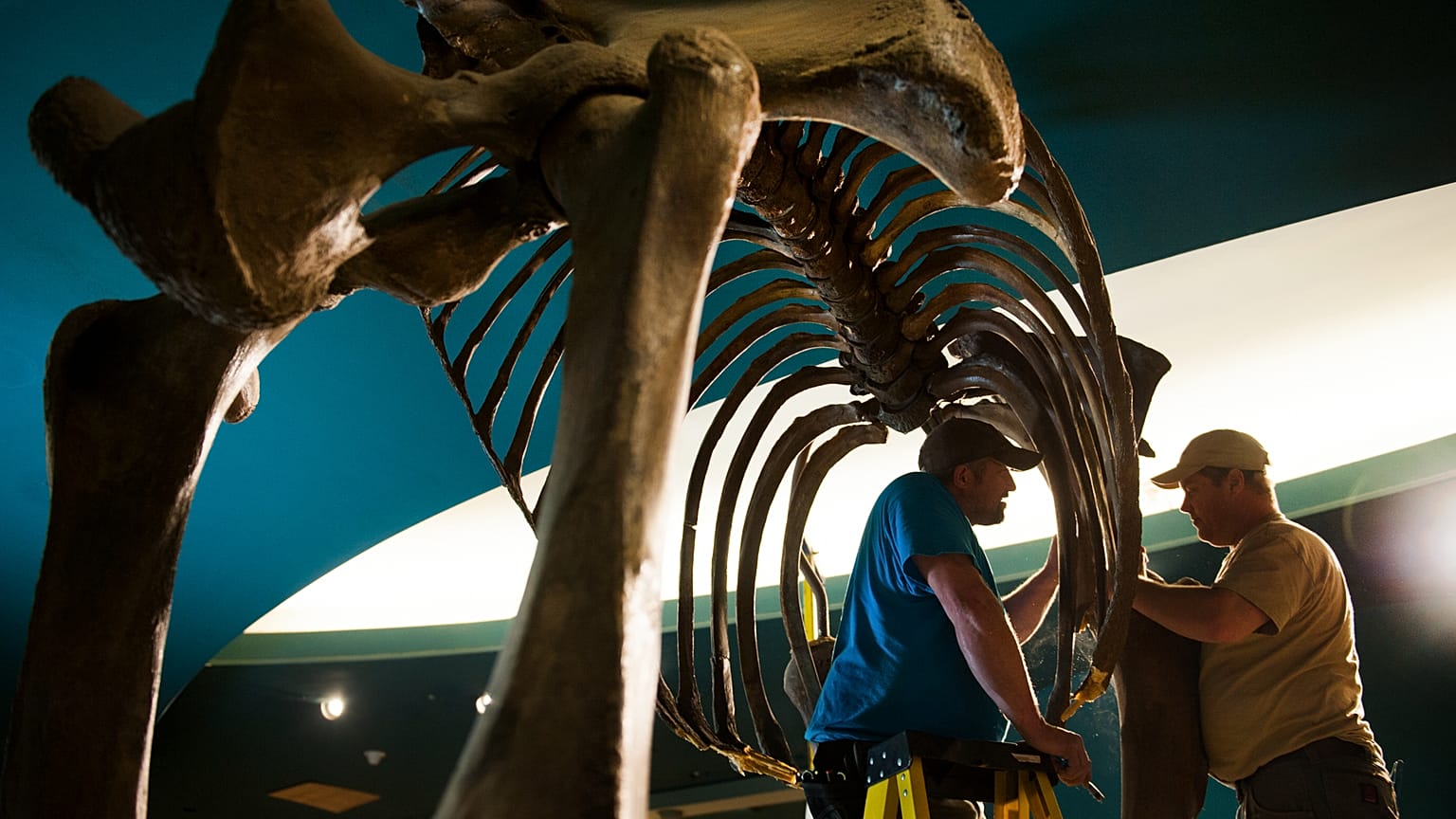
Record-low water levels have exposed the bones of a large mammoth in the riverbed near the village of Ryahovo in Bulgaria. Experts believe it is a woolly mammoth (Mammuthus primigenius).
On the banks of the Danube near the town of Ryahovo in Bulgaria, the remains of an ancient mammoth have resurfaced. The river, with water levels at record lows because of recent heatwaves, has revealed bones which, according to researchers at the Regional History Museum in Ruse, belong to a specimen of "Mammuthus primigenius", commonly known as the woolly mammoth.
So far, researchers have identified and recovered a jawbone, tusks, a shoulder blade, ribs and other bone fragments, but much of the skeleton is probably still buried.
The museum's curator, Krasimir Kirov, said that the animal, standing almost 5 metres tall and weighing more than 7–8 tonnes, may have been carried to that spot by the Danube, where the remains of prehistoric animals have accumulated over millennia.
The species existed from around 500,000–800,000 years ago until about 7,000–10,000 years ago. The bones can therefore be dated to several thousand years ago and, because of their prolonged exposure to water, are being removed from the riverbed with great care, given how vulnerable they are to deterioration once exposed to air.
Once they have been conserved and properly studied, the remains are expected to be put on display at the museum in Ruse, which is around thirty kilometres from where they were found.
What is emerging from the Danube
The Danube, which flows through ten countries from south-west Germany to the Black Sea, has dropped to record low levels along much of its course, exposing rocks, sandbanks and ancient wrecks that were rarely visible in the past.
Wrecks have surfaced both in Hungary, near Mohács, and in Serbia, at Prahovo, where German warships dating back to the Second World War have reappeared.
The discoveries are not the only consequence of the Danube running dry, though. Hungary is also facing a tense situation because the Paks nuclear power plant has been forcibly shut down, as the water level is too low to guarantee the cooling of the facility.
Europe's wildfires update: two helicopters collide while battling fire in Greece
After weeks of fighting wildfires, France has managed to stop the spread of the blazes. Spain's situation is improving but flames are still spreading while Greece struggles with multiple fires and high winds in different parts of the country.
Two helicopters have collided while battling Greece's wildfire in the Psatha area of Athens on Sunday, according to the fire service "Search and rescue teams were immediately mobilised to locate and assist the crews," it said.
Meanwhile, fire services struggles to stop the multiple fires in the greater Athens region and on the Cephalonia island, While France has managed to contain its wildfires in the Bordeaux region and in the southeast.
Strong winds have been spreading the fires across the country for days, which have dramatically increased the damage toll.
Blazes are sparking back up in Spain's Zamora region and in the eastern region of Castellón, but most of the fires are contained or extinguished.
Winds fueling Greek wildfires
Prime Minister Kyriakos Mitsotakis said Greece had faced "extreme weather conditions and winds" that often reached 100 kilometres an hour.
Gale-force winds created "extremely difficult conditions resulting in many cases where aircraft either cannot draw water or cannot carry out drops due to extreme turbulence", Greece's Civil Protection Minister Evangelos Tournas said.
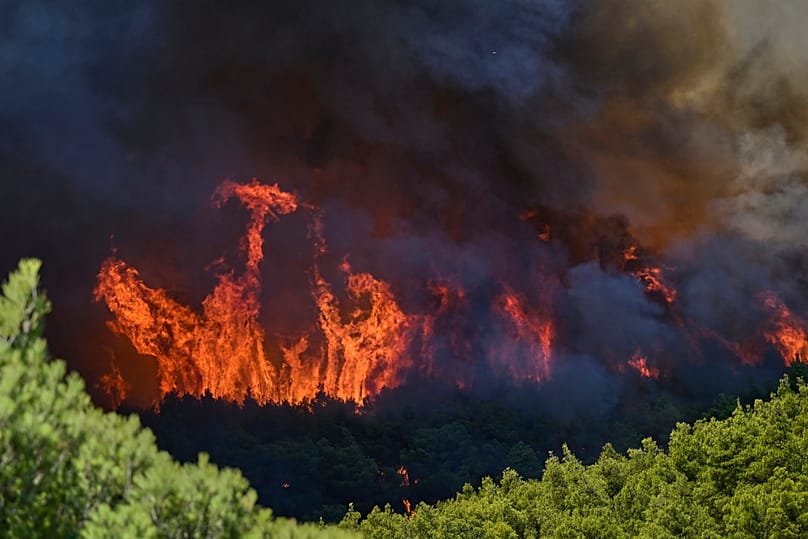
Flames burn through a forest during a wildfire near Porto Germeno, northwest of Athens, Greece, Saturday, 1 August 2026. The Associated Press. All rights reserved.
For yet another night, fire service units on the ground were battling the flames in regions near Athens (Attica, Boeotia and Fokida) under particularly adverse conditions, as strong winds continue to blow, while shortly before midnight a new front broke out on Cephalonia, an Ionian Sea island.
Though the winds eased late on Saturday, the greater Athens area and nearby Voiotia and the island of Evia were under near maximum fire risk on Sunday, the civil protection ministry said.
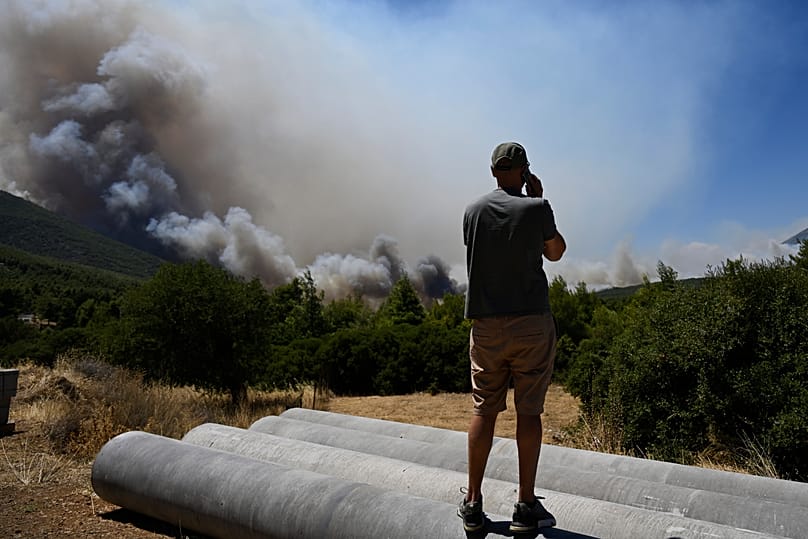
Firefighters were attempting to keep the fire from approaching the western outskirts of Athens after it scaled a mountain overnight.
Porto Germeno and other villages were evacuated when the fire broke out on Friday but local authorities say scores of homes were damaged or destroyed.
Earlier this week, fires on the islands of Crete and Paros affected another 6,000 hectares.
Smoke billows from a wildfire approaching Krio Pigadi near Porto Germeno, northwest of Athens, Greece, Saturday, 1 August 2026 The Associated Press. All rights reserved.
Firefighters have faced dozens of fires daily, and Greece's Civil Protection Minister Evangelos Tournas on Saturday said the fire department had been "pushed to its limits".
Three firefighters died this week in the line of duty, two in Crete and one in the Peloponnese.
Theodore Giannaros, a wildfire meteorologist and senior researcher at the National Observatory, said the fires around Porto Germeno appear to have affected an area of over 10,000 hectares, almost double the original estimate.
"Unfortunately, it is highly likely (if not almost certain) that this particular wildfire will be classified as a megafire," Giannaros wrote on Facebook.
By Sunday, wildfires in Greece had devastated over 12,000 hectares of forest and agricultural land.
Hit hard by the climate crisis like the rest of the Mediterranean region, Greece is plagued by wildfires every summer due to high temperatures, frequent heat waves and drought.
France fires 'contained'
In France, 63,000 hectares of forest and agricultural land were burnt since the beginning of July. The strongest fire in the Gironde region near Bordeaux is now contained and ravaged 42,000 hectares and destroyed 240 homes.
There, said Prime Minister Sebastien Lecornu, "we have returned to a more stable situation", confirming earlier comments by Interior Minister Laurent Nunez.
Of the 220,000 people who were evacuated, 208,000 have been able to go back home. It's the country's largest wildfire since 1949.
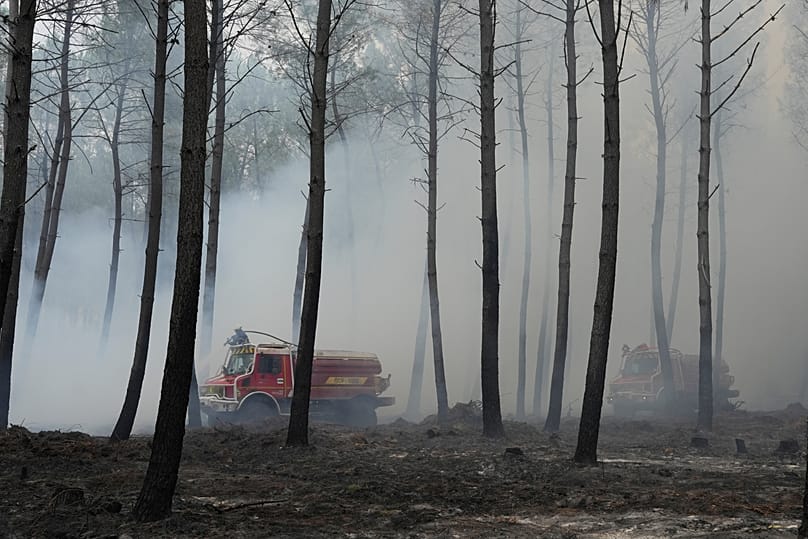
Firefighters work to extinguish a fire, near Blagon, southwestern France, Friday, 31 July 2026 The Associated Press. All rights reserved
The fire in the southeastern Var region is still under close surveillance. Firefighters there have managed to stem the advance of a fast-moving blaze that sprang up Friday, said regional prefect Simon Babre.
Strong winds fanning the flames had caused them to spread "faster than a galloping horse", he said, warning that the situation was still "extremely precarious".
"We're staying cautious, because the fight goes on," he added.
France has for weeks been battling wildfires after a series of deadly heatwaves that have dried up riverbeds and vegetation, extreme weather events scientists have linked to human-made climate change.
Across France, police have arrested 308 people in connection with the fires, of whom 33 are being held in custody.
Fires spark back in Spain
Spain continues to grapple with multiple wildfires following the lifting of the national state of emergency declared on Thursday.
In Zamora, northeast Spain, the fire in Fermoselle (11,134 hectares burnt) flared up again on Saturday near Mámoles, but was brought under control thanks to the deployment of seven helicopters and three aeroplanes, and residents have now returned to their homes.
A view of the area scorched by a wildfire in Villa del Prado, Madrid province, Spain, Thursday, 30 July 2026. The Associated Press. All rights reserved
The situation is worsening in León, with a new outbreak in San Tirso, in addition to those in Veguellina (where three villages have been evacuated) and Valdelaloba, the latter of which is showing positive signs.
In Cáceres, a lorry that caught fire on the A-66 sparked a wildfire that led to the precautionary evacuation of 150 people in Grimaldo and 650 in Casas de Millán.
On Sunday, they were allowed to return, although they were required to remain in their homes, after some 1,500 hectares had been burnt.
The major fires in the Sierra Oeste region of Madrid and Ávila (covering more than 70,000 hectares) remain under control.
Finally, in the eastern region of Castellón, the fire in Vall d’Uixó was stabilised on its seventh day, with 9,568 hectares burnt and all evacuated residents now rehoused. The Civil Guard suspects it may have been started deliberately after detecting two separate sources of ignition.
Between 1 January and 2 August 2026, 186,544 hectares of forest were burnt in Spain, according to provisional figures released on Sunday by the Ministry for Ecological Transition and Demographic Challenge.
In all of the EU, fires have burned around 485,000 hectares since the beginning of the year, which amounts to half of Cyprus' surface area.
Wildfires in Europe: blazes continue to spread in France and Greece
A wildfire in Provence continues spreading despite emergency services keeping it from nearby towns. Meanwhile, 400 firefighters battle winds-fueled fires threatening a coastal resort in Greece.
A wildfire in France's Provence region continued spreading on Saturday as overnight efforts successfully stopped the blazes from reaching the nearby towns of Correns and Montfort-sur-Argens.
Some 1,300 firefighters have been deployed to tackle the blaze, which has flared up again in the Gros Bessillon area, burning approximately 1,250 more hectares since Friday. By the end of the week, authorities said a total of 4,500 hectares had been burnt.
Despite the difficulties, 2,500 people were still unable to return home.
Meanwhile, authorities say France's largest wildfire in 70 years has been brought under control near the southwestern city of Bordeaux.
The Gironde fire has burned 420 square kilometres of pine forest west of the city, an area four times the size of Paris.
Firefighters said it remained contained within that perimeter Saturday, meaning flames had not broken beyond its existing boundaries. But it had not been declared “fixed” — the point at which crews determine that a fire is no longer advancing — and active sectors and buried hot spots persisted.
Twenty French departments were under an orange heat warning Saturday, mostly in the east and southeast. Temperatures of 35 to 39 degree celsius were forecast around the Mediterranean, while eight departments faced a high forest-fire risk.
Residents evacuated in Greece
In Greece, hundreds of firefighters on Saturday were battling to save a popular coastal resort northwest of Athens as violent winds lashed the country, hampering operations.
More than 400 firefighters, backed by several dozen specialised aircraft, were battling blazes in the area of Porto Germeno, the country's fire department said.
According to meteo.gr, the weather service of the National Observatory of Athens, winds up to 130 kilometres per hour were recorded Saturday.
The fire broke out Friday near the neighbouring coastal village of Agios Vasileios. Residents initially ignored a civil protection call to evacuate, and some 300 people had to be rescued by sea.
Wildfires have flared in several parts of the country this week, including on the popular island of Crete, and three firefighters have so far lost their lives.
Heatwaves to increase 'fivefold by 2050', warns French weather bureau chief
"We have had more heatwaves in the last 15 years than during the previous 60 years," the CEO of France's weather bureau Météo-France, Virginie Schwarz said on Thursday. As France experiences its fourth heatwave of the summer, experts warn preventative measures to deal with the changing climate are severely lacking.
Issued on: 02/08/2026 - RFI
A deer walks in a forest as a wildfire burns in Le Temple, in southwestern France's Gironde department, amid drought conditions following a heatwave and water shortages across much of France, 29 July.
REUTERS - Yves Herman
"We are already seeing the effects of climate change," Schwarz told France Inter radio.
"We have experienced more heatwaves in the last 15 years than in the preceding 60 years ... and we expect a fivefold increase by 2050 and a tenfold increase by 2100."
Regarding the heatwaves and fires that marked the start of the summer of 2026, she said "one can only be shocked by the severity of these events" and added that, in her view, they are part of an ongoing trend.
"Climate change is already here. That said, there are still year-to-year differences compared to the average climate," Schwarz said. "It is the average climate that is shifting, and climate variability leads to particularly exceptional years within that average – years that are especially hot – and that is going to be the case this year."
Scientists say climate change is making destructive events such as droughts, floods and heatwaves more frequent and intense, and that Europe is the world's fastest-warming continent.
This June was the hottest recorded in western Europe, the Copernicus Climate Change Service said, noting thousands of excess deaths. 'We will pay in human lives'
For Jean-Pascal van Ypersele, a climate scientist and professor at the Universities of Louvain and Liège in Belgium, the current crisis should be seized upon "to create a new momentum" of climate action in terms of adaptation and prevention.
Speaking to RFI's sister TV channel France 24 on Wednesday, he described Europe's latest heatwave as further evidence of a structural transformation of the continent's climate.
While insisting that humanity has not yet reached "the point of no return," he nonetheless said that the world has entered a period of exceptional urgency in which the costs of delaying climate action are escalating rapidly.
"If we don't invest in climate action now, we will pay much more in money and human lives later," he says.
One of the key issues, he said, is accelerating the transition away from fossil fuels to reduce greenhouse gas emissions and encouraging more diversity in nature – such as planting different species of trees together, creating better resilience when faced with wildfires.
Alexander Held of the World Fire and Climate Resilience Initiative at the European Forest Institute agrees that forest management is essential to prevent the type of wildfires currently raging across Europe.
Held says that the fires, "while unprecedented, do not come as a surprise" thanks to decades of scientific studies and warnings predicting them.
"The fire research is very clear. We have all the ingredients for these disaster fires and all this is known," he told France 24 earlier this week.
He lamented numerous missed opportunities for action, with more money being poured into disaster management and response than prevention, saying: "We have to look beyond the flames."
Pointing to the need for better management of the land in terms of biomass, forests, agriculture and water supplies, he said: "Forests are the Swiss army knife for dealing with climate change because they bring us so much."
He added that the burnt ground in areas affected by the wildfires must now be analysed to best decide which types of trees or vegetation should be replanted. Accelerated moisture loss
According to a report released by a team of international scientists last week, human-caused climate change has intensified a drought across Europe, with extreme heat, rather than low rainfall, driving the exceptionally dry conditions.
It found that today's hotter climate has accelerated moisture loss from Europe's soils, lakes and rivers, increasing the likelihood of bone-dry conditions.
Much of Europe received below-average rainfall during spring, but it was climate-driven heat that made the drought "more severe", said Imperial College London's Mariam Zachariah, who co-authored the World Weather Attribution group study.
"Overall, our results show that this drought is not primarily a story of low rainfalls but of a warmer atmosphere that is causing more moisture deficits on the land," Zachariah told reporters.
"This means that even in regions where the rainfall has changed little or is projected to increase seasonally, drought risk continues to rise."
This is because a warmer atmosphere can hold around 7 per cent more water vapour for every 1C rise in temperature, scientists say. The planet has warmed by around 1.4C since 1850–1900, primarily because of the burning of coal, oil and gas.
South Korea records its highest-ever temperature of 42.5C
Seoul (AFP) – South Korea registered its highest temperature since records began more than a century ago on Sunday, as authorities warned people to "immediately" stop all outdoor activities in affected areas.
The southeastern city of Yangsan saw the temperature reach 42.5C at 1:26 pm (0426 GMT), the Korea Meteorological Administration said on its website.
Yangsan has been the epicentre of the ongoing heatwave, where temperatures exceeded 40C for a fifth consecutive day on Sunday, while many other cities including Daegu and Busan are seeing temperatures climb into the high 30s.
People flocked to air-conditioned shopping malls or cafes to escape the blistering temperatures, an AFP reporter saw.
Ju Dong-yeol, 27, took refuge from the heat in a Starbucks in Seoul along with his parents and told AFP "it is too hot to be outside doing anything".
"I can't think of anything else to do other than stay in air-conditioned places like home, shopping malls and cafes," the office worker said.
More than 20 localities were under emergency heatwave alerts on Sunday -- a new warning category introduced this year to better address rising temperatures.
An emergency alert is issued when areas experiencing a heatwave are forecast to hit perceived temperatures of 38C or an actual temperature of 39C for the day.
Issuing a heat warning, the weather agency urged people to "immediately stop all outdoor activities", adding that "indoor spaces without air conditioning are dangerous".
"Move immediately to a cool place, such as a designated cooling centre or a shaded area, and stay hydrated while resting," it advised.
KMA data show the average annual number of heatwave days in the country has more than doubled to 19 over the past five years, from eight in the 1970s.
A heatwave day is defined as one with a maximum temperature of at least 33C. Baseball cancelled
South Korea's professional baseball league was also forced to cancel one game in Changwon after the city's temperature climbed to 39.5 degrees Celsius during the day, marking the second consecutive game cancellation in the city.
"The decision was made with the safety and health of spectators and players as the top priority, as a severe heatwave warning remains in effect for the Changwon area," said the Korea Baseball Organization in a statement.
Scientists warn that extreme weather events such as heatwaves are becoming more frequent and intense as a result of human-induced climate change.
Adding to the extreme weather is the return this year of El Nino -- a natural climate phenomenon that warms Pacific Ocean surface temperatures and typically occurs every two to seven years.
Europe also sweltered through a scorching summer this year, with prolonged heatwaves pushing temperatures above 40C in parts of the south.
European authorities issued health warnings, battled wildfires and urged people to avoid outdoor activities during afternoons.
After sweeping across western Europe at the start of last week, the season's latest heatwave scorched central Europe before reaching Italy over the weekend.
Italian authorities said nearly all of the country's major cities would be under the highest heat alert from Monday.
Astronomers find clear evidence that Betelgeuse star 'is not single'
Astronomers have this week unveiled the first image of an elusive companion star orbiting Betelgeuse, one of the brightest and best-known stars located in the Orion constellation.
Issued on: 02/08/2026 - RFI
A colour composite of Betelgeuse made from exposures from the Digitized Sky Survey 2 by the European Southern Observatory.
The best evidence of the existence of the companion star was published in a study on Tuesday, based on observations by the European Southern Observatory's Very Large Telescope (VLT) in Chile.
"This is the conclusion of a century-long quest," lead study author Miguel Montarges, of the Paris Observatory, said in a statement.
"We have shown that Betelgeuse is not single, it is accompanied by a faint stellar companion."
Betelgeuse is a a red supergiant star, known to many as the hunter's shoulder in the Orion constellation.
Records suggest that thousands of years ago, ancient Egyptians and Indigenous Australians noticed that the star's brightness changed in regular cycles.
The reason for this flickering remained a mystery until astronomers in 2024 posited that it was caused by the crossing of a much-smaller companion star. Betelgeuse B
Astronomers had feared that the VLT would not be able to spot the companion because it would be blinded by the light from Betelgeuse, which is 1,000 times bigger than the Sun.
The companion star – Betelgeuse B – had been thought to have only 1.5 times the Sun's mass.
"I jumped from my chair when I saw the processed images," Montarges said.
It turned out that the companion was significantly heavier than had been believed, weighing two to three times more than the Sun.
Using ESO’s Very Large Telescope, astronomers have obtained the clearest image yet of Betelgeuse B, a star orbiting Betelgeuse.
The observations were taken in December 2024, when the companion star was farthest away from Betelgeuse.
However it took a long time to process and analyse the data, the results of which were published in the journal Astronomy & Astrophysics.
While more observations are needed to definitively prove the companion's existence, "there is very little space left for doubt," Montarges said.
Betelgeuse previously surprised astronomers by dramatically dimming for five months between 2019 and 2020.
Scientists first thought the change meant the star would soon die in an epic supernova explosion.
However, further observations revealed the dimming was caused by a massive amount of material ejected from the surface that created a dust cloud which blocked the star's light.
(with AFP)
How The Sun Is Stripping Away Mars’ Atmosphere
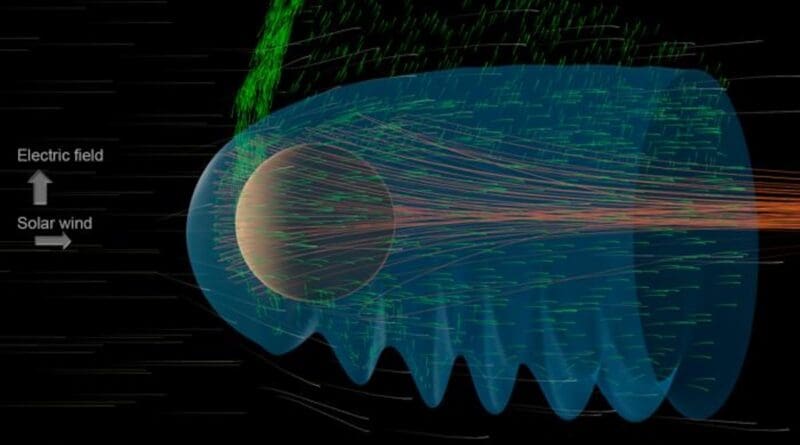
Depiction of Solar wind and electric field interacting. CREDIT: Chi Zhang, Boston University
Without a strong global magnetic field, Mars’ upper atmosphere is directly exposed to the solar wind, which can strip atmospheric particles into space in a process resembling wind generating waves on water.
Dual observations from MAVEN and Tianwen-1 reveal that Kelvin–Helmholtz waves stir the edge of Mars’ atmosphere, creating large plasma clouds that drive bulk escape of ions—mainly on one side of the planet depending on the solar wind electric field.
This mechanism helps explain how Mars lost much of its once-thicker atmosphere, with future studies and missions like ESCAPADE aimed at quantifying how strongly these waves contribute to atmospheric loss on Mars and similar unmagnetized planets.
Our Sun constantly releases a stream of high-speed charged particles, known as the solar wind. Unlike Earth, Mars does not have a strong global magnetic field to shield its atmosphere from this flow. As a result, the solar wind can interact directly with the upper atmosphere of Mars and gradually strip atmospheric particles into space.
A new Boston University-led study published in Science Advances found that this removal process can occur in a way that is similar to wind blowing across the surface of water. On Earth, wind can generate rolling waves and vortices on the water surface. At Mars, the solar wind can similarly “stir” the edge of the planet’s upper atmosphere and generate large boundary waves, known as Kelvin–Helmholtz waves.
First author Chi Zhang, a research scientist at BU’s Center for Space Physics, a collaboration between BU’s College of Arts & Sciences and College of Engineering, and a team of researchers used observations from both the MAVEN and Tianwen-1 missions in the study. Tianwen-1 served as a solar wind monitor, while MAVEN observed atmospheric ions escaping near Mars, allowing the researchers to directly relate real-time upstream solar wind conditions to atmospheric ion escape at Mars.
Large clouds of plasma in Mars’ upper atmosphere facilitate “bulk escape” of atmospheric ions. Zhang explained that, although several mechanisms had previously been proposed to account for the formation of these clouds, their origin remained unclear because direct observational evidence was still lacking. A major challenge in connecting the solar wind to atmospheric escape at Mars was that a single spacecraft could not simultaneously measure both the undisturbed solar wind upstream and the escaping atmospheric ions near Mars. In an earlier study published in Nature Communications, Zhang and colleagues demonstrated that simultaneous observations from MAVEN and Tianwen-1 could directly link variations in the upstream solar wind to the Martian space environment. Building on those dual-spacecraft observations, the new Science Advances study identified Kelvin–Helmholtz waves as a key mechanism driving atmospheric ion escape.
Zhang and colleagues provided clear evidence that these plasma clouds are generated by the Kelvin–Helmholtz waves. They further showed that this process does not occur evenly around the planet. “Instead, it is mainly observed on one side of the planet, depending on the direction of the solar wind electric field,” said Zhang. These results establish a direct link between the Kelvin–Helmholtz waves and enhanced atmospheric ion escape from Mars.
“Future research will focus on identifying the conditions that favor the formation and growth of Kelvin–Helmholtz waves and determining how much they contribute to atmospheric escape from Mars,” Zhang noted. Further studies will require more spacecraft observations and advanced numerical simulations. With MAVEN transitioning to the closeout stage of its mission, “its rich scientific legacy will be complemented by NASA’s ESCAPADE mission, which has already launched and will provide an important new opportunity to investigate solar-wind-driven atmospheric loss at Mars,” said Zhang.
“We want to know when these waves are most likely to form, how they evolve, and how strongly they can drive atmospheric escape,” said Chuanfei Dong, a BU Center for Space Physics faculty member and a College of Arts & Sciences assistant professor of astronomy. “This process could also occur on other planets that lack a strong magnetic field, including some exoplanets.”
“Mars is thought to have once been potentially habitable, with a thicker atmosphere and surface liquid water. Understanding how it became the cold, dry planet we see today is important for understanding how planetary environments evolve over time,” said Zhang.
Scientists Use Moonquakes To Locate Lunar Ice
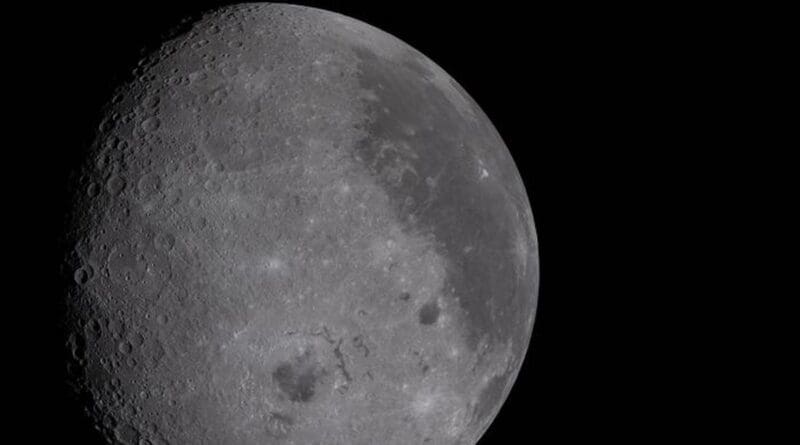
On the first shift during the lunar flyby observation period, the Artemis II crew captured more than two-thirds of the Moon showcasing the intricate features of the nearside. The 600-mile-wide impact crater, Orientale basin, lies along the transition between the near and far sides and is sometimes partly visible from Earth. The round black spot northeast of Orientale is Grimaldi crater, known for its exceptionally dark mare lava floor and heavily degraded rim. CREDIT: NASA
Seismic waves can detect and map buried water ice on the Moon because ice stiffens lunar soil, making vibrations travel two to three times faster and causing energy to bounce back. Laboratory tests, temperature modeling of polar craters, and computer simulations of moonquakes all showed clear seismic signatures of ice, offering a practical way to locate resources for NASA’s Artemis missions and future outposts.
Upcoming landers, including China’s Chang’e-7 (late 2026) and NASA instruments planned for 2028, will be able to test these predictions and potentially reveal ice deposits that could supply drinking water, oxygen, and rocket fuel.
Finding water on the moon may only be a matter of detecting the right vibrations.
A new study by geologists at the University of Maryland, Lawrence Berkeley National Laboratory and the University of Hawaii shows that seismic waves—the same kind of vibrations measured during earthquakes—could be used to locate and map ice buried beneath the lunar surface.
The team’s findings, published in the journal Science Advances on July 31, 2026, come at a pivotal moment. NASA’s Artemis program is targeting the moon’s south polar region for crewed landings in 2028, and water ice hidden in the deep, frozen shadows of polar craters is considered one of the most valuable resources an astronaut can find. Melted and purified, the ice can become drinking water. Split apart with electricity, the ice yields oxygen to breathe and hydrogen for rocket fuel, which means that locating a steady supply of lunar ice could dramatically reduce what future missions need to haul from Earth.
“It’s crucial to identify any materials on the moon that an astronaut can make use of while they’re up there,” said Nicholas Schmerr, an associate professor in UMD’s Department of Geological, Environmental, and Planetary Sciences and a co-author of the study. “Since they will be limited by the few resources they brought from Earth, anything they find on the moon will help them basically live off the land, especially for longer-term missions or outposts.”
Right now, no one knows exactly how much ice is on the moon or where it is. Satellites can scan the lunar surface from orbit, but they can only see the top layer of soil. Deposits of water ice may lie much deeper inside—and that’s where this new research comes in.
The idea behind the team’s work was straightforward: frozen soil and dry soil behave very differently when a seismic wave passes through them. Ice stiffens whatever it’s mixed into, making vibrations travel two to three times faster than they would through dry dirt. Ice-rich zones can also cause seismic energy to bounce back rather than pass through, much like how sounds can echo off a wall. Schmerr noted that a well-placed seismometer on the moon would be able to detect these effects.
“We can use seismic waves to not just see whether ice is present but also roughly how much of it there is,” he explained.
To test their theories, the researchers took three approaches. The study’s lead author, Harrison Lisabeth (Ph.D. ’16, geology), a rock physicist at Lawrence Berkeley National Laboratory and UMD alum, froze a volcanic rock from Arizona that when crushed, closely mimics moon dust. He then used X-rays to study how ice settles into tiny gaps between soil grains. Co-author Matthew Siegler from the University of Hawaii modeled detailed temperature maps of the moon’s south polar region, identifying which craters stayed cold enough to preserve ice for billions of years. At UMD, Schmerr ran computer simulations of small moonquakes rippling through and interacting with underground lunar ice. In every case, the ice left clear and measurable marks on the seismic data.
Beyond its practical value to astronauts, lunar ice also has scientific significance. The moon’s shadowed craters can freeze and trap volatiles like water ice, preserving them undisturbed over long timescales—and because the lunar rocks themselves date back some four billion years, studying that ice could reveal how water was delivered to the early solar system.
“The moon witnessed some of the most critical parts of the early solar system, including how water was delivered,” Schmerr said. “Studying the ice deposited there could reveal how water spread and ultimately how Earth’s oceans formed.”
The researchers won’t have to wait long to put their predictions to the test. China’s Chang’e-7 mission, which will carry a seismometer, is expected to land near Shackleton Crater in late 2026, and there are numerous suspected ice deposits in its vicinity. In 2028, NASA’s Artemis astronauts will potentially deploy the Lunar Environmental Monitoring Station, an instrument Schmerr helped develop for seismic exploration.
“Our findings are laying the groundwork for an observation we’ll get in the next couple of years,” Schmerr said. “No one has physically measured the ice on the moon.
Black Hole Feeding Frenzy Ends In Cosmic Indigestion
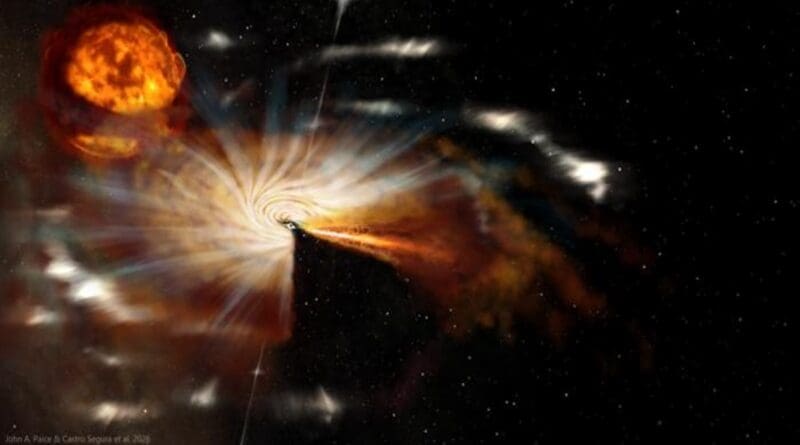
Artist impression of SwiftJ1727 with donor jet clouds. Credit: John A. Paice & Noel Castro Segura et al, ‘SwiftJ1727 - Final - No Overlay – DonorJetClouds’, (2026).
Black holes act more like cosmic digestive systems than bottomless pits. Observations of Swift J1727.8−1613 show that while the black hole consumes gas from a companion star, it simultaneously expels large amounts of material as jets and winds.
Powerful outflows continue even when the black hole is very faint. Dense gas was still being blown away after the system faded to just 1% of its peak activity, suggesting black holes remain inefficient eaters long after major outbursts.
The study provides one of the most detailed optical records of a black hole outburst. Using the VLT, researchers tracked the full cycle of feeding and expulsion in real time, revealing a strong link between inflowing disc material and outgoing jets/winds.
University of Warwick-led astronomers discover the cosmic digestive system of a black hole – showing that even when black holes appear faint, they’re not simply bottomless pits.
Black holes are often portrayed as cosmic gluttons that swallow everything that comes too close. But new observations of a dramatic black hole outburst – led by Warwick Postdoctoral Fellow Dr Noel Castro Segura – suggest the reality is much messier.
Using the European Southern Observatory’s Very Large Telescope (VLT), astronomers have followed the newly discovered black hole system, Swift J1727.8−1613, through a spectacular 2023 eruption.
Astronomers found that as the black hole consumed gas from a nearby star, it simultaneously launched some of that material back into space in the form of jets and winds. Critically, the massive outflows of material happen when black holes are very faint, when its activity is very low, much lower than previously thought – meaning black holes may behave less like bottomless pits and more like powerful cosmic digestive systems.
“People often imagine black holes simply swallowing everything around them,” said lead author Dr Noel Castro Segura, a Postdoctoral Fellow at the University of Warwick. “What we’re seeing is a much more complex process. Matter falls in, the system processes it, and a surprising amount is expelled again.”
The study provides one of the most detailed optical records yet of a black hole outburst, allowing researchers to watch how the system changed over time, rather than relying on a few observations. Rather than seeing a blackhole feeding from a star as a single photo, the evidence collected is throughout state changes.
Swift J1727.8−1613 was discovered when it suddenly flared into life in 2023, rapidly becoming one of the brightest X-ray sources in the sky. The system consists of a black hole pulling gas from a nearby star, creating a swirling disc of superheated material around it. During the outburst, astronomers had the opportunity to watch this feeding process unfold in real time as vents have rarely been observed in such quality.
One of the study’s most intriguing findings was that, as the black hole expelled a powerful jet, the disc feeding it also underwent significant changes. This offers a rare glimpse of the connection between matter falling towards a black hole and matter being expelled back into space.
Perhaps the most surprising result came after the black hole’s feeding frenzy had largely subsided. Even when Swift J1727 had faded to around one hundredth of its peak activity, the researchers found evidence that dense gas was still being blown away from the system.
The discovery suggests that black holes may continue driving powerful outflows long after their brightest activity has ended. In fact, the amount of material being expelled could rival the amount ultimately consumed by the black hole itself.
Reflecting on the digestive process of black holes, Dr Noel Castro Segura continued, “if black holes can continue shedding material even after their largest outbursts, it means they may be much less efficient eaters than we previously assumed. A significant fraction of the meal may never reach the black hole at all, changing our understanding of how binary stars in galaxies evolve.”
The observations add to growing evidence that black holes are not simply cosmic eaters. Instead, they appear to be dynamic systems that both consume and redistribute matter — taking material in, processing it and returning a substantial fraction to space through jets and winds.
Commenting on the research, Kyle Solomons, Doctoral Researcher at the University of Cape Town, said: “We usually gravitate towards the dramatic fireworks when a black hole outburst begins, but our observations show that the finale can be just as intense. Even as the system’s X-ray emission dropped to a fraction of its peak, it still had enough power to generate a massive expulsion of gas.”
For Swift J1727.8−1613, astronomers were able to watch that entire cycle unfold during a single outburst, providing one of the clearest views yet of how black holes feed, react, and influence their surroundings.
Cutting sugar up to age two associated with lower dementia risk ‘decades later,’ study finds
Less sweet treats during pregnancy and up to age two associated with lower dementia risk later in life, delayed onset of the disease and a healthier brain, according to a new study.
The research suggests that reducing sugar intake during the earliest stages of life was associated with a lower risk of dementia, a later onset of the disease and better markers of brain health in later life.
“Limiting sugar during the earliest stages of life may have lasting benefits for brain health,” said study author Jiazhen Zheng, of The Hong Kong University of Science and Technology in Guangzhou, China. “These results highlight the potential importance of early-life nutrition in reducing the risk of dementia decades later.”
Researchers analysed data from nearly 65,000 people born before and after World War II, when the British government introduced sugar rationing across the United Kingdom.
Sugar rationing, introduced during and after the war, ended in 1953. Once restrictions were lifted, average daily sugar consumption nearly doubled, rising from around 41g to 80
The researchers grouped participants according to their exposure to sugar rationing: those exposed before birth and during their first year of life, those exposed before birth and up to the age of two, and those born after rationing had ended.
Using medical records from the time participants were around 55 years old, the researchers tracked dementia diagnoses over the following 15 years.
People exposed to sugar rationing before birth and during their first year of life had a 21% lower risk of dementia than those born after sugar rationing ended. Those exposed to rationing before birth and up to the age of two had a 23% lower risk of dementia.
Among people who developed dementia, those exposed to lower sugar levels early in life were diagnosed an average of 2.6 years later than those who were not.
“Sugar restriction in the first 1,000 days was associated with lower dementia hazards, delayed onset, and more favorable brain-health profiles,” researchers wrote, adding that the findings support reducing sugar intake early in life as a potential strategy to lower dementia risk.
“Limiting added sugars during pregnancy and infancy may be one beneficial step that families and communities can take,” Zheng said, while stressing that further research is needed to understand how early-life sugar exposure influences dementia risk.
BORDERLESS PEOPLES
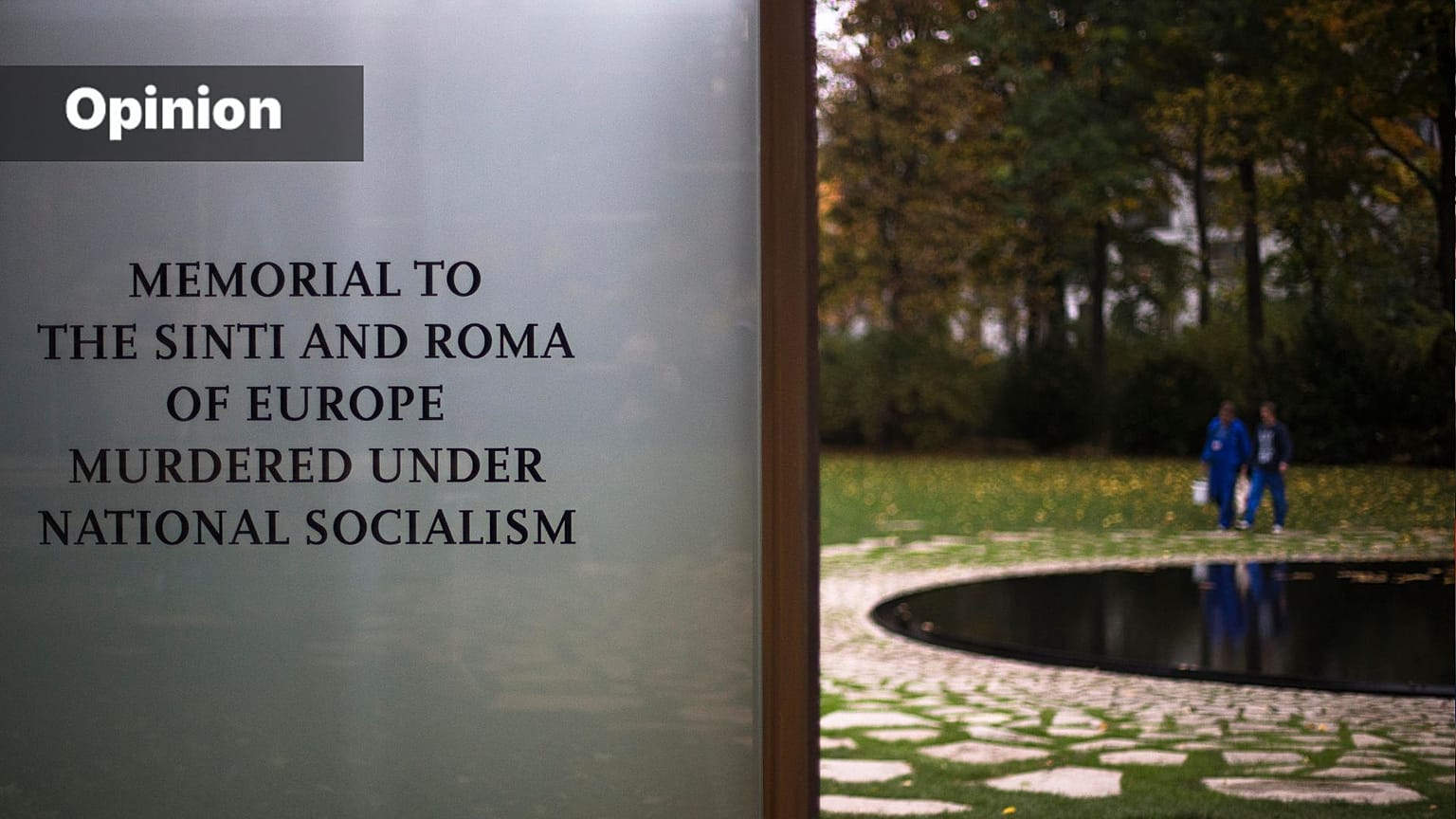
Euroviews. Memorial Day of Sinti and Roma: The genocide Europe struggles to remember
Copyright (AP Photo/Markus Schreiber)
By Michaela Küchler, Secretary General of the International Holocaust Remembrance Alliance
Published on
The opinions expressed in this article are those of the author and do not represent in any way the editorial position of Euronews.
Every year on 2nd August, Genocide of the Roma Memorial Day, Europe remembers the hundreds of thousands of Roma and Sinti people persecuted and murdered during the Nazi era. The real question is what happens on 3rd August – and every day thereafter asks Michaela Küchler in an OpEd für Euronews.
Victims of persecution can be lost twice: first when their lives are taken, and then when their names are quietly mislaid by history.
Victims of persecution can be lost twice: first when their lives are taken, and then when their names are quietly mislaid by history.
For decades, one of the most haunting images of Nazi persecution was known simply as the “girl with the headscarf”. She was filmed looking through the closing doors of a train leaving the Westerbork transit camp and widely assumed to be Jewish. The image became famous. The girl did not. Only years later did historical research restore her identity.
Her name was Settela Steinbach. She was Sinti.
Photograph of Settela Steinbach at the exhibition ‘The Nazi Genocide of the Sinti and Roma’ – January 2008, Weimar, Germany (AP Photo / Jens Meyer) AP Photo
Settela was nine when she and her family were deported to Auschwitz-Birkenau in May 1944. She was most likely murdered there with her mother, two brothers, and two sisters on the night of 2-3 August 1944. Only the photograph survived. Her name, her identity, and the history of the people to whom she belonged almost vanished from the story attached to it.
Hundreds of thousands of Roma and Sinti people were persecuted and murdered during the Nazi era
Every year on 2nd August, Genocide of the Roma Memorial Day, Europe remembers Settela and the hundreds of thousands of Roma and Sinti people persecuted and murdered during the Nazi era. The real question is what happens on 3rd August – and every day thereafter. It is crucial not to allow a memorial day to become an annual exercise in solemn words followed by institutional amnesia.
Roma and Sinti people were subjected to racist laws, imprisonment, forced labour, deportation, mass shootings and murder across Europe – yet their genocide remains one of the least recognised chapters of Nazi persecution.
Roma and Sinti victims were denied recognition from national histories. Many survivors received neither justice nor proper acknowledgement.
That neglect did not end in 1945 – for decades, Roma and Sinti victims were denied recognition from national histories. Many survivors received neither justice nor proper acknowledgement. The prejudices that had helped make persecution possible did not obligingly disappear when the war ended.
Recognition remains patchy
Of course, some progress has been made. Some memorials have been established and research has certainly deepened. Survivors, descendants, scholars and organisations have painstakingly recovered names and histories. Indeed, it was such difficult and important work that gave the “girl with the headscarf” her name again.
But recognition remains patchy. In too many classrooms and museums, the genocide is still presented as an optional appendix to the history of the Nazi era rather than an integral part of it. Ask what happened to Roma and Sinti people under Nazi rule and the answer may still be a blank look. That silence is not the fault of young people born decades later – they cannot know what they have never been taught.
Nazi crimes did not begin with mass murder. They began with stereotypes, exclusion, paperwork, racial classification, and the steady removal of rights – the bureaucratic preliminaries to barbarism. Teaching this history shows how prejudice emerges as administrative and legal and eventually becomes lethal.
Teaching history must show Roma and Sinti as more than anonymous victims
It must also show Roma and Sinti people as more than anonymous victims. They had families, professions, communities, and ambitions. They resisted persecution and rebuilt lives afterwards. Settela was not merely the frightened child caught on film for a few seconds: she was a daughter and sister; her father was a trader and violinist. These facts restore the individuality that persecution tried to erase – they are not decorative detail.
As opportunities to hear directly from living survivors and witnesses become fewer, responsibility passes increasingly to institutions.
As opportunities to hear directly from living survivors and witnesses become fewer, responsibility passes increasingly to institutions. Because recognition came so late, many Roma and Sinti voices were never recorded in the first place, making the testimonies that remain all the more precious. We must preserve the historical record while continuing to document the experiences of those who are still able to share them. Archives must be opened, sites connected to the genocide safeguarded, photographs correctly identified, and Roma and Sinti perspectives placed at the centre of education and commemoration.
Europe’s commitment to remembrance cannot be measured only by ceremonies held on 2nd August
The International Holocaust Remembrance Alliance’s “Recommendations for Teaching and Learning about the Persecution and Genocide of the Roma during the Nazi Era” were developed to turn that obligation into something more useful than good intentions. Designed for governments, policymakers, teachers, museums, memorial sites, archives and civil-society educators, they provide a practical framework for why this history should be taught, what students should learn, and how it can be approached responsibly. The Recommendations help countries bring this history into mainstream education and memory culture, safeguard the historical record, counter distortion, and ensure that teaching includes Roma voices, resistance and crucially – agency. They also offer guidance on curricula, educational resources, and teacher training, while recognising national and local experiences and involving Roma communities themselves.
But our Recommendations cannot manufacture political will. They can, however, remove the excuse that nobody knows what practical action looks like. Europe’s commitment to remembrance cannot be measured only by ceremonies held on 2nd August, however moving or well attended. It must be measured by what happens in classrooms, archives, museums, and public institutions throughout the year.
Europe cannot return those who were murdered. It can at least refuse to lose them twice
The test is whether future students will still encounter silence where this history should be taught– and whether people like Settela remain merely an anonymous face in an old film, or are remembered as people with names, families, and a history.
Europe cannot return those who were murdered. It can at least refuse to lose them twice.
A career diplomat, Michaela Küchler has held a range of positions including Press Attaché in Santiago de Chile, Cultural Attaché in former Czechoslovakia, and Consul General in Chennai. She also served as a negotiator for European Union enlargement and as a European policy adviser to two Federal Chancellors and three Federal Presidents. As Chair of the International Holocaust Remembrance Alliance (IHRA) German presidency in 2020, she spearheaded initiatives to counter distortion of the Holocaust and the genocide of the Roma.