UK Launches Accelerated Auction for Abandoned Offshore Wind Site
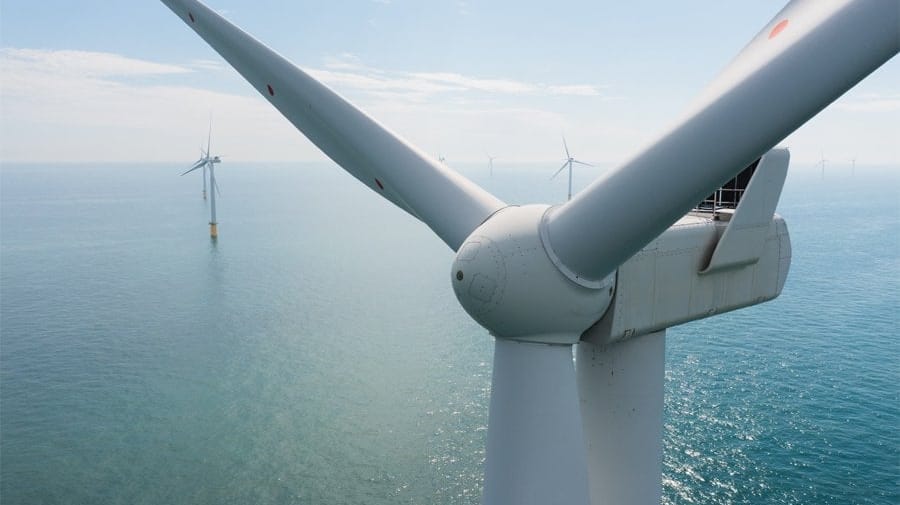
In what is seen as a key test for the UK’s offshore wind energy development plans, The Crown Estate announced that it is launching a new competitive tender for a large offshore wind farm in the Irish Sea. It reports that it has designed the process to derisk the project for new bidders while also accelerating the process to keep the UK’s offshore wind energy development on schedule.
The Morgan project is located in the Irish Sea and calls for approximately 1.5 GW of capacity. It was originally awarded in 2021 and was held in a joint venture between EnBW and what is now JERA Nex BP. The joint venture was dissolved in January 2026, with JERA Nex BP acquiring all rights to the adjacent Mona 1.5 GW wind farm and the lease abandoned back to the Crown Estate for the Morgan site. The Crown Estate had said it would move to quickly rebid the lease.
“Morgan is a strategically important offshore wind project that has already achieved significant development milestones. Our priority has been to move quickly and maintain the momentum already built behind the project,” said Gus Jaspert, Managing Director, Marine at The Crown Estate.
It points out that there has already been substantial progress on the development of Morgan, and that the goal is to preserve, wherever possible, the steps that had already been completed. A Development Consent Order was issued for Morgan in August 2025, and a decision on the order for the transmission assets is expected in September. A grid connection agreement was already reached with the National Energy System Operator.
The tender process was also streamlined in what The Crown Estate terms a “proportionate tender process.” It says there will be a transparent “rising clock auction” where bids will address a Site Exclusivity Fee as a lump sum paid over 20 years and payable when the project enters lease.
Bids are expected over the summer. The Crown Estate says it will select a preferred bidder toward the end of the year. This is ahead of the planned next round for offshore wind projects, tentatively set for the first half of 2027 and targeting 6 GW of additional capacity.
The UK government has set a target to reach an operational capacity of 50 GW of offshore wind by 2030. It currently has over 16 GW of operational offshore wind power with a total of over 30 GW either installed or committed. A further 7.2 GW of capacity is in the consent process. Losing the 1.5 GW Morgan project, however, could delay the ability to reach goals and send a signal of continued challenges in the industry.
Broken Wind Turbine Blade in North Sea Was a Menace to Shipping
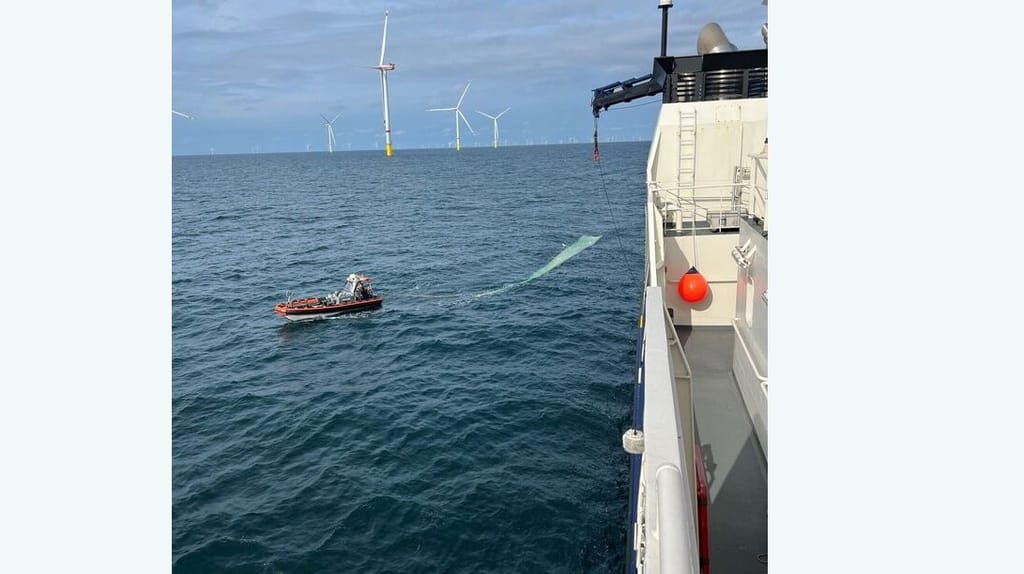
German police report they were able to recover a broken wind turbine blade that was drifting in the North Sea, creating a significant risk to navigation. The blade was recovered north of the German island of Borkum and is believed to have come from an under-construction offshore wind farm.
The Federal Police report they were advised that the blade was floating in a position between the Hohe See wind farm, which has been in operation since 2019, and the He Dreiht wind farm, which is under construction and expected to be commissioned in a few months. Both projects are owned by EnBW, and the police were advised that the companies had first attempted to recover the blade but were unsuccessful.
“Due to its size and composition, it posed a significant risk to maritime navigation,” said the Federal Police. It said the object floating in the water was 20 meters (approximately 66 feet) long and two meters (6.5 feet) wide and made of fiberglass coming from a wind turbine. Furthermore, it said the blade was floating just below the surface and was therefore difficult to spot.
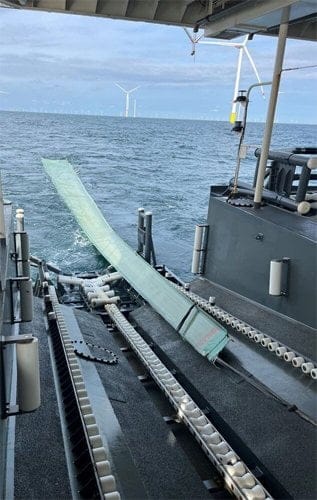
Blade was pulled aboard the patrol vessel and cut up (Federal Police)
The Waterways and Shipping Administration dispatched its patrol vessel Bad Duben (BP83) to the location, and it was redirecting shipping traffic in the area. The blade was floating between Hohe See, which is approximately 55 miles from Borkum, and He Dreiht, which is also over 50 miles from the island and approximately 65 miles from Heligoland. He Dreiht will consist of 64 wind turbines when it is completed.
The patrol vessel was able to locate the blade, and one of its launches was used to secure a line to the blade and tow it. The patrol vessel using its stern well was used to pull the blade out of the water. Because of its length, the crew used a saw to cut the blade into sections so that it could be entirely pulled aboard the patrol vessel.
The sections of the blade were unloaded in Cuxhaven on July 26. EnBW and Vestas, which manufactured the turbines, have not commented on how the blade ended up in the water. Cadeler was reported to be handling the installation, which was 70 percent complete as of June. The Waterways Authority said there would be an investigation.