It’s possible that I shall make an ass of myself. But in that case one can always get out of it with a little dialectic. I have, of course, so worded my proposition as to be right either way (K.Marx, Letter to F.Engels on the Indian Mutiny)
Tuesday, August 04, 2026
LNG Canada equity option agreement reached with five First Nations
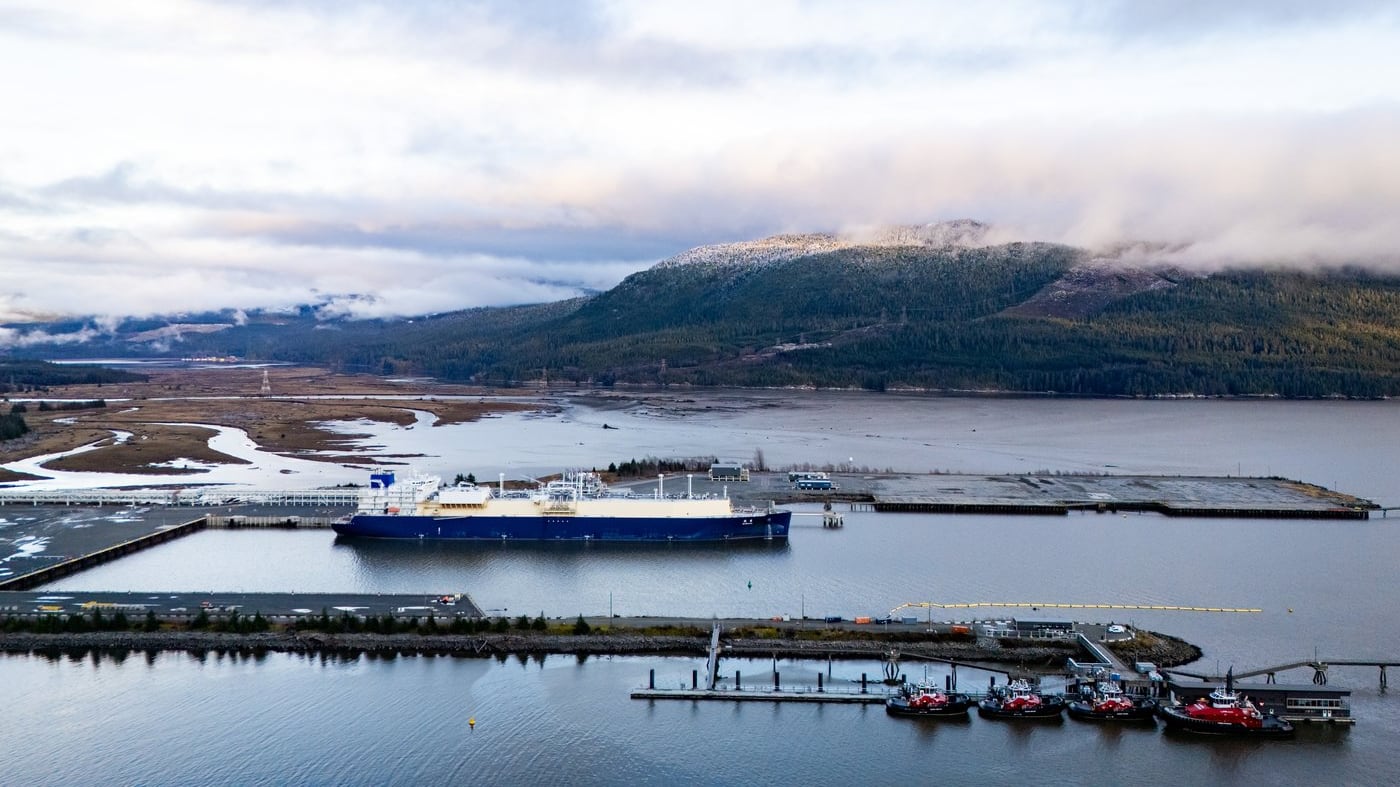
Wudang, a liquefied natural gas (LNG) tanker, fills up at an LNG Canada facility, in an aerial view, in Kitimat, B.C., on Thursday, November 13, 2025. THE CANADIAN PRESS/Ethan Cairns
KITIMAT — LNG Canada has reached an agreement with five neighbouring First Nations in northern B.C. that would provide them an option to invest up to $1-billion in the project’s proposed second phase.
The equity option agreement is with MNT Investments LP, which includes development organizations from the Gitga’at, Gitxaała, Haisla, Kitselas and Kitsumkalum.
MNT would be able to buy a majority stake in a special-purpose entity that would, in turn, buy a storage tank to be built as part of LNG Canada’s second phase.
The tank would then be leased back to LNG Canada for as long as the project in Kitimat, B.C., operates.
LNG Canada, led by Shell Canada alongside four Asian companies, aims to make a final investment decision by year-end on an expansion project that would double the current plant’s planned output.
The equity option agreement with the First Nations is conditional on the partners approving Phase 2, which has been referred to the federal major projects office.
This report by The Canadian Press was first published July 14, 2026.
Pakistan Partners with Canadian Firm to Boost Domestic Heavy Crude Output
Pakistan's national Oil and Gas Development Company Limited (OGDC) has signed an agreement with a Canadian firm to deploy advanced technology to boost production from heavy crude oilfields, the largest Pakistani exploration and production firm has said.
Under the agreement with Canada's Synergetic Oil Tools Inc, OGDC will deploy advanced Passive Energy Tool technology aimed at optimizing and boosting production from heavy crude oil fields, the Pakistani firm said.
The technology "is designed to improve flow assurance in highly viscous crude oil wells by optimizing fluid characteristics, reducing the frequency of workovers, minimizing well downtime, lowering operating costs and decreasing the use of production chemicals," OGDC added.
Pakistan has been scrambling for oil supply since the Iran war started despite being very close to the Middle East and a key mediator in some of the U.S.-Iran talks.
The country is looking to boost its domestic crude oil production to reduce its reliance on imports and to encourage oil producers from the Persian Gulf to set up crude reserve buffers at a planned Energy City near one of Pakistan's ports.
OGDC, for its part, holds the largest exploration acreage in Pakistan and has the highest oil and gas reserves in the country. OGDC produces about 166,497 barrels of oil equivalent per day (boepd). This output makes the state-owned firm producing nearly half, or 49%, of domestic crude oil, 28% of Pakistan's natural gas, and 34% of liquefied petroleum gas (LPG) output.
OGDC operates key fields including Qadirpur, Nashpa, Mela, KPD-TAY, and Bettani, and continues to expand through new exploration blocks.
Early this year, OGDC announced an oil and gas discovery at its exploratory well Baragzai X-01 in the Khyber Pakhtunkhwa Province.
At the end of last year, Pakistan signed five deals for oil and gas exploration with local private and state-owned companies that will develop three offshore and two onshore blocks.
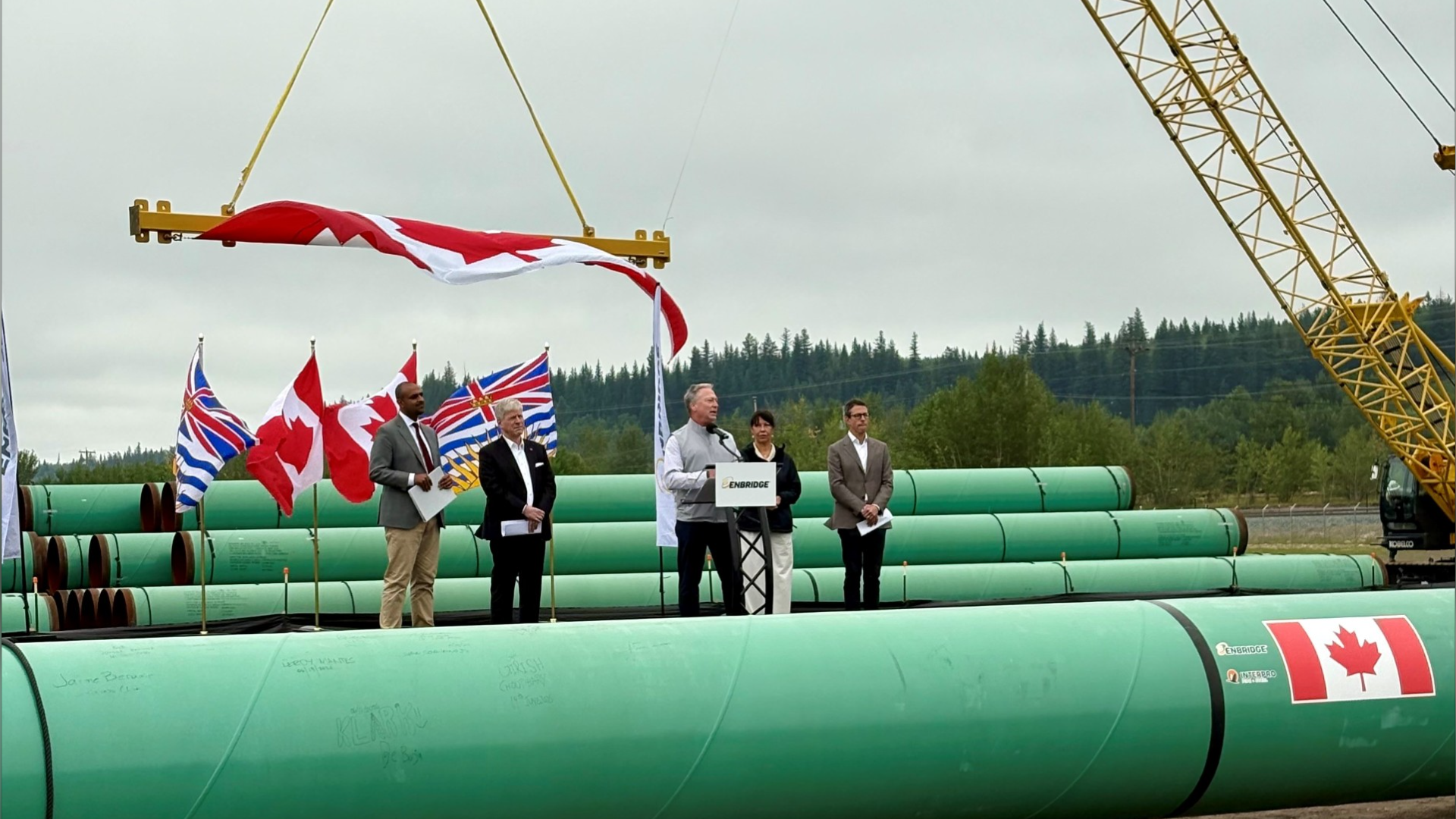
Canadian pipeline operator Enbridge has postponed the 250,000-barrel-per-day second phase of its Mainline crude pipeline network, it said on Friday, partly because Canadian oil producers have not committed to significant output increases.
The Mainline pipeline is Canada’s largest crude oil export pipeline and can already move 3 million barrels per day of crude from Western Canada to markets in Eastern Canada and the U.S. Midwest.
The second phase would have increased exports of Canadian crude to U.S. refineries.
But Enbridge CEO Greg Ebel said the company will focus first on its 100,000 bpd Flanagan South Expansion and its 50,000 bpd Southern Access Extension, which are smaller projects in scope.
They will add capacity to two secondary pipelines that connect to the Mainline in Illinois and transport crude to multiple U.S. refining centers and the Gulf Coast.
Enbridge is soliciting contracted volumes for the two pipelines through commercial open season processes.
Growing Canadian oil output
Canadian oil production is growing and hit a record high of 5.1 million bpd on average last year.
Expectations of further growth have in recent months spurred multiple proposals for additional export pipeline projects, including by South Bow and Bridger Pipeline to revive parts of the former Keystone XL project.
Enbridge has already committed to a first-phase Mainline expansion project, which would add 150,000 bpd of capacity and be placed into service by 2027. The company had previously projected the second phase could be in-service as early as 2028.
Ebel said Canada has a generational opportunity to expand its oil output as a result of federal government policy changes over the past year and the rollback of some environmental rules.
He also said that although agreements between the federal government and Alberta aimed at accelerating oil sands growth could have a major impact, most of the proposed changes remain non-binding and have yet to be enshrined into law.
Enbridge does not expect Canadian oil sands companies to meaningfully boost production until there is more policy and regulatory certainty, said Colin Gruending, the company’s president of liquids pipelines.
“Nor do we expect producers to be making binding FID-able commitments to new pipelines until then,” Gruending said, referring to final investment decisions.
He said Enbridge may have been too quick to propose the Mainline phase two project, but that the company was confident the project will eventually be needed.
Earlier this month, Alberta and the federal government announced plans for a potential 1 million bpd oil pipeline to Canada’s British Columbia coast, but no decisions have been made to go ahead with either that project or the South Bow-Bridger proposal.
(Reporting by Amanda Stephenson in Calgary; Editing by Rod Nickel and Barbara Lewis)
BOYCOTT CAT: ZIONIST TOOL OF DESTRUCTION OF GAZA
Caterpillar raises 2026 revenue growth target after quarterly profit beat
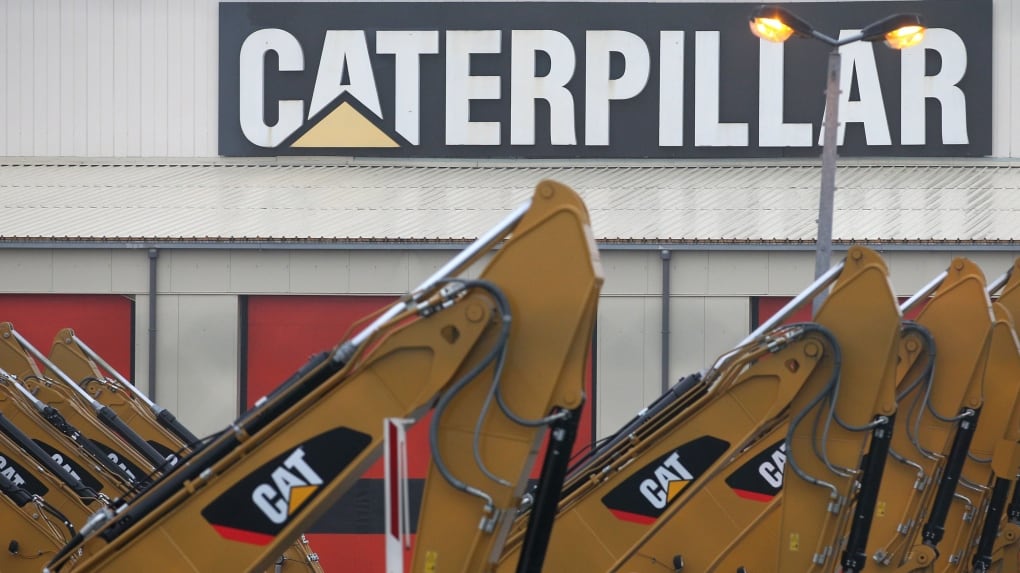
This Thursday, Feb. 28, 2013 file photo, heavy equipment is parked at the site of Caterpillar Belgium, in Gosselies, Belgium. U.S. (AP Photo/Yves Logghe, File)
Caterpillar raised its revenue growth forecast after beating second-quarter profit estimates on Tuesday, benefiting from a buildout of AI data centers that has spurred demand for its power-generation and construction equipment.
Shares of the company rose 9 per cent in premarket trading as it also cut its tariff costs forecast for the full year to around US$2.2 billion from an earlier forecast of US$2.2 billion to US$2.6 billion.
Over the last few quarters, the equipment giant has seen a surge in orders for construction equipment amid a nationwide buildout of data centers as well as the backup power equipment needed for such buildings.
Lowered tariffs in the U.S. and a flood of orders have overhauled the fortunes of equipment manufacturers such as Caterpillar, whose profits were upended at this time last year by Washington’s move to curb imports by raising levies.
Increased spending on infrastructure and energy projects by U.S. President Donald Trump’s administration as well as a boost in the construction of commercial buildings such as data centers are key reasons for Caterpillar’s swelling order books.
In the April to June quarter, Caterpillar said it booked orders worth US$9.4 billion, taking its order backlog to a record US$72.1 billion.
Its overall revenue grew 24 per cent to US$20.54 billion in the quarter ending June 30. Its core construction segment revenue grew 35 per cent in that period, led by a 50 per cent jump in the North America market.
The power and energy arm, meanwhile, posted 17 per cent growth in revenue. The two segments accounted for a combined 81 per cent of Caterpillar’s total revenue.
It reported adjusted per-share profit of US$8.17, compared with US$4.72 per share a year earlier, well above analysts’ expectation of US$6.20 per share, according to data compiled by LSEG.
Caterpillar expects its full-year revenue to grow in the mid-to-high-teens percentage range, compared to an earlier projection of low-double-digit growth.
(Reporting by Nandan Mandayam in Bengaluru; Editing by Pooja Desai)
SCI-FI-TEK 70YRS IN THE MAKING
Commonwealth Fusion Systems raises a further USD1 billion
US private fusion company Commonwealth Fusion Systems announced it raised USD1 billion of additional equity financing - the single largest funding round among fusion energy companies worldwide since CFS announced its USD1.8 billion Series B round in 2021.
(Image: CFS)
"With this capital, and the USD863 million the company raised last year, CFS has now raised a total of USD4 billion," the company said. "This USD4 billion represents about 30% of the total capital raised by the fusion industry to-date, reinforcing CFS's position as the world's largest and leading fusion company."
CFS said its global network of private investors expanded with the addition of a growing number of institutional investors, including pension funds, sovereign wealth funds, infrastructure investors, and industrial corporate partners. "This widening diversity and maturation of CFS's capital stack reflects the real evidence investors see in the assembly of SPARC and parallel development of its ARC power plant," it said. "In this concrete progress, investors see that CFS is maturing and have expressed trust in CFS's focused approach to commercialising fusion."
CFS said it will use the funds raised to further accelerate its progress to commercialisation.
CFS - spun out of the Massachusetts Institute of Technology in 2018 - is currently building the SPARC prototype fusion machine at its headquarters in Massachusetts. It is described as a compact, high-field, net fusion energy device that would be the size of existing mid-sized fusion devices, but with a much stronger magnetic field. The donut-shaped device will use powerful electromagnets to produce the right conditions for fusion energy, including an interior temperature surpassing 100 million degrees Celsius. It is predicted to produce 50-100 MW of fusion power, achieving fusion gain greater than 10.
The plan is for SPARC to pave the way for a first commercially viable fusion power plant called ARC, which is intended to generate about 400 MWe - enough to power large industrial sites, or about 150,000 homes. ARC, at the company's Fall Line Fusion Power Station in Chesterfield County, Virginia, is scheduled to deliver power to the grid in the early 2030s.
"CFS is making what once was impossible into inevitable," said the company CEO and co-founder, Bob Mumgaard. "In the 2030s, we will put commercial fusion on the grid. We have the science that works and the proven execution that's consistently validated by the market. We regularly welcome investors from around the world to our headquarters in Devens, Massachusetts, where they see real and tangible progress as we ready support systems and finalise the assembly of SPARC. In unlocking commercial fusion energy, we're on a path to make an impact at a civilisational level."
KIT becomes research hub for fusion technology
Federal government relies on KIT's expertise in building a fusion reactor
The Fusion Action Plan initiative was launched by the Federal Government to advance the construction of the Germany’s first fusion reactor. This involves establishing three research hubs. The aim is to pool expertise from science and industry to master the technological challenges associated with fusion energy. A request for proposals for three hubs to receive funding had been launched by the Federal Ministry of Research, Technology and Space (BMFTR). On July 29, 2026, the BMFTR announced its decision: One of the hubs will be set up at KIT. KIT’s research will focus on the development of the fuel cycle and new materials, and the technical implementation in the fusion power plant.
Petra Olschowski, Baden-Württemberg’s Minister for Science, Research, and the Arts, emphasized that the decision by the BMFTR will strengthen German fusion research and Baden-Württemberg as a center of science and innovation. “How soon fusion can play a role in the energy mix of the future depends mainly on the technological progress made in materials research and in the development of the fuel cycle. This is exactly where the Karlsruhe researchers rank among the world’s best: Materials suitable for fusion reactors are a decisive building block when it comes to enabling fusion technology. An equally relevant asset are the key skills KIT can provide for setting up a safe and sustainably working fuel cycle including the production of tritium, the element necessary for a working fusion process. The fact that KIT has been chosen for setting up one of the hubs will strengthen the leading role of Baden-Württemberg in fusion research in the long run. It clearly demonstrates the success of our approach, which focuses on future technologies and the alignment with the High-Tech Agenda Germany.”
Karlsruhe as an Ideal Site
“I’m very happy about the decision made by the Federal Ministry,” said Professor Jan S. Hesthaven, President of KIT. “We’re among the top institutions for fusion technology. Our expertise and our unique infrastructures make KIT an ideal site for this research. The Karlsruhe fusion hub will allow us to advance our research specifically in view of the key requirements for future fusion power plants.”
“Fusion energy has the potential to provide enormous amounts of energy. We at KIT are working to make it usable in practice as soon as possible,” said Professor Christoph Kirchlechner, speaker of the Fusion Program at KIT. “Together with our partners, we are developing technologies to enable safe, reliable, and economically viable fusion power plants.”
Industry will play a key role in this effort. According to Kirchlechner, the aim of the hub is to involve companies in the development of the technologies and to jointly establish the foundations for an efficient supply chain in the fusion industry. As the interface between the different fusion industry branches, the Karlsruhe hub brings together the Proxima Fusion and Gauss Fusion magnetic fusion companies with the Focused Energy and Marvel Fusion laser fusion companies. In total, more than 30 partners are involved in the effort. This includes universities, non-university research institutions, and established industrial companies.
Three Hubs Pave the Way to the Fusion Reactor
While two hubs will focus on magnetic confinement fusion and laser fusion, the third one is dedicated to the fuel cycle, the development of new materials, and the technical implementation in the power plant. KIT had applied for this hub to contribute the institution’s long-standing know-how and speed up the transfer of scientific findings to industrial applications.
KIT is renowned as one of the internationally leading institutions in these areas. The research conducted by the KIT researchers includes the development of breeder blankets, which are required for synthesizing tritium as the fuel for fusion reactions, technologies for its safe fuel-cycle management, and materials that permanently resist the extreme temperatures and high neutron fluxes.
In addition, key technologies such as high-frequency systems for plasma heating and components for the continuous operation of future plants are being developed at KIT. “It’s crucial to devise and combine these technologies with integration in mind,” said Kirchlechner. “This is the only way to arrive at solutions that work reliably in the power plant and can be operated economically.”
From Large-scale Research to Industrial Application
Considerable scientific and technical challenges must be overcome until a fusion power plant can actually supply power to the grid. At the same time, nuclear fusion is gaining momentum worldwide as a strategic future technology. Thus, fundamental research, the development of technologies, and educational efforts are closely linked at KIT. This includes areas such as providing highly specialized test facilities and qualifying specialists for handling complex systems such as the fusion fuel tritium. The aim is to establish the preconditions for developing fusion technology as a reliable complement to renewables in the long term.
In close partnership with society, KIT develops solutions for urgent challenges – from climate change, energy transition and sustainable use of natural resources to artificial intelligence, sovereignty and an aging population. As The University in the Helmholtz Association, KIT unites scientific excellence from insight to application-driven research under one roof – and is thus in a unique position to drive this transformation. As a University of Excellence, KIT offers its more than 10,000 employees and 22,800 students outstanding opportunities to shape a sustainable and resilient future. KIT – Science for Impact.

_78501.jpg)