Friday, July 24, 2026

‘This isn’t a peacekeeping initiative — this is a terror campaign’: Texas faith leaders condemn ICE deaths


AUSTIN, Texas (RNS) — A news conference inside the state Capitol brought together about two dozen leaders from the United Methodist Church, the Episcopal Diocese of Texas, the South Central Conference of the United Church of Christ, the National Council of Jewish Women and other faith-related groups.
Bishop Sue Briner with the Southwestern Texas Synod of the Evangelical Lutheran Church in America speaks against ICE activities in Texas and calls for an end of the current violent immigration enforcement regime at the Texas Capitol on July 22, 2026. Briner was joined by bishops, pastors, deacons, rabbis and other faith leaders across the county. (Photo courtesy of Aiden Gonzalez/The Texas Tribune)


AUSTIN, Texas (RNS) — A group of religious leaders gathered Wednesday (July 22) at the Texas State Capitol to condemn recent immigration enforcement-related deaths in Texas, Maine and Florida and to demand that federal immigration agents end what one pastor called a “terror campaign” against migrants. 

“We grieve every death, every act of violence and every enforcement practice that unnecessarily endangers human life or diminishes the God-given dignity of our immigrant neighbors,” said Bishop Sue Briner of the Southwestern Texas Synod of the Evangelical Lutheran Church in America. “When fear begins to shape the daily lives of our neighbors, it is time for the church to show up.”

The news conference inside the Capitol brought together about two dozen leaders from the United Methodist Church, the Episcopal Diocese of Texas, the South Central Conference of the United Church of Christ, the National Council of Jewish Women and other faith-related groups. Texas Impact, an interfaith grassroots advocacy network, organized the event in response to the July 7 fatal shooting of Lorenzo Salgado Araujo during a traffic stop by U.S. Immigration and Customs Enforcement agents in Houston.

The religious leaders present condemned deportations, detention centers and enforcement-related deaths involving ICE amid the Trump administration’s mass deportation efforts.

Federal agents who determine that their actions have been immoral should “resign and find other work,” said the Rev. Jim Harrington of St. James’ Episcopal Church in Austin, where he works with immigrants, and who is also a lawyer who founded the Texas Civil Rights Project. 

“Following orders is never a justification in the Christian tradition — nor in international law — to perpetuate evil,” Harrington said.


The Rev. Dan De Leon, senior pastor at Friends Congregational Church in College Station, invoked the Sermon on the Mount. “Jesus says, ‘Blessed are the peacemakers, for they will be called children of God.’ Notice that Jesus does not say, ‘Blessed are the peacekeepers,’ which is what ICE alleges to be doing in our communities,” De Leon said.

This isn’t a peacekeeping initiative — this is a terror campaign with the mission of traumatizing our neighbors until they self-deport,” De Leon said.

Jewish leaders turned to their faith as well: “Jewish tradition teaches that whoever saves a life saves the entire world, and conversely, whoever destroys a life destroys the whole world,” said Bettie Forman, with the National Council of Jewish Women Austin.

Others called for accountability and transparency. 

“Candidates for law enforcement must be properly vetted, fully and carefully trained, and held accountable when they do not meet appropriate standards,” said Elyse Rosenberg, who represented NCJW and is a member of Temple Beth Shalom, a Reform synagogue in Austin.

“Throughout our history, we have repeatedly seen firsthand the consequences of governments exercising unchecked power on vulnerable populations,” she said, adding that accountability should include impartial investigations of agent-involved shootings. 

Earlier this week, multiple news outlets reported the FBI would no longer investigate confrontations with immigration agents. Federal officials denied the change. 

The religious leaders also pressed for:

  • Clear limits on the use of lethal force and an end to dangerous tactics when pulling over vehicles. 
  • Restrictions on using unmarked vehicles and plainclothes agents.
  • Clearly visible identification and body cameras for federal immigration agents. 
  • Independent oversight of ICE operations with meaningful consequences if agents violate policy or the law. 

Families also deserve to be treated humanely and should never learn through social media that a loved one has been detained, seriously injured or killed, said Grace Bonilla, a policy advocate with Texas Impact.


“We are here today because Texans of faith and conscience refuse to accept what we witnessed in Houston as proper immigration enforcement,” Bonilla said, referring to Araujo. “That conviction does not conflict with border security. We recognize the federal government’s responsibility to enforce our immigration laws and maintain our borders, but enforcement must never come at the expense of human life.”

Texas state Rep. Vikki Goodwin, the Democratic candidate for lieutenant governor, attended the news conference, calling the religious leaders’ requests reasonable and encouraging legislators to pay attention. 

“I think the local or state government can have an impact on federal government by saying, ‘You’re coming into our state, this is what we want to see here,'” she said. “We want safety, not ICE agents who are wearing masks, who are frightening our community.”

“This is not a partisan issue; this is a humanity issue,” Goodwin said.

This story is published through a collaboration between Religion News Service and The Texas Tribune.

Holy Texas


 July 24, 2026

Bang! Texas. Graffiti, Portland, Oregon. Photo: Jeffrey St. Clair.

I have been thinking about folks who are into one or another messianic worldviews. This can be a secular or religious search for what is really a false sense of certainty. Either way that need for certainty requires one to think that history is foreordained and believe they hold the secret to correctly predicting mankind’s future. The United States has several versions of this obsession, among them Christian Fundamentalists and Christian Nationalists.

Who Are They?

You can describe these fundamentalists and nationalists as Christian absolutists. That is, anything the Bible (preferable the King James version) says is absolutely true. You can trace their communities back to 18th century America, but here I want to concentrate on the early 20th century.

In the first half of the 20th century, the fundamentalists were, by default, both politically and socially influential. This was because in many sections of the country (particularly the South) it was taken for granted that a Biblical interpretation of history and morality was self-evident. Many state legislatures, governors, town mayors and councilmen (not a lot of women in office), followed this creed (at least in public). However, this broad influence eroded in the multicultural and secularizing environment of evolving large urban centers.

That change came to the surface in 1925 because of an event in Dayton, Tennessee. There, “a high school teacher, John T. Scopes, was accused of violating a Tennessee state law by teaching human evolution in a public school.” While he was ultimately convicted and fined, the trial of Scopes was a turning point in public opinion. In those multicultural urban areas (then growing economically dominant), the Scopes trial seemed a demonstration of Christian fundamentalism’s superstitious and anti-modern character. In the decades following, many of the nation’s Christian fundamentalist communities became more insular—seeking to isolate themselves from the corrupting effects of a growing secular society.

This insularity lasted into the late 1970s. At that point in time an energetic Baptist minister/televangelist named Jerry Falwell founded the Moral Majority. The assertion of morality here was based on the assumption of the fundamentalist creed that it knew God’s mind. The majority assertion was an attempt to make Falwell’s movement appear larger than it actually was. In any case, Falwell was a talented organizer and the movement did grow, aligning itself with various conservative social causes. Falwell threw his support behind the Republican Party of Ronald Reagan and indeed helped Reagan become president in 1980. The movement would inspire what is now the multifaceted Christian right. In turn, the Christian right found another political hero in Donald Trump. On Trump’s coattails a slew of social reformers of Christian persuasion came to office. And so, today we are faced with not only Christian fundamentalists but also a parallel Christian nationalist campaign hoping to politically capture the entire country and universalize the religious creed that seemed to go into decline after the Scopes trial.

Texas

For someone of a secular background, someone who believes in the efficacy of science to explain the world, Christian fundamentalism is an escape into fantasy. Actually all religions are such an escape, though those that do not have messianic and proselytizing characteristics are a safer, more individually centered variety. The American brand of Christian fundamentalism is, however, something else. It is on a “mission from God.”

Want an example? Let’s take a look at Texas.

On Friday, June 26, 2026, the Republican-controlled Texas State Board of Education voted 9 to 5 to approve a required reading list for public school students that includes Bible stories. There will also be a new social science program with Christian-inspired lessons on how the “meaning” of the stories link to examples of great literature and U.S. history. This will be introduced in a state that already requires copies of the Ten Commandments to be displayed in all public school classrooms. Is this an effort to institutionalize a fundamentalist form of Christianity through the mechanism of public education? There are over 5 million public school students in Texas.

Here are some examples of those Bible stories:

+ At the elementary school level emphasis will be put on adventure stories wherein good guys appear to overcome bad guys, such as David and Goliath, Daniel in the Lion’s Den, and the story of Moses. Then, in the 5th grade, there is a transfer to the New Testament with passages about Jesus somehow made compatible with the prior stories.

+ Middle School students in the 6th and 7th grade will be required to take up Jesus’s teachings. The example given by the school board is the Sermon on the Mount.

+ At the High School level the emphasis goes back to the Old Testament where students will read, among other passages, the story of Adam and Eve and the Book of Job (I wonder how the teachers will rationalize that one). In an effort to show how this is all culturally relevant, the new approach requires that “these selections will be paired alongside works like Jane Austen’s Pride and Prejudice and books by Charles Dickens.” I think it would be fun to pair Jonah in the belly of the whale (“great fish”) with Moby Dick.

Here are a couple of questions to ask:

Except as a disguised proselytizing tool, does any of this make sense? Approximately one-third of the public school students in Texas are not Christian. They are Hindus, Muslims, Buddhists and a fair number of Jews—not to mention a handful of closet atheists. As one interviewed teacher observed, “I can say all day long, ‘Well, we’re teaching a theme, we’re teaching symbolism,’ but they’re hearing, ‘This is a Bible story. We’re talking about [somebody else’s] God.’”

What percentage of the country’s educated population actually believe the rationalizations given in support of this curriculum? Rationalizations such as, (1) “Supporters of the changes have argued that Judeo-Christian traditions were fundamental to the nation’s founding and that should be reflected in the public school curriculum.” In fact, most of the “Founding Fathers” were deists. And, in 18th century America, the fundamental thing Judeo-Christian belief and the Bible were used to support was slavery. That would not change until the abolitionists came along in the 19th century—a generation past the time of the “founding.” (2) It is claimed that “these timeless works, including Biblical passages, have shaped American culture and history, and have influenced generations of thinkers, leaders, and citizens.” Well, is that a good or bad thing? If these “timeless [religious] works” were seen as so positively influential and convincing, why was there always a constitutional barrier between church and state? The answer is that the “Founding Fathers” were well aware of the bloody history of European states fused to one religion or another. It continues today in several Muslim countries as well as in Israel. Obviously this is a history unknown in the “great” state of Texas.

Finally, is any of this constitutional? Well, the U.S. Constitution forbids (in the so-called Establishment Clause of the First Amendment) the federal government from “creating or officially favoring a national religion, and from overly entangling itself in religious matters.” According to the decision of the US Supreme Court in 1940, (based on the 14th Amendment which established the supremacy of federal law) that disestablishment of religion applies to all state governments. The Texas move, on the face of it, would seem to be an effort, through its control of public education, to establish a brand of Christianity as the religion favored by the state. Hence, it is unconstitutional.

Will the Trump administration fulfill its role as defender of the Constitution in this case? The Republicans, who control both the Texas state legislature and the Board of Education, are all Trump supporters. In the last presidential election, Trump carried the state with a 13.6% majority. Given Donald Trump’s dismal record of enforcing the Constitution along progressive lines, the chances are pretty good that he will do nothing to enforce the “Establishment Clause.” This puts the president himself in conflict with the Constitution, and not for the first time.

Conclusion

Perhaps the most important point to consider is that historically, fundamentalists/absolutists (be they of the religious or secular variety) have always had a disastrous impact on society whenever they attain power. This apparent inevitability stems from (1) their hard core belief that they have a mission to direct history in a preset direction (2) and in carrying out that mission, they suppress those who disagree particularly when the dissenters get close to majority status. As far as I know, there is no historical example of fundamentalists/absolutists in power operating in a way that is compatible with democracy.

It is the power of the U.S. Constitution that can hold at bay the nation’s Christian fundamentalist attempt to rule. How long will that last? These ideologues now have a president that caters to their ambitions, and they are likely to prosper as long as he does. Thus, if Trump ever conspires to overturn the Constitution, the Christian fundamentalists can be expected to back him.

This is what happens when you know no history or have been raised to replace real history with myth. The Texas State Board of Education has taken the first step in that direction.

Lawrence Davidson is a retired professor of history at West Chester University in West Chester, PA.

Source: Jacobin

Pundits close to the Democratic establishment have a new term to fling at the left-wing insurgents they want to disappear: “factionalism.”

Matthew Yglesias now constantly attacks socialists and their leading figures on the basis that they believe in “factionalism and anty-partyism,” or have “a whole factional project,” “factional talking point[s],” a “passion for factionalism.” At first, he took up this line over the Graham Platner candidacy, but now Yglesias uses it to refer to any attempt by the Left to replace establishment-friendly incumbents by beating them in primary races.

Center for American Progress President and CEO Neera Tanden agreed. Platner should have been solely attacking his Republican opponent, “not attacking Dems in factional fights,” she tweeted. Socialists had to be stopped from “giving away the Michigan Senate seat for factional reasons the way they tried (and likely succeeded in) giving away the Maine seat,” warned former George W. Bush speechwriter David Frum.

Even the cryptocurrency industry has gotten in on the act, with crypto investment firm executive and former Securities and Exchange Commission official Justin Slaughter adding his voice to the chorus warning that the Platner scandal was the doing of “a coherent and focused faction” more interested in remaking the Democratic Party than beating Donald Trump.

This line is a bit rich. In a phenomenon known as “mirror politics” or “accusation in a mirror,” the centrist figures pushing this talking point are accusing their leftist political opponents of the very thing they want to do — the very thing their side has already repeatedly done, in fact.

As one example, recall that to stop Bernie Sanders from winning the nomination in 2020, they coalesced around a candidate, Joe Biden, who they had openly acknowledged was cognitively unfit and whom they had little faith in. As we found out last year, Biden was so out of it, when they filmed him interacting with ordinary voters for that year’s Democratic convention, those who saw the footage were alarmed and convinced he couldn’t serve, and it required “creative” editing to salvage.

In other words, the factionalism-driven election disaster that party centrists are now accusing the Left of trying to engineer is exactly what they already did, risking handing the White House to Trump a second time because they were so desperate to stop Sanders. As Biden’s own adviser acknowledged, that this didn’t happen was only thanks to pure dumb luck, after a global pandemic meant Biden didn’t have to campaign or be regularly seen in public. Self-defeating “factionalism” is alive and well in the Democratic Party — but it’s coming from the establishment side.

But there’s a more important point to be made here, as well as a cautionary tale for those willing to learn from it. It happens to be related to the likely place that gave Yglesias, Tanden, and the like the idea to start spamming this word, “factionalism”: the United Kingdom.

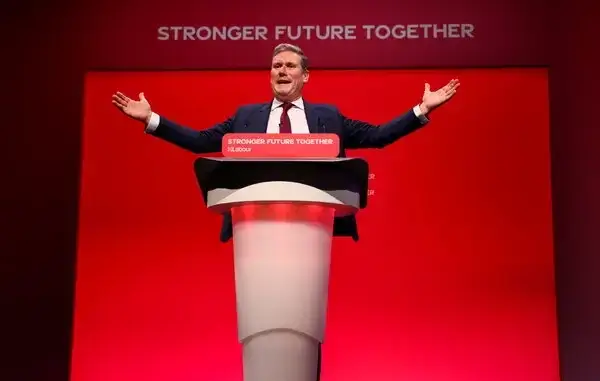
Five years ago, the UK’s Labour Party got exactly the party leader that establishment centrists dream of getting here: a dull centrist lawyer who more or less looked like what AI would spit out if you asked it to show you a British prime minister. Keir Starmer complained endlessly about “factionalism.” And just like Tanden and Yglesias, Starmer used this gripe against “factionalism” — by which he meant the party’s swing to the left occasioned by a democratic process won by a flood of energized, young members into the party — to launch an actual factional war against his party’s left.

Once leader, Starmer spent years systematically purging that left from the Labour Party, a campaign that often involved heroic levels of shameless hypocrisy. He suspended then booted his socialist predecessor, Jeremy Corbyn, from the party, a man he had once pretended to be an ally to and called a “friend.” He demoted several socialist MPs and continued suspending left-wing members any time they dissented. He banned left-wing intraparty groups and expelled their members, disproportionately targeting those of Jewish descent (while saying he was focused on “tackling antisemitism”). He made a series of arcane procedural tweaks to weaken the party’s left wing, cracked down on local branches controlled by the Left, and tried to get rid of the democratic process that let grassroots party members elect the leader (which is how the Left had taken power in the party in the first place).

The idea was that Labour had to reject its left wing to look more serious and electable, and that, once it won, with its radicals and lefty firebrands out of the picture, it could govern from the “sensible center,” ushering in a new golden age of liberal governance.

Five years on, how did this idea work out? Well, Starmer and Labour did win the election in 2024 — although polling showed voters were largely driven by hatred of the disastrous Conservative government, and Labour had won one of the more unusual landslides in politics, where its actual vote share had only gone up 1.6 points from its defeat under Corbyn to win barely more than a third of the vote.

That would turn out to be the high point of the Starmer experiment. Having muzzled any internal dissent from his left flank, Starmer embarked on a series of lethally unpopular neoliberal governing choices that would send his and his government’s approval ratings into free fall.

His decision, for instance, to make cuts to winter heating subsidies for pensioners, while simultaneously having taken a record amount of lavish gifts from a superrich donor, saw his personal popularity plummet to its lowest ever level after only two months (though he no doubt would’ve been pleased that he had become more popular among Conservative voters in that time).

The hits kept coming. Labour was decimated in the following year’s local elections in a major victory for the hard-right Reform Party. Starmer then lurched even further right in response, disgusting even more Labour voters and sending his favorability rating to a new nadir of -46 percent. Satisfaction ratings hit the lowest point for any prime minister in nearly fifty years, and Labour achieved the worst first-year polling drop of any governing party ever. Then Labour got another drubbing in this past May’s local and regional elections, which were viewed as a referendum on his leadership.

By the time Starmer resigned last month, he was widely considered a failure, the most unpopular British prime minister in polling history and a deeply hated one, who not only left his once-dominant party in a state of collapse and vulnerable to its first serious left-wing challenger in forty years, but may well end up having paved the way for the country’s takeover by the far right.

Starmer achieved this parade of humiliations by doing exactly what the likes of Yglesias and Tanden dream a future Democratic candidate will do: he governed with no real convictions; stuck close to big donors and neoliberal operatives who ended up creating scandals for him; was pro-business and sharply anti-immigration; went above and beyond to defend Israel’s genocide in Gaza; and, of course, he went to war with his party’s left. And as a result, he may have destroyed his party and certainly turned himself into one of history’s embarrassments.

There’s no reason to think this would go any different here. In fact, we’ve already gotten a taste of it. Two of the loudest figures attacking progressive “factionalism” right now both had a direct hand in the political conditions that brought Trump to power a second time: Tanden, who served as Biden’s adviser during his rightward pivot; and Yglesias, by being one of the most-read pundits in his administration, during which time he was serving Biden advice that people were wrong about their affordability struggles and the president should keep ignoring them.

Meanwhile, to deliver the White House to Trump a second time with her uninspiring centrist campaign, Kamala Harris actively sought out the expertise of Starmer’s inept advisers, who told her to focus on winning back voters drifting right, partly by presenting as an immigration hawk. Even though Starmer and his party’s approval was at that very point collapsing, she listened to them.

It doesn’t have to be this way. Just look at — and I can’t believe I’m writing this — New York governor Kathy Hochul, a conservative Democrat who, rather than going to war with the socialist mayor of her state’s biggest city, has governed in a loose coalition with him, even adopting some watered-down versions of his flagship policies as her own. That’s been a mutually beneficial arrangement for both of them, as Hochul moves to address New Yorkers’ affordability concerns in advance of her reelection.

As socialists continue to win elections around the country, you will hear more and more from the panicked voices who claim that democracy is some kind of nefarious plot against them. Driven by petty grudges and ideological resentment, those voices will only get more frenzied the more these wins stack up. Don’t take them seriously.


This article was originally published by Jacobin; please consider supporting the original publication, and read the original version at the link above.Email

Branko Marcetic is a staff writer at Jacobin magazine and a 2019-2020 Leonard C. Goodman Institute for Investigative Reporting fellow. He is the author of Yesterday’s Man: The Case Against Joe Biden.

2 Comments

  1. DSA and the Democratic party management operate in a kind of symbiosis. DSA is heavily dependent on the party’s electoral infrastructure, and DSA is tolerated only because it attracts voters. The party operatives know very well that purging the predominantly moderately Left DSA can have disastrous electoral consequences. The most fundamental problem DSA faces is that all the “progressives” it supports are elected independently with individual programs, and not as a block. They are Democratic candidates, not DSA candidates, will be neutralized in various ways, and will likely to make more symbolic rather than a decisive difference in the Congress. Business as usual. And the DSA insiders, including the author, know this game and its outcome very well, but they must have serious motives to play it again.

  2. In the long run, socialists running for office as members of a right-wing capitalist party funded by billionaires, Wall Street and corporations, is not going to work either. It’s far far more likely that they get either defeated or co-opted by the Democratic Party than they turn the Democrats into a socialist party. They need to abandon the Democrats and run as themselves or they’ll have no credibility.

Insurgents or Insiders?

Source: The Zero Hour Report

When I think about the left-wing reformers who are winning office as Democrats, I recognize that they need to govern alongside people who differ with them. That means compromise. It also means that politicians can’t lead the struggle for transformative change, at least not on their own. Movements lead, and sometimes they give rise to people who can also be effective in elected office.

I also worry that the party will absorb each new generation of reformers into its culture before they’re able to change it.

When I caught up with Norman Solomon, co-founder of RootsAction and executive director of the Institute for Public Accuracy, we started off by discussing his recent column arguing that today’s AOC wouldn’t have endorsed the insurgent AOC of 2018. She’s holding back on endorsements for challengers who are doing exactly what she did to get elected, and she recently endorsed Hakeem Jeffries for House Democratic leader—even as he sent colleagues a letter pledging to keep arming Israel.

From there we went to a couple of Norman’s other recent columns. Topics included the failure of institutional conformity in the Democratic Party, its moral and strategic failure on Gaza and Palestine, the myth of “insider expertise,”and the interplay between class, social forces, and personality in the shaping of history.

I enjoyed the conversation very much. I hope you do, too. There’s a (lightly edited) transcript below.

Here are the columns we discussed:

Today’s cautious AOC would not have endorsed the AOC of 2018
My Conversation With Karl Marx About Donald Trump
Why the Biden Debate Disaster Still Matters for the Future


Selected quotes

“When people lead, leaders will follow. If we don’t lead, they’re going to follow each other.”
— Norman Solomon

“At what point are you changing the party, and at what point is the party changing you?”
— Richard Eskow

“It’s stunning that [AOC] has made it a policy not to endorse any challenger to an incumbent Democrat when that’s how she got into Congress in the first place.”
— Norman Solomon

“It’s not about the celebrity figures. It’s about the movements that make them.”
— Richard Eskow

“It’s called democracy. We all take our best assessments and we push.”
— Norman Solomon


Transcript

Richard Eskow: Welcome back to The Zero Hour.

Norman Solomon: Thanks. Very glad to be here.

Richard Eskow: I want to start with this piece, because I thought it neatly encapsulated the situation with Alexandria Ocasio-Cortez, who I get asked about a lot. I think anybody identified as being on the left probably gets asked about her a lot. The headline, and I believe this piece itself was not from The Hill, though the headline was, read: “Today’s Cautious AOC Would Not Have Endorsed the AOC of 2018.” I thought that captured a shift people are concerned about with her. What inspired you to write it?

Norman Solomon: It occurred to me that when Alexandria Ocasio-Cortez got into Congress, it was by challenging someone who seemed almost unchallengeable, Joseph Crowley, the fourth-highest-ranking Democrat in the House. It seemed impossible. She had no prior, quote-unquote, experience in office. She’d tended bar, and she was a terrific activist. She won, and it stunned people.

Now, in 2026, as someone with a lot of well-justified clout on the left and in national political discourse, she’s declined to endorse any of the candidates trying to ascend the way she did, mostly, by the way, people of color who’ve won as Democratic Socialists in deep-blue districts in the last few weeks. They’re on their way to Congress, and frankly, no thanks to her. Now, I know it’s complicated, when you’re in office, you have to choose your endorsements carefully. But it’s stunning to me that she’s made it a policy not to endorse any challenger to an incumbent Democrat, when that’s exactly how she got into Congress in the first place.

Richard Eskow: It is striking. She deserves credit for helping Zohran Mamdani early on in his race, though that wasn’t a House race. I always worry about progressives getting elected and then joining what I’ve called the Democratic Borg collective of the power elite. To their credit, many of them haven’t done that. Bernie resisted it for a long time, he was always strategic about when and how he worked with insider groups. I didn’t always agree with him, but he was careful about it, and we could go down the list.

One of AOC’s first moves in Washington was joining a sit-in in Nancy Pelosi’s office, which got her in a lot of trouble. Now she seems to have taken the position that challenging an incumbent is outside the rulebook. But that’s not only how she got into office, it’s supposed to be how democracy works. So what do you think is at the root of her discomfort?

Norman Solomon: She’d be uncomfortable dealing with some of her colleagues in the House Democratic Caucus if she supported challenges to incumbent Democrats. It’s notable that some of the best members of Congress, not just her, got there that way: Ro Khanna, Ayanna Pressley, Cori Bush, who hopefully is coming back after being ousted. They got there by challenging people considered entrenched.

There’s a saying that we do political analysis, not psychoanalysis, so we never really know what’s going on inside someone’s head. But it’s pretty clear she’s aspiring to higher office. She may run for the Senate seat in 2028, whether or not Chuck Schumer runs for reelection. There’s also been increasing buzz in the media about her running for president in 2028. In either case, the traditional pathway is not to alienate the powers that be in the Democratic Party, and she seems to be taking the opposite path.

Just as I finished writing this piece for The Hill, news came that AOC had endorsed Hakeem Jeffries, the current House Democratic leader, to continue in that role next year, whether or not he becomes speaker. To me, that reinforces the concern, and maybe the reasonable guess, that she’s trying to curry favor with people in power. And nobody on the Democratic side of the House is more powerful than Hakeem Jeffries. Nobody is more pro-Israel, either, arguably, or certainly, no one is more powerfully pro-Israel.

Just days before we’re speaking, Jeffries sent an extraordinary “Dear Colleague” letter to every House Democrat, saying he’ll oppose any cutoff of weapons and military aid to Israel. He didn’t have to say that, even if he was personally going to vote against an arms cutoff, but he went out of his way to pledge his allegiance to the IDF, using his leverage to stop more Democrats from breaking away from the “Israel, right or wrong” line and voting against arming a government that is clearly engaged in genocide, as Amnesty International, Human Rights Watch, and the Israeli human rights groups Physicians for Human Rights Israel and B’Tselem have all documented.

And yet here’s this guy, in the middle of summer 2026, using his leverage to keep arming a genocide. In that context, it looks especially bad that AOC went out of her way to say, “This is our leader for next year.”

Richard Eskow: This gets back to a conversation you and I, and I think many of us, in various configurations, have had before: the fact that AOC, and candidly Bernie too, endorsed Joe Biden for reelection a year, maybe two years, before the campaign started. My memory’s a little hazy on the exact timing. But this was despite the fact that he was, at that point, supporting the ongoing genocide in Palestine, and he continued to do so, with no leverage used for humanitarian relief there or anywhere else.

It raises the question: at what point, as a politician who’s supposedly a change agent, are you changing the party, and at what point is the party changing you? In that race, who’s winning? Because it seems to me that in both cases, AOC traded away leverage, not just on a political issue that, according to the polls, would favor her, but on a moral one. So it makes me wonder: am I missing something here? I admit I’m baffled.

Norman Solomon: “Gratuitously early” is one way to describe AOC’s endorsement of Hakeem Jeffries as Democratic leader. The vote won’t happen until at least November, when the Democratic caucus decides on its leader for next year. That leader, speaker or not, has tremendous power and leverage over how the Democrats in Congress behave, over caucus positions, and especially over committee assignments.

It’s a bit like a labor leader going into negotiations with management and already giving up so much before any negotiating has even taken place. As you allude to, Richard, I think AOC, for whatever reason, decided to endorse before there was even a negotiation. She did offer an explanation: she said in her announcement that she’d met with Jeffries and was pleased he would support public housing in New York, which matters to her. I found that explanation baffling at best, and at worst, just not credible.

There are really only two possibilities you could draw from AOC’s explanation. One is that Jeffries is so unreliable and unprincipled on humanitarian issues that you have to cut a deal with him just to get his support for public housing that New Yorkers need. Or, on the other hand, he’s someone you can depend on, in which case, why would you need to cut a deal in the first place? Either way, it doesn’t pass the smell test. I don’t want to impute purely selfish motives, but these are politicians, she’s clearly ambitious for higher office, and I think that’s probably the most specific explanation. And then there’s the more generic one: if you want to get along with your colleagues in Congress, you don’t tell them you’re going to help remove them from office.

Richard Eskow: I’ve studied politics for a long time, as you have, Norman, and perception matters a lot. It’s hard to quantify, hard to predict. But the strength AOC brought to her initial campaign, to the House, to what quickly became political celebrity, was a combination of refreshing energy and an unsolemn, I don’t want to say rebellious, but a playful, in a good way, attitude. I thought it was a great moment when she told a hostile witness, “I was a bartender for years, I know how to handle men like you.” She has real gifts as a communicator.

But every gift is double-edged in politics, I’ve come to believe. The gift of being a facile communicator can quickly turn on you if people feel it’s not backed up by substance, character, and commitment. Her youth and youthful energy could equally turn against her if people start to feel there’s something superficial about her. I’m not saying this because I can predict the future or read people’s minds, but if she’s ambitious for herself and her career, and she clearly is, I think she’s playing a dangerous game.

Norman Solomon: On that note, trust can seem ineffable, almost abstract, but I think it matters enormously in the longer term. Let’s face it: if she runs for president, or even for Senate in New York, the right-wing guns will be trained on her, metaphorically. They really hate her, just look at right-wing media. She’s going to need her base to turn out. She’s going to need, as Mamdani had, tens or hundreds of thousands of volunteers willing to go door to door to counteract the corporate and militarist assaults, in media and in politics, that are sure to come, and that have already existed for years.

I’ve gotten pushback from progressives who say, “Why are you picking on her? She’s in Congress. She knows things you don’t. She understands tactical complexities you don’t.” I think that’s a very hazardous attitude. We saw it before, when almost every Democrat in Congress refused to say a negative word about Biden running for reelection. We were told, “They’re the pros, they’re the experts, who are we to micromanage them?” Well, it’s called democracy. We all make our best assessments and push, because that’s what activism, organizing, and participatory democracy are supposed to be about.

Richard Eskow: It’s not about the visible figures, the celebrities. It’s about the movements that make them succeed or fail, and that guide and pressure and encourage them. There’s a sad irony in seeing some of the people who came to power because Bernie Sanders challenged Hillary Clinton now using the same rhetoric to defend their choices that Hillary’s supporters once used against the Bernie contingent, “They’re the insiders, they’re the experts, they know what you don’t.” Well, you know what? In a democracy, if you know something I don’t, tell me, because that’s how democracy works.

Norman Solomon: That reminds me of something formative for me, and for many people of my generation, during the Vietnam War: we constantly heard that Lyndon Johnson knew things we didn’t, so why should we think we knew better than him? Year after year, I was a teenager at the time, 1965, ‘66, we were told the Democrats in Congress understood the war in ways we didn’t. The message was: butt out, and trust. But we can’t afford to trust, when circles of power so easily seduce the people inside them.

Richard Eskow: People remember, from those days, at least the title of David Halberstam’s book The Best and the Brightest, about the Kennedy people who went on to serve in the Johnson administration, Robert McNamara and others. What people forget is that the title is ironic, the “best and the brightest” made a mess of things.

That gets me to another piece you’ve written recently, Norman, the one headlined “Why the Biden Debate Disaster Still Matters for the Future.” I’m sure some people think, “Enough about the Biden debate disaster”, but we’re still talking about it, and not just you and me. This ties directly into what we were just discussing about AOC, doesn’t it?

Norman Solomon: Very much so. As it happens, two of my political heroes, Bernie Sanders and AOC, supported Biden right up until the last minute, until he announced he’d drop out. Patterns really matter. Political cultures matter, even when we have trouble putting our finger on them. There’s a conformity that’s magnetic, especially for people who want to ascend, or be taken seriously.

We saw that dynamic play out. Not to boast, but just to be factual: at RootsAction, we launched the “Don’t Run, Joe” campaign right after the 2022 midterms, and we couldn’t find any other sizable national group willing to join us. We heard privately from some who said, “Yeah, Biden shouldn’t run”, but they were afraid of losing access. The same was true for Democrats in Congress. Only one or two were willing, in 2023, to say publicly that Biden shouldn’t run. This has consequences, and we’re living them right now.

Some people watching might ask, “Why focus on Democrats, when we have this fascistic Republican regime?” And we certainly do focus on that. But the underlying question is: how do we defeat them? Can we do it the way Kamala Harris tried, splitting the difference and, to put it mildly, disrespecting the base that was horrified by the genocide the U.S. was supporting? The question answers itself. We need a departure from this willingness to reinforce the establishment and disregard the polling.

There’s one more piece here, going back to both the 2024 campaign and what we’re talking about with AOC: polling over the last twelve to eighteen months has been very clear, about 75% of Democrats don’t want to keep arming Israel. They believe Israel is engaged in genocide. And still, one of the best progressives in Congress just endorsed for leader someone who came out in favor of continuing to arm Israel. It may be a cliché, but it’s true: when people lead from the grassroots, leaders follow. If we don’t lead, they’ll follow each other, right over the cliff.

Richard Eskow: I get that question a lot too, Norm, “Why are you always so hard on the Democrats when we have this authoritarian Trump who’s so terrible?” My answer is always: that’s exactly why. Trump wouldn’t be there today, in my view, if Democrats were listening to activist movements and the popular will.

I get it, on one level, I’ve been close enough to the seats of power to understand that shifting this massive institution, the Democratic Party, from a large-donor model to a small-donor, popularly-funded one, is a major job. I get that it’s intimidating, that it’s a radical career change for a lot of people, that a lot of well-paid consultants would have to find other ways to make a living. I get all of it, the institutional momentum behind the party as it currently works.

But I think it’s not only good policy and good for the country, it’s the only way to win. Polls keep showing that. Where they don’t, it’s often the phrasing of the poll that’s the problem. The classic example for me is Medicare for All, which polls extremely well, unless you ask, “Would you support government-run health care even if it meant a big hike in your taxes?” Which it doesn’t necessarily have to mean, and which would be more than offset by what people no longer pay in premiums, co-pays, and deductibles.

So we have an agenda that would make the country safer and healthier, and yet there’s institutional resistance to it. To me, that should be a dividing line: do the politicians I support understand that, and want to work with the grassroots to overcome it? When you bring up the Biden debate performance, there are a million reasons behind it we haven’t even gotten into. But one of them is what the psychologist Stanley Milgram called obedience to authority, and we, as a movement, and the Democrats as a party, should not be so obedient to authority, especially authority that’s misled us so often. Sorry, I’m ranting a little. Let me turn it back to you.

Norman Solomon: No, that’s key. The huge gap between how Democrats, and often the country as a whole, poll, and the positions taken by Democratic Party leadership, is political malpractice. The vast majority of Democrats don’t want to keep arming Israel, for instance, and yet we have an institutionalized model that says those views don’t really matter compared to other factors, namely, that autocrats and the wealthy can write six- or seven-figure checks.

The reality is that successful campaigns have to be inspiring, that’s how the current mayor of New York got elected. A friend of mine gave a keynote to a state Democratic Party recently and asked, “How many of you would like to be campaigning alongside Chuck Schumer if you were running for office?” Hardly anyone raised their hand. I think it’s similar with Jeffries. What does that tell us? That the party’s ostensible leaders at the very top are found uninspiring, which translates into failing to drive turnout, which is essential to winning elections. Every cycle, come October, it’s a turnout election, and yet this so-called leadership is deadening rather than inspiring.

Another element you touched on, Richard, is the campaign funding model within the party. Without inspiration, you can’t do what Bernie Sanders did, averaging $27 donations. I don’t think the people running the DNC, or leading the House and Senate Democratic caucuses, really see small donations as the key. It’s the old line, if you don’t have the hammer, everything doesn’t look like a nail. They don’t inspire people, and no wonder the DNC is in such dire financial straits right now.

Richard Eskow: I get the challenge this poses to their mindset, even conceiving of a small-donation, popularly-funded party is alien to them. But I think they’re approaching a kind of freeze-up point. The only way they can raise money is by clinging to policies people don’t actually support, just to keep the fundraising going, which lets some people make a good living as consultants without significantly winning elections. Or, they decide they actually want to win, and build a coalition of people who do. Otherwise, they risk freezing in place, in a kind of stasis. What do you think?

Norman Solomon: That brings us back to where we started, the fact that Capitol Hill is, de facto, an insular bubble. You’re dealing with certain callings, certain pressures. I think a key question for those of us at the grassroots, progressives and others who want humane, progressive change, is whether we’re going to be a counter-pressure or not. Are we going to leave the field to the corporate interests and militarists who dominate that milieu on Capitol Hill? Or are we going to provide counter-pressure? Of course, it has to be the latter. That’s essential.

Richard Eskow: Absolutely. Before you go, Norman, I want to talk briefly about a piece you wrote called “My Conversation with Karl Marx About Donald Trump.” Correct me if I’m wrong, but I think what you were exploring, in channeling the late Karl Marx, was the tension between class struggle as the engine of history versus the historic, transformative personality, in this case, Donald Trump, as the engine of history.

Trump poses a real challenge to the left in that sense. I believe class and economic struggle are major drivers of history, and that there are tectonic forces at work, but individuals can also shift the course of events at certain moments. This is a challenge for the left, because so many centrists and corporate politicians have used Trump’s personality as an excuse not to offer better policies for the working class, which has created a counter-reaction. It’s a delicate balance. Is that a fair read of what you were trying to do with the Marx piece?

Norman Solomon: Yes, that’s largely what I was after. It is a delicate balance. I’m one of many people who, especially over the last year and a half, have been trying to reconcile a fairly solid analysis, that social forces determine what happens historically, in the present and future, and that we want to strengthen the social forces for good rather than for corporate militaristic evil, with the fact that along comes Trump, not just leading a cult of personality, but embodying a force, as an individual, that’s been genuinely transformative.

It’s a word that can sound academic or jargon-y, but dialectically, these are truths in conflict that coexist. I found a quote from Marx, writing to Engels, essentially saying: I never claimed that everything that happens is purely because of economics, people who say that aren’t being accurate. The basis of it is economics, and class struggle, but other factors are involved too. That’s the real world.

Richard Eskow: Right, it’s the gasoline and the match. The gasoline won’t catch fire or explode without a match. On one hand, there are clearly global social forces at work in the rise of the right and demagogic leaders, Orbán in Hungary, Le Pen in France, Farage in Great Britain, some in power, some out. There’s clearly something global going on: alienation against the elite, in the absence, in my view, of a valid left to challenge it. So that’s the structural side.

But on the other hand, would we be in this situation without Donald Trump specifically? I’d say no. I could go further and say he’s intensified the contradictions, to borrow that phrase from the ‘60s, “heightened the contradictions.” We don’t know how it will turn out, but we know we have to stop Trump and Trumpism if we want to create space for real transformative change. At least, that’s my view. I’m not sure Marx, or anyone else, would disagree.

Norman Solomon: Definitely, we need to roll back Republican power, it is fascistic power. When I hear some on the left say it doesn’t matter who’s individually in office, I think that’s, at this point, a kind of hallucination. It clearly matters who holds power. With the right wing running the executive and legislative branches, and much of the judicial branch, we’re entirely on the defensive, there’s no capacity to implement good policy, only damage control. That’s why getting them out of office is the imperative for this midterm election, and for 2028 as well.

Richard Eskow: The other reason to get these people out of office, as dissatisfied as I am with the Democratic Party, is that I think the sum total of human suffering in this country would be somewhat less if the far right were out of power. I don’t think a party deserves a laurel wreath for basic decency, but at least some measure of human decency might return. I’m not so cosmic that I think I know how much suffering should be tolerated in the short term because something magical might happen in the long term. I think we owe it to people to relieve suffering, to give them space to breathe and survive, and then show them what a better world can look like.

Before we go, I’ll give you the last word, there’s a great Marx quote I’d heard before, apropos of Trump. He wasn’t writing about Trump, obviously, in 1869, but he described a cult existing around a tyrant, and how the class struggle “created circumstances and relationships that made it possible for a grotesque mediocrity to play a hero’s part.” That sounds very much like the current president of the United States. But I’ll give you the last word.

Norman Solomon: That’s an amazing description by Marx, I believe of Napoleon III, and as you say, it fits the dangerous, vicious clown now serving as president. I do want to invite people to check out my latest book, which is free and available online in various formats, at blueroad.info. It’s called The Blue Road to Trump Hell.

Richard Eskow: I encourage people to do that. You and I have talked about it on the program before. Norman Solomon, co-founder of RootsAction and executive director of the Institute for Public Accuracy, thanks for these recent pieces, which I got a lot out of, and thanks once again for coming on the program.

Norman Solomon: Thanks a lot, Richard.


This article was originally published by The Zero Hour Report; please consider supporting the original publication, and read the original version at the link above.Email
avatar

Norman Solomon is the national director of RootsAction.org and executive director of the Institute for Public Accuracy. The paperback edition of his latest book, War Made Invisible: How America Hides the Human Toll of Its Military Machine, includes an afterword about the Gaza war.