(RNS) — Seven cities across the country — including Boston, Chicago, Denver, Kansas City, Philadelphia and Seattle — held similar public rituals to mark the Jewish day of mourning.
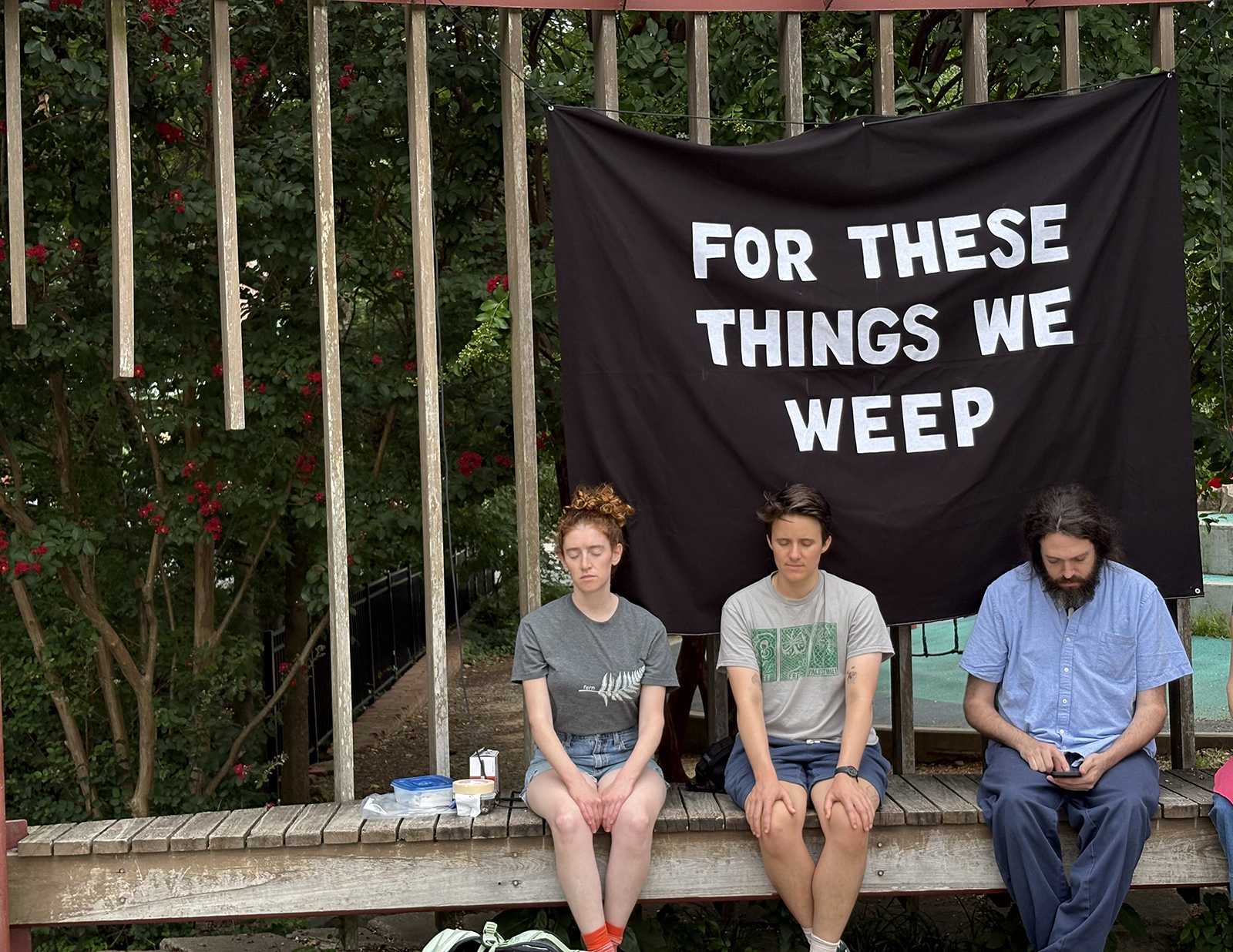
A group of Jews close their eyes in prayer during a Tisha B’Av ritual focused on solidarity with Palestinians in Durham, North Carolina’s Central Park on Wednesday, July 22, 2026. (RNS photo/Yonat Shimron)
Yonat Shimron
July 23, 2026
RNS
DURHAM, N.C. (RNS) — A group of 40 Jews gathered in a public park under cloudy skies on Wednesday (July 22) and wrote on scraps of white cloth the things they were grieving for this Tisha B’Av:
Dead children of Gaza
Loss of precious life
Apathy in the face of destruction
Loss of imagined future
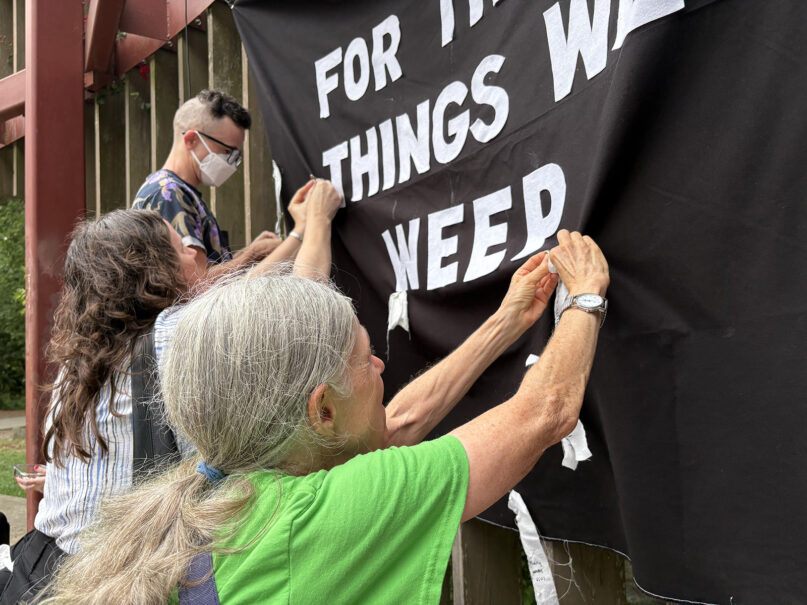
When they finished, they ripped the cloth, a Jewish mourning custom, and pinned it to a black banner with the words “For These Things We Weep” (a phrase from the biblical book of Lamentations).
Over the past three years, Tisha B’Av, the traditional day of mourning for the destruction of the first and second Jerusalem temples, has become an occasion among some on the left to lament not what was done to Jews (first by the Babylonians and, centuries later, the Romans), but what the state of Israel has done to Palestinians since the Oct. 7, 2023, Hamas attack on Israel.
“Today in 2026, we weave into this day of lamentation the ongoing destruction of Palestinian life by Israel,” said Rabbi Salem Pearce, a Durham-based rabbi who is a member of Rabbis for Ceasefire, a nonprofit group founded in 2023 to protest Israel’s retaliation in Gaza.
“A history of destruction and tragedy leads us to rise in solidarity with Palestinians facing violence by the Israeli military, and Tisha B’Av reminds us of the inviolable dignity of all human life,” she continued, speaking to the gathered crowd.
RELATED: As Jews mark Tisha B’Av, ancient mourning rituals make room for modern grief
Seven cities across the country — including Boston, Chicago, Denver, Kansas City, Philadelphia and Seattle — held similar public rituals to mark the Jewish day of mourning. It was the third year that Rabbis for Ceasefire had organized such an event. In Durham, it was cosponsored by the local chapter of Jewish Voice for Peace and Makom, an anti-Zionist congregation.
This is not the first time Tisha B’Av has been stretched to mark other historical tragedies. In past years, Jewish activists have also held public rituals on Tisha B’Av to mark the Holocaust and, more recently, the deaths of 1,200 Israeli residents who died at the hands of Hamas on Oct. 7, 2023.
But it is a reversal of sorts to use Tisha B’Av to mark tragedies inflicted on other people by Jews. The war in Gaza, which the Durham group called both a genocide and an ethnic cleansing, has angered and mobilized the Jewish left — and divided American Jews.
Polls show half of American Jews say Israel’s ongoing military operations in Gaza are unjustified. They don’t like Israeli Prime Minister Benjamin Netanyahu, with roughly 6 in 10 viewing him very or somewhat unfavorably, according to an AP/NORC poll. But they also fear that criticism of of Israel — such as that recently expressed by New York Mayor Zohran Mamdani in a video calling Netanyahu a war criminal — makes them feel unsafe as Jews.
Those at Wednesday’s Tisha B’Av in Durham said they felt morally compelled as Jews to respond to Israel’s actions in Gaza and elsewhere.
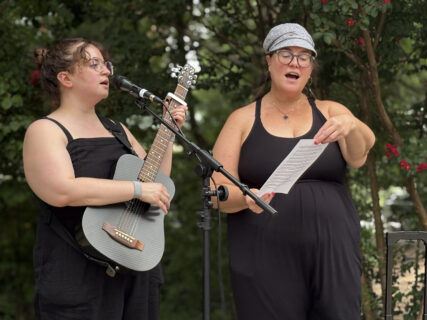
Rabbi Salem Pearce, right, and Eiiana Light, a songwriter and educator, led a Tisha B’Av ritual in a Durham, North Carolina, park Wednesday, July 22, to grieve Israel’s destruction of Palestinian lives. (RNS photo/Yonat Shimron)
Beth Bruch, one of the organizers of the Tisha B’Av ritual, related that her grandparents were able to escape Nazi Germany and settled in Illinois, while so many others Jews died in Europe.
“I just wish that more people had spoken up for my ancestors back then,” said Bruch, a 53-year-old school librarian. “How could I not speak up for people now?”
As an American Jew, she said she feels implicated in a war that has killed 73,000 Palestinians in Gaza, according to the Gaza Health Ministry, many with U.S.-made bombs.
“Our calendar gives us times to actually feel our grief, and I think it’s especially important given our complicity as Americans in what’s going on in Palestine,” Bruch said. “It’s my tax dollars that are funding the weapons, the war, the bombs that are being used to kill so many children, adults, elders in Gaza and the West Bank, even since the ceasefire.”
Grieving the destruction of Gaza is not just a political act, it is also part of the Jewish tradition of “teshuva” or repentance, those gathered for the ritual were reminded. Tisha B’Av, which concluded Thursday, is a bridge into the month of Elul, the final month of the Jewish year, a period of spiritual introspection leading up to the High Holidays with their theme of repentance.
DURHAM, N.C. (RNS) — A group of 40 Jews gathered in a public park under cloudy skies on Wednesday (July 22) and wrote on scraps of white cloth the things they were grieving for this Tisha B’Av:
Dead children of Gaza
Loss of precious life
Apathy in the face of destruction
Loss of imagined future
When they finished, they ripped the cloth, a Jewish mourning custom, and pinned it to a black banner with the words “For These Things We Weep” (a phrase from the biblical book of Lamentations).
Over the past three years, Tisha B’Av, the traditional day of mourning for the destruction of the first and second Jerusalem temples, has become an occasion among some on the left to lament not what was done to Jews (first by the Babylonians and, centuries later, the Romans), but what the state of Israel has done to Palestinians since the Oct. 7, 2023, Hamas attack on Israel.
“Today in 2026, we weave into this day of lamentation the ongoing destruction of Palestinian life by Israel,” said Rabbi Salem Pearce, a Durham-based rabbi who is a member of Rabbis for Ceasefire, a nonprofit group founded in 2023 to protest Israel’s retaliation in Gaza.
“A history of destruction and tragedy leads us to rise in solidarity with Palestinians facing violence by the Israeli military, and Tisha B’Av reminds us of the inviolable dignity of all human life,” she continued, speaking to the gathered crowd.
RELATED: As Jews mark Tisha B’Av, ancient mourning rituals make room for modern grief
Seven cities across the country — including Boston, Chicago, Denver, Kansas City, Philadelphia and Seattle — held similar public rituals to mark the Jewish day of mourning. It was the third year that Rabbis for Ceasefire had organized such an event. In Durham, it was cosponsored by the local chapter of Jewish Voice for Peace and Makom, an anti-Zionist congregation.
This is not the first time Tisha B’Av has been stretched to mark other historical tragedies. In past years, Jewish activists have also held public rituals on Tisha B’Av to mark the Holocaust and, more recently, the deaths of 1,200 Israeli residents who died at the hands of Hamas on Oct. 7, 2023.
But it is a reversal of sorts to use Tisha B’Av to mark tragedies inflicted on other people by Jews. The war in Gaza, which the Durham group called both a genocide and an ethnic cleansing, has angered and mobilized the Jewish left — and divided American Jews.
Polls show half of American Jews say Israel’s ongoing military operations in Gaza are unjustified. They don’t like Israeli Prime Minister Benjamin Netanyahu, with roughly 6 in 10 viewing him very or somewhat unfavorably, according to an AP/NORC poll. But they also fear that criticism of of Israel — such as that recently expressed by New York Mayor Zohran Mamdani in a video calling Netanyahu a war criminal — makes them feel unsafe as Jews.
Those at Wednesday’s Tisha B’Av in Durham said they felt morally compelled as Jews to respond to Israel’s actions in Gaza and elsewhere.
Rabbi Salem Pearce, right, and Eiiana Light, a songwriter and educator, led a Tisha B’Av ritual in a Durham, North Carolina, park Wednesday, July 22, to grieve Israel’s destruction of Palestinian lives. (RNS photo/Yonat Shimron)
Beth Bruch, one of the organizers of the Tisha B’Av ritual, related that her grandparents were able to escape Nazi Germany and settled in Illinois, while so many others Jews died in Europe.
“I just wish that more people had spoken up for my ancestors back then,” said Bruch, a 53-year-old school librarian. “How could I not speak up for people now?”
As an American Jew, she said she feels implicated in a war that has killed 73,000 Palestinians in Gaza, according to the Gaza Health Ministry, many with U.S.-made bombs.
“Our calendar gives us times to actually feel our grief, and I think it’s especially important given our complicity as Americans in what’s going on in Palestine,” Bruch said. “It’s my tax dollars that are funding the weapons, the war, the bombs that are being used to kill so many children, adults, elders in Gaza and the West Bank, even since the ceasefire.”
Grieving the destruction of Gaza is not just a political act, it is also part of the Jewish tradition of “teshuva” or repentance, those gathered for the ritual were reminded. Tisha B’Av, which concluded Thursday, is a bridge into the month of Elul, the final month of the Jewish year, a period of spiritual introspection leading up to the High Holidays with their theme of repentance.
A group of Jews write what they are grieving for this Tisha B’Av on scraps of white cloth in a public park in Durham, North Carolina, on Wednesday, July 22, 2026, before pinning them onto a banner that reads “For These Things We Weep.” (RNS photo/Yonat Shimron)
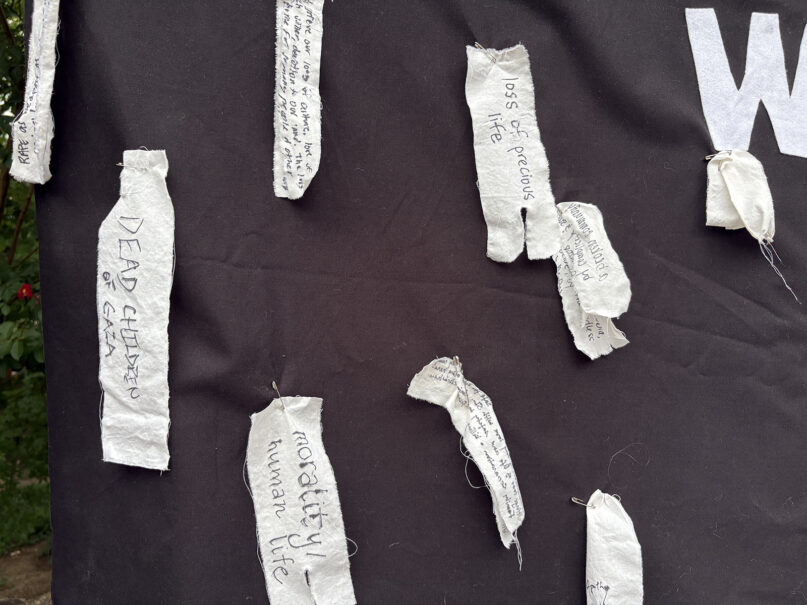
As part of a public ritual in Durham, North Carolina, on the eve of Tisha B’Av, July 22, 2026, participants write down what they are grieving for and pin it to a black banner. Most notes refer to grief for Palestinian lives. (RNS photo/Yonat Shimron)
“Even as the bombs fall, we are called to begin our teshuva, the path to sacred repair,” Pearce told participants.
She then led the chanting in Hebrew from the Book of Lamentations, which is traditionally sung with each verse beginning in a major key and descending into a minor key to evoke a sense of grief. A musician led two songs.
Kasey Kinsella, a 33 year-old performing artist who helped plan Wednesday’s liturgy but could not attend, said she believed such rituals are critical to helping Jews share their grief collectively.
“These grief rituals like this one is an opportunity to really come together and feel the emotions distributed to more than just ourselves,” she said. And critically, she added, such rituals can lead to more action.
“Even as the bombs fall, we are called to begin our teshuva, the path to sacred repair,” Pearce told participants.
She then led the chanting in Hebrew from the Book of Lamentations, which is traditionally sung with each verse beginning in a major key and descending into a minor key to evoke a sense of grief. A musician led two songs.
Kasey Kinsella, a 33 year-old performing artist who helped plan Wednesday’s liturgy but could not attend, said she believed such rituals are critical to helping Jews share their grief collectively.
“These grief rituals like this one is an opportunity to really come together and feel the emotions distributed to more than just ourselves,” she said. And critically, she added, such rituals can lead to more action.
As Jews mark Tisha B’Av, ancient mourning rituals make room for modern grief
(RNS) — ‘October 7 will definitely be in my mind, but Tisha B'Av also gives you the long view of Jewish history,’ Rabbi Diana Fersko said.
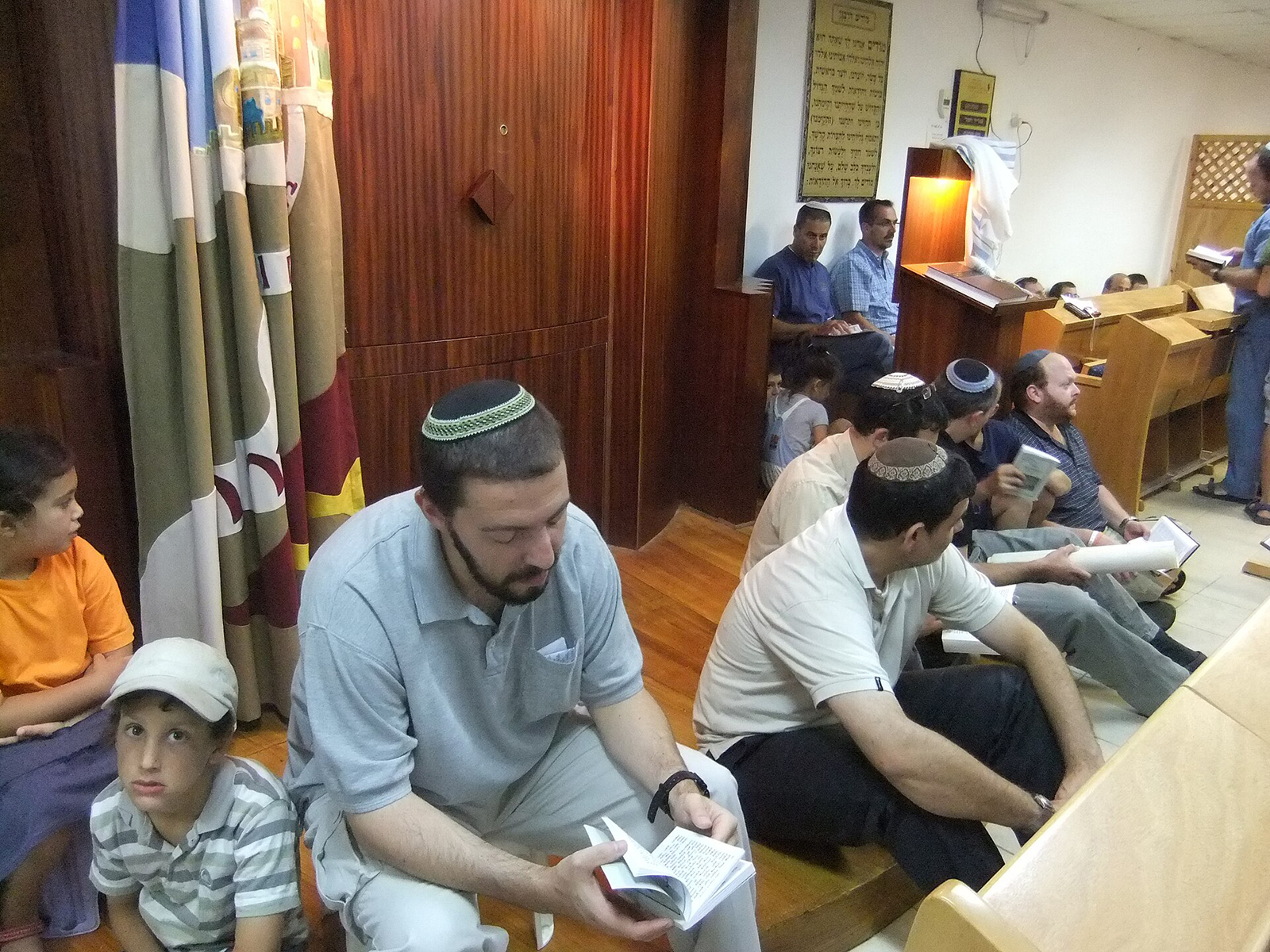
Worshipers sit on the floor of a synagogue before the reading of Lamentations during Tisha B’Av on Aug. 8, 2011. (Photo courtesy Wikimedia Commons)
Kyle Desrosiers-Levine
July 22, 2026
RNS
(RNS) — As Jews across the world observe Tisha B’Av, the annual fast mourning the destruction of the First and Second Temples in Jerusalem, many will also grieve modern-day tragedies.
The holiday, which begins at sundown Wednesday (July 22) and ends Thursday at sunset, is observed as Judaism’s central day of communal mourning. Centuries-long tradition contributes to an evolving memory of the fast day through “kinot,” the liturgical poems recited in synagogues that mourn the destruction of Jerusalem while also commemorating later tragedies.
Over centuries, rabbis and poets have composed new kinot in response to catastrophes and persecutions, from the Crusades and Inquisition to the Holocaust.
Since the Oct. 7, 2023, Hamas attacks on Israel and the devastating war in Gaza, new lamentations have continued that tradition as modern authors started penning liturgical poems.
(RNS) — As Jews across the world observe Tisha B’Av, the annual fast mourning the destruction of the First and Second Temples in Jerusalem, many will also grieve modern-day tragedies.
The holiday, which begins at sundown Wednesday (July 22) and ends Thursday at sunset, is observed as Judaism’s central day of communal mourning. Centuries-long tradition contributes to an evolving memory of the fast day through “kinot,” the liturgical poems recited in synagogues that mourn the destruction of Jerusalem while also commemorating later tragedies.
Over centuries, rabbis and poets have composed new kinot in response to catastrophes and persecutions, from the Crusades and Inquisition to the Holocaust.
Since the Oct. 7, 2023, Hamas attacks on Israel and the devastating war in Gaza, new lamentations have continued that tradition as modern authors started penning liturgical poems.

Rabbi Diana Fersko (Photo courtesy of Rabbi Diana Fersko)
“In 2026, Tisha B’Av looks a lot like it’s always looked,” Rabbi Diana Fersko, chief Jewish life officer at the Marlene Meyerson JCC Manhattan, told RNS. “It’s this day of sadness where you’re letting yourself sit in that emotion and reflect on some of the darkest moments in Jewish history. You’re doing it with your community, learning, reflecting, praying and contemplating the cosmic journey that we’ve been on.”
Unlike many Jewish holidays that emphasize celebration, family gatherings or festive meals, Tisha B’Av calls for an embrace of grief for 25 hours. Throughout that time, mourners fast, avoid physical comforts — like foregoing regular chairs for low stools — and gather in synagogues to read the biblical Book of Lamentations, alongside the kinot.
Fersko said the tradition of adding new kinot to respond to times of crises demonstrates that Jewish mourning has never been frozen in time.
RELATED: Orthodox Jewish groups oppose daylight saving bill, argue it would disrupt prayer
After Oct. 7, new liturgical works appeared almost immediately. “Kinat Be’eri,” written by Israeli poet Yagel Haroush to mourn the massacre at the Be’eri kibbutz in southern Israel, quickly became popular. The poem notably starts each stanza with “Eicha” — the Hebrew word for the question “how?” — alluding to the Book of Lamentations and wrestling with God amid mass deaths.
Yaacov Osadon is a “paytan,” or Jewish liturgical singer, from Dimona, Israel, who has spent a decade studying traditional Moroccan Jewish hymns and “piyyutim,” Jewish liturgical poems and hymns chanted during religious services, in his Sephardic tradition. He said diverse Jewish communities across the diaspora and Israel have always sought to grieve as a people after defining moments of loss.
“The purpose is not only to preserve their memory, but also to examine circumstances that led to these tragedies, learn from them and pray that such suffering will never happen again,” said Osadon, whose day job is operations manager at Yatir Winery, a kosher fine wine producer near Dimona.
Rabbi Or Rose leads prayer at a multifaith gathering at the Washington National Cathedral in 2025. (Photo courtesy of Rabbi Or Rose)
Rabbi Or Rose, director of the Betty Ann Greenbaum Miller Center for Interreligious Learning and Leadership at Hebrew College in Newton, Massachusetts, said this sense of evolving memory reflects the enduring purpose of the holiday itself.
“Tisha B’Av is about how we carry loss now, and how memory can become a stimulus for moral and spiritual introspection and renewal,” Rose said.
This year, he said, the holiday arrives as many Jews continue to process multiple crises in what Rose described as “a world that feels especially fragile and unsettled.”
Rose continued, “The liturgy of Tisha B’Av is intentionally spare and somber. The traditional physical practices of the day — fasting, sitting low, refraining from comfort, and observing a kind of communal austerity — help make the mourning feel embodied, and not just intellectual.”
New liturgical poems do not replace ancient laments, Fersko said, but rather place more recent suffering — and prayers for restoration — within the longer arc of Jewish history.
“October 7 will definitely be in my mind, but Tisha B’Av also gives you the long view of Jewish history,” Fersko said. “As long as it’s done with thought, care and sincerity, it makes sense to bring modern pain points into this very sad day.”
For Osadon, the lessons of Tisha B’Av extend beyond remembrance. Jewish tradition, he pointed out, teaches that the Second Temple was destroyed because of “sinat chinam,” or baseless hatred, and destructive internal division among Jews. In today’s sharply polarized Israeli society, he believes that message carries particular urgency.
“History should not only be remembered — it should also be learned from,” he said. “We should make every possible effort to strengthen mutual respect, preserve our unity despite our differences and ensure that disagreement never turns into hostility.”
Rose echoed that teaching, pointing to the late Rabbi Abraham Isaac Kook’s call for “ahavat chinam,” or baseless love, as an antidote to repair a broken world.
The Jewish tradition, Rose said, “does not let us only point outward at the world’s cruelty; it also asks us to examine our own moral failings, our communal divisions and the ways hatred can corrode our life together,” he said.
One teaching predicts the coming Messiah will be born on Tisha B’Av, suggesting that redemption will emerge only after catastrophe.
“Tisha B’Av teaches us that Jewish hope is not naive optimism,” Rose said. “It is hope forged in the presence of loss. The day holds grief and longing together, and in that sense it points toward a future in which what has been broken may yet be mended.”
Takeaways from the AP-NORC poll of more than 1,000 Jewish Americans
WASHINGTON (AP) — The survey of 1,022 Jewish adults — including people who identify as Jewish by religion and religiously unaffiliated people who identify as Jewish through culture, ethnicity or family background — offers a rare detailed accounting of a key demographic that sits at the very center of some of the nation’s most divisive political debates.

Linley Sanders
July 21, 2026
WASHINGTON (AP) — The Associated Press surveyed more than 1,000 Jewish adults in the U.S. to better understand their views on Israel’s military actions in Gaza, their opinions of the political parties and their experiences with prejudice in the United States.
The survey of 1,022 Jewish adults — including people who identify as Jewish by religion and religiously unaffiliated people who identify as Jewish through culture, ethnicity or family background — offers a rare detailed accounting of a key demographic that sits at the very center of some of the nation’s most divisive political debates.
Here are five takeaways from the AP-NORC survey:
Jewish adults have complicated views about Israel and the war in Gaza
Among Jews with a religious affiliation, views on Israel’s recent military actions are far from uniform or uncritical.
About 7 in 10 Jewish adults overall identify as Jewish when asked about their religious affiliation. The rest, about 3 in 10 Jewish adults, say they are atheists, agnostics, or have no particular religious affiliation, but still identify as Jewish in other ways.
While about 8 in 10 of those with a religious affiliation say Israel’s immediate military response to Hamas’ attack on October 7 was “justified,” only about half say Israel’s ongoing military operations in Gaza are justified. Among Jewish adults without a religious affiliation, only about half saw Israel’s immediate response as justifiable. Now, only about 2 in 10 say the ongoing military operations are acceptable.
About one-quarter of Jewish adults with a religious association believe Israel has committed genocide against Palestinians in Gaza, an accusation that’s been leveled by some major human rights organizations and a team of independent experts commissioned by the United Nations. That accusation has been vehemently denied by Israel and the U.S. government. Roughly 4 in 10 Jewish adults without a religious affiliation say Israel has committed genocide.
Many Jewish adults feel unsafe in the United States
About 6 in 10 Jewish adults say prejudice against Jewish people is an “extremely” or “very” serious problem in the United States today.
About one-third of Jewish adults in the survey say they feel “very” or “somewhat” safe as a Jewish person in the U.S. today, while about one-third feel “very” or “somewhat” unsafe. The remaining roughly 3 in 10 say they feel neither safe nor unsafe.
A significant share of Jewish adults, about 3 in 10, say they or someone in their household has experienced physical assault, verbal abuse, online harassment or damaged property because of their Jewish background over the last year, according to the survey.
The survey points to how Jewish adults’ attitudes toward their own personal safety have changed over a relatively short period as more Americans became critical of the United States’ close alliance with Israel and the war in Gaza. The poll found that Jewish adults who feel a close emotional tie to Israel are particularly likely to feel unsafe in the country today.
Most American Jews don’t feel politicians are supporting Jewish people
Few Jewish adults believe that President Donald Trump — or the Democratic or Republican parties — are doing a good job supporting Jewish people in the U.S.
Only about 2 in 10 Jewish adults say Trump supports Jewish people in this country “extremely” or “very” well. That’s similar to the slight share who find the Republican Party and the Democratic Party highly supportive, but Jewish adults are more likely to say the Democratic Party is at least “somewhat” supportive.
Americans overall are more likely than Jewish adults to see Trump as “extremely” or “very” supportive of Jewish people in the United States. About 3 in 10 U.S. adults say Trump is highly supportive of Jewish people, compared to about 2 in 10 Jewish adults.
The poll also found most Jewish adults have negative views of Trump. About 7 in 10 Jewish adults have a “very” or “somewhat” unfavorable opinion of Trump, compared to about 3 in 10 who have a favorable view.
Jewish adults are divided over whether protesting Israel is a form of antisemitism
Protests around events conducted in support of Israel became more common following the backlash over Israel’s military action in Gaza.
The war in Gaza began with Hamas’ Oct. 7, 2023, attack on Israel that killed roughly 1,200 people, most of them civilians. Israel responded with a yearslong counterattack that killed more than 73,000 people, according to the Gaza Health Ministry, which is part of the territory’s Hamas-run government. Its casualty figures are viewed as generally reliable by U.N. agencies and international organizations but don’t distinguish between civilians and militants.
The poll found that about half of Jewish adults say protesting an event that is supportive of Israel is not a form of antisemitism, but roughly 4 in 10 say it is. About 1 in 10 are uncertain.
Jewish adults are more unified in deeming some actions as definitively antisemitic. The overwhelming majority say vandalizing synagogues or Jewish-owned businesses because of Israel’s actions is antisemitism. The same goes for denying the reality or scope of the Holocaust, putting responsibility for Israel’s actions on Jewish people in the United States or saying Israel shouldn’t exist as a Jewish state.
Support for Israel is less of a priority for younger Jewish adults
Support for Israel is a key component of the religious identity of many older Jewish adults in the United States, but younger Jewish adults appear less likely to prioritize it.
About half of older religious Jewish adults — those 45 and older — say that supporting Israel is “extremely” or “very” important for their Jewish identity. By contrast, only about 4 in 10 younger religious Jewish adults emphasize support for Israel.
Younger Jewish adults are more likely to prioritize other forms of connection, like celebrating Jewish holidays. About 7 in 10 Jewish adults under 45 say celebrating Jewish holidays is at least “very” important to their Jewish identity, compared to about half of older Jewish adults.
Associated Press religion coverage receives support through the AP’s collaboration with The Conversation US, with funding from Lilly Endowment Inc. The AP is solely responsible for this content.
July 21, 2026
WASHINGTON (AP) — The Associated Press surveyed more than 1,000 Jewish adults in the U.S. to better understand their views on Israel’s military actions in Gaza, their opinions of the political parties and their experiences with prejudice in the United States.
The survey of 1,022 Jewish adults — including people who identify as Jewish by religion and religiously unaffiliated people who identify as Jewish through culture, ethnicity or family background — offers a rare detailed accounting of a key demographic that sits at the very center of some of the nation’s most divisive political debates.
Here are five takeaways from the AP-NORC survey:
Jewish adults have complicated views about Israel and the war in Gaza
Among Jews with a religious affiliation, views on Israel’s recent military actions are far from uniform or uncritical.
About 7 in 10 Jewish adults overall identify as Jewish when asked about their religious affiliation. The rest, about 3 in 10 Jewish adults, say they are atheists, agnostics, or have no particular religious affiliation, but still identify as Jewish in other ways.
While about 8 in 10 of those with a religious affiliation say Israel’s immediate military response to Hamas’ attack on October 7 was “justified,” only about half say Israel’s ongoing military operations in Gaza are justified. Among Jewish adults without a religious affiliation, only about half saw Israel’s immediate response as justifiable. Now, only about 2 in 10 say the ongoing military operations are acceptable.
About one-quarter of Jewish adults with a religious association believe Israel has committed genocide against Palestinians in Gaza, an accusation that’s been leveled by some major human rights organizations and a team of independent experts commissioned by the United Nations. That accusation has been vehemently denied by Israel and the U.S. government. Roughly 4 in 10 Jewish adults without a religious affiliation say Israel has committed genocide.
Many Jewish adults feel unsafe in the United States
About 6 in 10 Jewish adults say prejudice against Jewish people is an “extremely” or “very” serious problem in the United States today.
About one-third of Jewish adults in the survey say they feel “very” or “somewhat” safe as a Jewish person in the U.S. today, while about one-third feel “very” or “somewhat” unsafe. The remaining roughly 3 in 10 say they feel neither safe nor unsafe.
A significant share of Jewish adults, about 3 in 10, say they or someone in their household has experienced physical assault, verbal abuse, online harassment or damaged property because of their Jewish background over the last year, according to the survey.
The survey points to how Jewish adults’ attitudes toward their own personal safety have changed over a relatively short period as more Americans became critical of the United States’ close alliance with Israel and the war in Gaza. The poll found that Jewish adults who feel a close emotional tie to Israel are particularly likely to feel unsafe in the country today.
Most American Jews don’t feel politicians are supporting Jewish people
Few Jewish adults believe that President Donald Trump — or the Democratic or Republican parties — are doing a good job supporting Jewish people in the U.S.
Only about 2 in 10 Jewish adults say Trump supports Jewish people in this country “extremely” or “very” well. That’s similar to the slight share who find the Republican Party and the Democratic Party highly supportive, but Jewish adults are more likely to say the Democratic Party is at least “somewhat” supportive.
Americans overall are more likely than Jewish adults to see Trump as “extremely” or “very” supportive of Jewish people in the United States. About 3 in 10 U.S. adults say Trump is highly supportive of Jewish people, compared to about 2 in 10 Jewish adults.
The poll also found most Jewish adults have negative views of Trump. About 7 in 10 Jewish adults have a “very” or “somewhat” unfavorable opinion of Trump, compared to about 3 in 10 who have a favorable view.
Jewish adults are divided over whether protesting Israel is a form of antisemitism
Protests around events conducted in support of Israel became more common following the backlash over Israel’s military action in Gaza.
The war in Gaza began with Hamas’ Oct. 7, 2023, attack on Israel that killed roughly 1,200 people, most of them civilians. Israel responded with a yearslong counterattack that killed more than 73,000 people, according to the Gaza Health Ministry, which is part of the territory’s Hamas-run government. Its casualty figures are viewed as generally reliable by U.N. agencies and international organizations but don’t distinguish between civilians and militants.
The poll found that about half of Jewish adults say protesting an event that is supportive of Israel is not a form of antisemitism, but roughly 4 in 10 say it is. About 1 in 10 are uncertain.
Jewish adults are more unified in deeming some actions as definitively antisemitic. The overwhelming majority say vandalizing synagogues or Jewish-owned businesses because of Israel’s actions is antisemitism. The same goes for denying the reality or scope of the Holocaust, putting responsibility for Israel’s actions on Jewish people in the United States or saying Israel shouldn’t exist as a Jewish state.
Support for Israel is less of a priority for younger Jewish adults
Support for Israel is a key component of the religious identity of many older Jewish adults in the United States, but younger Jewish adults appear less likely to prioritize it.
About half of older religious Jewish adults — those 45 and older — say that supporting Israel is “extremely” or “very” important for their Jewish identity. By contrast, only about 4 in 10 younger religious Jewish adults emphasize support for Israel.
Younger Jewish adults are more likely to prioritize other forms of connection, like celebrating Jewish holidays. About 7 in 10 Jewish adults under 45 say celebrating Jewish holidays is at least “very” important to their Jewish identity, compared to about half of older Jewish adults.
Associated Press religion coverage receives support through the AP’s collaboration with The Conversation US, with funding from Lilly Endowment Inc. The AP is solely responsible for this content.

No comments:
Post a Comment