Opinion
Half of Gen Z says Trump support keeps them out of church
(RNS) — A new study found that, even among Gen Z Christians, the strong alliance between Trump and Christianity has had a negative impact on churchgoing for many.

Roughly a dozen people attend pastor Ryan Burge's Sunday service at First Baptist Church in Mt. Vernon, Ill., Sept. 10, 2023. (AP Photo/Jessie Wardarski, File)
Ryan Burge and Rick Richardson
July 20, 2026
(RNS) — No matter how many Americans say they don’t want to see politics and religion mix, it’s inevitable those two forces will collide in one way or another. For instance, when the average American thinks about Donald Trump’s supporters, there’s a high likelihood that they will conjure images of white evangelicals who have cast ballots for him in huge majorities over the last three election cycles. This connection is continuing to emerge in the polling data, with an increasing number of politically conservative Americans self-identifying as evangelical/born again even if they don’t go to church that much.
Of course, the current and former president is a deeply polarizing figure. While he has certainly amassed a base of tens of millions of Americans who proudly call themselves MAGA, his personality and policies have also alienated tens of millions of Americans as well. But has the strong alliance between Christians and Donald Trump actually pushed some people out of church?
We now have data to answer this question with a great deal of specificity among those who would be the future of the church: Generation Z. The Billy Graham Center Research Institute fielded a survey of 2,365 Gen Z adults (ages 18-28) through NORC’s AmeriSpeak panel between Aug. 9 and Sept. 26, 2024. This effort was supported by the Lilly Endowment, and the lead investigator for this project was Rick Richardson at Wheaton College. Buried in a battery about political de-motivators for church involvement was this statement: “Christians’ support of Trump has made me less likely to go to church.”

So, it’s fair to say young adults are pretty evenly divided on this idea. But these results are confounded by a few variables: Younger adults tend to be more left-leaning in their politics, and a significant share of Gen Z claims no religious affiliation, which means a lot of these respondents wouldn’t be going to church much anyway.
Let’s explore the results to this question through a couple of lenses, starting with the political partisanship of the respondents.

Independents are an interesting case because their answers should presumably be less tainted by a political bias. Among this group, 42% said Christians’ support of Trump was making them less likely to go to church — a slightly smaller number than in the full sample.
What about the religious affiliation of the respondents?

But even among Gen Z Christians, there’s a significant share who said Trump made it harder for them to attend at all: 44% of those who identified as a generic Christian, 42% of Catholics and 30% of Protestant young adults said they were turned off by the Christian-Trump alliance.
Is this connection between Christians and the Trump administration having a deleterious impact on the attendance of Gen Z Christians, though?

So, it’s not fair to use this data to make the claim that young Christians would be flocking back into the church if the church would drop politics. However, the other way to interpret this data is that about 40% of young adult Christians see the church’s association with Trump as an impediment to them becoming more involved with their faith community. According to this result, more daylight between the church and the GOP may lead to an uptick in attendance among young Christians at every level of the attendance continuum.
The question is: Can we estimate what share of Generation Z might be more inclined to show up to church if the association between Trump and Christianity weakened in the years ahead?
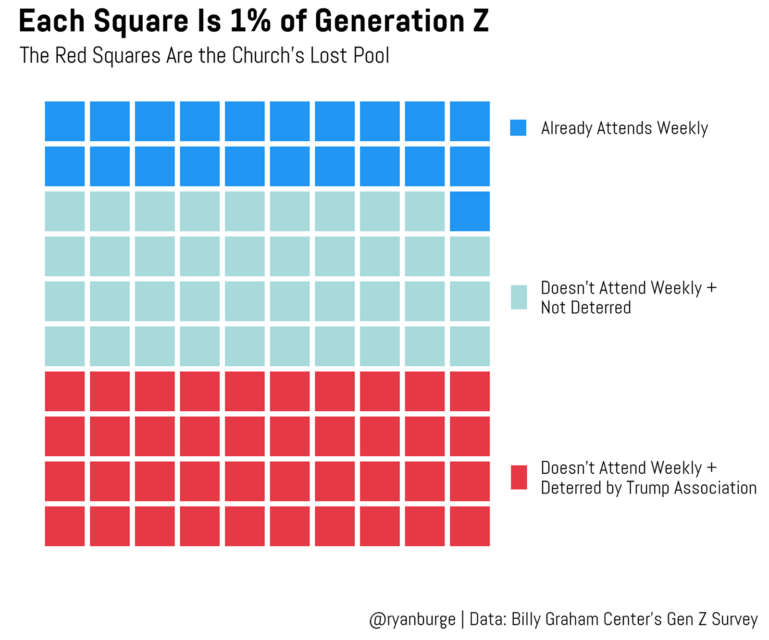
To assess this question, the sample of young adults was broken down into three categories: those who attend church weekly, those who don’t attend weekly but not because of the Trump-Christian association, and those who don’t go to church that much and pointed to the Trump connection as at least one reason making them less likely to show up for Sunday worship.
About 20% of Gen Z is already going to church on a regular basis. The remaining 80% are evenly split on whether Christian support of Trump has impacted their churchgoing. Said simply: 40% of Gen Z said politics was keeping them away from a local church.
Again, it’s important to note that we can’t say if this is the only reason these members of Gen Z are staying away from a house of worship. Their lack of attendance could stem from a variety of concerns based on religious beliefs, life circumstances and any number of other factors. But the data from this survey does point to a large share of Gen Z being repelled from American Christianity due (in some part) to its predilections toward the GOP.
Newton’s Third Law of Motion says that “for every action, there’s an equal and opposite reaction.” That maxim certainly applies to the world of physics, but it also is instructive in the social world. It’s undoubtedly the case that the growing alliance between Christianity and Donald Trump has drawn some people closer to evangelicalism while pushing others away. Among Gen Z, a significant share report that it has created a barrier to entry for them when it comes to regular worship.
Understanding what impact that will have on the future of American Christianity is a necessary academic pursuit.
(Ryan Burge is a professor of practice at the John C. Danforth Center on Religion and Politics at Washington University and author, most recently, of “The American Religious Landscape: Facts, Trends, and the Future.” Rick Richardson is professor of evangelism and leadership, director of WCBGC Research Institute and director of the Church Evangelism Institute at Wheaton College. The views expressed in this commentary do not necessarily reflect those of Religion News Service.)
LOS ANGELES (AP) — This phenomenon of irony collapsing into sincerity is being interpreted by some as a way for younger generations to grapple with ritual, meaning and authenticity, even as participation in organized religion in the United States has dropped dramatically in recent decades.
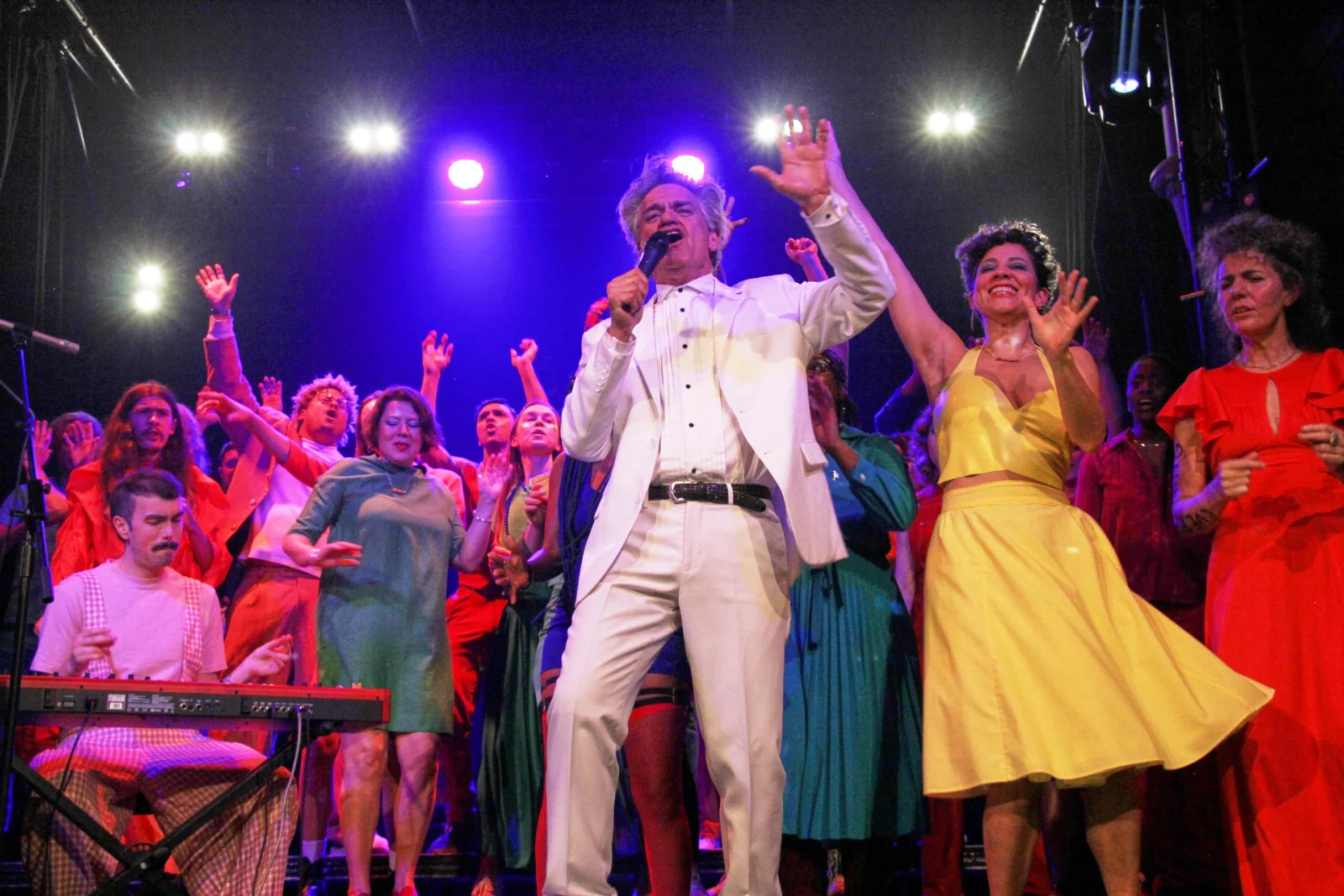
Reverend Billy and the Stop Shopping Choir perform from the Colchester Arts Centre in Colchester, England during their Fabulous Unknown UK tour on Oct. 23, 2024. (Miranda Zhen Yao via AP)
Krysta Fauria
July 21, 2026
LOS ANGELES (AP) — Indie musician Alex Cameron is known for his transgressive lyrics. So when he started singing passionately about Jesus during his concert in a trendy Los Angeles neighborhood, the crowd seemed unsure if he expected them to laugh or worship.
“Jesus never had no porno / Jesus never had cocaine / Jesus never had Ibiza / He never even went to Spain,” the Australian singer-songwriter crooned, prompting sporadic chuckles across the venue.
This mix of the absurd and sincere reflects a kind of artistic engagement with existential questions that is increasingly resonating with people, many of whom are disconnected from organized religion. Some scholars even have a name for it: “reverent irreverence.”
When Cameron reached the chorus, the laughter stopped. “But every time he spoke / The people gathered round / When he washed their feet / The demons all came out / So when’s he gonna come again?” he sang over a wistful electric guitar.
Funny to some, potentially offensive to others, there’s a palpable earnestness to “Jesus Never Had No Porno” and other Cameron songs invoking similar themes.
“You’ve been disarmed with laughter. Now you’re kind of open to anything. You’re open to profound sadness or hope,” Cameron said in an Associated Press interview ahead of his album, “Late to Set,” dropping July 24. “That’s my entire life. It’s serious, but it’s funny.”
Art still loves religion, regardless of whether people believe in it
This phenomenon of irony collapsing into sincerity is being interpreted by some as a way for younger generations to grapple with ritual, meaning and authenticity, even as participation in organized religion in the United States has dropped dramatically in recent decades.
“Religion is understood as a source of power, whether or not you believe in it,” said Kathryn Lofton, who studies religion and pop culture at Yale University.
As the world feels increasingly chaotic and stripped of moral boundaries, Lofton is seeing more skeptics seeking out sacred settings where they can experience transcendence and community.
Despite the rise of people unaffiliated with an organized religion — so-called “nones” — it remains a creative touchstone. Its enduring usefulness as a shared language extends to the upper echelons of popular culture, from Beyoncé’s engagement with Yorùbá religion and other African diasporic spirituality, to Rosalía’s 2025 concept album, “Lux,” inspired by Catholicism, female saints and mysticism.
These themes are not siloed to overtly evangelistic channels, like contemporary Christian radio. But when religion is invoked by comedians or artists whose work is assumed to be funny, it can have a distinct appeal to people who see themselves as impervious to the cultural and political associations with traditional faiths.
“Someone who is playing with it, is humorous about it, has a sense of irony — it’s a way for them to engage these kinds of questions and at the same time retain plausible deniability that they really are interested in religion,” said Leigh Eric Schmidt, a professor at Washington University in St. Louis.
Making jokes that are ‘seriously full of God’
Throughout Nathan Fielder’s HBO docuseries, “The Rehearsal,” religion is a recurring theme as he explores ideas surrounding interfaith relationships, antisemitism, forgiveness and numerology.
“I was raised Jewish and I still do all the holidays and stuff,” he narrates in one episode, adding he “hadn’t been to synagogue in years because it’s so boring.”
For some fans, ambiguity is what attracts them to Fielder’s humor. “You never know if he’s serious or not,” said Shelah Marie, a 41-year-old wellness influencer from Atlanta.
“There’s an increasing level of disassociation that we have to feel in order to maintain sanity. It is psychotic, the amount of information that we receive,” she said. “Maybe being absurd is our protection.”
Cameron Winter, the front man of the rock band Geese, blurs these lines in his debut solo album “Heavy Metal.” “God is real, God is real / I’m not kidding, God is actually real,” he belts.
Though saying one is “not kidding” may invite skepticism, his commanding voice carries such gravity that it’s hard to dismiss his proclamation as mere sarcasm.
“It’s a fine line,” said Schmidt, who co-organized a series of lectures in 2024 titled “Reverent Irreverence: Parody, Religion, and Contemporary Politics.” “You’re not going to convince people that you’re not just making fun of them sometimes.”
One of those talks was on The Church of Stop Shopping, led by director Savitri D and the character of the Reverend Billy, played by actor and playwright William Talen. As this anti-consumerist collective satirizes tropes surrounding conservative Protestant denominations, “irony gives way to an articulation of communal values that are sincerely held,” said sociologist George González, who wrote a book on the group.
In a testament to that sincerity, Neil Young had the Stop Shopping Choir open for him on his 2024 tour.
“We’re an adopted church for lots of post-religious people,” said Talen, reflecting on what it means to be “seriously full of God at the same time that you’re seriously full of bull(asterisk)(asterisk)(asterisk)(asterisk).”
‘Reverent irreverence’ encourages authenticity in the age of AI
Christian theologian Harvey Cox wrote in the 1960s about how effectively humor can be used to attract people to church, noting that when society’s icons are used “to say something different in an ironical manner, we heap nuance upon nuance and combine satire, hope and playfulness.”
Now these artists are exploring the relationship between humor and faith with audiences that are feeling the impact of artificial intelligence on creativity and culture.
“We can no longer tell surface from depth and treasure from knockoff,” González said. “Is my art real or did an algorithm produce it?”
Cameron is acutely aware of this tension, joking that humans are on track to exist solely in the service of tech companies. “Aren’t we all just eventually going to be in gestating pods where they fill up every orifice with a way to extract experience out of us?”
But that anxiety has coincided with a search for transcendence. Although he didn’t grow up going to church, Cameron has tried to make a habit of it as an adult.
“Just to try and ground myself in something ritualistic,” he said. “Magic is real and God is real, and you know those things are pretty widely accepted, I think.”
___
Associated Press religion coverage receives support through the AP’s collaboration with The Conversation US, with funding from Lilly Endowment Inc. The AP is solely responsible for this content.

No comments:
Post a Comment