Friday 24 July 2026, by Adam Novak
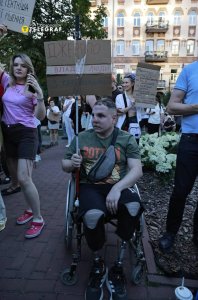
For the second consecutive day, Ukrainians are on the streets — in Kyiv, Lviv, Rivne, Odesa, Dnipro, Poltava, Mykolaïv, Ivano-Frankivsk, Ternopil, Zaporizhzhia, Kropyvnytskyi, Cherkasy, and in the diaspora. On 14 July, Ukraine’s parliament voted to dismiss the entire government of Prime Minister Yuliia Svyrydenko. Among those who went with it was Mykhailo Fedorov — until January 2026 Ukraine’s Minister of Digital Transformation, then its Defence Minister, and in both roles the principal architect of Ukraine’s drone strategy. When the Koretskyy government was confirmed on 16 July, President Zelensky submitted no candidates for the posts of Defence Minister or Foreign Affairs Minister. Yevhenii Khmara, head of the Security Service (SBU), was named acting Defence Minister. It was that appointment — a security services figure placed at the head of a ministry Fedorov had been reforming around drone technology and distributed warfare — and what it revealed about the direction of military policy, that brought people into the streets. [1] The demands being raised go considerably further than any one government position.
In Zaporizhzhia, protesters re-enacted the famous Repin painting of Zaporizhzhian Cossacks writing a defiant letter to a foreign ruler, then drafted their own open letter to Zelensky: reinstate Fedorov, dismiss Syrskyi. In Ivano-Frankivsk, the placards read: "Fedorov is Defence Minister!", "Syrskyi, out!", "The government is the people!" In Lviv, demands included a full independent audit of the Commander-in-Chief’s activities and the restoration of parliament’s role in forming the government. In Rivne: fight corruption.
As Oksana Kozlova of the European Network for Solidarity with Ukraine (ENSU, Belgium) puts it: "I would dare to say that they are standing up not so much in support of Fedorov, and even not that much against Syrskyi. They are protesting against an army with ’Skelia’, post-Soviet-style generals such as the 155th Brigade former commander, the criminal ’negligence’ in Vyshneve, the old guard apparatchiki enriching themselves through arms procurement, the absence of transparent digitalised reporting on military budget use, mobilisation squads that resemble mafia gangs, the persecution of independent media." [2]
This is not a protest for a minister. It is a protest against a system.
The cardboard sign has become the symbol of Ukrainian wartime civic life — low-threshold, undeniable, effective. It appeared in July 2025 when the government tried to dismantle the independence of the anti-corruption agencies NABU (National Anti-Corruption Bureau) and SAPO (Specialised Anti-Corruption Prosecutor’s Office), and parliament was forced to reverse course within nine days. [3] The cardboard sign is back now, in greater numbers and with a longer list of demands.
Two days before Fedorov’s dismissal, activists from Sotsialnyi Rukh (Social Movement), the Pryama Diya (Direct Action) student union and the Pasyazhery Kyiva (Kyiv Passengers) civic group were already outside city hall protesting a near-fourfold rise in public transport fares. [4]
Families of soldiers have been on the streets since October 2023 demanding defined demobilisation terms and rotation after eighteen months of service. [5]
Each wave has been distinct. Each has forced a retreat or a concession.
A crisis with a military logic
The confrontation that produced Fedorov’s dismissal did not begin with the cabinet reshuffle. It began with a Telegram post. [6] On 10 July, Oleksandr Syrskyi — Commander-in-Chief of the Armed Forces since February 2024 — published a text on Telegram claiming the situation was "far from a turning point in the war" and warning against underestimating the adversary. Nobody disputes the second point. But the first — the denial that anything has fundamentally shifted — is simply false.
Since the summer of 2025, Ukrainian drones have destroyed a significant share of Russia’s refinery and hydrocarbon export capacity, striking targets deep into Russian territory. Russian advances at the front have slowed and, in several sectors, reversed. The Crimean peninsula is increasingly isolated. Putin’s demonstration of fear at the 9 May 2026 parade has become a political fact that the Russian ruler cannot undo. Ukraine’s 40-day operation, announced by Zelensky on 25 June, combines targeted strikes in Russian territory, front pressure and the continuing isolation of Crimea. Zelensky chose Syrskyi over Fedorov. The streets have responded.
The connection is not accidental. As French APLUTSOC and ENSU member Vincent Présumey writes, citing the journal Diplomatie: drone warfare requires "a disseminated, not centralised, and democratic, cooperative framework" — the opposite of what Syrskyi represents. The revolution in drone, AI and robotics technology, which has been accumulating since the mass uprising of February 2022, crossed a qualitative threshold at roughly the same moment as the July 2025 cardboard revolution — as Présumey insists, "in no way a coincidence." Democratic civic mobilisation and distributed technological warfare share a structural logic. Both require initiative from below. Both are weakenedby the apparatus of centralised command.
This also explains what is at stake economically. As Jean Batou and I recently argued, the Western arms industry covets Ukraine’s drone expertise "exactly as they would a deposit of qualified labour or rare earths." [7] The push for centralised procurement and large defence contractors serves not only Syrskyi’s military doctrine but the strategic interests of western firms like Rheinmetall. The two logics — authoritarian military command and oligarchic capture of the defence economy — reinforce each other.
The political consequences of that reinforcement are already visible in the streets. By the second day of protests in Kyiv, a far-right current had appeared within the broader movement. Placards named Andrii Biletskyy — founder of Azov, member of Tryzub (the Bandera organisation), commander of the 3rd Army Corps, and leader of the National Corps party — as the preferred Commander-in-Chief. "Syrskyi is Soviet-era deadweight. Fedorov is digital. Biletskyy is results." "Fedorov makes deep strikes. Biletskyy holds the front." [8]These slogans do not represent the protest as a whole, but they document an organised far-right presence attempting to hegemonise a crisis that began elsewhere.
The question of who replaces Syrskyi, on what criteria, chosen by whom, is not a secondary personnel matter. It is the political content of the crisis. The left might not yet be contesting the question of military command, but the far right is steping in with an answer of its own.
The demands that could win
The protests are already raising demands that go beyond personalities. In Lviv, protesters called for the restoration of parliament’s role in forming the government. In Rivne, the demand was to fight corruption. These connect directly to the programme that Sotsialnyi Rukh and the Pryama Diya student union formulated during the July 2025 anti-corruption protests: "We demand the abolition of everything that allows those close to power to steal with impunity, both at the rear and at the front" — an independent anti-corruption investigation, real labour inspection, comprehensive social protection financed by taxation of the rich, financial transparency in times of war, "a fair state, not a state for corporations." [9] The cardboard sign connects July 2025 to July 2026. The same forces are on the street. The demands have deepened.
The street ptotests reflect majority feeling that Syrskyi should be dismissed and his conduct investigated. Fedorov himself said at his 16 July press conference that Ukraine cannot "win asymmetrically, with minimum losses" under the current command structure, and called for replacing both Syrskyi and the Chief of the General Staff. [10] He is right. The same hierarchical doctrine that drove Syrskyi to suppress Fedorov’s initiatives produced the failures that soldiers have been publicly documenting for two years. Under Syrskyi, the 36-month service rotation limit was stripped from the mobilisation law before its April 2024 passage. Mobilisation has operated through methods — street round-ups, coercion, the suppression of complaints — that corrode the democratic culture on which Ukrainian resistance depends. Soldiers from the 125th Brigade’s repair battalion — drone repairers, welders, excavator operators — were sent to assault positions with no relevant training; two died. Their collective statement was not a refusal to fight: it was an indictment of command decisions that wasted specialised capacity and killed people unnecessarily. Soldiers of the 48th Separate Assault Battalion publicly opposed their commander’s replacement at a critical combat moment. Patrick Le Tréhondat, translator and ENSU solidarity activist, who brought the 125th Brigade case to international attention, was correct: "Protests within the ranks of the Ukrainian army are not signs of weakness but indices of strength." [11] Public challenges to military hierarchy that would result in summary punishment in Russia’s armed forces are, in Ukraine, expressions of the democratic vitality that distinguishes this resistance.
Many feel that Fedorov should be reinstated — not as a personality beyond criticism, but because what his ministry was building must not be defeated by the right and far right. He championed the asymmetric strategy Ukraine needs. An audit of 7.2 billion dollars in defence overpayments was under way on his watch. His neoliberal failings are real, and Sotsialnyi Rukh has documented them consistently — most recently on the Labour Code his government was simultaneously advancing. [12] A critique of his record must be paired with concrete proposals for organising the defence economy in a democratic, cooperative way rather than through Silicon Valley entrepreneurship, deals with the western arms industry and untransparant oligarchic procurement. State coordination, transparency, worker representation, taxation of super-profits: these are the conditions for an efficient defence sector that serves society.
The soldiers fighting this war have not waited for civilians to articulate their demands. They have been building their own. Veteranka — Ukraine’s first organisation of women veterans, now with over 3,000 members — spent years filling a gap the state refused to fill: producing free women’s uniform sets because the Ministry of Defence issued none until February 2024. Their legislative work has been equally concrete. Their campaign for Bill 13037, adopted by the Verkhovna Rada on 25 February 2026 with 276 deputies voting unanimously on Ukrainian Women’s Day, obliges commanders to investigate every case of discrimination and violence in the armed forces and formally defines sexual harassment as a disciplinary offence requiring emergency response within fifteen minutes. Their head Kateryna Pryimak states plainly what underlies all of this: "The army is the group in society with the fewest rights, and women in the army face the greatest restrictions." [13]
LGBT Military for Equal Rights, representing more than 700 openly serving LGBT+ personnel across 59 units, is fighting a different but structurally identical battle: the right to exist legally as the person you are while risking your life for the state. Their core demand is civil partnership rights that would allow soldiers’ partners to visit them in hospital, make medical decisions, inherit property, receive military pensions and arrange funerals. The case of Maria Zaitseva illustrates what the absence of these rights costs in practice. Killed in service, her partner Anna Honcharova could only see her body because "a comrade made arrangements." When Maria received the Order of Courage posthumously, Anna was not notified — the award went to "next of kin," a legal category that did not include her. Parliament has not passed the civil partnerships bill. The Parliamentary Speaker has stated it "is not a priority." [14]
In June 2026, the Confederation of Free Trade Unions of Ukraine (KVPU) announced the creation of the All-Ukrainian Union of Combatants, Military Personnel and Veterans. Mykhailo Volynets, KVPU president, described the new union’s purpose: veterans and military personnel "must not only enjoy society’s respect, but also have effective mechanisms to influence state policy and defend their civil rights." [15] This is the first organisational link between the labour movement and the soldiers’ movement. Workers and soldiers share an interest in accountability, transparency, and protection against arbitrary power.
Taken together, Veteranka, LGBT Military, and the KVPU soldiers’ union represent something the Ukrainian state has consistently failed to ensure: democratic infrastructure within the military. They are not lobbying for abstractions. They are naming specific failures, winning specific legislative changes, and building institutions to defend rights the state denies. They are doing, within the armed forces, what the left needs to do politically in these protests: not just demanding that the system change, but showing what the change looks like in practice.
The defence sector as a whole needs democratic restructuring that goes further still. Sotsialnyi Rukh’s March 2025 statement "For a Ukraine Without Oligarchs and Occupiers" specifies: 50 per cent worker representation on supervisory boards of infrastructure, defence and mineral extraction enterprises; nationalisation of strategic enterprises under workers’ control; progressive taxation reaching 90 per cent on top incomes; confiscation of oligarch assets for the war effort. [16] Their October 2024 conference resolution insisted that "the unwillingness to nationalize production capacities, tax large businesses, and direct the budget towards rearmament makes it possible to prolong the war at the cost of significant human losses and constant mobilization." [17]
Ukraine’s domestic tax revenues currently cover only defence spending. Everything else — pensions, hospitals, schools — depends on foreign loans. This is a political choice, not an economic necessity. And it is the same choice that keeps the labour inspection toothless, the anti-corruption agencies under threat, and the soldiers’ demands unanswered.
The protests have not yet fused these threads into a single programme. As Kozlova writes, the people on the streets "will not allow an arrogant mob to treat them as cattle born to obey. Not even under the pretext of military discipline." That refusal is the foundation. But refusal alone does not decide who takes command, how the defence economy is structured, or whether the legal invisibility of women and LGBT+ soldiers outlasts the war. Sotsialnyi Rukh, Pryama Diya, Veteranka, LGBT Military and the KVPU soldiers’ union already have some answers to those questions. The challenge now is to make those answers the content of the protest — before someone else fills the gap.
18 July 2026
Source: ESSF.
Attached documents
Footnotes
[1] Euronews, "A crisis of his own: Zelenskyy’s wartime reshuffle backfires and leads to protests", 17 July 2026, https://www.euronews.com/my-europe/2026/07/17/a-crisis-of-his-own-zelenskyys-wartime-reshuffle-backfires-and-leads-to-protests
[2] The 425th Separate Assault Regiment "Skelia" became a symbol of command abuse and impunity after an investigation documented systematic hazing, torture, and the despatch of ill-equipped recruits to front-line positions without training. See Adam Novak, "Ukraine’s Disposable Conscripts and Unaccountable Officers", ESSF, 27 June 2026, https://www.europe-solidaire.org/spip.php?article79187
[3] Adam Novak, "The Rear Collapses: Ukraine’s Anti-Corruption Demonstrators Confront Wartime Neoliberalism", ESSF, November 2025, https://www.europe-solidaire.org/spip.php?article77130
[4] Olena Tkalich, "’Transport Is Not a Privilege!’: Kyiv Residents Protest Fare Rise", ESSF, 14 July 2026, https://www.europe-solidaire.org/spip.php?article79393
[5] Adam Novak, "We fight, we have rights", ESSF, November 2025, https://www.europe-solidaire.org/spip.php?article77000
[6] Vincent Présumey, "Notes politico-militaires sur l’évolution de la guerre impérialiste russe contre l’Ukraine depuis le 24 février 2022 et le moment présent", Aplutsoc, 16 July 2026, https://aplutsoc.org/2026/07/16/notes-politico-militaires-sur-levolution-de-la-guerre-imperialiste-russe-contre-lukraine-depuis-le-24-fevrier-2022-et-le-moment-present/
[7] Jean Batou and Adam Novak, "Europe as a Great Power is not Ukraine’s Friend", ESSF, 30 June 2026, https://www.europe-solidaire.org/spip.php?article79218
[8] Mariya Nazarova and Yan Dobronosov, "’Syrskoho na Biletskoho’: u Kyievi tryvayt protesty cherez vidstavku Fedorova", Telegraf, 17 July 2026, https://news.telegraf.com.ua/ukr/ukraina/5945587-sirskogo-na-biletskogo-u-kievi-trivayut-protesti-cherez-vidstavku-fedorova-reportazh-yana-dobronosova; "Na protesti proty vidstavky Fedorova zyavylysya plakaty iz zaklykamy zaminyty Syrskoho na Biletskoho", Gordon.ua, 18 July 2026, https://gordonua.com/ukr/section-politics/news-na-protesti-proty-vidstavky-fedorova-zyavylysya-plakaty-iz-zaklykamy-zaminyty-syrskoho-na-biletskoho-18-07-2026.html
[9] Pryama Diya (Direct Action) and Sotsialnyi Rukh (Social Movement), "Ukraine: anticorruption protests", ESSF, 23 July 2025, https://www.europe-solidaire.org/spip.php?article75706
[10] Podrobnosti.ua, "Posada radnyka prezydenta, dohany Drapatomy, konflikt iz Henshtabom: holovne iz bryfinhdu Fedorova", 16 July 2026, https://podrobnosti.ua/2518090-posada-radnika-prezidenta-dogani-drapatomu-konflkt-z-genshtabom-golovne-z-brifngu-fedorova.html
[11] Patrick Le Tréhondat, "Qu’on ne s’y trompe pas, la contestation dans les rangs de l’armée ukrainienne n’est pas un signe de faiblesse, mais un indice de sa force", cited and discussed in Adam Novak, "Ukraine’s Disposable Conscripts and Unaccountable Officers", ESSF, 27 June 2026, https://www.europe-solidaire.org/spip.php?article79187
[12] Sotsialnyi Rukh (Social Movement), "Ukraine’s New Labour Code: An Obstacle to the Decent Work Programme", ESSF, 4 July 2026, https://www.europe-solidaire.org/spip.php?article79274
[13] Adam Novak, "The political economy of Ukraine’s war and the politics of a coming bad peace", ESSF, May 2026, https://www.europe-solidaire.org/spip.php?article78849
[14] Adam Novak, "We fight, we have rights", ESSF, November 2025, https://www.europe-solidaire.org/spip.php?article77000
[15] KVPU, "Ukraine: A soldiers’ union is formed", ESSF, 10 June 2026, https://www.europe-solidaire.org/spip.php?article79016
[16] Sotsialnyi Rukh, "For a Ukraine Without Oligarchs and Occupiers", ESSF, March 2025, https://www.europe-solidaire.org/spip.php?article74018
[17] Sotsialnyi Rukh (Social Movement), "Ukraine: Conference of Sotsialnyi Rukh (Social Movement), 5–6 October 2024", ESSF, October 2024, https://www.europe-solidaire.org/spip.php?article72344
Adam Novak
Adam Novak is an editor of Europe Solidaire Sans Frontières (ESSF) and former coordinator of the European Network for Solidarity with Ukraine (ENSU/RESU).
Could Zelensky Suffer Diem’s Fate?
U.S. and NATO leaders have waged a multi-year propaganda campaign to convince Western publics that Ukraine is a splendid democracy and that President Volodymyr Zelensky is an extremely popular elected leader who epitomizes those values. Multiple aspects of that carefully crafted image are untrue. Ukraine is a corrupt, autocratic state that maintains strict censorship and brutally represses political opponents. When Zelensky’s term ended in 2024, he and his obedient followers in parliament simply postponed elections indefinitely. Even absent adverse election result, though, there are ample signs that NATO’s much-lauded hero has alienated Ukraine’s public.
The systematic campaign to present Zelensky as a hero is crucial to NATO’s overall portrayal of the ongoing Ukraine-Russia war as nothing less than an existential struggle between freedom and dictatorship – a conflict with truly global implications. New York Times columnist David French contends that “for the first time in my adult life, the moral and strategic heart of the defense of liberal democracy doesn’t beat in Washington. It doesn’t beat in London or Paris or Berlin or Ottawa, either. It’s in Kyiv, where a courageous leader and a courageous people have picked up the torch America has dropped.”
Western leaders have redoubled their propaganda initiatives efforts in recent months to sell the proposition that underdog Ukraine is beginning to win the military contest against Russia. Despite a few flashy Ukrainian military successes, however, the overall picture of an eventual Russian victory in a war of attrition remains essentially the same.
Domestic developments in Ukraine even more strongly suggest that Zelensky may be closer to the precipice of disaster than to the summit of victory. Indeed, his position bears an eerie resemblance to that of an earlier U.S. client and political darling, South Vietnam’s Ngo Dinh Diem. U.S. officials gradually soured on Diem, however, and in 1963 they quietly encouraged South Vietnamese military leaders to oust him. Those generals did so on November 2, killing Diem as well as his brother and chief adviser, Ngo Dinh Nhu.
The Diem episode highlights a broader theme. U.S. foreign clients who become inconvenient to Washington have not fared well over the decades. Given the recent adverse domestic developments with respect to Zelensky, he has ample reason to worry about his long-term survival prospects.
Major political fractures have occurred in Ukraine over the past year, and they are intensifying in both frequency and severity. Zelensky’s actions even alienated some of his most reliable supporters and apologists in the West. For example, the decision by Zelensky and his parliamentary allies in 2025 to curb the independence of anti-corruption agencies proved to be extremely unpopular. Several rounds of anti-government demonstrations erupted in Kiev and several other cities. Zelensky’s reputation throughout the West of being a noble leader dedicated to democracy and honest government was always unwarranted, but this time a good portion of Ukrainian public opinion became disillusioned as well.
Several new incidents indicate mounting political turmoil. General Oleksandr Syrskiy was once considered a national hero. During the early days following Russia’s expanded invasion of Ukraine in February 2022, he masterminded the successful defense of Kiev against a much larger Russian force surging toward Ukraine’s capital. He then planned the counteroffensive that helped his country regain some conquered territory in the east. Zelensky made him commander-in-chief of Ukraine’s armed forces two years later.
By the summer of 2026, though, most Ukrainians no longer viewed Syrskiy as a heroic figure whom they wished to follow. Moreover, Zelensky himself came under intense political fire and confronted waves of street protests throughout the country after siding with the 60-year-old general to fire the country’s charismatic young defense minister, Mykhailo Fedorov, in mid-July. For only the second time since February 2022, thousands of people joined mass anti-government demonstrations. The goal was to pressure Zelensky to change course and reaffirm Fedorov’s vision of technology-driven warfare increasingly relying on drones and robots. (The first large protests, in the summer of 2025, denounced Zelensky’s purge of government anti-corruption agencies.)
Syrskiy also had faced criticism for the heavy loss of life incurred in the Battle of Bakhmut, which drew comparisons with trench warfare in World War I as Ukrainian troops fought for months to defend a town that many analysts considered to have little strategic value.
New York Times correspondents Marc Santora, Liubov Sholudko, and Stanislav Kozliuk conclude that “The current public anger threatens the national unity that has sustained Ukraine through nearly four and a half years of fighting.” They note that “after he was fired, Fedorov issued a scathing public indictment of the military high command.” Other respected Western analysts note the growing bureaucratic turmoil in Ukraine’s government and Zelensky’s ever more perilous political position.
The emergence of such bitter divisions within the top ranks of any country’s military hierarchy is especially destabilizing and ominous. However, the turmoil in Ukraine’s government continues to deepen, not recede. On July 21, 2026, Zelensky capitulated to the demonstrators and fired Syrskiy, replacing him with Major General Mykhailo Drapatyi. Santora asserts that “Drapatyi represents a newer generation of post-Soviet military leadership in Ukraine that has embraced more modern approaches to warfighting.”
An especially crucial question is how the Trump administration views the developments in Kiev. How worried are U.S. policymakers about Ukraine’s continuing viability as a U.S./NATO security client and Zelensky’s status as Ukraine’s leader going forward?
Washington never likes turmoil in any of its client states. Loyal political figures in those countries typically are courted only as long as they advance Washington’s international policy goals. However, even clients who have outlived their usefulness to the United States but depart quietly tend to be treated well and enjoy a cozy retirement. Conversely, clients who become uncooperative or attempt to remain in power beyond their “use by” date fare decidedly less well. One need only consult the ghosts of Manuel Noriega, Saddam Hussein, and Ngo Dinh Diem for confirmation of the latter point.
The recent political instability in Ukraine suggests that the time may have arrived when the Trump administration will “ask” Zelensky to step aside and enable a new, more popular and capable figure to take the helm. If such a “request” is made, the Ukrainian leader would be wise to heed it.
The Abstraction of War: Ukraine, Proxy Dynamics, and the Erasure of the Working Class
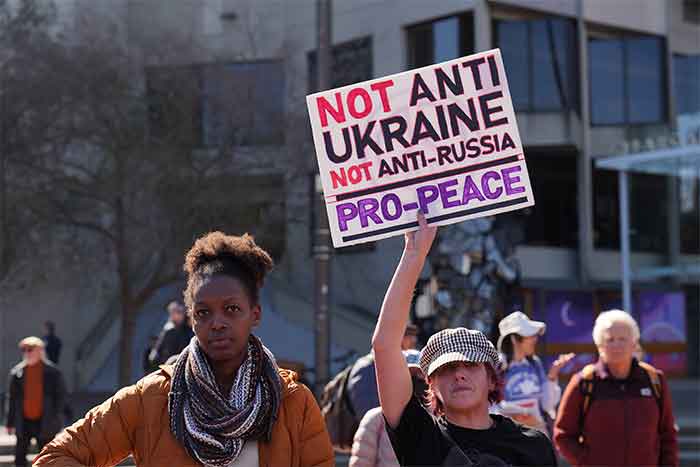
The history of warfare shows that conflicts end either with a clear victory by one side or through negotiations when both face the exhaustion of resources and the will to continue sacrificing lives. There is also a third way: a silent ending of hostilities, the establishment of a ‘cold peace,’ and the freezing of the conflict without an explicit acknowledgment of defeat. It is important to emphasize that wars do not begin out of the blue: they are merely the escalation of deep-seated contradictions that were not resolved through peaceful means. To quote Clausewitz, war is the continuation of politics by other, violent means. From a peace perspective, every war is a defeat not only of politics but also of common sense and civilization. Yet the era in which we live has normalized violence; humanity has even taken a ‘step forward’ by reconciling itself with, or actively supporting, systematic destruction. The international legal framework that once prohibited war has been silenced, pushed far from public view. The public either follows military operations as if they were sporting events or turns away, refusing to see, hear, or speak about evil.
The duration of the Ukraine war has already exceeded that of the First World War. The fact that, comparatively speaking, the number of casualties is framed as lower is merely a statistical illusion since this is not a world war, but a localized meat grinder. It offers no comfort to the families of those killed. Regarding this war (which began in 2014, not later), wise observers immediately stated it was the most predictable, and therefore theoretically the easiest to prevent. Once the masks fell and former Western leaders admitted that early negotiations were never conducted in good faith, but were instead a way of buying time for the peripheral state to prepare for an open confrontation, it became clear that political will for peace was entirely lacking. Responsibility for the belligerence of the authorities in the conflict zone lies with a range of figures in the imperial core (primarily, Biden and Trump). First came one political faction, then another continued the trajectory, and this has persisted until today. Even after Russia launched its special military operation, there were ways to stop it, but peace was prevented by external actors, notably the UK, intent on prolonging the conflict. The West, infused with a visceral hostility (usually named Russophobia) and intent on profiting from a proxy war where others pay the price in human lives, did not encourage a single genuine peace initiative.
Ukraine, a vast country with a large population and rich natural resources, is a military theater for which there is diminishing hope of a swift conclusion. The strategy of fighting ‘to the last Ukrainian,’ now openly pursued by NATO, is entering a new phase of escalation. The danger of a nuclear confrontation is real, although mainstream media and their experts have begun to relativize it by normalizing the idea that ‘tactical’ weapons could end the war. Hawks exist on all sides. It is as if the legendary cinematic figure Dr. Strangelove has multiplied instead of disappearing. At times, one cannot help but ask: have all of them lost their minds?
It is said that war has changed its nature, especially because of the destructive power of drones and ballistic missiles. Once again, war is proving beneficial for the development of military technology and for generating enormous profits for the military-industrial complex. Peace is unprofitable, even politically. As one critical scholar expressed succinctly, without war, there would be Zelensky. Ordinary citizens are not asked anything because elites make decisions through the lens of alleged competence, the preservation of their reputation, position, and profits. Occasional public opinion polls both in the West and Ukraine reveal a different picture, though everything depends on who asks the questions. Yet the impression remains that ordinary people do not want death. Gen Z can hardly imagine themselves in military uniforms, enduring exhausting physical activities, losing comfort, and giving up their dependence on modern technology. Surveys show that when asked whether they would defend their country in a case of war, a significant number answer positively in the abstract. But when the issue ceases to be hypothetical, a gap emerges: young people are not interested in military training or even in defending their own country. In fact, there is a clear divergence between elites and citizens, who do not want either an arms race or military obligations.
Recently, at a post-Ankara event, this issue was raised: how do you intend to support your commitment to prolonged warfare when you struggle to reach the human factor? The answers were confused and rhetorical, essentially claiming that while the human deficit is real, member states have an obligation to work on public education and on ‘societal resilience.’ This last phrase is a modern euphemism designed to avoid the real words for what is being done: deliberate intimidation, the spread of hatred, parallel militarization, and the diversion of funds from social needs toward military spending. Anyone who protests risks being labeled either a coward or a traitor who does not love their country.
Ukraine is, of course, a special case. The comparison between national polls and independent international surveys regarding attitudes toward the war shows differences too vast to be the result of a sudden shift in public opinion. Local polling institutes regularly focus on the population’s resistance, high respect for the army and rejection of compromise. But despite the clear internal purpose of these surveys, the trend is inexorable: support for military outcomes has been declining, while support for negotiations is rising (66 percent in July). The trend is clear: war fatigue and the desire for a practical solution are growing among the populace, alongside a drop in trust toward foreign leadership. In short, local polls measure determination and identity orientation, while Gallup asked a direct question: negotiations vs. continuation of combat operations.
The political implications are clear: the Kiev authorities must balance public resolve with a growing desire for compromise. Those who oppose continuing a war that has already turned vast fields into graveyards see the daily reality in video clips showing the violent and brutal ‘conscription’ taking place on the streets of cities far from the front lines. Citizens openly and massively resist the ‘cannon fodder hunters’, the Lvov case being the latest. Meanwhile, foreign allies are assisting the political leadership by cutting all benefits for the Ukrainian citizens who hold refugee status, preparing them to be sent back to the country to serve.
In the battle of narratives, it is very difficult to get an accurate picture, but the media inflames this psychological warfare with headlines claiming that newly deployed Russian soldiers last barely half an hour at the front (according to the CIA director). It is no secret that the price being paid by Russia is becoming increasingly unacceptable to its public. However, there is no question of mass forced conscription there, as the army continues to be replenished by volunteers signing state contracts for economic survival. The number of casualties and unrecovered bodies of Ukrainian soldiers suggests that headlines about the short lifespan of the opposing soldiers are likely exaggerated propaganda.
The tragedy of this war, like any other, becomes visible when one looks down at ‘ordinary mortals’. Through a human and class lens, the entire picture comes into view, mirroring what a Serbian proverb expressed long ago:
The state gives cannons, the rich give oxen, and the poor give their sons. When the war is over, the state gets its cannons back, the rich get their oxen back, and the poor are left with nothing but graves.
To put it more vividly, on the Russian side, those fighting are individuals who cannot otherwise earn a decent living, making the state’s financial offer appear attractive—a clear case of economic conscription. On the Ukrainian side, stories of untrained and forcibly conscripted young people are filled with examples of corruption, post-traumatic stress disorders that fail to prevent redeployment to the front, and brutal punishment by comrades for anyone who does not show enough courage.
If a broader European-Russian war breaks out, it will reproduce the same pattern. Every general or politician calling for ‘resilience,’ the ‘education of youth,’ and public readiness to sacrifice their sons should recognize that such demands extend the brutal class logic of warfare onto the entire continent: those who make strategic decisions are rarely those who bear the ultimate costs. The invisible, class-based reality of war—who decides, who profits, and who dies—must not be erased from public consciousness.
This article was produced by Globetrotter.
Extending and expanding Canada’s military presence on Russia’s border is apparently not newsworthy to the dominant media. Quadrupling down on a policy that’s contributed to hundreds of thousands of needless deaths, which could still lead to nuclear Armageddon, is of little interest.
At the recent NATO summit, Prime Minister Mark Carney “announced the extension of the Canadian-led Operation REASSURANCE until 2031, including plans to increase Canada’s persistently deployed personnel to up to 2,600.” That represents an increase from 2,200 “persistently deployed” soldiers and puts Canada’s total deployment in Latvia and elsewhere in Eastern Europe at some three thousand. With about 2,200 military personnel stationed in a country of 1.8 million, there are nearly as many Canadian troops on a per capita basis in Latvia as there are in Canada!
Carney’s extension of Operation REASSURANCE to 2031 is an obvious bid to ‘get tough’ on Vladimir Putin. Eleven months ago, Carney traveled to Latvia to announce a three-year extension of the mission to 2029. Is the plan going forward to extend the deployment by two or three years every eleven months?
By 2031, Canadian troops will have been stationed on Russia’s border for 14 years. In a sign of the permanence of the deployment, Canada recently broke ground on a $70 million upgrade to its base in the country and, through Operation REASSURANCE, Canada has invested more than $315 million in military infrastructure in Latvia since 2017.
At the NATO summit, Carney announced an expansion of Canada’s role in Latvia through NATO’s Multinational Division North, and last month the head of the mission described how the Canadian-led NATO brigade of 4,000 keeps growing and bolstering its position near the Russian border. According to Defense News, “The Canada-led NATO brigade in Latvia has moved beyond its original ‘tripwire’ deterrence posture and is now focused on mounting a credible defense of the Baltic country bordering Russia, according to its commander, Col. Kris Reeves. Reeves said the shift towards what he described as ‘tactical credibility’ has meant establishing forward locations and stationing troops near Latvia’s eastern border, in the terrain where they would actually fight in the event of a conflict.”
There’s been barely a peep about the expansion and extension of the provocative deployment in the media. A July 20 “Operation REASSURANCE” Google news search for the past month unearthed a single article about Carney’s announcement in the Baltic Times. Additionally, a July 11 Journal de Montreal article headlined “Threat from Moscow: will Canadian soldiers in Latvia serve as cannon fodder?” (my translation) devoted a single sentence to Carney’s extension of Operation REASSURANCE in the ten paragraphs. (Multiple media outlets reported on two Canadian naval vessels that recently departed Halifax to join Operation REASSURANCE.)
Permanently stationing troops on Russia’s border is of little media or political interest despite its implications. According to Refdesk.ca, “The Latvia extension is a strategic bet on a long war. Extending Operation Reassurance to 2031 signals that Canada expects Russia to remain a threat throughout the decade. This is a significant policy statement: it commits CAF force generation to a specific mission for eight more years, constrains flexibility to respond to other threats (Arctic security, Indo-Pacific), and puts sustained pressure on recruitment and retention.”
Most significantly, extending Operation REASSURANCE escalates tensions with Russia. Alongside stationing troops in Latvia, Poland and elsewhere, Canada has plowed $26 billion into the NATO proxy war in Ukraine, which is more than Ottawa spent on its 13-year occupation of Afghanistan.
Since the early 1990s, Canada has steadily escalated its belligerence towards Russia. For 30 years they’ve pushed NATO expansion eastward and funded pro-Western civil society organizations. They coordinated Western diplomatic support for the 2004 Orange Revolution, and when Viktor Yanukovych was elected in 2010, Ottawa worked to undermine his presidency, directly assisting the 2014 Maidan coup. Subsequently, Canada instigated Operation Unifier to assist Ukrainian forces engaged in a civil war/low-level proxy fight with Russia, which Moscow greatly expanded four and a half years ago.
Today Russia and Ukraine are increasingly attacking oil refineries and civilian infrastructure. NATO is involved in every facet of the conflict, and Donald Trump appears to have largely ditched efforts to negotiate an end to the horrors. The possibility of further escalation is real.
Canada extending its mission on Russia’s border and massively increasing military spending is ratcheting up tensions at a time when humanity needs to unite to combat the climate crisis.


No comments:
Post a Comment