Trump Administration Invests in Removing Ocean Research Instruments
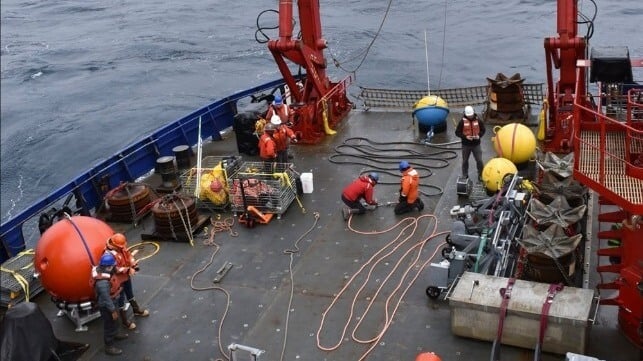
Moving the objectives of Project 2025 one step closer to completion, the National Science Foundation is removing 900 ocean data collecting buoys that cost more than $370 million to install. If left in place, the buoys would have continued to provide climate-related data to scientific researchers for another 15 years - an outcome that NSF's plan will prevent, saving taxpayers nearly $50 million per year. It will also unwind the decades of effort by American oceanographers, technicians and professional mariners who have installed and maintained the network. The Coastal Endurance Array off the Pacific Northwest is the first to go, and removal operations at that site are already in process, according to the Ocean Observatories Initiative (OOI).
Instead of abandoning the buoys and subsea landers in place, NSF will allocate ship-days to physically remove OOI equipment from far-flung locations around the globe, from the North Pacific to Greenland to the Southern Ocean, the New York Times reports.
"Over more than a decade, OOI has delivered the world’s most advanced continuously operating ocean observing systems, supporting science, engineering, education, and workforce development across the ocean sciences community. We are profoundly grateful for the extraordinary efforts of the scientists, engineers, operators, educators, students, and partners who made this facility possible and who continue to advance its legacy through the use of its data," said Jim Edson, the head scientist for the NSF Ocean Observatories Initiative in a statement.
The initiative to cease collection of climate-related ocean data aligns with the priorities of Project 2025's "Mandate for Leadership," a transition guide for the current administration. In 2024, the project's authors advised that the NOAA Office of Oceanic and Atmospheric Research (OAR) - a key customer of OOI ocean data, an adjacent enterprise through NOAA's U.S. Integrated Ocean Observing System (IOOS), and a funder of OOI host institution Woods Hole (WHOI) - was in the authors' view "the source of much of NOAA’s climate alarmism," and "the preponderance of its climate-change research should be disbanded."
This vision was partially realized over the course of the administration's first year. NOAA shed about 20 percent of its workforce through layoffs in the first 12 months, with cuts concentrated at OAR. The administration's first budget, written by Project 2025 co-author and current White House Office of Management and Budget director Russell Vought, would have seen OAR "eliminated as a line office," ended OAR's 16 scientific cooperation agreements with 80 different research universities, and folded the rest of its work into other departments. Congress declined to enact this proposal and funded OAR at $630 million for FY2026.

No comments:
Post a Comment