(RNS) — The largest Presbyterian denomination in the US and the American Academy of Religion both referred to Israel's war in Gaza as genocide in new resolutions condemning the war.

Palestinians inspect damage to their tents following an Israeli airstrike in Khan Younis, Gaza Strip, Tuesday, June 30, 2026. (AP Photo/Abdel Kareem Hana)
Chloe Landen
July 1, 2026
RHS
(RNS) — The largest Presbyterian denomination in the United States voted Tuesday evening (June 30) to recognize Israel’s war in Gaza as a genocide, two days after the Presbyterian Church (U.S.A.) unanimously voted to divest from Palantir Technologies and General Electric Aerospace over technologies used in the war.
Tuesday’s vote at the denomination’s General Assembly in Milwaukee passed 454-15 and called for Presbyterians to also lobby Congress for an arms embargo against Israel and to boycott Israeli products that contribute to the war.
Additionally, the American Academy of Religion adopted a Resolution in Solidarity with Gaza last week condemning the Israeli government for the war in Gaza, calling it a genocide. The association of religious studies scholars that boasts 6,000 members worldwide referred to the war at its Annual Business Meeting in Atlanta as a “scholasticide,” or an “intentional effort to comprehensively destroy the Palestinian education system.” The motion was approved by 98% of members, according to a news release
The religious organizations’ resolutions add to growing criticism accusing Israel of committing genocide in Gaza — a claim Israel has repeatedly denied.
Since the war in Gaza began after the Oct. 7, 2023, Hamas attacks on Israel, more than 73,000 Palestinians have been killed, according to the Gaza Health Ministry, which is run by the Palestinian Authority. Almost a third of the reported casualties have been children, according to a United Nations Human Rights Council investigative body. Additionally, according to the U.N., 2 million Gazans are displaced, leaving swaths of Palestinians suffering from starvation, dehydration, inadequate shelter, poor sanitation, environmental exposure and other continued risks caused by the war.
(RNS) — The largest Presbyterian denomination in the United States voted Tuesday evening (June 30) to recognize Israel’s war in Gaza as a genocide, two days after the Presbyterian Church (U.S.A.) unanimously voted to divest from Palantir Technologies and General Electric Aerospace over technologies used in the war.
Tuesday’s vote at the denomination’s General Assembly in Milwaukee passed 454-15 and called for Presbyterians to also lobby Congress for an arms embargo against Israel and to boycott Israeli products that contribute to the war.
Additionally, the American Academy of Religion adopted a Resolution in Solidarity with Gaza last week condemning the Israeli government for the war in Gaza, calling it a genocide. The association of religious studies scholars that boasts 6,000 members worldwide referred to the war at its Annual Business Meeting in Atlanta as a “scholasticide,” or an “intentional effort to comprehensively destroy the Palestinian education system.” The motion was approved by 98% of members, according to a news release
The religious organizations’ resolutions add to growing criticism accusing Israel of committing genocide in Gaza — a claim Israel has repeatedly denied.
Since the war in Gaza began after the Oct. 7, 2023, Hamas attacks on Israel, more than 73,000 Palestinians have been killed, according to the Gaza Health Ministry, which is run by the Palestinian Authority. Almost a third of the reported casualties have been children, according to a United Nations Human Rights Council investigative body. Additionally, according to the U.N., 2 million Gazans are displaced, leaving swaths of Palestinians suffering from starvation, dehydration, inadequate shelter, poor sanitation, environmental exposure and other continued risks caused by the war.
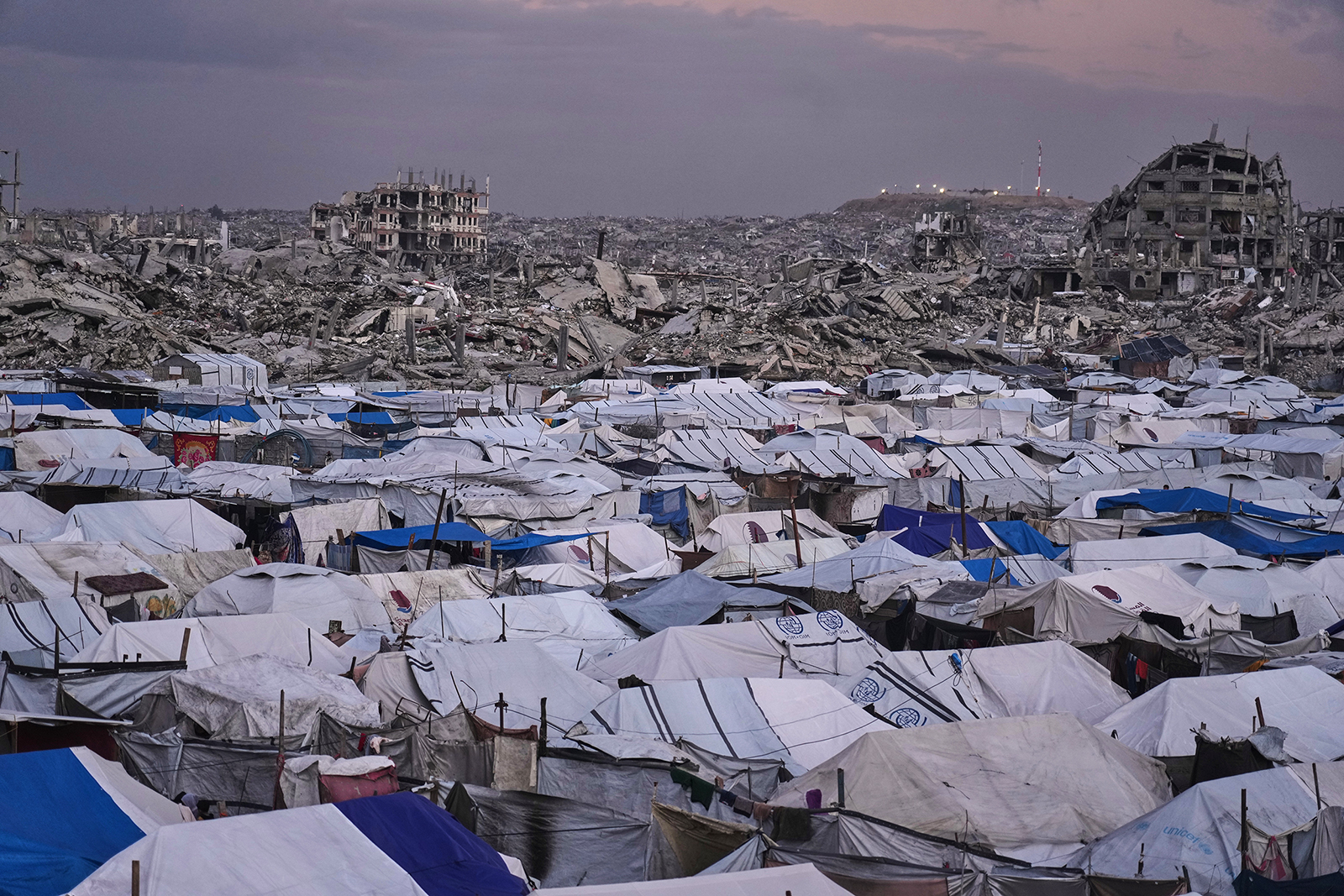
A tent camp for displced Palestinians stretches across the Zeitoun neighborhood of Gaza City, Jan. 14, 2026. (AP Photo/Jehad Alshrafi)
On Tuesday, the U.S. House deliberated an amendment to cut funding for Israel. The bill was spearheaded by Kentucky Republican Rep. Thomas Massie but has mostly received support from House Democrats.
RELATED: Israeli drone strike kills Palestinian siblings in a Gaza tent camp
PCUSA’s decision to divest from Palantir and GE reflects the two corporations’ active roles in conflicts that have drawn condemnation from humanitarian groups, the denomination said.
Palantir Technologies, a data analysis and technology firm that provides militaries with artificial intelligence, has used its technologies to support the Israel Defense Forces post-Oct. 7, according to a UN report. Al Jazeera reported Palantir’s software has been instrumental in interpreting data to develop “kill lists” for the Israeli military.
General Electric provides Israel with engines and manufacturing components that have been used in military assaults deemed war crimes by human rights organizations, PCUSA wrote in its analysis.
This week’s votes are not the first time PCUSA has criticized Israel and divested from corporations. In 2014, the denomination divested in three companies — Caterpillar, Inc., Hewlett-Packard and Motorola Solutions — that provided Israel with equipment to aid in the occupation of Palestinian territories. And in 2024, PCUSA voted to divest from Israel bonds and approved a resolution denouncing Christian Zionism. The denomination began considering divestment from GE and Palantir the same year.
“We are pleased that the denomination has taken meaningful steps to address the genocide and other gross human rights abuses against Palestinians and others around the world,” the Rev. Marietta Macy, the co-moderator of the Palestine Justice Network of the PCUSA, said in a recent news release.

Mourners carry the body of Palestinian Abdullah Moussa, 30, who was killed in an Israeli airstrike, during his funeral in Khan Younis, southern Gaza Strip, Saturday, June 27, 2026. (AP Photo/Abdel Kareem Hana)
The International Association of Genocide Scholars, a group with 500 members that includes Holocaust experts, accused Israel of genocide last year.
Last month, a U.N. commission reported that Israeli forces deliberately shot at Palestinian children’s “vital organs using precision weapons such as quadcopters and snipers” and inflicted “death and severe bodily and mental harm” to hundreds of thousands of Palestinian children “through (the) use of high impact weapons” on residential buildings, schools and displacement camps. In targeting children, Israel is “intend(ing) to destroy the existence of the Palestinians in Gaza as a group,” the report concluded.
Israel’s Foreign Ministry called the report “a propaganda piece as outrageous as its previous ones” and “libelous,” The Washington Post reported.
Church investment is a direct “instrument of mission,” PCUSA wrote in its initial considerations. PCUSA noted in its analysis that GE’s materials have also been used in alleged war crimes in Yemen and for the forced migration and re-education of China’s Uyghur population, and that Palantir’s technology has been used in human rights violations against asylum seekers in the U.S.
The Rev. Marcella Glass, chair of the Committee on Mission Responsibility Through Investment of the PCUSA, told RNS that her committee began “focused engagement with Palantir and GE Aerospace on human rights concerns in conflict-affected” areas in 2024. The engagement included dialogue and filing shareholder resolutions with both companies.
“Despite our engagement, both companies continue to provide products or services to customers that are credibly accused of human rights or international humanitarian law violations with no sign of slowing down or changing course,” Glass said. Therefore, MRTI recommended PCUSA divest from both companies.
“We pray that this action motivates both companies to take a hard look at their connections to human rights violations and end these practices,” Glass added. She noted that if either company were to end its contracts “with customers connected to human rights violations” or stop “providing services connected to such violations,” MRTI would recommend their removal from the divestment list to a future General Assembly.
Rabbi Jessica Rosenberg, associate director of religious and cultural organizing at Jewish Voice for Peace, an anti-Zionist group, told RNS in a statement that PCUSA’s decision to divest from Palantir and GE “marks yet another important milestone in the growing movement to hold the Israeli government and military accountable.”
It is unclear how the recent PCUSA and American Academy of Religion resolutions will be received by mainstream Jewish leaders and groups. But before PCUSA’s 2014 divestment vote, Rabbi Rick Jacobs, president of the Union for Reform Judaism, asked the denomination to reconsider, claiming that “a vote for divestment will cause a painful rift with the great majority of the Jewish community.”
The Union for Reform Judaism declined an RNS request for comment.
Israel's targeting of Gaza's children proves genocidal intent, UN inquiry finds
The deliberate targeting of Palestinian children is central to a United Nations-mandated report's conclusion that Israel is committing genocide in Gaza. The commission argues that children have not only been victims of the war, but have been targeted in ways that help establish genocidal intent. Israel has dismissed the findings of the report, released this week, as "defamatory".
Issued on: 26/06/2026 - RFI

The deliberate targeting of Palestinian children is central to a United Nations-mandated report's conclusion that Israel is committing genocide in Gaza. The commission argues that children have not only been victims of the war, but have been targeted in ways that help establish genocidal intent. Israel has dismissed the findings of the report, released this week, as "defamatory".
Issued on: 26/06/2026 - RFI
A Palestinian man mourns his wife and two children, who were killed in an Israeli strike in Deir al-Balah, Gaza, on 2 May 2025. © Abdel Kareem Hana / AP
Children have been killed directly through military attacks and indirectly through the destruction of schools and hospitals, starvation and the collapse of essential services, the report said.
The Independent International Commission of Inquiry on the Occupied Palestinian Territory, including East Jerusalem, and Israel, mandated by the UN, said it had found "reasonable grounds" to conclude that Israel was committing genocide.
The commission said Israel's actions have left a generation physically and psychologically scarred, while undermining the ability of Palestinians to survive as a group.
The report, which was released this week and is around 100 pages long, documents what it describes as violations and crimes committed against Palestinian children in Gaza between 7 October, 2023 and 31 March, 2026.
More than 20,000 children were killed in Gaza between 7 October, 2023 and 7 October, 2025. More than 40,000 were wounded and more than 58,500 lost at least one parent or became orphans, the commission said.
Because children represent the future of a people, the commission argues, deliberately targeting them supports the conclusion that Israeli authorities intended to destroy Palestinians as a people in Gaza in whole or in part.
Children have been killed directly through military attacks and indirectly through the destruction of schools and hospitals, starvation and the collapse of essential services, the report said.
The Independent International Commission of Inquiry on the Occupied Palestinian Territory, including East Jerusalem, and Israel, mandated by the UN, said it had found "reasonable grounds" to conclude that Israel was committing genocide.
The commission said Israel's actions have left a generation physically and psychologically scarred, while undermining the ability of Palestinians to survive as a group.
The report, which was released this week and is around 100 pages long, documents what it describes as violations and crimes committed against Palestinian children in Gaza between 7 October, 2023 and 31 March, 2026.
More than 20,000 children were killed in Gaza between 7 October, 2023 and 7 October, 2025. More than 40,000 were wounded and more than 58,500 lost at least one parent or became orphans, the commission said.
Because children represent the future of a people, the commission argues, deliberately targeting them supports the conclusion that Israeli authorities intended to destroy Palestinians as a people in Gaza in whole or in part.
'Maximum damage'
The commission said Israeli forces repeatedly bombed densely populated neighbourhoods, schools and crowded refugee camps while dismantling the systems children need to survive and develop.
It said 97 percent of schools were destroyed, 95 percent of universities were damaged, with 22 of Gaza's 38 universities completely destroyed.
It also accuses Israel of targeting maternity and neonatal services, contributing to miscarriages and birth defects, while starvation imposed by Israel killed children through malnutrition and caused long-term harm.
By 1 October, 2025, 151 children had died from malnutrition, it said.
"Israel is attacking the very ability of the Palestinian people to exist and determine their future by targeting children," commission chairman Srinivasan Muralidhar said.
The report said Israeli forces also deliberately targeted children using precision weapons.
The report cites evidence that it says shows children were shot in the head and upper body by quadcopter drones, other drones and sniper rifles "to inflict maximum damage".
Among the cases it documents is an incident in which a baby being breastfed inside a tent was shot in the head by a drone equipped with an infrared camera.
It also cites the widely reported killing of five-year-old Palestinian girl Hind Rajab, who was trapped for hours in a car after members of her family were killed as she waited for rescuers to reach her.
"The severe physical and psychological injuries, collective trauma, orphanhood, separation, disability, repeated displacement, starvation and collapse of the education and healthcare systems have destroyed these children's childhoods and will continue to affect them throughout their lives in Gaza," the report said.
Israeli denials
Israel rejected the findings, calling the report "defamatory" and a "slanderous masquerade".
The country's Foreign Ministry said the claims had not been verified and described the commission as "a fundamentally flawed mechanism whose very purpose is to single out and vilify Israel rather than seek the truth".
It accused the commission of ignoring "Hamas's brutal tactics, which ruthlessly target Israeli children and use Palestinian children as human shields".
Israel has also previously accused the commission of anti-Semitism and of acting as Hamas proxies.
The commission said its findings were based on evidence rather than allegations.
"We know who they are," commissioner Chris Sidoti said, referring to Israeli military divisions, brigades and units which the report identifies as potentially involved in incidents in which children were killed in Gaza and the occupied West Bank.
'The reality behind the figures'
The commission said children have continued to be killed and seriously wounded despite the October 2025 ceasefire. Since the truce began, at least 265 children have been killed, an average of one each day.
"Raghad, a 17-year-old Unicef youth ambassador, was killed in Gaza on Monday while travelling to her final secondary school examination," Baptiste Chapuis, Unicef's advocacy and international programmes chief, told RFI.
For the children who survive, the damage can last a lifetime.
"Fear and violence have become so regular, so everyday and so constant that the trauma we see is no longer just an episode in their lives," Chapuis said.
"It is intrinsically linked to their daily reality and to the very fabric of their childhood. Everyday life is filled only with anxiety, fear, sleeplessness and the loss of loved ones. That is the reality behind the figures in this report."
Unicef spokesman James Elder emphasised the everyday circumstances in which children had been killed.
"These children were not killed in a war zone. They were killed in their homes. In their schools. While playing football. While fishing. They were shot, bombed and targeted by drones."
In eight months, more than 400 children have been wounded, with doctors treating brain haemorrhages and severe injuries to the head, chest and abdomen.
"The reality is that Palestinians continue to be killed and injured in Gaza even after the ceasefire announced last October, while the amount of humanitarian aid allowed into Gaza remains far below what is needed," Muralidhar said.
Child mortality remains high, many children are still waiting for emergency medical evacuation and medicines remain in critically short supply, the report said.
Violence beyond Gaza
The commission also examined the treatment of children in the occupied West Bank and East Jerusalem, where it said violence by Israeli settlers and soldiers against children has increased.
It said torture, sexual violence and deprivation of food during arrests and detention, mainly affecting boys, amount to crimes against humanity under international law.
More than half of Palestinian children held in Israeli prisons at the end of last year were being detained without charge or trial, the child rights NGO Defence for Children International said.
Israel and the occupied Palestinian territories rank first in the latest UN secretary-general's report on children in armed conflict, ahead of the Democratic Republic of Congo. The violations listed include killings, mutilations, sexual violence, deliberate obstruction of humanitarian access and attacks on hospitals and schools.
The report also said videos showing Israeli soldiers destroying and mocking children's toys raise "serious ethical, disciplinary and legal concerns", adding that they symbolise "the dehumanisation of Palestinian childhood itself".
Israel said its actions are justified by what it describes as a constant terrorist threat.
The commission said Israeli forces repeatedly bombed densely populated neighbourhoods, schools and crowded refugee camps while dismantling the systems children need to survive and develop.
It said 97 percent of schools were destroyed, 95 percent of universities were damaged, with 22 of Gaza's 38 universities completely destroyed.
It also accuses Israel of targeting maternity and neonatal services, contributing to miscarriages and birth defects, while starvation imposed by Israel killed children through malnutrition and caused long-term harm.
By 1 October, 2025, 151 children had died from malnutrition, it said.
"Israel is attacking the very ability of the Palestinian people to exist and determine their future by targeting children," commission chairman Srinivasan Muralidhar said.
The report said Israeli forces also deliberately targeted children using precision weapons.
The report cites evidence that it says shows children were shot in the head and upper body by quadcopter drones, other drones and sniper rifles "to inflict maximum damage".
Among the cases it documents is an incident in which a baby being breastfed inside a tent was shot in the head by a drone equipped with an infrared camera.
It also cites the widely reported killing of five-year-old Palestinian girl Hind Rajab, who was trapped for hours in a car after members of her family were killed as she waited for rescuers to reach her.
"The severe physical and psychological injuries, collective trauma, orphanhood, separation, disability, repeated displacement, starvation and collapse of the education and healthcare systems have destroyed these children's childhoods and will continue to affect them throughout their lives in Gaza," the report said.
Israeli denials
Israel rejected the findings, calling the report "defamatory" and a "slanderous masquerade".
The country's Foreign Ministry said the claims had not been verified and described the commission as "a fundamentally flawed mechanism whose very purpose is to single out and vilify Israel rather than seek the truth".
It accused the commission of ignoring "Hamas's brutal tactics, which ruthlessly target Israeli children and use Palestinian children as human shields".
Israel has also previously accused the commission of anti-Semitism and of acting as Hamas proxies.
The commission said its findings were based on evidence rather than allegations.
"We know who they are," commissioner Chris Sidoti said, referring to Israeli military divisions, brigades and units which the report identifies as potentially involved in incidents in which children were killed in Gaza and the occupied West Bank.
'The reality behind the figures'
The commission said children have continued to be killed and seriously wounded despite the October 2025 ceasefire. Since the truce began, at least 265 children have been killed, an average of one each day.
"Raghad, a 17-year-old Unicef youth ambassador, was killed in Gaza on Monday while travelling to her final secondary school examination," Baptiste Chapuis, Unicef's advocacy and international programmes chief, told RFI.
For the children who survive, the damage can last a lifetime.
"Fear and violence have become so regular, so everyday and so constant that the trauma we see is no longer just an episode in their lives," Chapuis said.
"It is intrinsically linked to their daily reality and to the very fabric of their childhood. Everyday life is filled only with anxiety, fear, sleeplessness and the loss of loved ones. That is the reality behind the figures in this report."
Unicef spokesman James Elder emphasised the everyday circumstances in which children had been killed.
"These children were not killed in a war zone. They were killed in their homes. In their schools. While playing football. While fishing. They were shot, bombed and targeted by drones."
In eight months, more than 400 children have been wounded, with doctors treating brain haemorrhages and severe injuries to the head, chest and abdomen.
"The reality is that Palestinians continue to be killed and injured in Gaza even after the ceasefire announced last October, while the amount of humanitarian aid allowed into Gaza remains far below what is needed," Muralidhar said.
Child mortality remains high, many children are still waiting for emergency medical evacuation and medicines remain in critically short supply, the report said.
Violence beyond Gaza
The commission also examined the treatment of children in the occupied West Bank and East Jerusalem, where it said violence by Israeli settlers and soldiers against children has increased.
It said torture, sexual violence and deprivation of food during arrests and detention, mainly affecting boys, amount to crimes against humanity under international law.
More than half of Palestinian children held in Israeli prisons at the end of last year were being detained without charge or trial, the child rights NGO Defence for Children International said.
Israel and the occupied Palestinian territories rank first in the latest UN secretary-general's report on children in armed conflict, ahead of the Democratic Republic of Congo. The violations listed include killings, mutilations, sexual violence, deliberate obstruction of humanitarian access and attacks on hospitals and schools.
The report also said videos showing Israeli soldiers destroying and mocking children's toys raise "serious ethical, disciplinary and legal concerns", adding that they symbolise "the dehumanisation of Palestinian childhood itself".
Israel said its actions are justified by what it describes as a constant terrorist threat.
Call to action
An earlier inquiry published in September last year concluded that genocide was taking place in Gaza, saying Israel had committed four of the five prohibited acts under the 1948 Genocide Convention.
Shortly afterwards, UN High Commissioner for Human Rights Volker Turk said he saw "growing evidence" of genocide in Gaza.
As the occupying power, Israel has a legal duty to protect, care for and ensure the survival of Palestinian children, the commission said.
"Israeli authorities have violated every standard of international law in their treatment of Palestinian children, and they must be held accountable," Sidoti said.
The latest report concludes that much of the harm suffered by Palestinian children "was not incidental but intended to destroy the existence of Palestinians in Gaza as a group".
It calls on the international community, including France, to use all available diplomatic means to stop the violations, ensure those responsible are held accountable and guarantee unrestricted humanitarian access to Gaza.
"As long as these systematic violations continue, the killing and mutilation of children will continue without pause. Do we really believe that the life of a Palestinian child is worth less than that of a child from another country? What justifies such a double standard? Chapuis said.
"The scale of the violations of international humanitarian law and children's rights over the past two and a half years has been documented. No one will be able to say they did not know."
This story has been adapated from the original version in French by Anne Bernas
An earlier inquiry published in September last year concluded that genocide was taking place in Gaza, saying Israel had committed four of the five prohibited acts under the 1948 Genocide Convention.
Shortly afterwards, UN High Commissioner for Human Rights Volker Turk said he saw "growing evidence" of genocide in Gaza.
As the occupying power, Israel has a legal duty to protect, care for and ensure the survival of Palestinian children, the commission said.
"Israeli authorities have violated every standard of international law in their treatment of Palestinian children, and they must be held accountable," Sidoti said.
The latest report concludes that much of the harm suffered by Palestinian children "was not incidental but intended to destroy the existence of Palestinians in Gaza as a group".
It calls on the international community, including France, to use all available diplomatic means to stop the violations, ensure those responsible are held accountable and guarantee unrestricted humanitarian access to Gaza.
"As long as these systematic violations continue, the killing and mutilation of children will continue without pause. Do we really believe that the life of a Palestinian child is worth less than that of a child from another country? What justifies such a double standard? Chapuis said.
"The scale of the violations of international humanitarian law and children's rights over the past two and a half years has been documented. No one will be able to say they did not know."
This story has been adapated from the original version in French by Anne Bernas