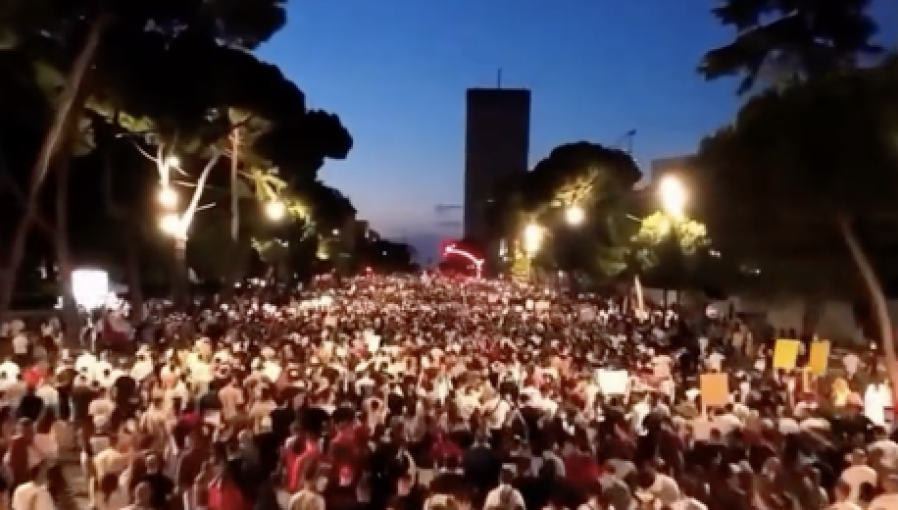
Weeks of anti-government protests in Albania, initially sparked by opposition to a luxury tourism development near protected wetlands, have evolved into the most significant grassroots challenge to Prime Minister Edi Rama in years, exposing broader anger over corruption, environmental degradation and economic inequality, according to a comment from Warsaw-based think tank the Centre for Eastern Studies (OSW).
The demonstrations, dubbed the “Flamingo Revolution”, began on May 30 near the village of Zvërnec, where activists sought to halt construction linked to a luxury resort project near the Vjosa wetlands, an ecologically sensitive area that is home to hundreds of bird species, including flamingos.
What started as a local environmental protest quickly spread to Tirana and other Albanian cities including Vlorë, Durrës and Korçë, while members of Albania’s large diaspora staged parallel demonstrations abroad.
According to the OSW, the movement signals “a break with the stagnation that has characterised Albania’s civil society in recent years”, with protesters increasingly targeting the political establishment as a whole rather than a single policy dispute.
Demonstrators are now calling for Rama’s resignation, corruption investigations and what they describe as a fundamental overhaul of an economic model dominated by oligarchic interests and organised crime.
The project at the centre of the unrest has attracted international attention due to links to investors associated with the family of US President Donald Trump. Though investment vehicles linked to the president’s daughter Ivanka Trump and her husband Jared Kushner have reportedly stepped back formally, the couple is believed to remain involved privately.
The resort, estimated to cost at least $1.4bn, has become symbolic of what critics call Albania’s increasingly tourism-dependent growth model. Protesters argue large-scale luxury developments enrich elites while offering limited benefits to ordinary citizens and doing little to reverse emigration among young professionals.
“The protesters have also criticised the government’s emphasis on developing tourism,” the report said, arguing its “large scale and increasingly luxury-oriented character” has accelerated environmental harm.
Albania, with a population of roughly 2.8mn, receives more than 12mn visitors annually, making tourism a major pillar of economic growth.
Investigations by Albania’s anti-corruption prosecutor, SPAK, have added to the controversy. Although authorities reportedly unfroze investor funds after determining their origins were legitimate, investigators are now examining land transactions surrounding the project amid allegations of speculative purchases and possible money laundering.
The protests also reflect deeper frustrations over governance. OSW pointed to “mass emigration of young and educated people, pervasive corruption, vote-buying in elections and persistent rule-of-law concerns” as major drivers of public anger.
Rama’s government initially dismissed the demonstrations, but as international scrutiny intensified, the prime minister responded with accusations of foreign interference.
OSW said Rama “continued to reject the protesters’ demands and to look for those responsible beyond Albania’s borders”. According to the report, he first accused Greece of fomenting unrest to weaken Albanian tourism, before later suggesting Iran was behind the protests in retaliation for Tirana’s support for US-Israeli military actions and its hosting of Iranian dissidents. The report noted Rama “has not presented any evidence to support these claims.”
European institutions are also paying closer attention. The protests have received support from members of the European People's Party and the European Democratic Party, while the European Commission has reportedly warned the development could complicate Albania’s EU accession path. Environmental compliance is particularly sensitive because Chapter 27 of accession talks covers climate and environmental standards.
Opposition leader Sali Berisha has backed the protests rhetorically but remains absent from demonstrations. Protest organisers have deliberately kept traditional opposition parties at arm’s length, seeking to maintain the movement’s anti-establishment credibility. OSW said the opposition is “not welcome at the demonstrations, as they are directed against the political establishment as a whole.”
Despite continued control over state institutions, signs of strain are emerging within Rama’s governing Socialist Party. One lawmaker has left the party, in a second internal split in recent months.
For now, OSW analysts do not expect Rama to yield quickly, especially given the geopolitical implications of abandoning a project involving high-profile foreign investors. Still, the think-tank warned the protests have already weakened his political standing.
Whether the movement can translate street anger into lasting political change remains unclear. But for the first time in years, Albania’s ruling establishment faces a broad-based civic uprising capable of reshaping the country’s political landscape.
Albanian police fire water cannon as protests against Trump-linked luxury resort continue
The government says the development on the Adriatic coast would be transformational for the former communist nation as it seeks to enter the high-end tourism market and pushes for European Union membership.
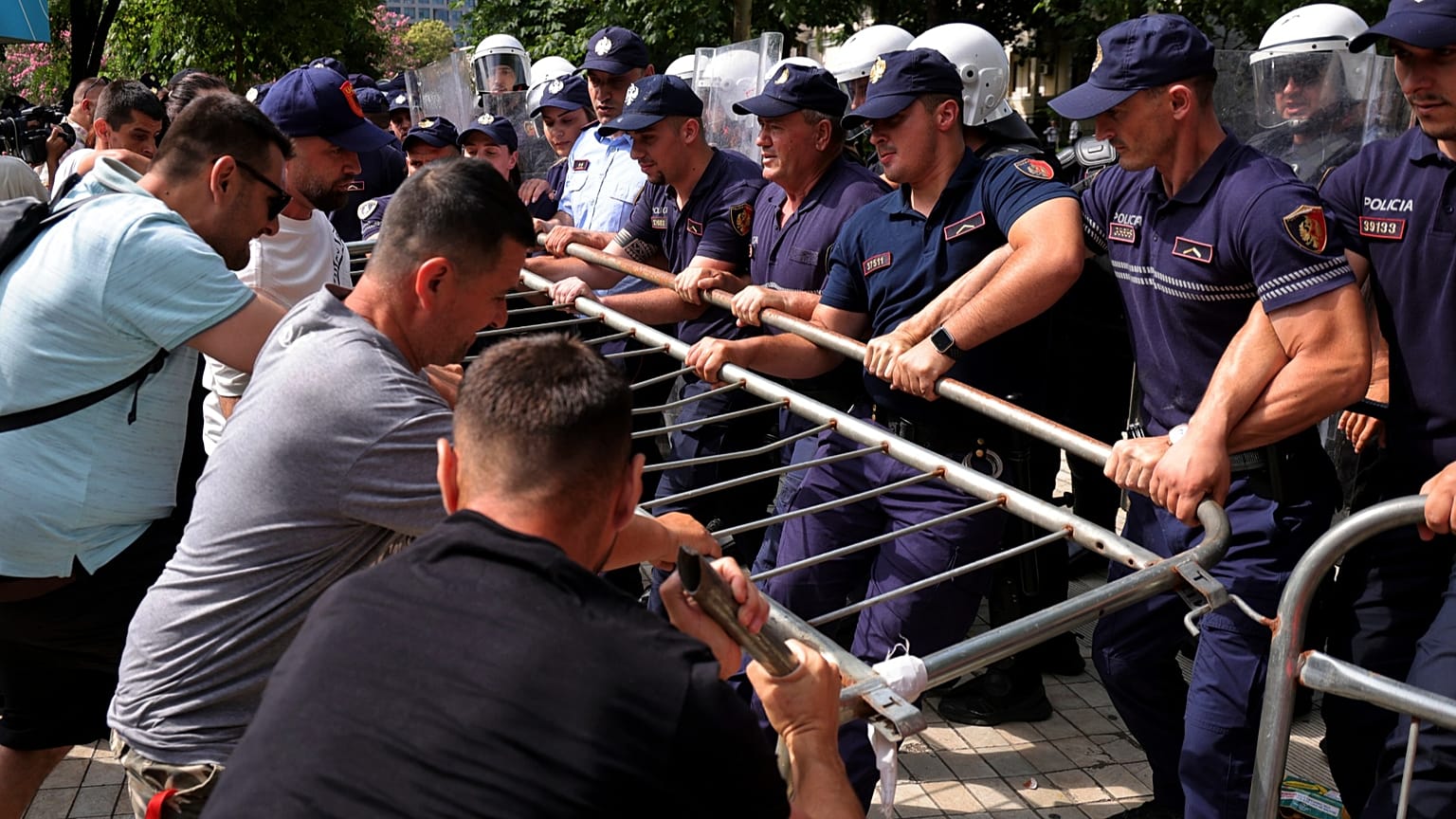
Violent clashes erupted between police and demonstrators outside Albania's parliament on Thursday, as protests against a controversial resort development linked to US President Donald Trump's family continue.
Since late May, protests have been held against the construction of a luxury hotel linked to Trump's daughter Ivanka and her husband Jared Kushner in a nature reserve in Zvernec, on Albania's southwestern coast.
For the second time this week, large groups of protesters had gathered outside the country's parliament in an attempt to confront lawmakers and block entry to the building.
Hundreds of demonstrators were met with lines of riot police who pushed them back from the building, leading to clashes and several arrests, according to journalists at the scene.
Police used pepper spray and a water cannon in an attempt to break up the crowd as some protesters attempted push through lines of officers.
Nine officers were injured by projectiles thrown by protesters, police said, but did not confirm arrest numbers.
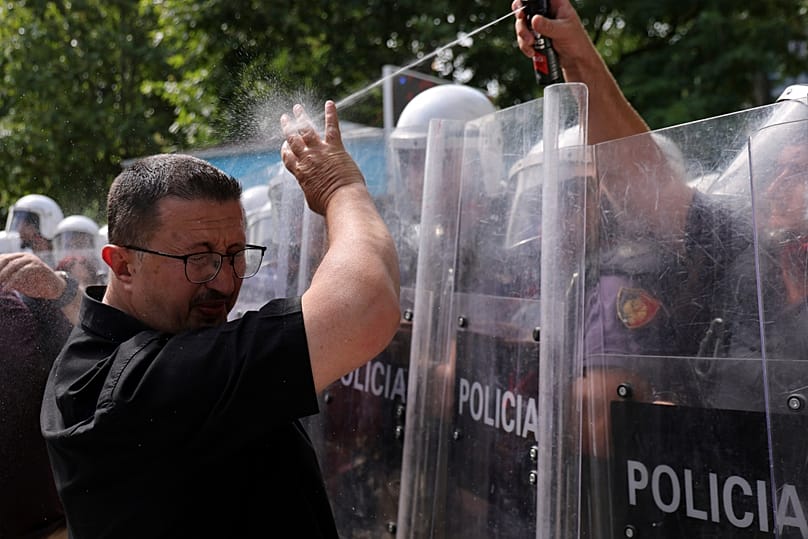
People were also seen smashing the windows of an empty police car in a nearby street as the crowd was pushed away from area.
It comes after six protesters were arrested on Tuesday when demonstrators threw eggs at lawmakers' cars.
The violence is a marked contrast to the overwhelmingly peaceful daily gatherings that have drawn thousands to the streets since the movement began.
The planned resort was first unveiled in 2024, but the latest wave of protests began after barbed-wire fencing and bulldozers appeared on beaches in late May.
The government says the development on the Adriatic coast would be transformational for the former communist nation as it seeks to enter the high-end tourism market and pushes for European Union membership.
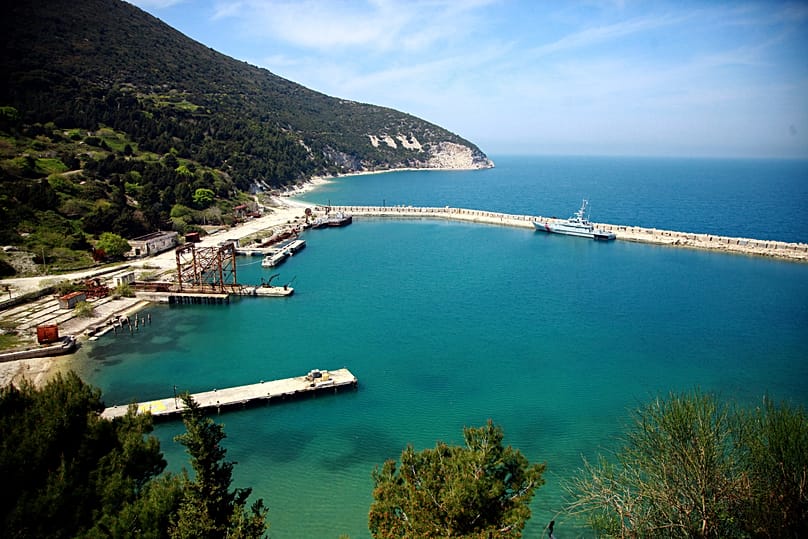
But the venture, spanning a protected island and a nearby stretch of seafront on Albania’s southern coast, has drawn opposition from environmental campaigners and critics of long-time Socialist Prime Minister Edi Rama.
The luxury project has two components: a coastal development in the Narta Lagoon area, which is a wildlife reserve, and a smaller resort on the nearby uninhabited island of Sazan, a communist-era military base.
Opposition to the project has become a flashpoint for anger over perceived corruption, with protesters calling for Prime Minister Edi Rama to step down over what they describe as a lack of transparency.
Hybrid war
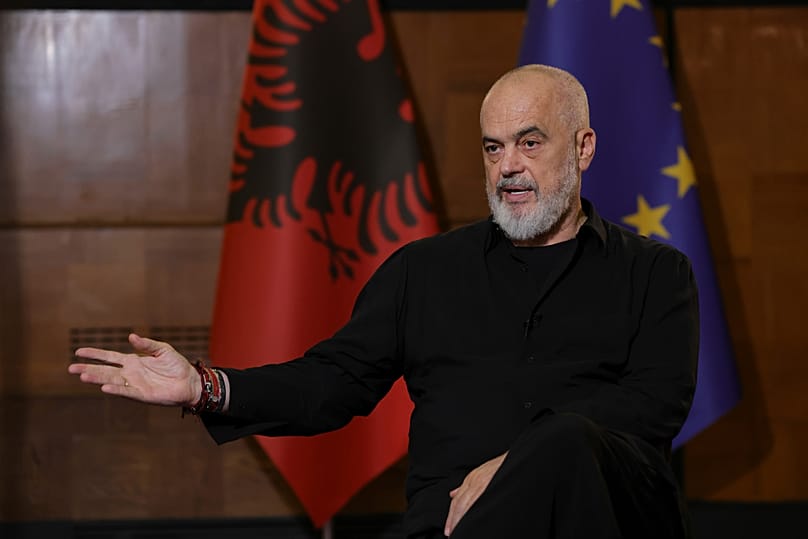
Last month, Rama told Euronews that a “hybrid war” was responsible for stoking anger among protesters, blaming bots, antisemitic narratives and hostile external forces.
"It's a lot of bots, it's a lot of fake profiles, it's a lot of attacks coming from all over," Rama said. "I have seen it this week on social media. The way it has happened in other countries, I am now seeing it in my own country.
Asked whether protesters' concerns were legitimate, Rama argued that their "well-meaning" worries were being "weaponised" by hostile actors employing a coordinated online strategy to exploit public sentiment around environmental protection and Albania's relationship with Israel.
Also in June, the European Commission issued a veiled warning to the Albanian government over the planned project, urging authorities to “act without delay” in order to avoid jeopardising the country’s bid to join the EU, which will require it to align with the bloc’s environmental rules.
“Albania should refrain from actions that could undermine the fulfilment of the closing benchmark, in this case Chapter 27, and so we expect the Albanian authorities to act without any delay,” spokesperson Guillaume Mercier said, referring to the chapter of EU accession talks which requires a candidate country to align with environmental rules.

No comments:
Post a Comment