It’s possible that I shall make an ass of myself. But in that case one can always get out of it with a little dialectic. I have, of course, so worded my proposition as to be right either way (K.Marx, Letter to F.Engels on the Indian Mutiny)
Thursday, July 02, 2026
Pentagon Puts All Drone Programs Under One Office, Except Navy's MUSV
Large unmanned aircraft and the Navy's ship-sized drone vessels are outside of the new office's scope
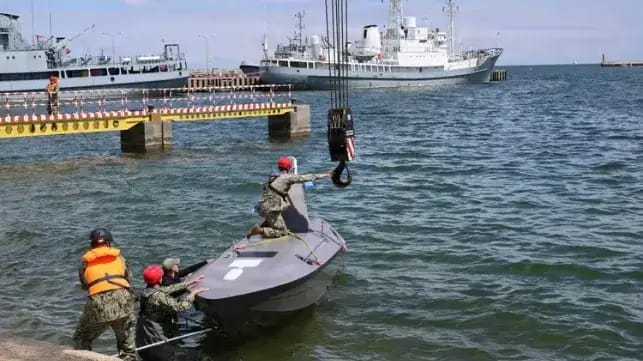
Navy personnel launch a drone boat in an exercise in Gdynia, Poland, June 2026 (USN)
As the Pentagon moves to expand its unmanned-systems programs in all domains and across all service branches, it is setting up a new command center for all U.S. military drone acquisition and R&D programs. The newly-formed office - dubbed the Direct Reporting Portfolio Manager for Unmanned Systems, and referred to day-to-day as the DRPM-UxS - will be in charge of overseeing drone subs, drone boats, terrestrial drones and airborne drones, both autonomous and remotely-controlled.
"While global military unmanned systems production has skyrocketed over the last three years, the United States has been slow to field these capabilities at scale. Drones and autonomous systems are the most consequential battlefield innovation of this generation. The DoW must move at the speed this moment demands," Defense Secretary Pete Hegseth said in a statement.
The existing directors of the Defense Autonomous Warfare Group and Joint Interagency Task Force 401 are folded into the new office's functions as dual-hatted appointments, to be overseen by the head of DRPM-UxS. "The DRPM-UxS will take precedence on all acquisition matters related to execution of UxS programs after the Sec War and the DepSecWar," Hegseth wrote - including serving as the Milestone Decision Authority (MDA). The office will be exempted from all restrictions on hiring for its own personnel.
The largest unmanned aviation programs (systems over about 1,300 pounds) remain under the control of each service branch. So does the Navy's restructured MUSV unmanned warship program, which remains under the control of the Portfolio Acquisition Executive Robotic Autonomous System (PAE RAS), headed by longtime Navy engineer Rebecca Gassler.
The recently-completed reorganization of the Navy's unmanned-systems programs and the revamp of the MUSV acquisition were based in part on detailed guidance from the Government Accountability Office, which recommended thorough reforms in early 2025.
One Missing in U.S. Navy Helicopter Crash in Arabian Sea
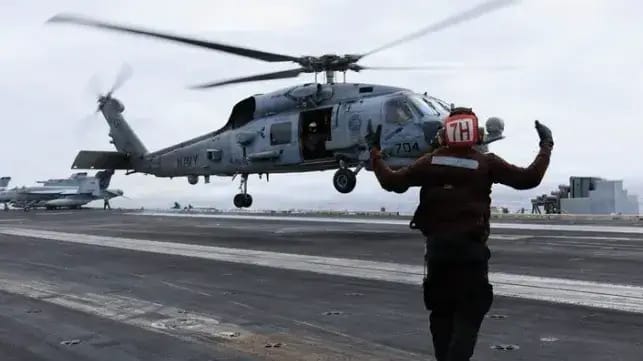
A helicopter takes off from the deck of USS George H.W. Bush, June 2026 (USN)
A helicopter from the carrier USS George H.W. Bush has gone down in the Arabian Sea, prompting a sustained search and rescue effort.
At about 0330 Eastern Time on July 1 - late morning in the region - an MH-60S Sea Hawk helicopter went down in the Arabian Sea with four crewmembers on board. Three were rescued swiftly and are on board in stable condition, according to U.S. 5th Fleet.
The fourth crewmember remains missing, and Navy assets in the area are conducting a search.
The cause of the accident is under investigation, but it is not believed that any hostile action was involved, 5th Fleet said.
The last loss of a helicopter in the operation was the downing of an Army Apache attack helicopter early last month in the Strait of Hormuz, caused by Iranian fire. The Iranian antiaircraft missile that struck the Apache failed to detonate, and both pilots managed to survive a water landing and escape the cockpit. The attack prompted an inventive SAR effort (involving an unmanned vessel) and a sizeable round of retaliatory strikes.
The USS George H.W. Bush has a comparatively positive safety record. A crewmember was struck by a propeller blade and killed during routine deck operations in 2018, but there have been few incidents since. The ship is currently deployed in the Arabian Sea as part of the mission to deter Iranian attacks on shipping.
House Leaders Call for an End to White House's Jones Act Waiver
The Republican leaders of the House of Representatives have written to the White House to ask for an eventual end to the sweeping 150-day waiver of the Jones Act. The waiver is the longest and broadest in scope since at least 1950, and industry advocates say that it is already having damaging effects on the health of America's domestic maritime sector.
The petition's signatories include all relevant House decisionmakers, including House Speaker Mike Johnson (R-LA), House Oversight chairman Rep. James Comer (R-KY), House Majority Leader Rep. Steve Scalise (R-LA), Transportation Committee Chairman Sam Graves (R-MS), Maritime Transportation Subcommittee Chairman Mike Ezell (R-MS), and 47 other members of the chamber. Together, they have asked the White House to allow the waiver to expire at the end of its currently-scheduled lifespan - August 16 - and use other authorities to help reduce the cost of fuel at the pump.
The waiver has been quite controversial. The Jones Act shipping industry says that the use of foreign-flag tanker tonnage has not meaningfully affected gas prices, has had no impact on military operations (the only statutory reason for a waiver), and is causing harm to domestic shipping and shipbuilding. Anecdotal reports suggest that at least some Jones Act newbuild decisions have been slowed down in order to wait for long-term clarity on the Act's future, and that U.S. oil-industry charterers have used the threat of waivers to press U.S. tanker operators for day-rate discounts.
The House letter notes that about 95 percent of the waivered voyages benefit foreign operators that do not pay taxes and do not have to comply with U.S. immigration laws in order to crew their ships. "The Jones Act waiver has become a loophole exploited by adversarial countries to erode America’s maritime dominance, the authors concluded.
Foreign-flag shipping's lower operating costs - along with the far-lower capital cost of foreign-built hulls - make it difficult for American maritime operators to compete commercially, and the Jones Act provides them protection to sustain operations. "Our nation’s strongest shield against foreign exploitation of American waterways is the Jones Act," the congressmen wrote to the president. "We respectfully request that you allow the waiver to expire on August 16, 2026. Thank you for your consideration of this matter."
Jones Act opponents have noted that waivered voyages have delivered large quantities of fuel from Texas to California, the highest-priced fuel market in the lower 48 states. Administration officials have generally supported the waiver. Energy Secretary Chris Wright told the Atlantic Council in June that it has been "enormously helpful to suspend the Jones Act temporarily," and White House Council of Economic Advisors chairman Kevin Hassett told reporters that the waiver was "incredibly effective" for moving fuel from the Gulf to the West Coast. The editorial board of the Washington Post has hailed it as a "real-life experiment of what life would be like without the Jones Act," calling for the Act's permanent repeal.
The waiver's future is uncertain. Global oil prices have plummeted since the signing of the U.S.-Iran ceasefire MOU last month, and domestic fuel prices at the pump have fallen below the $4 per gallon mark. This means the end of the high-price situation that the waiver was created to address; though the underlying rationale has passed - at least for now - the White House has yet to signal whether it would sign another extension to keep the waiver in effect.
Greece Arrests Cruise Ship Captain After Lines Part and Passenger Falls
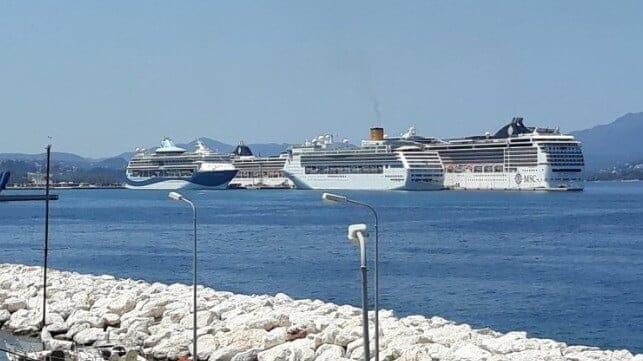
The cruise ship moved after its lines parted and a passenger on the gangway fell into the water (Corfu Port file photo)
Greece has placed the captain of a large, international cruise ship under arrest after an incident in the Port of Corfu on Wednesday evening, July 1. The cruise ship was one of four docked in the port, which was experiencing strong winds.
The Hellenic Coast Guard reports the lines holding the cruise ship, which is registered in the Bahamas, parted in the wind. The vessel had its gangway down, and passengers were returning for a day on shore before the departure.
After the lines broke, the gangway shifted and a female passenger, age 56 from New Zealand, lost her footing and fell into the water. The crew and dockworkers rush in and they were able to retrieve the woman, who is reported to have suffered slight injuries on her face and body. She was sent to a local hospital by ambulance.
The captain of the cruise ship, a 56-year-old Italian citizen, was taken into custody as an investigation began into the incident. The captain was arrested on charges of violating an article of the Hellenic Penal Code that pertains to exposing an individual to life-threatening danger or placing them in a helpless situation. The captain could face charges of neglecting a legal duty of care for the passenger.
The cruise ship was able to continue on its voyage after the incident, while the investigation is being carried out by the Central Port Authority of Corfu.
France Fines and Releases Shadow Fleet Tanker Held for a Month
French forces detained the tanker for an investigation after saying it was sailing under a false flag
French prosecutors and the Maritime Court in Brest accepted a plea deal, which will fine and release the shadow fleet tanker Tagor (114,809 dwt). The vessel was boarded by French troops on May 31 as it was sailing in the Mediterranean.
The reports indicate a total fine of €1 million ($1.1 million) for the vessel and a pledge from the vessel’s owners to seek a legitimate flag for the ship. The fines for vessels have become a common tactic as part of a French campaign, which President Emmanuel Macron said would delay the vessels and disrupt their finances.
The crude oil tanker Tagor was coming from Murmansk, according to the reports, when it was boarded on suspicion of sailing without a legitimate flag. The troops inspected the vessel and ordered it to head to the French coast. The tanker had been previously sanctioned by the UK, EU, and U.S. for its involvement in the Russian oil trade.
Records show the vessel as sailing since July 2025, first claiming a flag in Guinea, then Madagascar, and now Cameroon. Each is listed as false. The owner of the vessel, which is listed as being based in Abu Dhabi, reportedly admitted guilt as part of the plea deal.
The Tagor was the fourth crude oil tanker that France has stopped since it started the efforts in September 2025. Each has ultimately been fined and released, although the French courts also tried the Chinese master of the first vessel in absentia. The others each paid fines. France is still holding a fifth shadow fleet tanker, Discover, which was interdicted last week.
Russia continues to call these interventions “piracy” and has taken steps to increase the protection of the shadow fleet. Russian warships have been seen escorting the vessels in some busy seaways such as the Baltic and the English Channel. There are also reports of armed guards on some of the ships who have a Russian military background, and pictures recently emerged showing military submachine guns above the bridge of a Russian gas carrier that was sailing in the Baltic.
The AIS signal for the Tagor shows it remains off the French coast, but it is expected to get underway. It is broadcasting a destination of Istanbul.
Conditions Deteriorating for Hijacked Seafarers as Somalia Piracy Continues
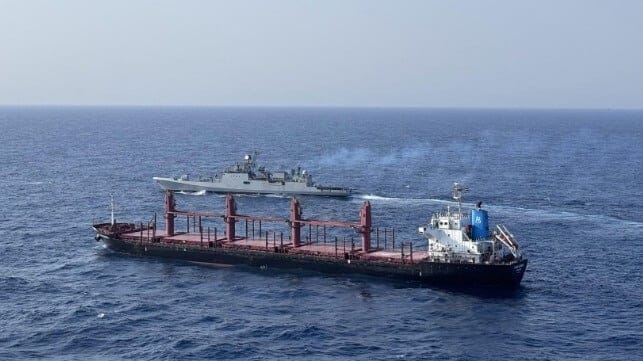
Indian Navy released the crew of one bulker which had secured itself in a citadel (Indian Navy)
The IMO released a statement highlighting the deteriorating conditions for three crews stuck in Somalia after their vessels were seized by pirates while calling for more action from the international community. It came as the Indian Navy responded to a new distress call and was able to release a crew sheltering from pirates in their vessel’s citadel.
The current chair of the Djibouti Code of Conduct/Jeddah Amendment, a regional initiative implemented by the International Maritime Organization, reports deteriorating humanitarian conditions for the crew of the MT Honour 25, which was seized on April 24, as well as for the crews of the Sward and Eureka, which were also seized around the same time.
According to the statement released by the IMO, the captain of the Honour 25 says the crew is caught between two factions in Somalia. The rival group recently tried to storm the ship, and there was an exchange of gunfire between the two groups.
Five of the 17 crewmembers, including the captain, of the Honour 25 are now suffering from health problems. The captain reports that the food supplies have been reduced to rice, and the available water is unsafe for drinking.
As a result, the Chair of the IMO initiative, Metse Ralephenya of South Africa, is calling for “urgent, coordinated and decisive international intervention to secure the immediate, safe, and unconditional release of the crews.”
His statement came as Egypt’s Foreign Ministry reported it was increasing its diplomatic efforts to gain the release of its nationals aboard the Eureka. The report said the pirates, however, had changed their demands.
Another crew was able to avoid abduction, however, as the Indian Navy’s frigate Trikand reached the bulker Golden Arsenal, which had been boarded on Wednesday, July 1. The crew of 21 had been able to retreat to the citadel aboard the 28,221-dwt bulker, which was sailing between Yemen and Somalia.
The bulker registered in St. Vincent and the Grenadines had sailed from Aden, Yemen, and was reporting that it was heading to Tuticorin, India. It was approximately 300 nautical miles east-northeast of Djibouti when it was overtaken by a skiff with four heavily armed individuals. Reports yesterday said the pirates had RPGs.
The pirates were able to board the vessel and damage the bridge and some of the surrounding compartments, but were unable to beach the citadel. The crew had issued a distress call and remained sheltered. The pirates appeared to have abandoned the ship, but the crew saw that the boarding ladders were still in place and decided to remain in the citadel until assistance could reach them.
Sailors from the Indian Navy boarded the Golden Arsenal and searched the vessel, confirming the pirates had fled. They released the crew from the citadel and assisted in restoring the vessel so that it could continue its voyage.
The Indian Navy also undertook aerial surveillance in the area. This came after reports that the pirate group had pursued another vessel on Monday, and the authorities warned the group was likely still looking for targets.
Pirates Board and Damage Vessel and Then Pursue Second Ship in Gulf of Aden
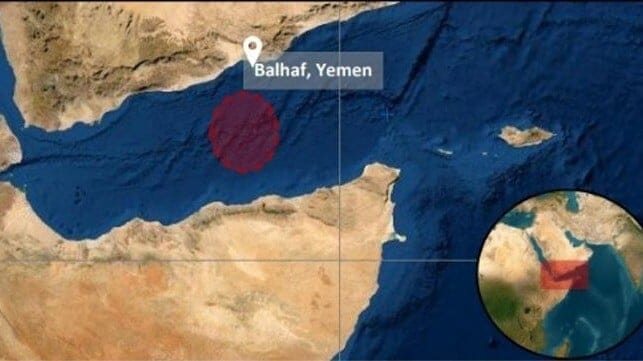
Two vessels were attacked in the same area between Yemen and Somalia (UKMTO)
A pirate action group was active in the Gulf of Aden on July 1, as the level of activity continues at an increased level in the area. UK Maritime Trade Operations and MSCIO are reporting the pirates were able to board one vessel but abandoned it when the crew locked into the citadel, but a short time later, the same group was pursuing a second vessel.
The first incident took place in a position approximately 76 nautical miles south of Balhaf, Yemen, and 110 nautical miles northeast of Bosaso, Somalia. An unnamed bulker reported it was being approached by a small boat with four people aboard. They were heavily armed, including the RPGs.
Being overtaken, the crew of the bulker stopped the vessel and proceeded to enter the citadel to issue a distress call. They were awaiting assistance.
The crew later left the citadel to inspect the ship, reporting the pirates had fled. While they could not find any of the pirates, they saw that the boarding ladders were still on the hull of their ship. As a precaution, they re-entered the citadel until assistance arrived.
The reports indicated that four pirates had boarded the ship. The crew observed damage to the bridge and several compartments around the bridge.
Later, four people, also heavily armed, were observed in pursuit of a second merchant ship. MSCIO said it was likely the same group based on the timing and location.
The second vessel reported that it was able to evade the pirates. The skiff discontinued the pursuit. The authorities, however, are warning that the group appears to be searching for additional targets.
Three other ships continue to be held by pirate groups in Somalia since late April and early May. Egypt’s Foreign Ministry has ordered an increased effort in an attempt to free Egyptian sailors being held on one of the vessels.
Egypt Intensifies Efforts to Free Crew of Hijacked Tanker
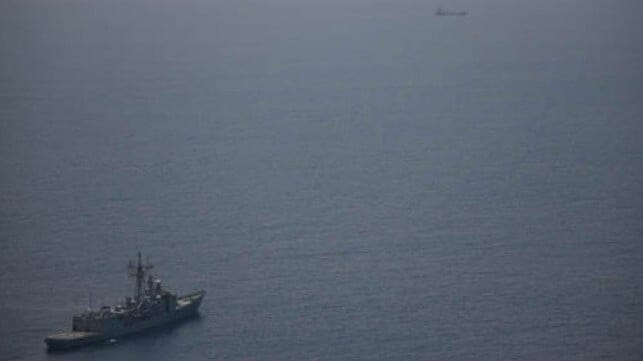
EU Navy forces have been monitoring the three hijacked vessels (EUNAVFOR Atalanta)
Egypt is intensifying efforts to free the crew of a tanker that has been held by pirates off Somalia since early May. The Foreign Ministry, in a new statement, emphasized the efforts while also working to support the families of the Egyptian sailors aboard the tanker.
The efforts come after the head of Egypt’s Maritime Officers Syndicate said last week talks had collapsed, according to The National news outlet in Egypt. It reports that the liaison to the International Transport Workers’ Federation said that the pirates demanded a higher ransom. He told the outlet that the issue was back to “square one.”
The incident started on May 2 while the tanker Eureka (3,353 dwt) was at anchorage off Qana Port, Shabwa, Yemen. Armed individuals reportedly boarded the vessel and took control. Later reports stated the vessel was underway toward Somalia, and at last report, it is anchored off the coast in the Puntland region.
The vessel, which is owned by interests in Yemen, was built in 2006 and registered in Togo. It has a crew of 22 aboard, including eight Egyptians.
The ministry reports it is coordinating efforts to ensure the welfare of the crewmembers. The embassy in Mogadishu made arrangements to enable the crew to communicate with their families.
The foreign minister has directed that they maintain daily monitoring while they work toward the release of the crew. At the same time, it has been communicating with the shipowner in Yemen and enlisted the aid of the Egyptian embassy in Riyadh, which is accredited in Yemen, to coordinate with the Yemeni authorities.
The hijacking of the Eureka was one of three incidents reported over a matter of days in late April and early May. EUNAVFOR Atalanta reports it is monitoring the situation and, as of last week, listed all three hijackings as ongoing.
Pirate activity increased dramatically this spring off the coast of Somalia and in the waters toward Yemen. Several ships reported being approached and getting into gun battles with the pirates, while others were able to outrun and maneuver to avoid boarding attempts.
Cargo Ship Grounds In Strait Of Hormuz As Iran Defends Shipping Controls
(Albawaba) — A foreign container ship ran aground in the Strait of Hormuz after sailing through what Iranian authorities described as an unauthorized route, with Iranian state media portraying the incident as evidence of the need to follow Tehran-approved navigation channels.
Iranian state television reported that the vessel became stranded in shallow waters after deviating from routes designated by Iranian authorities, leaving it unable to continue its voyage. Officials did not immediately identify the ship, its flag, destination, or cargo.
The grounding comes amid heightened tensions over maritime navigation in the strategic waterway following recent U.S.-Iran hostilities and the fragile Islamabad Memorandum of Understanding.
Iran has repeatedly warned that it cannot guarantee the safety of vessels using routes outside those approved by its authorities and has insisted that commercial shipping coordinate transit through the Strait of Hormuz with Iranian officials.
The United States has backed alternative shipping routes intended to preserve freedom of navigation without requiring coordination with Iran. Iranian media claimed the grounded vessel had been using one of those alternative routes.
The incident is likely to add to security and insurance concerns for commercial shipping in the Strait of Hormuz, a vital global energy corridor through which about one-fifth of the world’s oil trade passes. It also comes as U.S. and Iranian negotiators continue technical talks in Doha on implementing a ceasefire framework and establishing long-term maritime security arrangements.
About Al Bawaba News Al Bawaba provides top stories and breaking news about the Middle East and the world. The Al Bawaba network consists of several web portals and media platforms. View all posts by Al Bawaba News →
Iran Exploits Containership Grounding to Assert Hormuz Control
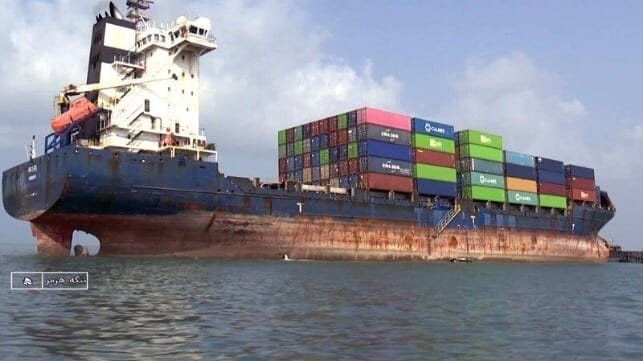
Image from Iranian state media of a containership it says is aground near Hormuz (Iribnews)
Iranian state media released a video and is reporting that a containership went aground because it was operating outside its designated shipping lane in the Strait of Hormuz. The IRGC, however, appears to be exploiting an incident involving a shadowy vessel that was operating on an Iranian coastal route.
The state media report only identified the vessel as “foreign” and said it had gone aground on July 1. It asserted the ship was “bypassing” the Strait of Hormuz outside the designated route when it went into the mud.
“According to the IRGC Navy’s warning to the captains, owners, and officials of the world shipping companies, any entry and exit other than the path of authority in the Persian Gulf will cause irreparable events,” the report said. Iran has repeatedly asserted that it has the only route through the Strait and, in last week’s break with the ceasefire, launched drones at multiple ships sailing the route along the Omani coast. An Evergreen containership and a tanker were both struck before the ceasefire was restored.
The Iranian reports are not identifying the vessel, but one ship shows aground based on its AIS signal. The Arita (20,643 dwt), which was transmitting that it was traveling to Asseluysh, Iran. The vessel’s position is north of Hormuz Island and well north of the Iranian route near Lark Island.
Equasis lists the vessel as having been sold in 2025 to unknown owners and sailing under a false Comoros flag. The ship is 168 meters (551 feet) in length. Its last registered inspection was at the beginning of 2026 in Novorossisk, Russia. The images show the vessel riding high in the water with containers loaded on deck.
Despite Iran’s claim about the Strait of Hormuz, Kpler tracked a total of 34 verified crossings on June 30. It reports they were fragmented across Iran’s route, the Omani/IMO route, or some transited dark. It says there was a broad mix of types of vessels making the transit.
The IMO paused its evacuation program last week after the Evergreen containership was struck, and there were new reports of Iran demanding guarantees. However, the United States continues to assert that the Strait of Hormuz is open and is also reporting progress in the latest round of talks with Iran.
More than 100,000 killed in Myanmar since 2021 coup, monitor says
Since a 2021 coup ousted Myanmar's democratically elected government and triggered a civil war, 100,114 people have been killed across the country, according to a report by monitoring group Armed Conflict Location & Event Data (ACLED) released Wednesday.
More than 100,000 people have been killed across all sides in Myanmar since a military coup five years ago triggered civil war, a conflict monitor said Wednesday.
The military ousted the elected government of Aung San Suu Kyi in February 2021, detaining the Nobel Peace Prize laureate and ending Myanmar's decade-long experiment with democracy.
Anti-putsch protests were put down by security forces, but activists quit the cities to form pro-democracy guerrilla groups, fighting alongside ethnic minority armies which have long resisted central rule.
Since the coup there have been 100,114 conflict related fatalities, according to latest data from monitoring group Armed Conflict Location & Event Data (ACLED), which tallies media reports of violence.
There is no official toll and estimates vary widely, but analysts regard the half-decade civil war as Asia's deadliest active conflict.
"The pain is just endless," said 49-year-old Thein Aye Nu, whose husband was killed in an air strike in the western state of Rakhine last month.
"I am so deeply resentful and very angry. But I don't even know who to be angry at anymore. I just have to console myself by accepting it as fate." Whole-country conflict
After the coup, Myanmar was ruled by diktat for five years by military chief Min Aung Hlaing.
He retired from the armed forces to take office as civilian president in April after deeply restricted elections blocked by rebels from their territory, and in which Suu Kyi's party was sidelined.
Democracy monitors dismissed the vote as a charade to rebrand Min Aung Hlaing's rule and rebels rejected his call for fresh peace talks as an insincere ploy to launder his image abroad.
"If there was no coup, children would be studying at schools," said one man in Myit Chay town in central Magway region, whose teenage son was recently killed.
His son died in combat after running away from home to fight for pro-democracy rebels, he said.
"We didn't even get a chance to properly chant Buddhist funeral rites. Heavy artillery was being fired," he said.
"He left so many memories – I am not satisfied to do have done so little for him."
More than 3.7 million people are internally displaced in Myanmar, according to the United Nations, and more one in five people face acute food insecurity amid a national backslide into poverty.
In the largest city, Yangon, violence can take the form of occasional assassinations.
Other places are riven by entrenched warfare or pounded by daily air strikes by the military's Russian- and Chinese-supplied jets.
Myanmar was the second most conflict-hit nation in the world last year, according to ACLED, behind only the Palestinian territories.
ACLED has registered more than 1,200 distinct armed groups in the civil war, calling it "the most fragmented conflict in the world".
"It's deadly, it's dangerous to civilians, the conflict has spread across the whole country," said ACLED senior analyst Sun Mon Thant.
The conflict dynamic has shifted at times in favour of both sides.
A combined offensive among some rebels starting late 2023 saw them win stunning advances, bearing down on the second largest city Mandalay – with speculation they may even capture the ancient royal capital.
But the tide has turned back in favour of the military, analysts say, after China threw support behind it and Beijing-backed truces were signed with two of the most powerful ethnic minority armies.
'Sent to die'
In February 2024, the military activated conscription legislation, aiming to bolster its ranks by forcibly recruiting 50,000 citizens.
"These conscripts can't do anything. It's like they are just being sent to die," said one former military conscript who deserted after serving on the front lines.
"If you don't die in one place, they send you to another," said the 20-year-old, anonymous for security reasons.
The war has also had far-reaching consequences abroad, filling camps in neighbouring Thailand and Bangladesh with an exodus of refugees, and creating fertile ground for transnational criminal enterprise.
Armed groups on all sides fill their war chests with profits from the booming production of drugs such as heroin and methamphetamine, monitors say.
Meanwhile Myanmar's loosely governed borderlands have become a hotbed for online scam centres often operating out of fortified compounds guarded by militants.
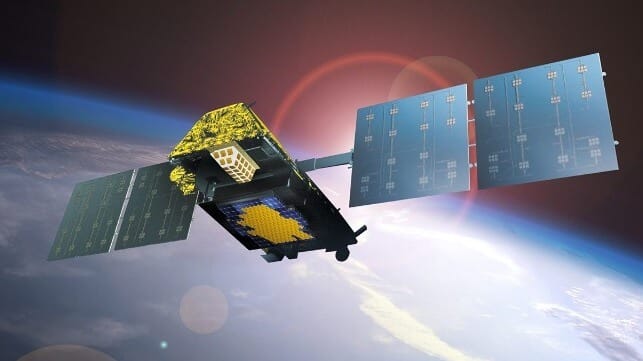
Iridium, the high-uptime LEO satcom operator, will soon be acquired by launch services company Rocket Lab, the two firms announced Monday. The $8 billion deal will create a vertically integrated rocket-plus-satcom company, comparable in structure to the core businesses of SpaceX/Starlink.
Rocket Lab plans to pay each Iridium shareholder $27 per share in cash, plus new shares of Rocket Lab to bring the total near to about $54 per share. The deal should close in mid-2027, once shareholder approvals are received.
"As the worlds of space and terrestrial communications continue to converge, more critical services will depend on space-based capabilities," said Iridium's CEO, Matt Desch. "Success will come from those who can bring new innovations to space quickly and sustain them over time as efficiently as possible."
Iridium is a well-established and well-known service provider for shipping, one of the company's core markets. It has been in operation since 1998, and is an authorized provider of GMDSS satellite emergency messaging. Its new network also supports resilient positioning, navigation and timing, performing functions comparable to GPS. Iridium's 66-strong constellation has full polar coverage, a virtue of the low earth orbit model, and its L-band network is less affected by weather than most broadband services. It has 2.5 million subscribers across aviation, maritime, commercial and government user bases.
"By marrying Iridium's deep heritage, trusted infrastructure, and highly sought-after spectrum with Rocket Lab's extensive and proven launch and manufacturing capabilities, we have the capability to unlock entirely new markets," said Rocket Lab founder and CEO Peter Beck in a statement.
The merged entity will look more like SpaceX's business, which combines orbital launch services (for other satellite operators) and its own broadband satcom fleet (launched into orbit on its own rockets). The two businesses are synergistic and have propelled SpaceX to a remarkable valuation, driving the largest single IPO of all time.
NASA robot rescue mission sets sights on a space telescope plummeting to Earth US space agency NASA is preparing to launch a robotic rescue mission to haul an ageing telescope into a higher orbit to save it from burning up as it falls back down to Earth. The next launch attempt is set for Wednesday after a previous liftoff was pushed back due to the weather.
NASA is set to launch a daring robotic rescue mission to prevent one of its ageing telescopes from vanishing into dust.
If successful, the effort could pave the way for giving other satellites a second life.
The operation is set to last several months, kicking off with the launch of a robot designed to rescue the Swift space telescope that's currently falling towards Earth.
Without intervention, Swift is expected to soon burn up in the atmosphere.
The rescue spacecraft developed by the US startup Katalyst was slated to lift off Tuesday at 1023 GMT from a Pacific Ocean atoll aboard a small rocket named Pegasus.
But NASA postponed the launch, citing unfavourable weather conditions, and set the next launch attempt for "no earlier than Wednesday, July 1" at 0943 GMT.
The rocket-propelled launch vehicle will not take off from a launch pad. Instead, it will be released from a jet.
"Everything about this mission is so crazy," NASA astrophysicist Regina Caputo said with a laugh.
After it reaches an orbit near that of the telescope, the robot must locate Swift across the vastness of space.
The aim is then for the robot to maneuver around the telescope and latch on with three movable arms.
It will then vie to tow Swift into a stable orbit over the course of at least a month, rescuing it from destruction by moving it about 300 kilometres higher.
Only China has attempted a mission like the upcoming one, successfully boosting a satellite into a higher graveyard orbit four years ago.
"This is a lot of firsts stacked on top of each other," said Shawn Domagal-Goldman, the director of NASA's astrophysics division, during a recent call with reporters.
"I'm just deeply thankful that we're even giving this a go."
'Special' telescope
The idea of such a rescue might seem odd at first glance.
The Neil Gehrels Swift Observatory telescope was launched in 2004, and was originally designed for a two-year mission.
The device was intended to study gamma-ray bursts, what Caputo called "the most energetic things that happen in the universe".
She likened it to a supercharged version of a supernova, which is a dramatic, explosive death of a star.
Gamma-ray bursts are extremely brief, she explained, so the telescope was placed at an altitude of approximately 600 kilometres in low Earth orbit, so it could remain in constant communication with researchers.
But with that pro came a con – at such an altitude, the device without its own propulsion would eventually drift closer to Earth and burn up in the atmosphere.
Caputo said that phenomenon was expected and normal, because when the Sun is in its more active cyclical stages, it emits more particles and causes an expansion of Earth's atmosphere.
That creates drag, meaning satellites in low Earth orbit lose altitude.
Yet when forecasts in early 2025 indicated the telescope was nearing the end of its life, NASA began considering a possible rescue.
"We decided, yeah, we want to go save this one this time, because of how special it is," said Domagal-Goldman. '50-50'
Despite its age, the Swift telescope remains in high demand within the scientific community, not least for its rapid response capabilities.
Should it burn up, it could not be immediately replaced.
The mission attempting unprecedented maneuvers has a projected cost of $30 million to save the device, which originally cost $250 million.
The rescue robot, named LINK, has its work cut out for it.
Engineers do not have a clear picture of what the back of the telescope actually looks like – even though that's where the robot must latch on.
With a laugh, Caputo projected the chances of success at "maybe 50-50".
Still, both NASA and the company Katalyst believe the mission – which could run into the fall – might pave the way for new possibilities in spacecraft management, and is worth a shot.
Robert Lamontagne, a vice president at Katalyst, said during a call with journalists that it could represent the "start of a new model" to "refuel, reposition, repurpose, repair, and even upgrade satellites, even if they were never prepared for it".
INTERVIEW
'An honour to be chosen': Italian astronaut on piloting Nasa lunar mission
Italian astronaut Luca Parmitano will be the first European to participate in Nasa's lunar programme, as part of the Artemis III mission in 2027. He spoke to RFI about the challenges of such a mission, and the risks.
Issued on: 27/06/2026 - RFI
Luca Parmitano speaks at the unveiling of the Artemis III mission at Nasa's Johnson Space Center in Houston, Texas, 9 June. REUTERS - Antranik Tavitian
Nasa's Artemis III mission follows the successful Artemis II flight completed in April – the farthest humans have travelled from the Earth.
The crew will undertake a series of challenging tests in Low Earth Orbit in 2027, in preparation for Artemis IV, the first planned crewed mission to the lunar South Pole, in 2028.
At the helm will be Italy's Luca Parmitano, heading up a four-member crew expected to remain in space for around two weeks.
Selected by the European Space Agency (ESA) as an astronaut in 2009, Parmitano has a master’s degree in experimental flight test engineering from the Institut Supérieur de l’Aéronautique et de l’Espace in Toulouse. He has logged more than 2,000 flight hours across 40 types of aircraft.
RFI: Nasa announced on 9 June that you will be part of the next Artemis mission in 2027 – the first European to participate in a mission of the American space agency's lunar programme. How does it feel to be selected for such an adventure?
Luca Parmitano: It's incredible. I'm truly honoured to have been chosen for this role and this pilot position. It was completely unexpected. I'm approaching this role with humility because I know it's a very complex mission. I have a lot to learn.
RFI: What do you think made Nasa choose you?
LP: I think they looked at the experience, the background, the rank of the test pilots, and I think they looked at my experience as an astronaut with two missions to the International Space Station, station controls, spacewalks... They looked at all of that. They also looked at the coordination between who was going to fly, with what experience. So I was there at the right time, where my experience had the characteristics they were looking for.
RFI: You've already spent more than a year in space with two missions aboard the International Space Station – as a European on an American mission. Would you say international space cooperation still exists?
LP: I think this is a very good sign of international collaboration. In fact, I think it's a statement that Nasa believes everything we have to offer – our experience, our technology, our science, but also our personnel – is valuable, something that Nasa needs. And that's why I think it's a really good sign for now and for the future, because the Artemis project is very large, and so there are still many European contributions to this major exploration programme [to come].
RFI: So you'll be the first European on this Artemis programme, but perhaps not the last?
LP: I'm sure I won't be the last. I'm the first for this mission. But afterwards, the goal is to broaden our contribution in order to have boots on the moon.
RFI: There will be four of you on the mission, and you will be testing two lunar modules. What sort of activities will you be doing?
LP: With our crew, we're going to create the procedures for the in-orbit connection between the Orion space shuttle and the Human Landing System, the shuttles that will take the astronauts to the lunar surface until that point. We don't have anything like this yet. This procedure doesn't exist. We have to develop it. Our mission is to do it twice.
You might think it's simple because we're not going to the Moon, but in fact that's why it's much more complex, because the spacecraft is a Deep Space Shuttle. It was designed to work in space around the Moon, so working with it around Earth is much more difficult. And on top of that, we'll be working with two shuttles that have never flown. So it's really an experimental, testing mission, and that's why I'm so busy as a test pilot.
RFI: Do you think about the risks when you embark on this kind of mission?
LP: It's clear there will be risks. That's why we're going to do them in an environment we can control more easily. Because if there are major problems, we can quickly get back on the field. But risks are a bit like the salt of life. If there's no salt, life has no flavour. If there's too much, you can't enjoy it. You need the right level of risk to appreciate life.
RFI: During your first trip to the ISS, you had a problem during a spacewalk that could have been fatal when water got into your helmet and you nearly drowned...
LP: It was an experience that showed us that space flight is never what you expect. There will always be situations we haven't experienced. And you have to be prepared for them. [But] even when you're not prepared, it's clear that the training you receive is enough to give you the ability to cope, even when you don't have a procedure to follow.
RFI: The Artemis mission is at the end of 2027, almost a year and a half away. What will you be doing between now and then?
LP: We've started with training on the Orion shuttle. It's a shuttle that I don't know at all. I need to know it like my own car, or even better, within a few months, because the team will be working with this shuttle, along with other shuttles we don't know at all. So the Orion system needs to become my area of expertise, something I know very well, including the procedures and systems. So I have a lot of work to do.
This interview has been adapted from the original version in French by Arnaud Pontus and lightly edited for clarity.