Monday, July 06, 2026

How China’s Renewable Technology Benefits The West – OpEd


Western Tariffs Hurt Green Goals — US/EU restrictions on Chinese solar, EVs, and batteries slow the global renewable transition and raise costs.

China Dominates Renewables — China leads in manufacturing capacity and price reduction for solar, wind, and batteries, adding more renewable power than the rest of the world combined.

Cooperation Beats Confrontation — Engaging China on green tech would accelerate decarbonization and innovation; protectionism harms the West’s own climate and economic interests.

The current heat wave in Europe and North America is seen by scientists as evidence of the accelerating impact of climate change. With temperatures across a wide swath of eastern U.S. and northern Europe topping historical highs and the heat domes persisting beyond normal time trends, an unprecedented number of the public – several hundred million people – are suffering from their government’s failure to prioritise a more rapid transition to renewable and clean energy technology in their national development.

Missing or lost amidst the furore generated by the mounting heat related deaths and other impact caused by the heat wave and the search for relief from a weather phenomenon that is likely to become more frequent and widespread is the war that the West is waging on the renewable technology front against China.

This policy war has been intensifying with an emphasis on actively “de-risking” and protecting domestic markets from what is being sold to the western public as “China Shock 2.0” .


Key strategies in this war for now include high tariffs, strict procurement rules, and supply chain security bans targeting electric vehicles, batteries, solar panels, and inverters.

United States Initiatives

Targeted Inverter Bans: The U.S. is currently drafting regulations to restrict the import of Chinese energy inverters, citing national security threats to electrical grids.National Defense

Restrictions: The U.S. updated the National Defense Authorization Act (NDAA) to prohibit the Department of Defense from procuring solar equipment and inverters manufactured by Chinese entities of concern.

Heavy Tariffs: The U.S. continues to enforce major Section 301 tariffs on Chinese electric vehicles, batteries, solar cells, steel, and aluminum.
European Union Initiatives

Trade Defense Instruments: The EU is heavily utilizing anti-dumping investigations and countervailing duties against Chinese electric vehicles, steel, and industrial manufacturing.

Industrial Accelerator Act: The EU has proposed the Industrial Accelerator Act, which prioritizes EU-made clean-tech and low-carbon products in projects that use public funds, aiming to reduce reliance on third-country supply chains .

G7 Alignment: European leaders and the G7 bloc have collectively agreed to map and reduce critical mineral dependencies.

Next On The Renewable Technology War Front

Western nations are currently implementing tariffs, stricter local content requirements, and anti-subsidy investigations on Chinese solar panels, EVs, and batteries. The primary stated goals are to protect domestic manufacturing and address concerns about China’s alleged overcapacity. As these barriers increase the cost of imported equipment, they will raise upfront prices for consumers and slow down the adoption rate of renewable and clean technology,

The uncomfortable and indisputable reality the West should accept is that China is a market leader and perhaps even a role model for the West in renewable energy. Hence, it is counter productive on the energy and climate change fronts to fight rather than work with China. The other reality is that China’s scaling of renewable energy manufacturing has created significant price efficiencies – solar panel prices declined by 89% between 2010-2023 largely due to Chinese production scale. This price effect has accelerated global, including western, adoption of renewable technology.

China’s New Long March In Development


China’s “New Long March” – a phrase frequently invoked by Chinese leadership – can be seen also to be referencing the nation’s coordinated, state-driven pivot away from cheap, scale-led manufacturing toward technological self-reliance, green and clean energy adoption, and industrial modernization.

​This transition has been responded to by the West through a lens of intense geopolitical friction, treating it as a zero-sum conflict. In the past, opposition to China was justified on security, human rights, labour concerns and other governance related grounds.

This strategy no longer works. When reapplied to the renewable energy front, it misjudges how the global and Chinese economy works. If structured and integrated constructively, China’s economic and technological evolution including in the green revolution can yield massive dividends for the West and the rest of the world.
​Areas of Mutual Benefit

​The global community stands to gain significantly from China’s upgraded industrial model, provided both sides maintain open economic pipelines free of the ideological battles that Western leaders have foisted on the world.

The clearest example for now is the demand by Western consumers for Chinese air conditioners and other cooling appliances during this heat wave episode. This is a policy lesson for critics attempting to justify restrictions on Chinese imports on the basis of the reflexive and protectionist ‘overcapacity’ charge regularly trotted out by senior European lawmakers and politicians.

​1. Accelerating the Global Green Transition


​China has essentially built the supply-chain backbone for the world’s decarbonization efforts. In recent years, its expansion in renewable energy capacity has been unprecedented, adding more solar and wind power than almost the rest of the world combined.

​The Benefit: By leveraging China’s massive manufacturing efficiencies in electric vehicles (EVs), lithium-ion batteries, and solar photovoltaics, Western countries can dramatically lower the capital cost of hitting their own net-zero climate goals.

​2. Driving Global Scientific Breakthroughs

​China’s 15th Five-Year Plan (2026–2030) centers on foundational research, artificial intelligence, and frontier sciences. According to trackers from groups like the Australian Strategic Policy Institute, China now leads global research output in a vast majority of critical technologies.

​The Benefit: Rather than treating scientific advancement as a closed loop, encouraging academic transparency and cross-border scientific collaboration allows Western researchers and corporations to build upon these foundational breakthroughs. This speeds up global innovation cycles that can help in mitigating the impact of climate change.

​3. Stabilizing Global Supply Chains


​The upgraded version of China’s economic model focuses heavily on industrial resilience and preventing catastrophic bottlenecks.

​The Benefit: A highly organized, high-tech manufacturing sector reduces the risk of global supply chain shocks. While the West is actively “de-risking” or friend-shoring critical components, a robust, highly productive Chinese industrial base keeps a floor under global manufacturing capacity, curbing long-term inflationary pressures.

​How the West Can Encourage a Productive Outcome


​For China’s “New Long March” to benefit everyone, the global response needs to shift from purely defensive isolation and protectionism to engagement and partnership. An emphasis on actively “de-risking” and protecting domestic markets from a perceived “China Shock 2.0” will only hurt the West or other countries attempting similar policy measures..

“At what cost” the conundrum frequently used to describe and criticise China’s development is one that the West needs to apply to itself in this and many more of the ways that it approaches the challenges of our time.

·

About Lim Teck Ghee

Lim Teck Ghee PhD is a Malaysian economic historian, policy analyst and public intellectual whose career has straddled academia, civil society organisations and international development agencies. He has a regular column, Another Take, in The Sun, a Malaysian daily; and is author of Challenging the Status Quo in Malaysia.
View all posts by Lim Teck Ghee →
As a new heatwave looms, Europe falls for Chinese air conditioners

Issued on: 06/07/2026 - 

Hundreds of people besieged supermarkets in and around Paris, with scuffles and shouting matches breaking out as residents scrambled to get their hands on bargain air-cooling units before the next heatwave. With the hunt for affordability, Europeans are turning to Chinese AC units - despite trade tensions between Beijing and Brussels. FRANCE 24's Yena Lee tells us more.


Mount Etna ash grounds flights at Sicily's Catania Airport

06.07.2026, 

Photo: Soeren Stache/dpa

Persistent ash fall from renewed volcanic activity at Mount Etna forced the suspension of all flights at Catania Airport in Sicily on Monday, the airport operator SAC said.

The operator said all incoming flights had been halted and no departures were permitted. The restrictions are expected to remain in place until 10 am (0800 GMT) on Tuesday. The airport said further information on developments will follow.

Passengers were advised to contact their airlines before travelling to the airport. According to the airport's website, almost all flights had been cancelled.

Europe's largest active volcano has shown renewed activity since the weekend. Italy's National Institute of Geophysics and Volcanology (INGV) reported strong ash emissions from one of Etna's vents early on Sunday.

The activity then intensified, sending a cloud about 1.5 kilometres above the volcano's summit. Residents reported ash and volcanic dust falling across a wide area.


Heavy rains trigger deadly landslides in Bangladesh refugee camps

06.07.2026

Photo: Mohammed Shajahan/ZUMA Press Wire/dpa

At least nine people, including eight Rohingya refugees, were killed in landslides triggered by heavy rain in south-eastern Bangladesh, officials said on Monday.

Rescue workers recovered the bodies of the Rohingya victims from beneath the mud after their thatched homes were buried in two refugee camps in Cox's Bazar district, said Dollar Tripura, head of the local Fire Service and Civil Defence rescue unit.

The camps are located more than 300 kilometres south-east of the capital, Dhaka.

A ninth victim was killed in Cox's Bazar town, a major tourist destination, according to local police.

More than 1 million Rohingya refugees live in overcrowded camps in Cox's Bazar after fleeing persecution in neighbouring Myanmar. More than 750,000 crossed into Bangladesh following a military crackdown in Myanmar's northern Rakhine State in August 2017.

Most refugees live in makeshift shelters of bamboo and tarpaulin built on steep hillsides across the sprawling camp complex in the Ukhiya and Kutupalong areas, leaving them particularly vulnerable to landslides during the annual monsoon.

Authorities had warned residents of the risk of landslides and flash floods and urged them to move to safer ground.

Cox's Bazar has been battered by heavy rain in recent days. The local meteorological office recorded more than 150 millimetres of rainfall in the 24 hours to Monday morning and forecast further rain on Tuesday.

The United Nations High Commissioner for Refugees (UNHCR) said the heavy rainfall had triggered landslides and flooding across the Rohingya camps, causing deaths and injuries.

"Our thoughts are with the affected families," the UNHCR said in a post on X.


Microsoft announces 3,200 job cuts in Xbox business

06.07.2026, 

Photo: Oliver Berg/dpa

Microsoft announced on Monday that it is cutting around 3,200 jobs in its Xbox video games division, in what Xbox chief executive Asha Sharma described as the "most significant restructure" in her company's history.

"Our business today is not healthy," Sharma said in an email to staff shared on X.

She said some work currently passes through too many layers of management and that the complex organizational structure slows down decision-making. The "reset" will reduce management to a maximum of five layers, and only three where possible, she said. 

Sharma said 1,600 jobs will be cut immediately, with the remainder to be finalized within 12 months. In addition, four game development studios are to leave the group, she said.

The chief executive noted that the number of players and the time spent gaming on Xbox platforms has fallen in recent years.

Sharma wrote that the restructuring was aimed at future growth for the Xbox business, and that she wanted the firm to eventually reach more than 1 billion daily users. 

Microsoft has already cut thousands of video game jobs since completing its roughly $69 billion acquisition of the studio Activision Blizzard at the end of 2023.


Samsung sees quarterly profit jump more than 1,800% on AI boom

07.07.2026,

Photo: Rolf Vennenbernd/dpa

Samsung Electronics said on Tuesday it expects second-quarter operating profit to surge more than 1,800% from a year earlier, as strong demand for artificial intelligence infrastructure boosted sales of its memory chips.

The South Korean technology giant forecast consolidated operating profit of 89.4 trillion won ($58 billion) for the April-June quarter, according to a preliminary earnings estimate.

The figure would mark Samsung's third consecutive quarter of record operating profit and exceed its operating profit for all of 2025, which totalled 43.6 trillion won.

Samsung, one of the world's largest semiconductor makers, has benefited from booming demand for advanced memory chips used in AI data centres and other computing infrastructure.

The forecast also topped the average market forecast compiled by South Korea's Yonhap news agency by 6.2%.

The earnings boom has fuelled debate in South Korea over how the benefits of the AI-driven semiconductor surge should be shared. Earlier this year, members of Samsung's labour union accepted a pay deal that included large annual bonuses for workers in the company's highly profitable chip division.

Samsung's quarterly figures are preliminary estimates. The company is expected to release detailed earnings results later this month.


Germany wins landmark Canadian submarine deal ahead of NATO summit

06.07.2026

Photo: Christian Charisius/dpa

By Carsten Hoffmann, André Klohn and Elena Radwan, dpa

Canada has awarded German naval shipbuilder TKMS a historic multibillion-euro contract to build up to 12 submarines, Prime Minister Mark Carney said on Monday, handing Berlin a major defence industry win on the eve of a NATO summit in Turkey.

Carney announced the decision at the Canadian Forces Base in Halifax before departing for the two-day meeting in Ankara, where alliance leaders are expected to discuss further strengthening NATO's defence capabilities.

Germany, which faced competition from South Korean supplier Hanwha Ocean, had pushed hard for the Canadian order as allies seek to counter the growing threat posed by Russia, including in the Arctic and Atlantic.

"In a more dangerous and divided world, Canada must be prepared to defend our interests, protect our citizens, build our economy, and secure our future. To that end, we are making the largest defence procurement in our nation's history with speed, ambition, and discipline," Carney said in a statement issued by his office.

"Together with our German and Norwegian Allies, we will build at speed and scale to expand our strategic capabilities and create greater strategic autonomy."

Under the deal, TKMS will supply Canada with up to 12 Type 212CD submarines, a new class jointly developed by Germany and Norway. The "CD" designation stands for "Common Design," a standardized platform intended to reduce costs and improve interoperability.

The order is the largest in TKMS's history and makes Canada the third major operator of the Type 212CD, alongside Germany and Norway.

The submarine agreement is intended as the centrepiece of a wider economic pact with Canada as Ottawa seeks to reduce its dependence on the United States.

Canada currently obtains around 80% of its military equipment from the US, but relations have been strained since President Donald Trump returned to office last year, imposing steep tariffs on the northern neighbour and repeatedly threatening to annex the world's second-largest country.

Neither Canada nor TKMS disclosed the value of the deal, but the submarines and related support are expected to be worth around €20 billion ($22.8 billion), according to information obtained by dpa. 

Including maintenance and operation over the coming decades, the overall programme could reach about 100 billion Canadian dollars ($70.3 billion), Canadian media reported.

The submarines are to be built at TKMS shipyards in Kiel and Wismar in northern Germany, where the company plans to create up to 1,500 jobs. TKMS employs more than 9,100 people worldwide, including around 3,300 in Kiel.

Canada aims to bring the first submarines into service by 2035, though recent indications suggest deliveries could begin earlier.

"Today's decision will provide the Royal Canadian Navy a critical capability, ensuring we can defend and secure Canada's vast coastline," Canadian Defence Minister David McGuinty said.

"From coast to coast to coast, this historic investment in the Canadian Armed Forces will bring strong economic benefits and jobs across the country."

German Defence Minister Boris Pistorius welcomed Canada's decision, describing it as a milestone in efforts to strengthen trans-Atlantic security.

"Together, we will build the world's largest and most advanced conventional submarine fleet," Pistorius said. "The information gathered by our 24 submarines in the North Atlantic, the Arctic and the High North can be exchanged, analysed and used quickly among us."

German Chancellor Friedrich Merz said Canada's decision to procure the German-Norwegian-designed submarines sent "a strong signal" of strategic cooperation.

"Ahead of tomorrow's NATO summit, the Canadian government is sending a strong signal of trans-Atlantic and European cooperation in the defence industry," Merz said in a statement.

Germany, Canada and Norway entered into a maritime security partnership in July 2024 that also covers defence cooperation. Denmark has since joined the alliance.

Death toll from DR Congo Ebola outbreak passes 500 as healthcare workers threaten strike


The deadly Ebola outbreak in the Democratic Republic of Congo has killed more than 500 people, the UN health agency's figures showed Monday. Healthcare workers in Ituri province, the heart of the outbreak, on Sunday issued a 24-hour notice threatening to strike if the government did not improve their working conditions and pay them promised benefits.


Issued on: 06/07/2026 
By: FRANCE 24

A child returning from school stops to look at Ebola awareness illustrations displayed on the signboards of the Ebola Treatment Center in Munigi on June 2, 2026. © Jospin Mwisha, AFP


More than 500 people have now died in the Ebola outbreak gripping the Democratic Republic of Congo, World Health Organization figures showed Monday.

A newly updated count issued by the UN health agency showed that there have been 1,561 confirmed cases in the DR Congo since the outbreak was declared in mid-May, including 506 confirmed deaths.

Two others have also died in neighbouring Uganda, where the situation is more stable. The country has seen 16 patients recover out of 20 total confirmed cases.

The WHO's figures for the DR Congo, which come from the health authorities in the vast country, show that the outbreak there has a case fatality rate of 32 percent.

A total of 254 patients have recovered, while 354 suspected cases of the viral haemorrhagic fever are currently under investigation.

The outbreak is being driven by the rare Bundibugyo species of Ebola, for which there are no approved vaccines or treatments.

The trial of two potential treatments for Bundibugyo began in the DR Congo on Thursday.

The trial is evaluating the safety and effectiveness of the monoclonal antibody MBP134 and the antiviral drug remdesivir, alone and in combination.
Breaking point

Frontline workers deployed in Ituri province, the epicentre of the outbreak, issued a 24-hour notice on Sunday threatening to strike if authorities fail to pay them and improve their working conditions.

The workers include mostly health professionals who have been labouring with little rest as they battle attacks from angry residents and widespread scepticism about the virus.

In the notice to the government, a copy of which was seen by the Associated Press, the workers both in and outside hospitals said they had not been paid benefits since the outbreak began and they do not have adequate supplies for their work.


Ebola outbreak 'serious' but not 'out of control', head of Africa CDC says
 TÊTE À TÊTE © FRANCE 24
12:45


They also complained of poor salaries, the "arrogance" of teams sent from Congo's capital of Kinshasa, and the “excessive” use of labour from other provinces without prioritising local labour in Ituri, as well as the lack of adequate equipment.

The strike threats come just days after enrollment for clinical trials started.
'The threat never truly goes away'

The milestone of 500 confirmed deaths comes as WHO member states reconvene to negotiate the missing section of the landmark pandemic agreement struck last year, aimed at avoiding a repeat of the international disarray in response to the Covid-19 pandemic.

"The next pandemic will not wait for us to be ready," WHO chief Tedros Adhanom Ghebreyesus warned countries on Monday.

"The Ebola outbreak still unfolding in the DRC right now is proof of that. It is not some distant, hypothetical scenario in a briefing document. It is happening.

"Ebola may not be the next pandemic. But it is a reminder, a painful one, that the threat never truly goes away."

The DRC's 17th Ebola outbreak was declared on May 15 after several unexplained deaths in mineral-rich but volatile Ituri, which is plagued by armed groups.

The virus spreads through close contact and infected bodily fluids.

(FRANCE 24 with AFP and AP)
Death toll from Venezuela quakes rises to 3,535 as more than 17,000 left homeless

The death toll from the back-to-back earthquakes that hit Venezuela on June 24 has risen to 3,535, official figures released on Monday showed. More than 17,000 people have been left homeless by the twin disasters.


Issued on: 06/07/2026
By: FRANCE 24


Workers prepare graves on the day of the burial of earthquake victims, in the aftermath of the June 24 earthquakes, at La Esperanza Cemetery, in La Guaira, Venezuela, July 6, 2026. © Adriano Machado, Reuters


The death toll from Venezuela's twin earthquakes has risen to 3,535, with more than 16,700 injured in the disaster, according to updated official figures released on Monday.

The massive June 24 earthquakes flattened entire neighbourhoods in La Guaira state north of the capital Caracas, and thousands are still reported missing.

The government said 16,740 people were injured in the powerful back-to-back shocks and that more than 17,000 were left homeless.

The government has not given a figure for those still missing under mountains of rubble, but the UN estimates that as many as 50,000 people may still be unaccounted for.


Many of the survivors are living in temporary camps on the street, in public parks or car parks.


Venezuelans mobilise to deal with earthquakes' consequences: FRANCE 24 reports
'Not a single person hasn't helped' dealing with the aftermath of Venezuela's earthquakes © France 24
02:58


As focus shifts from rescuing survivors to burying the dead and clearing the debris, international rescue teams have begun leaving Venezuela.

But the UN ​said it was continuing to ramp up aid operations ​in coordination with the government in Caracas.

"Some search and rescue teams remain deployed in the affected areas, while ​other specialised engineering teams and medical support continue to arrive," UN spokesperson Stephane Dujarric told reporters on Monday.

Families meanwhile continue to search for their dead in the hope of giving them a dignified burial.

On Sunday, authorities began burying dozens of unidentified victims in a mass grave.

A line of simple white crosses with small bouquets at their foot marked a long row of individual graves in La Esperanza cemetery in La Guaira.

Each one had the same date of death: June 24, 2026.

(FRANCE 24 with AFP and Reuters)
Hamas dissolves Gaza governing body, clearing way for technocratic committee

The Palestinian movement Hamas announced Monday that it had dissolved its governing body in the Gaza Strip after nearly 20 years in power, paving the way for a technocratic committee to administer the territory.


Issued on: 06/07/2026 
FRANCE 24
Video by: Noga TARNOPOLSKY

Buildings that were destroyed during the Israeli ground and air operations stand in the northern Gaza Strip as seen from southern Israel on July 2, 2026. © Leo Correa, AP
03:29


Palestinian Islamist movement Hamas announced Monday the dissolution of the body that has governed the Gaza Strip for nearly two decades, clearing the way for a technocratic committee to administer the territory.

The move marks a significant political shift by Hamas, which has run Gaza since its fighters seized control from rival Palestinian movement Fatah in 2007 after winning legislative elections the year before.

Since a ceasefire took effect in Gaza last October between Hamas and Israel, the group has repeatedly said it is prepared to step aside from day-to-day governance, but the thorny issue of its disarmament remains unresolved.

Ismail al-Thawabta, head of Hamas's media office in Gaza said the head of the government's emergency committee had "decided to dissolve the committee to facilitate the administrative and governmental transition to the National Committee for the Administration of Gaza (NCAG)".

Hamas spokesman Hazem Qassem told AFP that the group took the decision to relinquish charge "in order to remove any pretexts for the occupation, which continues its aggression and war of extermination".

The dissolution of the Hamas body paves the way for the National Committee for the Administration of Gaza (NCAG), headed by Palestinian official Ali Shaath, to assume administrative responsibilities.

Shaath, head of NCAG, said his committee was "fully prepared to assume its national responsibilities as soon as the necessary resources and capabilities are available".

"The fundamental requirements for the committee's success are a single authority, a single law with a clear mandate, and a single armed force under the authority of this single entity," Shaath said on X.

READ MOREHamas says ready to transfer Gaza governance to Palestinian technocratic committee

The NCAG was established by the Board of Peace, which was in turn set up by US President Donald Trump when he brokered the ceasefire between Hamas and Israel last October.

But it has remained based outside Gaza for months, reportedly due to Israeli objections to its entry into the war-devastated territory.

The Board of Peace insisted on X on the "the consolidation of all weapons under the control of the NCAG as provided for in the Comprehensive Gaza Peace Plan and United Nations Security Council Resolution 2803".

Hamas and other Palestinian factions have held several rounds of talks in Cairo with mediators to narrow differences, particularly over the second phase of the Gaza ceasefire.

The first phase involved the release of the last Israeli hostages held by Hamas in exchange for Palestinians detained by Israel.

The transition to the second phase, which was to involve Hamas's disarmament and a gradual withdrawal of Israeli forces from Gaza, has been stalled for months.

Israeli forces have actually expanded their occupation of the territory in recent months, taking control of nearly 70 percent.

Meanwhile, Hamas is demanding the establishment of a Palestinian administration before it will consider handing over any part of its arsenal.

The question of Gaza's post-war governance remains one of the main sticking points in negotiations on implementing phase two.

Israel rejects any return of Hamas to power, but also rejects a direct takeover by the Ramallah-based Palestinian Authority at this stage.

(FRANCE 24 with AFP)


Hamas says ready to transfer Gaza governance to Palestinian technocratic committee

Hamas is ready for a "complete transfer of governance" to a technocratic committee in the Gaza Strip, a spokesman for the militant group told AFP on Wednesday, adding that the critical Rafah border crossing with Egypt must be opened in both directions, "without any Israeli obstacles".

By: FRANCE 24


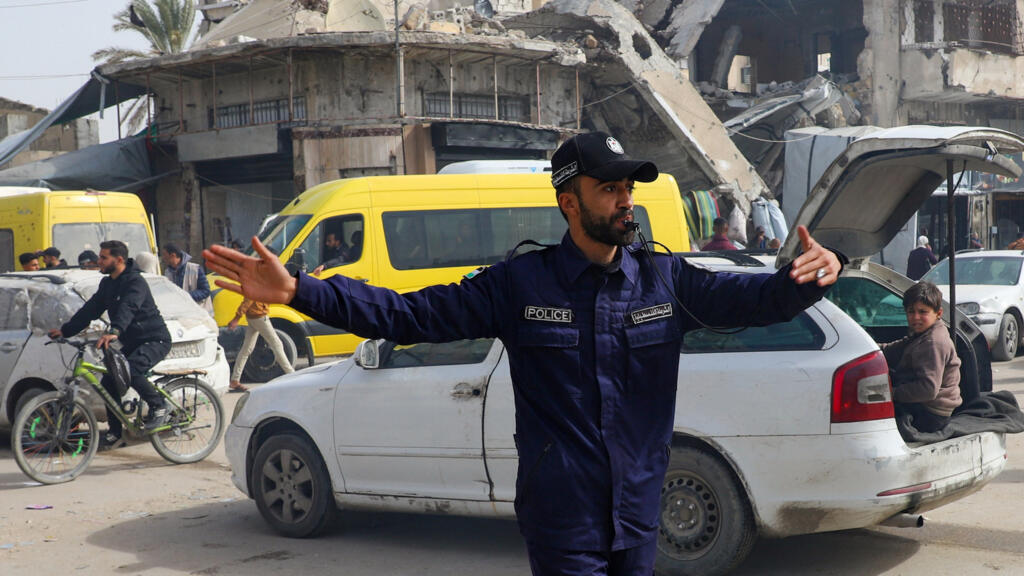
A Hamas police officer directs traffic in Gaza City on January 28, 2026. © Reuters stringer

Hamas said Wednesday it was ready to transfer the governance of Gaza to a Palestinian technocratic committee, while insisting the key Rafah border crossing be fully reopened within days.

"Protocols are prepared, files are complete, and committees are in place to oversee the handover, ensuring a complete transfer of governance in the Gaza Strip across all sectors to the technocratic committee," Hamas spokesman Hazem Qassem told AFP.

The 15-member National Committee for the Administration of Gaza (NCAG) is a team of Palestinian technocrats created as part of the US-sponsored ceasefire agreement which came into effect on October 10.

It is charged with managing the day-to-day governance of post-war Gaza and will work under the supervision of the "Board of Peace", which US President Donald Trump will chair.

The NCAG, headed by former Palestinian Authority deputy minister Ali Shaath, is expected to enter the Gaza Strip once the territory's Rafah crossing, on its border with Egypt, reopens.

Hamas spokesman Qassem added that the Rafah crossing "must be opened in both directions, with full freedom of exit and entry to the Gaza Strip, without any Israeli obstacles".

Rafah is Gaza's only gateway to the outside world that does not lead to Israel and is a key entry point for both people and goods.

It has been closed since Israeli forces took control of it in May 2024, except for a limited reopening in early 2025, and other bids to reopen have failed to materialise.

NCAG head Shaath announced last week that Rafah would reopen in both directions the following week.

Qassem told AFP the "independent national committee's announcement of the opening of the Rafah crossing is important".

"What is more important is that we monitor this committee's handling of citizens' departures and entries in full freedom in accordance with the agreement, and not according to Israeli conditions," he added.

Israel has said it would only allow pedestrians to travel through the crossing as part of its "limited reopening" once it had recovered the remains of the last hostage, Ran Gvili.

Israeli forces brought back Gvili's remains on Monday and his funeral was held in the southern town of Meitar on Wednesday.

Qassem said Wednesday that "it is clear that Hamas is committed to the agreement to stop the war on the Gaza Strip", which began after the militant group's deadly attack on southern Israel on October 7, 2023.

"It has carried out everything required of it in the first phase and is ready to enter all tracks of the second phase," he added.

With the technocratic committee's creation and the last hostage held in Gaza returned to Israel, the ceasefire deal's next important milestones will be Hamas's disarmament and Israel's withdrawal from Gaza.

Though Hamas said the return of Gvili's body showed its commitment to the ceasefire deal, it has so far not surrendered its weapons.

The group has repeatedly said disarmament is a red line, but it has also suggested it would be open to handing over its weapons to a Palestinian governing authority.

Neither Israel nor Hamas have committed to a clear date or strategy for withdrawal or disarmament.